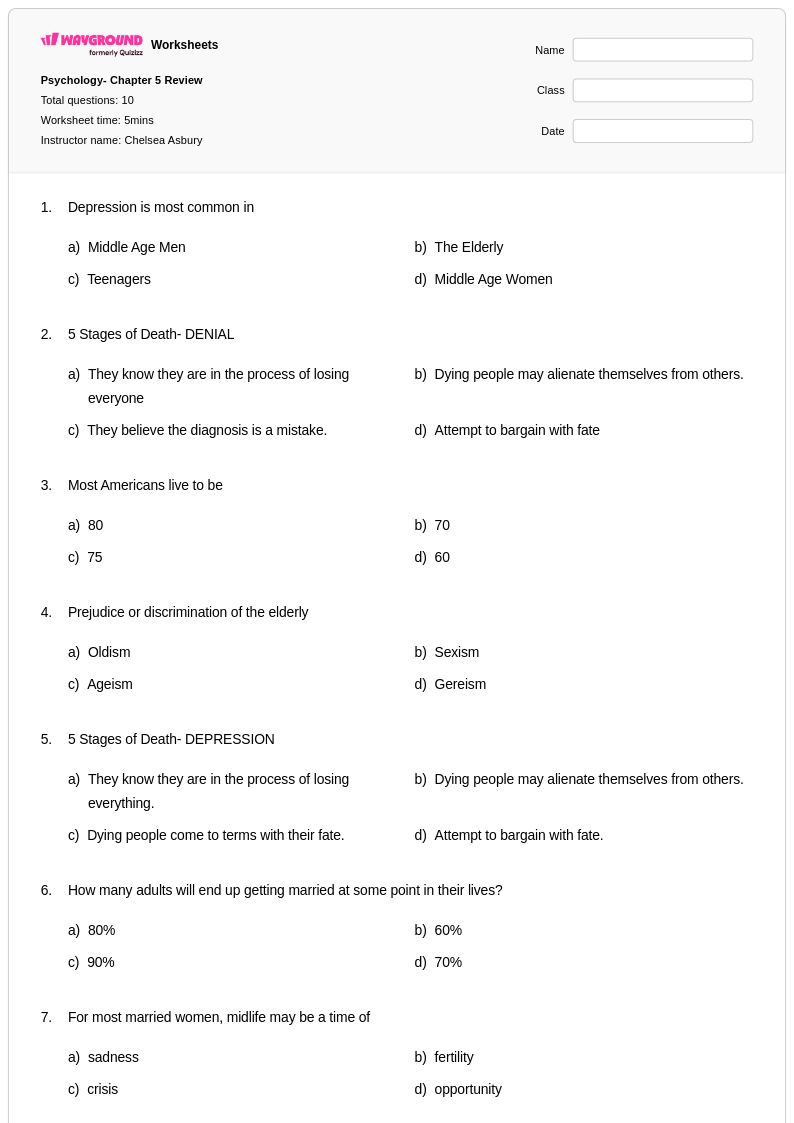
Explore Wayground's free printable worksheets on the stages of grief to help students develop essential social skills through guided practice problems and comprehensive answer keys in PDF format.
Stages of grief worksheets available through Wayground (formerly Quizizz) provide students with structured opportunities to explore and understand the emotional process individuals experience when facing loss or significant life changes. These comprehensive educational resources focus on the five classical stages identified by Elisabeth Kübler-Ross—denial, anger, bargaining, depression, and acceptance—while helping students develop critical thinking skills about human psychology and emotional responses. The worksheets feature practice problems that guide learners through real-world scenarios, case studies, and reflective exercises designed to build empathy and emotional intelligence. Each printable resource includes detailed answer keys that support both independent study and classroom discussion, with free pdf formats making these materials accessible for diverse learning environments.
Wayground's extensive collection of stages of grief worksheets draws from millions of teacher-created resources, offering educators powerful search and filtering capabilities to locate materials perfectly suited to their instructional needs. The platform's robust differentiation tools enable teachers to customize content complexity and presentation style, ensuring that students across various learning levels can engage meaningfully with this sensitive topic. Standards alignment features help educators integrate grief education seamlessly into broader social studies curricula, while the availability of both printable and digital pdf formats provides flexibility for classroom instruction, homework assignments, and remote learning scenarios. These comprehensive resources support teachers in planning thoughtful lessons that address emotional literacy, facilitate remediation for students who need additional support processing difficult concepts, and offer enrichment opportunities for learners ready to explore advanced psychological theories about human responses to loss and change.
FAQs
How do I teach the stages of grief to students?
Introduce the five stages identified by Elisabeth Kübler-Ross—denial, anger, bargaining, depression, and acceptance—through real-world scenarios and case studies that make abstract emotional processes concrete. Framing grief as a non-linear, personal experience helps students avoid the misconception that everyone moves through the stages in a fixed order. Pairing direct instruction with reflective exercises and guided discussion builds both conceptual understanding and emotional intelligence, which is why structured worksheets with scenario-based prompts are particularly effective for this topic.
What exercises help students practice understanding the stages of grief?
Effective practice activities include case study analysis where students identify which stage a fictional character is experiencing and justify their reasoning, as well as reflective writing prompts that ask students to connect the stages to personal or observed experiences. Scenario-based matching exercises, where students read emotional responses and assign them to the correct stage, reinforce recognition and comprehension. These types of exercises develop both critical thinking about human psychology and the empathy needed to apply grief theory to real situations.
What misconceptions do students commonly have about the stages of grief?
The most common misconception is that the five stages are a fixed, sequential process that every person must pass through in order—in reality, individuals may skip stages, revisit them, or experience them simultaneously. Students also frequently assume that grief applies only to death, when in practice it can be triggered by any significant loss or life change, including divorce, illness, or major transitions. Correcting these misconceptions early prevents students from applying the model too rigidly when analyzing case studies or real-life situations.
How can I use stages of grief worksheets to support students who are processing difficult topics emotionally?
Because grief education involves sensitive subject matter, it is important to create a safe, low-pressure environment where students engage with the material at their own pace. Reflective exercises and case studies that use fictional or historical examples allow students to explore emotional concepts without requiring personal disclosure. On Wayground, teachers can enable the Read Aloud accommodation for students who benefit from having content read to them, and adjust font sizes and themes through Reading Mode to reduce cognitive barriers, making the material more accessible for students who may already be under emotional strain.
How do I use Wayground's stages of grief worksheets in my classroom?
Wayground's stages of grief worksheets are available as printable PDFs for traditional classroom use and in digital formats for technology-integrated or remote learning environments, giving teachers flexibility in how they assign and deliver the material. Teachers can also host worksheets directly as a quiz on Wayground, enabling real-time student responses and progress tracking. Each worksheet includes a complete answer key, making them suitable for independent practice, small-group discussion, or homework assignments without requiring additional preparation.
How do I differentiate stages of grief instruction for students at different learning levels?
For students who need additional support, simplified scenario prompts and reduced answer choices help lower cognitive load when identifying and distinguishing between the five stages. For advanced learners, enrichment activities can extend into broader psychological theories about human responses to loss and change, moving beyond the Kübler-Ross model. Wayground's differentiation tools allow teachers to customize content complexity and presentation style, and student-level accommodations such as extended time and reduced answer choices can be configured individually so each student engages with the material in the way that best supports their learning.