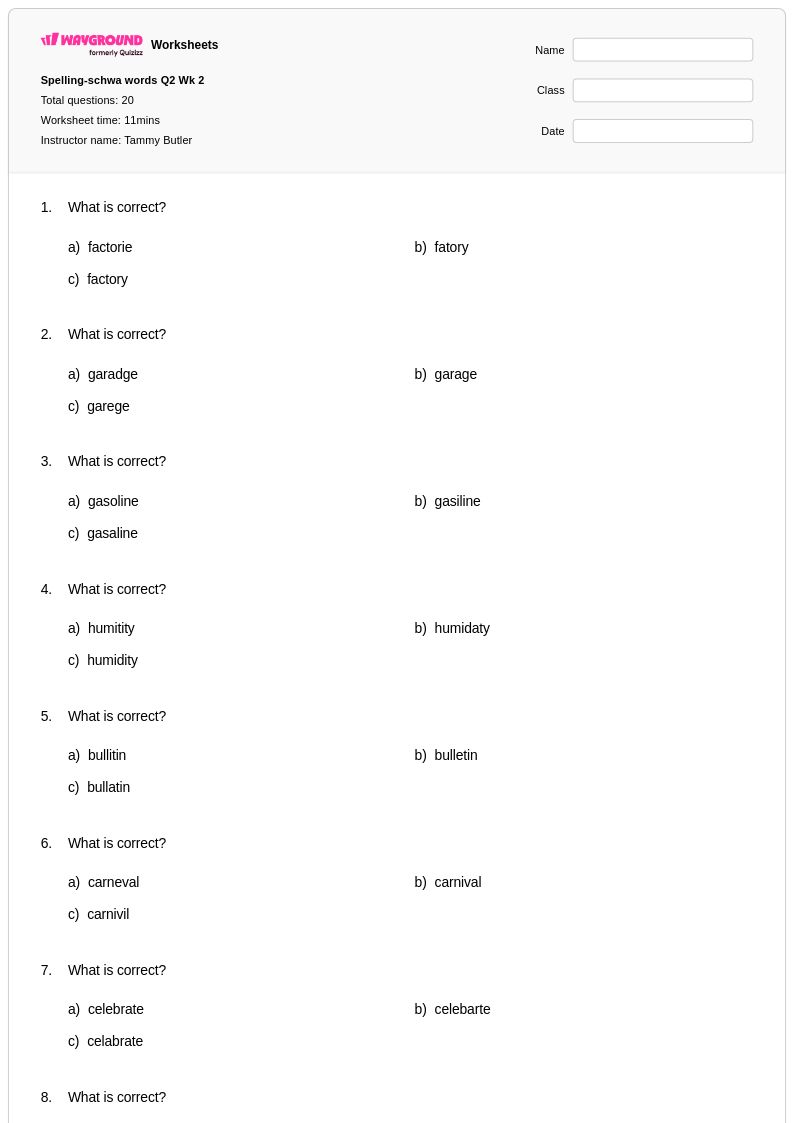
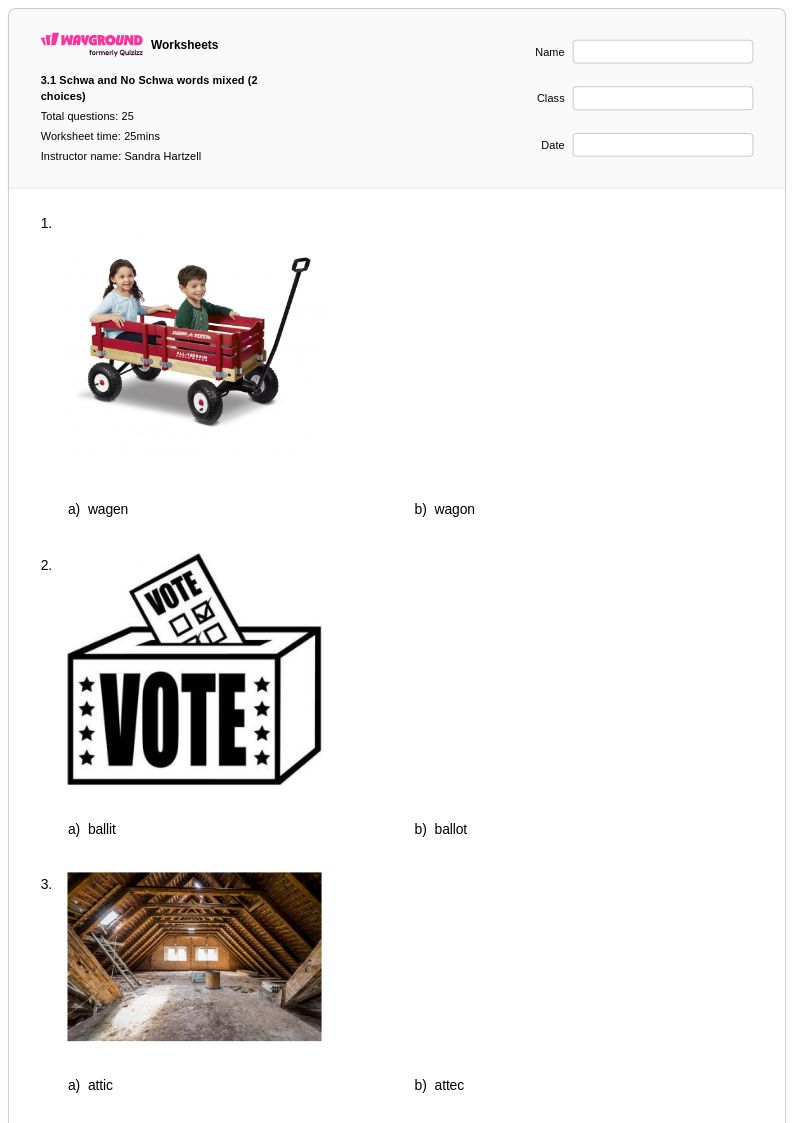
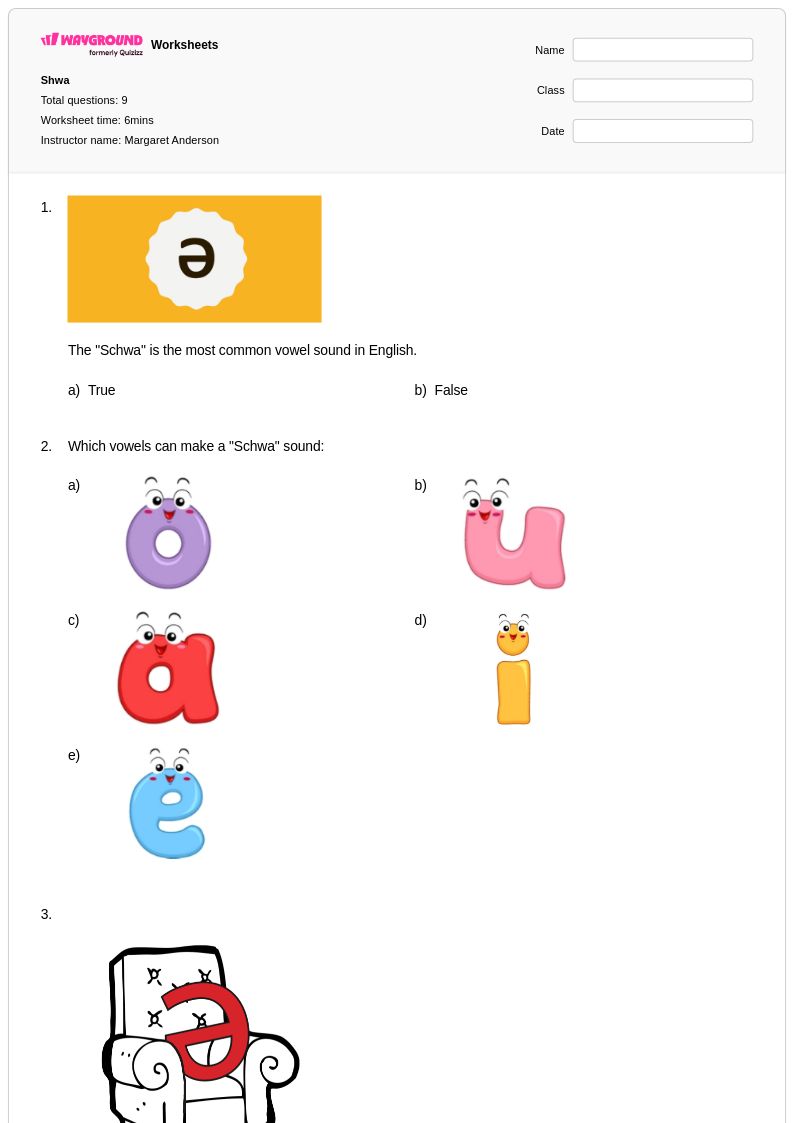
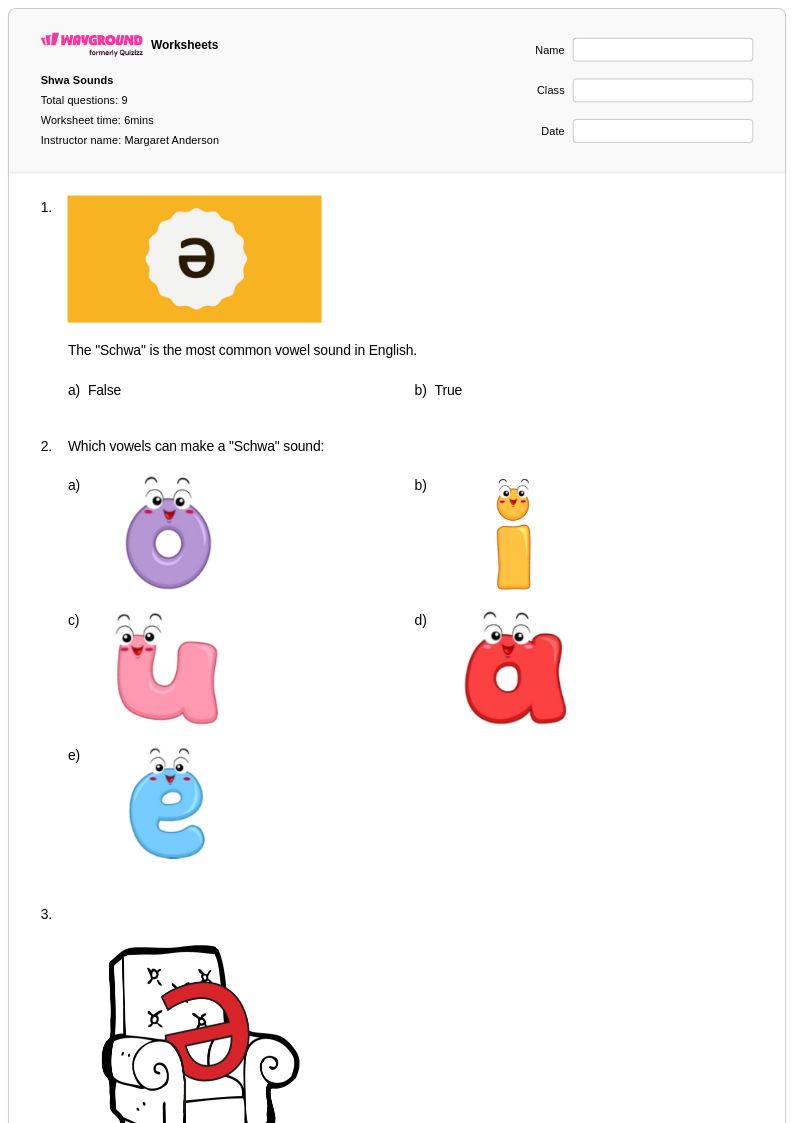
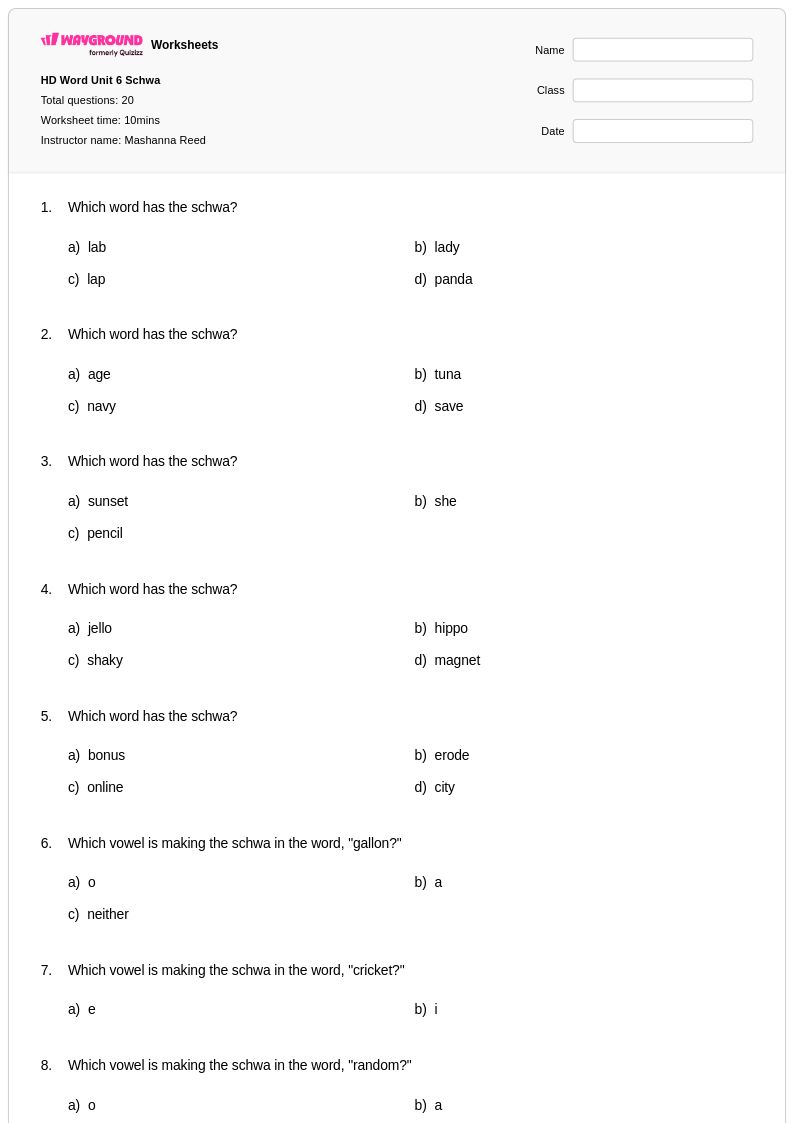
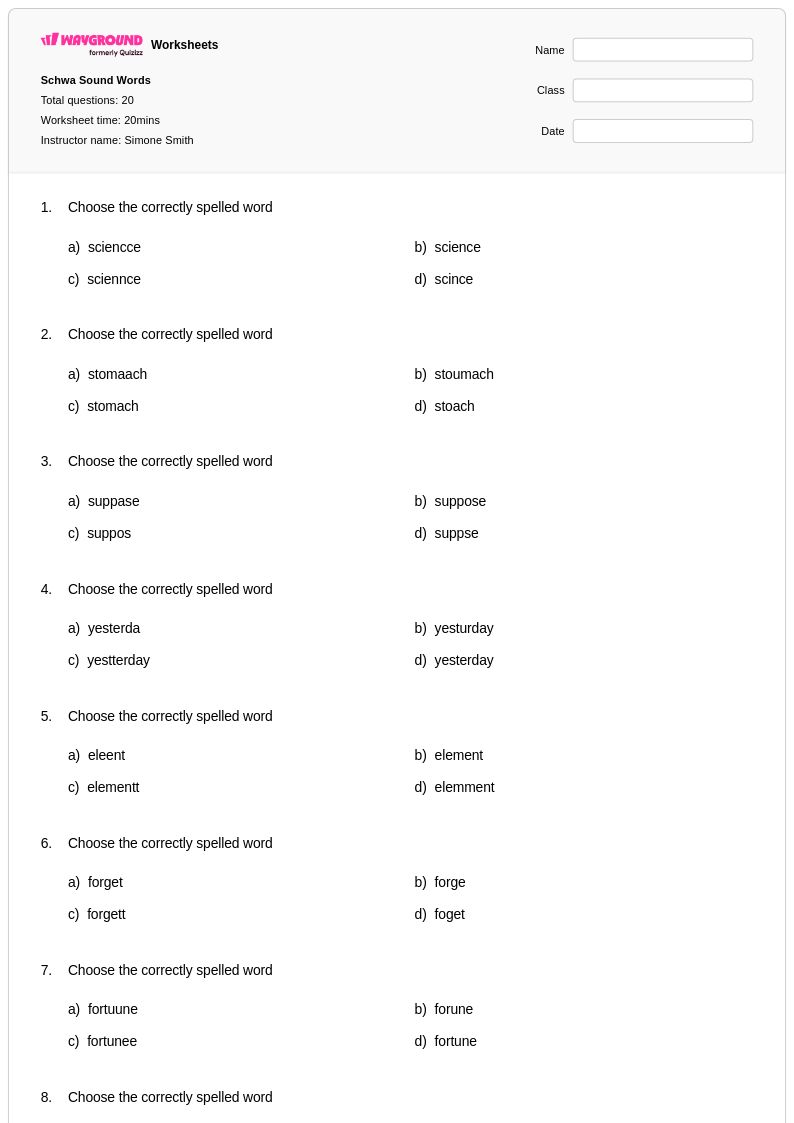
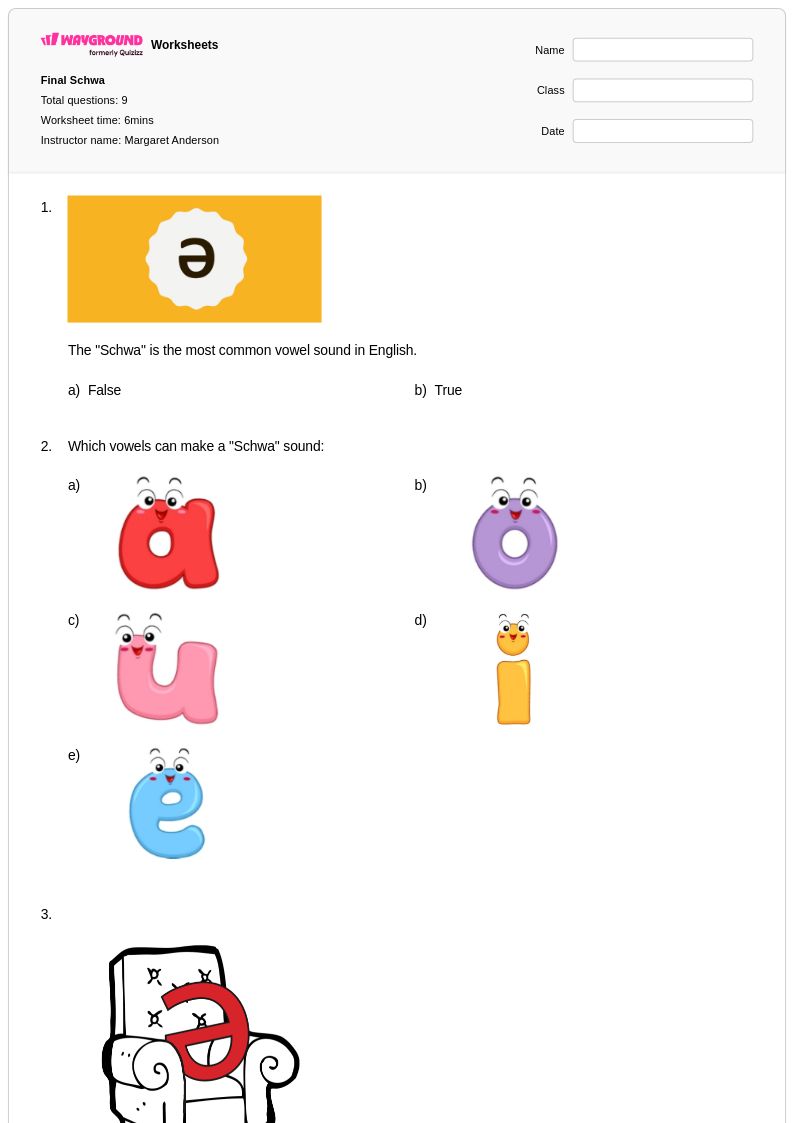
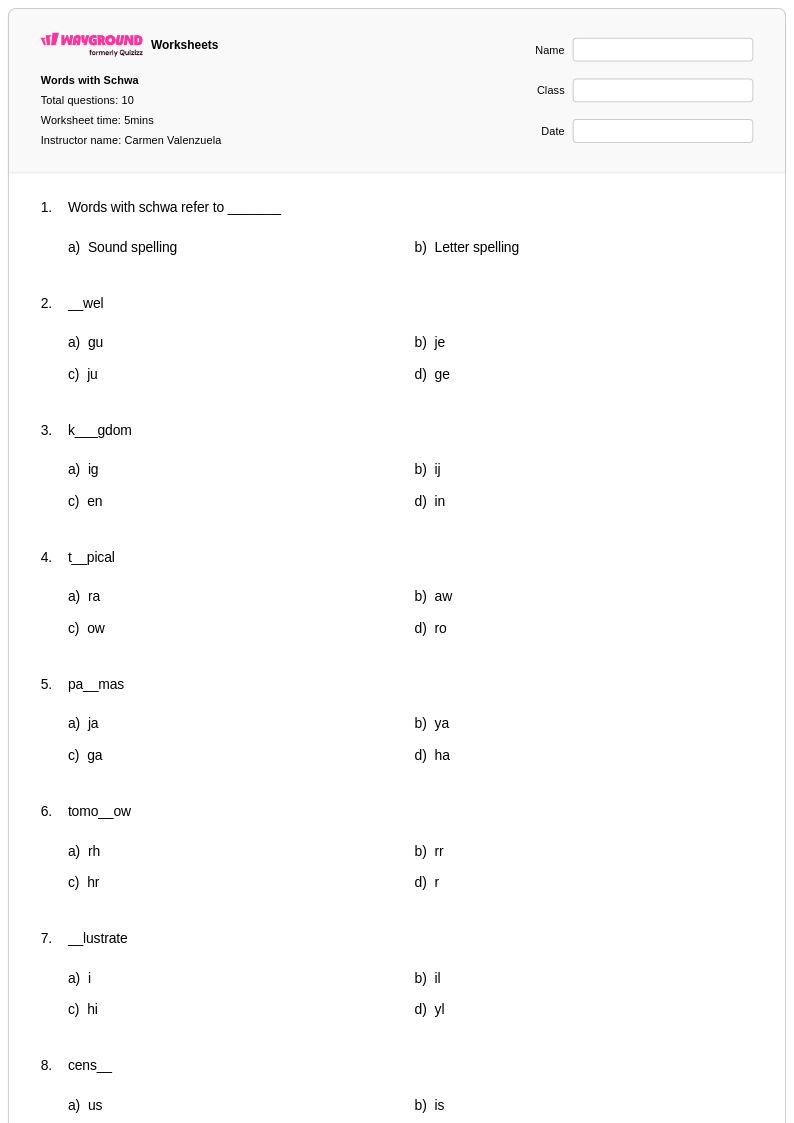
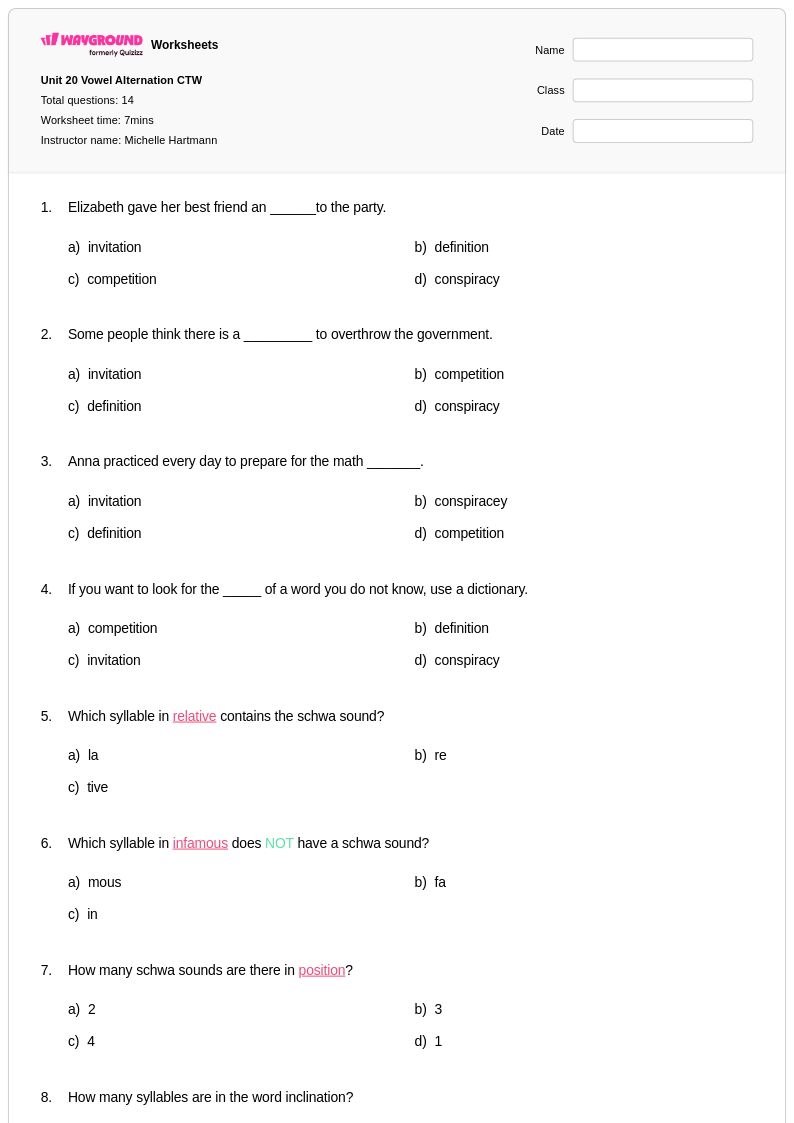
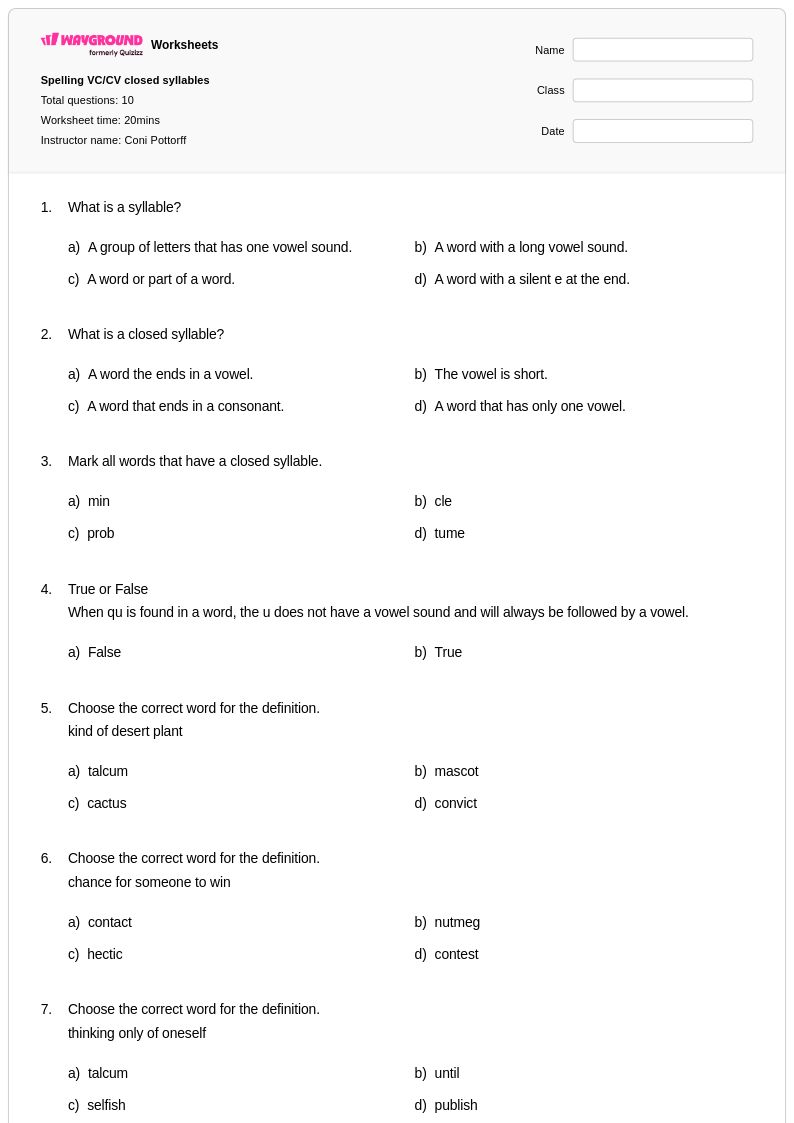
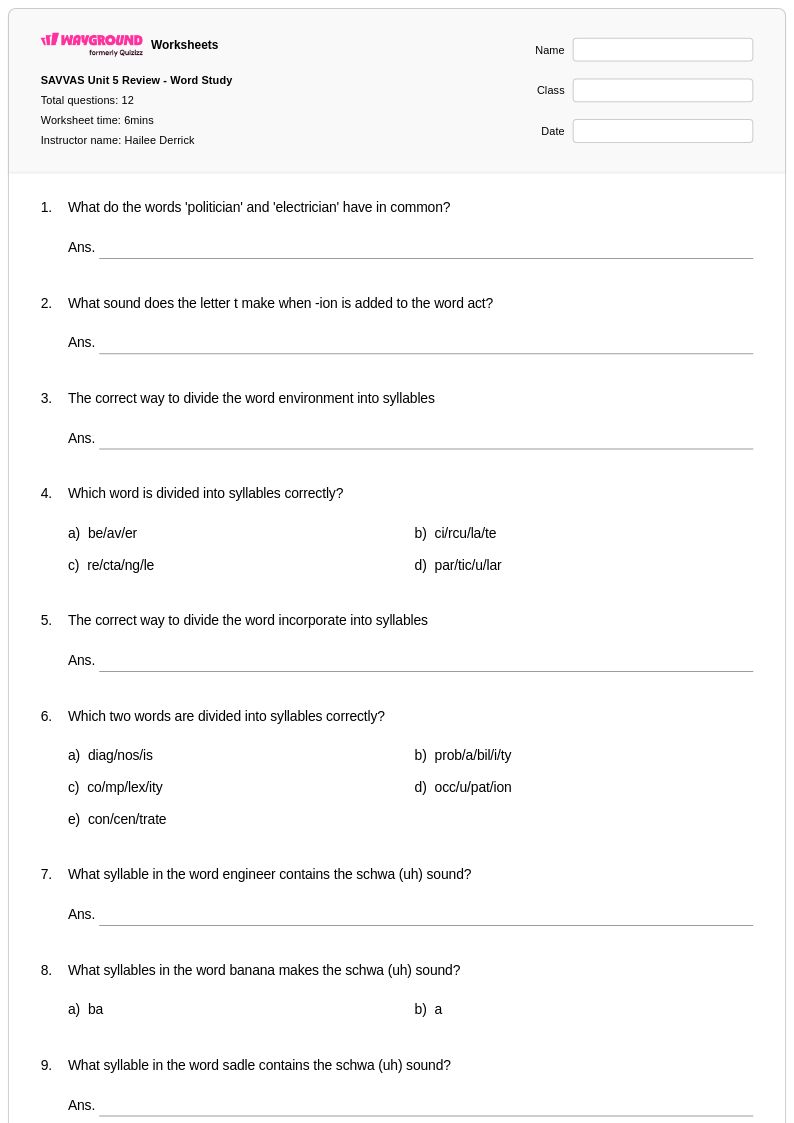
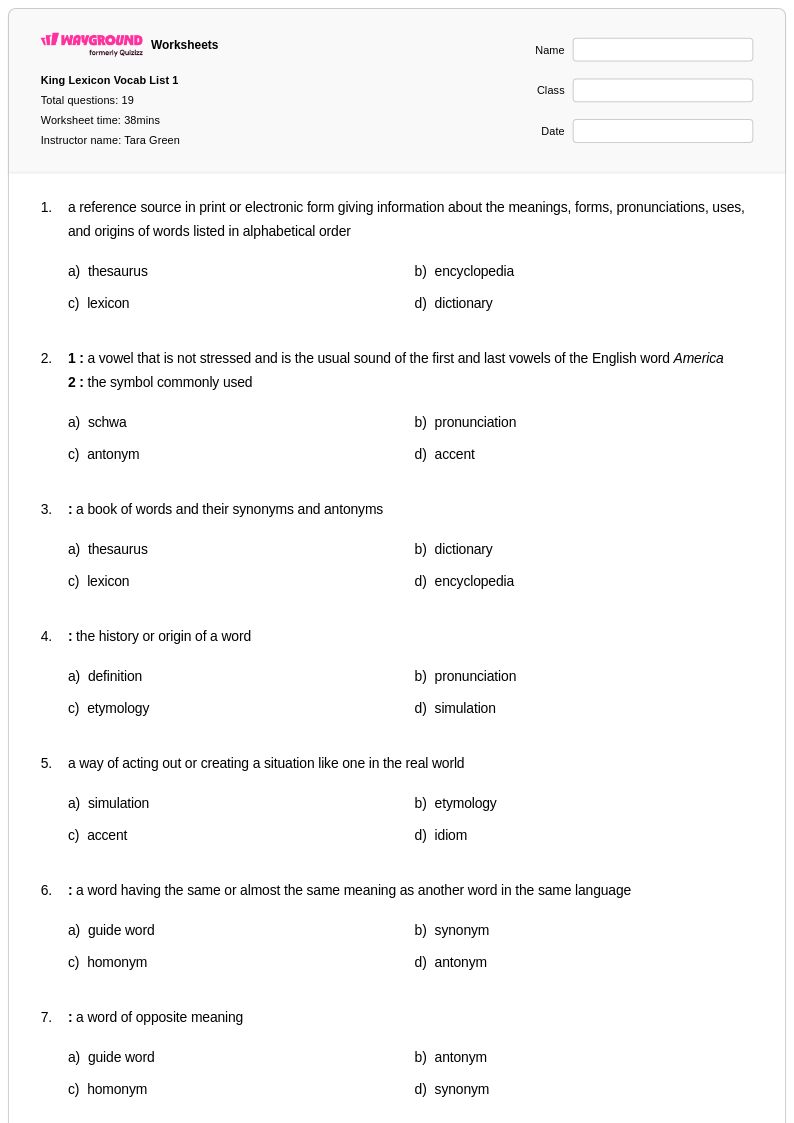
Grade 5 schwa worksheets from Wayground help students master this unstressed vowel sound through engaging printables, practice problems, and comprehensive answer keys for effective phonics learning.
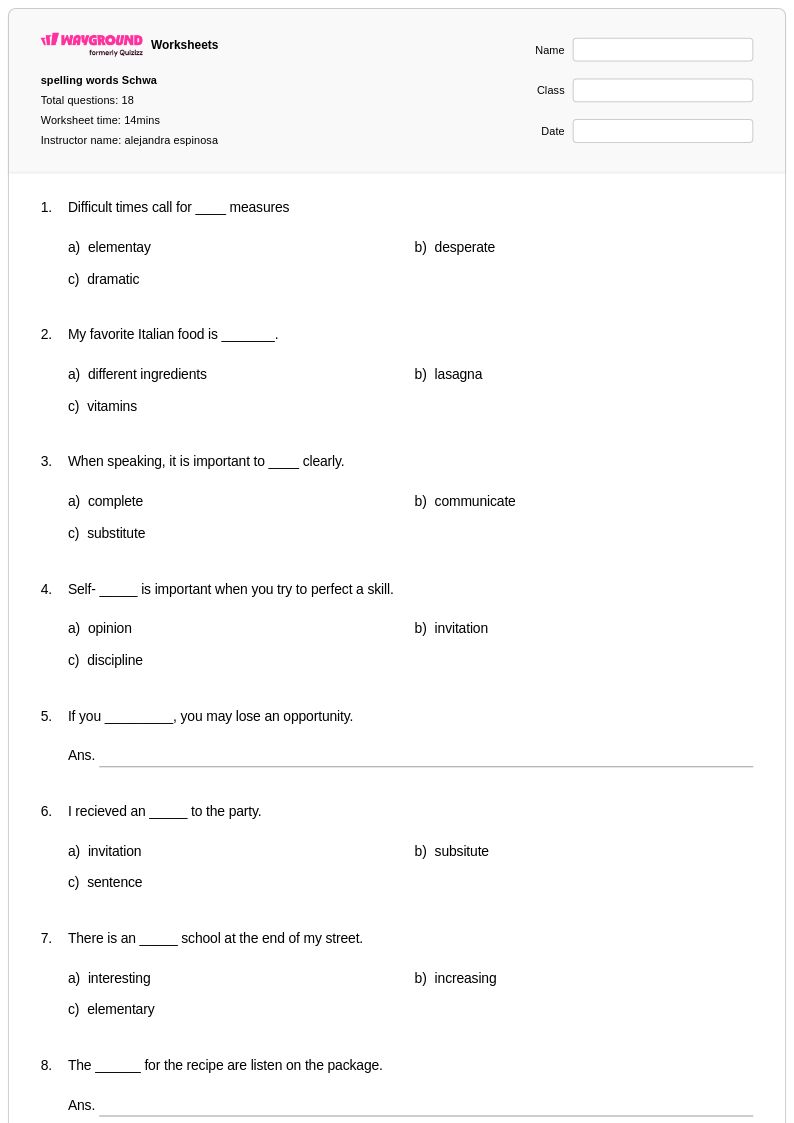
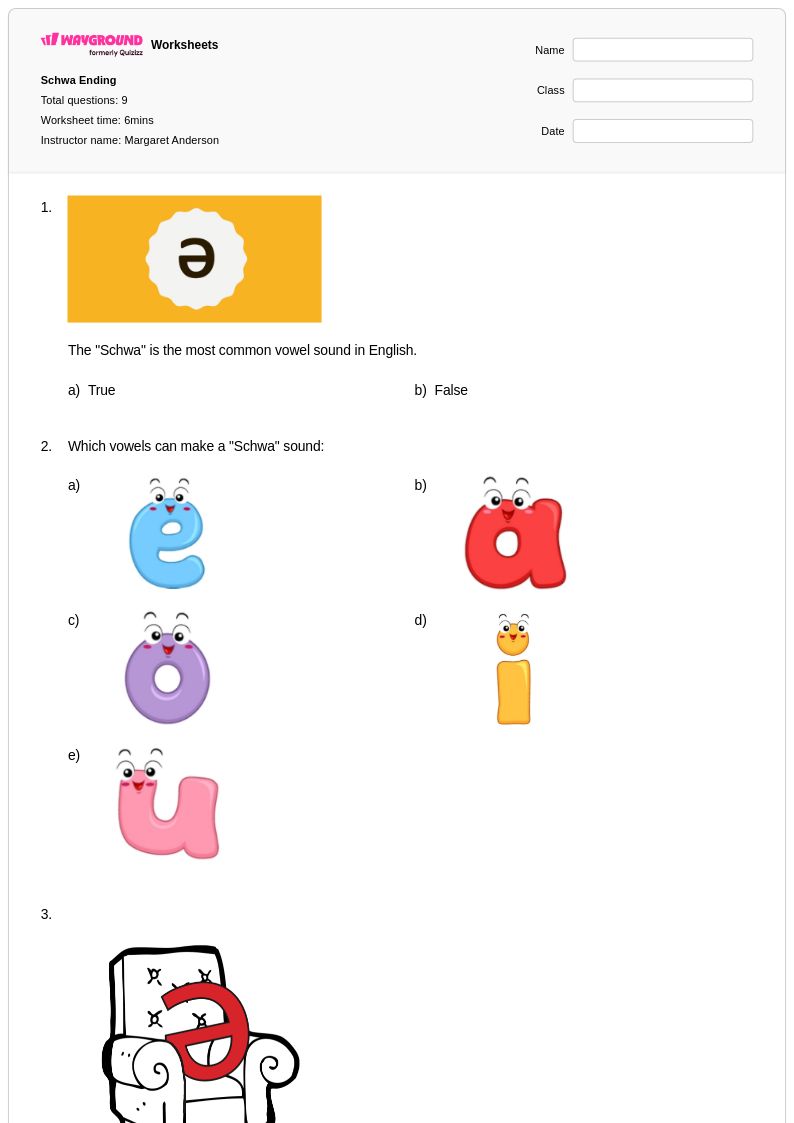
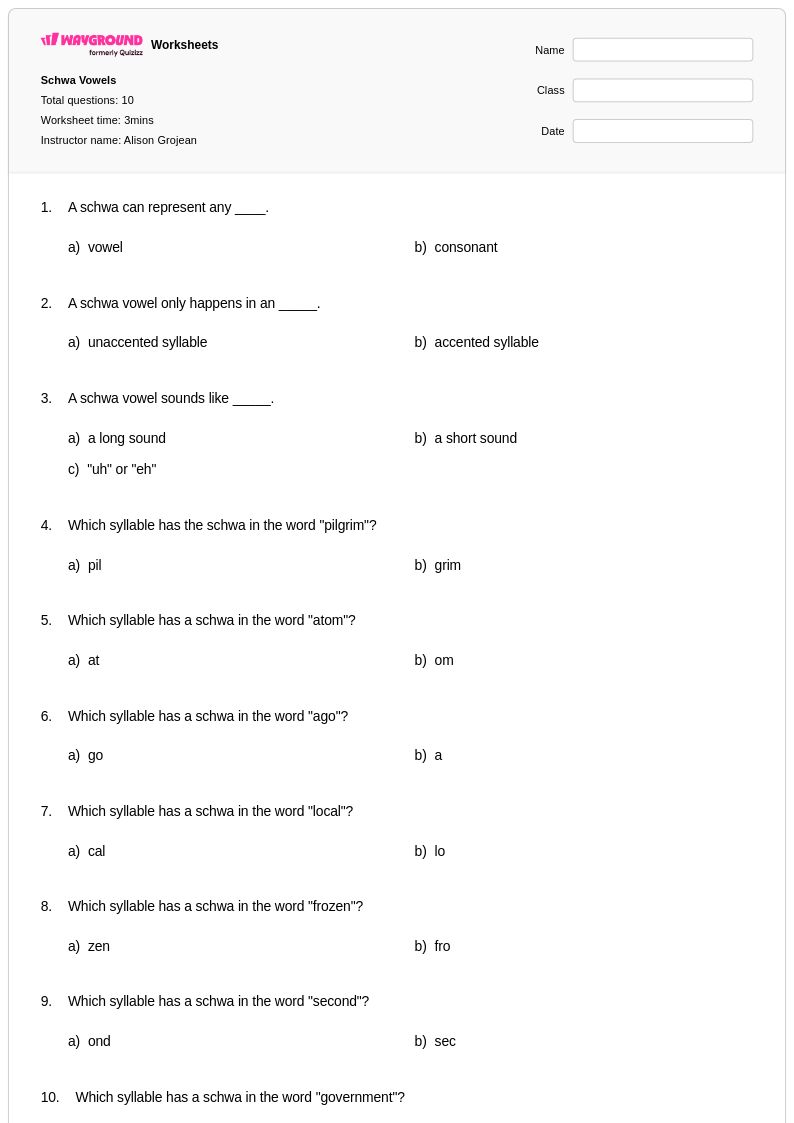
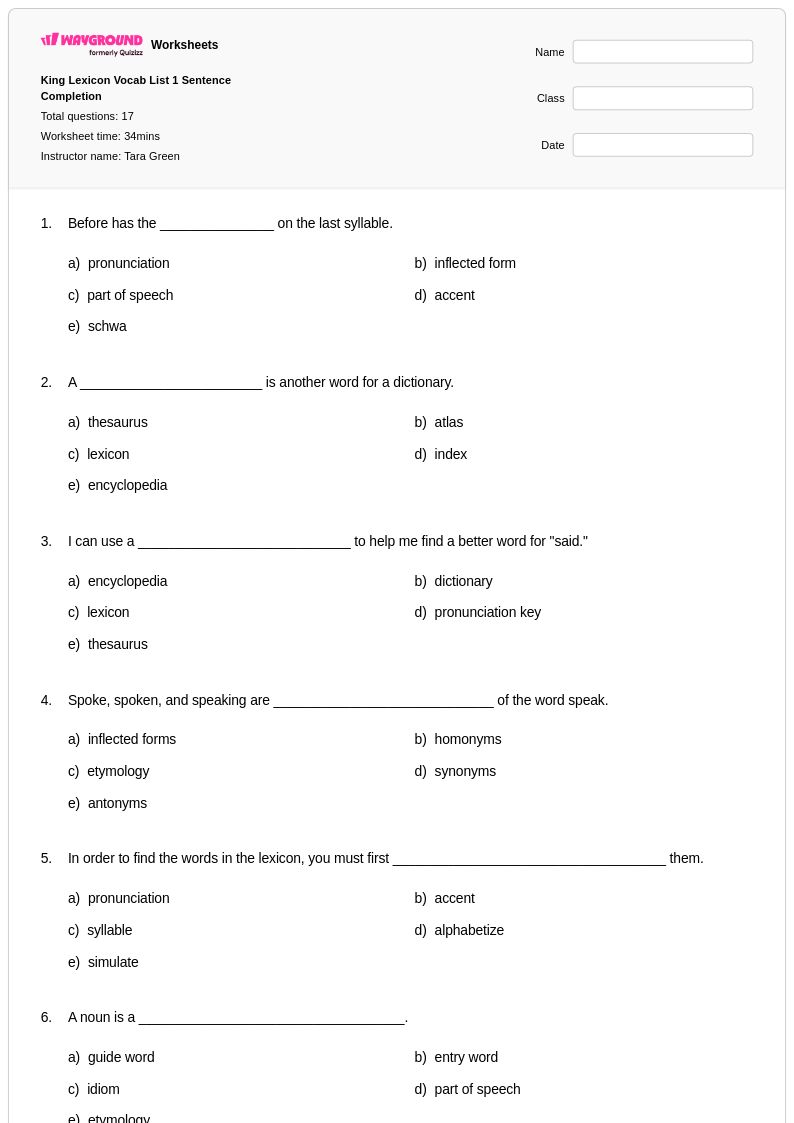
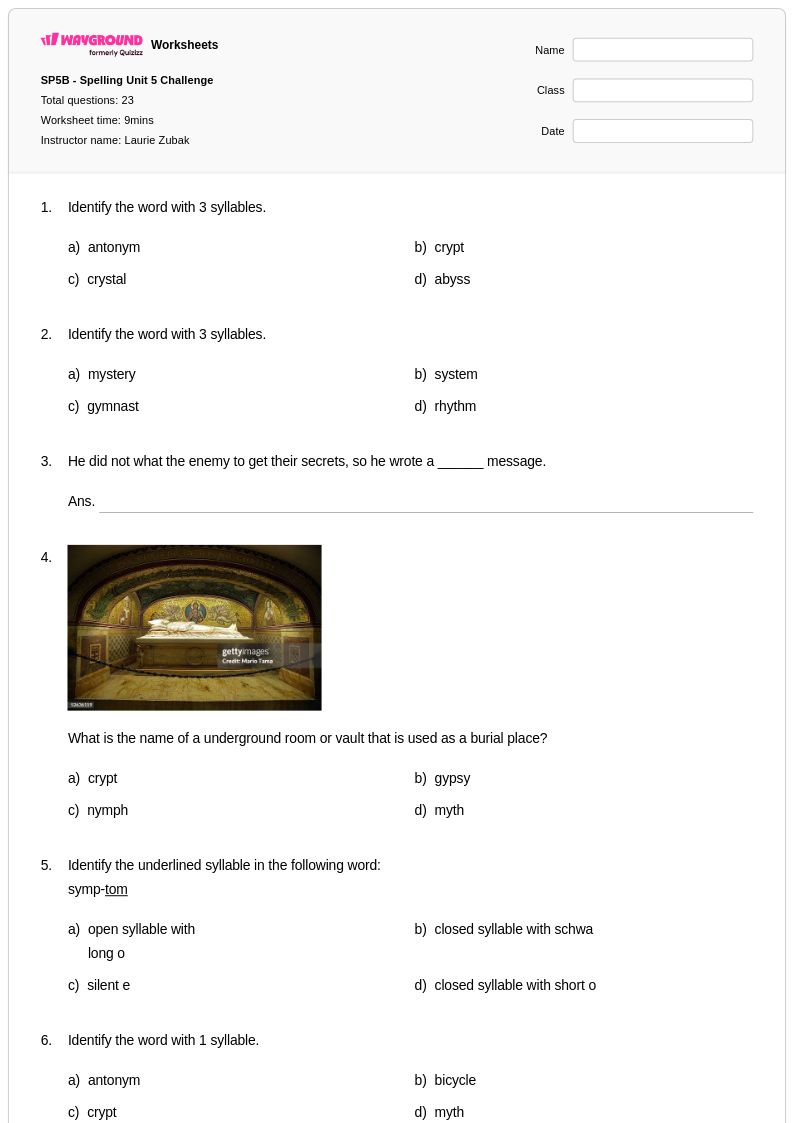
Schwa worksheets for Grade 5 students available through Wayground (formerly Quizizz) provide comprehensive practice with the most common vowel sound in English. These educational resources focus on helping fifth-grade students identify and master the schwa sound, which appears in unstressed syllables and is represented by the upside-down "e" symbol (ə) in phonetic transcription. The worksheets strengthen critical phonemic awareness skills by teaching students to recognize schwa in multisyllabic words like "about," "problem," and "circus," where vowels in unstressed positions often reduce to this neutral sound. Each printable resource includes structured practice problems that guide students through identifying schwa patterns, understanding syllable stress, and improving their overall reading fluency. These free pdf materials come complete with answer keys, making them valuable tools for both independent student work and guided instruction in phonics fundamentals.
Wayground (formerly Quizizz) supports educators with an extensive collection of teacher-created schwa worksheets, drawing from millions of phonics resources specifically designed for Grade 5 instruction. The platform's robust search and filtering capabilities enable teachers to quickly locate materials that align with reading standards and match their students' specific learning needs. These differentiation tools allow educators to customize worksheets for various skill levels, providing targeted remediation for struggling readers while offering enrichment opportunities for advanced students. Available in both printable and digital pdf formats, the worksheet collections facilitate flexible lesson planning and can be seamlessly integrated into phonics centers, homework assignments, or assessment preparation. Teachers benefit from the platform's organizational features that streamline the process of finding age-appropriate schwa practice materials, ultimately supporting more effective phonics instruction and helping students develop stronger decoding skills essential for reading success.
FAQs
How do I teach the schwa sound to elementary students?
Start by helping students understand that the schwa is the most common vowel sound in English — a soft, unstressed 'uh' sound that can be spelled by any vowel letter. Introduce it using familiar two-syllable words like 'about,' 'taken,' and 'circus,' where the unstressed syllable contains a schwa. Have students clap syllables and identify which syllable feels weaker or quieter, then mark that vowel as the schwa. Connecting schwa awareness to stress patterns early on helps students recognize it consistently across new vocabulary.
What exercises help students practice identifying the schwa sound?
Effective schwa practice exercises include sorting words by syllable stress, underlining the unstressed vowel in multisyllabic words, and substituting the schwa symbol (ə) for the correct vowel in written words. Dictation activities where students listen for unstressed syllables are especially useful because they train the ear before the eye. Worksheets that ask students to identify schwa sounds in different syllable positions — initial, medial, and final — build the flexibility students need to apply this skill across reading and spelling contexts.
Why do students struggle with spelling words that contain the schwa sound?
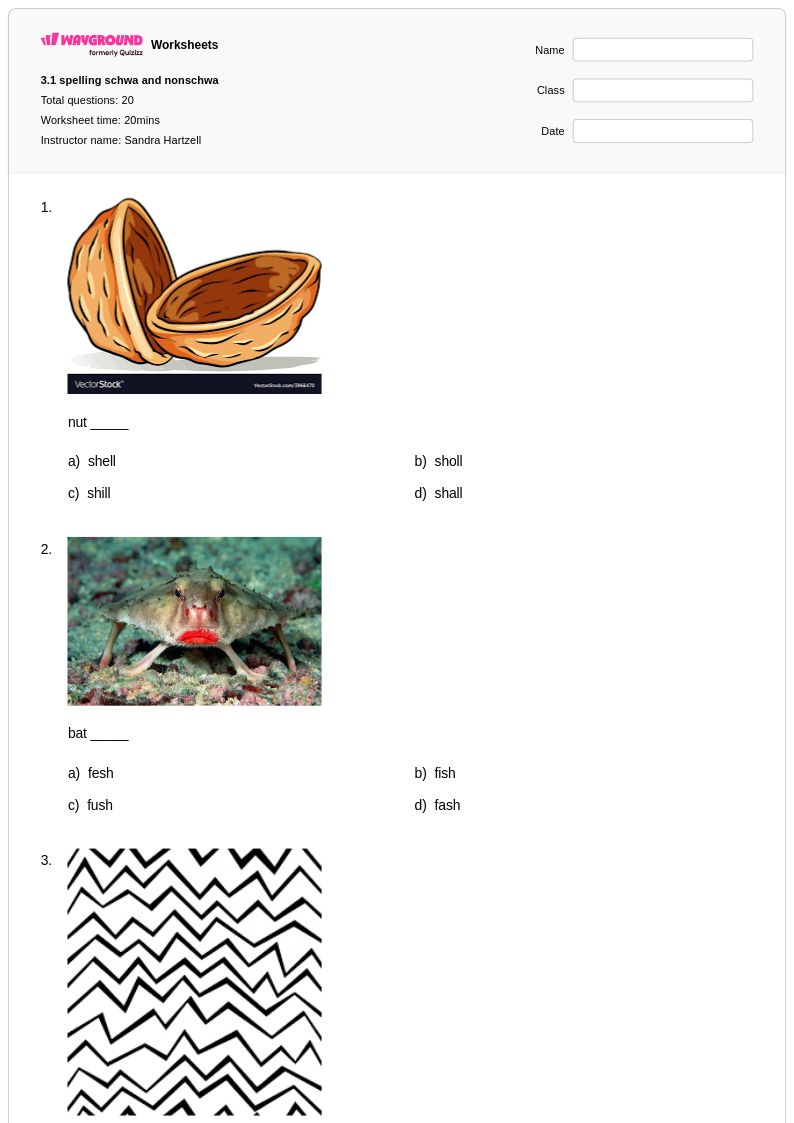
The schwa is the most common source of spelling errors in English because the same 'uh' sound can be spelled with any vowel letter — a, e, i, o, or u — and there is no reliable phonetic rule to determine which letter to use. Students who rely on sounding words out will consistently misspell schwa syllables because the sound gives no clue about the correct spelling. Instruction should explicitly teach students to memorize the spelling of schwa syllables in high-frequency words and to use visual memory strategies rather than phonetic guessing.
How is the schwa different from other short vowel sounds?
Unlike short vowel sounds, which are stressed and have consistent spellings tied to their sound, the schwa is always unstressed and can be represented by any vowel letter. Short vowels like the 'a' in 'cat' or the 'e' in 'bed' appear in stressed syllables where the vowel sound is clearly pronounced. The schwa, by contrast, occurs only in unstressed syllables and is reduced to a neutral 'uh' sound regardless of which letter spells it. Teaching this distinction helps students understand why phonics rules that work for short vowels do not apply to schwa syllables.
How do I use Wayground's schwa worksheets in my classroom?
Wayground's schwa worksheets are available as printable PDFs for traditional classroom use and in digital formats for technology-integrated learning environments, and can also be hosted as a quiz directly on Wayground. Each worksheet includes a complete answer key, making them practical for independent practice, small-group instruction, homework assignments, or remediation sessions. Teachers can use Wayground's search and filtering tools to find materials aligned to specific phonics standards, and built-in differentiation features — such as read aloud, extended time, and reduced answer choices — allow the same worksheet to be customized for students at different ability levels without singling anyone out.
At what reading level should schwa instruction begin?
Schwa instruction is typically introduced in second or third grade, once students have a solid foundation in single-syllable phonics and are beginning to decode multisyllabic words. However, schwa awareness becomes especially critical in grades 3 through 5 as academic vocabulary expands and students encounter longer, more complex words in content-area reading. Students who struggle with reading fluency or spelling accuracy in upper elementary grades often benefit from targeted schwa review, even if they have had prior phonics instruction, because the schwa is easily overlooked in early literacy programs.