Explore Wayground's free Grade 6 taxes worksheets and printables that help students understand tax concepts, government revenue, and economic systems through engaging practice problems with comprehensive answer keys.
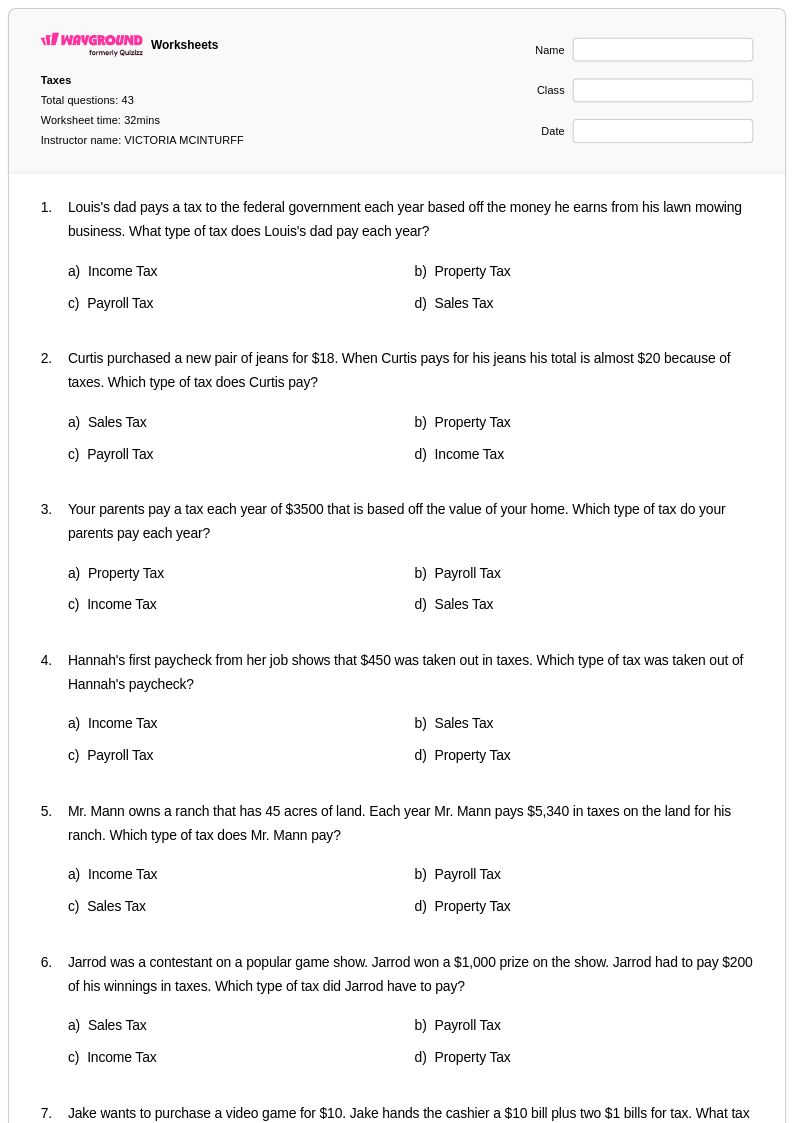
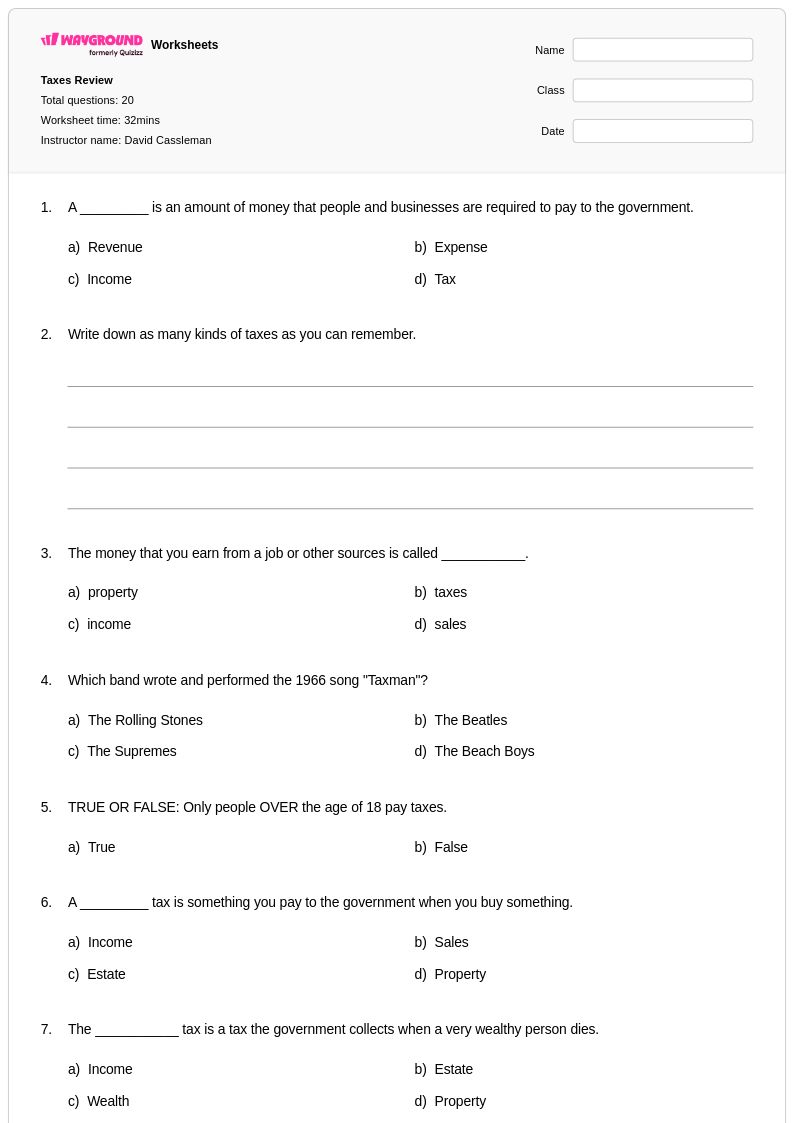
Grade 6 taxes worksheets available through Wayground (formerly Quizizz) provide students with comprehensive practice in understanding how taxation functions within economic systems and impacts individuals, families, and communities. These carefully designed educational resources strengthen critical thinking skills by guiding students through fundamental tax concepts including income tax, sales tax, property tax, and the relationship between taxation and government services. Students engage with real-world scenarios that demonstrate how taxes are calculated, collected, and utilized to fund public programs such as schools, roads, and emergency services. The worksheets include detailed answer keys that support independent learning, while printable pdf formats ensure easy classroom distribution. Free practice problems range from basic tax identification exercises to more complex calculations that help sixth graders grasp the mathematical components of taxation and develop essential financial literacy skills.
Wayground (formerly Quizizz) empowers educators with an extensive collection of teacher-created tax and economics resources, drawing from millions of high-quality materials that align with social studies standards and grade-level expectations. The platform's robust search and filtering capabilities enable teachers to quickly locate worksheets that match specific learning objectives, whether focusing on introductory tax concepts or more advanced economic principles. Differentiation tools allow educators to customize content difficulty levels, ensuring that all Grade 6 students can access appropriate challenges while building foundational knowledge about civic responsibility and economic participation. These versatile resources are available in both printable and digital formats, including downloadable pdfs, making them ideal for classroom instruction, homework assignments, remediation support, and enrichment activities. Teachers can seamlessly integrate these materials into lesson planning to provide targeted skill practice that reinforces students' understanding of how taxation connects individual financial decisions to broader community welfare and democratic participation.
FAQs
How do I teach taxes to students who have no prior experience with financial concepts?
Start by grounding the concept in everyday examples students already encounter, such as sales tax on a purchase or noticing tax lines on a family receipt. From there, build toward more abstract structures like income tax and progressive versus regressive tax systems. Using real-world scenarios and case studies helps students connect taxation to government services they use, making the concept tangible before moving into formal calculations.
What types of practice problems help students learn tax calculations?
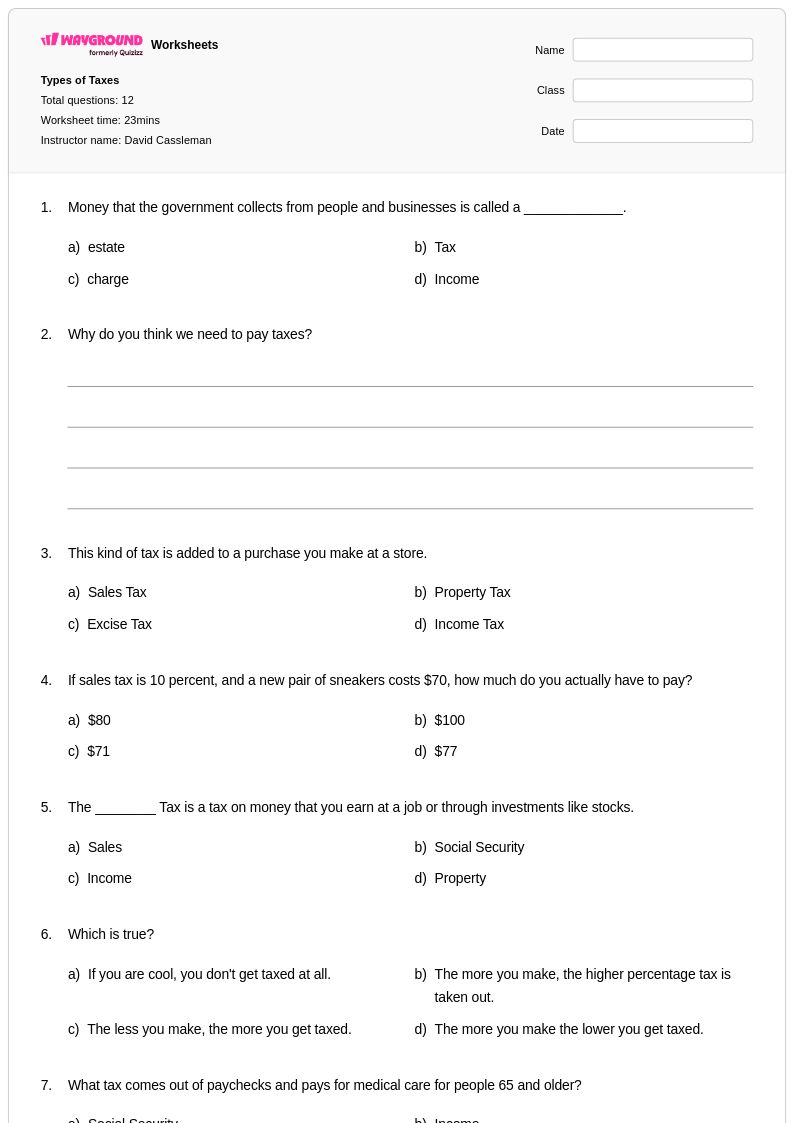
Effective tax practice problems include calculating sales tax on purchases, determining net income after income tax withholding, and comparing tax burdens under progressive, regressive, and proportional systems. Problems that simulate real-world scenarios, such as filing a simple income tax return or analyzing a paycheck stub, build procedural fluency alongside conceptual understanding. Layering problem complexity from straightforward percentage calculations to multi-step scenarios ensures students develop both accuracy and analytical thinking.
What mistakes do students commonly make when learning about taxes?
A frequent error is confusing tax rate with tax burden, particularly when students first encounter progressive tax brackets and assume a higher bracket means all income is taxed at that rate. Students also commonly conflate the different types of taxes, mixing up how income, sales, and property taxes are calculated and applied. Misconceptions about who pays taxes and how tax revenue connects to government services are also common, which is why case study analysis is a valuable instructional tool alongside calculation practice.
How can I use taxes worksheets to address different skill levels in the same classroom?
Taxes worksheets can be differentiated by assigning simpler percentage-based sales tax problems to students building foundational skills while directing more advanced students toward multi-step income tax scenarios or policy analysis tasks. On Wayground, teachers can apply student-level accommodations such as reduced answer choices to lower cognitive load for students who need additional support, or extended time for students who require it, without disrupting the experience for the rest of the class. This allows a single lesson to serve a range of proficiency levels simultaneously.
How do I use Wayground's taxes worksheets in my classroom?
Wayground's taxes worksheets are available as printable PDFs for traditional classroom use and in digital formats for technology-integrated or remote learning environments. Teachers can also host worksheets directly as a quiz on Wayground, enabling real-time student response tracking. Each worksheet includes a complete answer key, so they work equally well for in-class instruction, independent practice, or homework assignments.
How do taxes connect to broader economics and civic education standards?
Taxation is a foundational concept in both economics and civics because it links individual financial decisions to government funding, public services, and policy trade-offs. Teaching taxes in context, including how tax structures affect income distribution and how tax revenue funds public goods, supports standards related to financial literacy, economic reasoning, and civic responsibility. Worksheets that include analysis of tax policy alongside calculation practice help students develop the critical thinking skills needed to evaluate real fiscal decisions.

![Unit 3 State Government [CE.3a-e] - Printable Taxes Worksheets Grade 6 - Wayground](https://quizizz-static.s3.amazonaws.com/_media/worksheets-new/68ed6feda009e0b58dbbf524-unit-3-state-government-ce3a-e)