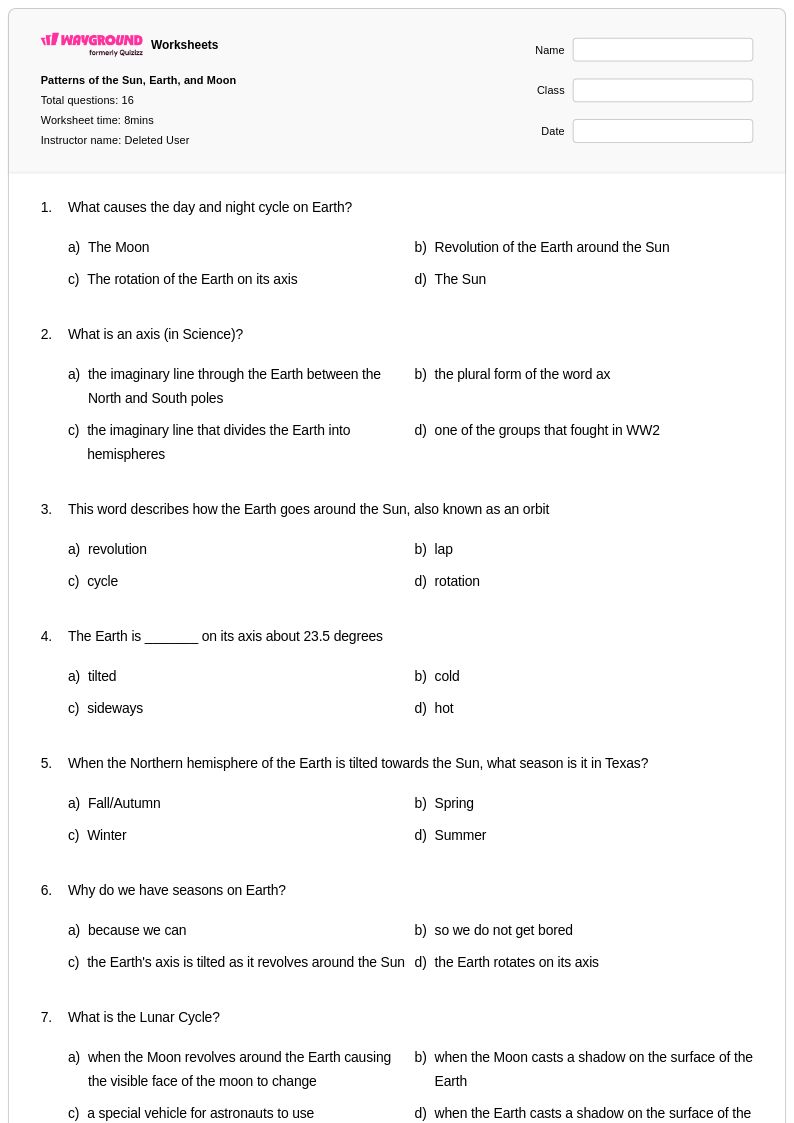
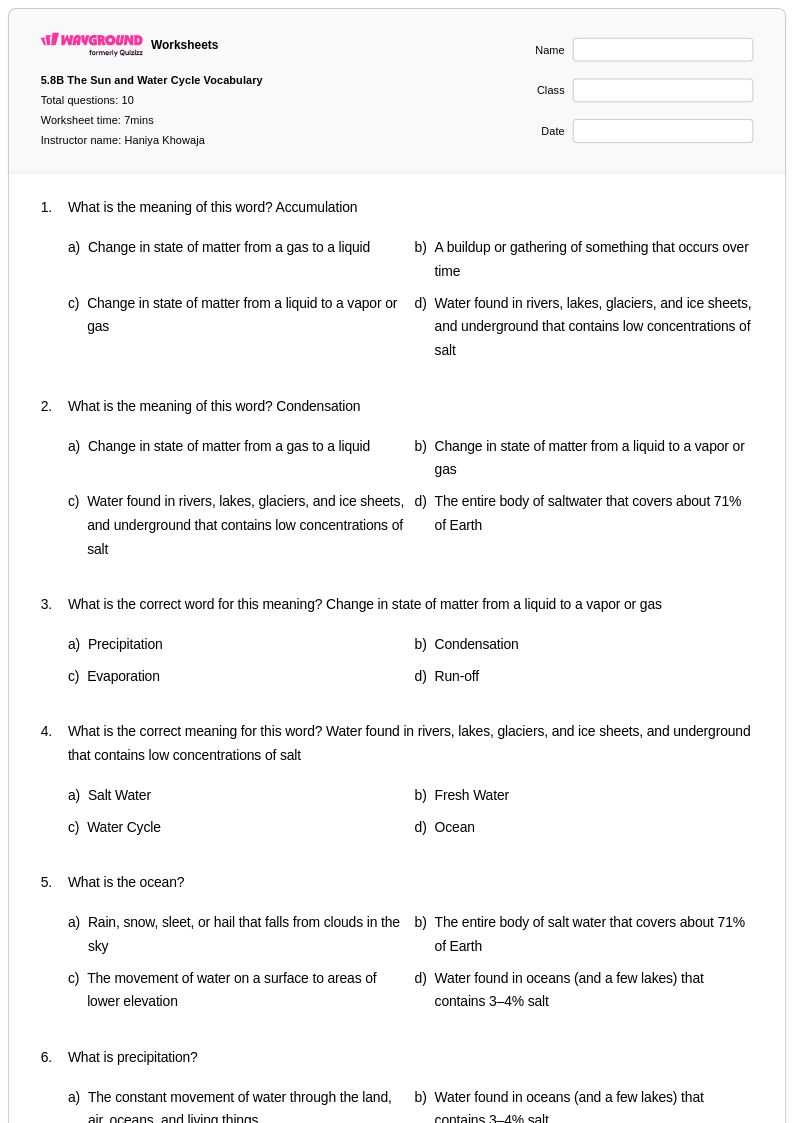
Explore Grade 4 Sun worksheets and printables from Wayground that help students discover solar facts, energy, and the Sun's role in our solar system through engaging practice problems and free PDF resources with answer keys.
The Sun worksheets available through Wayground (formerly Quizizz) provide Grade 4 students with comprehensive practice materials that explore our nearest star and its fundamental role in Earth's systems. These carefully designed resources strengthen essential scientific observation skills, data interpretation abilities, and conceptual understanding of solar phenomena including the Sun's structure, energy production, and effects on Earth's weather and seasons. Students engage with varied practice problems that challenge them to analyze solar characteristics, compare the Sun to other stars, and investigate how solar energy drives Earth's water cycle and climate patterns. Each worksheet collection includes detailed answer keys and is available as free printables in convenient PDF format, making it simple for educators to implement meaningful science instruction that builds foundational astronomy knowledge.
Wayground (formerly Quizizz) supports science teachers with an extensive library of millions of teacher-created resources specifically focused on solar science concepts appropriate for elementary learners. The platform's robust search and filtering capabilities allow educators to quickly locate worksheets that align with specific science standards and match their students' diverse learning needs. Teachers can easily customize existing materials or create differentiated versions to support remediation for struggling learners or provide enrichment opportunities for advanced students. Available in both printable PDF format and interactive digital versions, these Sun-focused worksheet collections streamline lesson planning while providing flexible options for skill practice, formative assessment, and concept reinforcement that can be seamlessly integrated into comprehensive Earth and Space Science curricula.
FAQs
How do I teach students about the Sun's structure and layers?
Teach the Sun's structure by moving from the core outward: the core (where nuclear fusion occurs), the radiative zone, the convective zone, the photosphere (visible surface), the chromosphere, and the corona. Using labeled diagrams alongside guided reading helps students visualize what they cannot directly observe. Connecting each layer to a measurable property, such as temperature or energy transfer method, gives students a concrete framework to anchor the vocabulary.
What worksheets help students practice identifying the Sun's layers?
Diagram labeling worksheets are particularly effective for the Sun's layers because students must recall and place each zone in correct spatial order, reinforcing both vocabulary and structure simultaneously. Fill-in-the-blank and short-answer practice problems that ask students to match each layer with its defining characteristics, such as nuclear fusion in the core or convection currents in the convective zone, push students beyond memorization into conceptual application.
What common mistakes do students make when learning about the Sun?
A frequent misconception is that the Sun burns like fire, when in reality it generates energy through nuclear fusion, a process that combines hydrogen nuclei into helium under extreme pressure and temperature. Students also commonly confuse the chromosphere and corona, or assume the corona is hotter than the photosphere without understanding why, which is still an area of active scientific research. Addressing these errors explicitly with targeted practice problems helps students build accurate mental models of solar processes.
How can I connect Sun lessons to broader Earth science concepts?
The Sun is the primary driver of Earth's climate, weather patterns, and ocean circulation, making it a natural anchor for interdisciplinary science instruction. Lessons connecting solar radiation to the greenhouse effect, or solar wind to auroras and magnetosphere disruptions, help students see the Sun not as an isolated topic but as a system that actively shapes conditions on Earth. Building these connections early supports deeper understanding when students encounter climate science or atmospheric science later.
How do I use Sun worksheets from Wayground in my classroom?
Wayground's Sun worksheets are available as printable PDFs for traditional classroom use and in digital formats for technology-integrated learning environments, giving teachers flexibility regardless of setting. You can also host worksheets as a quiz directly on Wayground, which supports formative assessment and immediate feedback. For students who need accommodations, Wayground allows teachers to enable features such as extended time, read aloud, or reduced answer choices on an individual basis without affecting the experience for the rest of the class.
How do I differentiate Sun science instruction for students at different levels?
For students still building foundational knowledge, focus on the Sun's basic role as the center of the solar system and its energy output before introducing nuclear fusion or electromagnetic radiation. Advanced learners can explore topics such as solar magnetic field dynamics, coronal mass ejections, and the Sun's influence on space weather. Wayground supports this by allowing teachers to assign accommodations, including reduced answer choices or extended time, to specific students individually so differentiated support is seamless and private.