Free Printable Topographic Maps Worksheets for Grade 3
Grade 3 topographic maps worksheets offer free printables and practice problems to help students learn elevation, contour lines, and landform interpretation with comprehensive answer keys for effective geography skill development.
Explore printable Topographic Maps worksheets for Grade 3
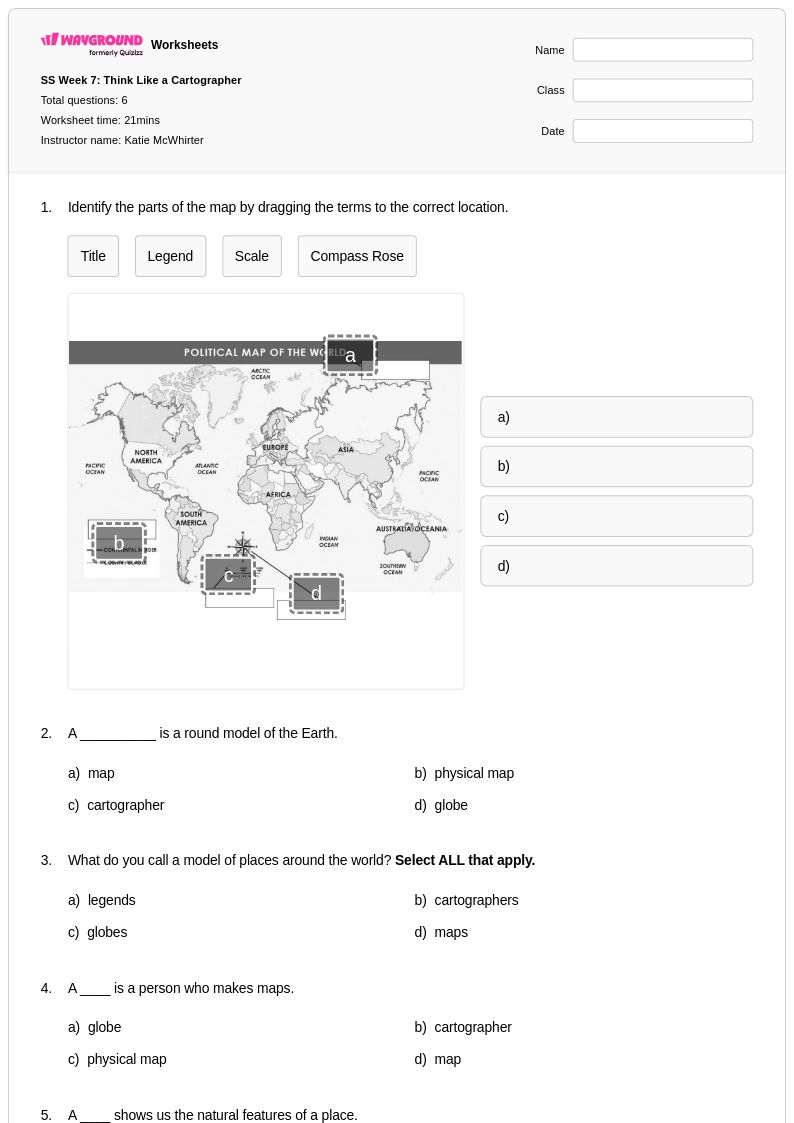
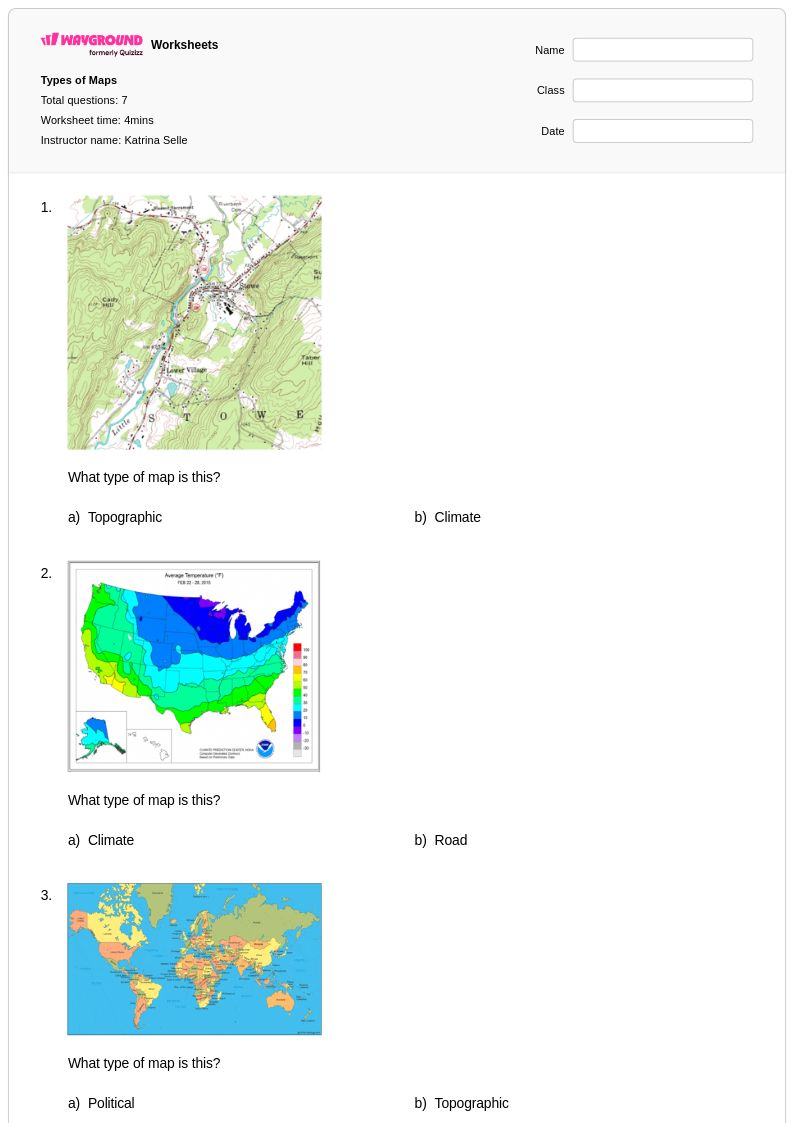
Topographic maps for Grade 3 students represent a foundational introduction to understanding how three-dimensional landforms are represented on two-dimensional surfaces through the use of contour lines, elevation markers, and terrain symbols. Wayground's extensive collection of Grade 3 topographic map worksheets provides young learners with structured practice in reading basic elevation changes, identifying common landform features like hills, valleys, and ridges, and interpreting simple map symbols that represent natural and human-made features. These carefully designed printables strengthen essential geographic literacy skills including spatial reasoning, map interpretation, and landscape visualization while building vocabulary related to physical geography concepts. Each worksheet includes comprehensive answer keys and practice problems that guide students through progressively challenging exercises, from recognizing basic contour line patterns to understanding how closely spaced lines indicate steep terrain and widely spaced lines represent gentle slopes.
Wayground supports educators with millions of teacher-created topographic map resources specifically calibrated for Grade 3 learning objectives, offering robust search and filtering capabilities that allow teachers to locate materials aligned with state geography standards and curriculum requirements. The platform's differentiation tools enable instructors to customize worksheet difficulty levels, modify practice problems for diverse learning needs, and select from both digital and printable PDF formats to accommodate various classroom environments and teaching preferences. These comprehensive collections facilitate effective lesson planning by providing ready-to-use materials for initial instruction, targeted remediation for students struggling with map reading concepts, and enrichment activities for advanced learners ready to explore more complex topographic features. Teachers can seamlessly integrate these resources into geography units, outdoor education programs, or cross-curricular science lessons that examine landform processes and environmental relationships.
FAQs
How do I teach students to read topographic maps for the first time?
Start by grounding students in the core rule: contour lines connect points of equal elevation, and lines that are closer together indicate steeper terrain. Use a physical model, such as a layered landform built from cardboard or clay, so students can see the connection between a 3D surface and its 2D map representation before they ever read a contour line on paper. From there, introduce key vocabulary — contour interval, index contour, relief, and gradient — with visual examples. Structured practice problems that ask students to trace specific elevations and identify landform types (ridge, valley, depression) build the spatial reasoning needed to read topographic maps with confidence.
What exercises help students practice interpreting contour lines and elevation patterns?
Effective practice moves students from recognition to interpretation: begin with exercises that ask them to label elevations on a pre-drawn map, then progress to calculating gradient between two points, identifying watershed boundaries, and sketching a cross-sectional profile from a contour map. Exercises that pair a topographic map with a photograph of the same terrain are especially useful for building the spatial connection between contour patterns and real landforms. Topographic map worksheets that include a mix of question types — multiple choice for vocabulary, short answer for gradient calculations, and diagram labeling for landform identification — reinforce skills across different levels of complexity.
What mistakes do students commonly make when reading topographic maps?
The most common error is misreading the contour interval: students frequently confuse the interval value with individual elevation readings, which cascades into incorrect gradient and relief calculations. Many students also struggle to distinguish between a hill and a depression on a map, since both appear as closed concentric loops — depressions are marked with hatchure lines, a detail students often overlook. A third frequent misconception is assuming that widely spaced contour lines mean flat terrain rather than a gentle slope. Targeted practice that isolates these specific error patterns, with immediate feedback through answer keys, helps students correct misconceptions before they become entrenched.
How can I differentiate topographic map instruction for students at different skill levels?
For students who are still developing spatial reasoning, simplify the map by reducing the number of contour lines shown and providing a word bank of landform types to reduce cognitive load. For students who have mastered basic contour reading, increase complexity by introducing gradient calculations, scale applications, and watershed analysis. On Wayground, teachers can apply accommodations such as Read Aloud for students who benefit from audio support, reduced answer choices for those who need scaffolding, and adjustable font sizes through reading mode — all configurable per student without flagging those settings to the rest of the class.
How do I use Wayground's topographic maps worksheets in my classroom?
Wayground's topographic map worksheets are available as printable PDFs for traditional classroom use and in digital formats for technology-integrated environments, including the option to host them as a quiz directly on Wayground. Printable versions work well for independent seat work, small group activities, or take-home practice, while digital formats allow for self-paced completion with built-in answer key access. Each worksheet includes a complete answer key, making it straightforward to use for guided instruction, station rotations, or self-checking independent practice without additional teacher preparation.
How do I help students understand the relationship between contour lines and real-world terrain features?
Connecting the abstract visual language of contour lines to physical landscapes is the central challenge of topographic map instruction. Have students analyze contour patterns for familiar landform types — V-shapes pointing uphill indicate valleys, rounded closed loops indicate hills — and then verify their interpretations using satellite imagery of the same area. Asking students to draw a topographic profile, or cross-section, along a given line on a map is one of the highest-yield exercises for cementing this relationship, as it forces them to translate the 2D contour pattern into an explicit elevation graph.