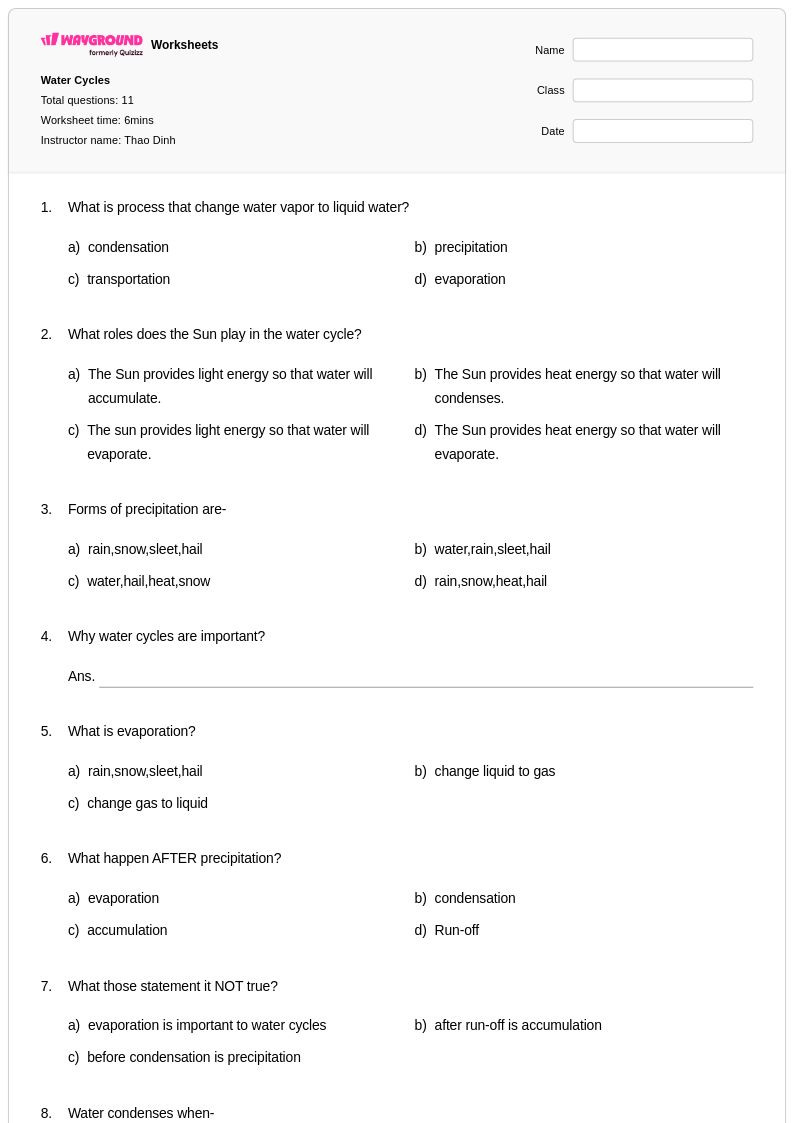
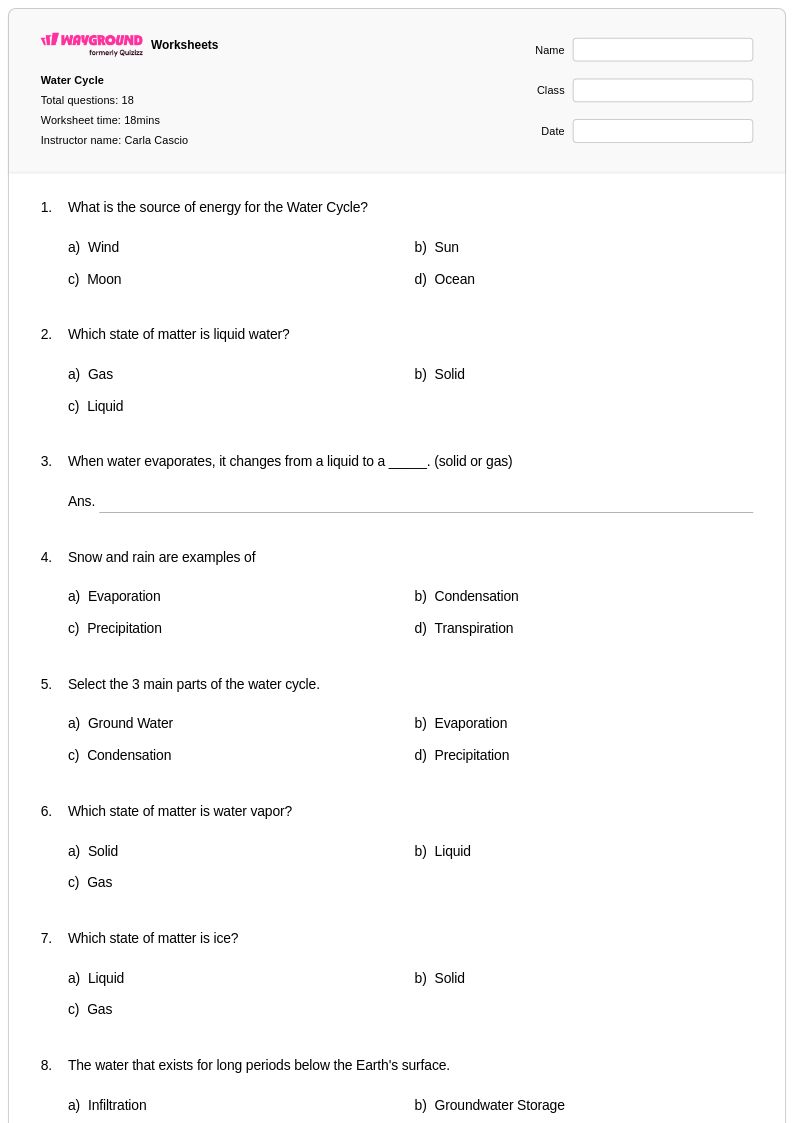
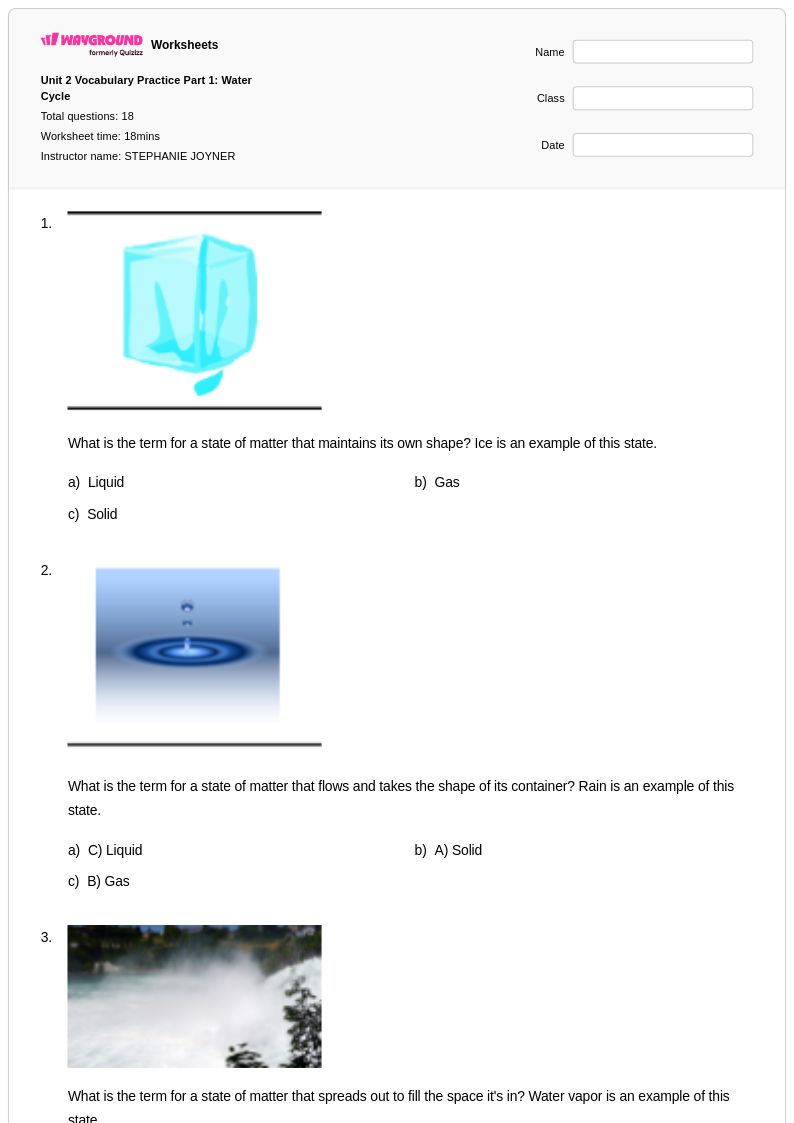
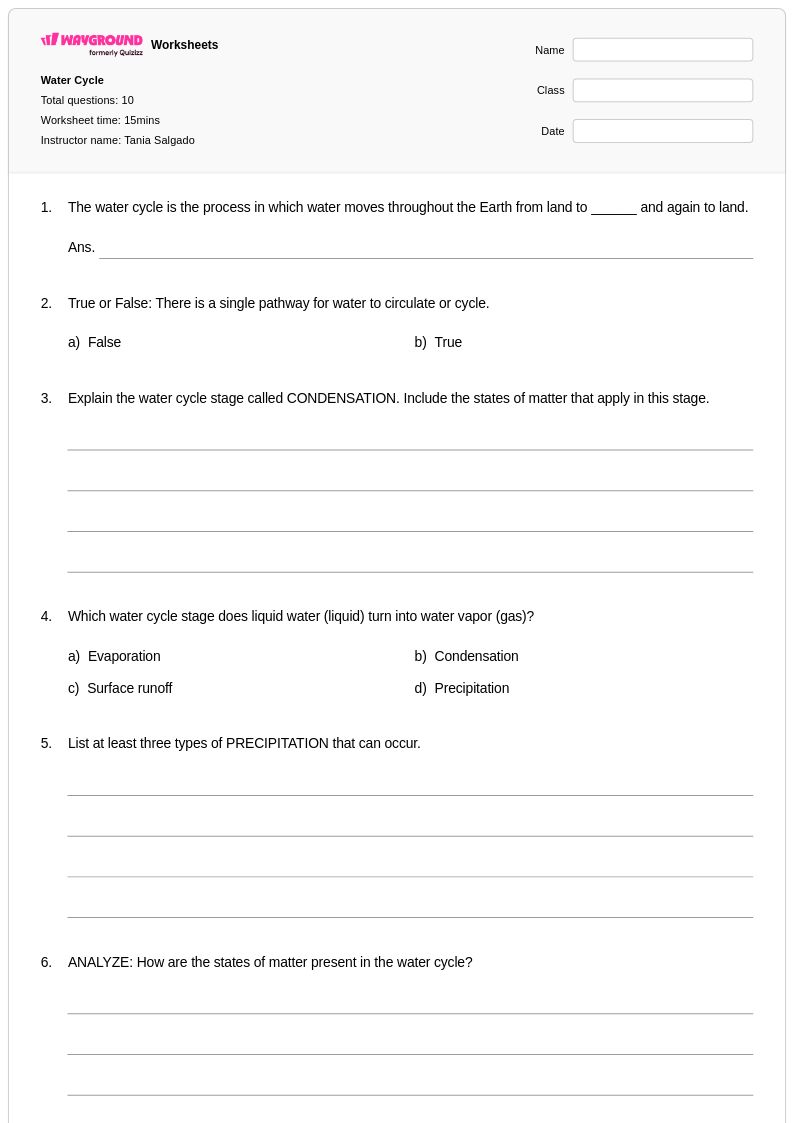
Explore Wayground's free Grade 4 water science worksheets and printables that help students discover water cycles, states of matter, and conservation through engaging practice problems with complete answer keys.
Grade 4 water science worksheets available through Wayground (formerly Quizizz) provide comprehensive coverage of essential hydrological concepts that fourth-grade students need to master. These carefully designed educational resources focus on the water cycle, states of matter, water conservation, and the role of water in Earth's systems, helping students develop critical scientific thinking skills through hands-on practice problems. Each worksheet collection includes detailed answer keys that enable both independent student work and efficient teacher assessment, while the free printables offer flexible learning opportunities that accommodate various classroom settings and homework assignments. The pdf format ensures easy distribution and printing, making these water-focused materials accessible for immediate classroom implementation.
Wayground (formerly Quizizz) empowers educators with millions of teacher-created water science resources specifically aligned with Grade 4 learning standards, featuring robust search and filtering capabilities that allow quick identification of appropriate materials for diverse student needs. The platform's differentiation tools enable teachers to customize worksheet difficulty levels, supporting both remediation for struggling learners and enrichment opportunities for advanced students ready to explore more complex water science concepts. Available in both printable pdf format and interactive digital versions, these comprehensive worksheet collections streamline lesson planning while providing targeted skill practice that reinforces key learning objectives. Teachers can efficiently organize water science units, create assessment materials, and supplement core curriculum with these professionally developed resources that support standards-aligned instruction across various teaching methodologies.
FAQs
How do I teach the water cycle to students?
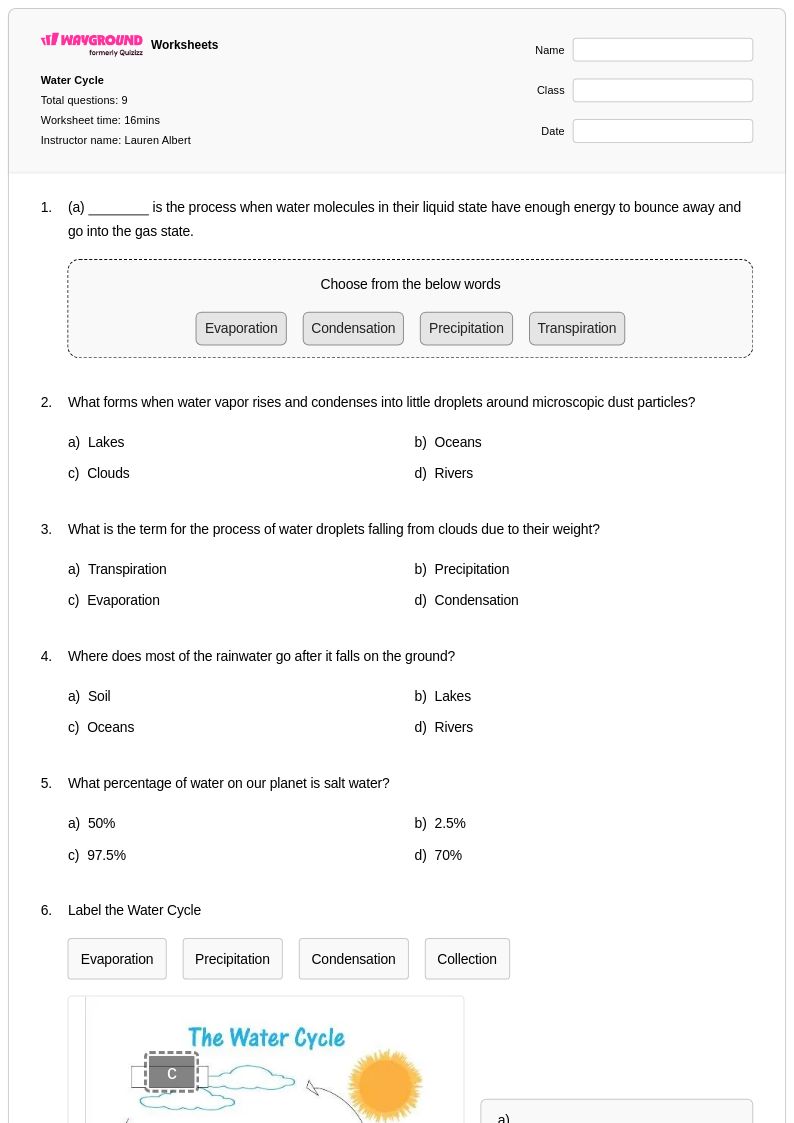
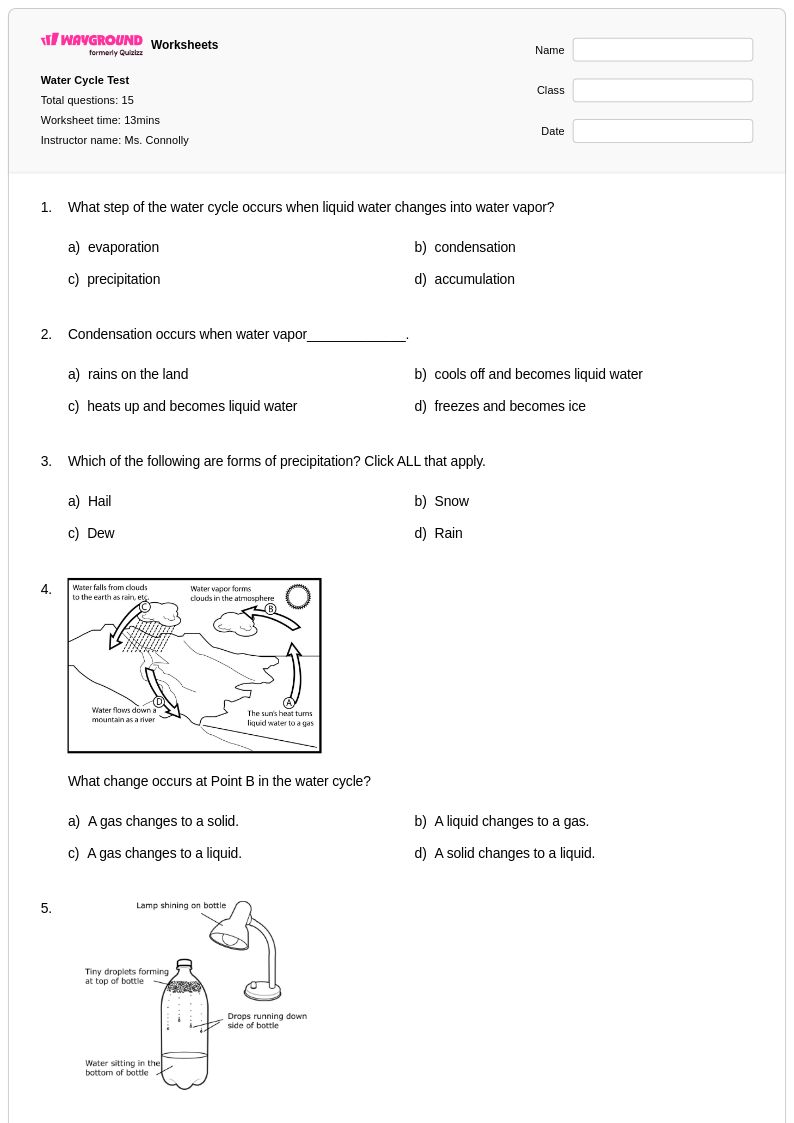
Teaching the water cycle is most effective when students can trace the path of a single water molecule through evaporation, condensation, precipitation, and collection. Use labeled diagrams and process-sequencing activities to reinforce each stage before connecting them into the full cycle. Grounding abstract processes like condensation in visible, real-world examples — such as dew on a glass or cloud formation — helps students build durable conceptual understanding.
What exercises help students practice water science concepts?
Effective practice for water science includes diagram labeling of the water cycle, fill-in-the-blank exercises on evaporation and condensation, and short-answer questions on groundwater systems and watershed management. Structured practice problems that progress from basic water properties to advanced topics like ocean currents and climate connections help students build understanding incrementally. Repeated, low-stakes practice with answer key feedback accelerates retention of these foundational Earth science concepts.
What misconceptions do students commonly have about the water cycle?
A common misconception is that water disappears during evaporation rather than changing state and entering the atmosphere. Students also frequently confuse condensation with evaporation, or believe precipitation always means rain, overlooking snow, sleet, and hail. Another frequent error is treating the water cycle as a simple loop rather than a dynamic system influenced by temperature, geography, and human activity.
How do I use Wayground's water science worksheets in my classroom?
Wayground's water science worksheets are available as free printable PDFs for traditional classroom use and in digital formats for technology-integrated environments, including the option to host them as a quiz on Wayground. Teachers can use them as guided practice during a lesson, independent review after instruction, or as homework to reinforce water cycle and conservation concepts. Each worksheet includes a complete answer key, making self-assessment and teacher grading straightforward.
How can I differentiate water science instruction for students at different skill levels?
For students who need additional support, Wayground offers built-in accommodation tools including Read Aloud for audio delivery of questions, reduced answer choices to lower cognitive load, and extended time settings configurable per student. These accommodations can be applied individually so that advanced students continue working at full challenge level without disruption. For enrichment, water science worksheets covering advanced topics like hydrological systems, watershed management, and water resource conservation provide meaningful extension opportunities.
How do I connect water science to weather and climate in my lessons?
Water's role in weather and climate is best introduced by linking the water cycle directly to atmospheric processes — showing how evaporation from oceans drives humidity, cloud formation, and precipitation patterns. From there, teachers can expand into ocean currents and their influence on regional climates, and then into broader topics like water resource conservation as a consequence of climate variability. Structured worksheets that sequence these concepts help students see water science as an integrated Earth system rather than isolated facts.