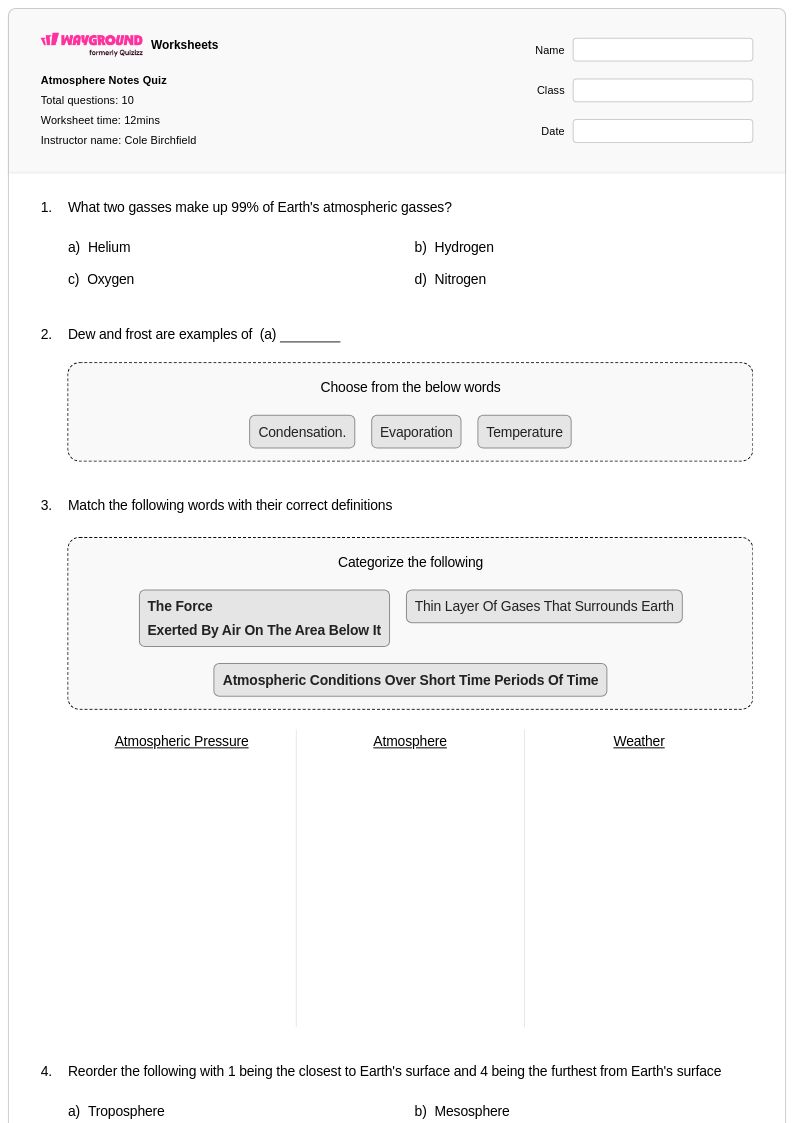
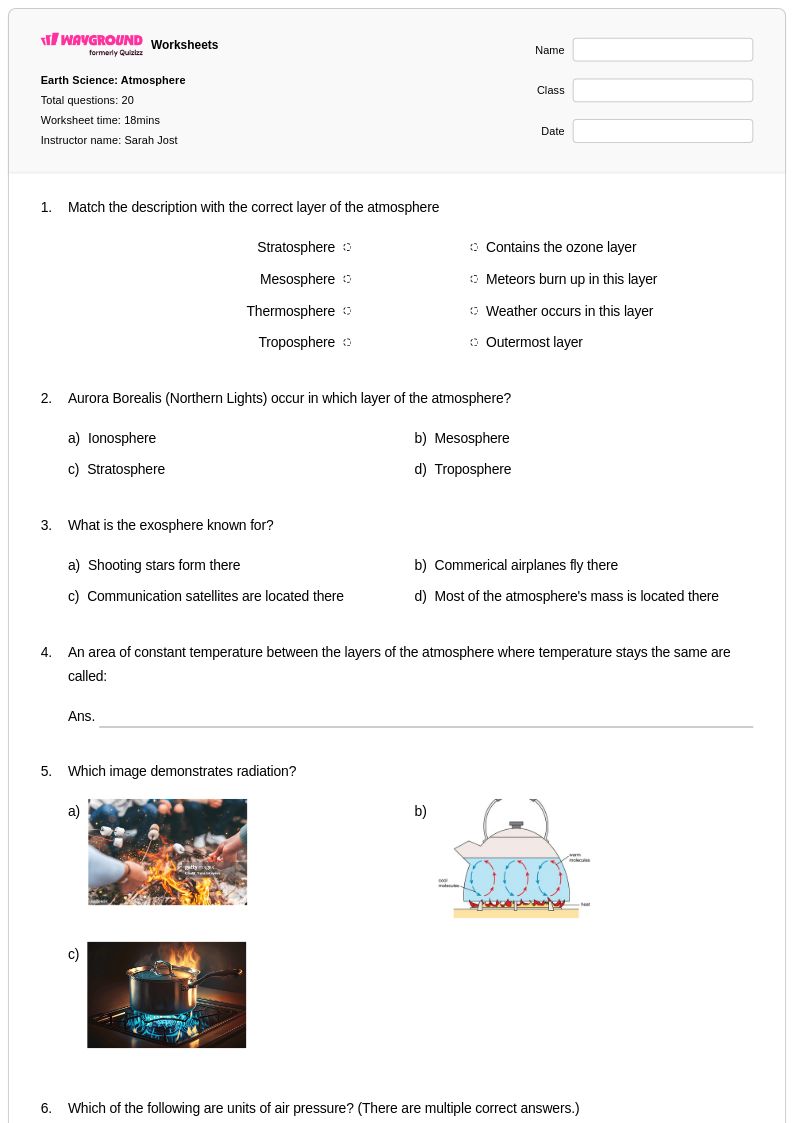
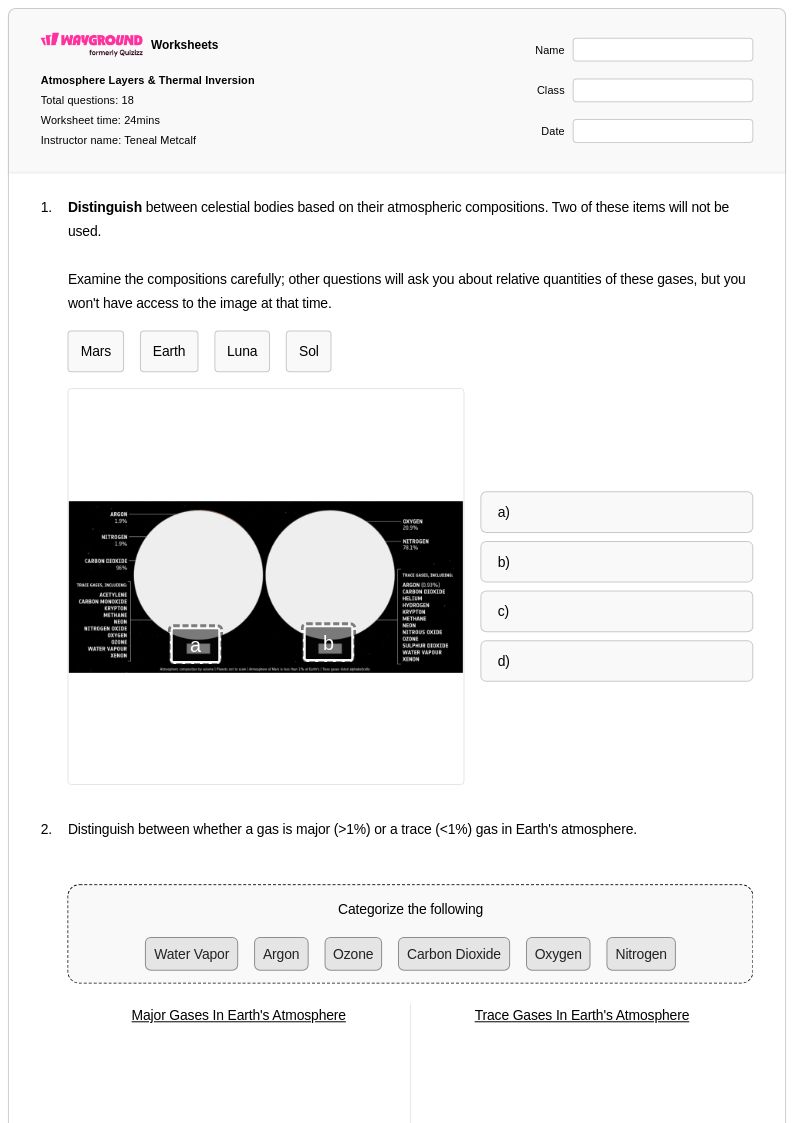
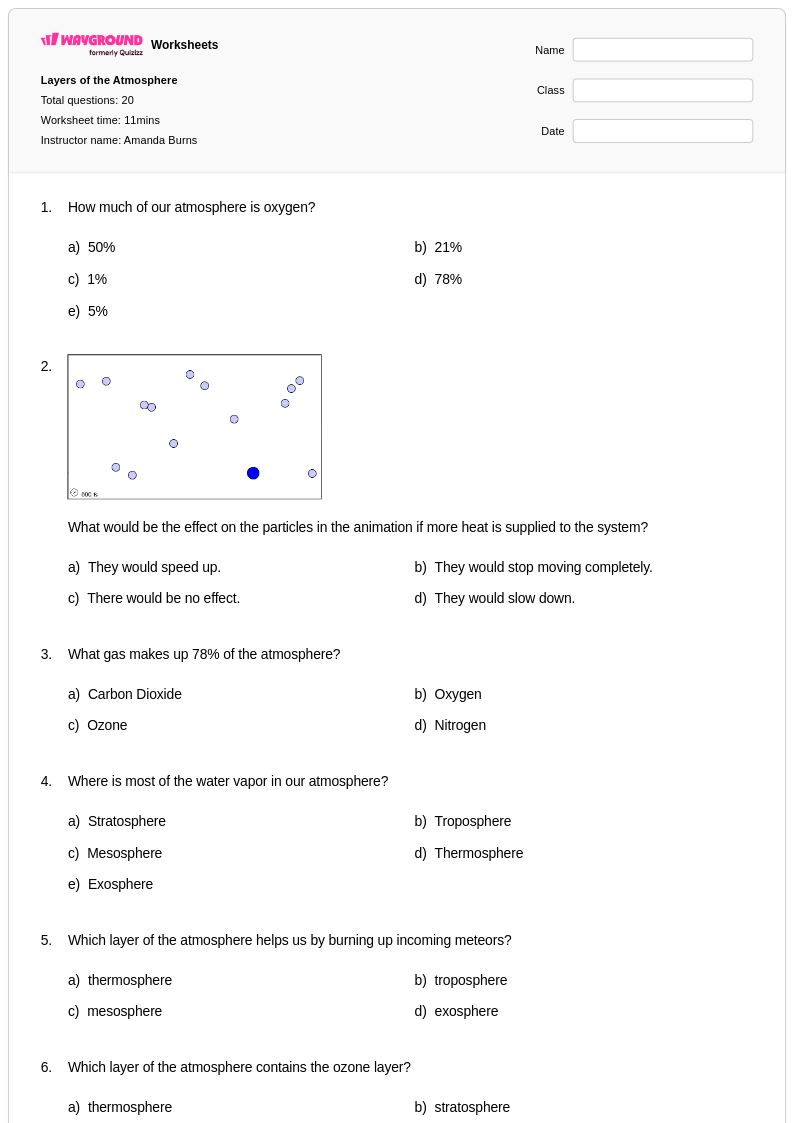
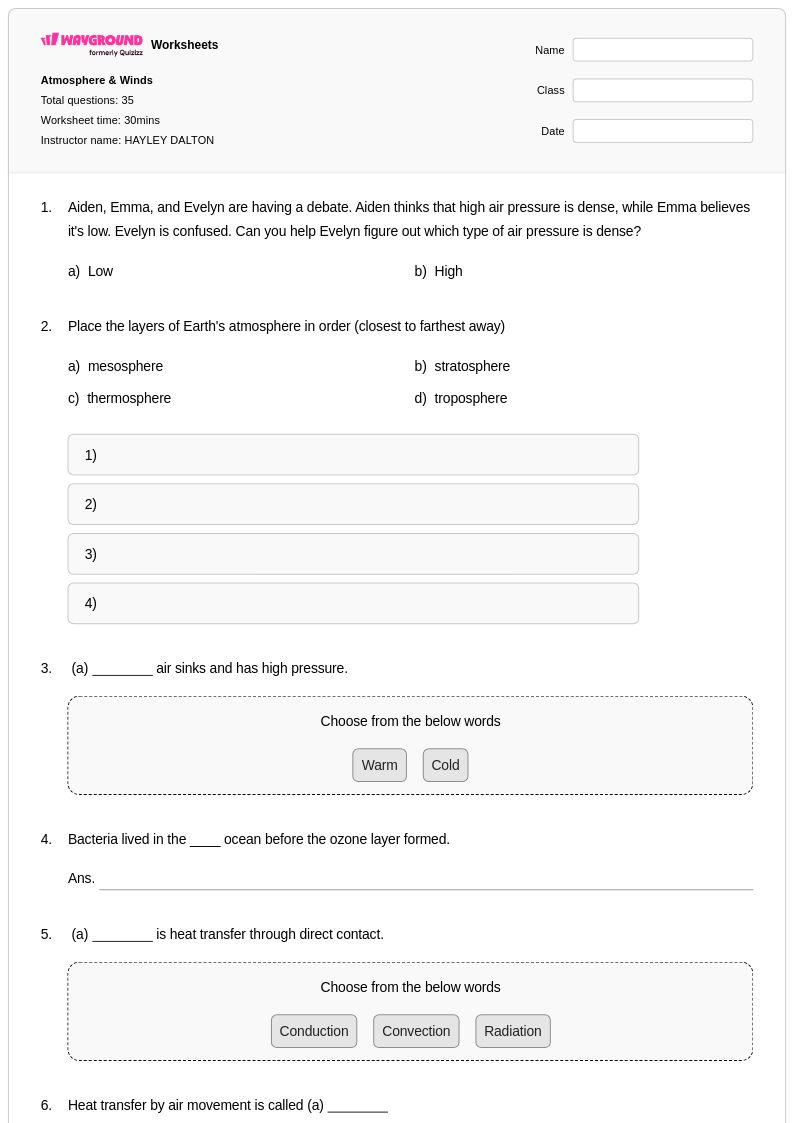
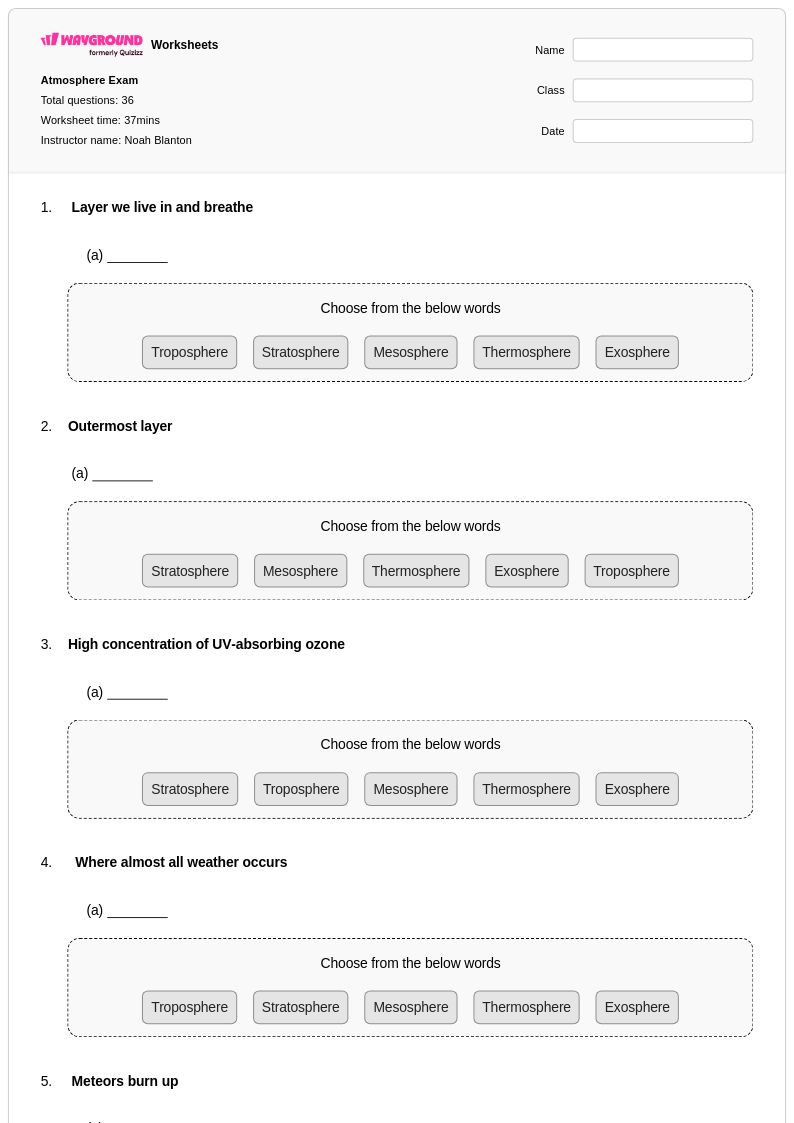
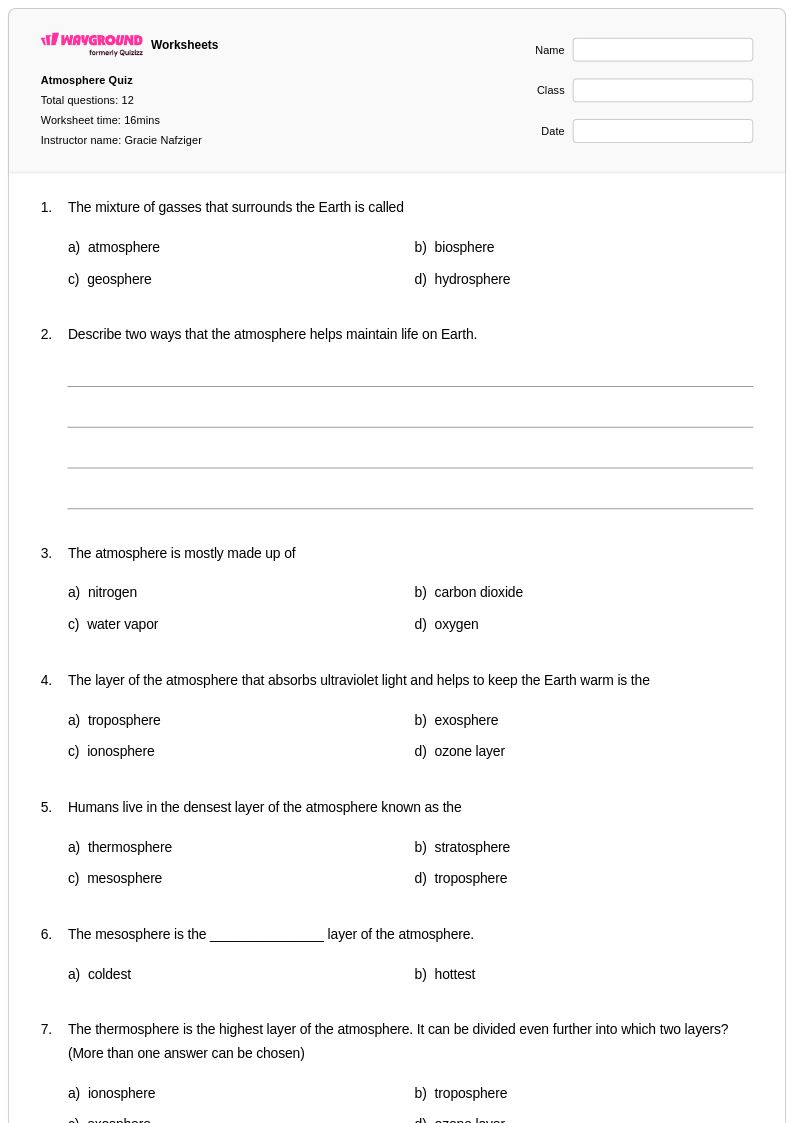
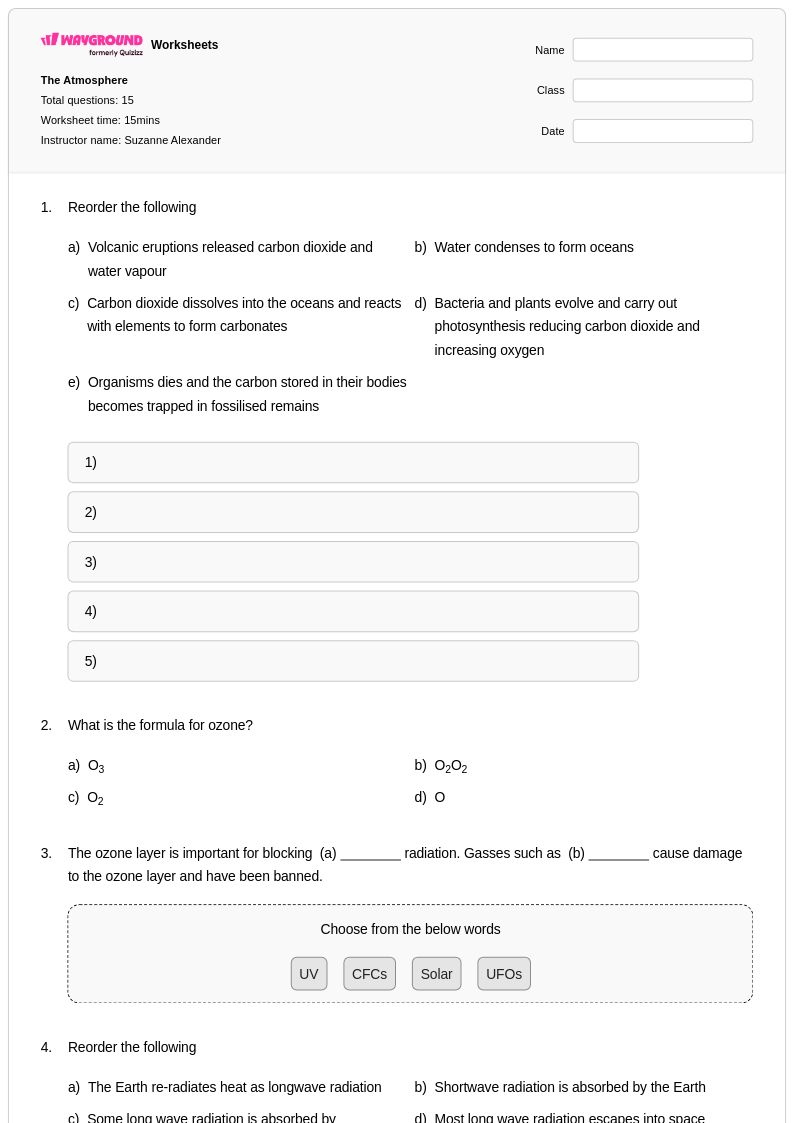
Class 9 atmosphere worksheets and printables help students explore Earth's atmospheric layers, weather patterns, and climate systems through engaging practice problems with comprehensive answer keys available as free PDF downloads.
Explore printable Atmosphere worksheets for Class 9
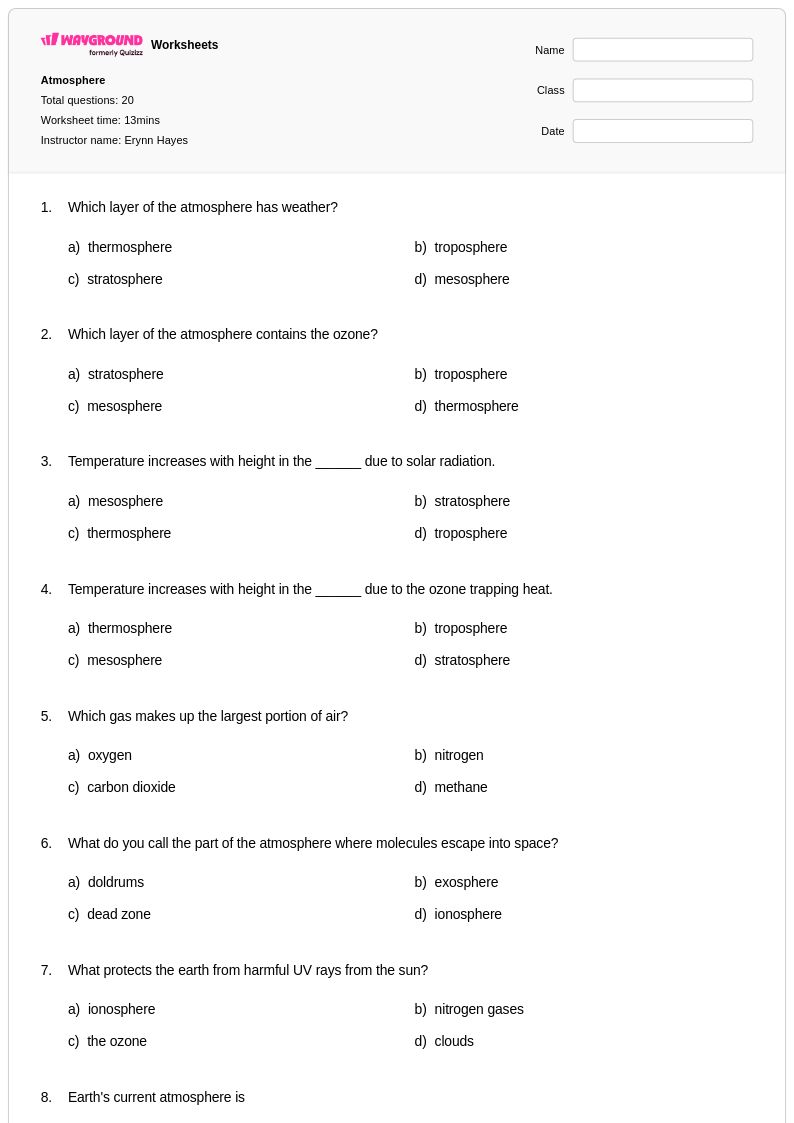
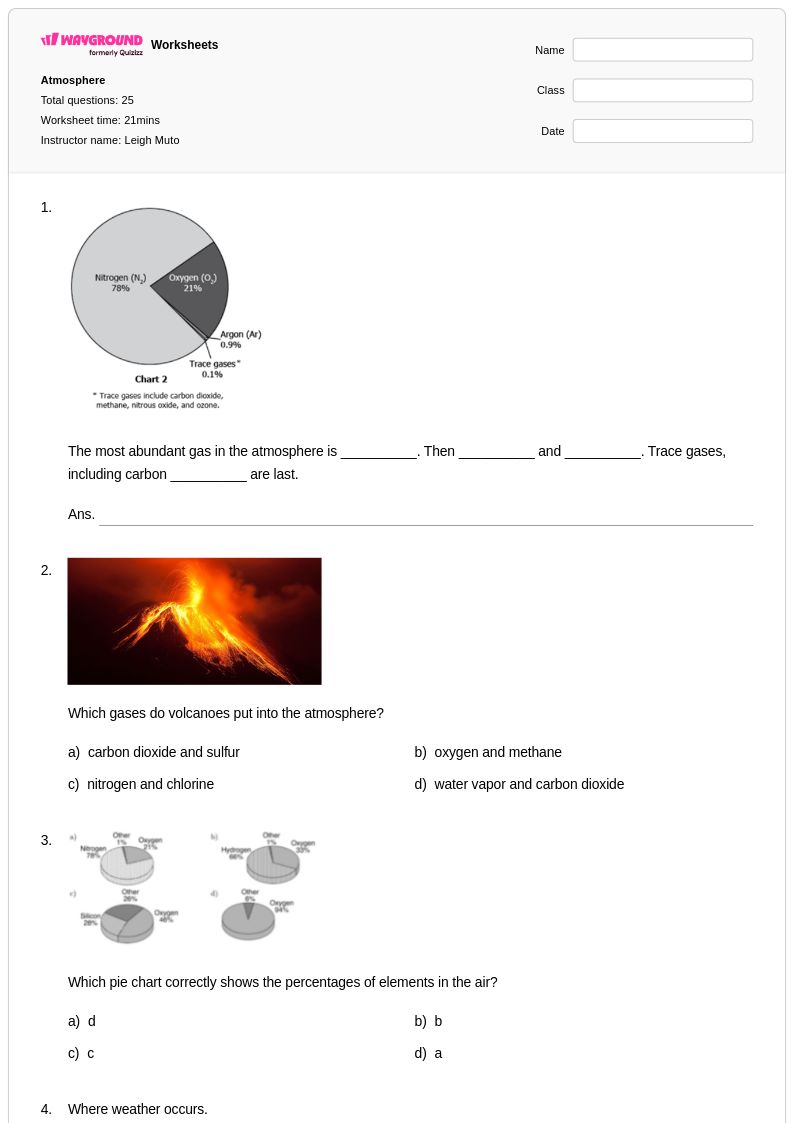
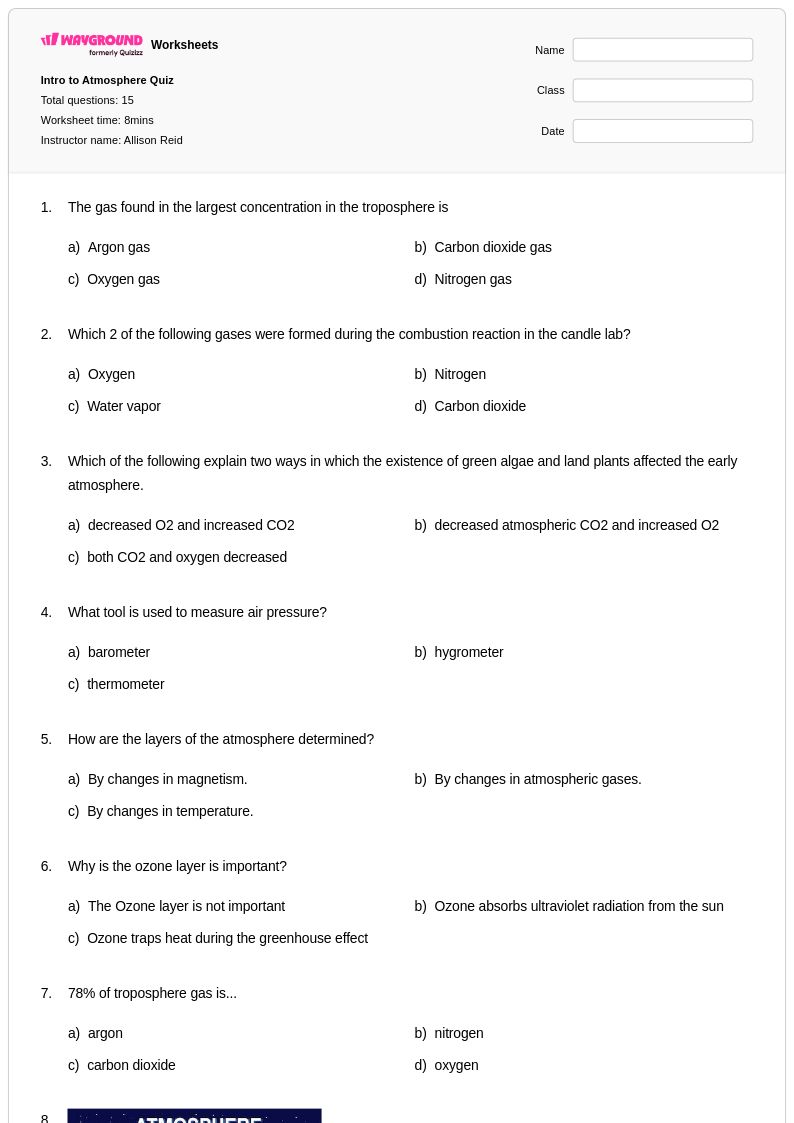
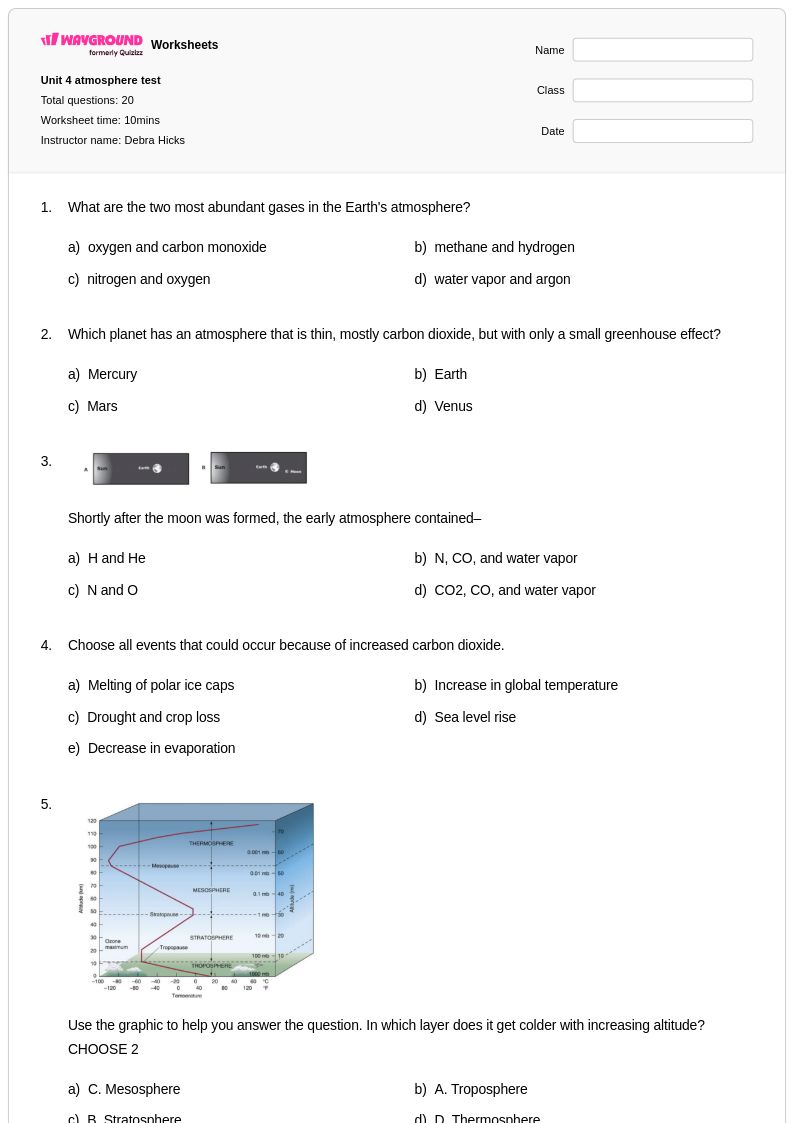
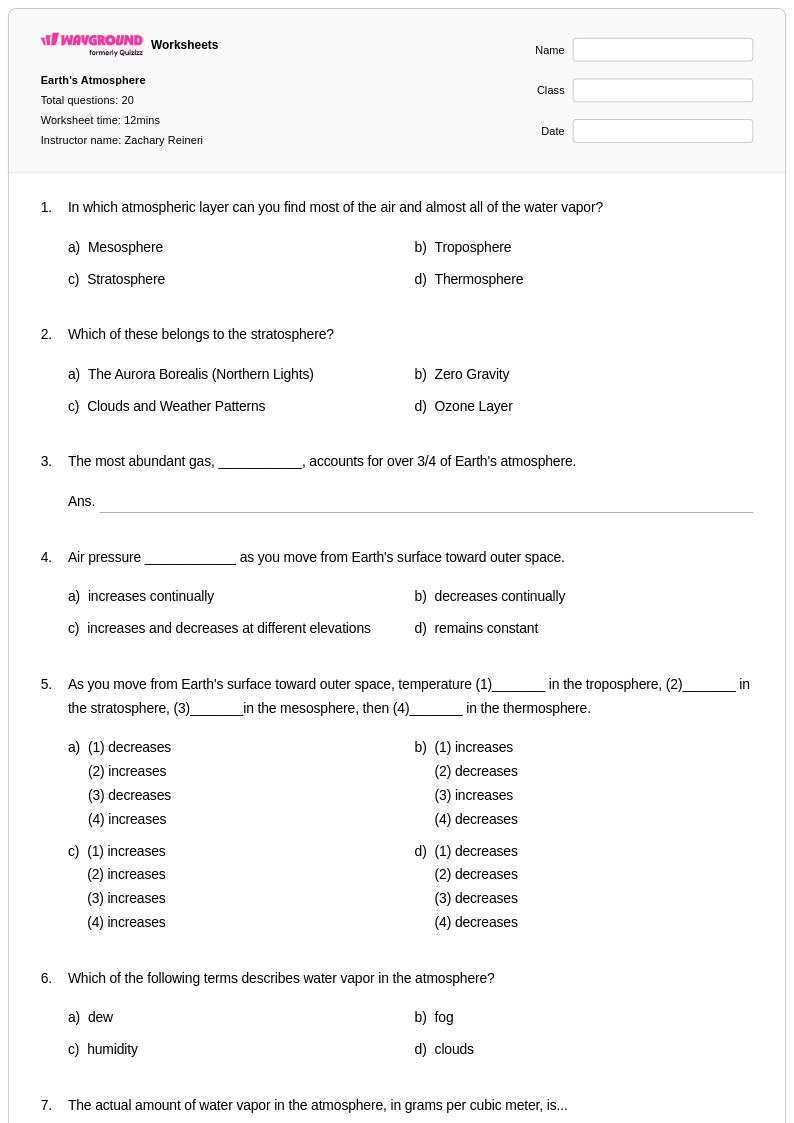
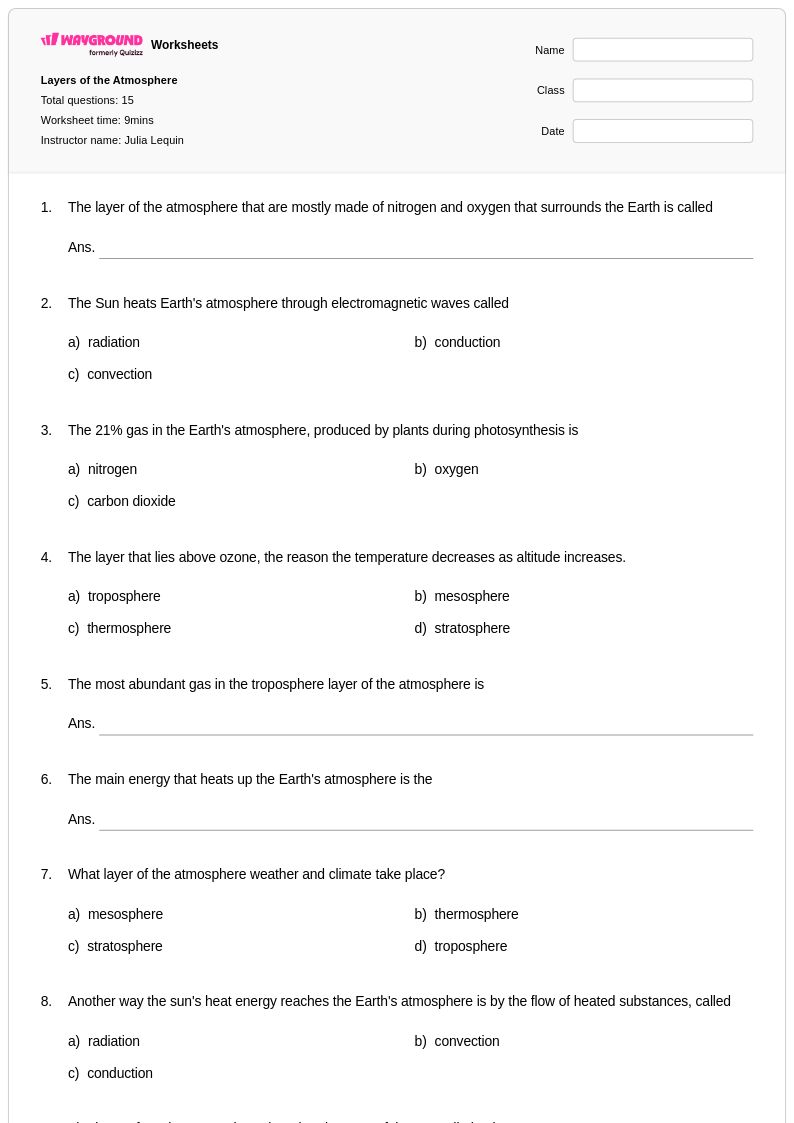
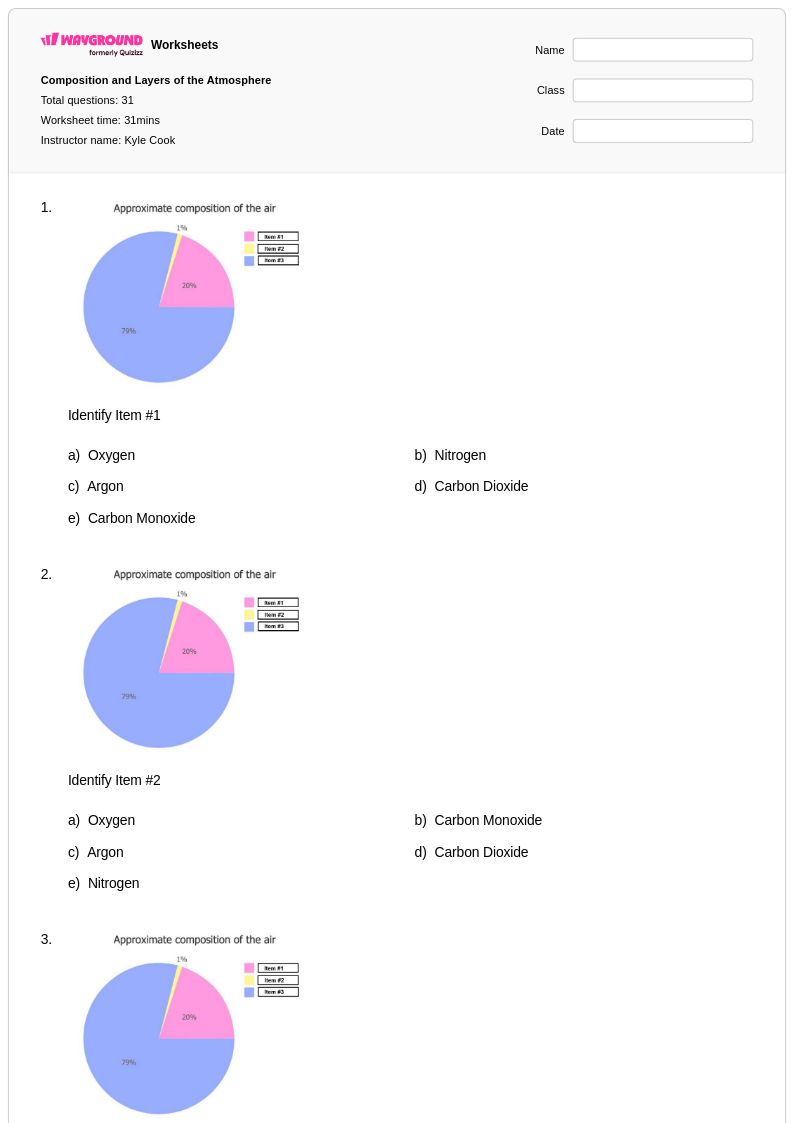
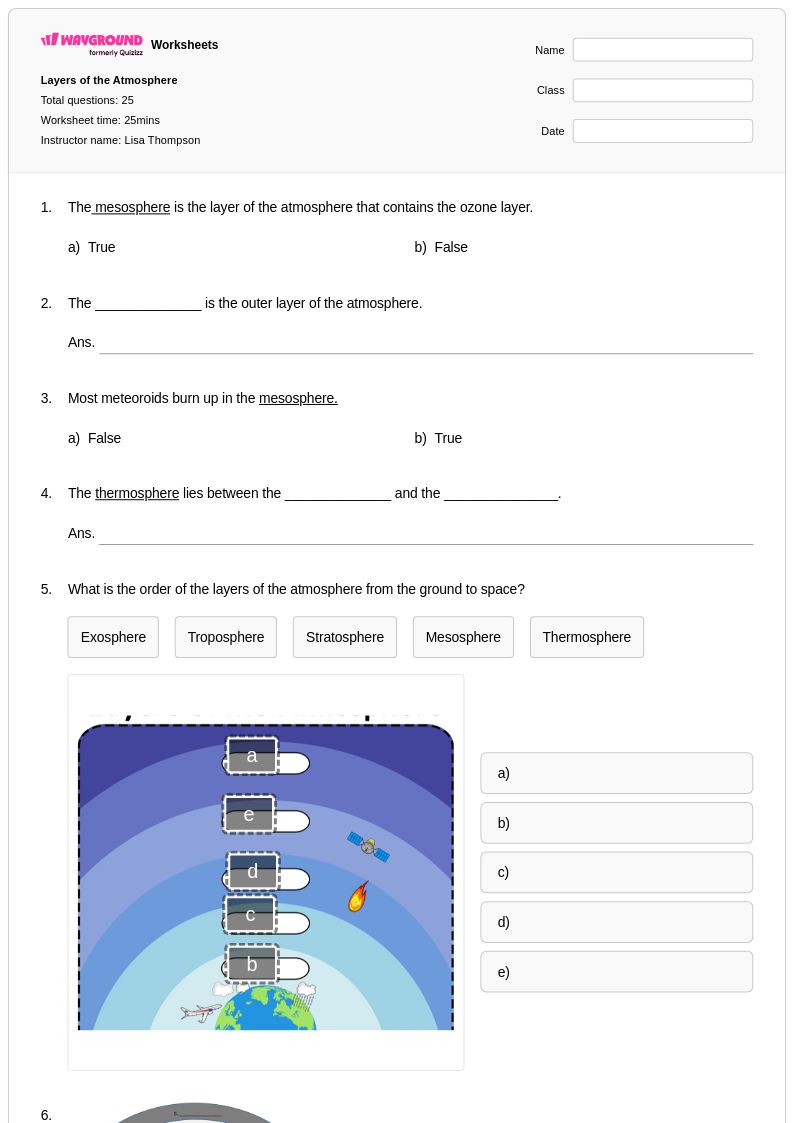
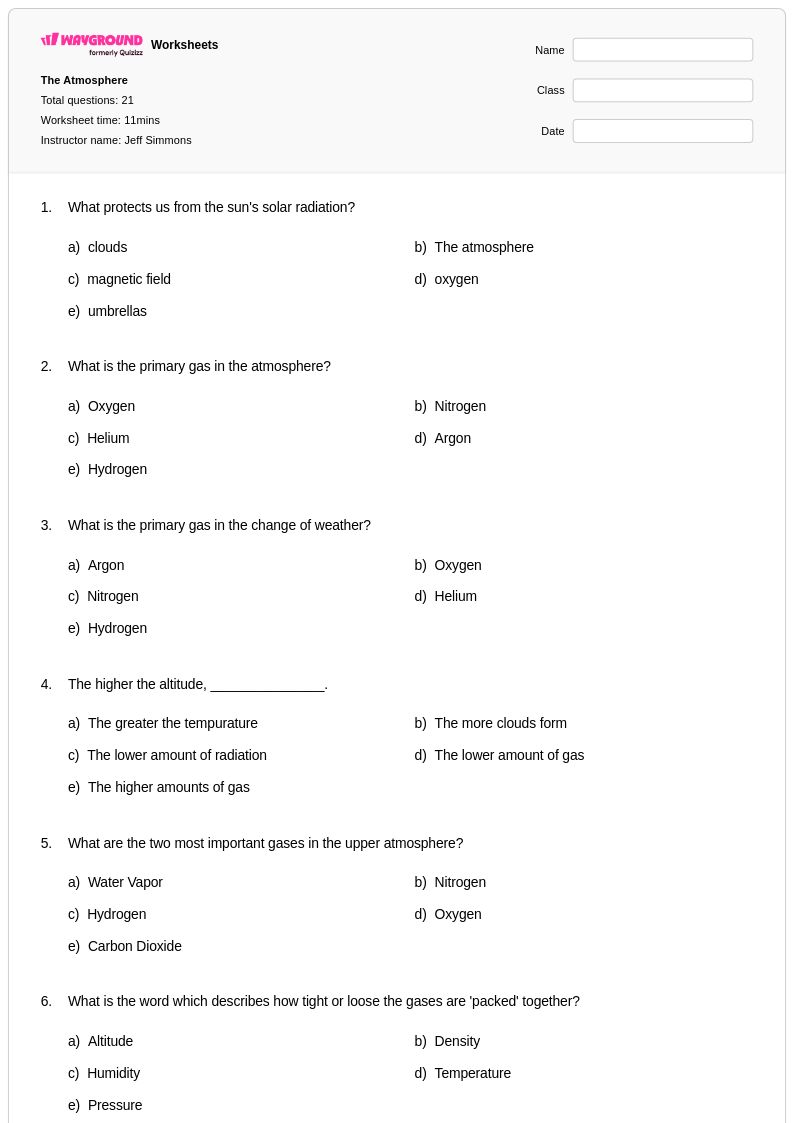
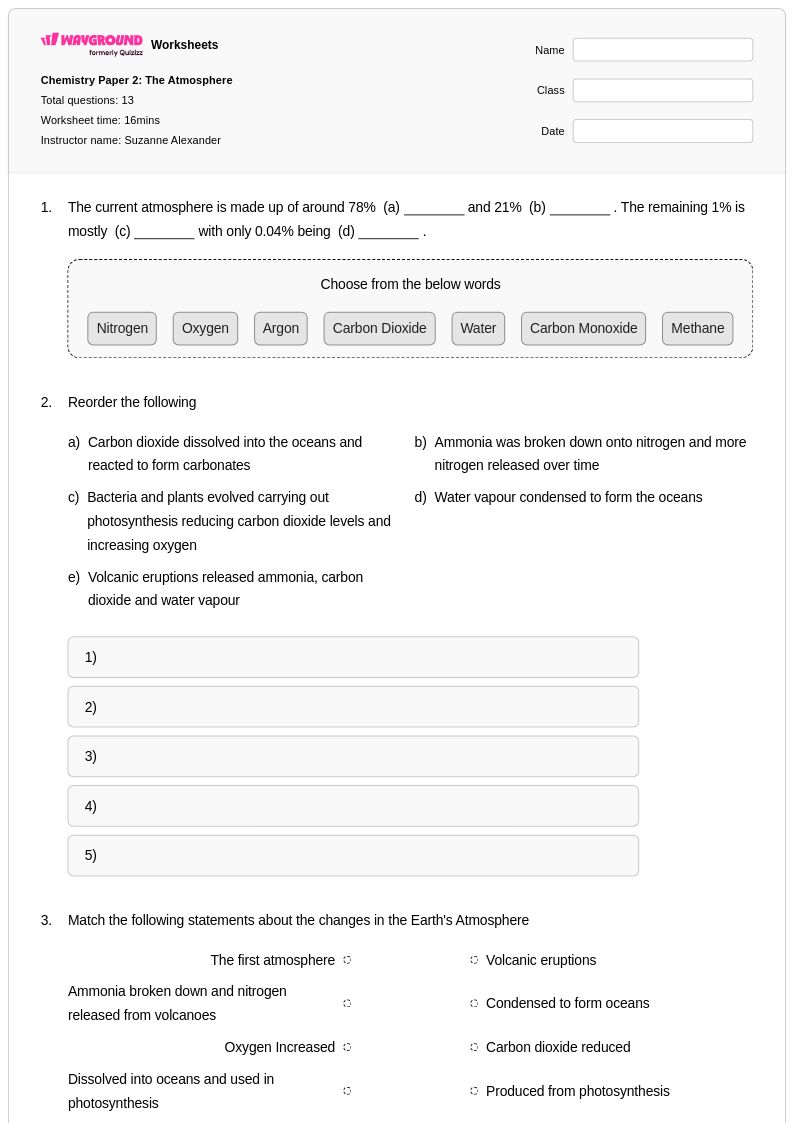
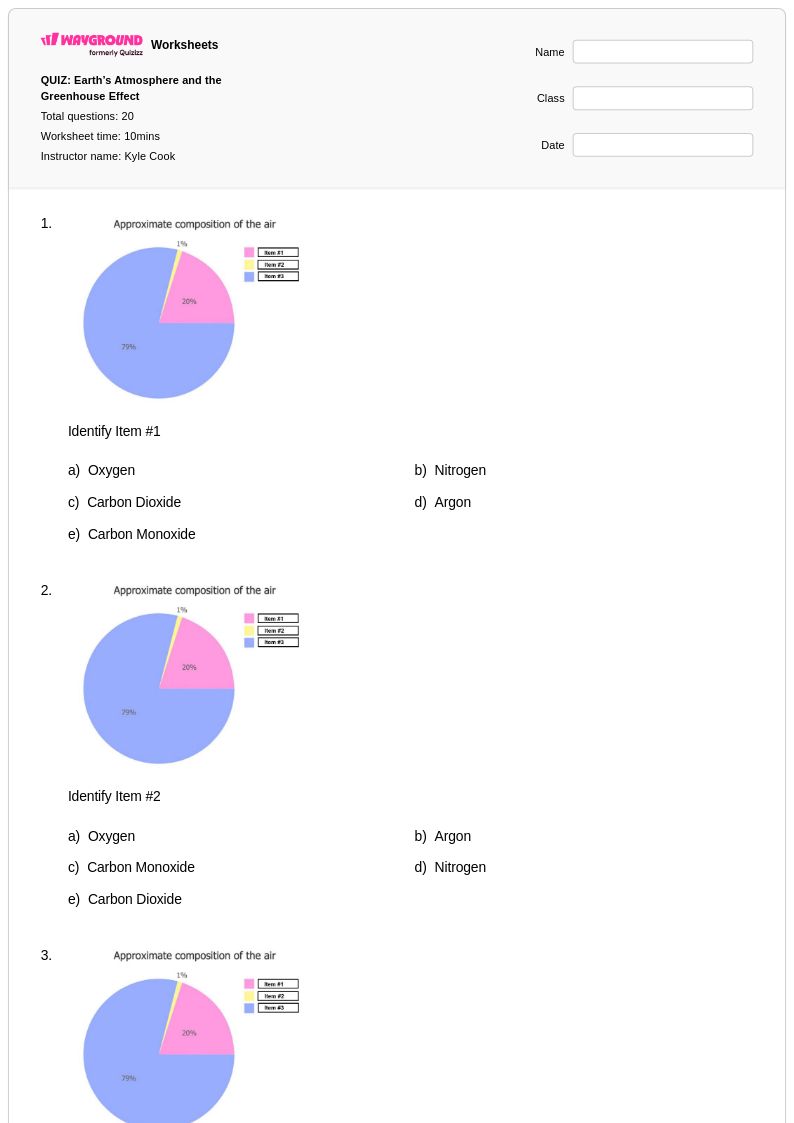
Atmosphere worksheets for Class 9 students through Wayground (formerly Quizizz) provide comprehensive coverage of Earth's atmospheric layers, composition, weather patterns, and climate systems. These expertly designed educational resources strengthen students' understanding of atmospheric pressure variations, greenhouse effects, ozone layer dynamics, and the water cycle's role in weather formation. The practice problems guide ninth graders through complex concepts including air mass movements, front formations, and the relationship between solar radiation and atmospheric heating. Each worksheet collection includes detailed answer keys that support both independent study and classroom instruction, with free printables available in convenient pdf formats that accommodate diverse learning environments and teaching approaches.
Wayground (formerly Quizizz) empowers educators with millions of teacher-created atmospheric science resources that streamline lesson planning and enhance student engagement. The platform's robust search and filtering capabilities allow teachers to quickly locate worksheets aligned with specific grade-level standards, covering everything from tropospheric phenomena to stratospheric chemistry. Advanced differentiation tools enable instructors to customize content complexity, ensuring appropriate challenge levels for varied student abilities while supporting both remediation for struggling learners and enrichment for advanced students. Available in both printable and digital formats including downloadable pdf versions, these atmospheric science worksheets facilitate flexible implementation across traditional classrooms, hybrid learning environments, and remote instruction scenarios, making quality earth science education accessible regardless of teaching constraints.
FAQs
How do I teach atmospheric layers to middle or high school students?
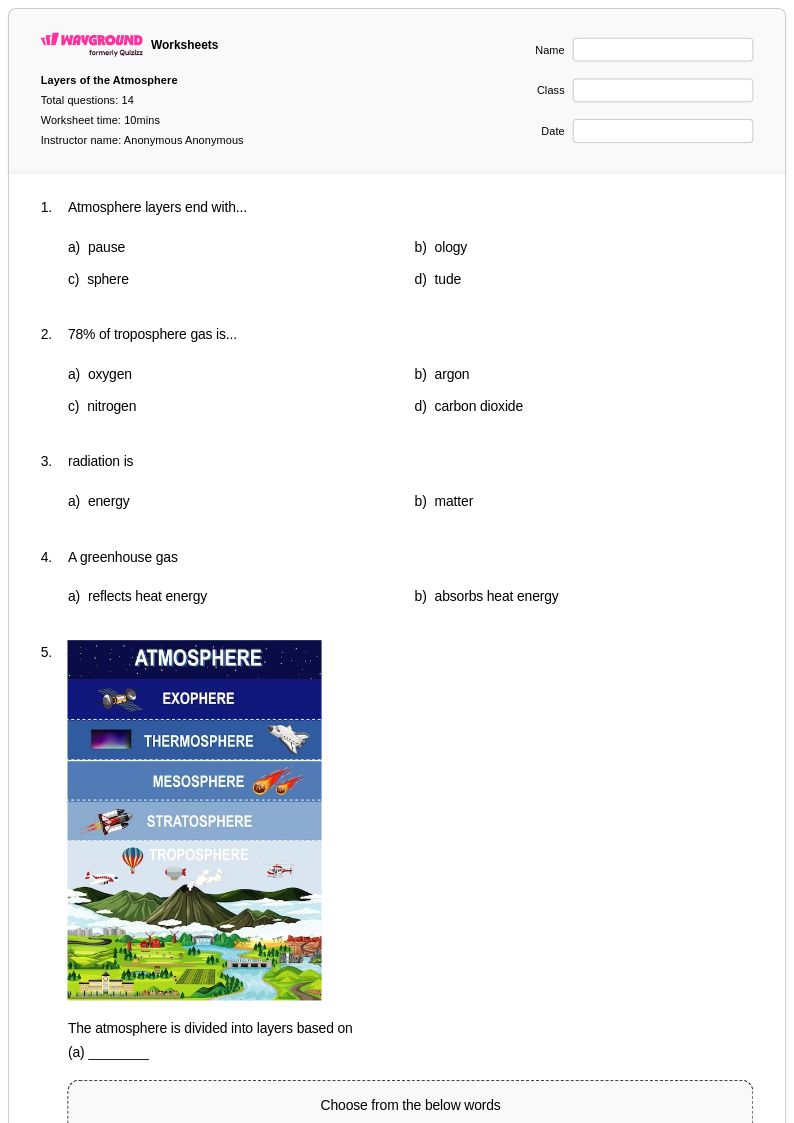
Start by anchoring instruction around altitude and temperature changes, since students often assume temperature decreases uniformly as altitude increases. Introduce each layer — troposphere, stratosphere, mesosphere, thermosphere, and exosphere — using data tables or graphs that show how temperature actually fluctuates. Connecting each layer to real-world phenomena, such as weather occurring in the troposphere and the ozone layer sitting in the stratosphere, helps students build durable mental models rather than memorizing isolated facts.
What exercises help students practice interpreting weather maps and atmospheric data?
Worksheets that ask students to read isobars, identify high and low pressure systems, and predict wind direction are especially effective for building weather map literacy. Practice problems that pair a weather map with follow-up questions about fronts, precipitation likelihood, and pressure gradients push students beyond simple identification toward analysis. Regularly cycling through atmospheric data interpretation exercises also builds the quantitative reasoning skills needed for standardized science assessments.
What misconceptions do students commonly have about air pressure and the atmosphere?
One of the most persistent misconceptions is that air has no weight, which causes students to struggle with understanding why atmospheric pressure decreases with altitude. Students also frequently confuse weather and climate, treating short-term atmospheric conditions as evidence of long-term patterns. Another common error is misidentifying where the ozone layer sits, with many students placing it at the edge of the atmosphere rather than in the stratosphere.
How do I help students understand the relationship between solar radiation and atmospheric gases?
Students benefit from guided practice that traces the path of solar energy from entry into the atmosphere through absorption, reflection, and re-radiation. Worksheets that ask students to explain why greenhouse gases trap outgoing longwave radiation — rather than incoming shortwave radiation — directly address a common conceptual gap. Linking this mechanism explicitly to climate change discussions gives the concept relevance and helps students connect atmospheric science to environmental impact.
How can I use Wayground's atmosphere worksheets in my classroom?
Wayground's atmosphere worksheets are available as printable PDFs for traditional classroom use and in digital formats for technology-integrated learning environments, so they work whether students are completing work on paper or on a device. Teachers can also host the worksheets as a live quiz directly on Wayground, which allows for real-time participation and immediate scoring. For students who need additional support, Wayground offers built-in accommodations such as read aloud, extended time, and reduced answer choices, all configurable per student without disrupting the rest of the class.
How do I differentiate atmosphere instruction for students at different skill levels?
For students still building foundational knowledge, worksheets focused on layer identification and basic atmospheric composition provide necessary scaffolding before moving to pressure and radiation concepts. Advanced learners benefit from problems that require them to analyze atmospheric data, model climate interactions, or evaluate the impact of human activities on air quality. Wayground's differentiation tools allow teachers to adjust content complexity and assign individual accommodations — such as reduced answer choices or font adjustments through reading mode — so each student is appropriately challenged within the same lesson.