Free Printable Caste System in India Worksheets for Class 11
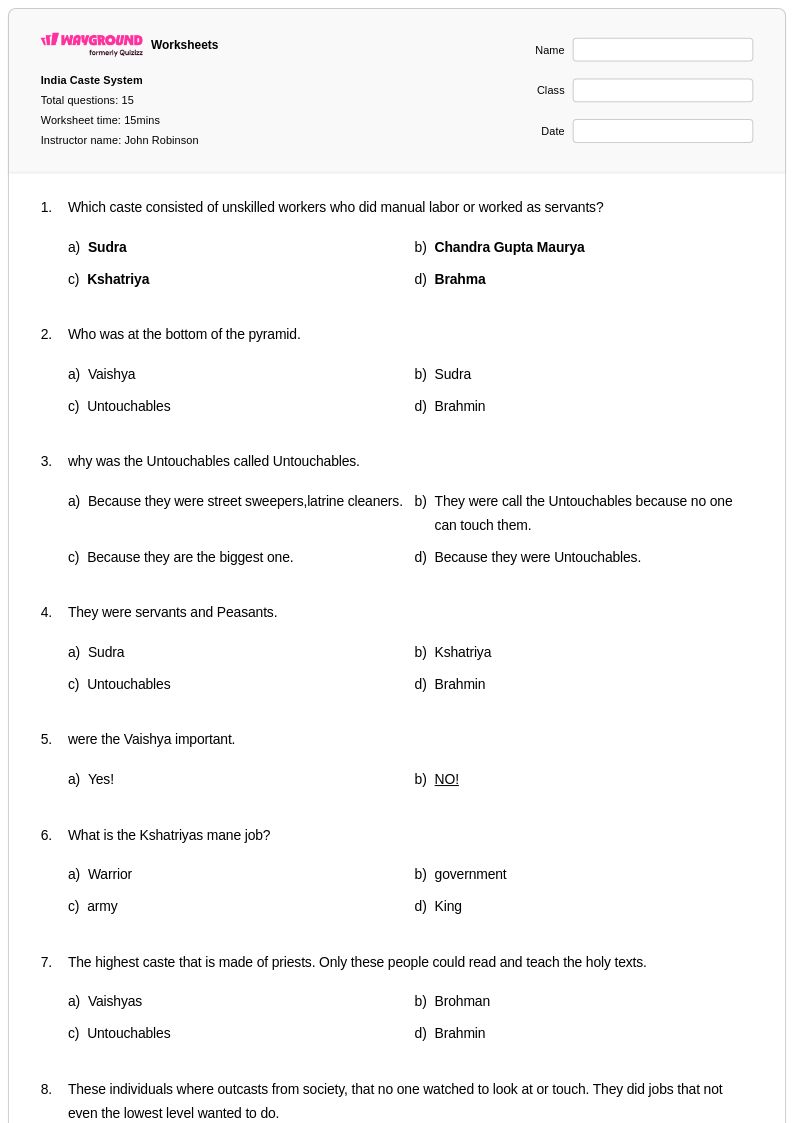
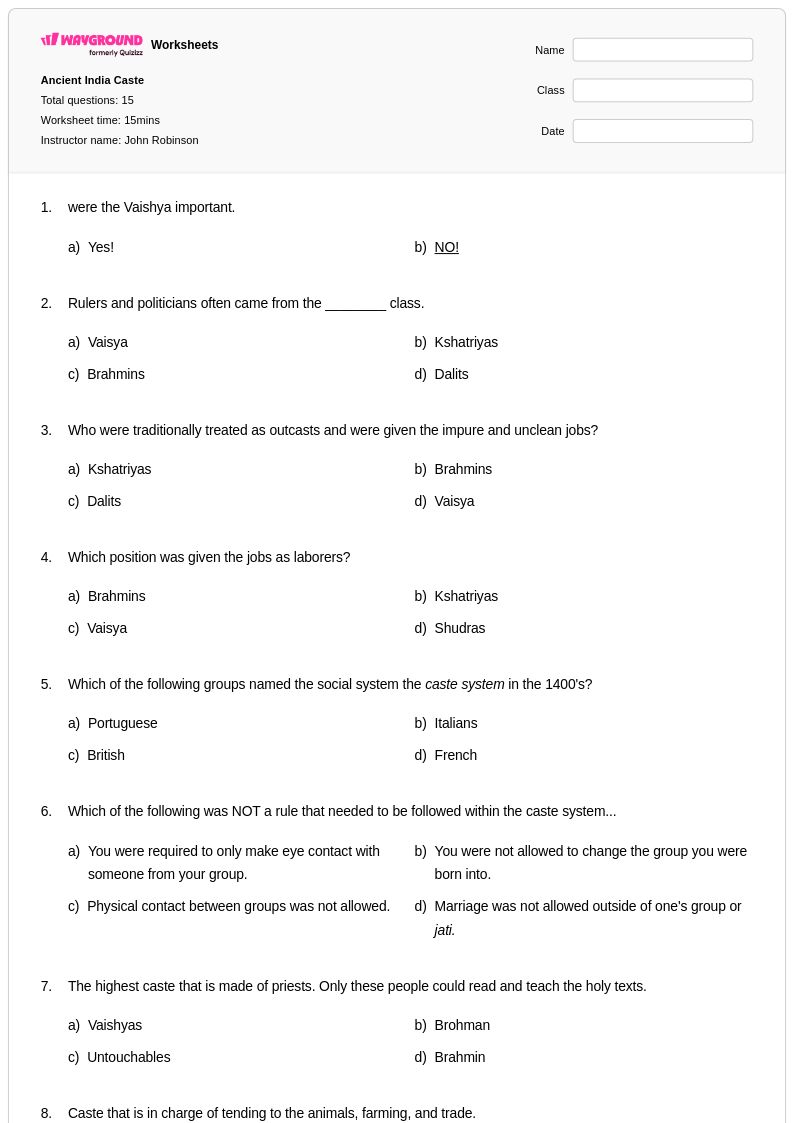
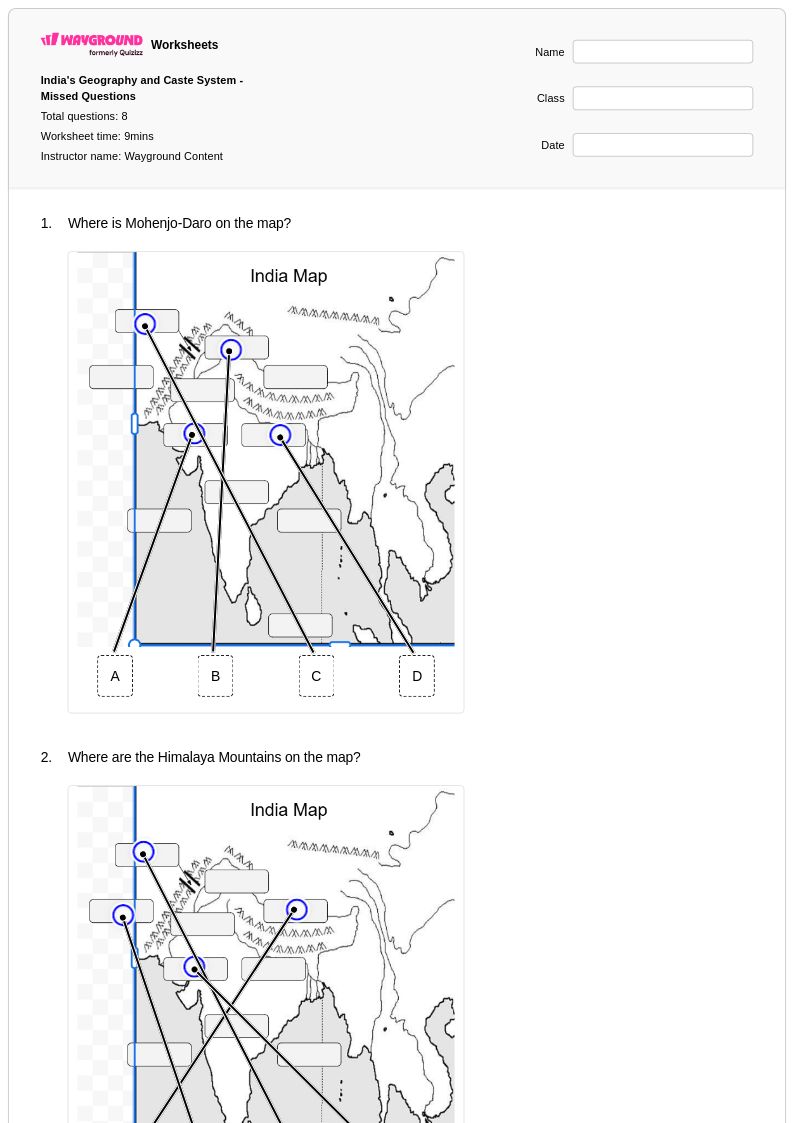
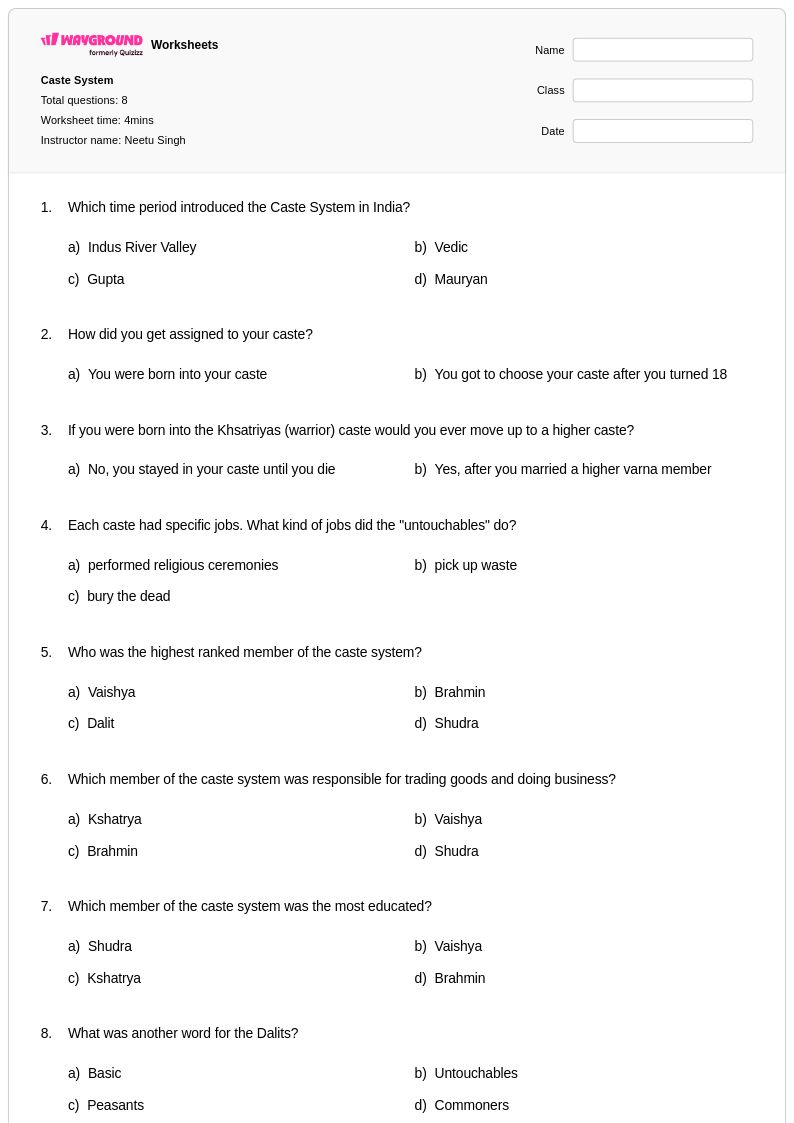
Explore Class 11 free worksheets and printables on India's Caste System through Wayground, featuring practice problems and answer keys to help students understand this complex social hierarchy in world history.
Explore printable Caste System in India worksheets for Class 11
The Caste System in India worksheets available through Wayground (formerly Quizizz) provide Class 11 students with comprehensive resources to examine one of the most enduring and complex social structures in world history. These expertly crafted materials guide students through the historical origins, religious foundations, and hierarchical organization of India's traditional caste system, helping them analyze how this social stratification has influenced centuries of Indian civilization. The worksheets strengthen critical thinking skills by encouraging students to evaluate primary sources, compare different perspectives on caste roles and restrictions, and assess the ongoing impact of caste dynamics in modern India. Each resource includes detailed answer keys and practice problems that reinforce understanding of key concepts such as varna classifications, jati subdivisions, and the concept of dharma, while free printable pdf formats ensure easy classroom implementation and student accessibility.
Wayground (formerly Quizizz) supports educators with an extensive collection of teacher-created resources covering the Indian Caste System, drawn from millions of high-quality materials that undergo rigorous content review and standards alignment. The platform's advanced search and filtering capabilities allow teachers to quickly locate worksheets that match their specific curriculum needs, grade level requirements, and student proficiency levels. Differentiation tools enable educators to customize content complexity and provide targeted support for diverse learners, while flexible formatting options include both digital and printable pdf versions to accommodate various teaching environments. These comprehensive worksheet collections prove invaluable for lesson planning, providing structured practice opportunities, supporting remediation efforts for struggling students, and offering enrichment activities that deepen understanding of how historical social systems continue to shape contemporary global societies.
FAQs
How do I teach the caste system in India to middle or high school students?
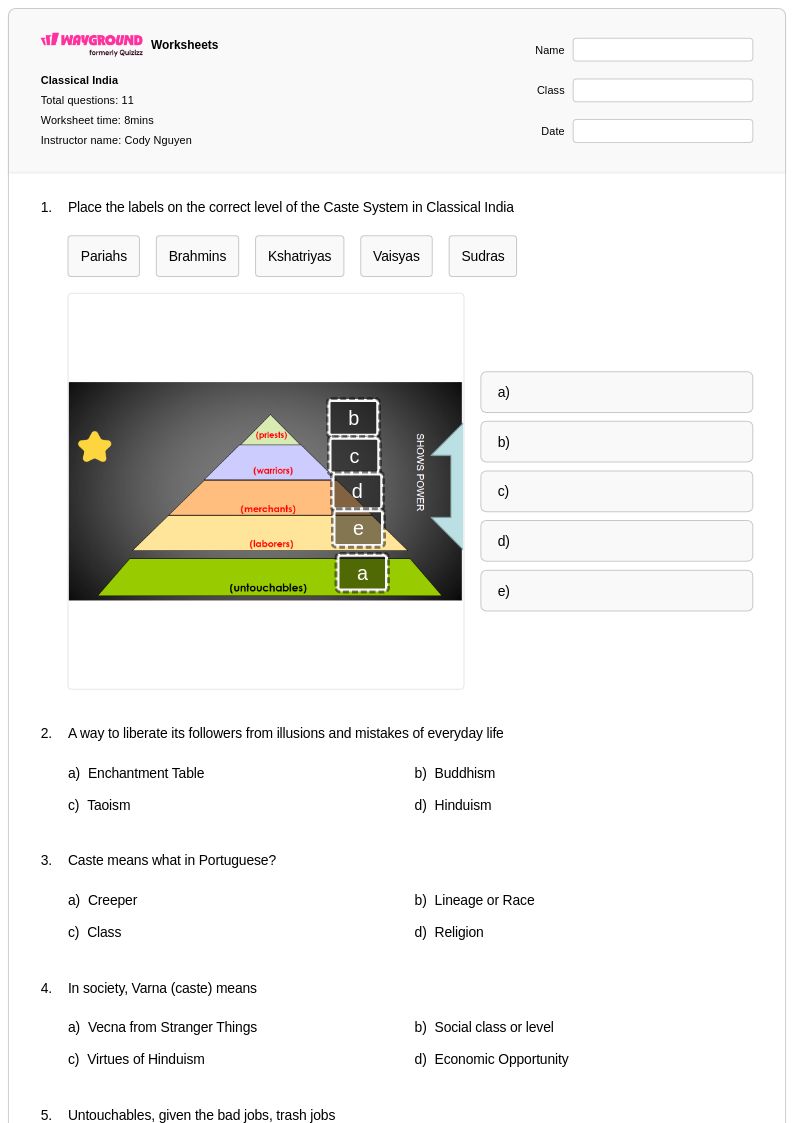
Start by grounding students in the four primary varnas (Brahmin, Kshatriya, Vaishya, and Shudra) and the position of the so-called 'untouchables' outside the varna system before expanding to broader social and economic implications. Using primary source documents alongside comparative analysis, such as connecting India's caste system to other historical social stratification systems, helps students build context rather than viewing caste as an isolated phenomenon. Framing discussions around social justice and human rights gives students a lens for evaluating both historical and contemporary consequences of caste-based discrimination.
What exercises help students practice and understand the caste system in India?
Effective practice exercises include document analysis tasks where students examine historical texts describing varna roles and social restrictions, as well as comparative activities that ask students to identify similarities and differences between the Indian caste system and other hierarchical societies. Structured reflection prompts that ask students to evaluate how caste-based restrictions on social mobility shaped daily life in ancient India, and how their legacy persists in modern Indian society, reinforce both content knowledge and critical thinking. Answer-key-supported worksheets allow students to self-check their understanding of key vocabulary, social structures, and cause-and-effect relationships.
What misconceptions do students commonly have about the caste system in India?
A frequent misconception is that the caste system is purely a religious artifact with no ongoing relevance, when in fact its influence persists in contemporary Indian society through economic inequality, marriage practices, and political representation. Students also often conflate varna (the classical fourfold division) with jati (the thousands of hereditary occupational communities that operate within it), which leads to oversimplification of how the system functioned in practice. Another common error is treating 'untouchability' as a minor footnote rather than a defining feature of the system that affected tens of millions of people and was formally outlawed by the Indian Constitution in 1950.
How do I handle the caste system as a sensitive topic in a social studies classroom?
Approach the caste system the same way you would other systemic discrimination topics: establish clear community norms for discussion, center the experiences and perspectives of those who were marginalized by the system, and connect historical analysis to broader human rights frameworks. Avoid presenting the caste system as uniquely 'other' or exotic; drawing explicit comparisons to other stratification systems students have studied, such as feudalism or Jim Crow, helps build empathy and analytical rigor simultaneously. Using structured discussion protocols and scaffolded reading tasks ensures that emotionally charged content is processed thoughtfully rather than reactively.
How can I use Wayground's caste system in India worksheets in my classroom?
Wayground's caste system worksheets are available as printable PDFs for traditional classroom distribution and in digital formats for technology-integrated or hybrid learning environments, giving teachers flexibility in how they deploy the materials. Teachers can also host worksheets as a live quiz on Wayground, making them suitable for formative assessment, whole-class review, or independent practice. Each worksheet includes detailed answer keys, so they work equally well for guided instruction, independent study, or remediation activities.
How can I differentiate caste system instruction for students with different learning needs?
For students who need additional support, simplifying source texts and reducing the number of answer choices on assessment questions can lower cognitive load without removing conceptual rigor. Wayground's platform supports individual accommodations including read-aloud functionality for students who benefit from audio delivery of content, extended time settings, and adjustable font sizes and themes through reading mode, all of which can be configured per student without affecting the experience of the rest of the class. For advanced learners, extending activities to include evaluation of modern court cases, constitutional provisions against caste discrimination, or comparative social justice essays deepens analytical engagement with the topic.