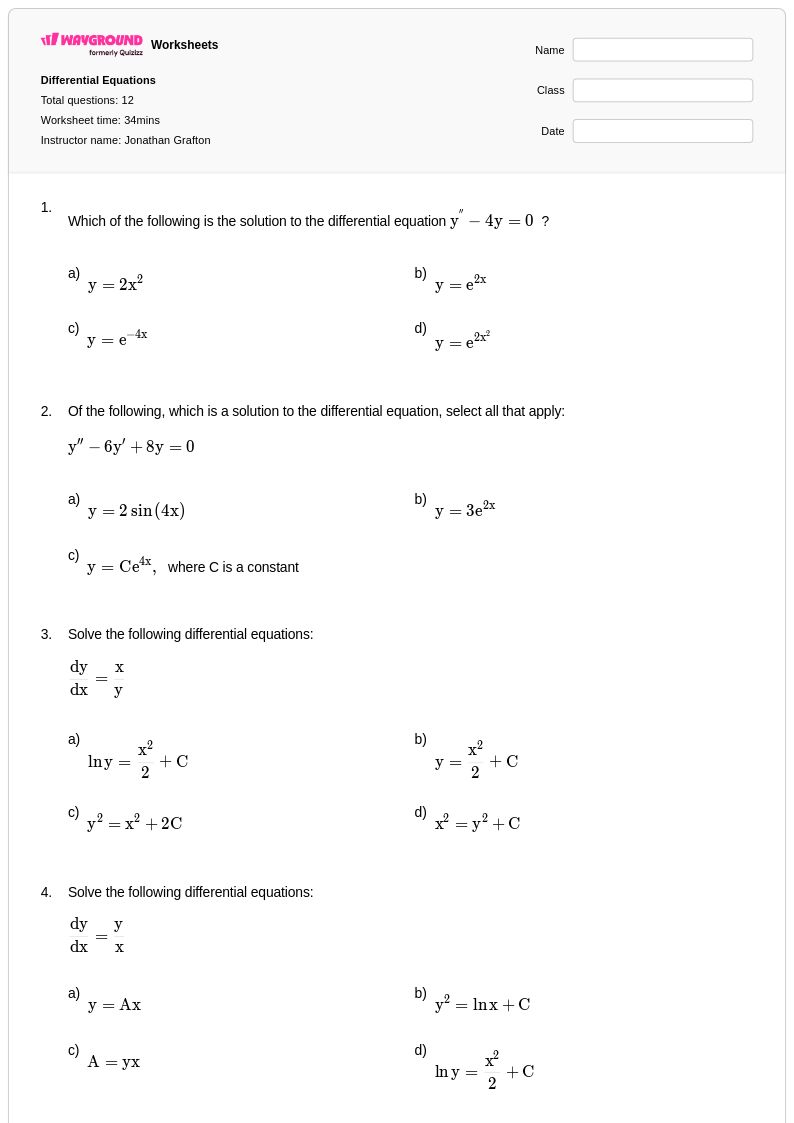
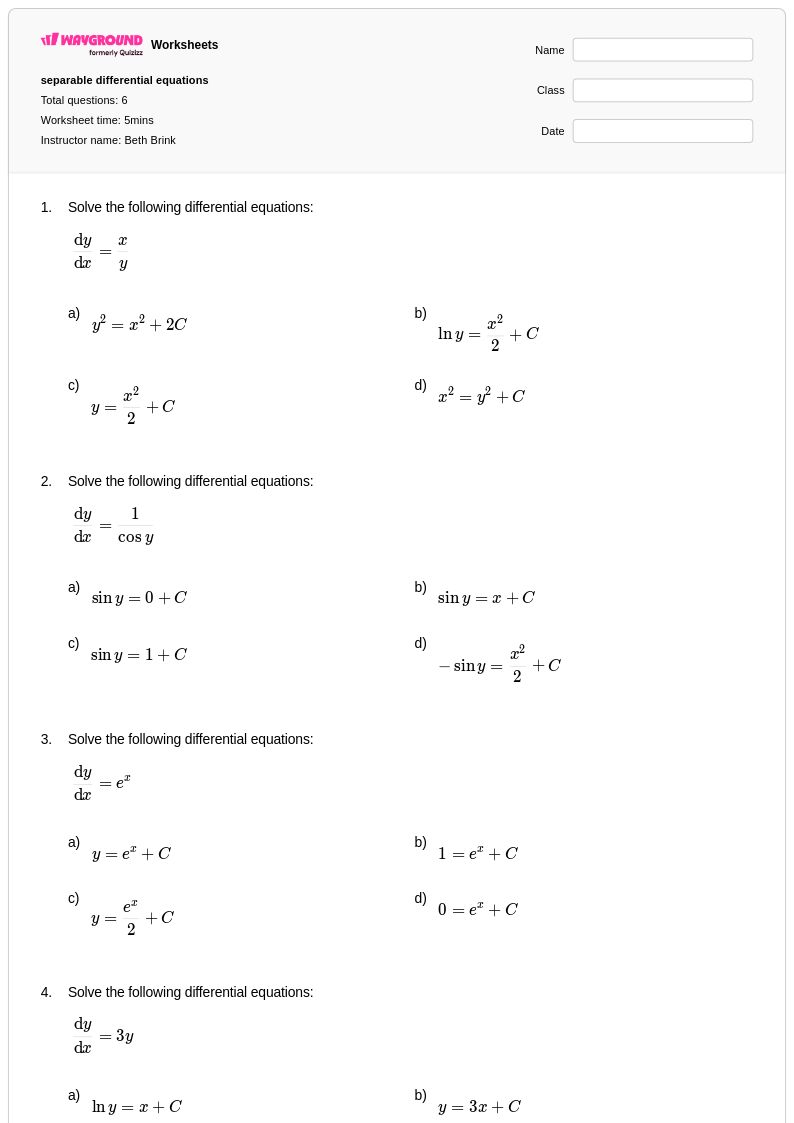
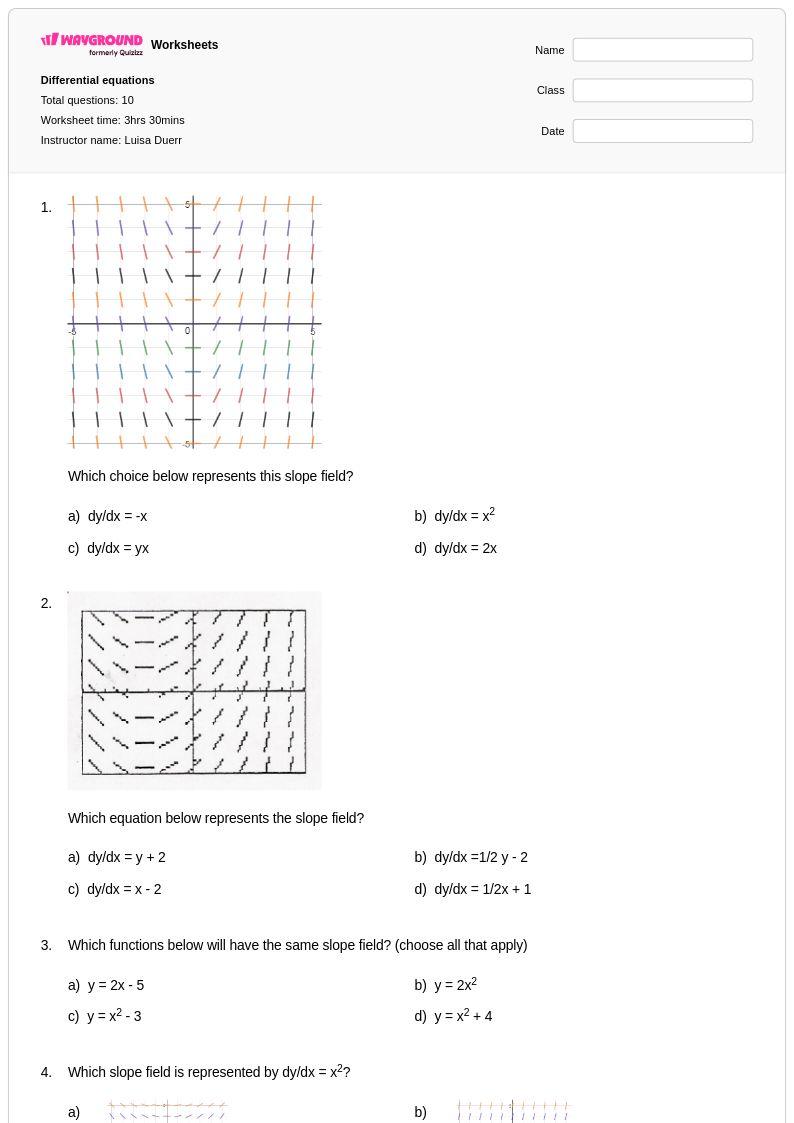
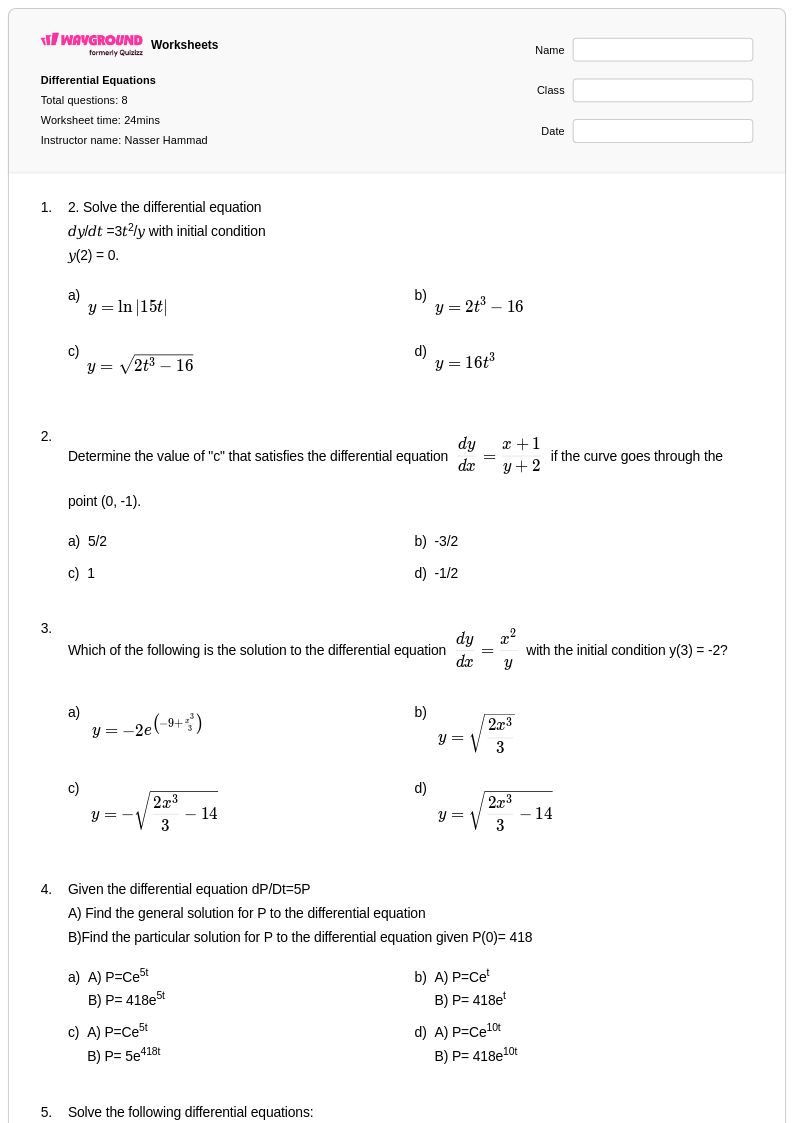
Free differential equations worksheets and printables help students master solving first-order equations, separable equations, and initial value problems through comprehensive practice problems with detailed answer keys.
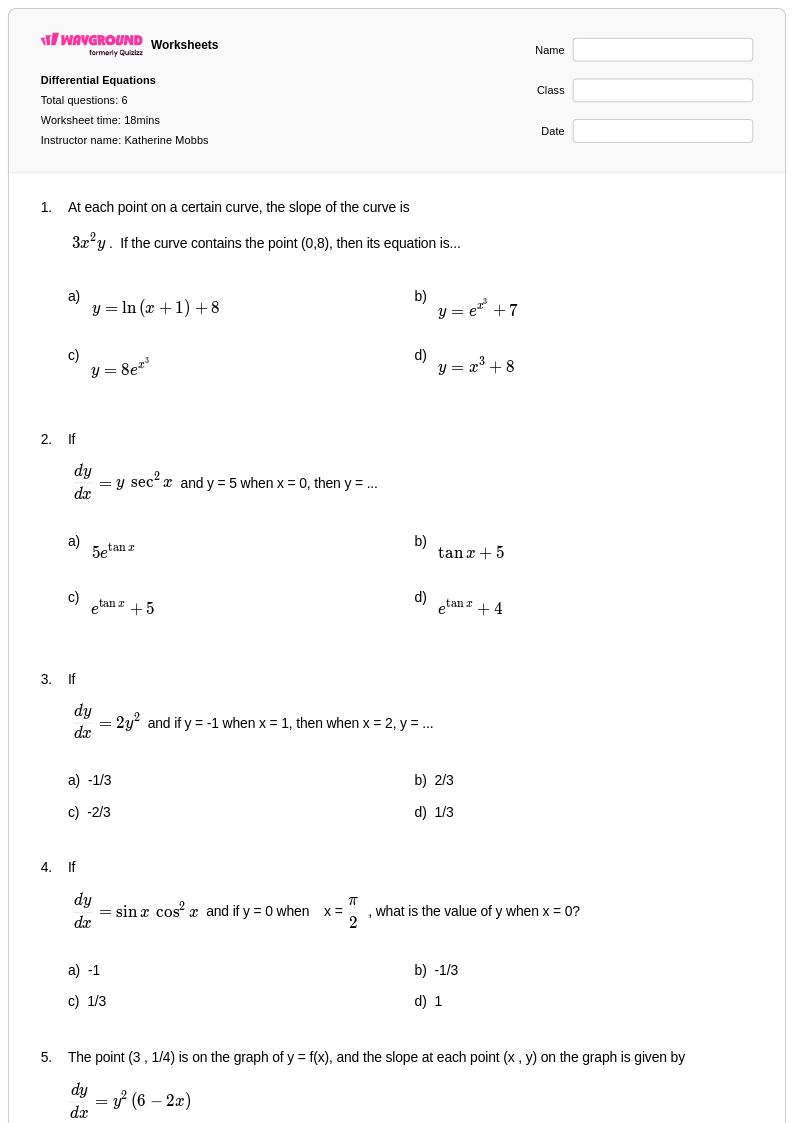
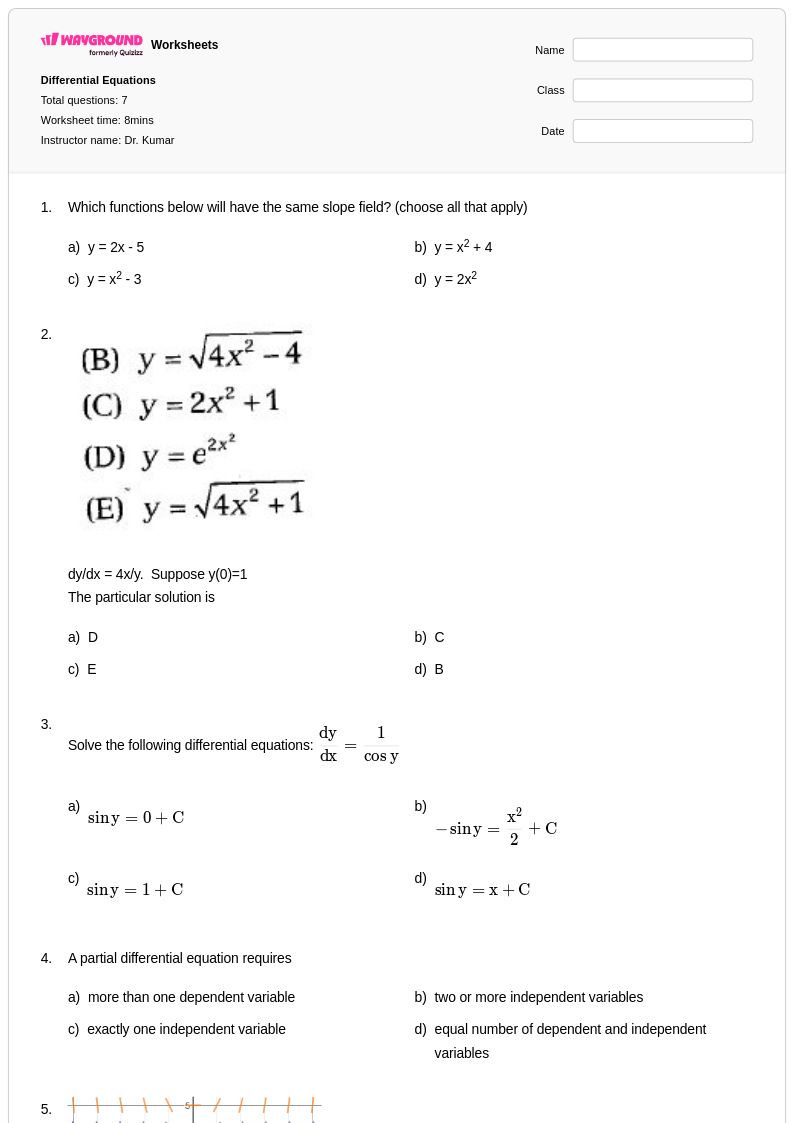
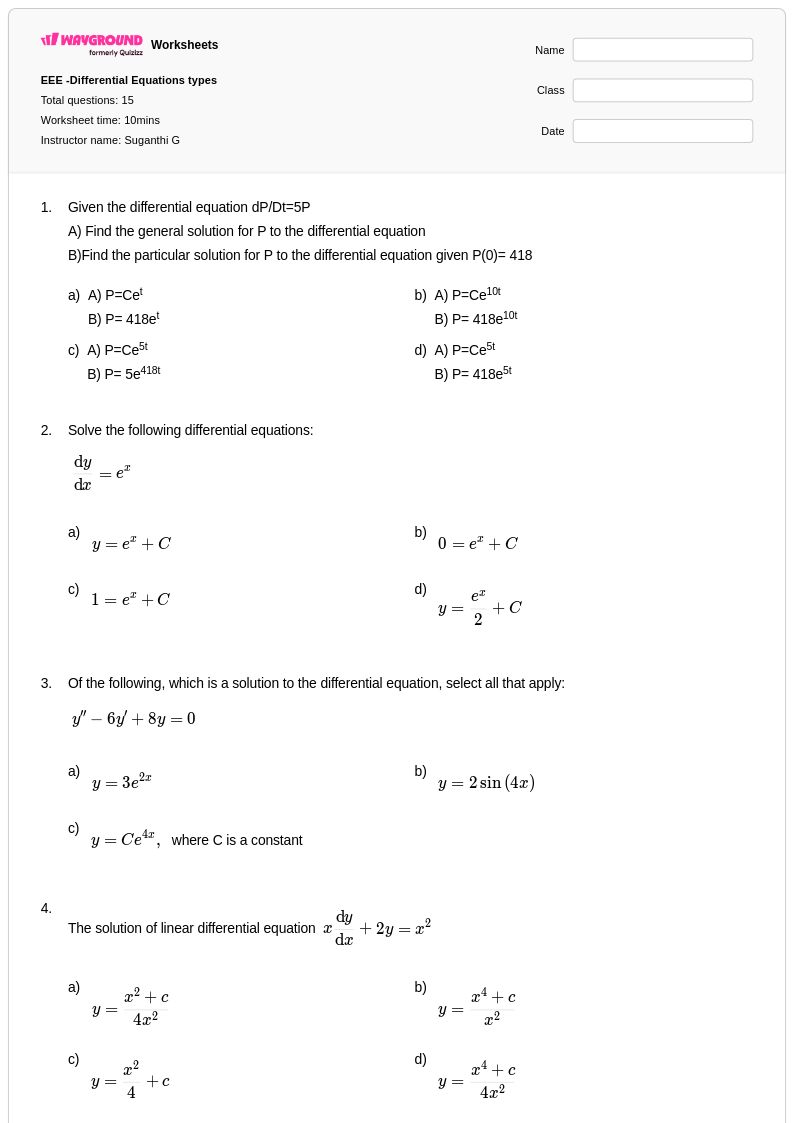
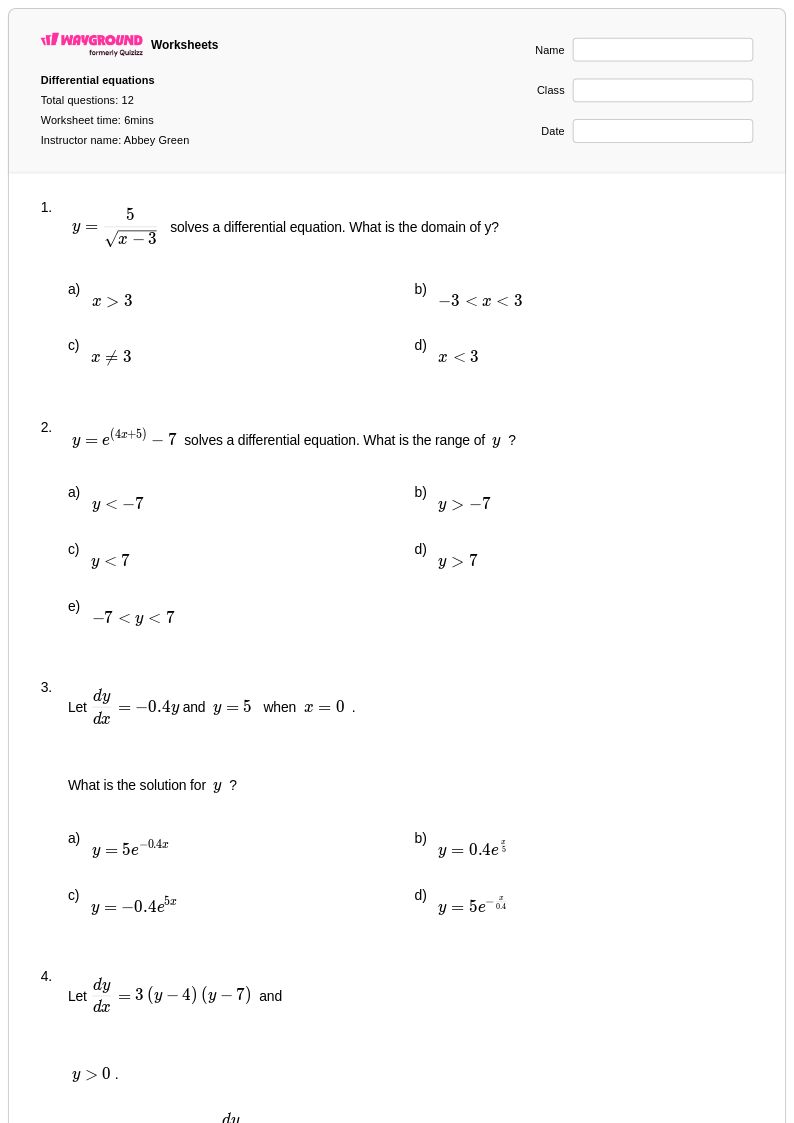
Differential equations worksheets available through Wayground (formerly Quizizz) provide comprehensive practice materials that strengthen students' ability to solve and analyze mathematical relationships involving rates of change. These expertly crafted resources cover essential differential equation concepts including separable equations, first-order linear equations, exact equations, and applications to real-world scenarios such as population growth and cooling problems. Each worksheet collection includes detailed answer keys that guide students through step-by-step solution processes, while free printable pdf formats ensure accessibility for both classroom instruction and independent study. The practice problems progress systematically from basic separation of variables techniques to more complex scenarios involving integrating factors and boundary conditions, helping students build confidence in this challenging area of advanced mathematics.
Wayground (formerly Quizizz) empowers mathematics educators with millions of teacher-created differential equations resources that streamline lesson planning and enhance student outcomes. The platform's robust search and filtering capabilities allow instructors to quickly locate worksheets aligned with specific curriculum standards and learning objectives, while built-in differentiation tools enable customization for diverse skill levels within the same classroom. Teachers can seamlessly adapt existing materials or create new assessments using flexible formatting options, with resources available in both digital and printable pdf formats to accommodate various learning environments. These comprehensive worksheet collections support targeted remediation for struggling students, provide enrichment opportunities for advanced learners, and offer systematic skill practice that reinforces the complex problem-solving strategies essential for mastering differential equations.
FAQs
How do I teach differential equations effectively?
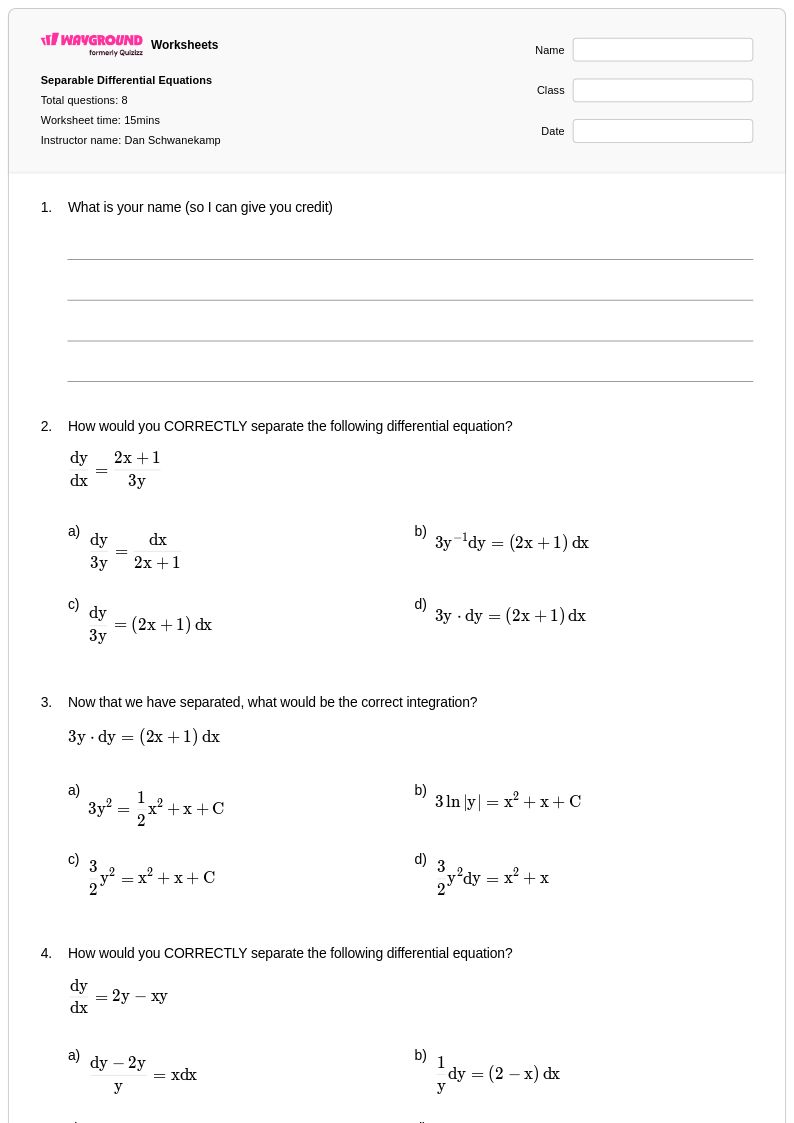
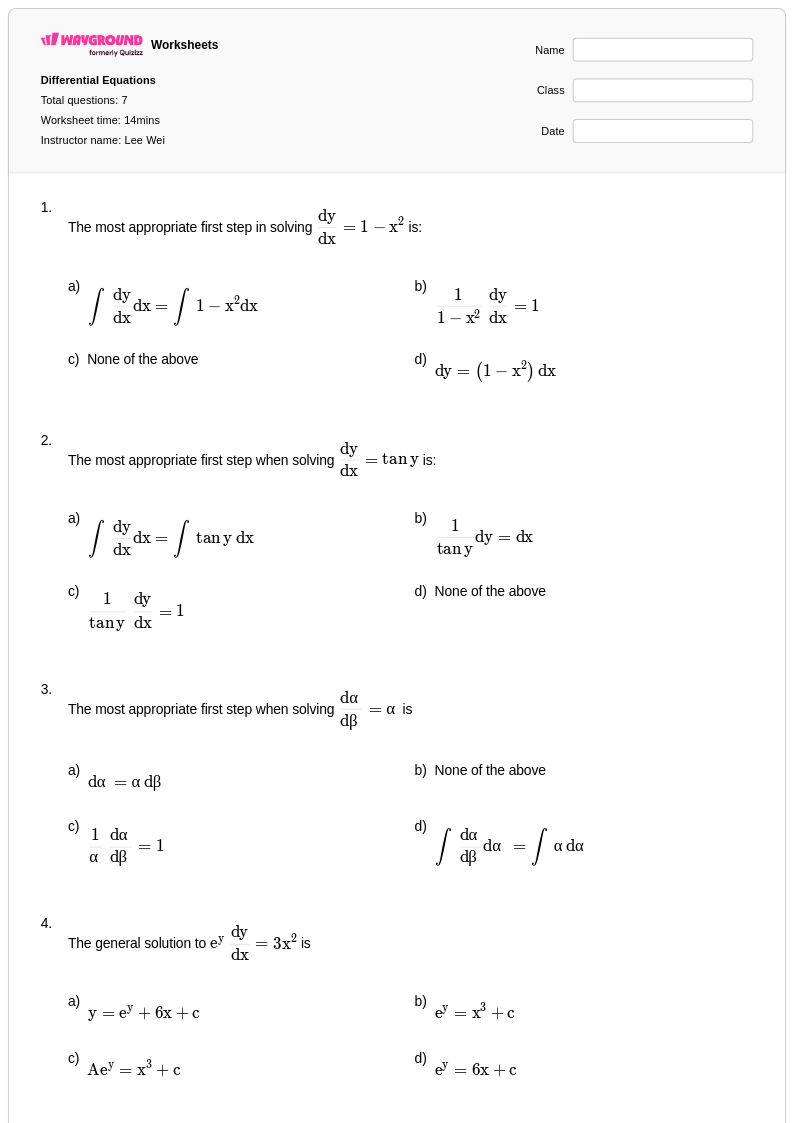
Start with the concept of a rate of change before introducing any notation, students who understand what dy/dx represents physically will set up equations far more reliably than those who jump straight to procedures. From there, separable equations make the best entry point: the algebra is manageable, and students can see the full solution process end to end. Once separation of variables is solid, first-order linear equations and integrating factors follow naturally. Grounding each technique in a real context, population growth, Newton's law of cooling, gives students a reason to care about the method, not just the mechanics.
What practice exercises help students get better at differential equations?
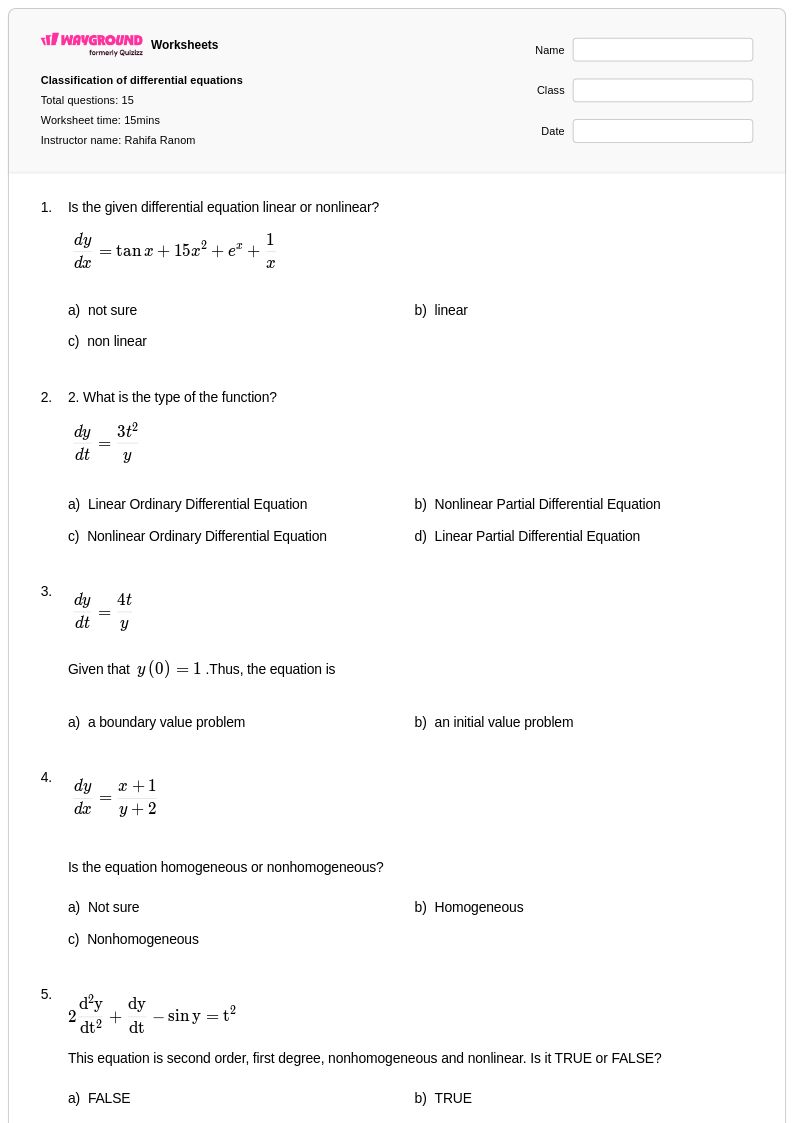
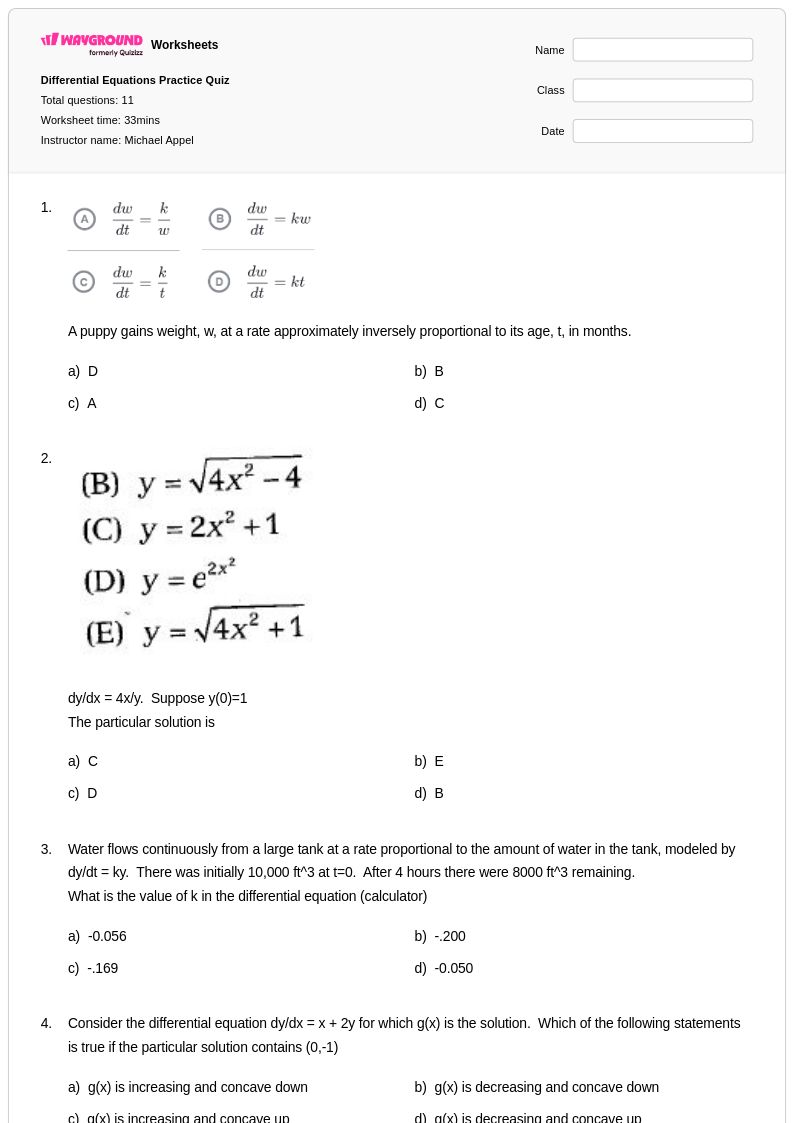
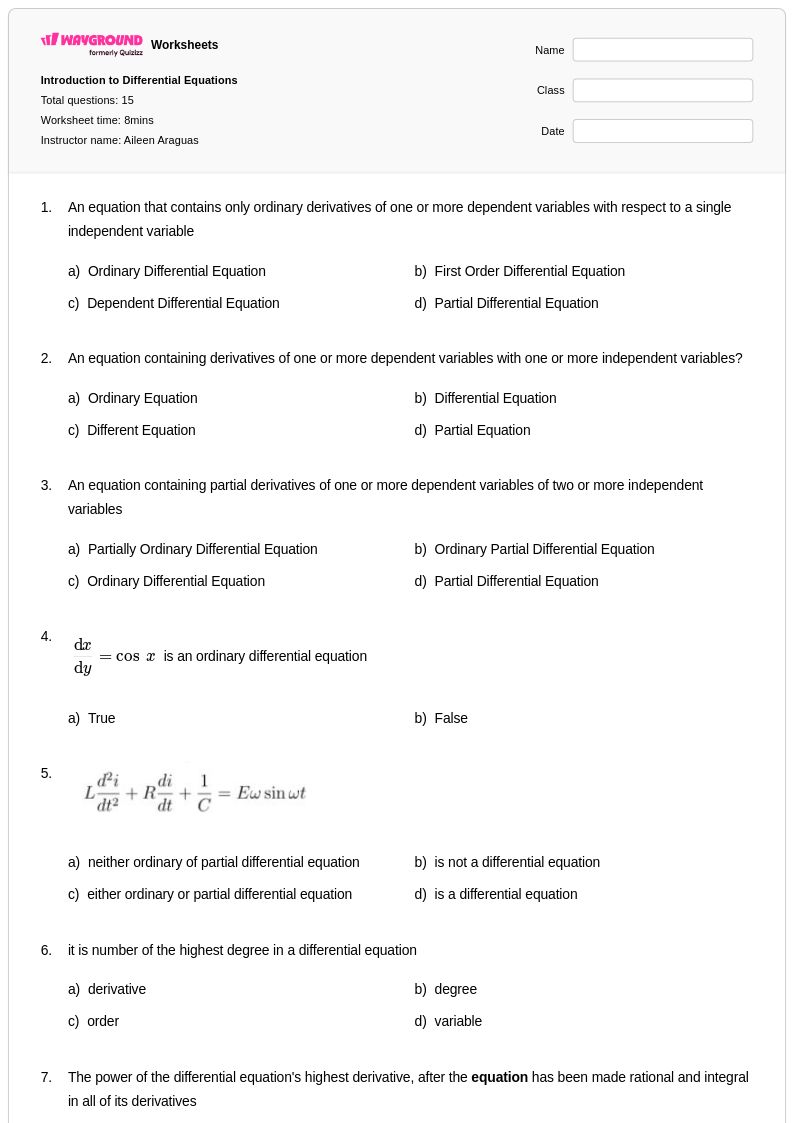
The most effective practice moves students through three stages: identifying the equation type, choosing the right method, and verifying the solution by substituting back. Worksheets that mix equation types on the same page, rather than drilling one method in isolation, build the classification skill that exams actually test. Applied problems (cooling, growth/decay, mixing) are worth including early, not just as enrichment, because they force students to set up the equation themselves rather than just solve one handed to them.
What mistakes do students commonly make with differential equations?
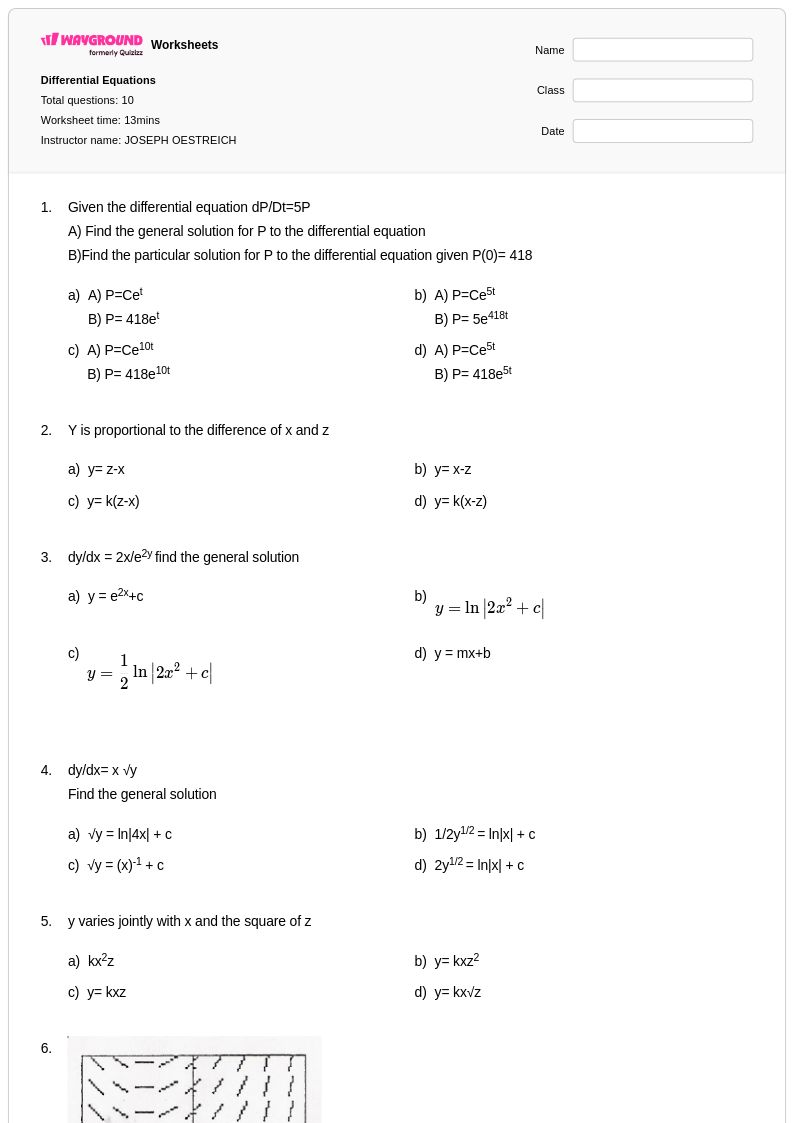
Three errors come up constantly. First, students forget to separate all y-terms to one side and all x-terms to the other before integrating, leading to incorrect integrals. Second, they drop the constant of integration, or treat two separate constants as one, which breaks any initial value problem. Third, when using integrating factors, students apply the factor to only one side of the equation. Targeted practice that asks students to identify the error in a worked solution (rather than just solve from scratch) is particularly effective at catching these habits early.
How do I use Wayground's differential equations worksheets in my class?
Each worksheet comes with a complete answer key, so students can check their work independently — useful for homework or self-paced review. You can host any worksheet as a digital quiz on Wayground, or download the printable PDF and assign it on paper. If you go the paper route, the Wayground for Teachers app lets you scan or capture student submissions for grading without re-entering anything manually.
Are differential equations worksheets aligned to Common Core or AP Calculus standards?
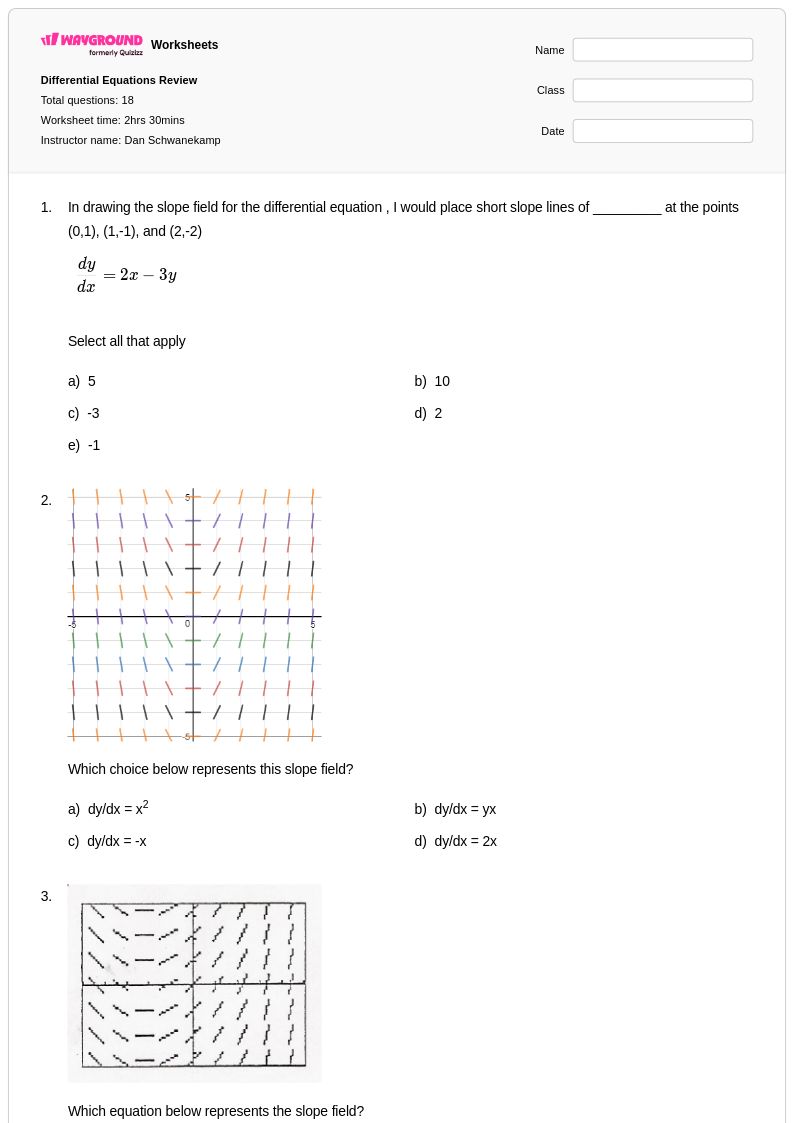
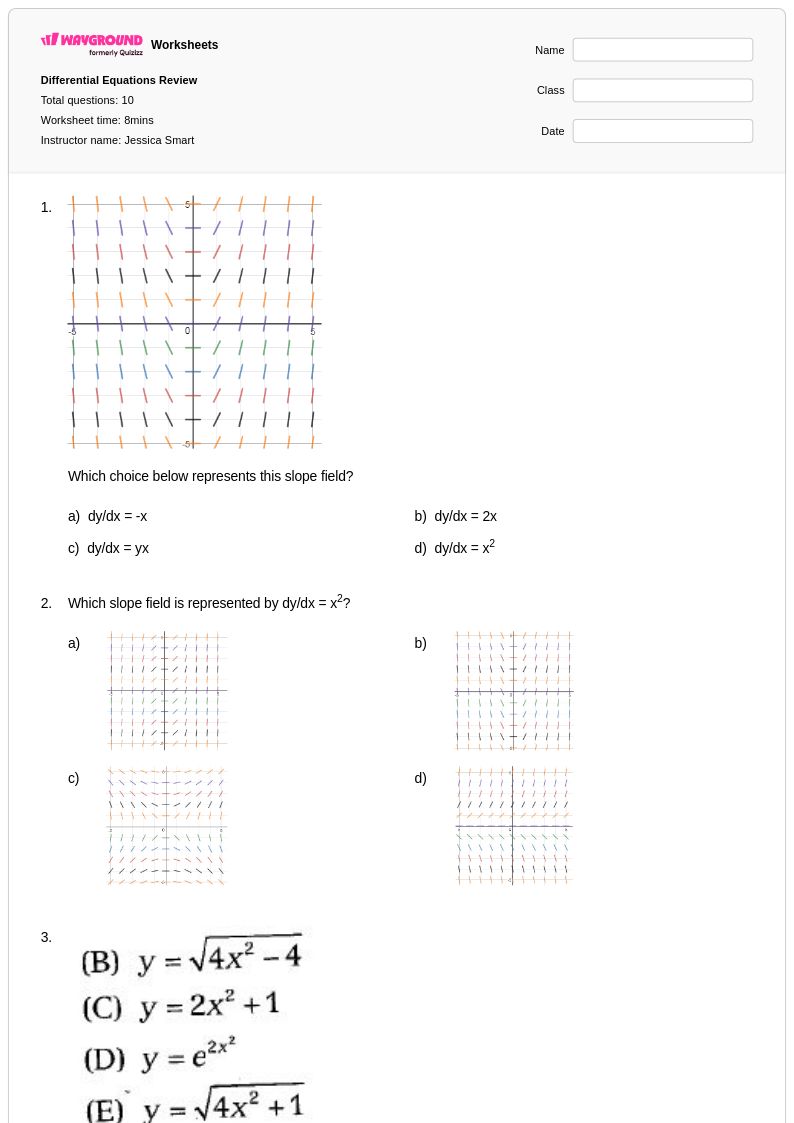
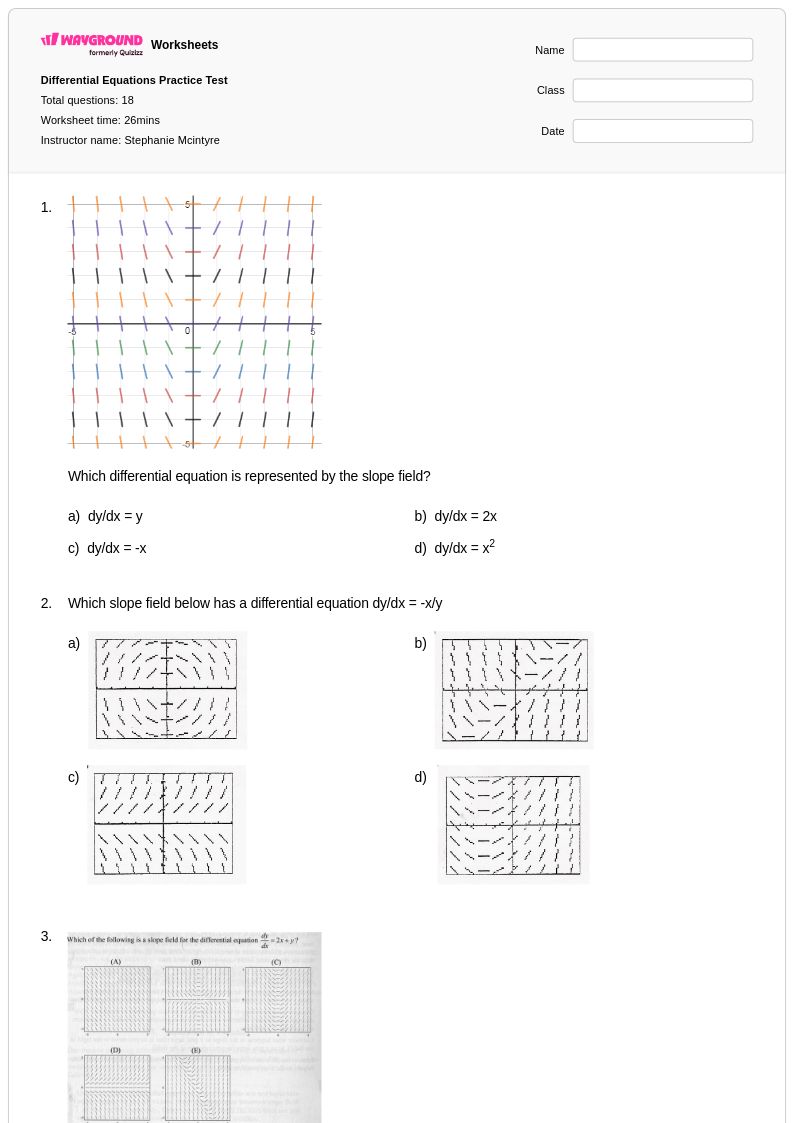
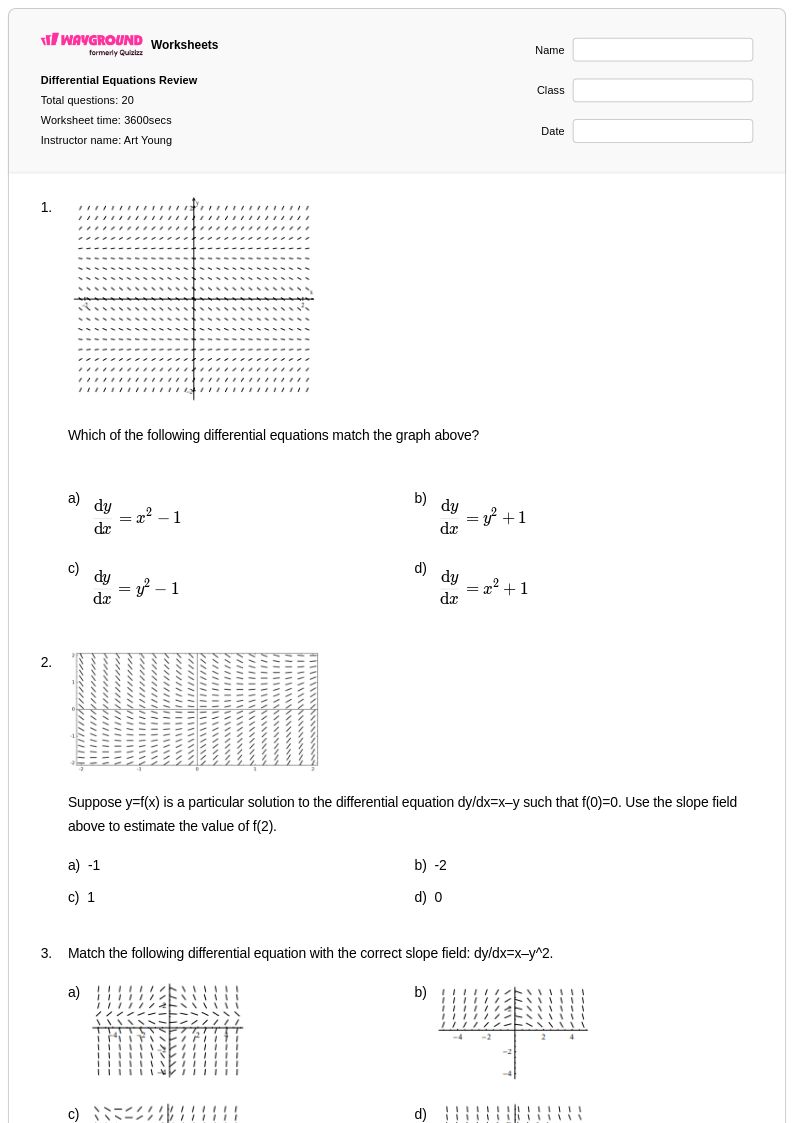
Differential equations sit outside the K–12 Common Core sequence, which ends before this topic. In practice, differential equations appear in AP Calculus BC, where the College Board expects students to solve separable equations analytically, use slope fields to reason about solutions graphically, and apply Euler's method numerically. These worksheets align with that progression — moving from separation of variables and initial value problems toward the modeling applications (population dynamics, cooling) that AP Calculus BC uses to assess conceptual depth alongside procedural skill.
How can I differentiate differential equations practice for students at different levels?
For students who are still shaky on the underlying calculus, Wayground's reduced answer choices accommodation lowers the cognitive load on classification questions so they can focus on the solution process itself. For students with reading barriers, the Read Aloud feature handles word problems — which matter a lot in applied differential equations. At the worksheet level, you can generate a version with a dyslexia-friendly font or larger text in a few clicks, and translate the worksheet for students whose first language isn't English, all without creating a separate assignment from scratch.
What topics within differential equations should I cover first?
Separation of variables is the right starting point — it requires only integration skills students already have, and it covers a wide range of applied problems. First-order linear equations and integrating factors come next, followed by exact equations. Initial value problems should run alongside each method rather than being saved for the end; applying a boundary condition immediately shows students why the constant of integration matters. Slope fields and Euler's method are worth introducing as conceptual tools before or alongside analytic methods, since they build intuition about solution behavior that pure algebra doesn't provide.