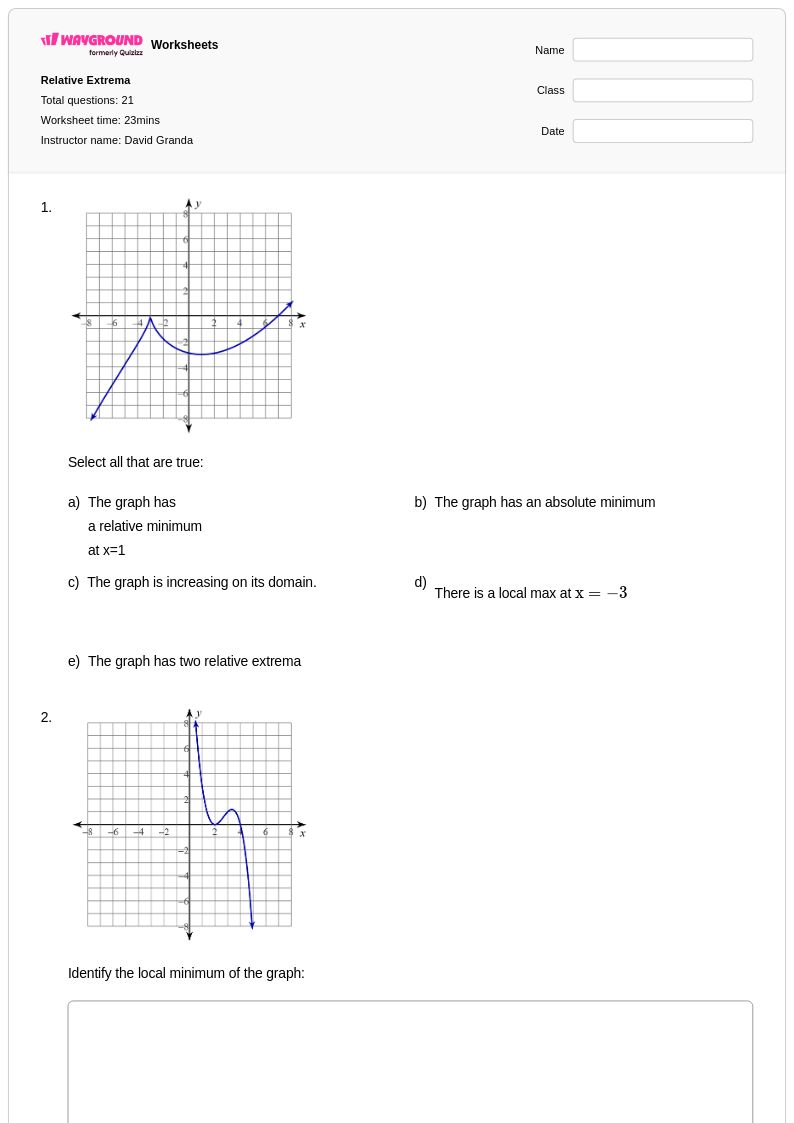
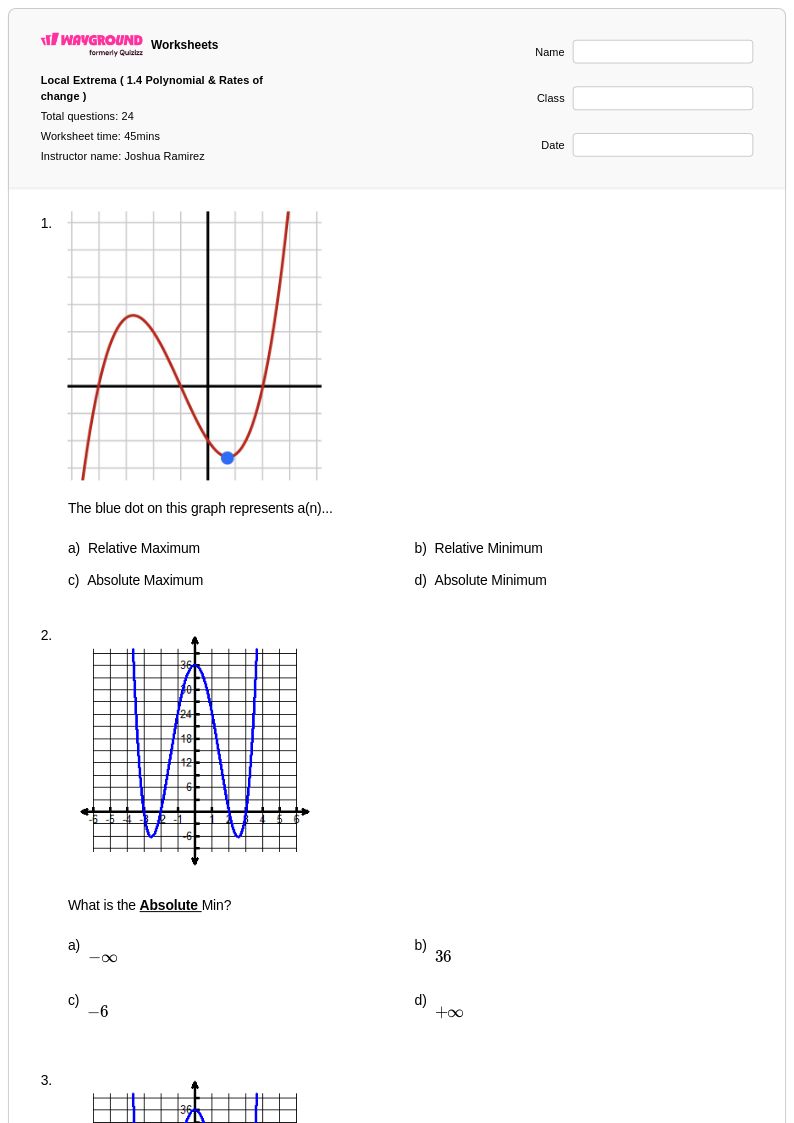
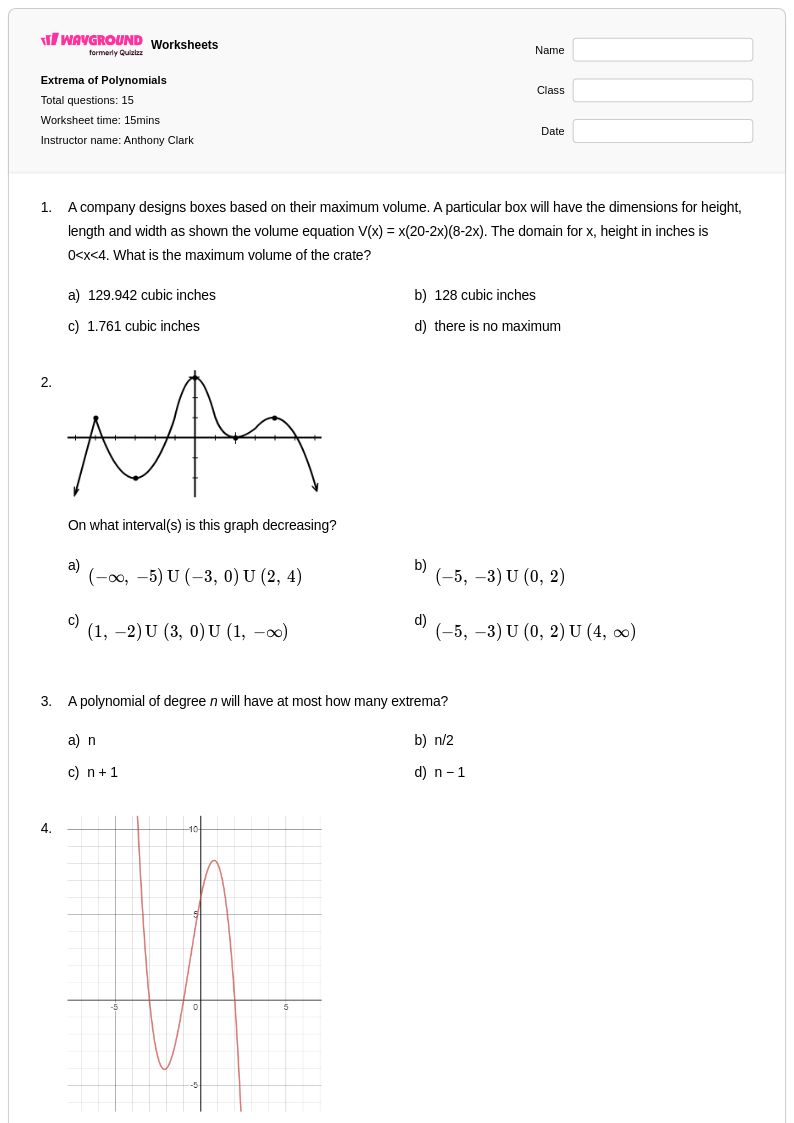
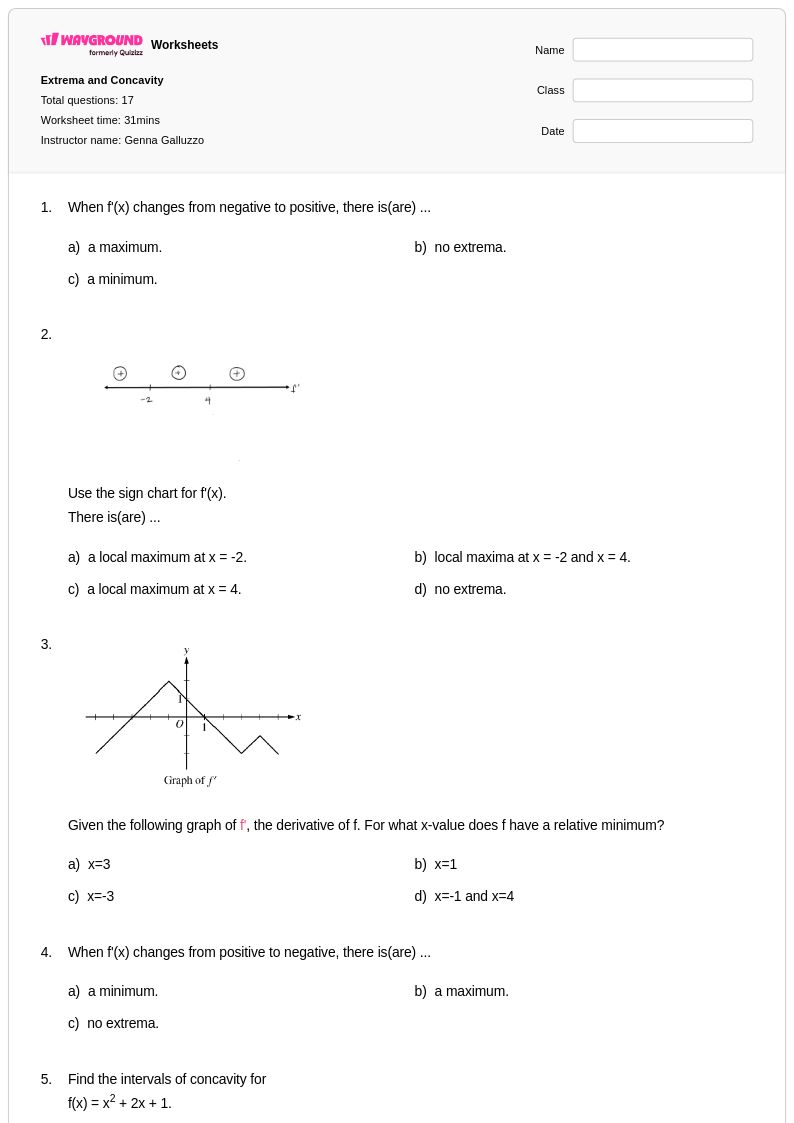
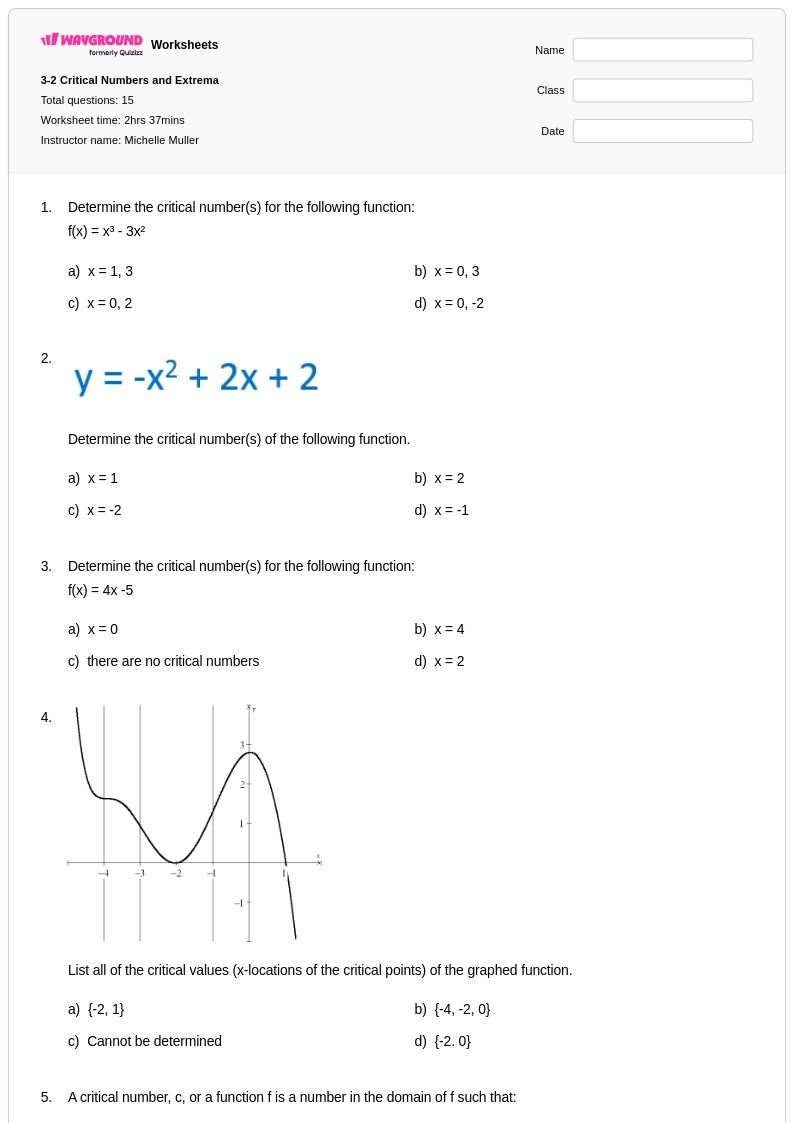
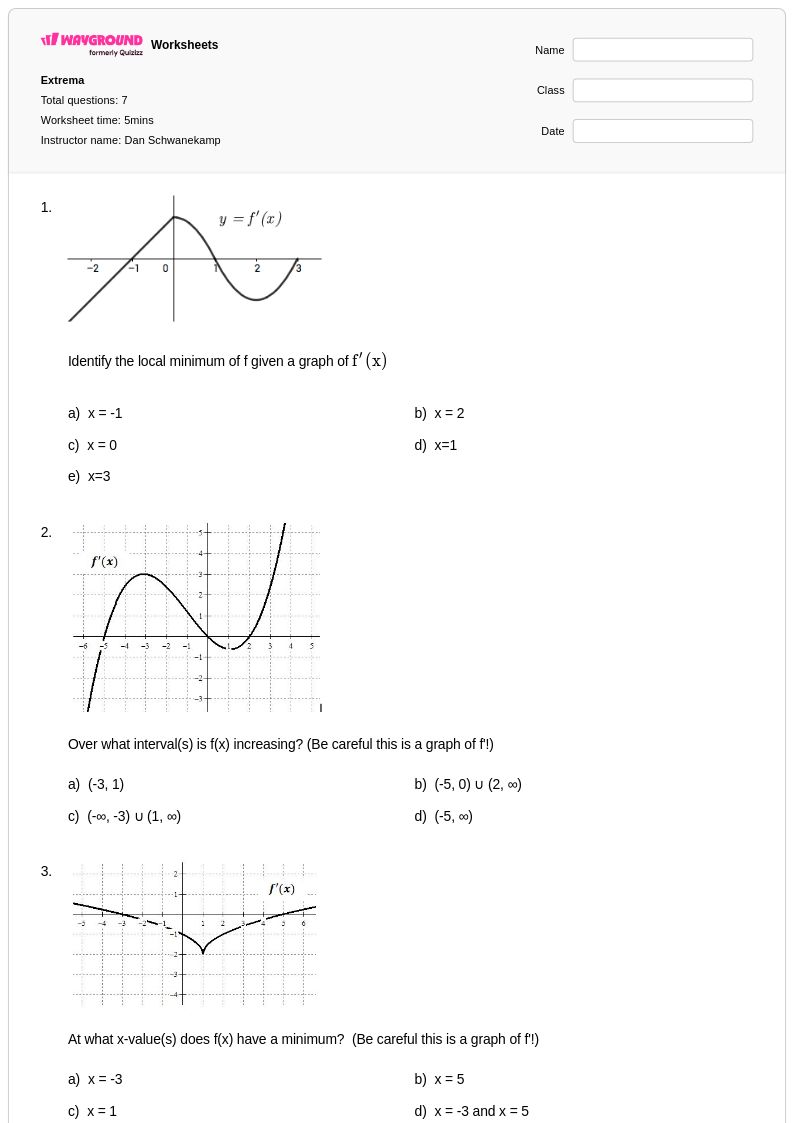
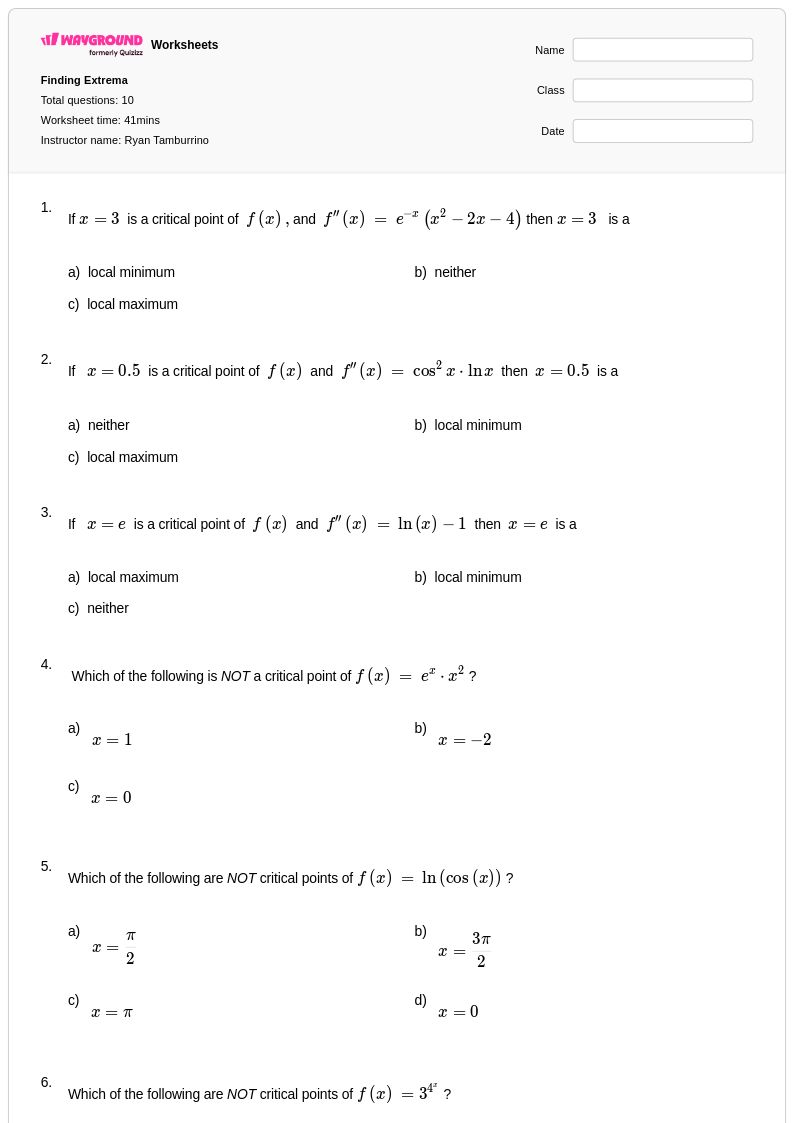
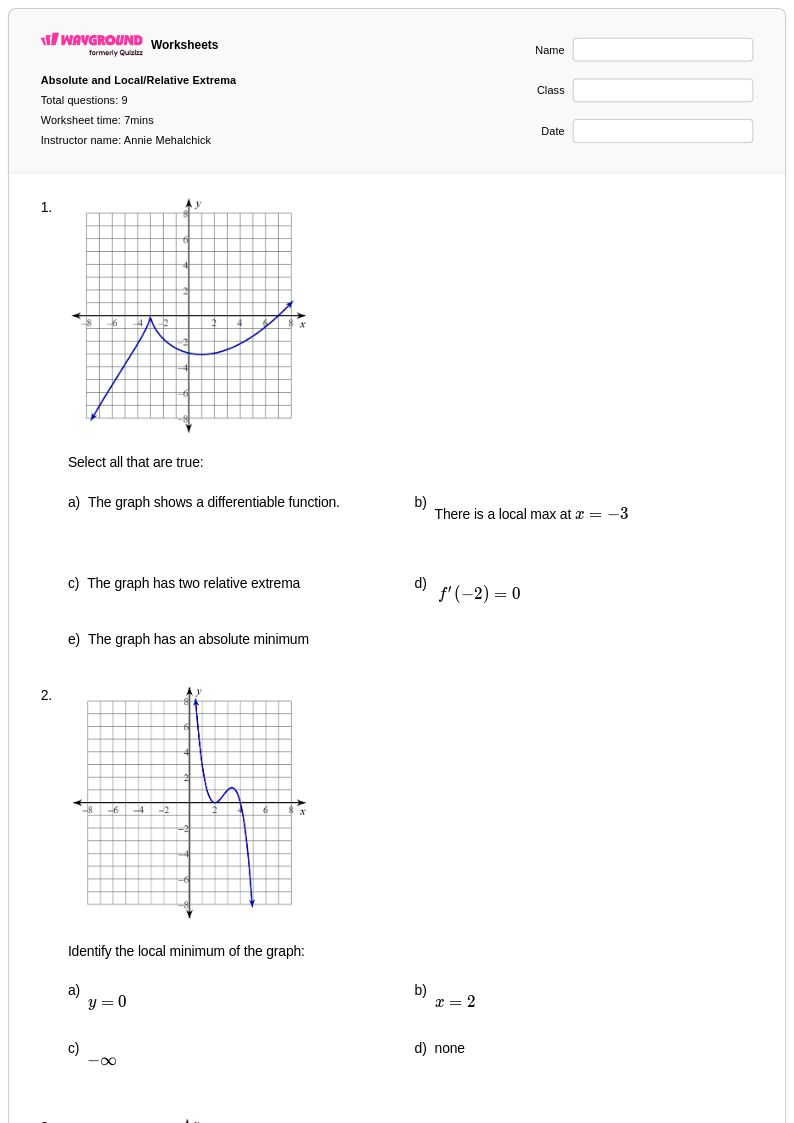
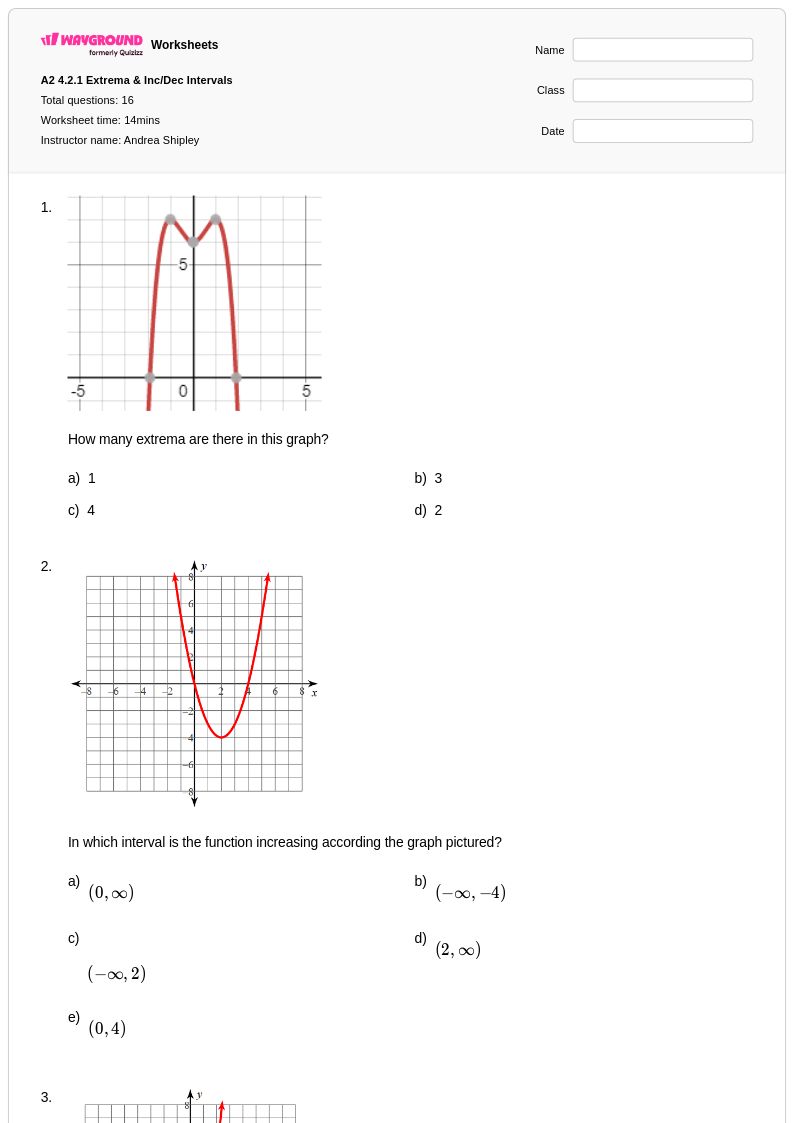
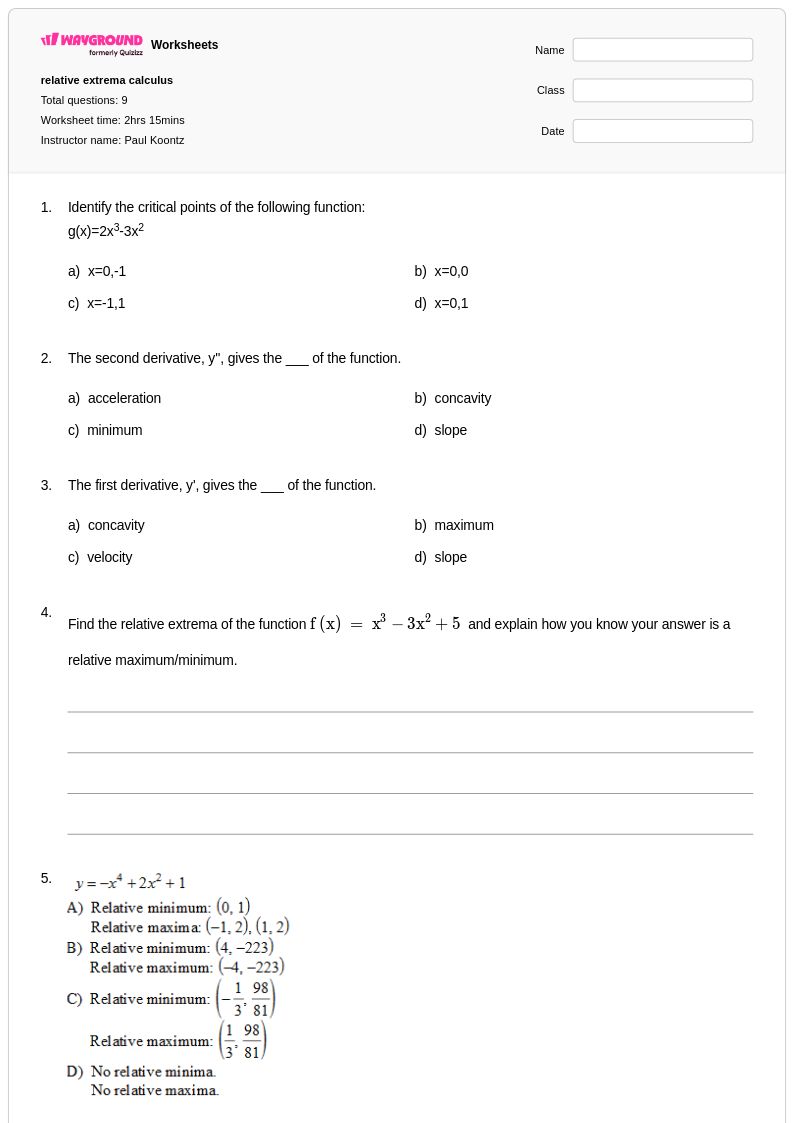
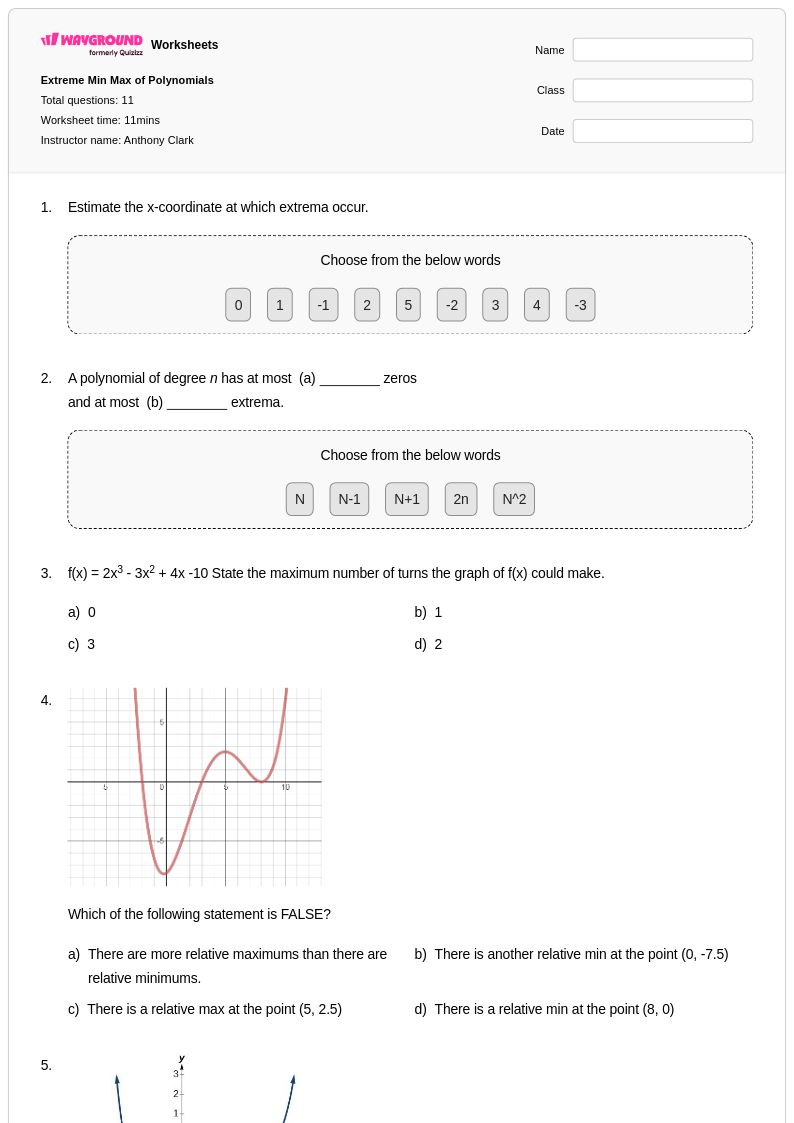
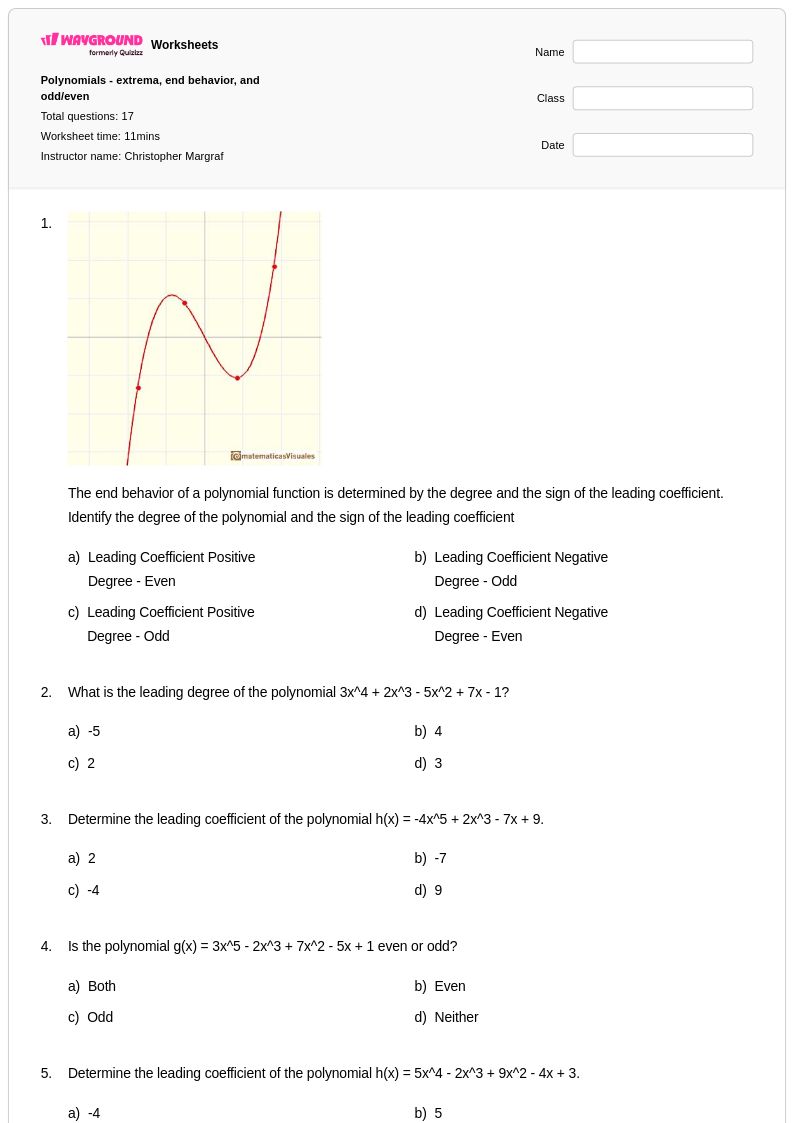
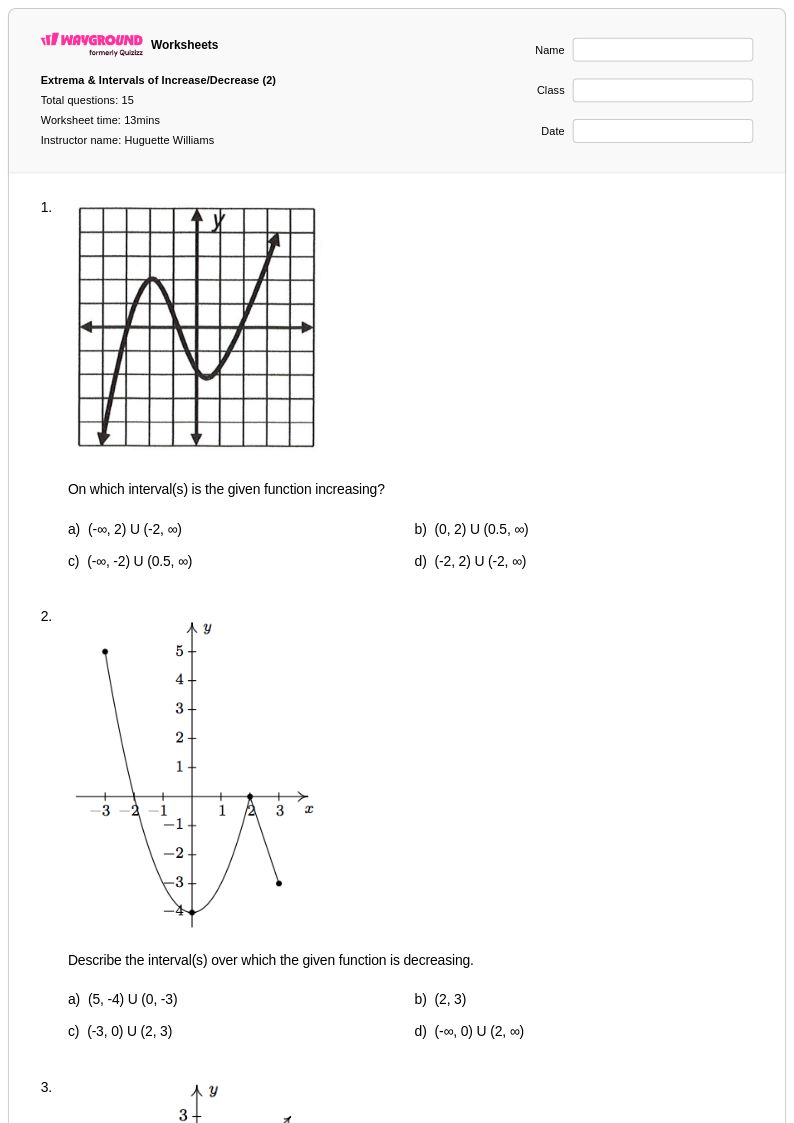
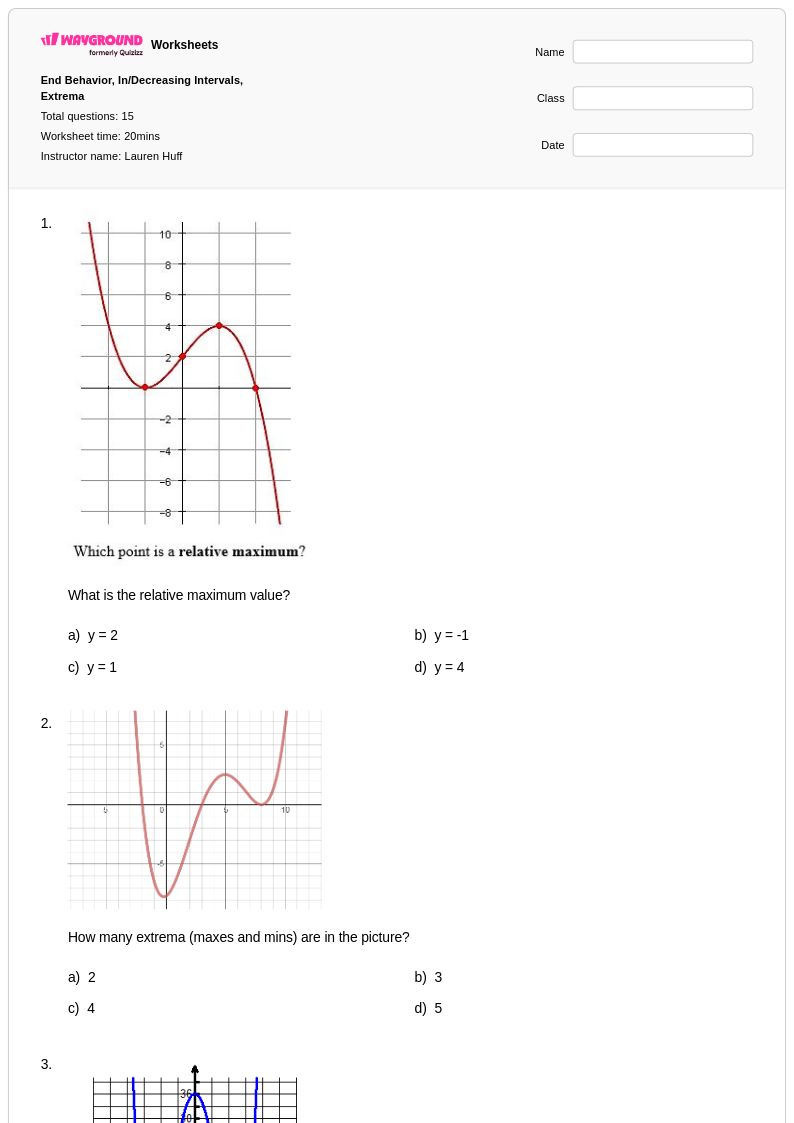
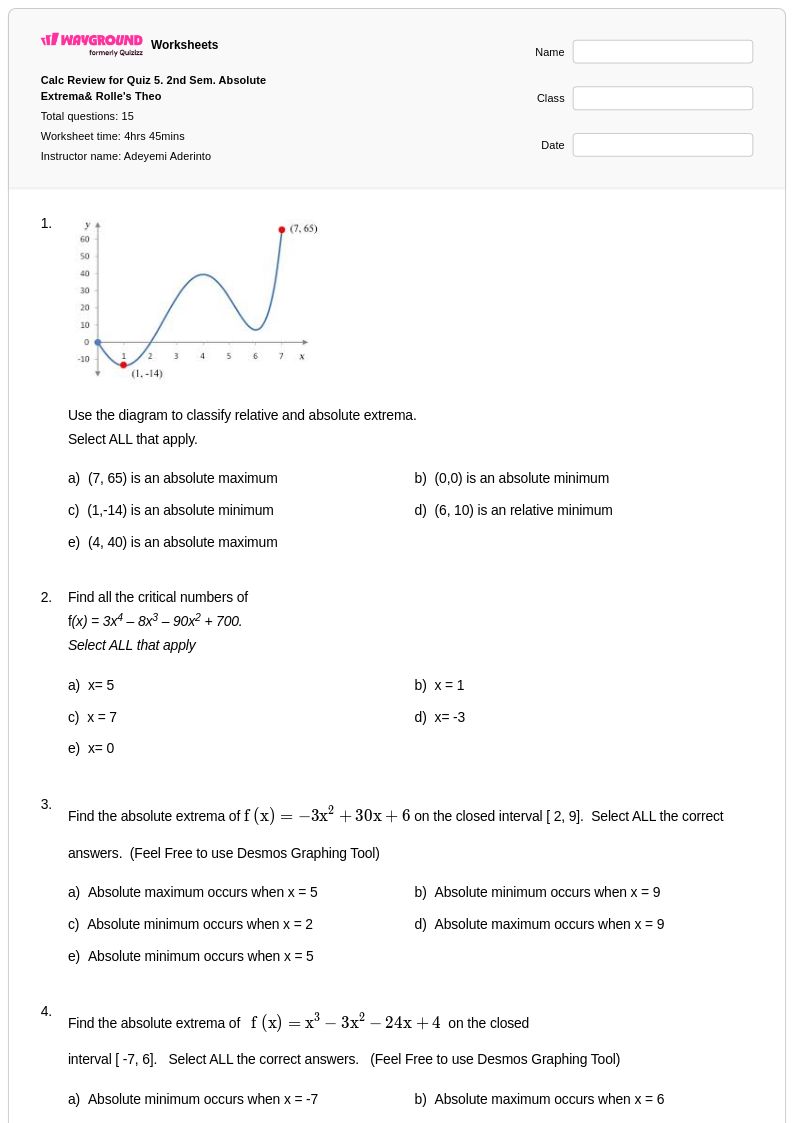
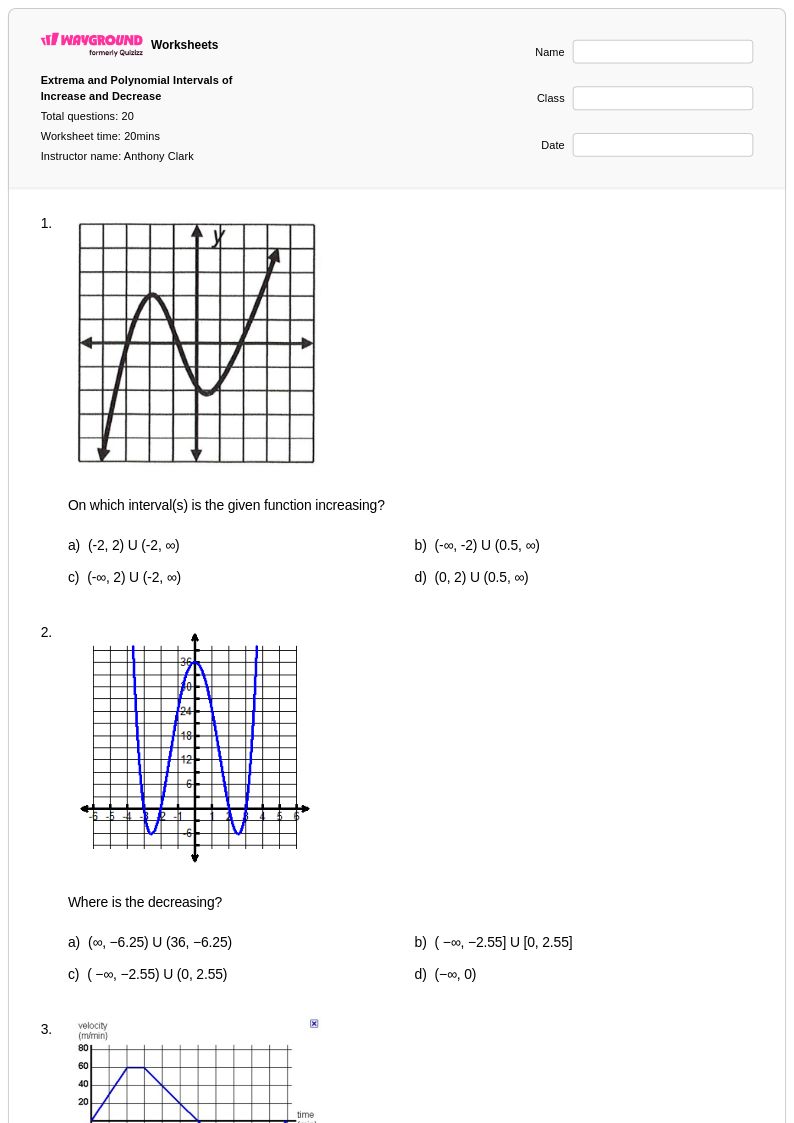
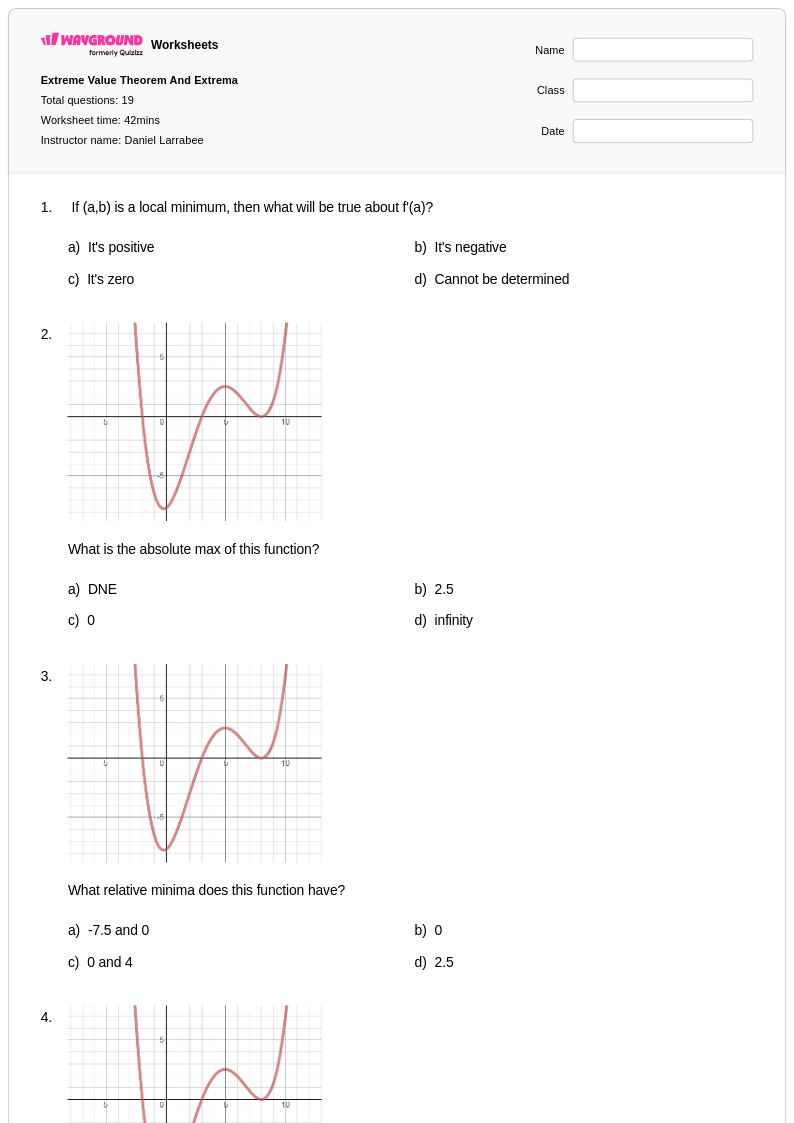
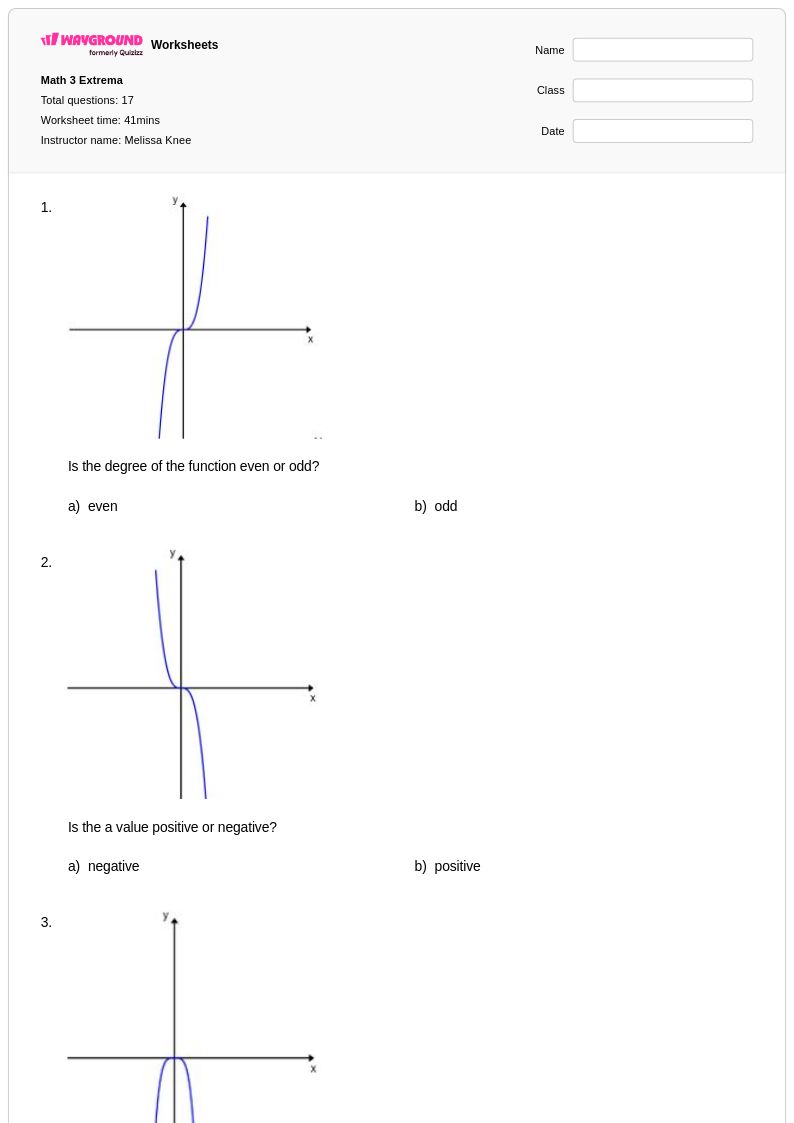
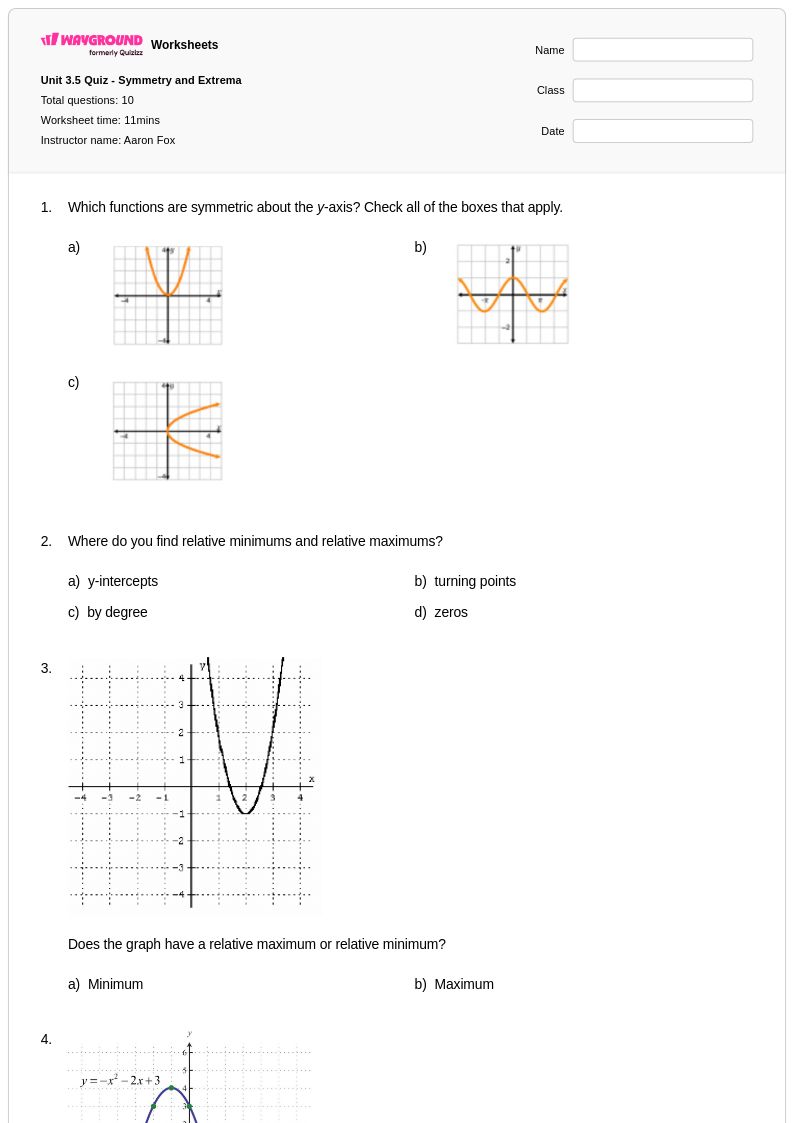
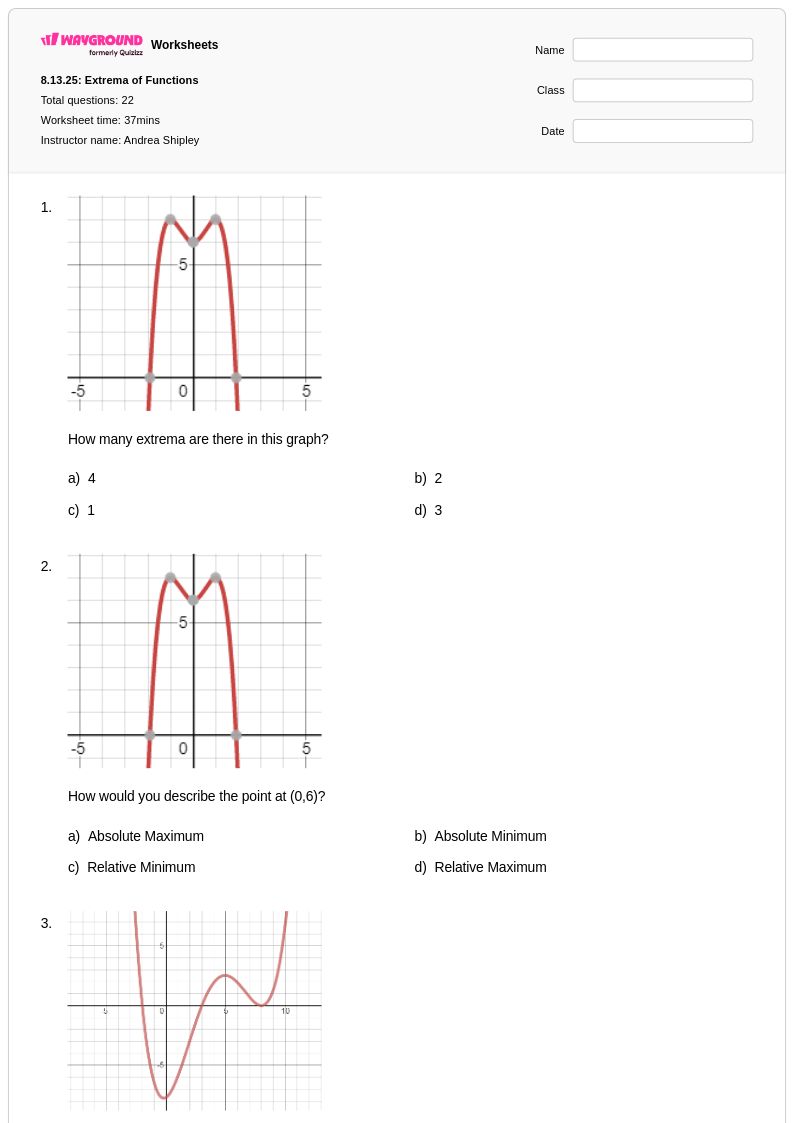
Discover Wayground's comprehensive collection of calculus extrema worksheets featuring printable PDFs with practice problems and answer keys to help students master finding maximum and minimum values of functions.
Extrema worksheets available through Wayground (formerly Quizizz) provide comprehensive practice materials for students learning to identify and analyze critical points, maximum and minimum values, and optimization problems in calculus. These expertly designed resources strengthen essential skills including finding critical points using derivative tests, applying the first and second derivative tests to classify extrema, solving real-world optimization problems, and understanding the relationship between graphical features and analytical methods. Each worksheet collection includes detailed answer keys and step-by-step solutions, with materials available as free printables and downloadable pdf formats that make it easy for educators to distribute practice problems both in classroom settings and for independent study.
Wayground (formerly Quizizz) supports mathematics educators with millions of teacher-created extrema resources that can be easily located through advanced search and filtering capabilities designed specifically for calculus instruction. The platform's extensive worksheet collections align with standard calculus curricula and offer robust differentiation tools that allow teachers to customize content difficulty, problem types, and mathematical complexity to meet diverse student needs. These flexible resources are available in both printable pdf formats and interactive digital versions, enabling seamless integration into lesson planning, targeted remediation for students struggling with optimization concepts, enrichment activities for advanced learners, and regular skill practice sessions that reinforce critical thinking about maximum and minimum value problems across various mathematical contexts.
FAQs
How do I teach extrema in calculus?
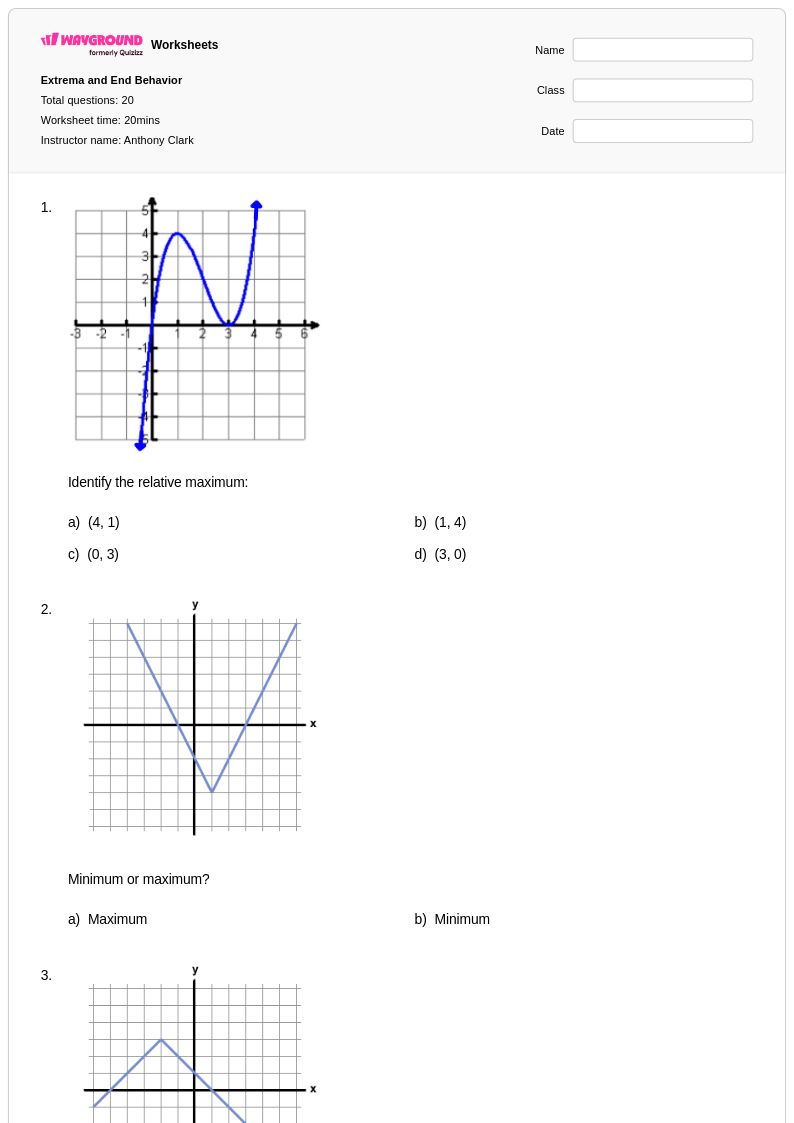
Start with the graphical intuition: have students sketch curves and mark where the function "turns around" before introducing any algebra. Once they can identify peaks and valleys visually, connect that to the derivative equaling zero at those points. From there, teach the first derivative test (sign change around a critical point) and the second derivative test (concavity at the critical point) as two separate tools, and let students see when each is more convenient. Optimization problems land better after students are comfortable classifying extrema on simpler functions first.
What exercises help students practice finding extrema?
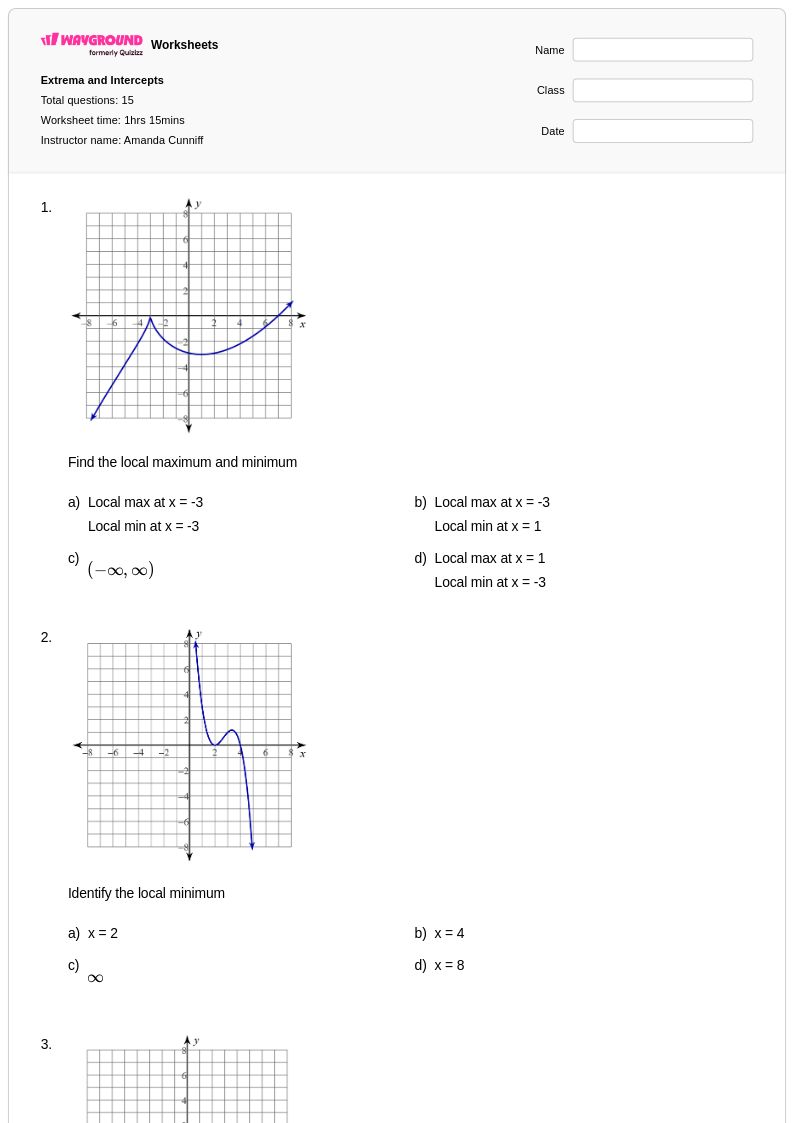
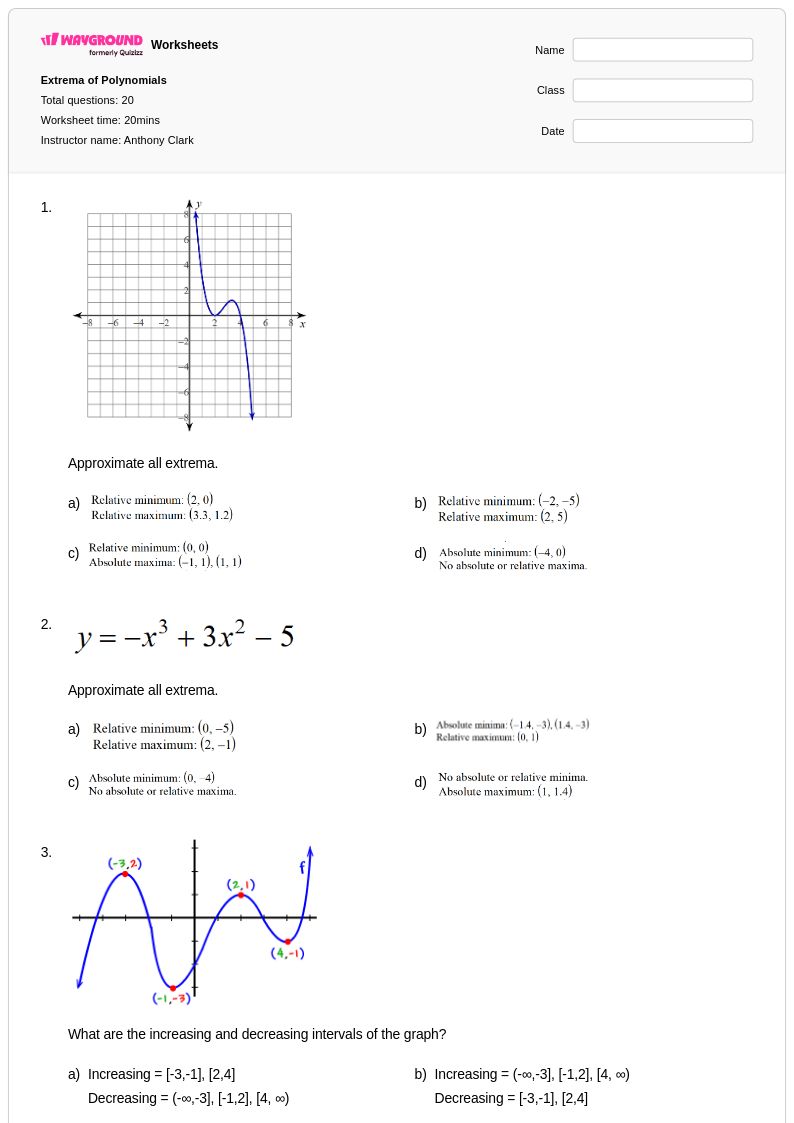
The most effective practice moves through three stages: finding critical points algebraically, classifying them with derivative tests, and then applying those skills to optimization word problems. Mixing function types matters — polynomial functions are a natural starting point, but students need practice with rational and trigonometric functions too, since the derivative work looks different. Wayground's extrema worksheets cover this progression, with problems ranging from basic critical point identification to multi-step optimization scenarios.
What mistakes do students commonly make when finding extrema?
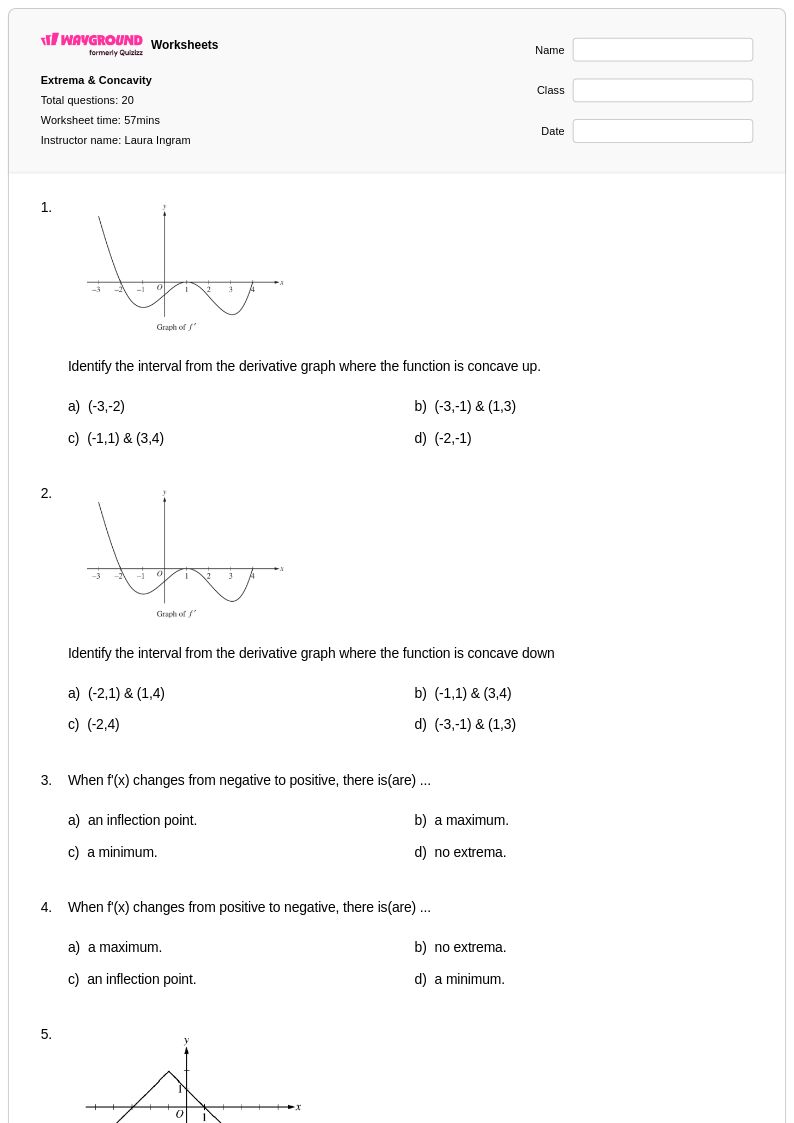
Three errors come up repeatedly. First, students treat every point where f'(x) = 0 as an extremum — they forget that a zero derivative is necessary but not sufficient (a point of inflection can also have f'(x) = 0). Second, they ignore endpoints when the problem specifies a closed interval, missing that the absolute maximum or minimum might not be at a critical point at all. Third, when using the second derivative test, they get stuck when f''(x) = 0 and don't know to fall back on the first derivative test instead.
How do I use Wayground's extrema worksheets in my class?
Each worksheet comes with a complete answer key, so you're not building solutions from scratch. For digital practice, you can host the worksheet as a quiz on Wayground — students work through it on their devices and results come back to you automatically. If you prefer paper, download the printable PDF and distribute it in class; you can then grade submissions using the Wayground for Teachers app, which lets you scan or capture student work for grading without manual data entry.
How does extrema fit into the AP Calculus curriculum sequence?
In the College Board's AP Calculus framework, extrema analysis sits within the broader unit on applying derivatives — students are expected to arrive here already fluent with differentiation rules. The progression moves from finding critical points, to classifying local extrema with the first and second derivative tests, to solving optimization problems where students must set up their own objective function. That last step — translating a word problem into a function and then minimizing or maximizing it — is where extrema work becomes genuinely difficult and is heavily tested on the AP exam.
How can I differentiate extrema practice for students at different levels?
For students who are still shaky on the derivative mechanics, Wayground lets you reduce answer choices on digital assignments, which lowers the cognitive load and keeps the focus on the extrema reasoning rather than the algebra. For students with reading challenges, the Read Aloud accommodation reads problem text aloud, which helps with the dense language in optimization word problems. On the worksheet itself, you can apply a dyslexia-friendly font or increase font size — useful when problems involve multiple equations and notation that can visually run together.