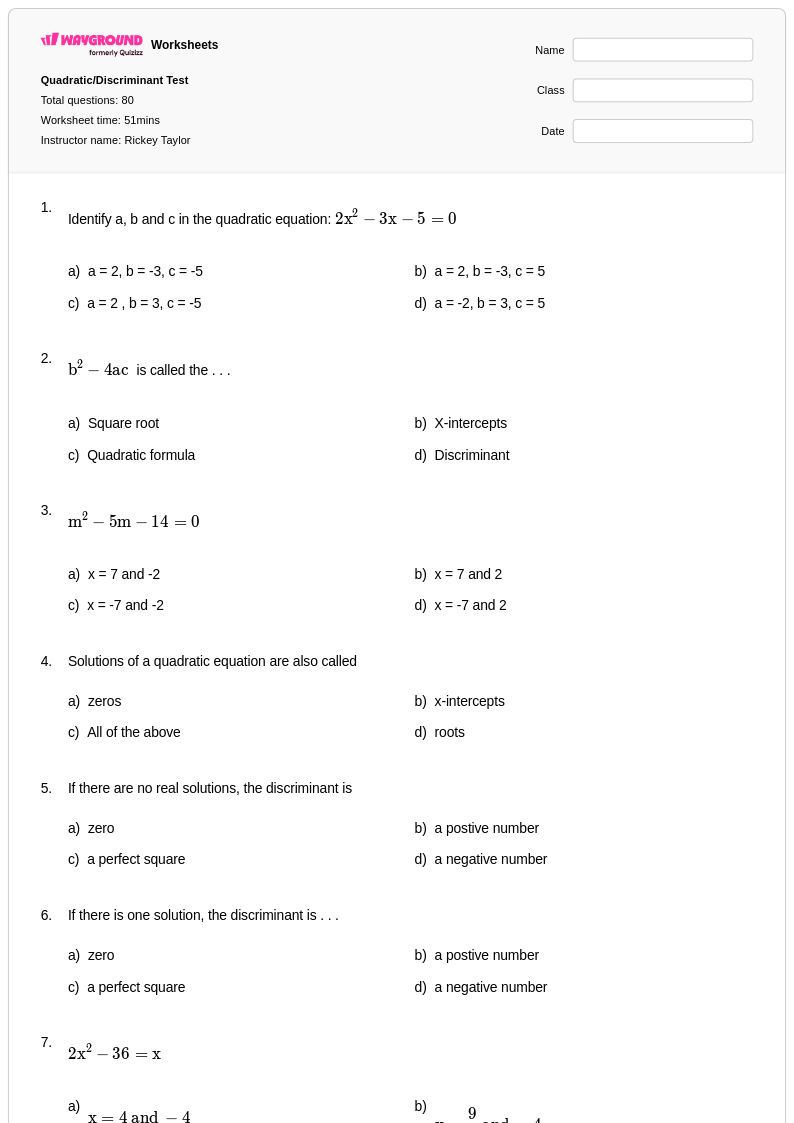
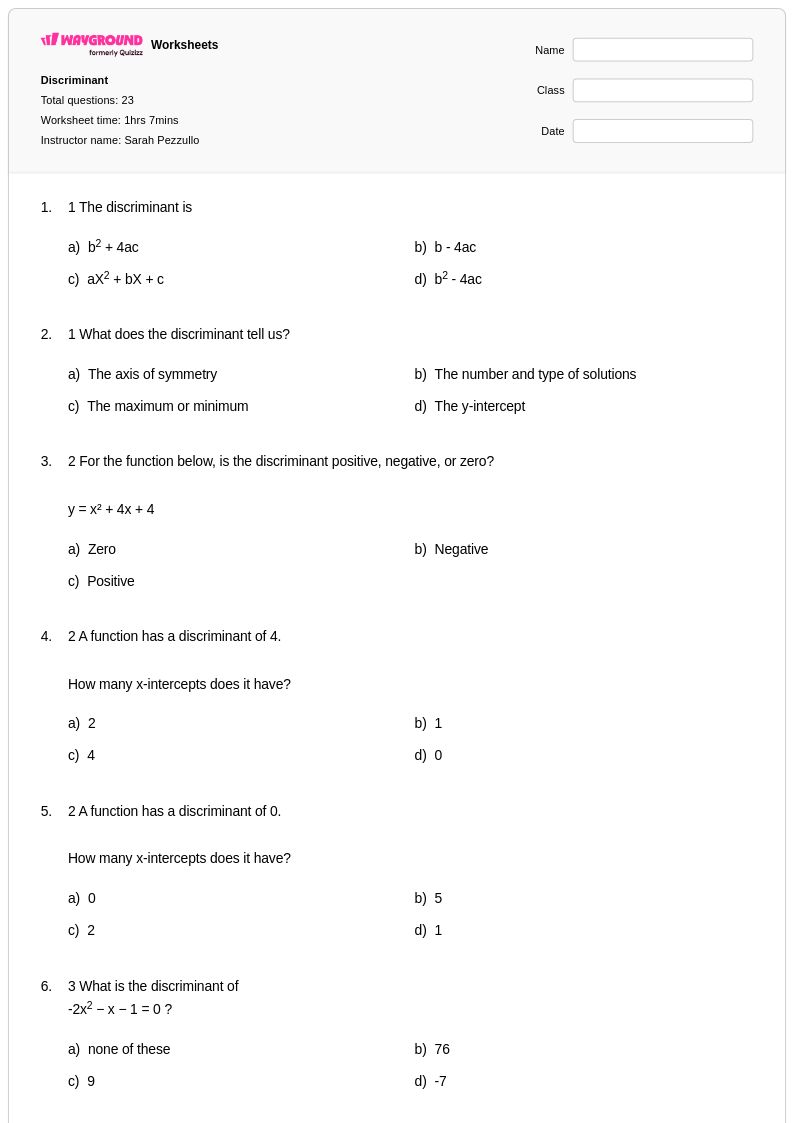
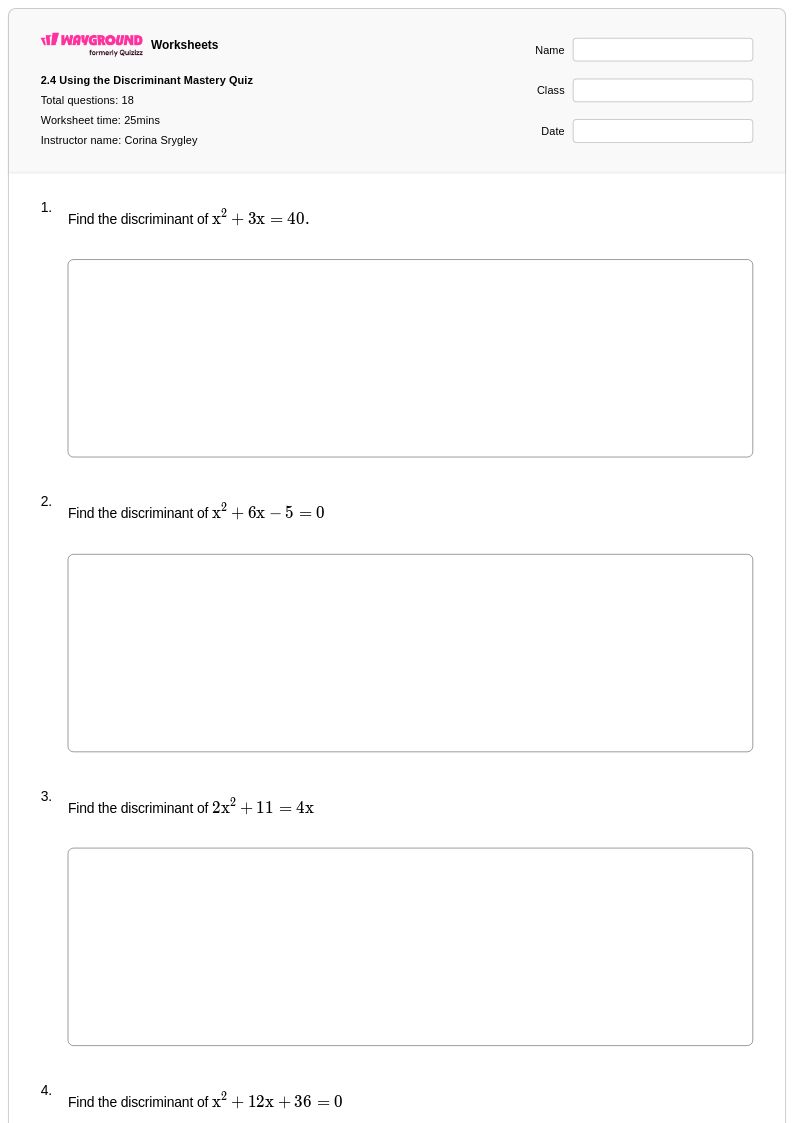
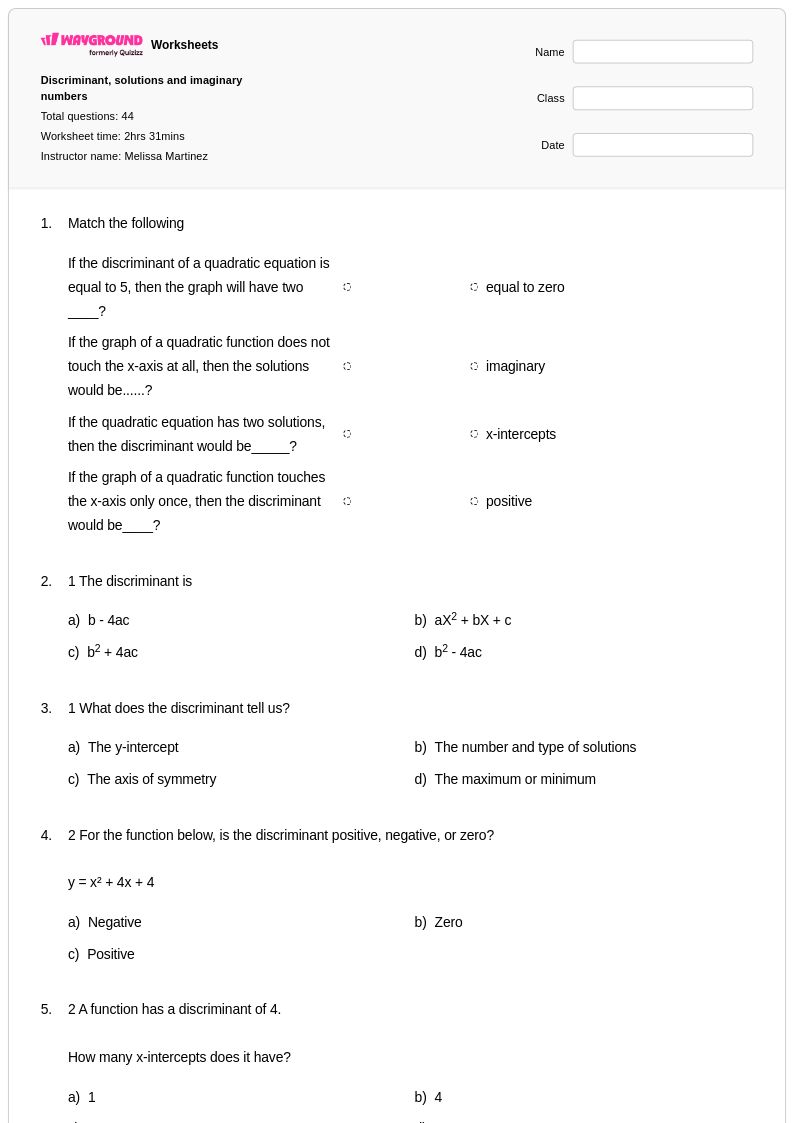
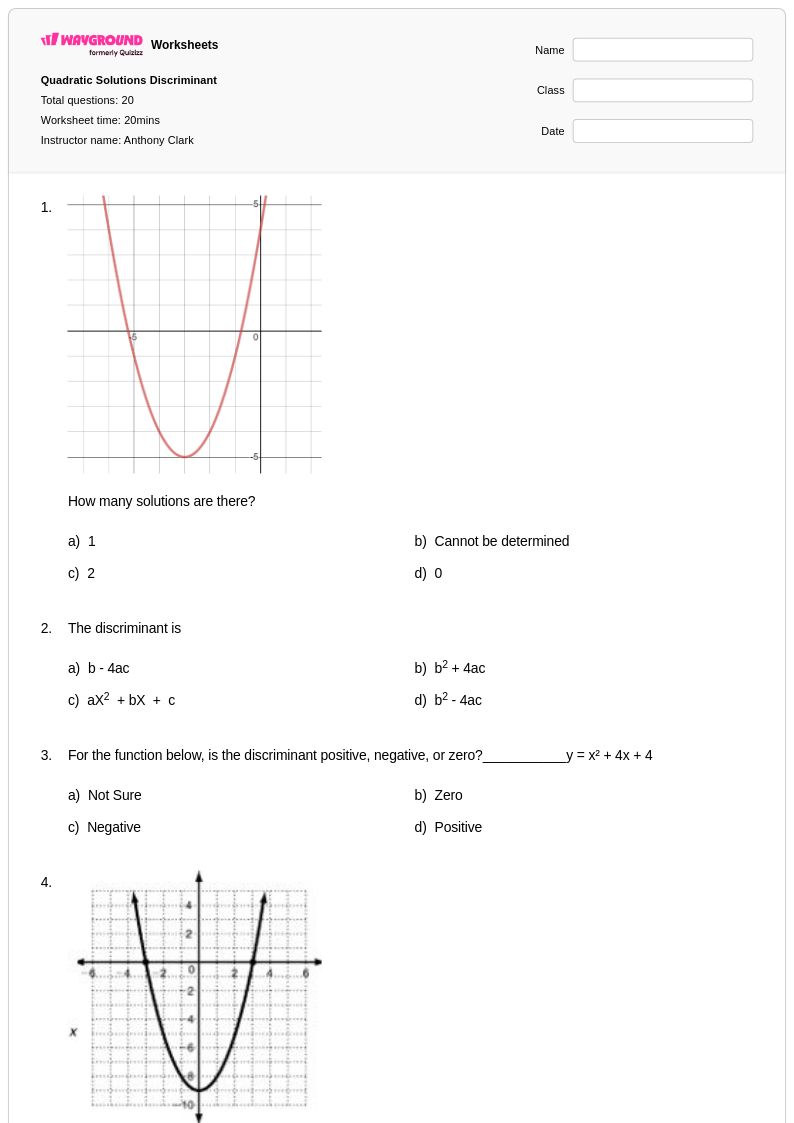
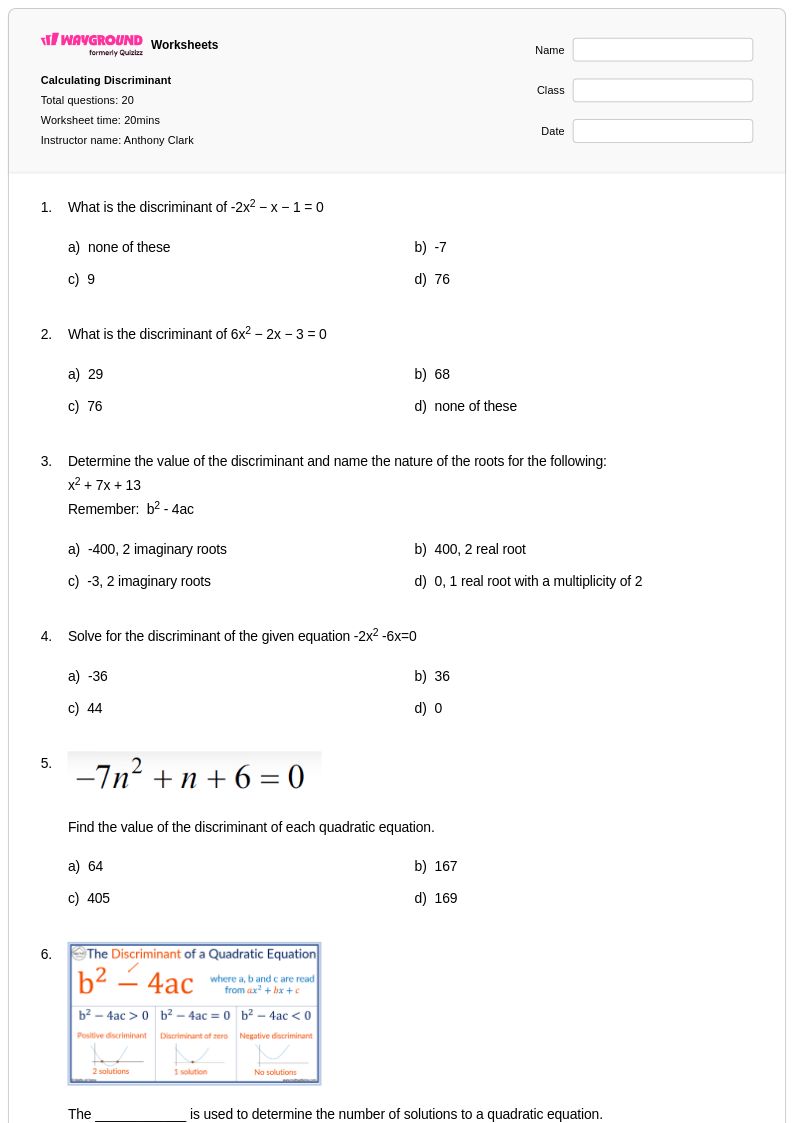
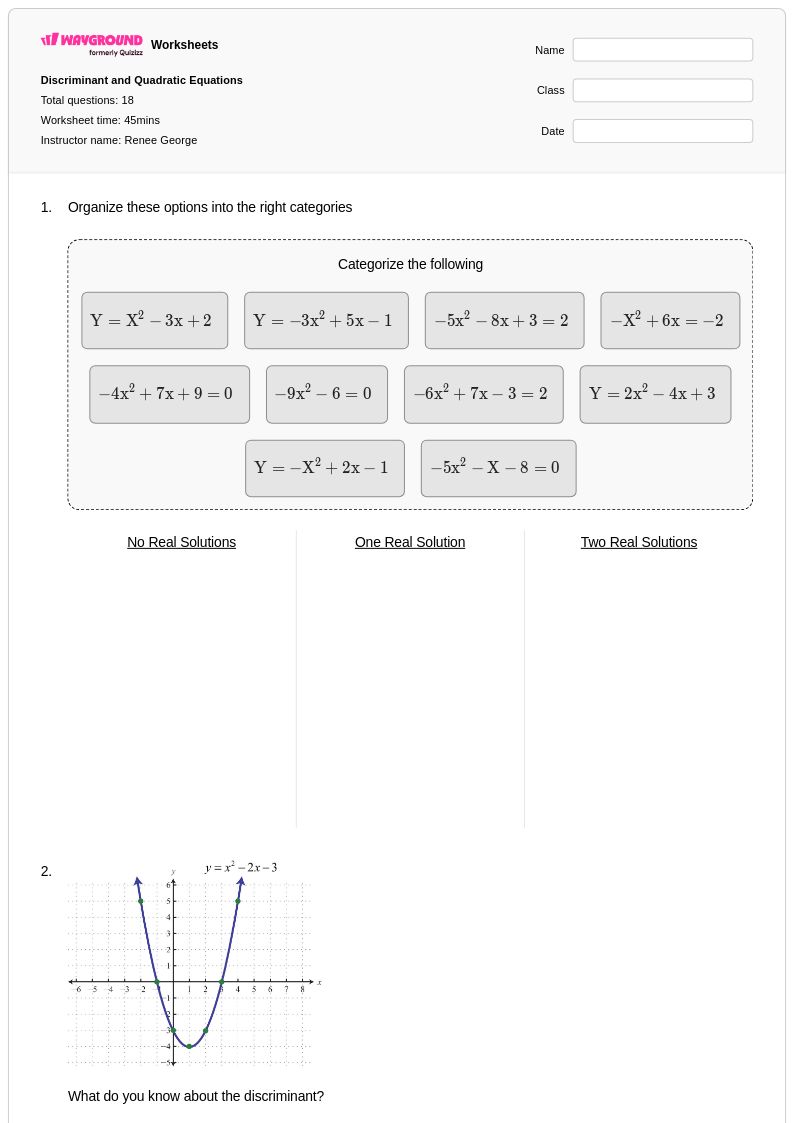
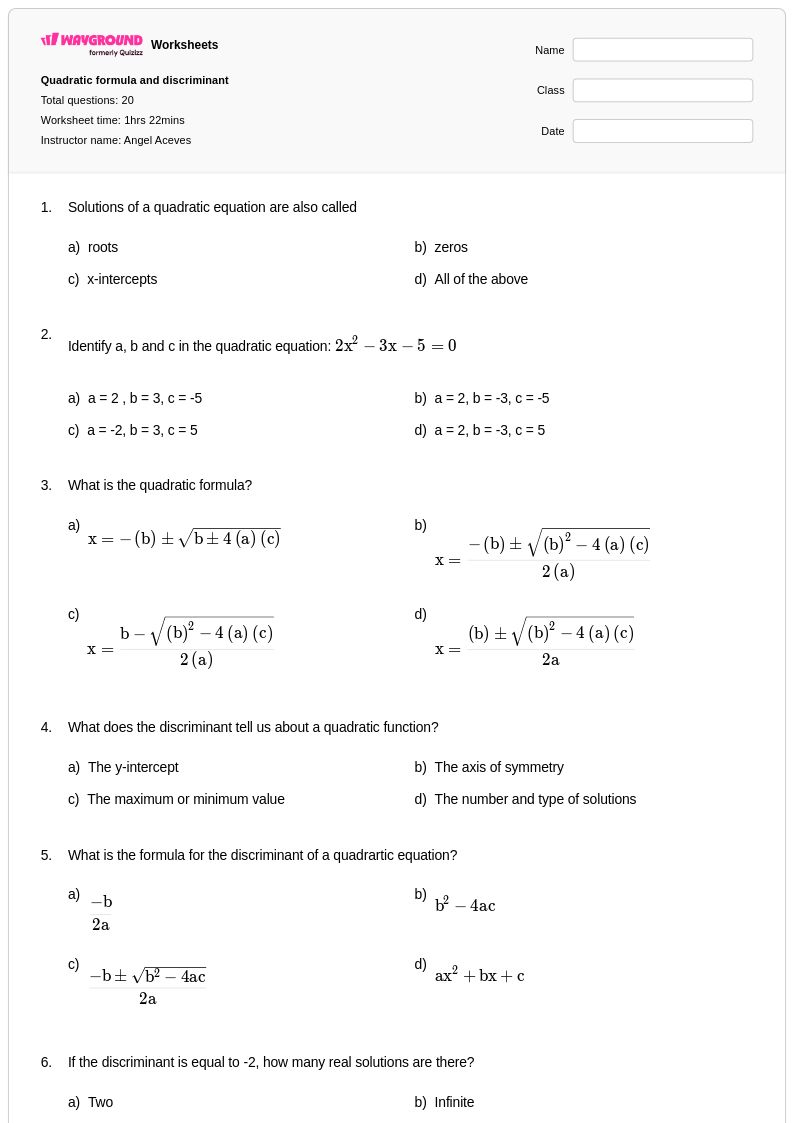
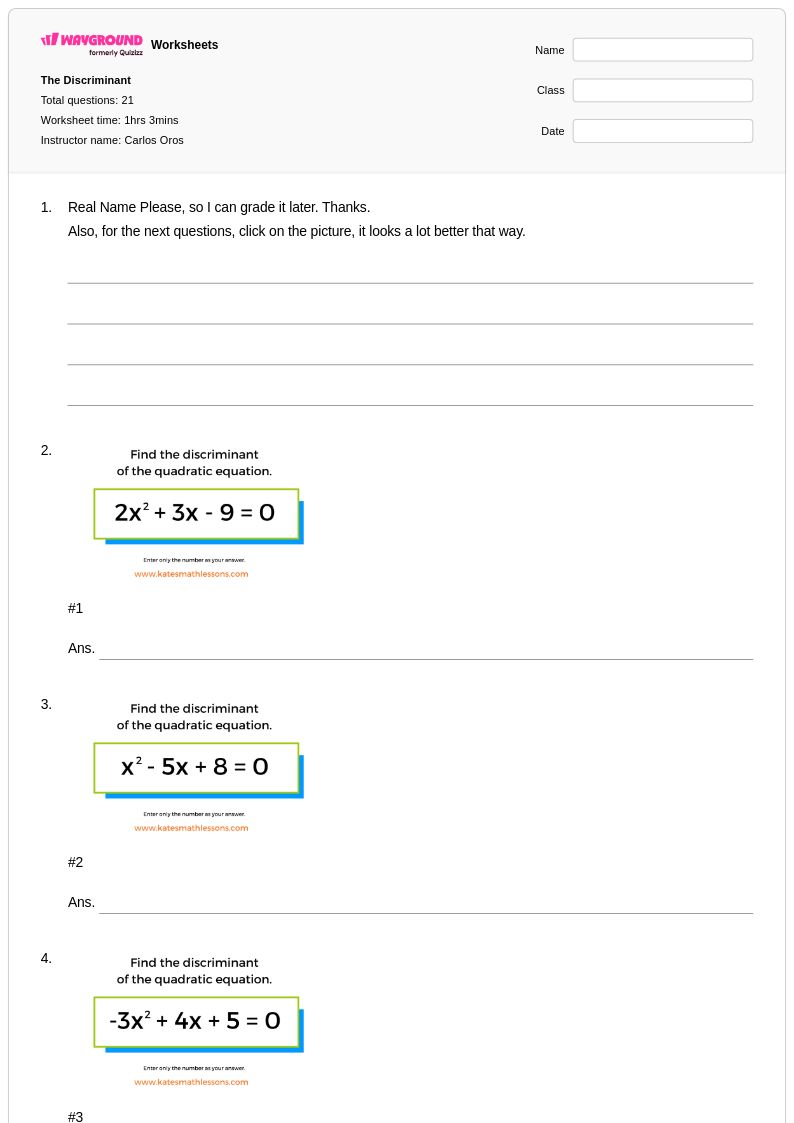
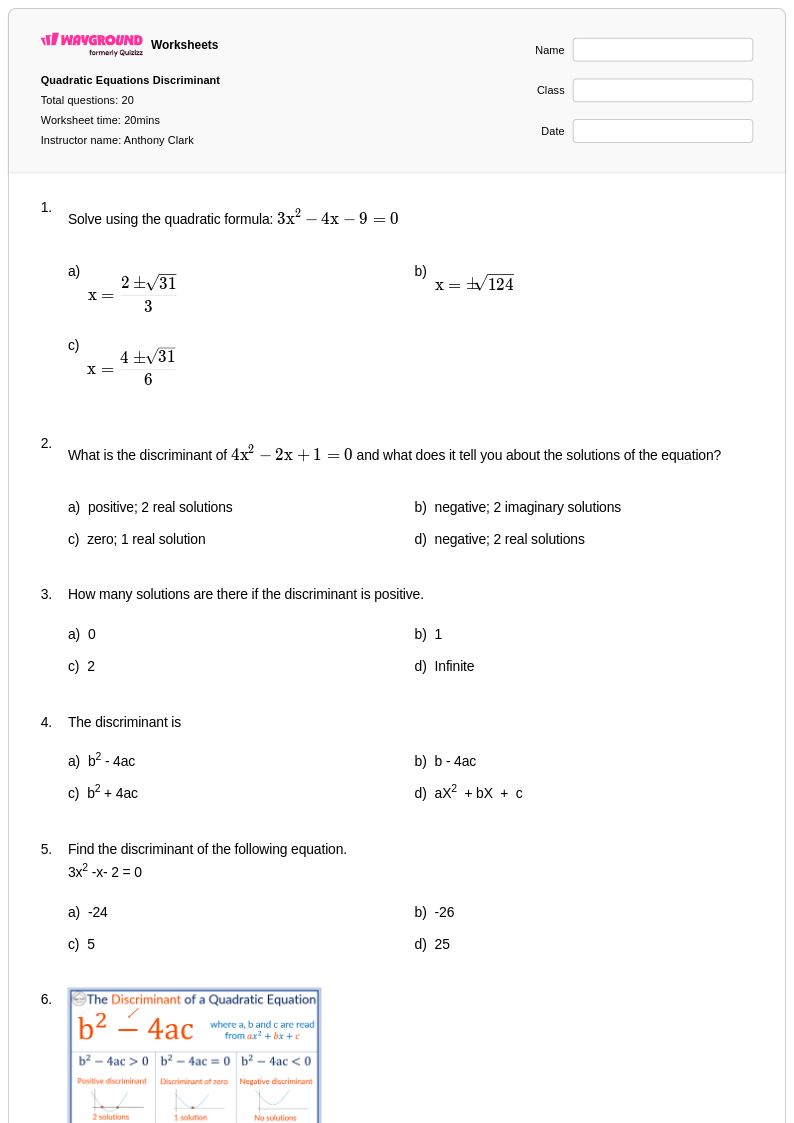
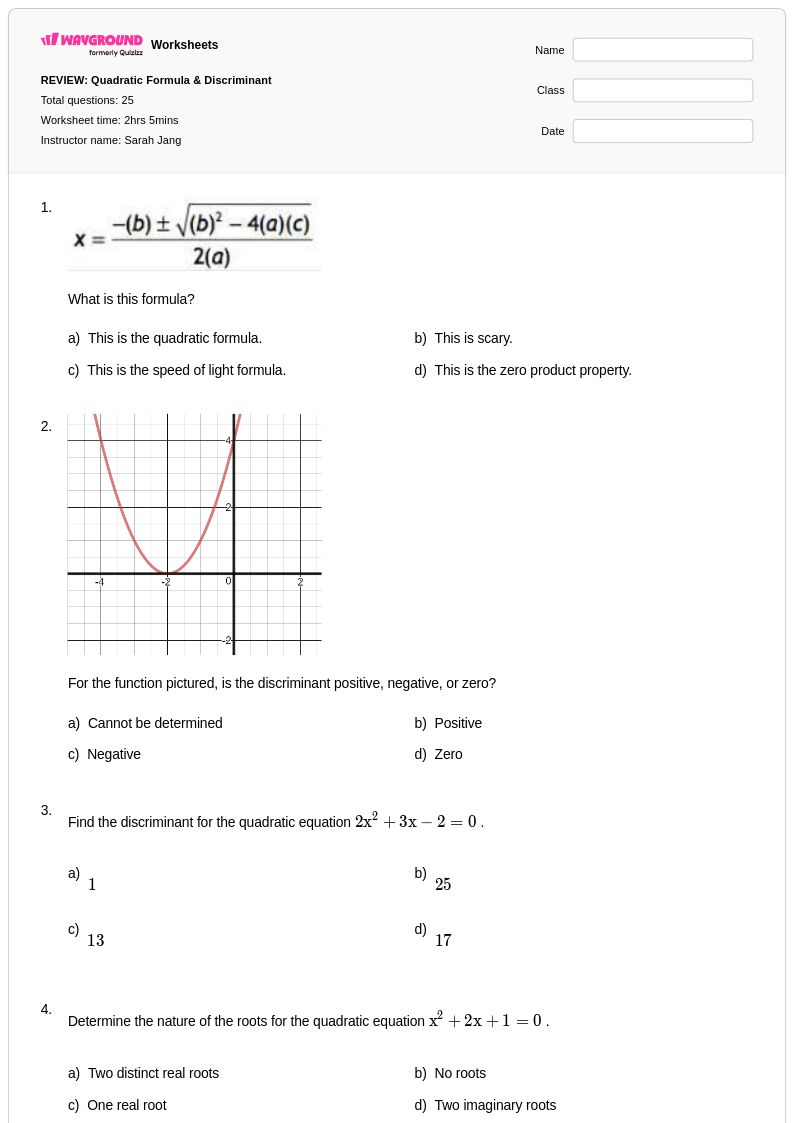
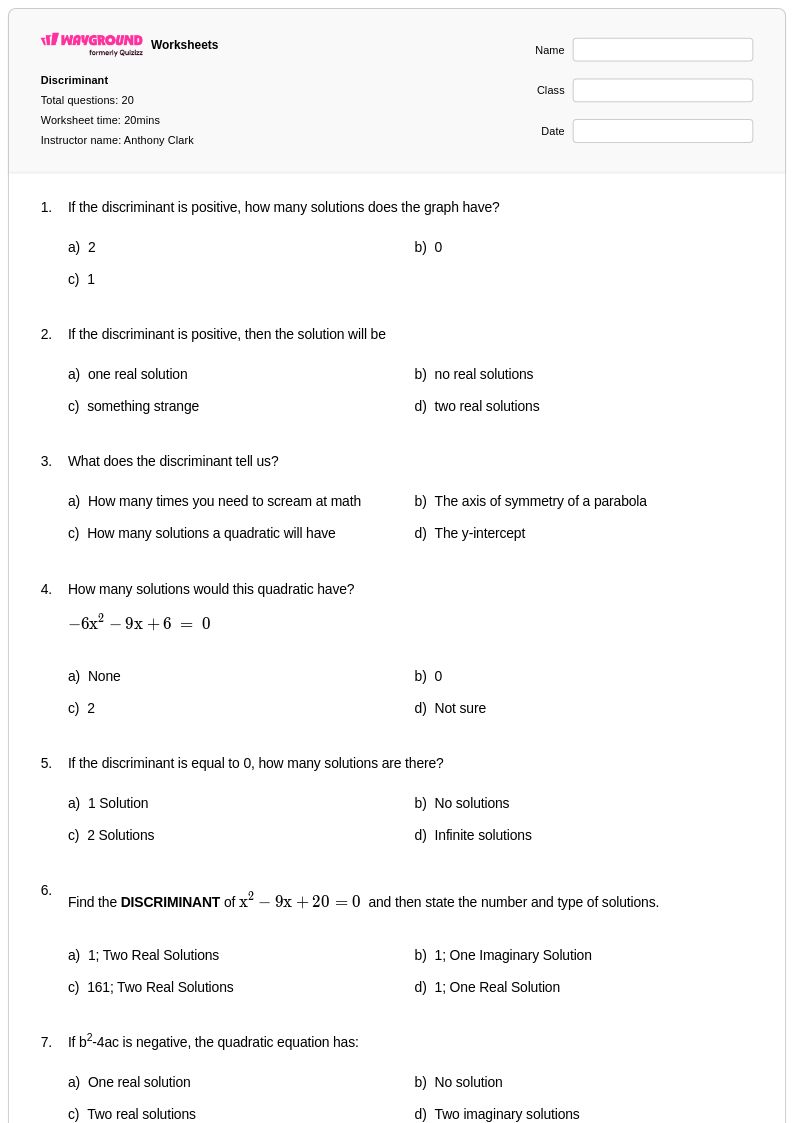
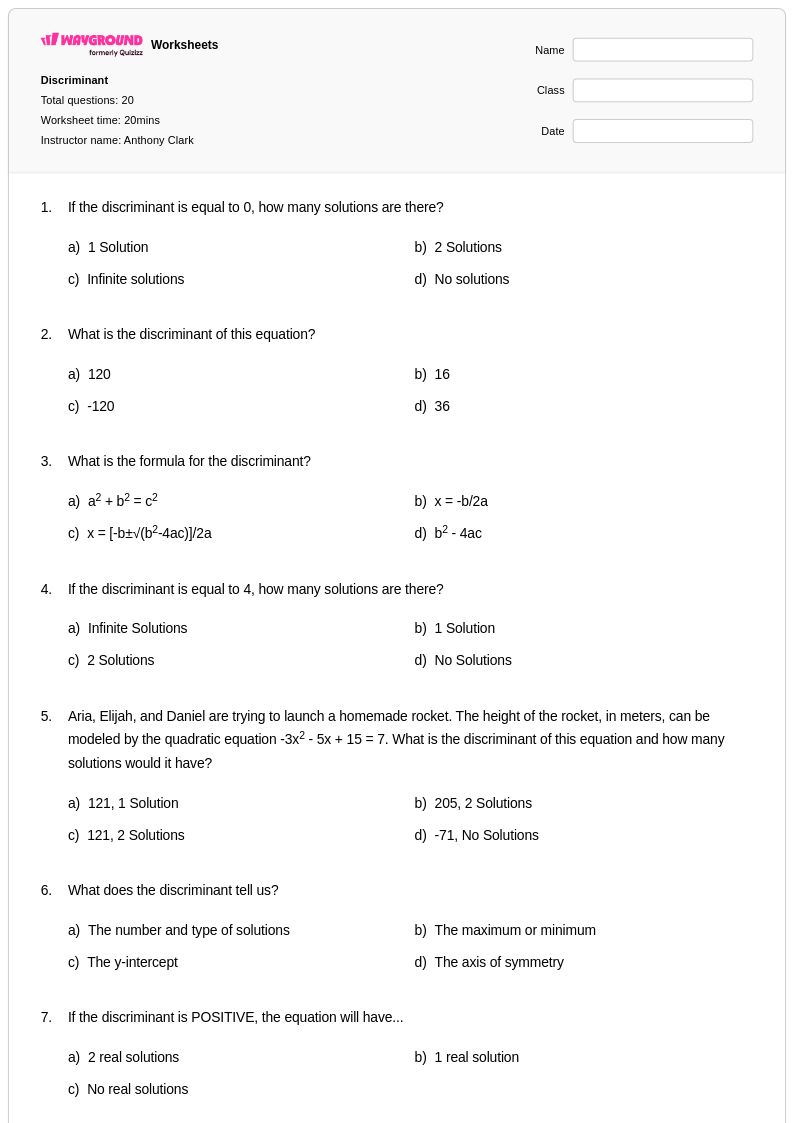
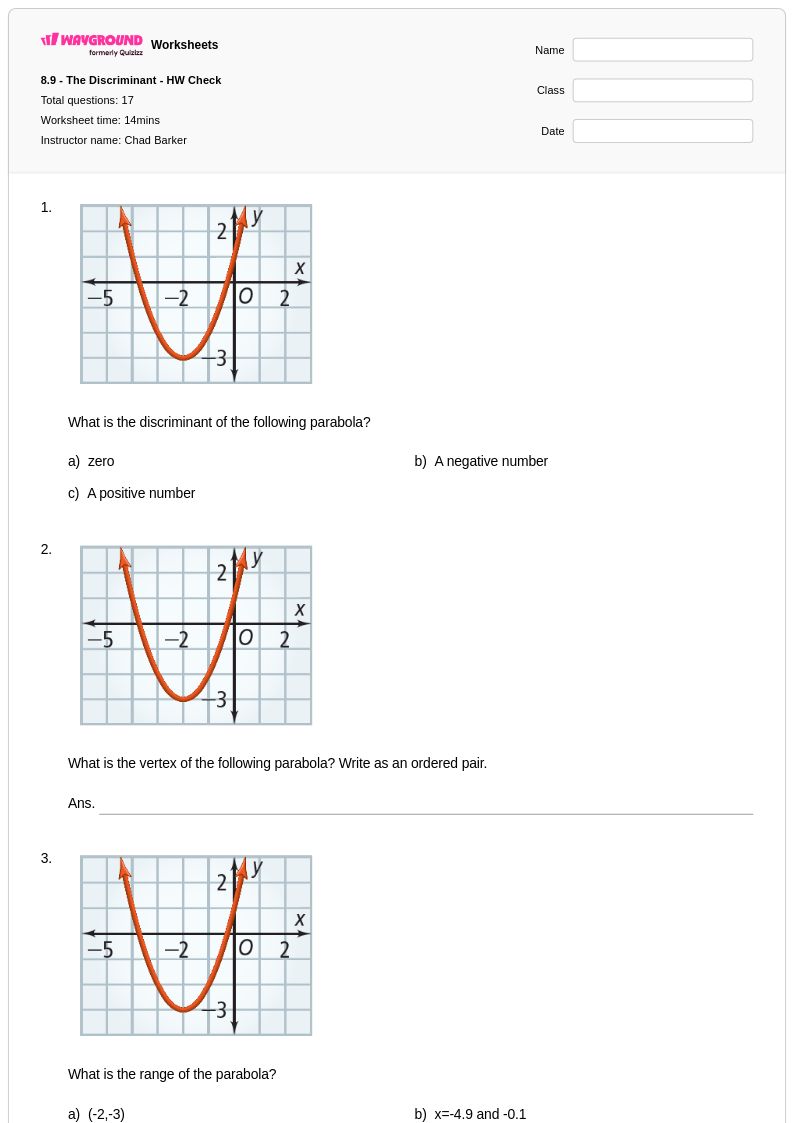
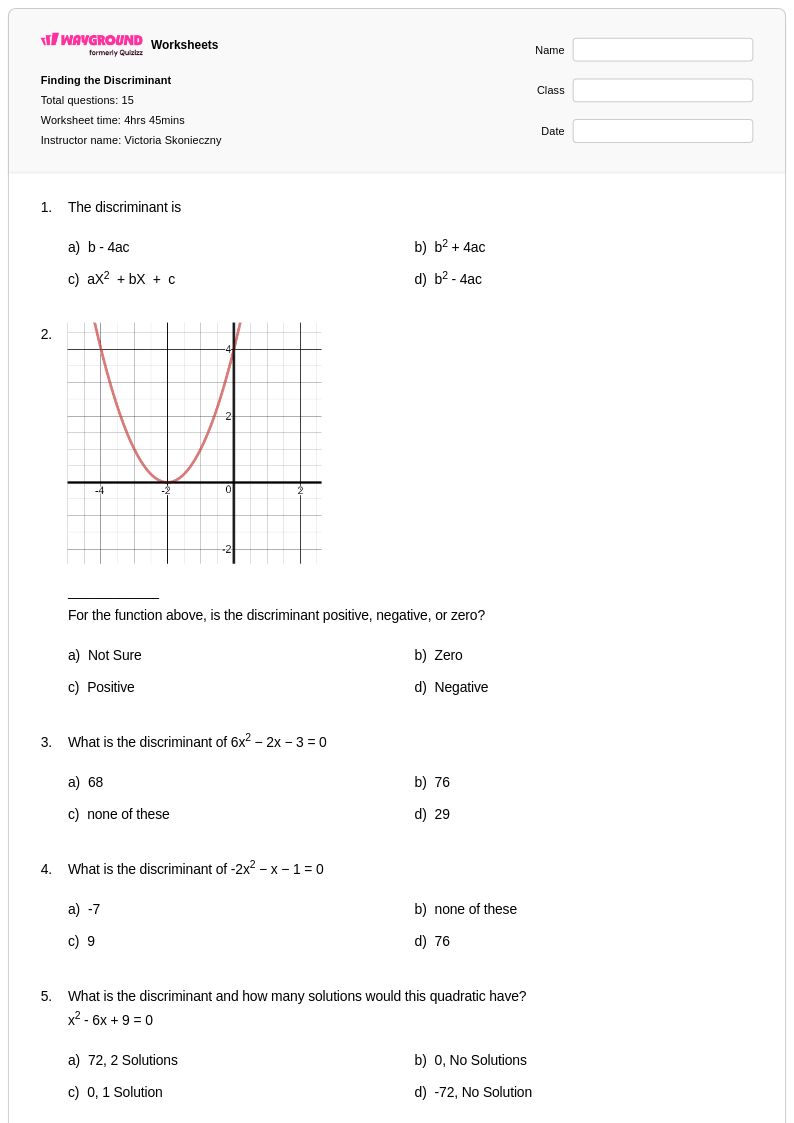
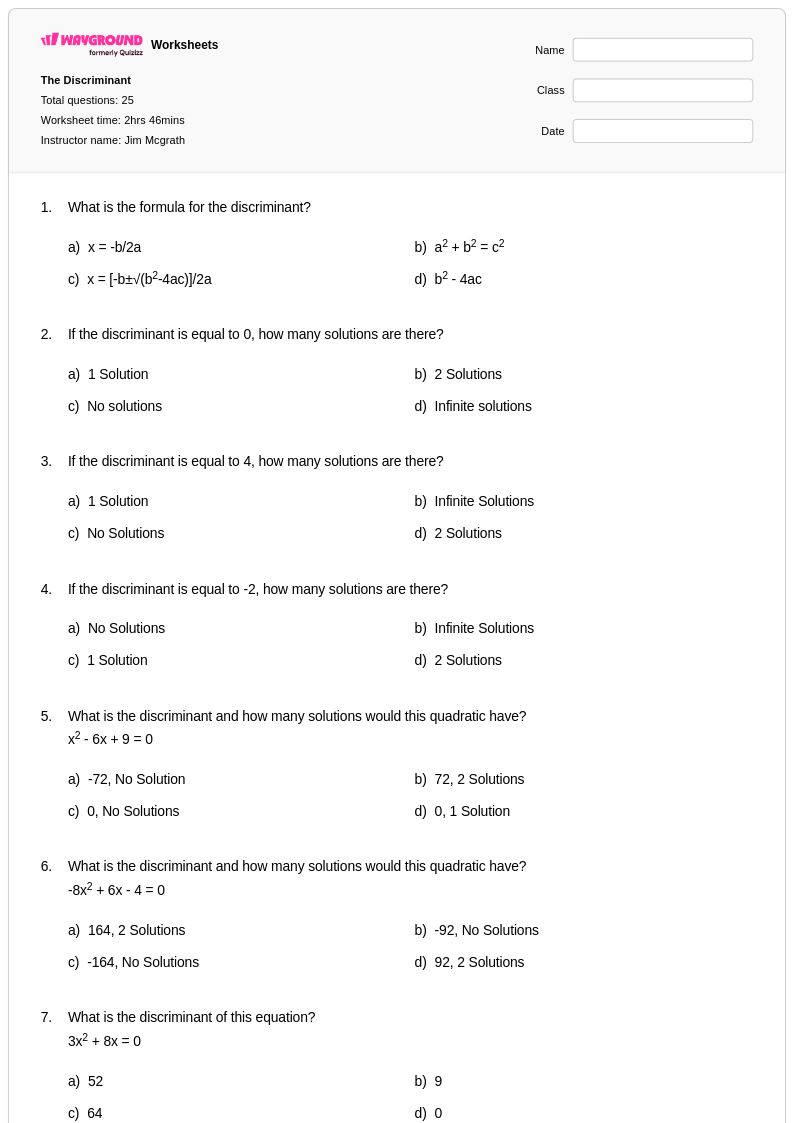
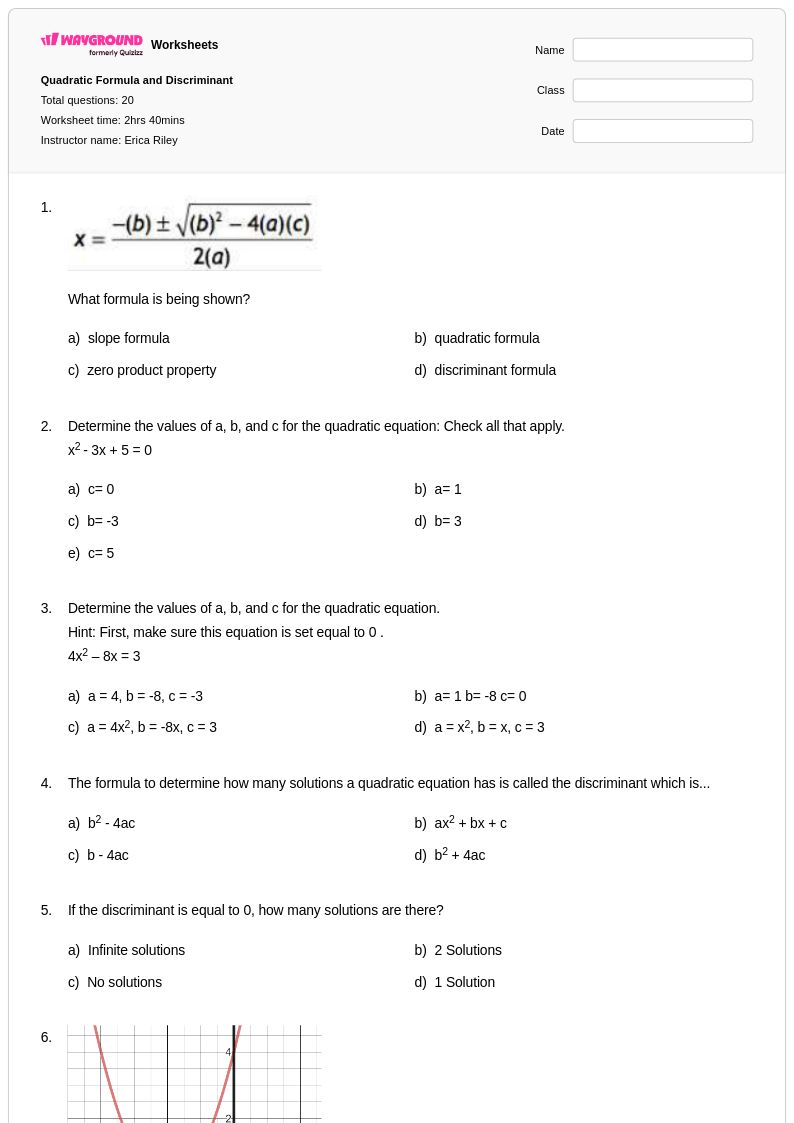
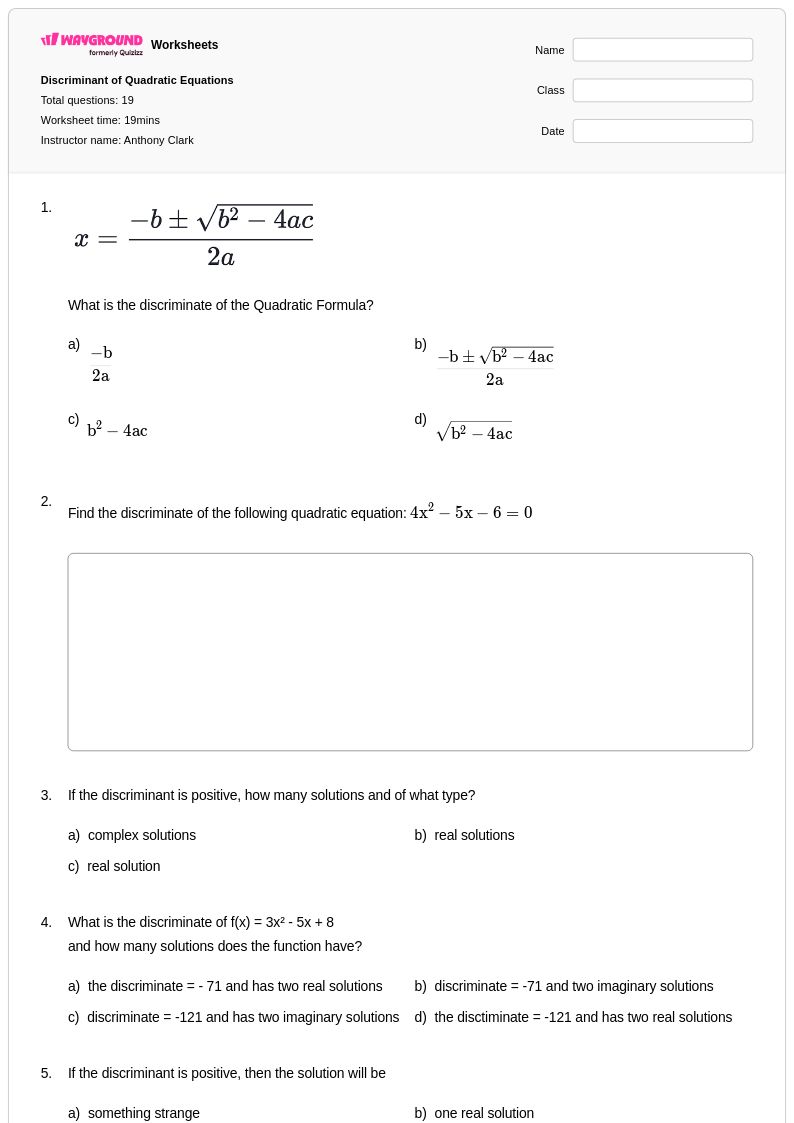
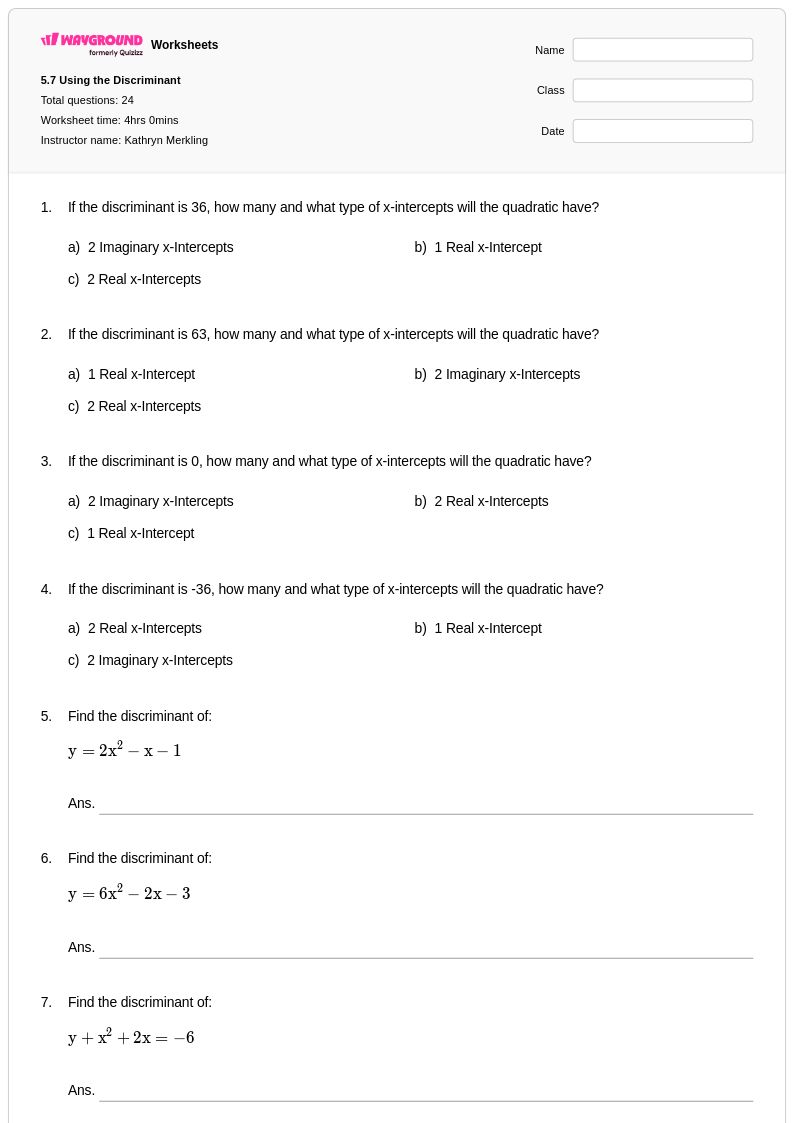
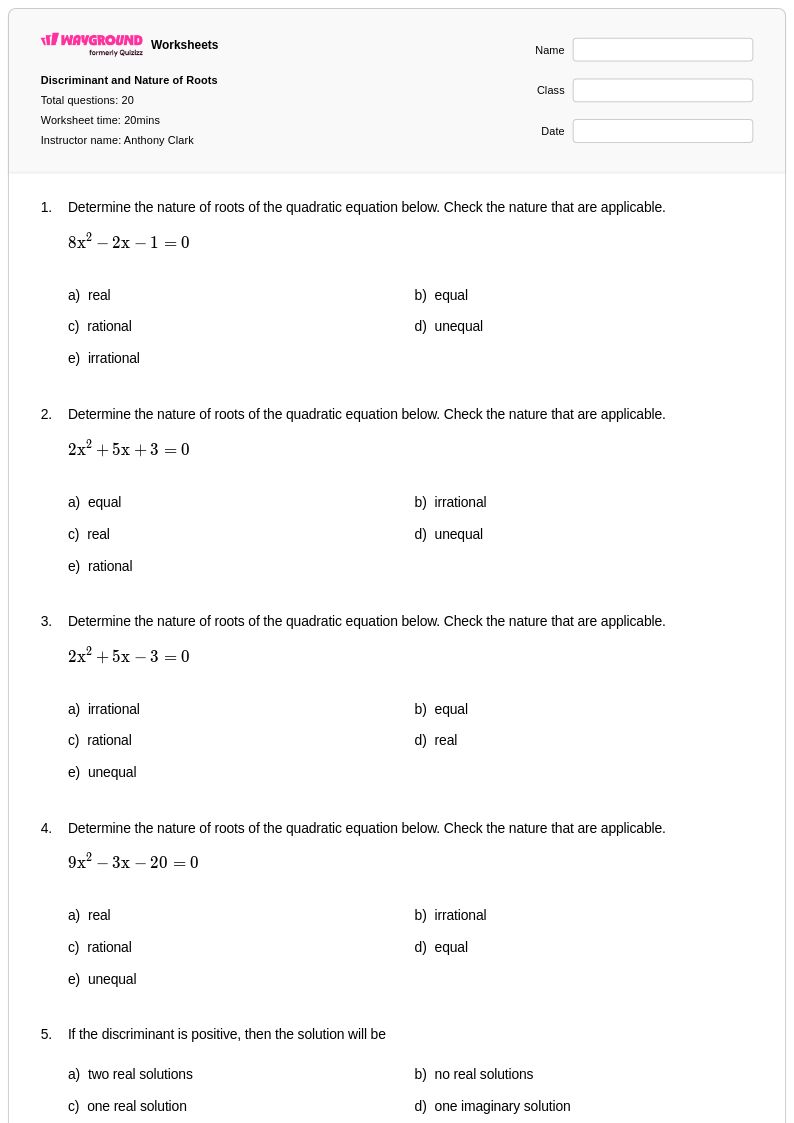
Explore Wayground's comprehensive collection of discriminant worksheets featuring free printables and practice problems with answer keys to help students master identifying and calculating discriminants in quadratic equations.
Discriminant worksheets from Wayground (formerly Quizizz) provide comprehensive practice opportunities for students to master this fundamental concept in quadratic mathematics. These carefully designed resources help students develop proficiency in calculating the discriminant using the formula b² - 4ac and interpreting its meaning to determine the nature of solutions for quadratic equations. Through systematic practice problems, students learn to identify when quadratic equations have two distinct real roots, one repeated real root, or two complex roots based on whether the discriminant is positive, zero, or negative respectively. The worksheets include detailed answer keys that guide students through step-by-step solutions, while printable pdf formats ensure easy access for both classroom instruction and independent study. These free educational resources strengthen critical analytical skills by connecting algebraic computation with conceptual understanding of quadratic behavior.
Wayground (formerly Quizizz) empowers mathematics teachers with an extensive collection of discriminant worksheets drawn from millions of teacher-created resources that can be easily discovered through robust search and filtering capabilities. The platform's standards-aligned materials support diverse instructional needs, offering differentiation tools that allow educators to customize content complexity and problem types to match varying student skill levels. Teachers can seamlessly integrate these resources into their lesson planning for initial instruction, targeted remediation, or enrichment activities, with flexible options to assign materials in both digital and printable pdf formats. The comprehensive worksheet collections enable educators to provide focused skill practice that builds student confidence in discriminant analysis while supporting deeper understanding of quadratic equations and their graphical representations, making complex mathematical concepts more accessible and engaging for learners.
FAQs
How do I teach the discriminant to students who are new to quadratic equations?
Start with the formula b² - 4ac in isolation before connecting it to the full quadratic formula. Have students calculate the discriminant for three carefully chosen equations — one with a positive result, one with zero, one with negative — and ask them to graph each on the same axes. Seeing two x-intercepts, one tangent point, and no crossing makes the abstract sign rule concrete. Once that visual connection clicks, the classification (two real roots, one repeated root, two complex roots) tends to stick.
What exercises help students practice the discriminant effectively?
The most productive practice moves in two directions: calculation and interpretation. Students should first drill identifying a, b, and c from equations not already in standard form — that step trips up more students than the arithmetic does. Then shift to interpretation: give the discriminant value and ask students to describe the solution type and sketch what the parabola looks like. Wayground's discriminant worksheets cover both directions, with problems that range from straightforward calculations to applications requiring students to connect discriminant values to graphical behavior.
What mistakes do students commonly make when working with the discriminant?
Three errors come up repeatedly. First, students misidentify coefficients when the equation isn't in standard form — they'll grab the wrong value for b or miss a negative sign on c. Second, they mishandle negative b: squaring a negative b gives a positive result, but students often carry the negative through and get a wrong discriminant. Third, they confuse a discriminant of zero with "no solution" rather than recognizing it means exactly one repeated real root. Targeted practice on non-standard-form equations and sign-handling catches most of these before they become habits.
How do I use Wayground's discriminant worksheets in my class?
You can run these as a digital quiz hosted on Wayground — students submit answers online and you get results immediately — or download the PDF and hand it out on paper. Every worksheet includes a complete answer key, so paper assignments are easy to review. If you go the printable route, the Wayground for Teachers app lets you scan or photograph student work to grade it without re-entering everything by hand.
How does the discriminant fit into the Common Core algebra progression?
Common Core introduces quadratic equations in Algebra I, where students solve by factoring and completing the square. The discriminant becomes central in Algebra II, when students are expected to extend their understanding to complex solutions and explain why some quadratics have no real roots. At that stage, the discriminant bridges the earlier procedural work of solving equations to the conceptual question of what the solution set actually looks like — including when it lives outside the real numbers entirely.
How can I differentiate discriminant practice for a mixed-ability class?
For students who struggle with the coefficient-identification step, Wayground's reduced answer choices accommodation lowers the cognitive load so they can focus on the discriminant calculation itself rather than getting lost in the setup. For students with reading difficulties, the Read Aloud feature handles word problems and multi-step instructions. On the worksheet side, you can generate an alternate version with a larger font or a dyslexia-friendly font without changing the math content — same problems, more accessible format.