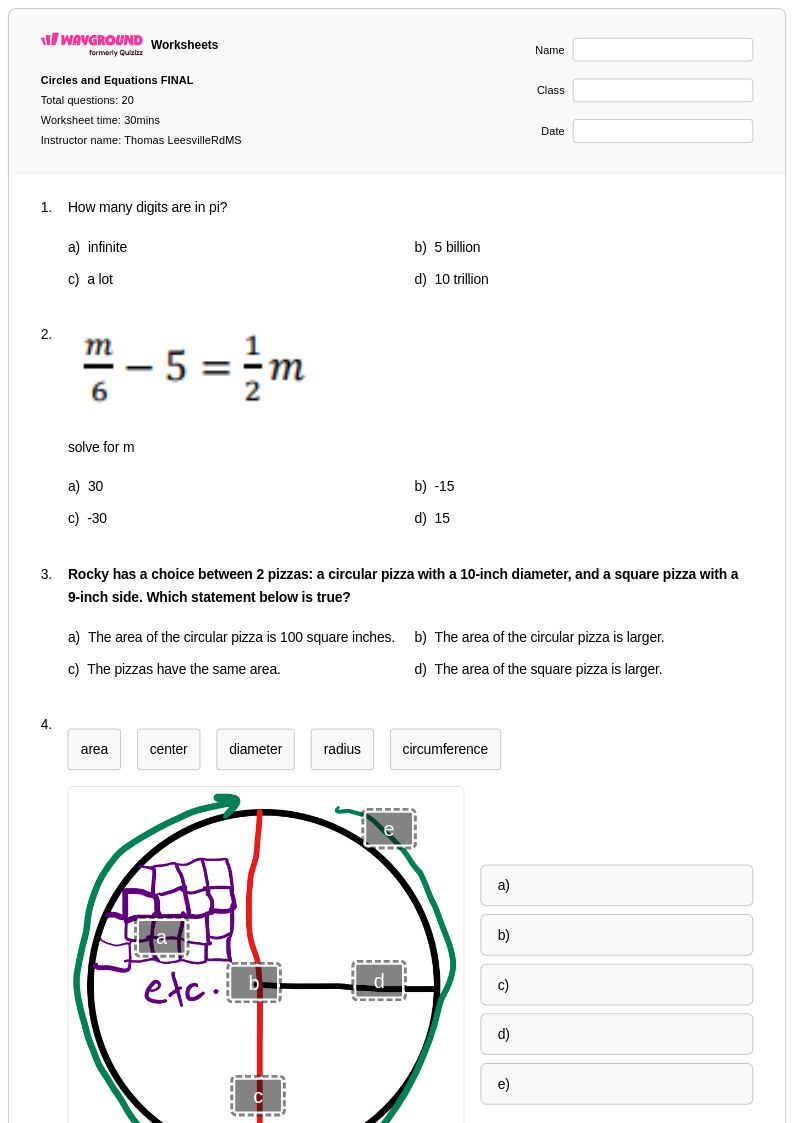
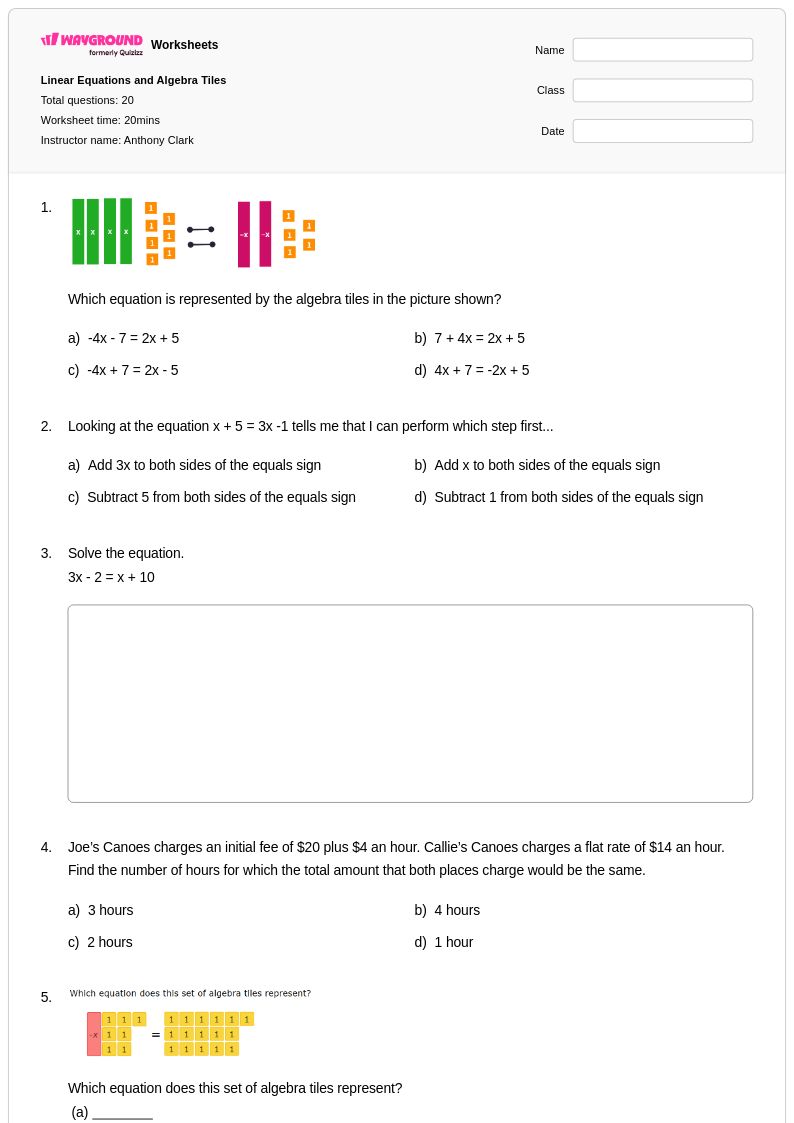
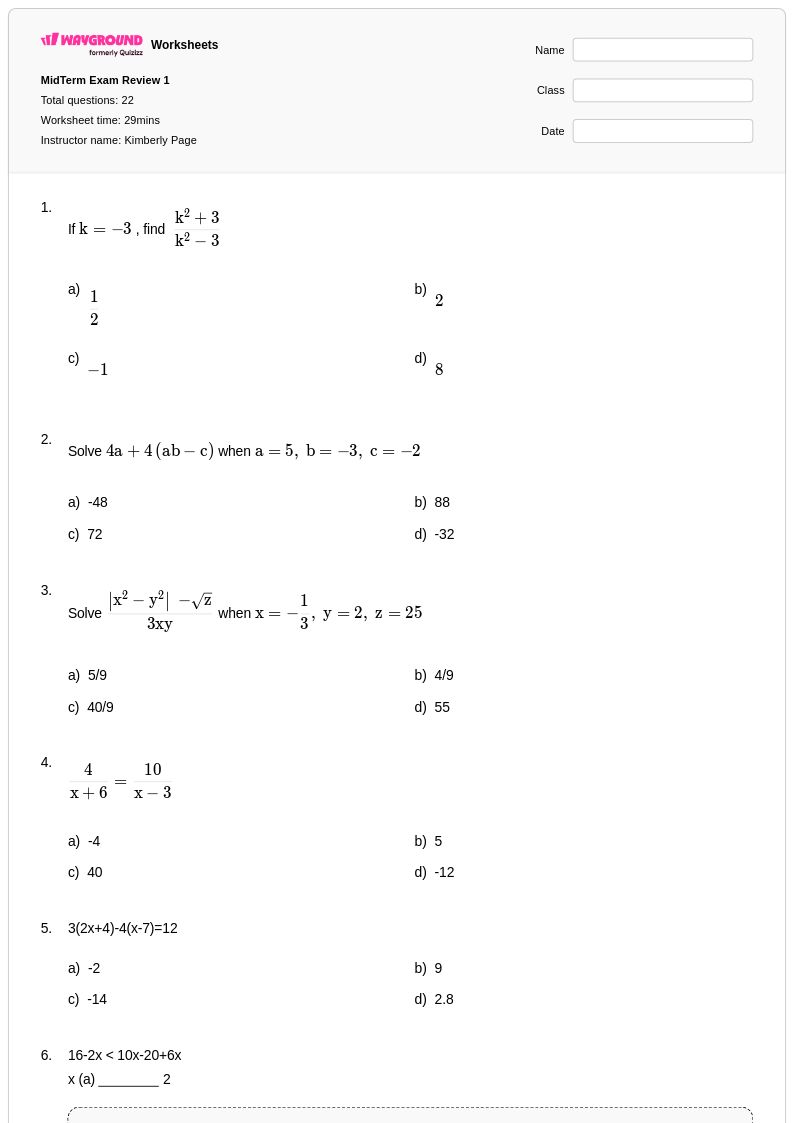
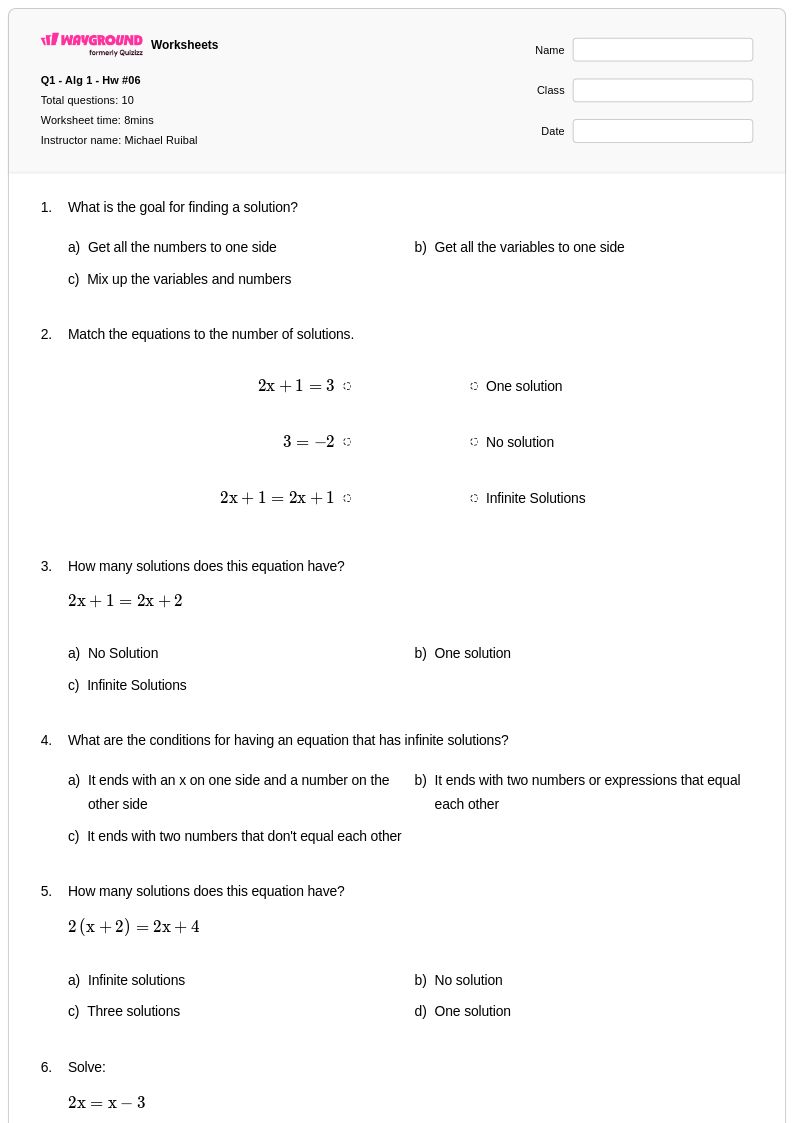
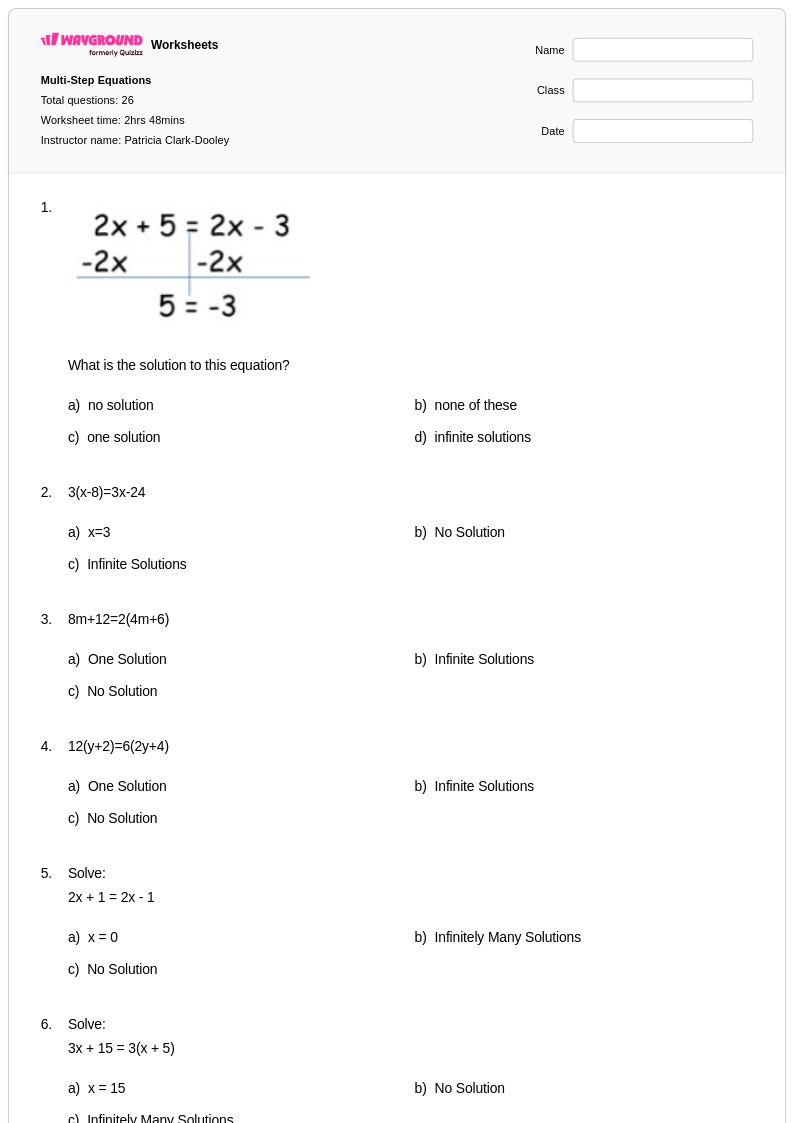
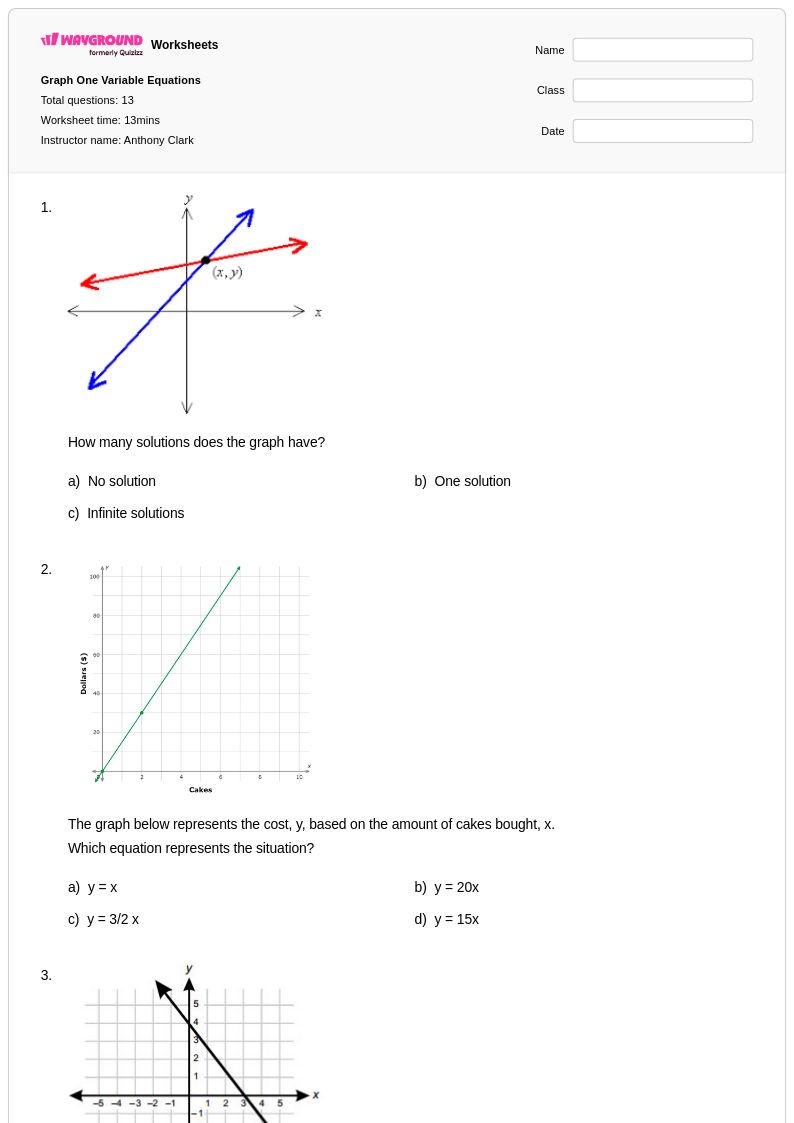
Free Printable Equations with Infinite and No Solutions worksheets
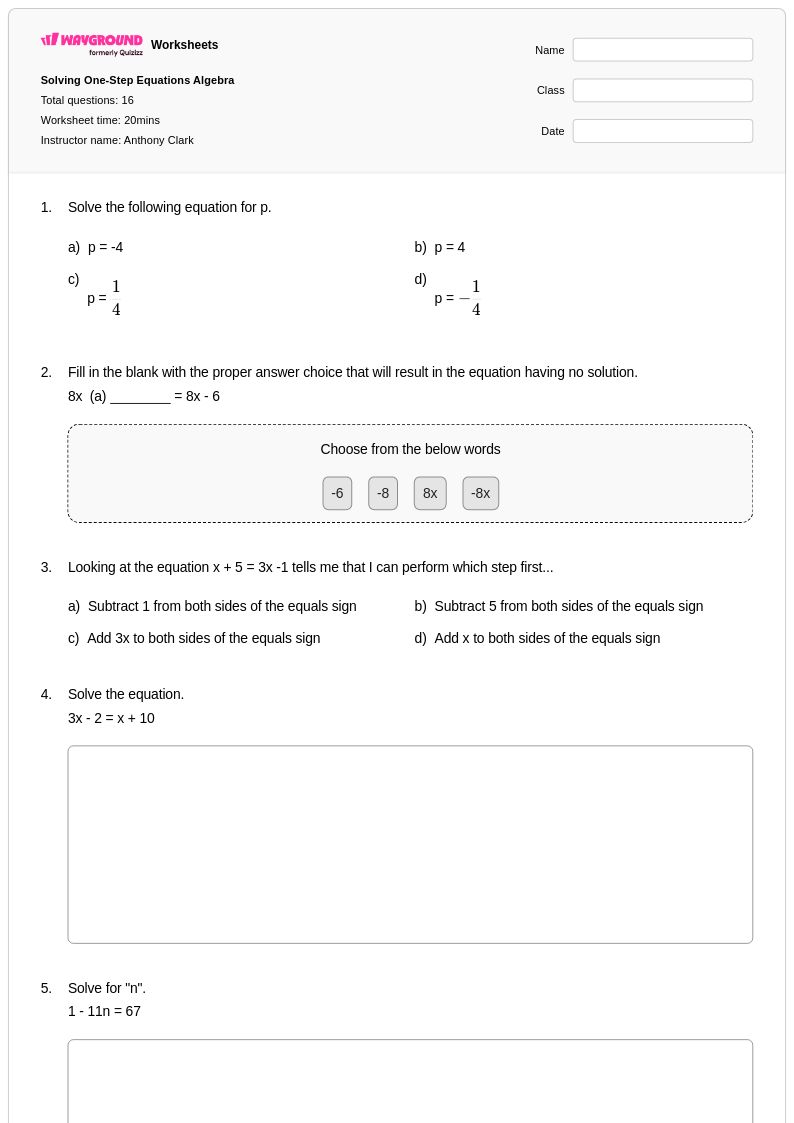
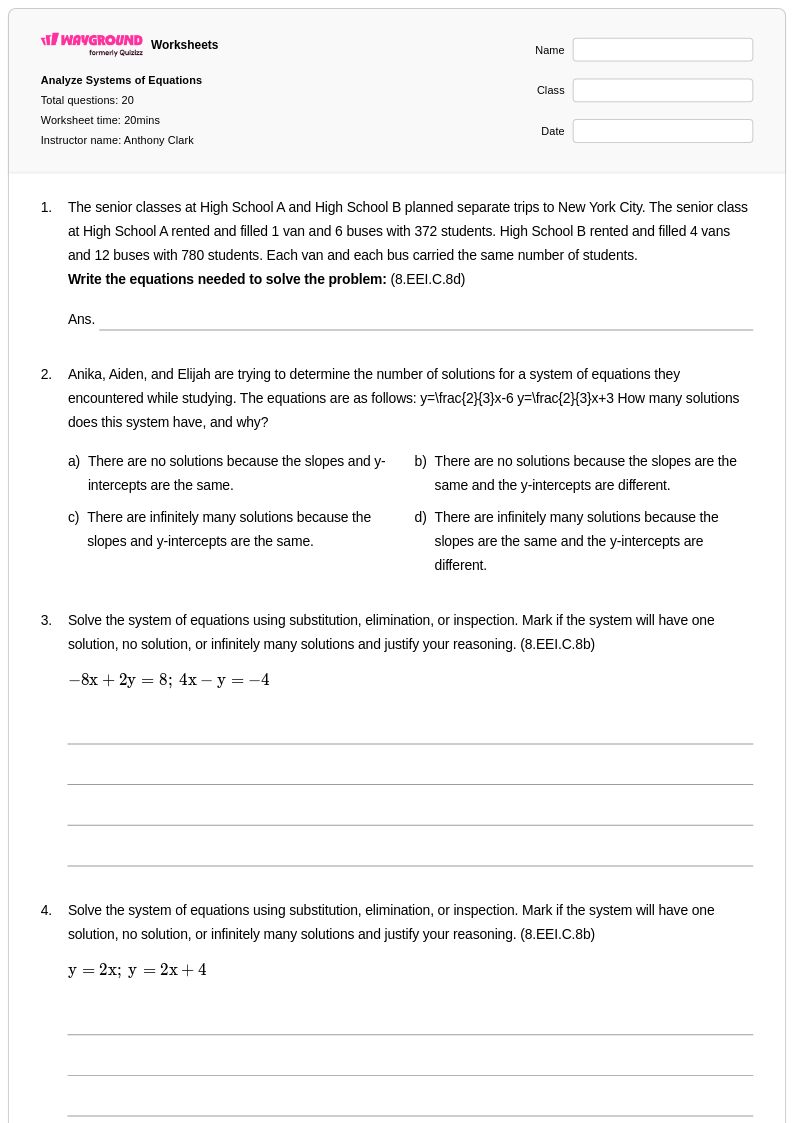
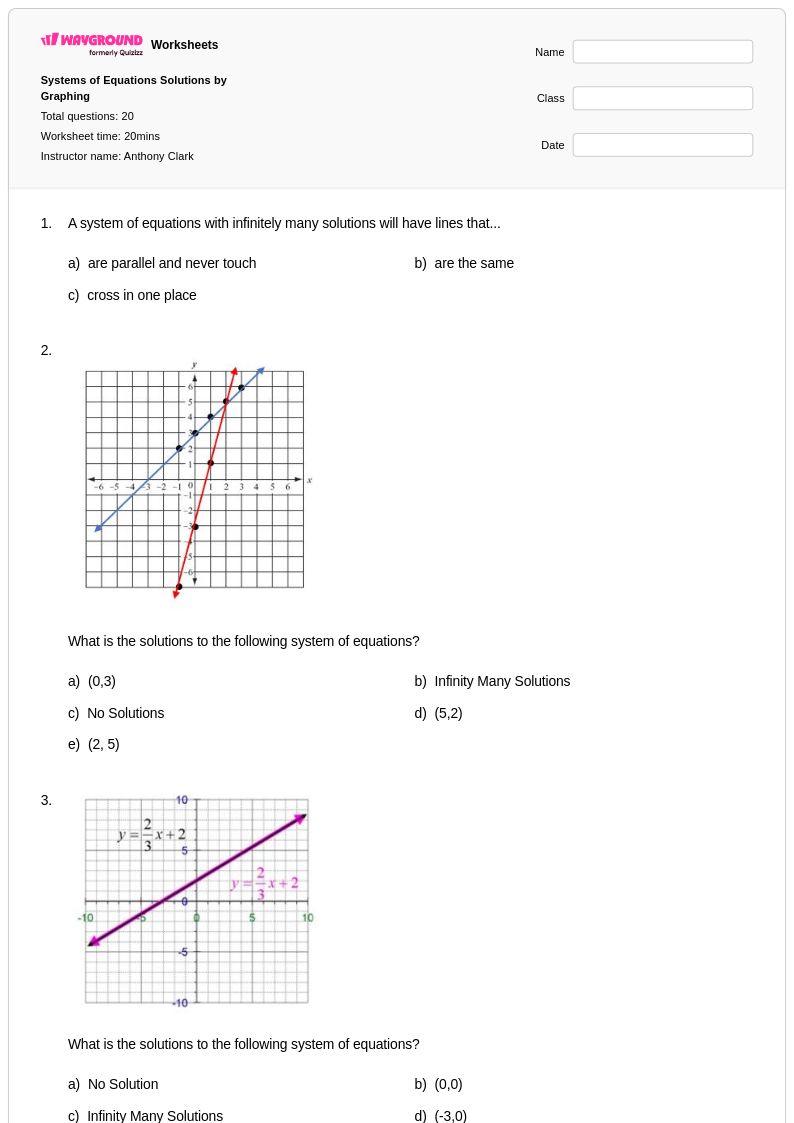
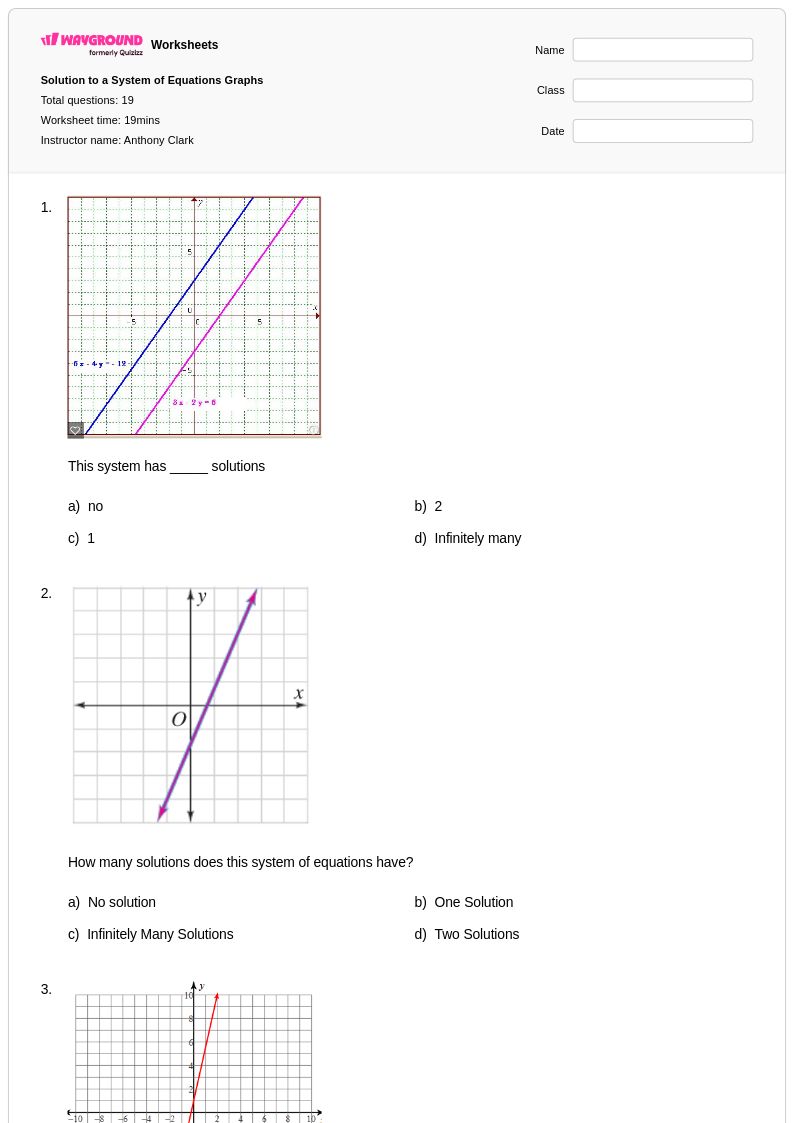
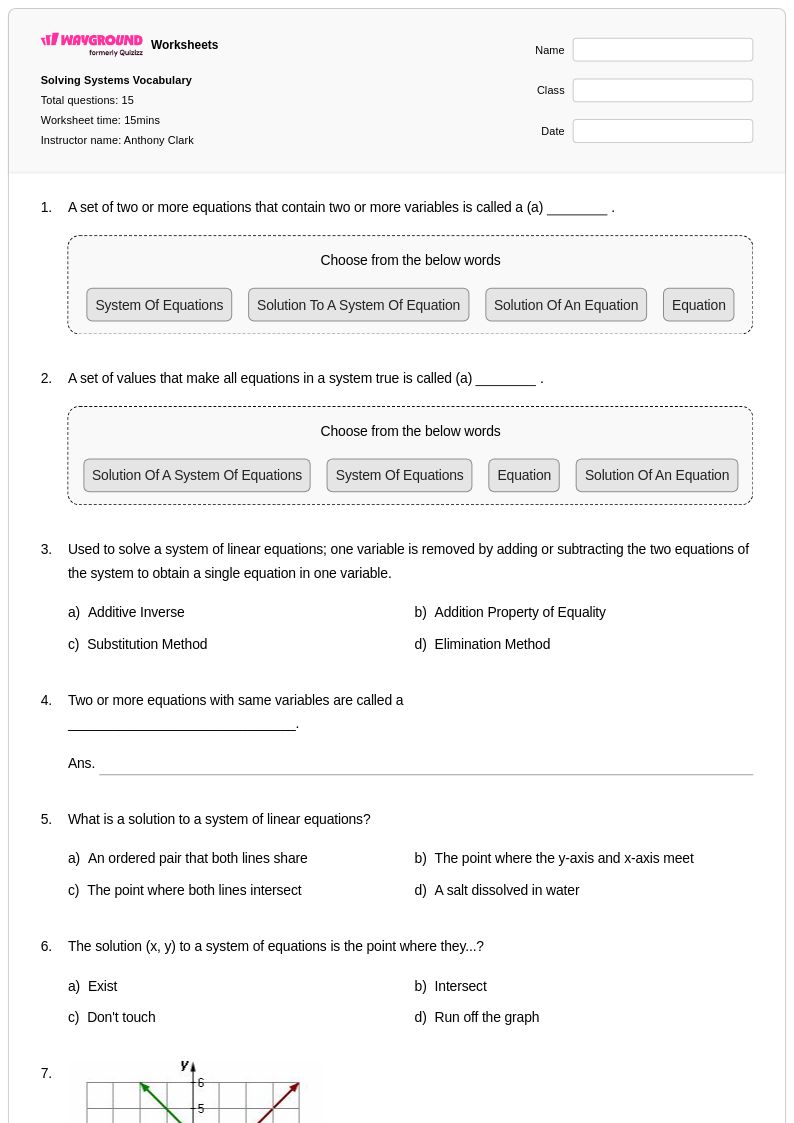
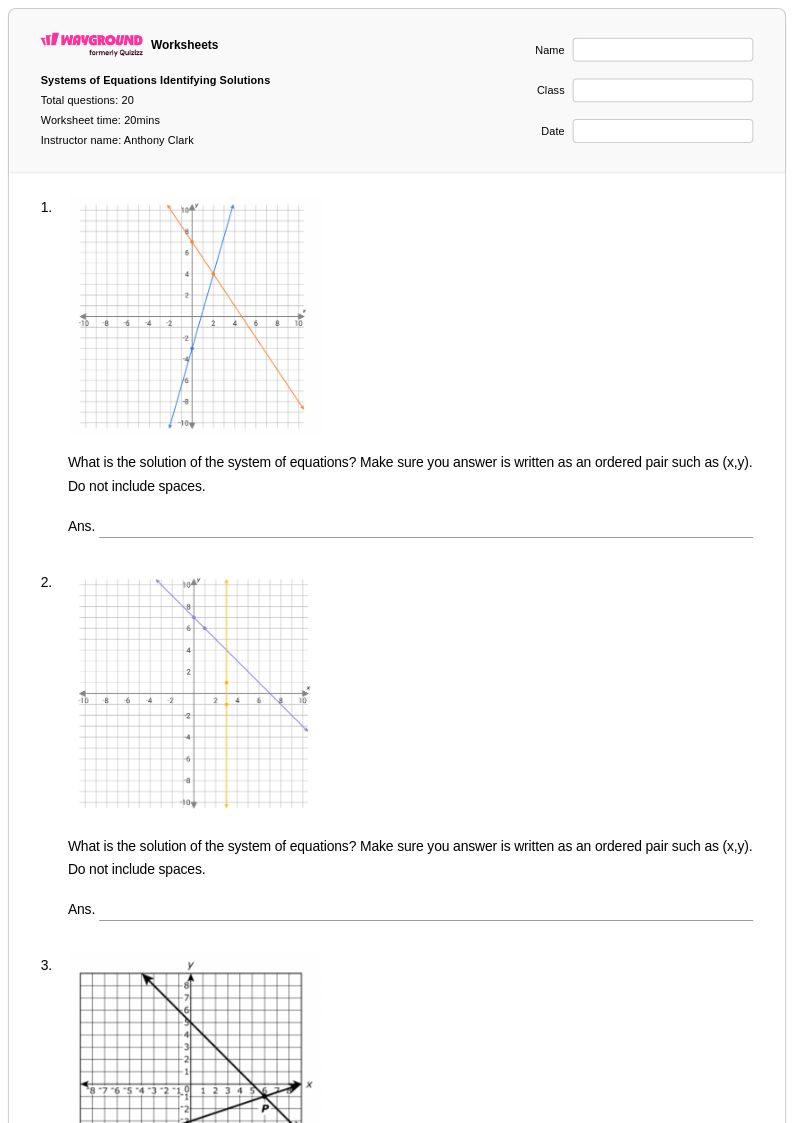
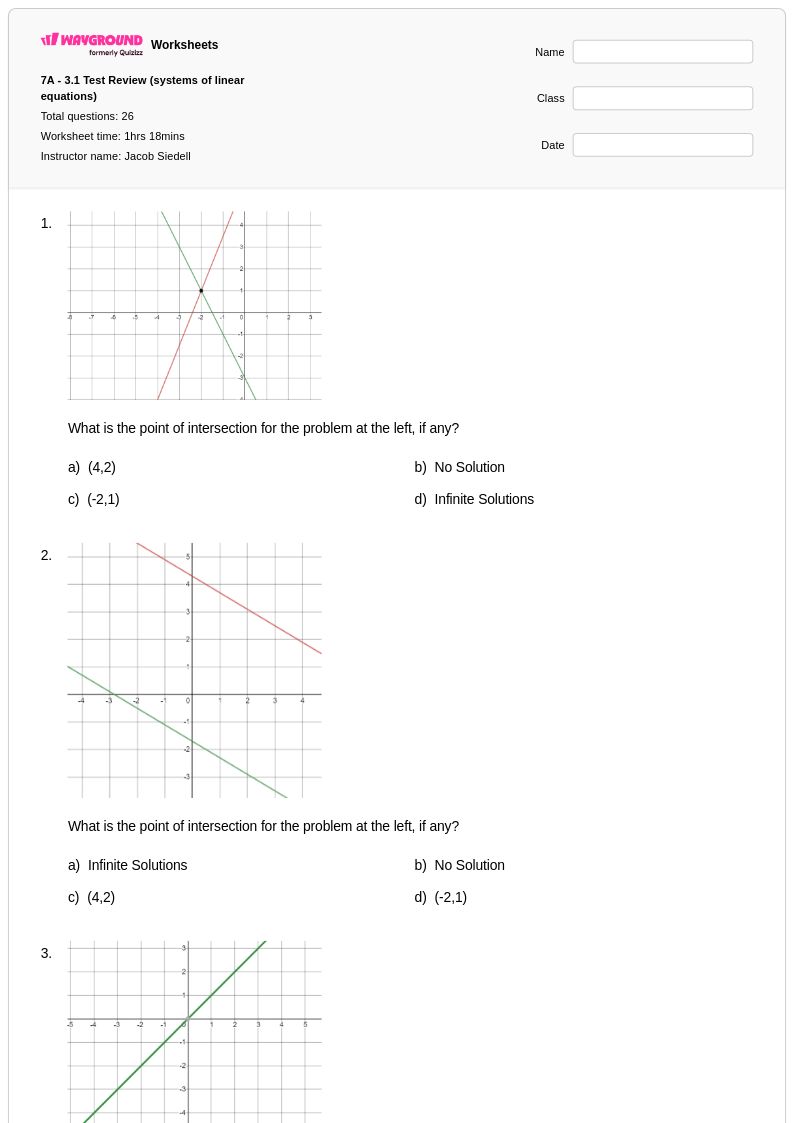
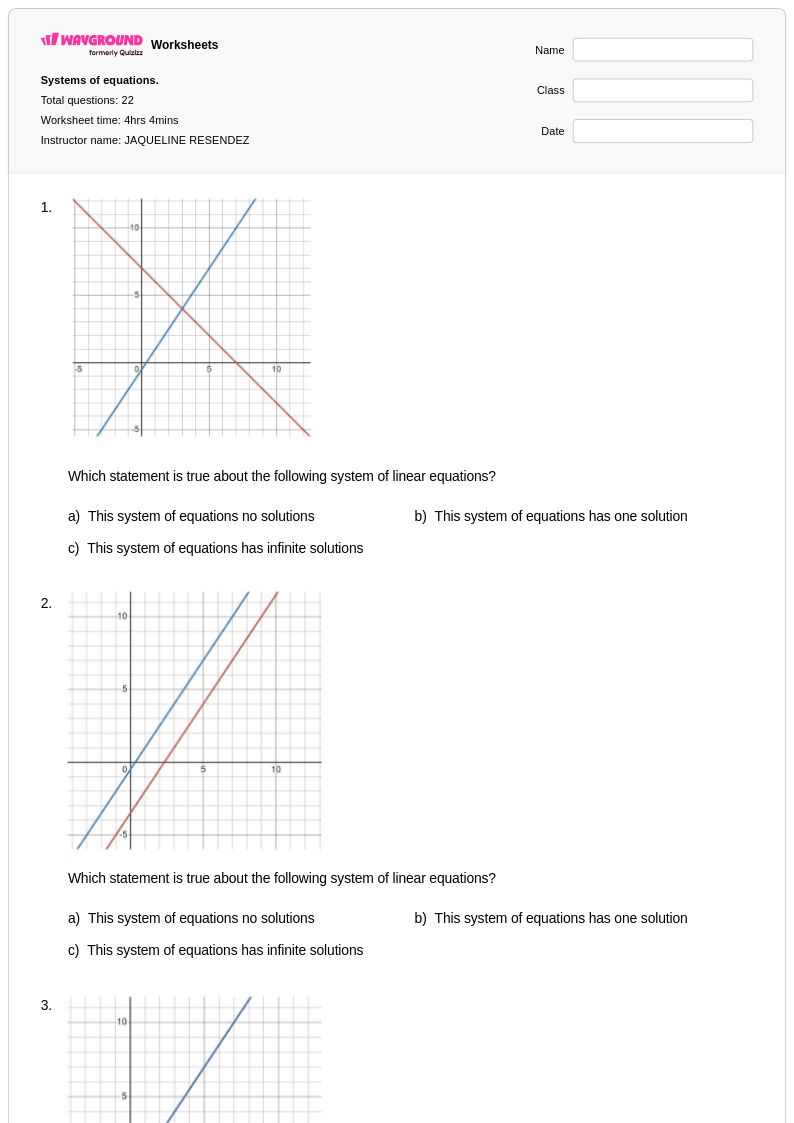
Master equations with infinite and no solutions through Wayground's comprehensive collection of free algebra worksheets, featuring printable PDFs with practice problems and detailed answer keys to strengthen mathematical reasoning skills.
Explore printable Equations with Infinite and No Solutions worksheets
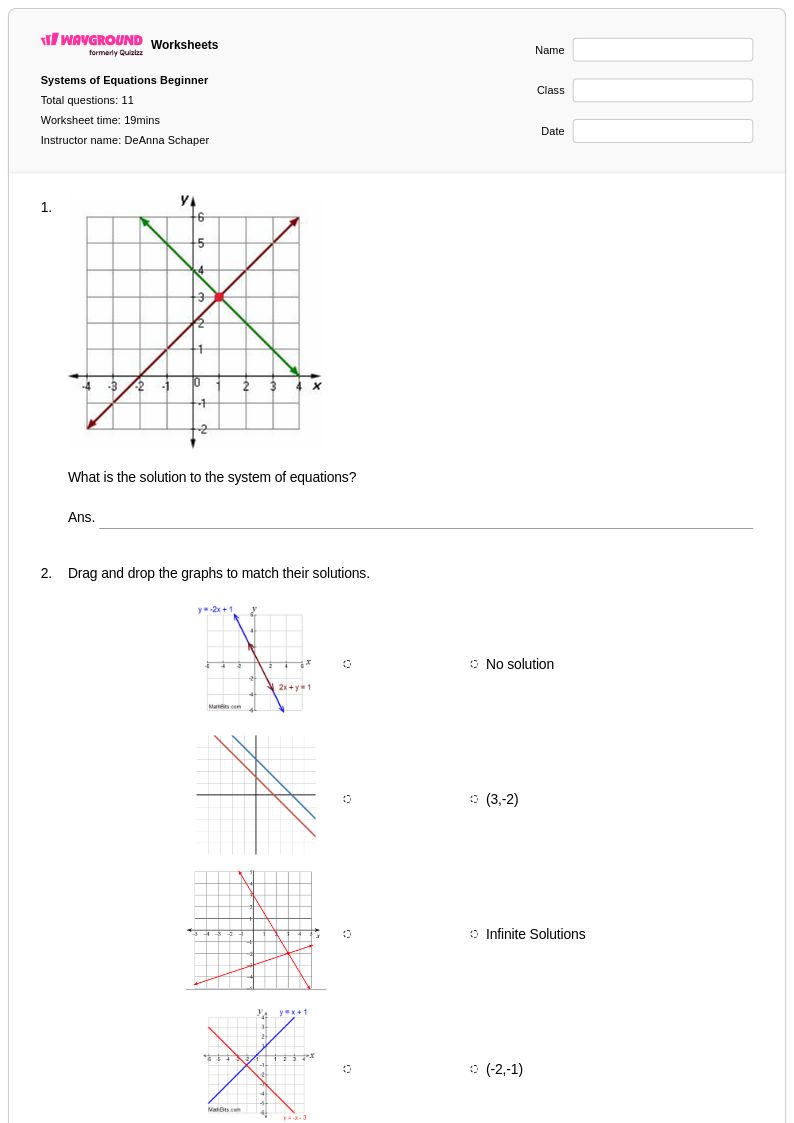
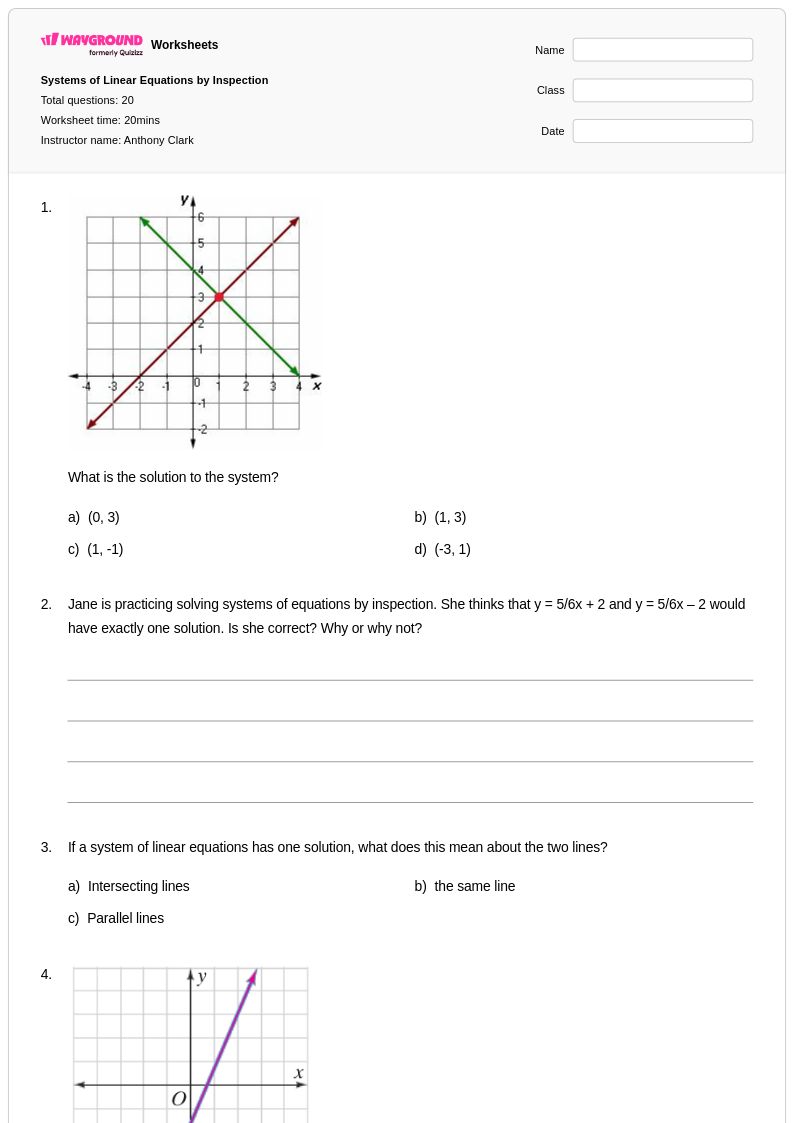
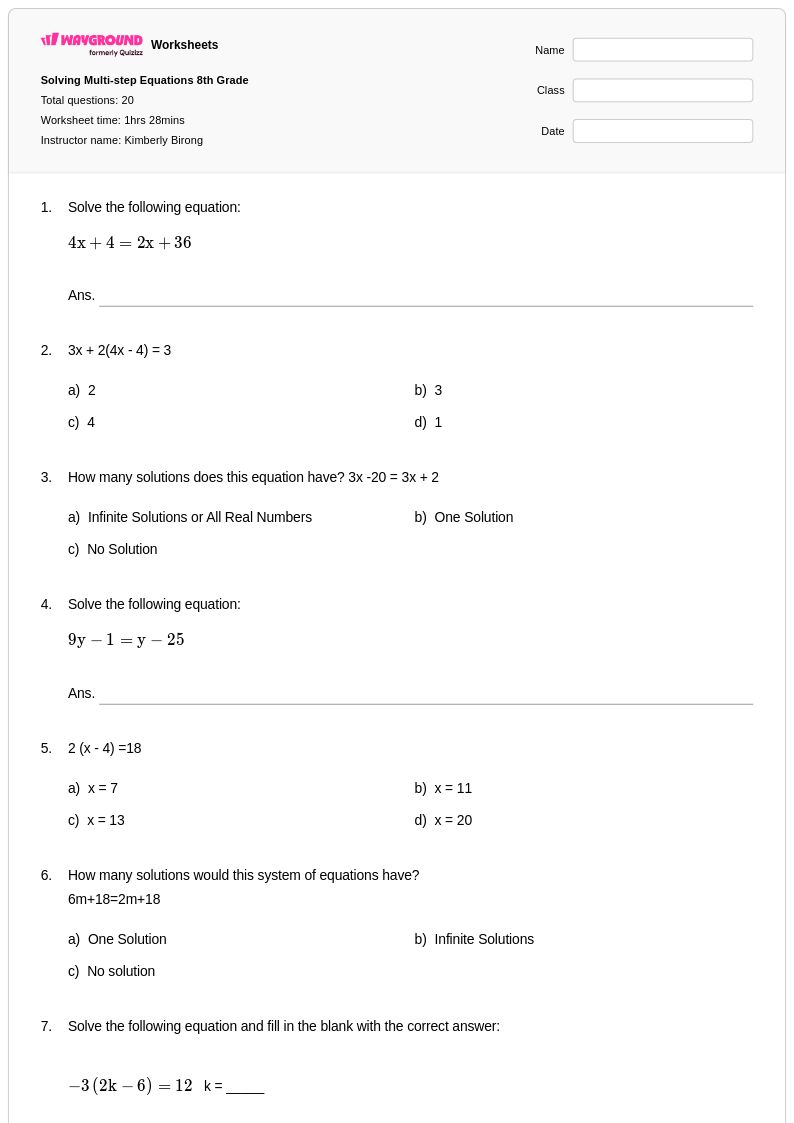
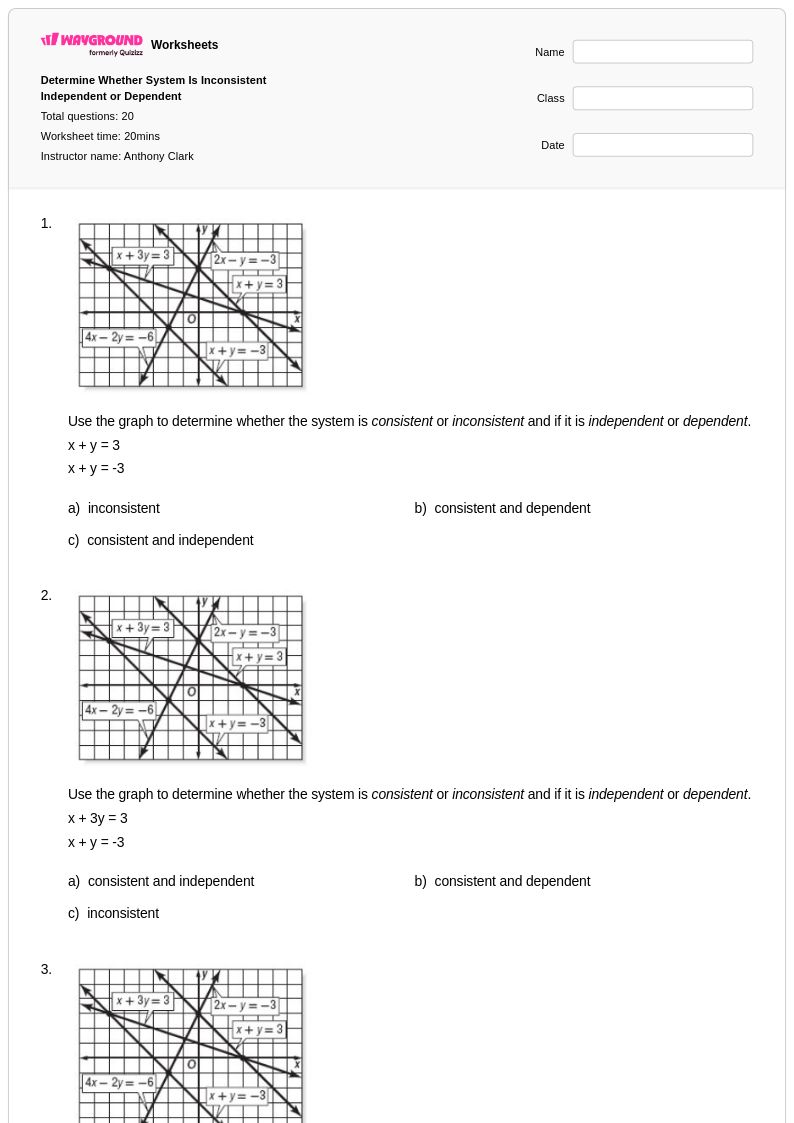
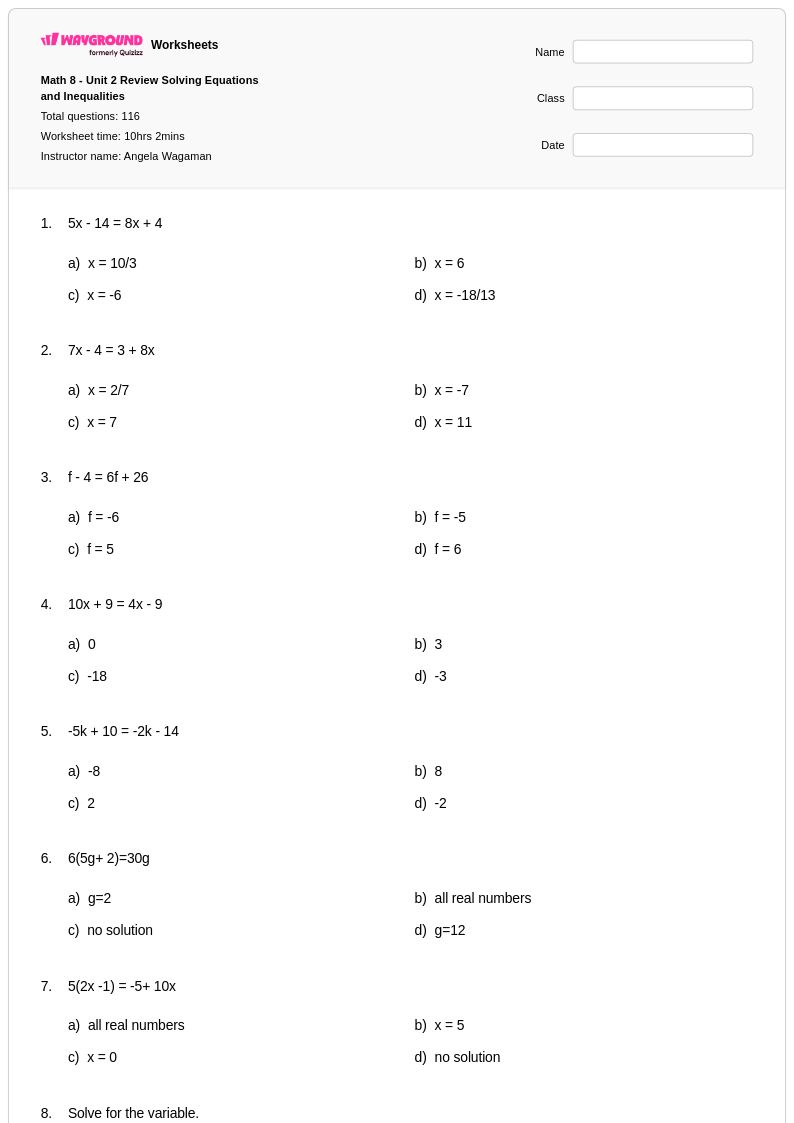
Equations with infinite and no solutions represent a critical algebraic concept that challenges students to think beyond traditional problem-solving approaches and develop deeper mathematical reasoning skills. Wayground's comprehensive worksheet collection addresses this sophisticated topic through carefully designed practice problems that guide learners through the process of identifying when linear equations result in identities (infinite solutions) or contradictions (no solutions). These free printable resources strengthen students' ability to recognize patterns in algebraic manipulations, distinguish between consistent and inconsistent systems, and understand the geometric interpretations of parallel and coincident lines. Each worksheet includes a detailed answer key that explains the algebraic steps leading to conclusions like 0 = 0 for infinite solutions or 0 = 5 for no solutions, helping students master this fundamental yet often challenging algebraic skill through systematic practice.
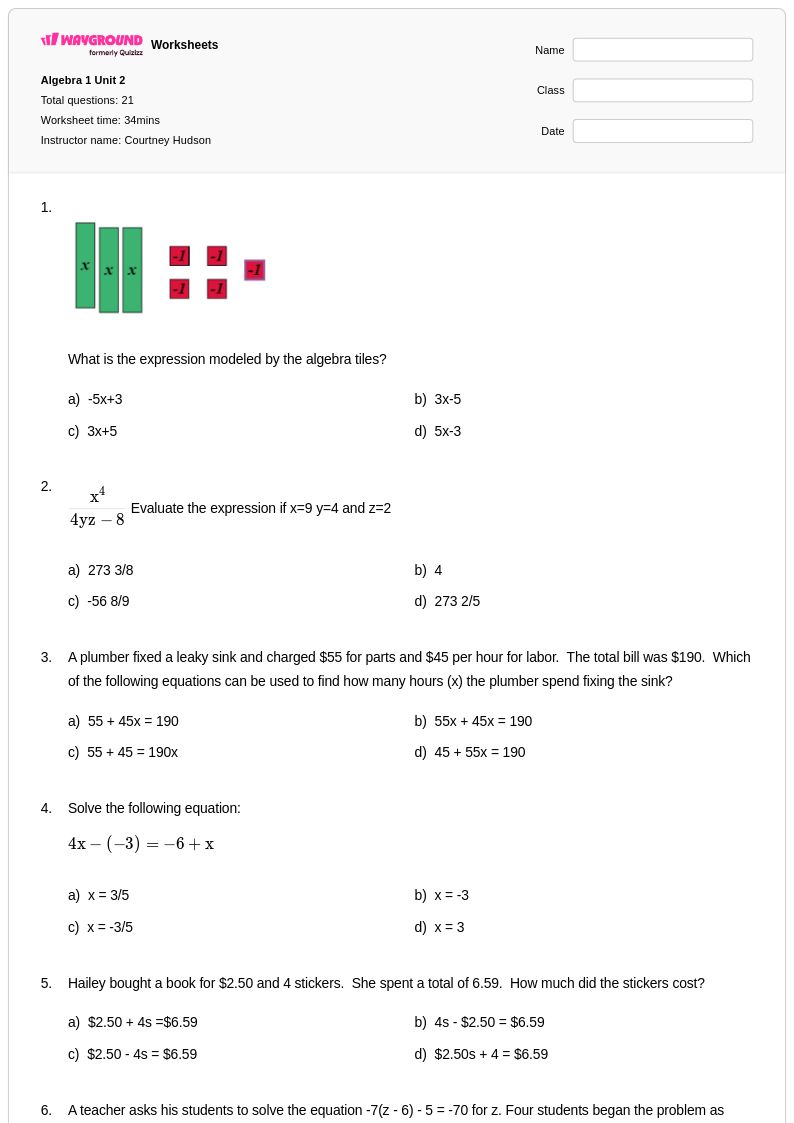
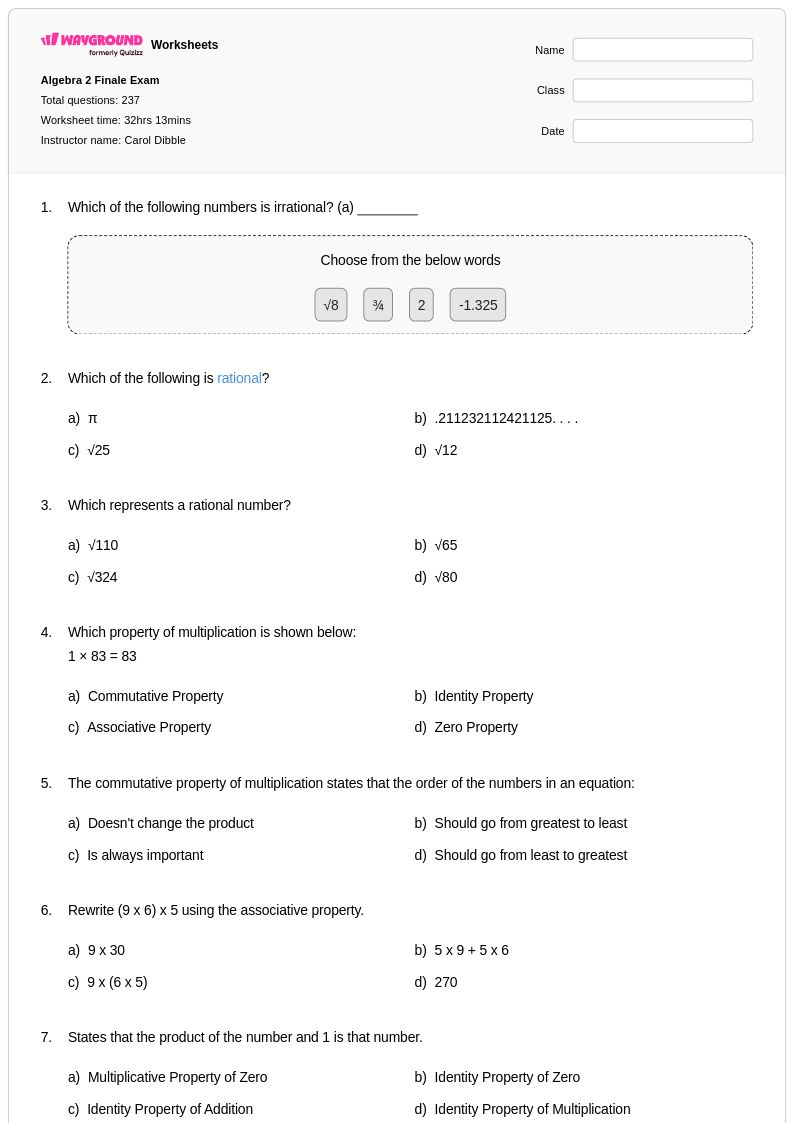
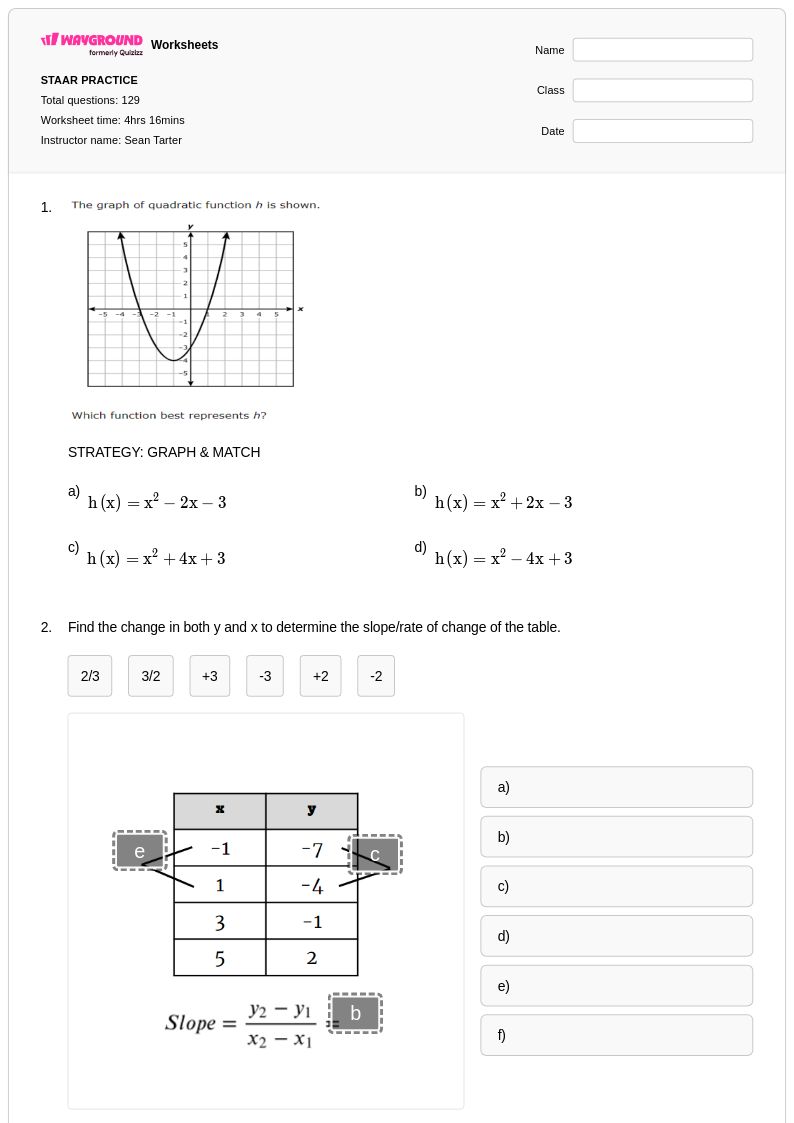
Wayground's extensive library of teacher-created resources provides educators with powerful tools to effectively teach equations with infinite and no solutions across diverse classroom settings. With millions of expertly developed worksheets available through advanced search and filtering capabilities, teachers can quickly locate materials that align with their specific curriculum standards and student needs. The platform's differentiation tools enable instructors to customize practice problems for various skill levels, while the flexible format options allow seamless integration of both printable pdf worksheets and interactive digital activities into lesson plans. These comprehensive resources support targeted remediation for students struggling with algebraic reasoning, enrichment opportunities for advanced learners ready to explore complex equation types, and ongoing skill practice that reinforces conceptual understanding through varied problem contexts and solution strategies.
FAQs
How do I teach equations with infinite and no solutions?
Start by making sure students can fluently solve standard one-variable linear equations before introducing special cases. Then present an equation like 2(x + 3) = 2x + 6 and walk through the algebra together — when the variable drops out and you're left with 6 = 6, that's the moment to ask: 'What does this mean?' Students need to connect the algebraic result to the idea that every value of x satisfies the equation. Do the same with a contradiction like 2x + 1 = 2x + 5, where you land on 1 = 5. Pairing these algebraic outcomes with their geometric interpretations — coincident lines for infinite solutions, parallel lines for no solution — gives students two ways to reason about the same concept, which deepens retention.
What exercises help students practice identifying equations with infinite or no solutions?
The most effective practice moves students through three stages: first, classifying pre-simplified equations (e.g., 0 = 0 vs. 0 = 7) so they recognize the end-state; second, simplifying multi-step equations and classifying the result themselves; third, working backwards — given that an equation has no solution, fill in the missing constant. That last type is especially useful because it forces students to think about structure rather than just execute steps. Wayground's worksheets cover these problem types with a full answer key that explains the reasoning behind each classification, not just the final answer.
What mistakes do students commonly make with equations that have infinite or no solutions?
The most common error is concluding that a contradiction means they made an algebra mistake and going back to 'fix' it. Students have been trained that equations have answers, so 0 = 5 feels like a sign of error rather than a valid result. A related mistake is confusing which outcome is which: students sometimes label 0 = 0 as 'no solution' because 'zero means nothing.' It helps to address both misconceptions directly — show a worked example where the contradiction is intentional, and explicitly discuss why 0 = 0 means infinitely many solutions rather than 'zero solutions.'
How do I use Wayground's worksheets for equations with infinite and no solutions?
You can run these worksheets as a digital quiz hosted on Wayground — students work through the problems on-screen and answers are captured automatically. If you prefer paper, download the printable PDF and distribute it in class; every worksheet includes a complete answer key so you're not building one from scratch. After students submit paper work, you can grade it using the Wayground for Teachers app, which lets you scan or capture student responses for quick review.
Is this topic aligned to Common Core standards, and where does it fit in the algebra progression?
Yes. Common Core's algebra strand builds toward students understanding that an equation is a statement that may be true for all values, no values, or exactly one value of the variable. Students first encounter this distinction when solving linear equations in one variable — recognizing that some equations are identities and others are contradictions. This lays the groundwork for later work with systems of equations, where infinite solutions correspond to dependent systems (the same line) and no solution corresponds to inconsistent systems (parallel lines). Mastering the single-equation case here makes the systems case significantly easier to grasp.
How can I differentiate practice on this topic for mixed-ability classes?
For students who are still shaky on the underlying algebra, Wayground lets you generate an alternate version of the worksheet with wider font spacing and a larger font size, which reduces visual clutter and helps them focus on one step at a time. For students who struggle with reading the problem setups, the Read Aloud accommodation reads questions aloud so decoding doesn't become a barrier to the math. Advanced students who finish early benefit most from the 'work backwards' problem type — given a desired outcome (infinite solutions or no solution), construct an equation that produces it — which you can assign as a separate Wayground worksheet.