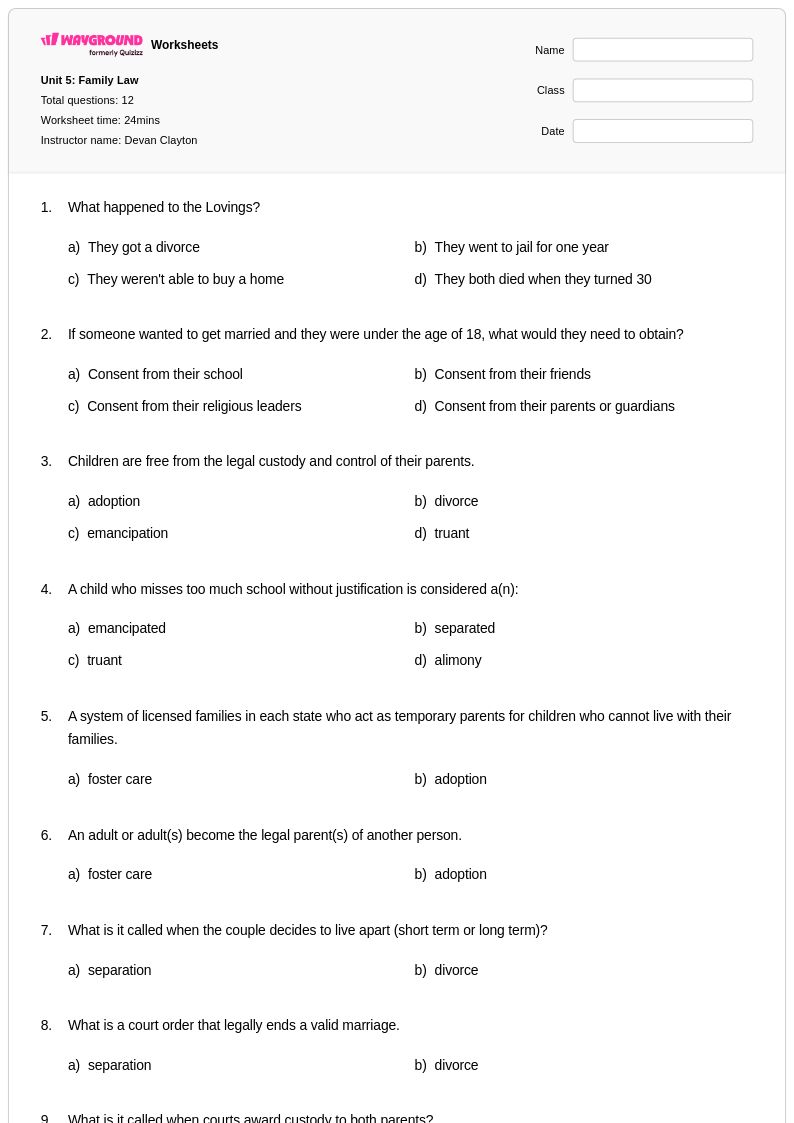
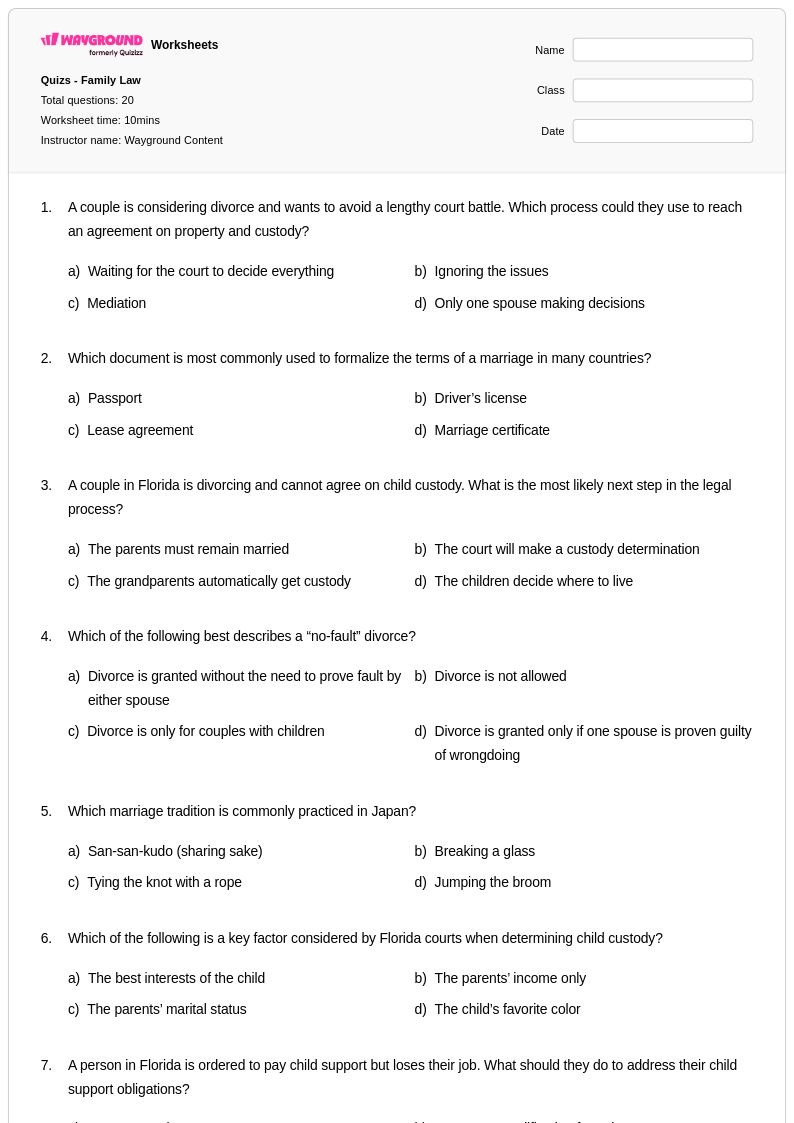
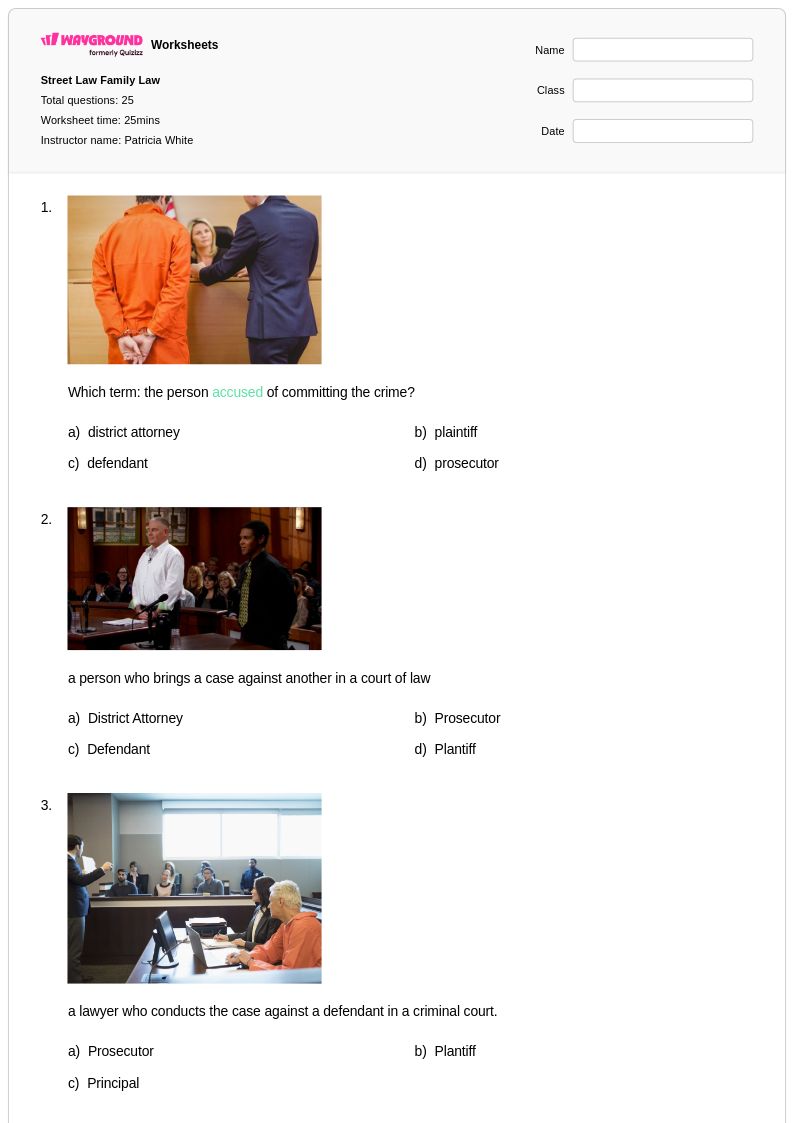
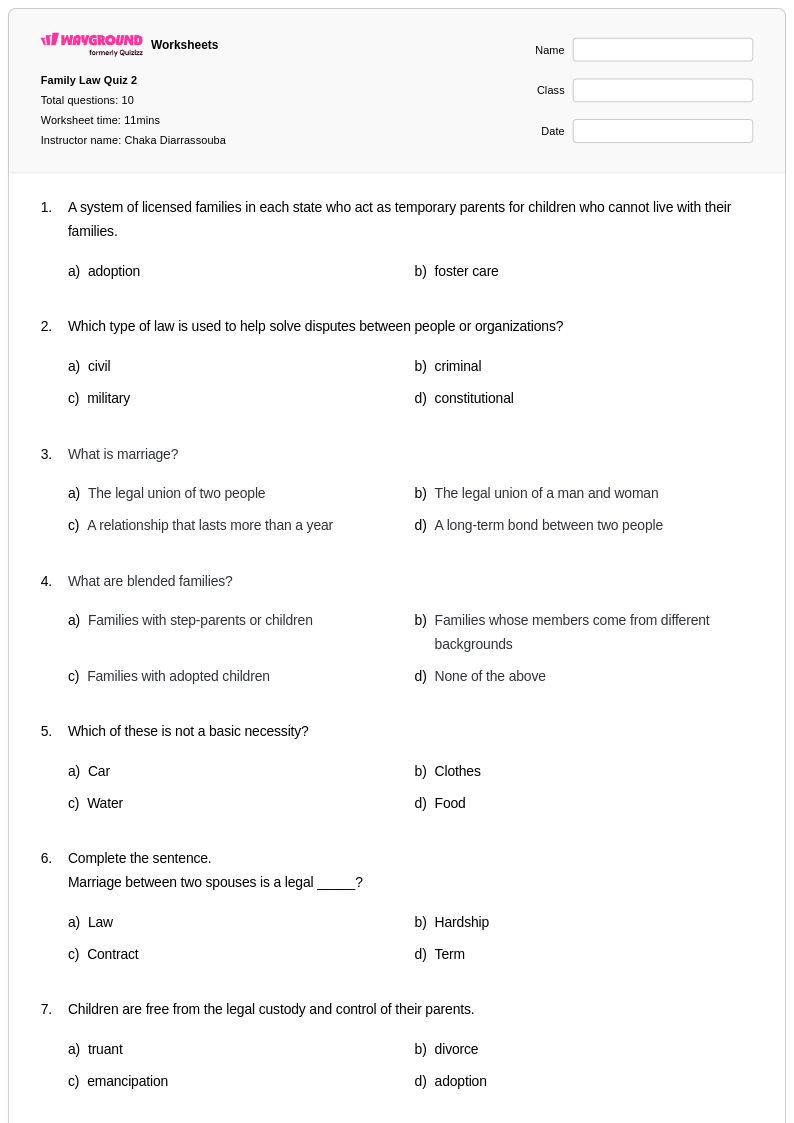
Explore Wayground's comprehensive collection of free family law worksheets and printables that help students understand legal relationships, rights, and responsibilities within families through engaging practice problems and detailed answer keys.
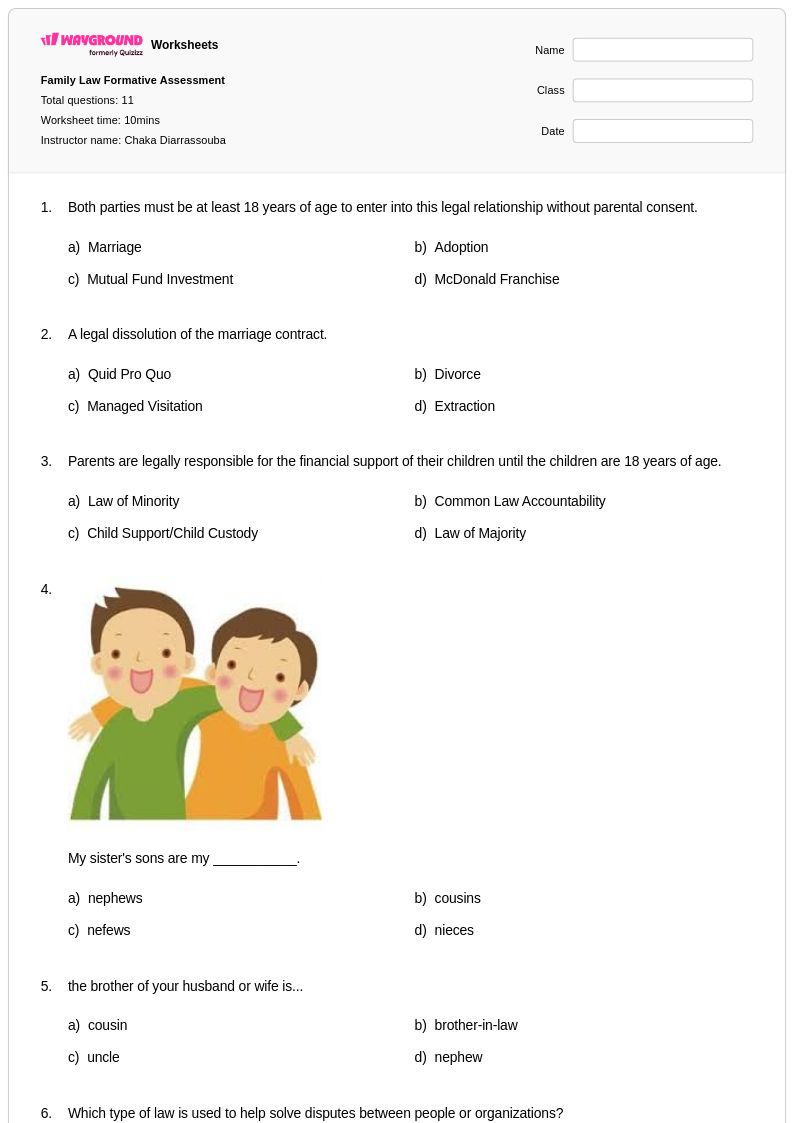
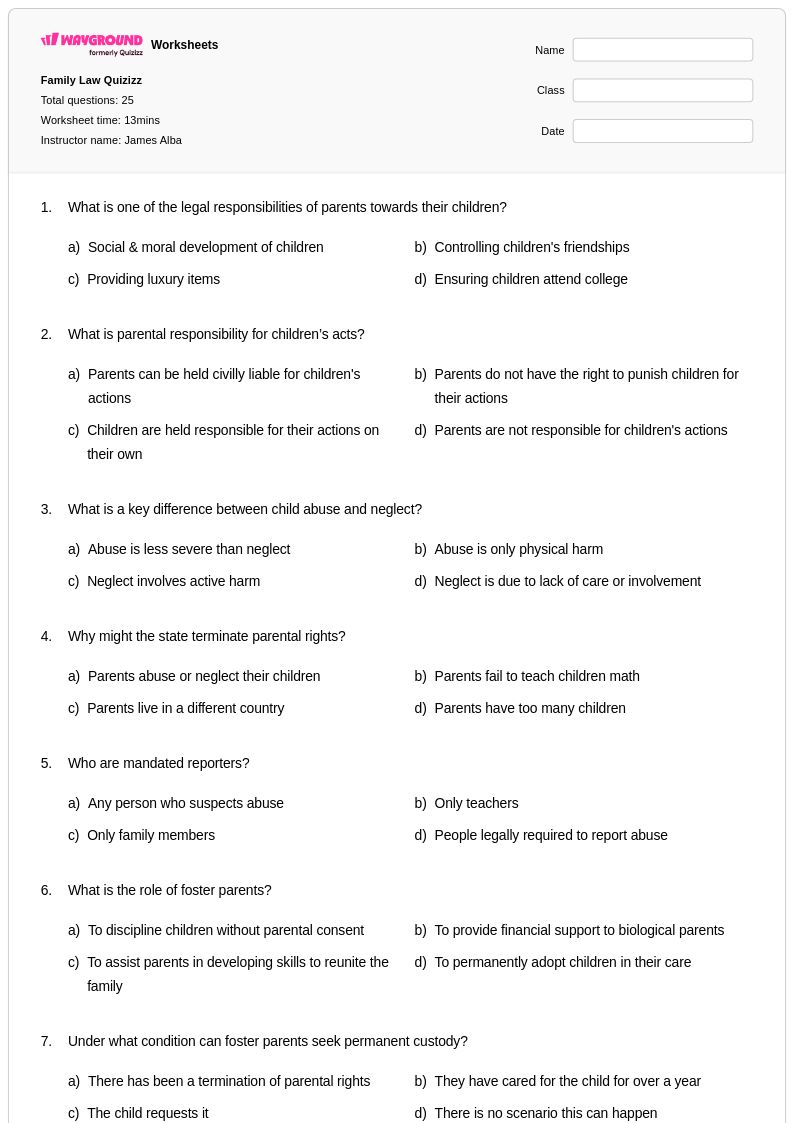
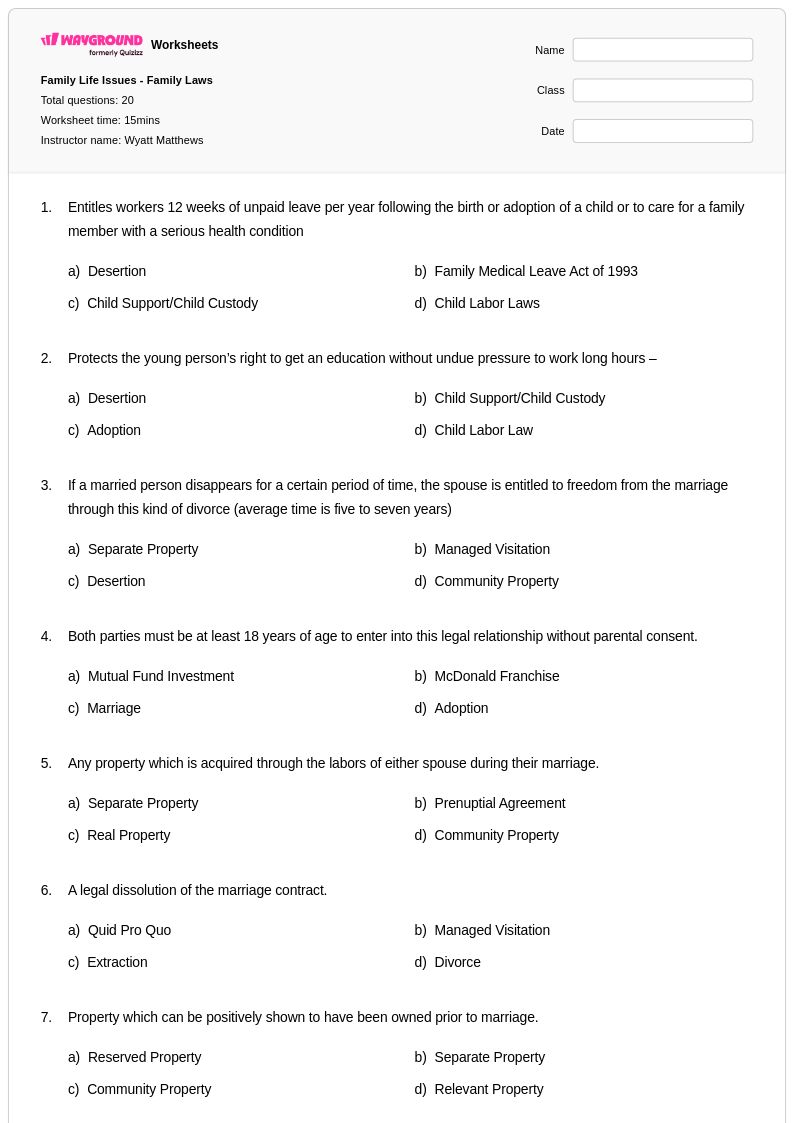
Family Law worksheets available through Wayground (formerly Quizizz) provide comprehensive educational resources that explore the legal framework governing domestic relationships and household structures within the American judicial system. These expertly crafted materials help students understand essential concepts including marriage and divorce proceedings, child custody arrangements, adoption processes, domestic violence protections, and property division laws. The worksheets strengthen critical thinking skills by presenting real-world scenarios that require students to analyze legal precedents, interpret statutory requirements, and evaluate the rights and responsibilities of family members under various circumstances. Each resource includes detailed answer keys and practice problems designed to reinforce understanding of complex legal terminology, court procedures, and the intersection between federal and state family law jurisdictions, with many available as free printable PDF downloads.
Wayground (formerly Quizizz) supports educators with an extensive collection of millions of teacher-created Family Law resources that can be easily discovered through robust search and filtering capabilities aligned with social studies standards. Teachers benefit from comprehensive differentiation tools that allow customization of worksheet difficulty levels, content focus, and assessment formats to meet diverse student needs across different academic levels. The platform's flexible design enables seamless transitions between printable PDF formats for traditional classroom use and interactive digital versions for remote learning environments. These features significantly enhance lesson planning efficiency while providing targeted resources for remediation of struggling learners, enrichment activities for advanced students, and consistent skill practice opportunities that help all students develop a thorough understanding of how family law impacts their daily lives and future civic participation.
FAQs
How do I teach family law to students who have no legal background?
Start by grounding students in the idea that family law governs the legal relationships between individuals within a household, including marriage, divorce, child custody, and adoption. Use real-world scenarios and simplified case studies to make abstract legal concepts concrete before introducing formal legal terminology. Building from familiar situations, such as what happens when parents separate, helps students connect legal procedures to lived experience and develop the analytical skills needed to interpret statutory language.
What exercises help students practice family law concepts?
Scenario-based practice problems are among the most effective tools for reinforcing family law concepts because they require students to apply legal principles to realistic situations rather than simply recall definitions. Exercises that ask students to evaluate custody arrangements, trace the steps of a divorce proceeding, or identify the rights of parties in an adoption case build both comprehension and critical thinking. Pairing these with structured vocabulary work on legal terminology ensures students can read and interpret the kinds of documents they may encounter in civic life.
What common mistakes do students make when learning about family law?
A frequent misconception is that family law is uniform across the United States, when in fact most family law is governed at the state level, meaning procedures and rights can vary significantly by jurisdiction. Students also tend to conflate related concepts, such as legal custody and physical custody, or treat property division as an automatic equal split without understanding the distinction between community property and equitable distribution states. Addressing these errors explicitly, with examples that contrast state-level variations, prevents students from overgeneralizing.
How do I use family law worksheets in my classroom?
Family law worksheets on Wayground are available as printable PDFs for traditional classroom use and in digital formats for technology-integrated or remote learning environments, giving teachers flexibility in how they assign and collect work. Teachers can also host worksheets as a quiz directly on Wayground, making it easy to track student responses and review results. Each worksheet includes a detailed answer key, so teachers can use them efficiently for guided practice, independent work, or formative assessment without significant prep time.
How do I differentiate family law instruction for students at different levels?
For students who need additional support, reduce the complexity of scenarios and focus on one legal concept at a time, such as the difference between a legal separation and a divorce, before layering in related topics. Advanced students can be challenged with comparative tasks that ask them to analyze how the same custody dispute might be resolved differently under the laws of two different states. On Wayground, teachers can apply individual accommodations such as reduced answer choices or read-aloud support to specific students, ensuring all learners can access the same core content.
How does family law connect to broader civics and social studies standards?
Family law sits at the intersection of constitutional rights, state authority, and everyday civic participation, making it a natural fit for social studies curricula focused on government structures and individual rights. Topics like the federal versus state jurisdiction divide in family law reinforce broader lessons about the American judicial system, while content on domestic violence protections connects to civil rights frameworks. Teaching family law also builds students' functional legal literacy, preparing them to understand how the courts may affect decisions in their own adult lives.