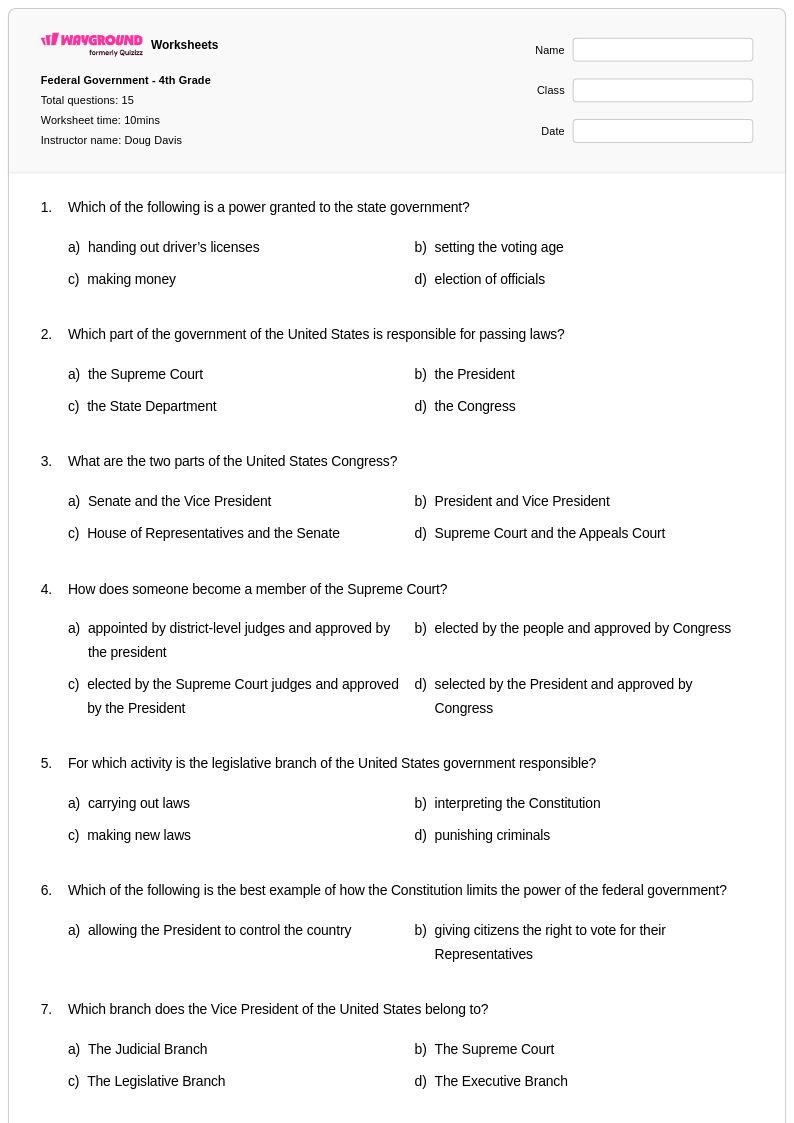
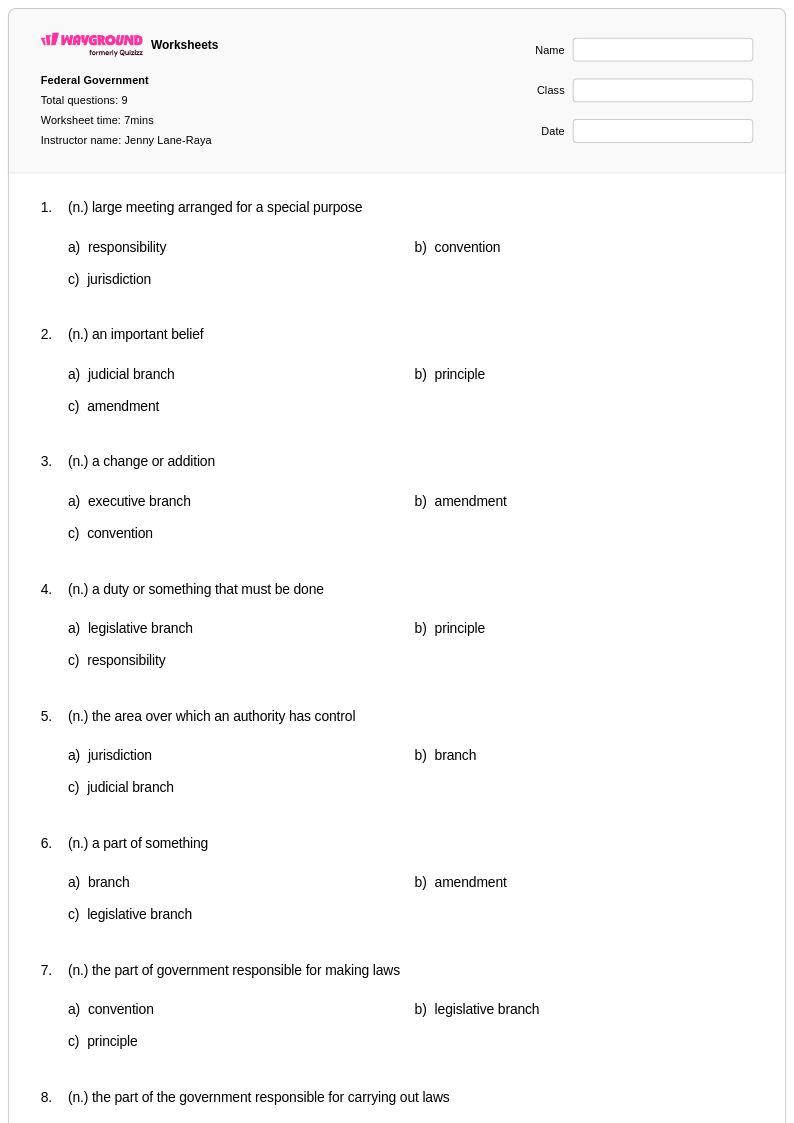
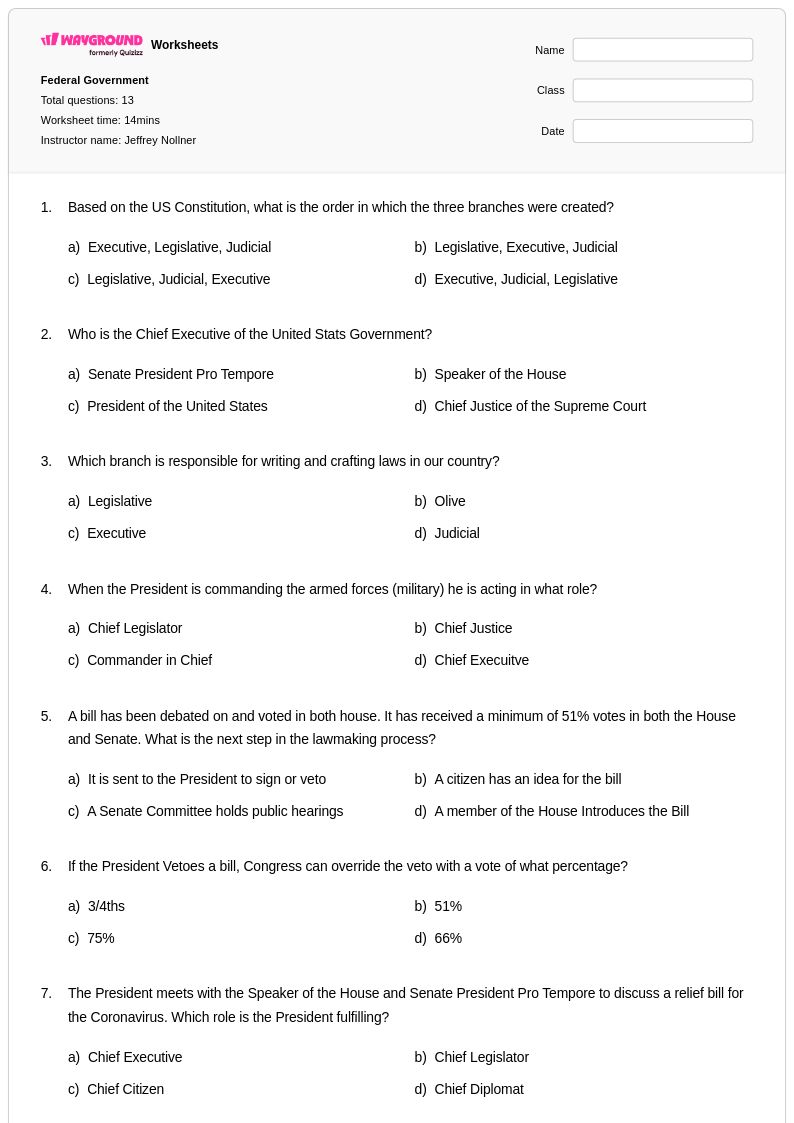
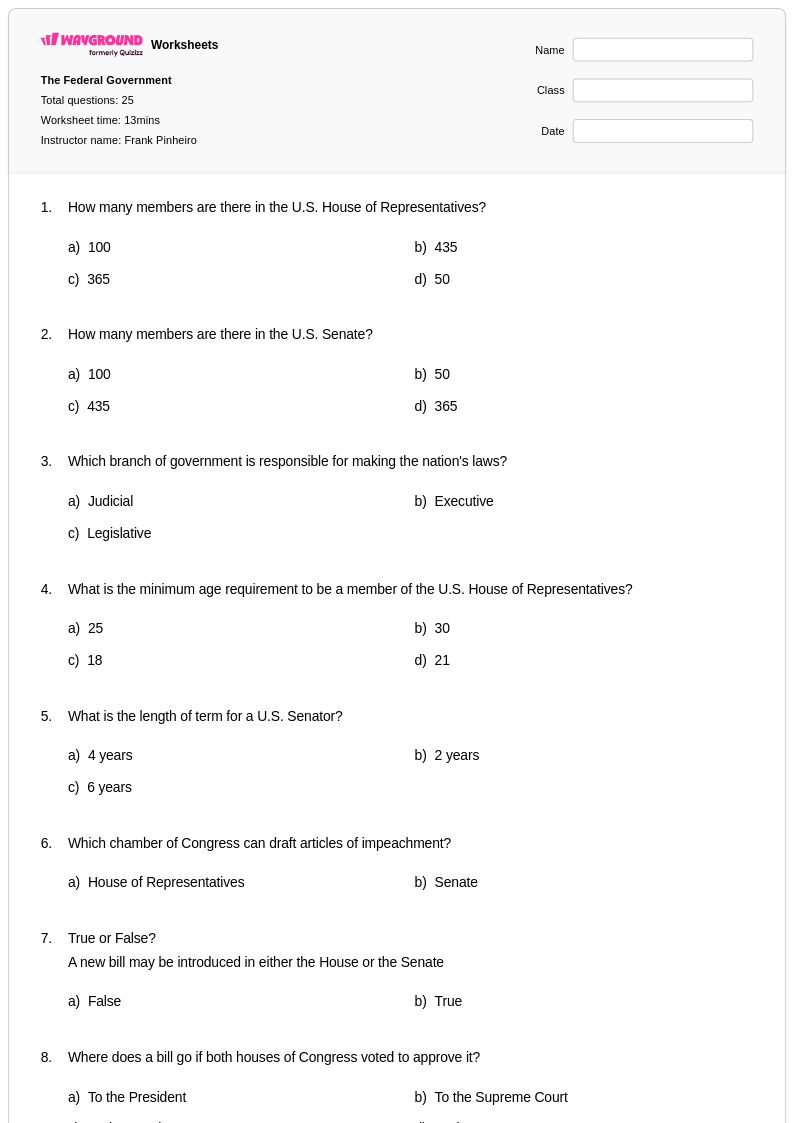
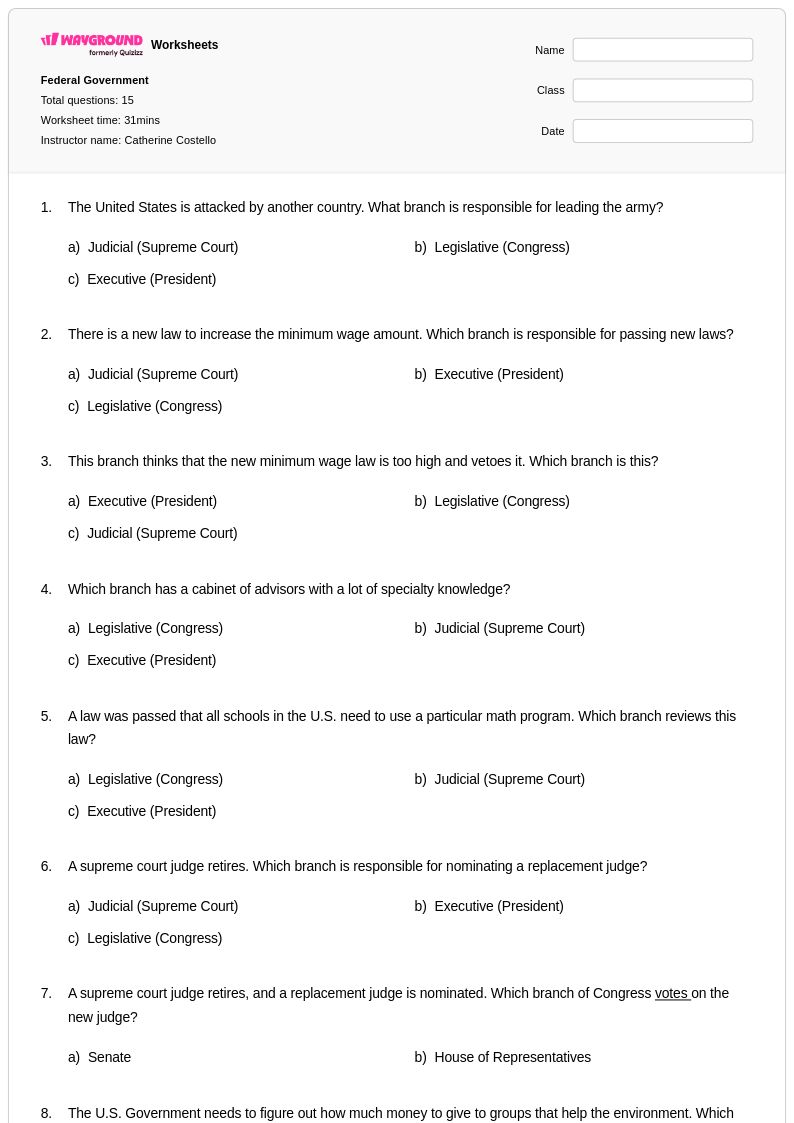
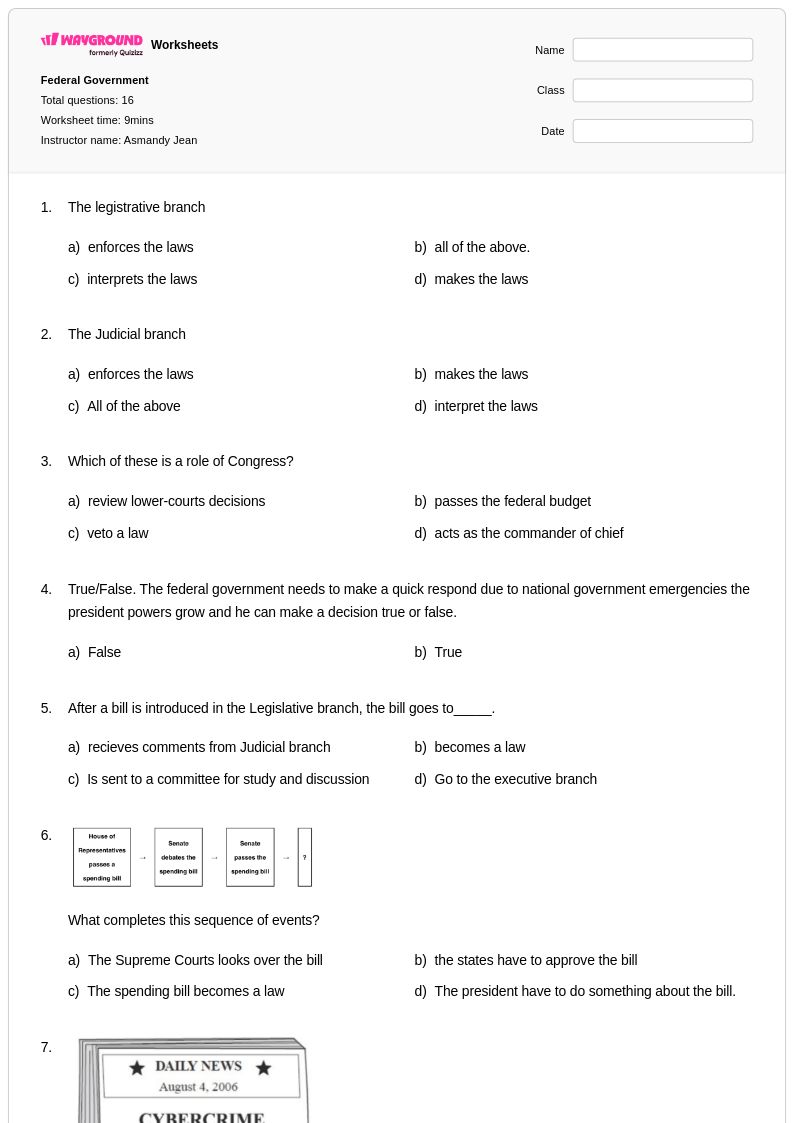
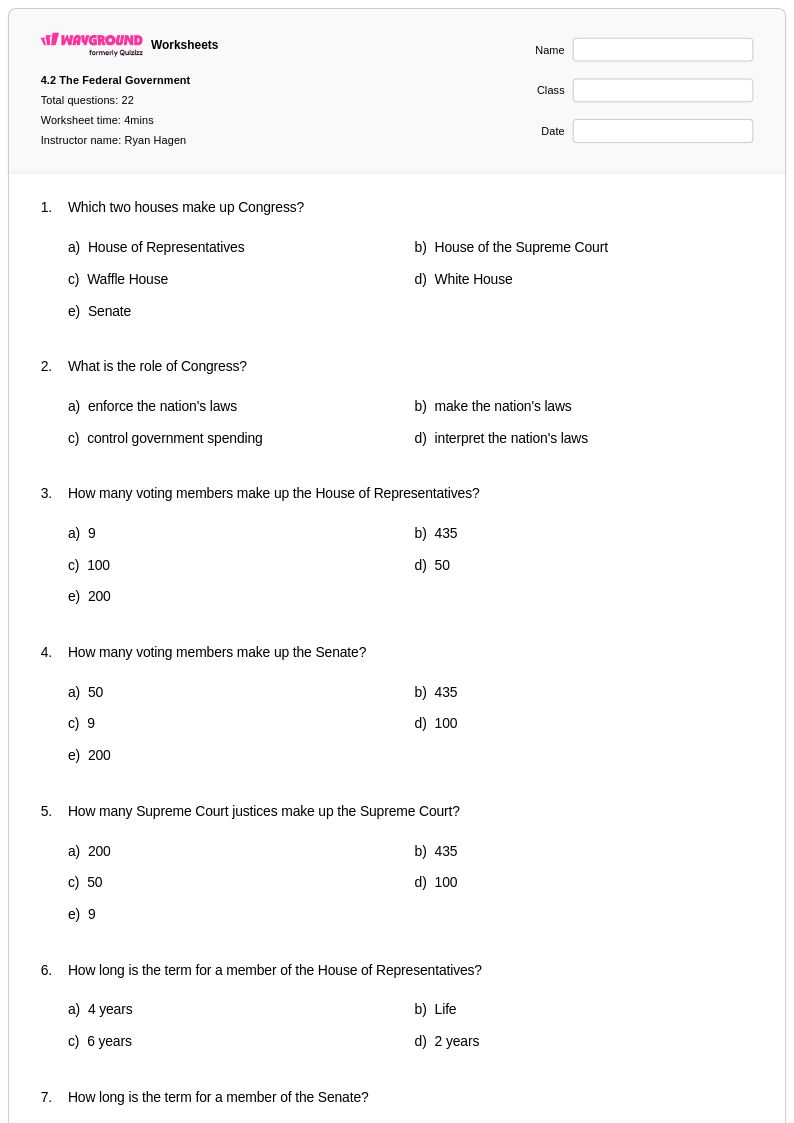
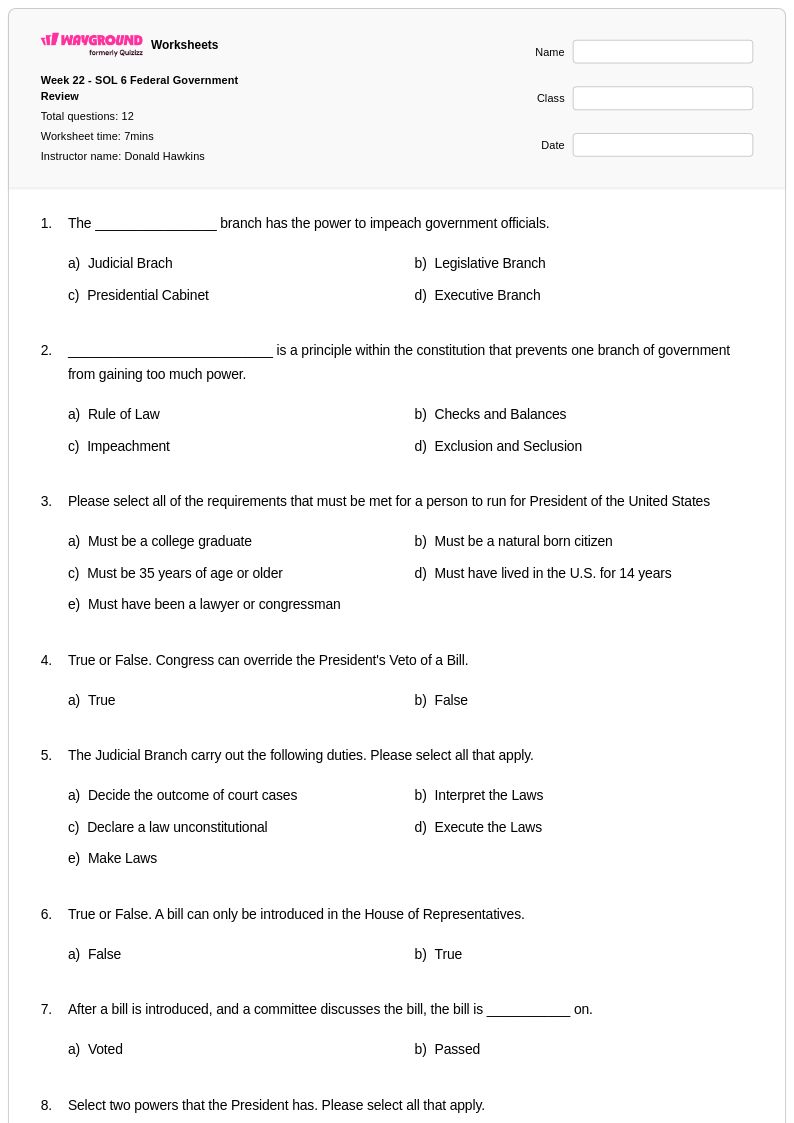
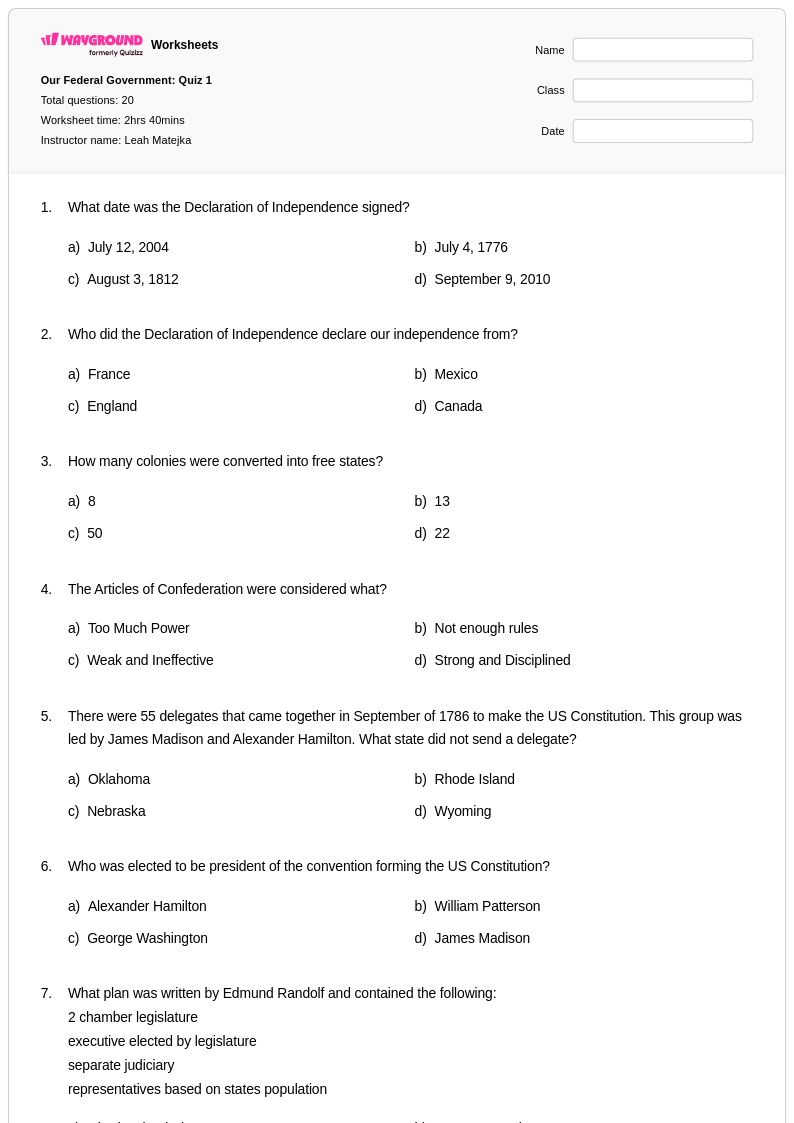
Explore Wayground's comprehensive collection of free Federal Government worksheets and printables that help students master key civics concepts through engaging practice problems and detailed answer keys in convenient PDF format.
Federal Government worksheets available through Wayground (formerly Quizizz) provide comprehensive resources for exploring the structure, functions, and operations of America's national government system. These expertly crafted materials help students develop critical understanding of constitutional principles, the three branches of government, federalism, and the complex processes that govern our nation. Through carefully designed practice problems, students examine executive powers, legislative procedures, judicial review, and the intricate system of checks and balances that defines American democracy. Each worksheet includes detailed answer keys to support independent learning and self-assessment, while the free printable format ensures accessibility for diverse classroom environments. These pdf resources strengthen analytical thinking skills as students investigate real-world applications of federal authority, constitutional amendments, and the dynamic relationship between national and state governments.
Wayground's extensive collection draws from millions of teacher-created resources, offering educators powerful search and filtering capabilities to locate precisely targeted Federal Government materials that align with curriculum standards and learning objectives. Teachers can easily differentiate instruction by accessing worksheets that span various complexity levels, from foundational concepts of governmental structure to sophisticated analyses of policy implementation and constitutional interpretation. The platform's flexible customization tools allow educators to modify existing materials or combine multiple resources to create comprehensive units that address specific classroom needs. Available in both printable and digital pdf formats, these resources seamlessly integrate into lesson planning, providing versatile options for skill practice, remediation activities, and enrichment opportunities that deepen students' civic knowledge and democratic understanding.
FAQs
How do I teach the three branches of the federal government?
Teach the three branches by anchoring instruction in the Constitution itself — show students where each branch is established (Articles I, II, and III) before explaining what each branch does. Use concrete examples like a recent Supreme Court ruling, a presidential veto, or a Senate confirmation hearing to make the structure feel current and relevant. Pairing direct instruction with structured practice on checks and balances helps students see how the branches interact, not just how they function in isolation.
What exercises help students practice checks and balances?
Scenario-based exercises work well for checks and balances — give students a real or hypothetical government action and ask them to identify which branch acted, which branch could check it, and how. Fill-in-the-blank charts mapping each check to its corresponding branch reinforce the mechanics, while short-answer questions push students to explain the purpose behind the system. Federal Government worksheets that include both identification and explanation tasks build the analytical depth students need for civics assessments.
What mistakes do students commonly make when learning about federalism?
The most common misconception is that federalism simply means the federal government has more power than state governments. Students often struggle to distinguish concurrent powers from exclusive federal or state powers, and they frequently conflate the Supremacy Clause with total federal authority over all policy areas. Targeted practice that asks students to categorize powers and analyze specific policy examples — such as education funding or law enforcement — helps correct these errors before they solidify.
How do I help students understand the difference between constitutional principles and how government actually operates?
Students benefit from comparing the constitutional text with real procedural examples — for instance, how the Senate filibuster shapes legislation even though the Constitution does not mention it. Encourage students to ask 'Where is this in the Constitution?' when studying any governmental process, which trains them to distinguish formal constitutional authority from political norms and conventions. Worksheets that present case studies alongside primary source excerpts are especially effective for building this critical distinction.
How can I use Federal Government worksheets from Wayground in my classroom?
Federal Government worksheets on Wayground are available as printable PDFs for traditional classroom use and in digital formats for technology-integrated instruction, giving teachers flexibility regardless of their classroom setup. Teachers can assign them as independent practice, guided review, or formative assessment, and each worksheet includes a complete answer key to support self-assessment and reduce grading load. Worksheets can also be hosted as a quiz directly on Wayground, making it easy to track student performance on specific civics concepts.
How do I differentiate Federal Government instruction for students at different levels?
For students who need foundational support, start with visual organizers that map the three branches before introducing the nuances of federalism or judicial review. Advanced students can engage with primary sources like Federalist No. 51 or landmark Supreme Court decisions alongside analytical questions that require constitutional interpretation. On Wayground, teachers can apply accommodations such as read aloud, extended time, or reduced answer choices to individual students, allowing the same worksheet set to serve diverse learners without requiring entirely separate materials.