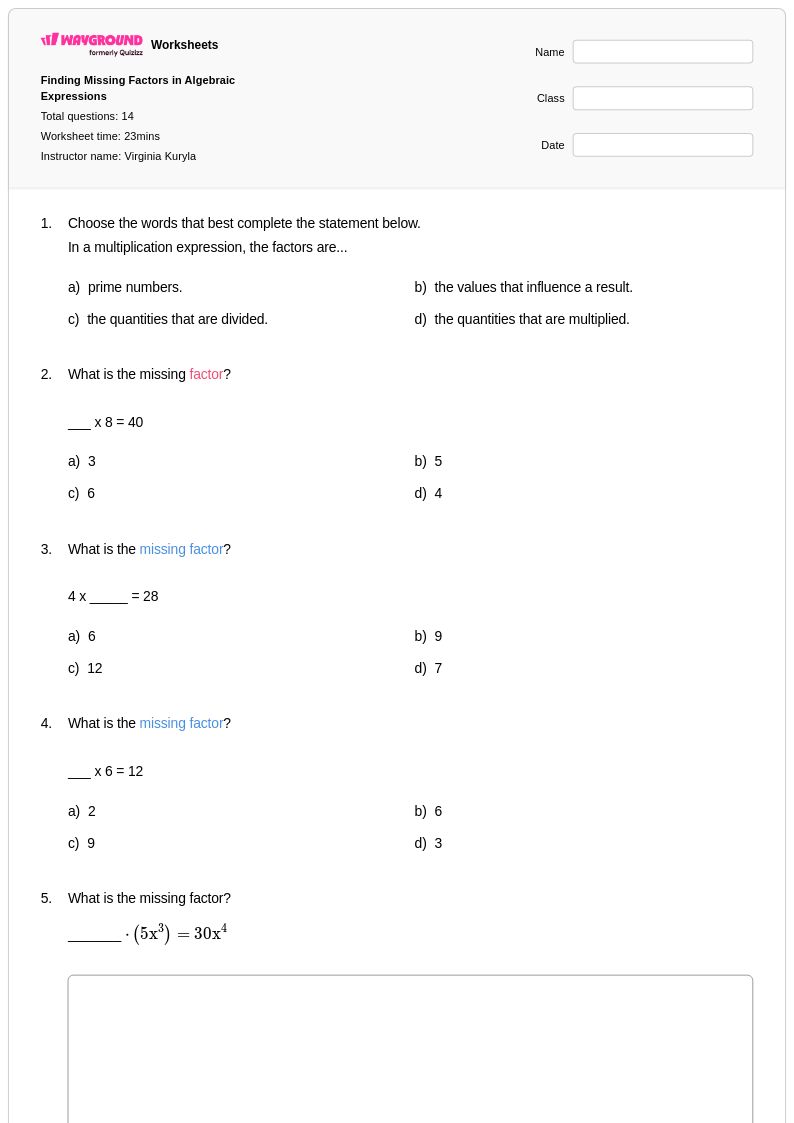
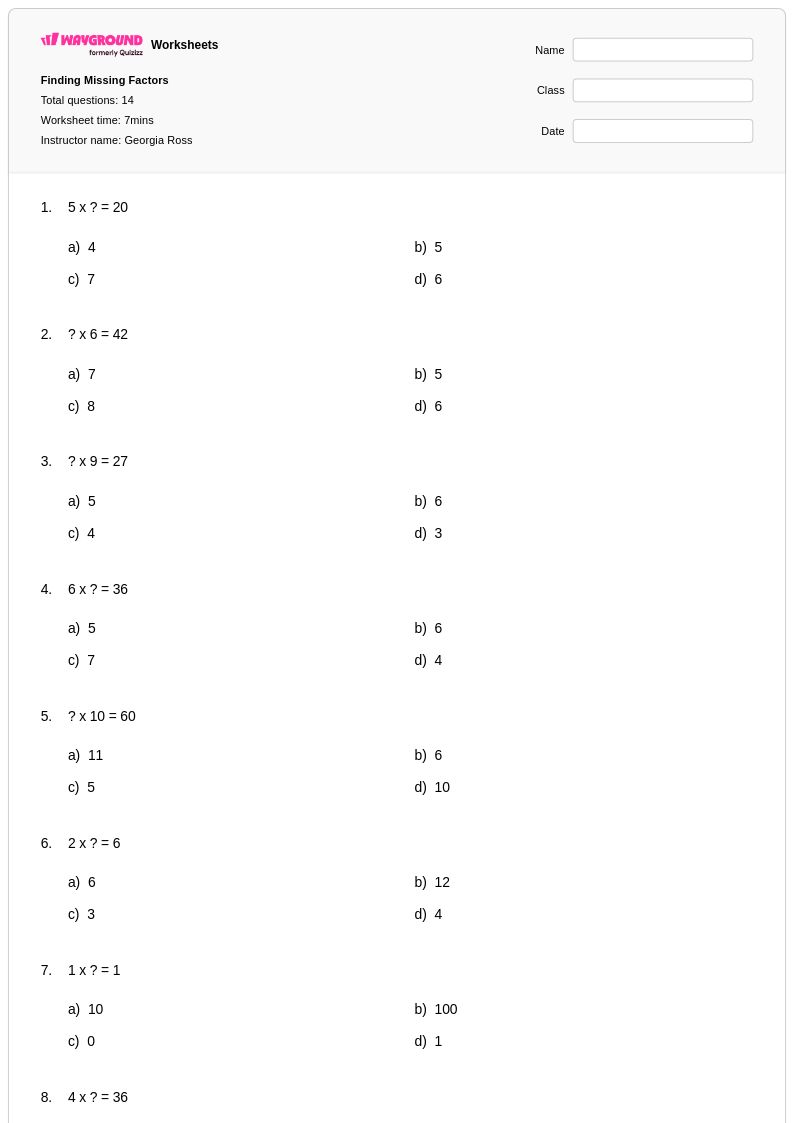
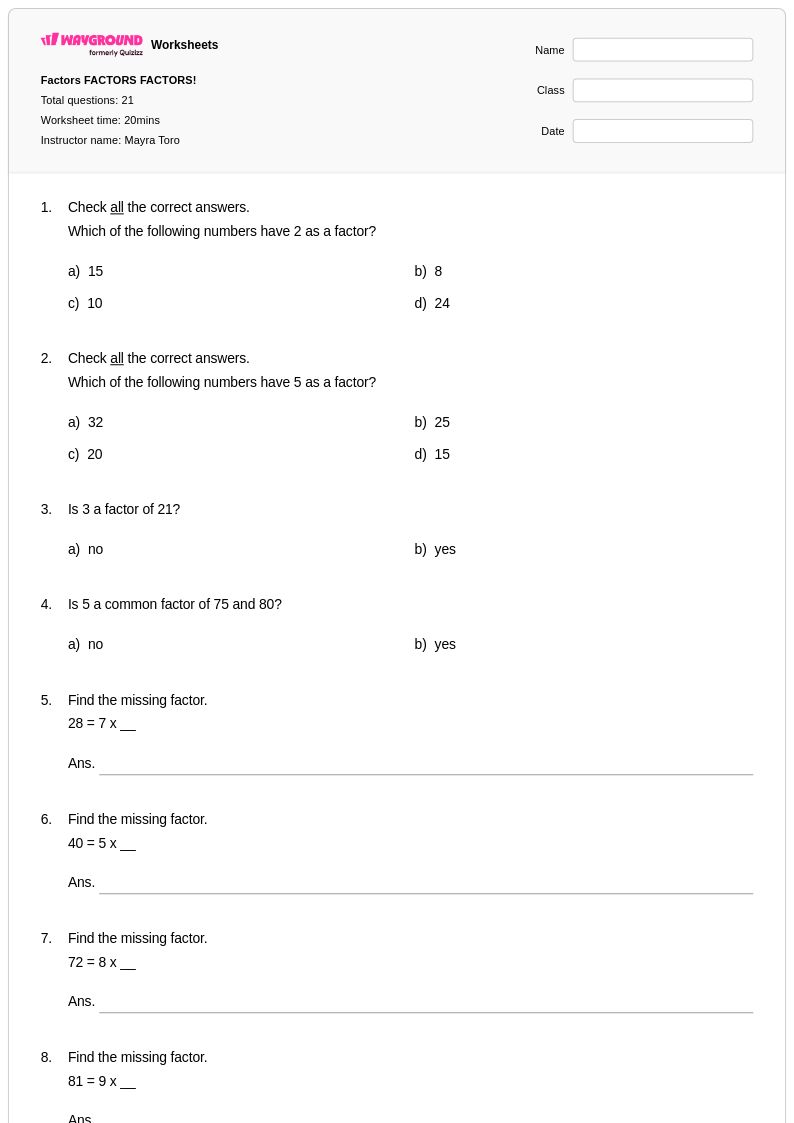
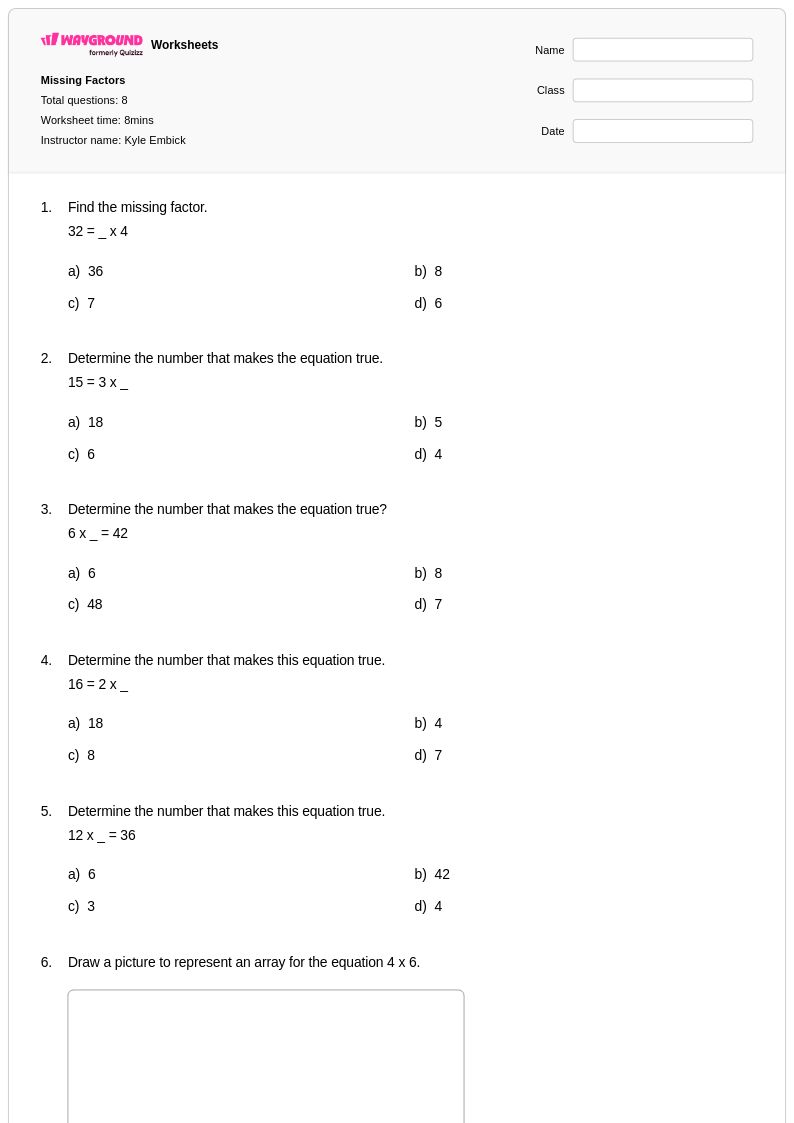
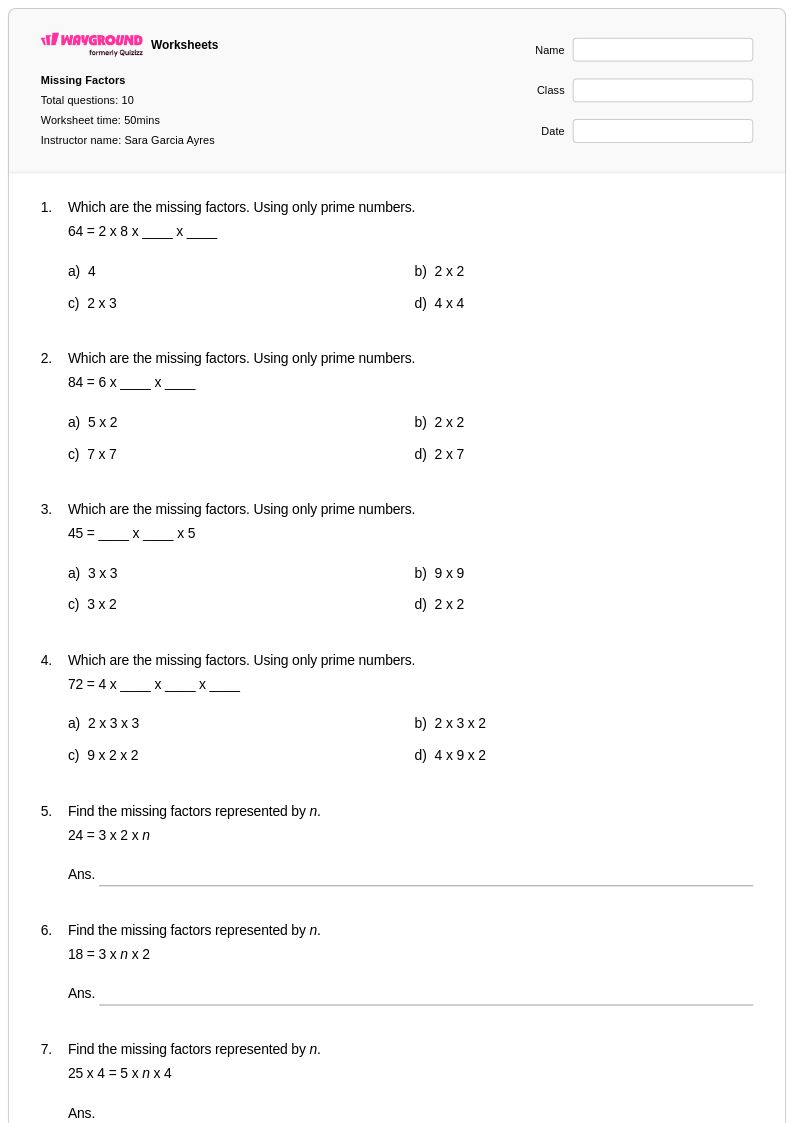
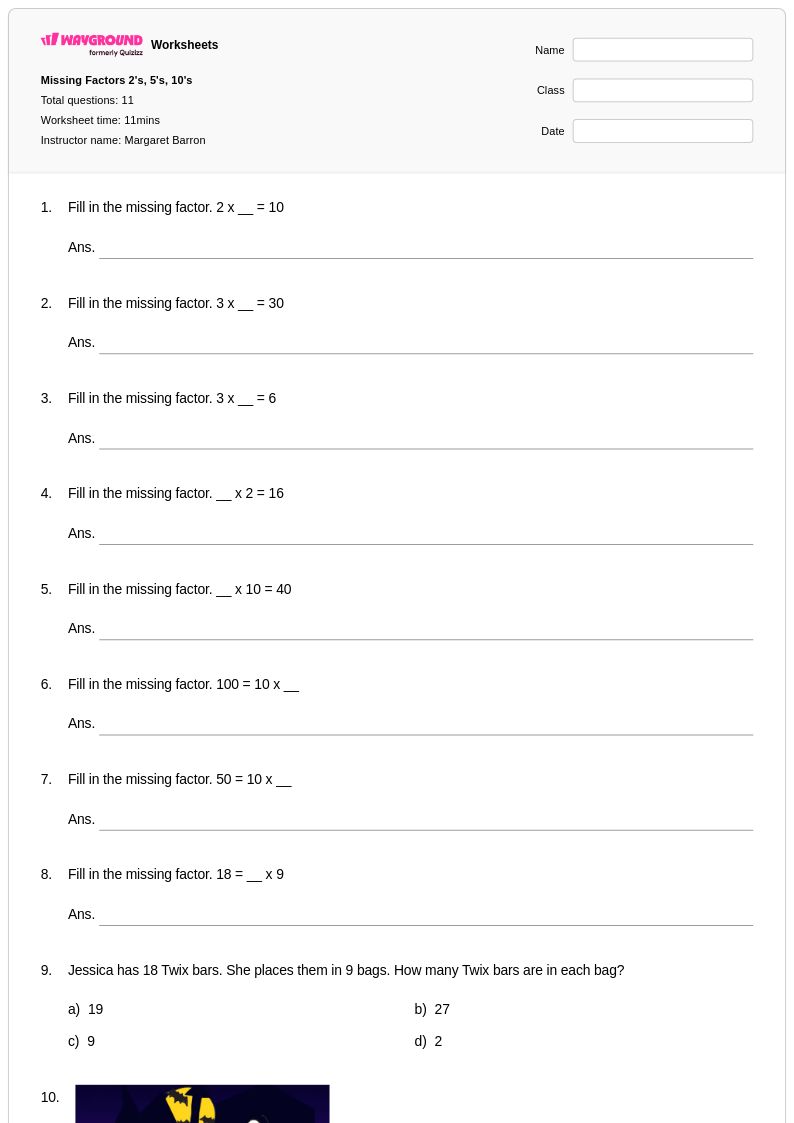
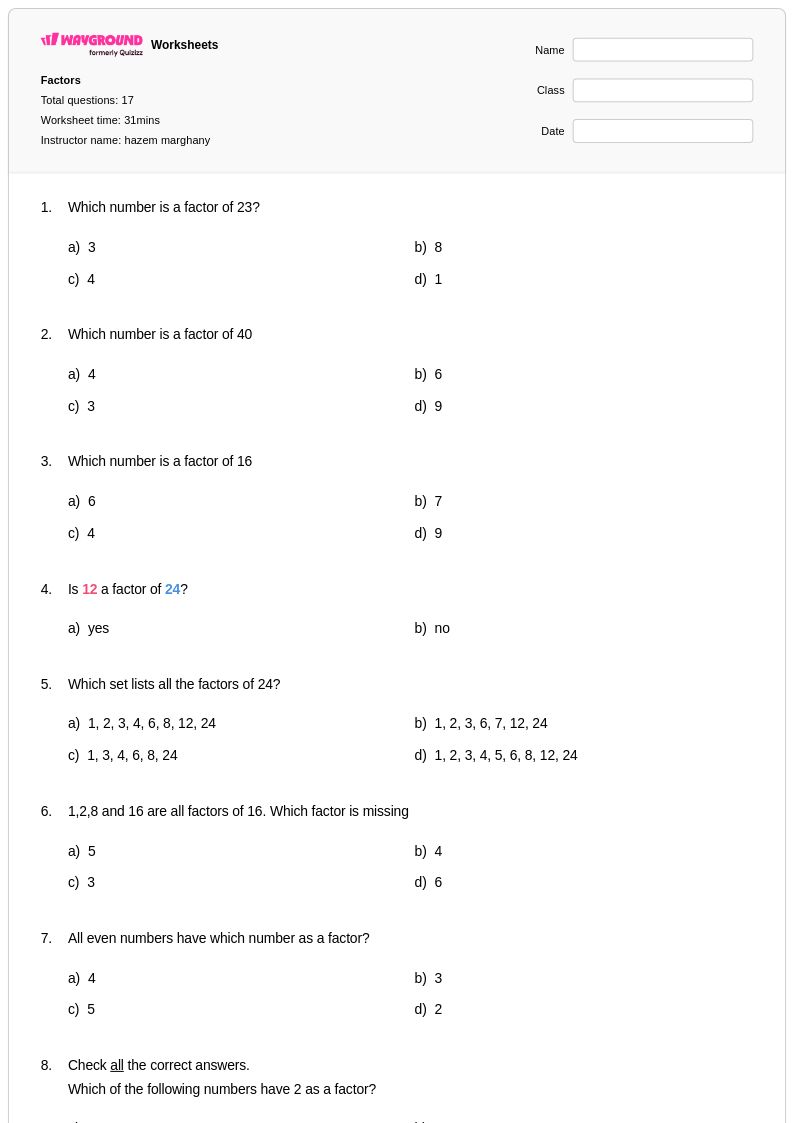
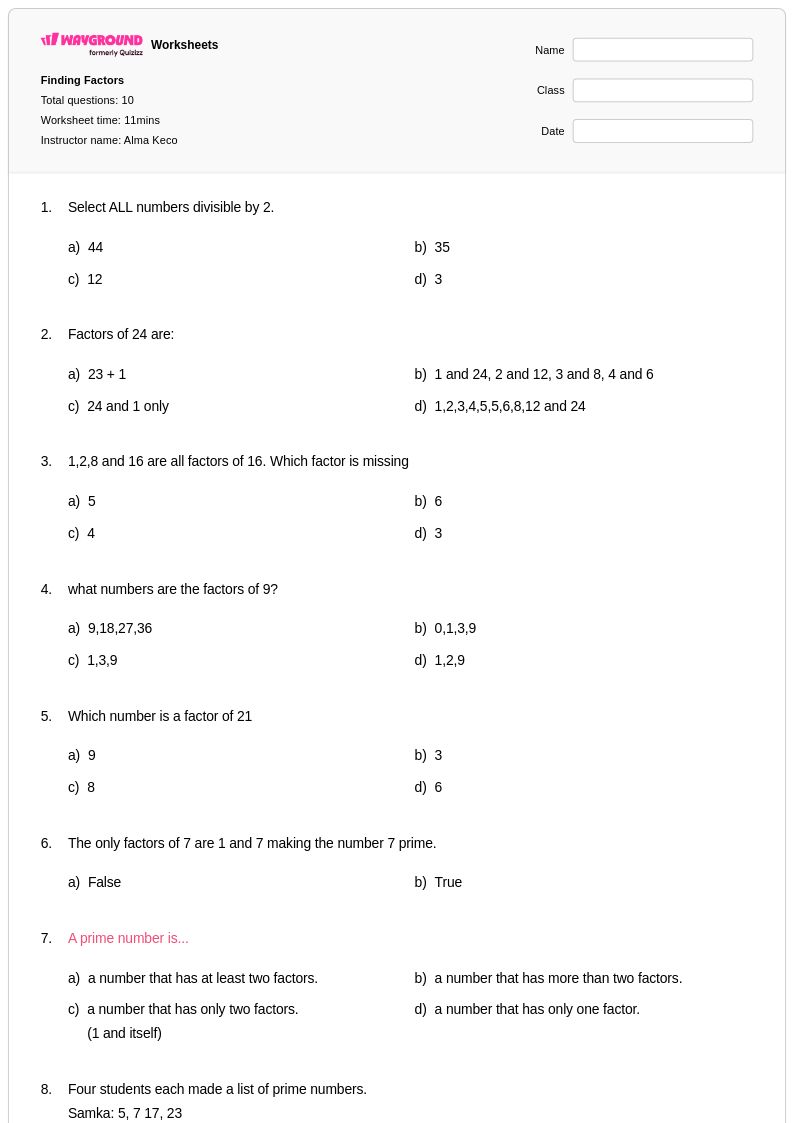
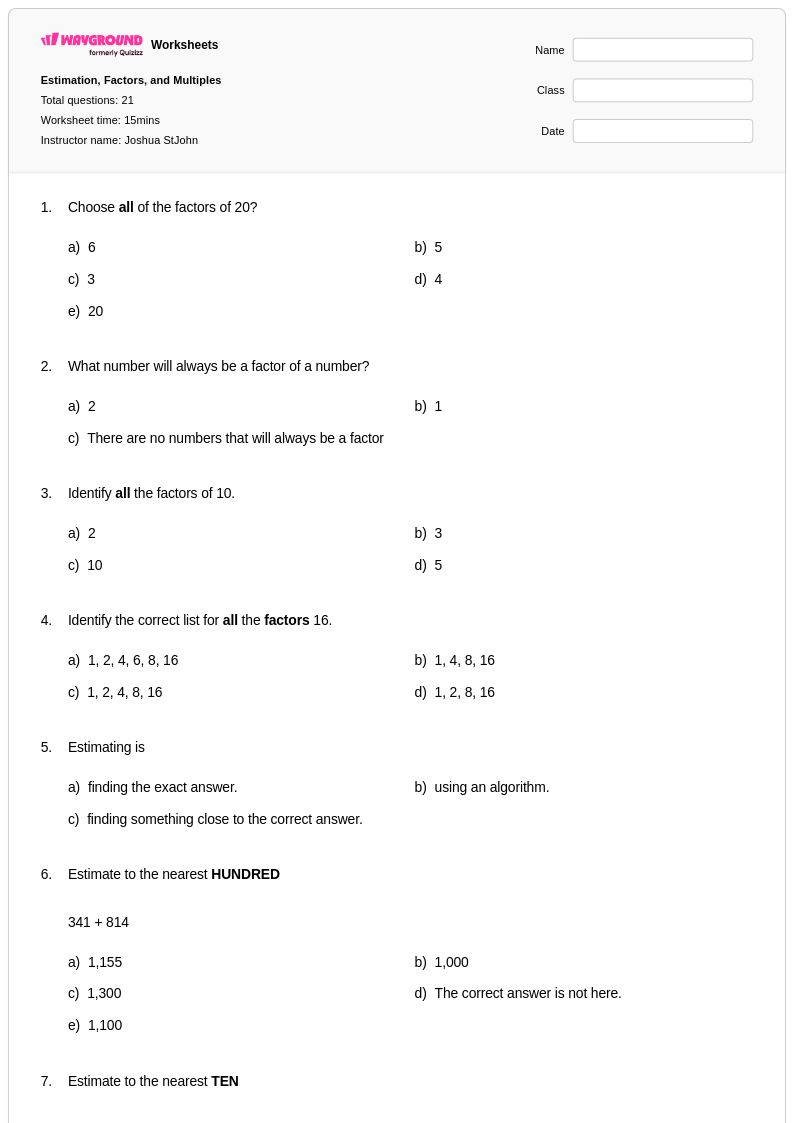
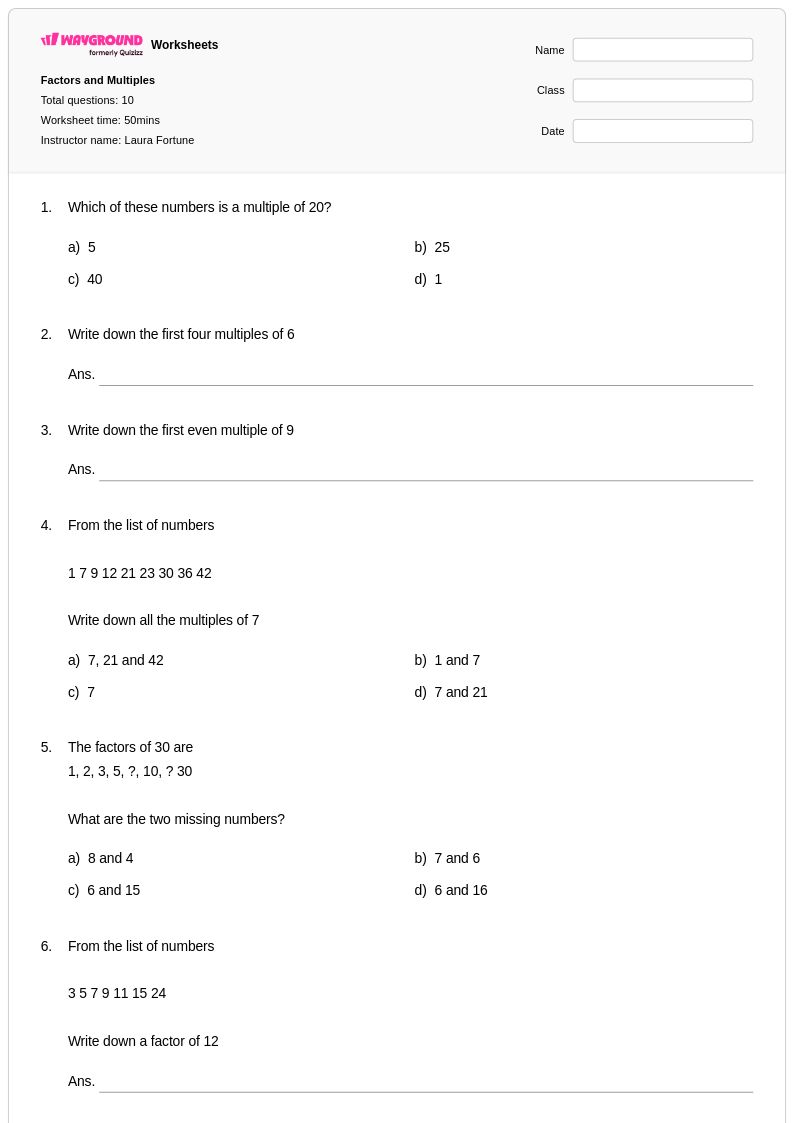
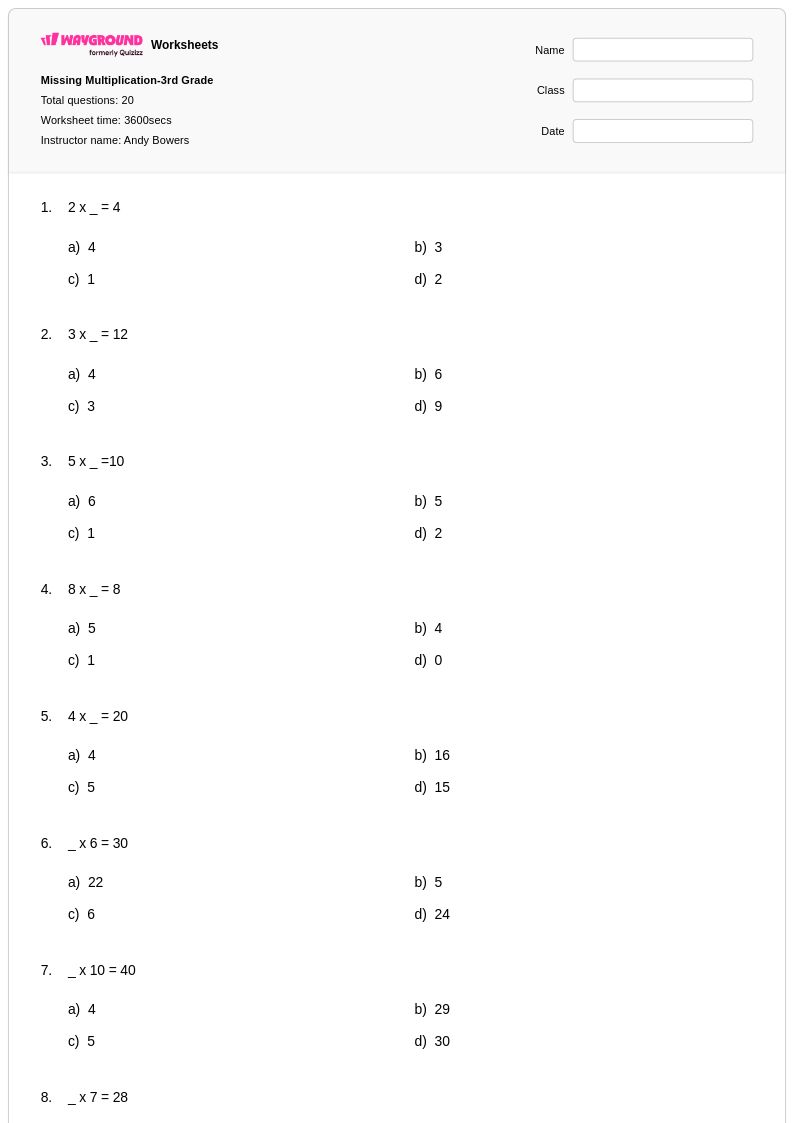
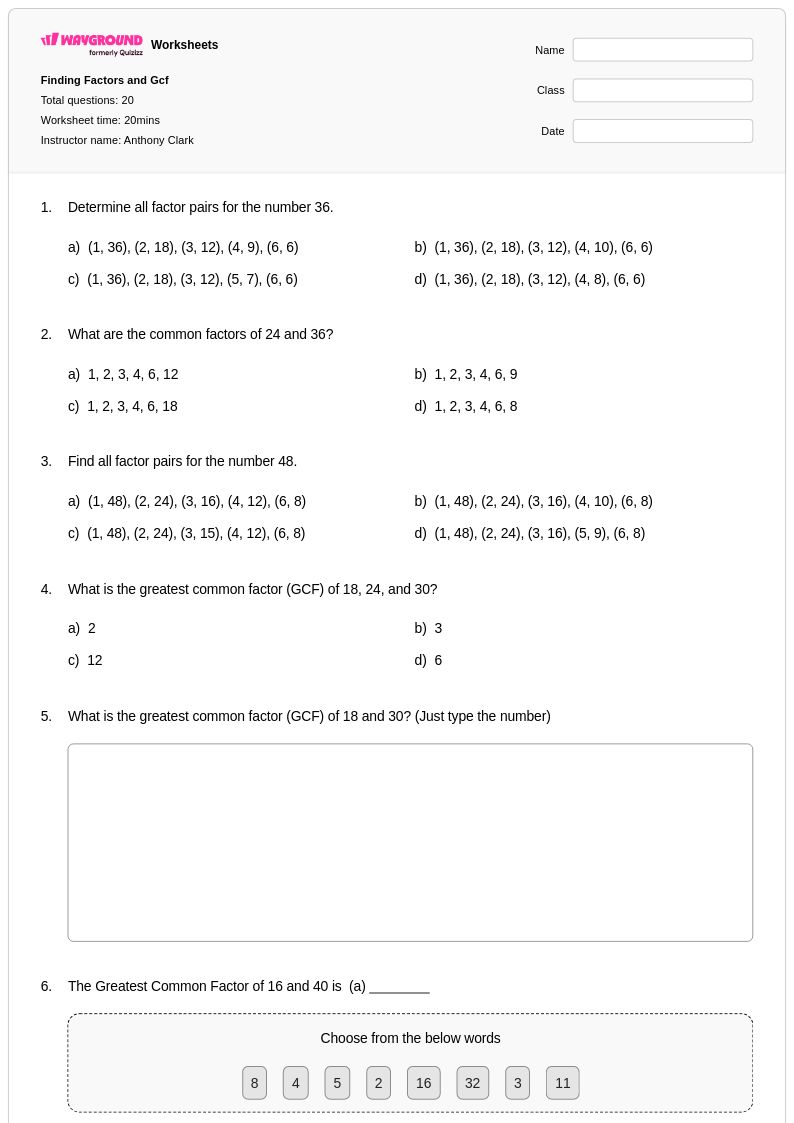
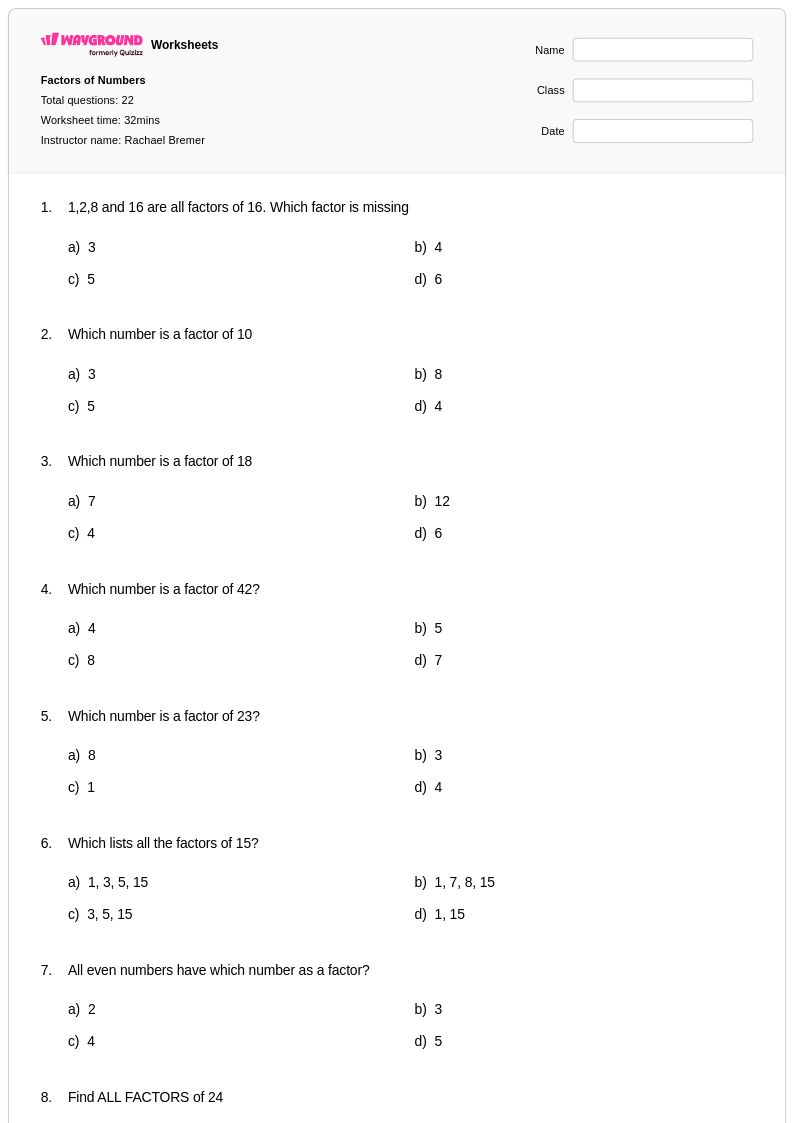
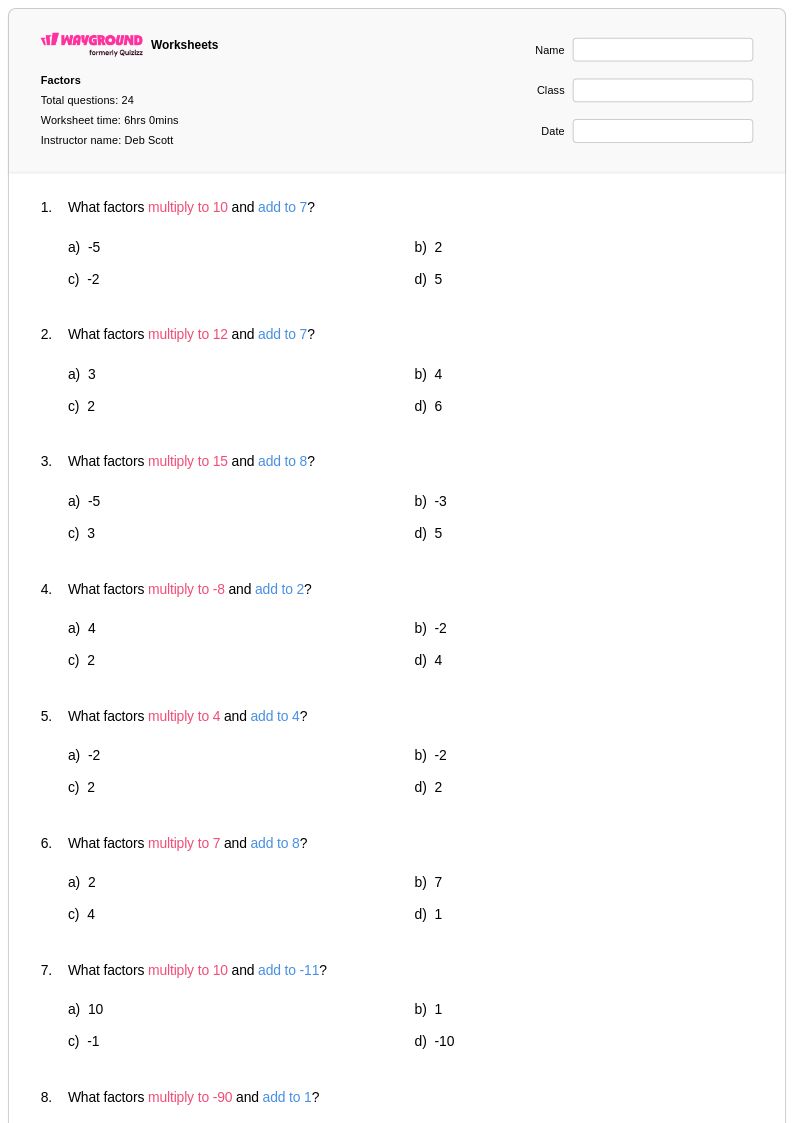
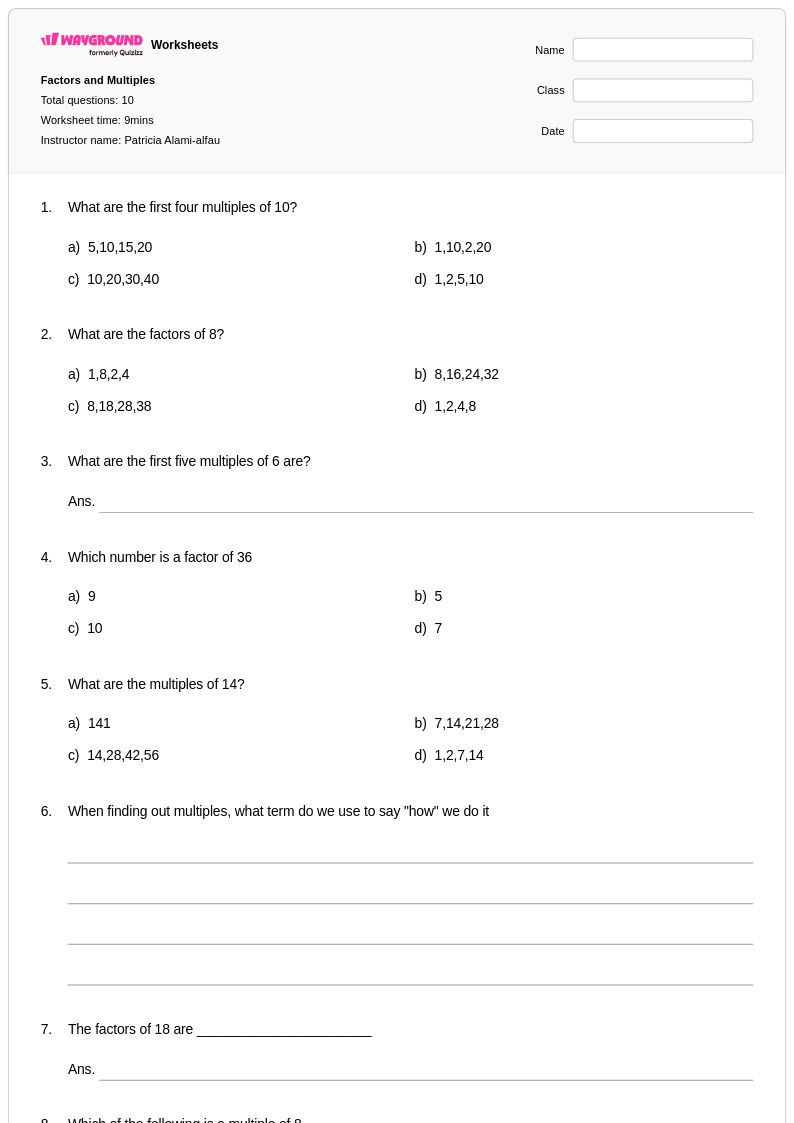
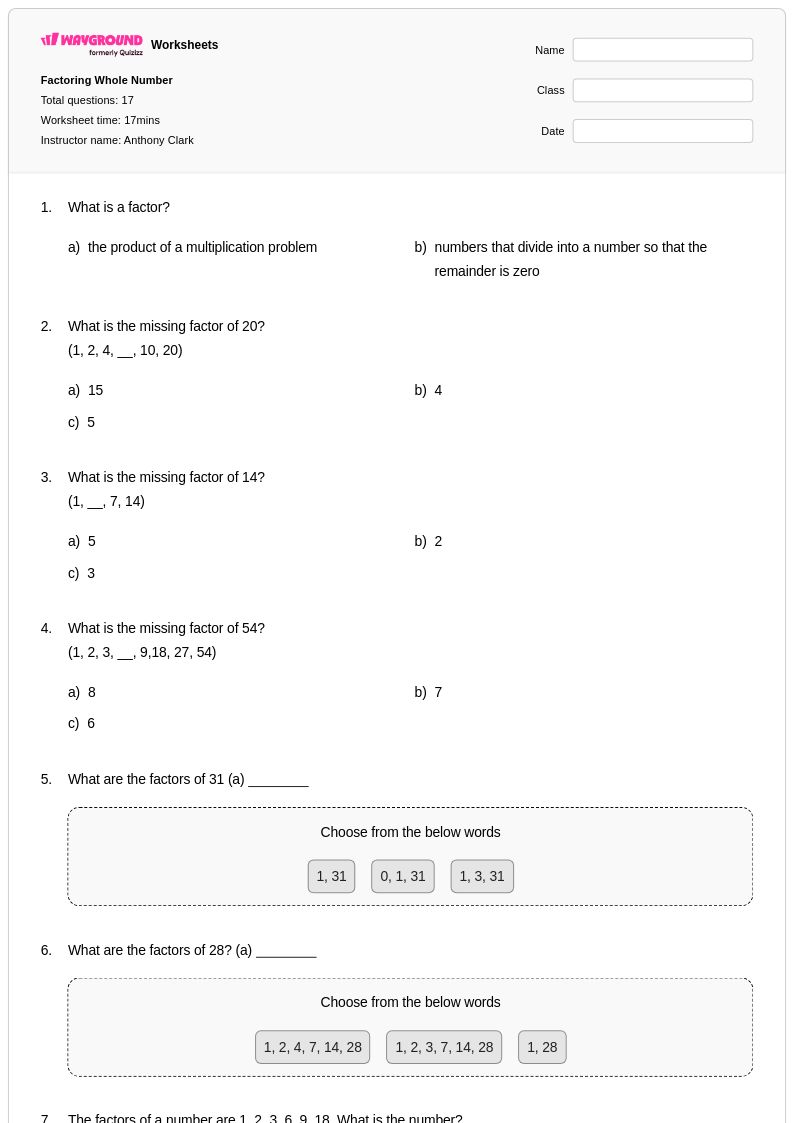
Discover free printable worksheets and practice problems focused on finding missing factors in multiplication, complete with answer keys to help students master this essential mathematical skill through engaging PDF exercises.
Finding missing factors worksheets available through Wayground (formerly Quizizz) provide students with essential practice in reverse multiplication thinking, where they must determine unknown multipliers or multiplicands in equations. These comprehensive worksheets strengthen critical mathematical reasoning skills by requiring students to work backwards from products to identify the missing components in multiplication problems. Each worksheet collection includes varied practice problems that progress from simple single-digit factors to more complex multi-digit scenarios, complete with answer keys and available in convenient pdf format for both classroom use and independent study. The free printables offer systematic skill-building opportunities that help students develop number sense, reinforce multiplication fact fluency, and build the foundation for algebraic thinking through factor identification exercises.
Wayground (formerly Quizizz) supports mathematics educators with millions of teacher-created resources specifically designed for finding missing factors instruction, featuring robust search and filtering capabilities that allow teachers to locate worksheets perfectly matched to their curriculum needs and standards alignment requirements. The platform's differentiation tools enable educators to customize worksheet difficulty levels and problem types, ensuring appropriate challenge levels for diverse learners while supporting both remediation for struggling students and enrichment opportunities for advanced learners. Teachers benefit from flexible formatting options that include printable pdf versions for traditional paper-based learning and digital formats for technology-integrated classrooms, streamlining lesson planning and providing immediate access to high-quality practice materials that reinforce factor identification skills through varied, engaging problem sets.
FAQs
How do I teach finding missing factors?
Start by grounding the concept in fact families. If students know 4 × 6 = 24, they can reason that ___ × 6 = 24 must be 4. From there, introduce the idea explicitly: finding a missing factor is the same as dividing the product by the known factor. Use number lines or arrays to make the inverse relationship visible before moving to abstract equations. Once students see it as division in disguise, the skill clicks quickly.
What exercises help students practice finding missing factors?
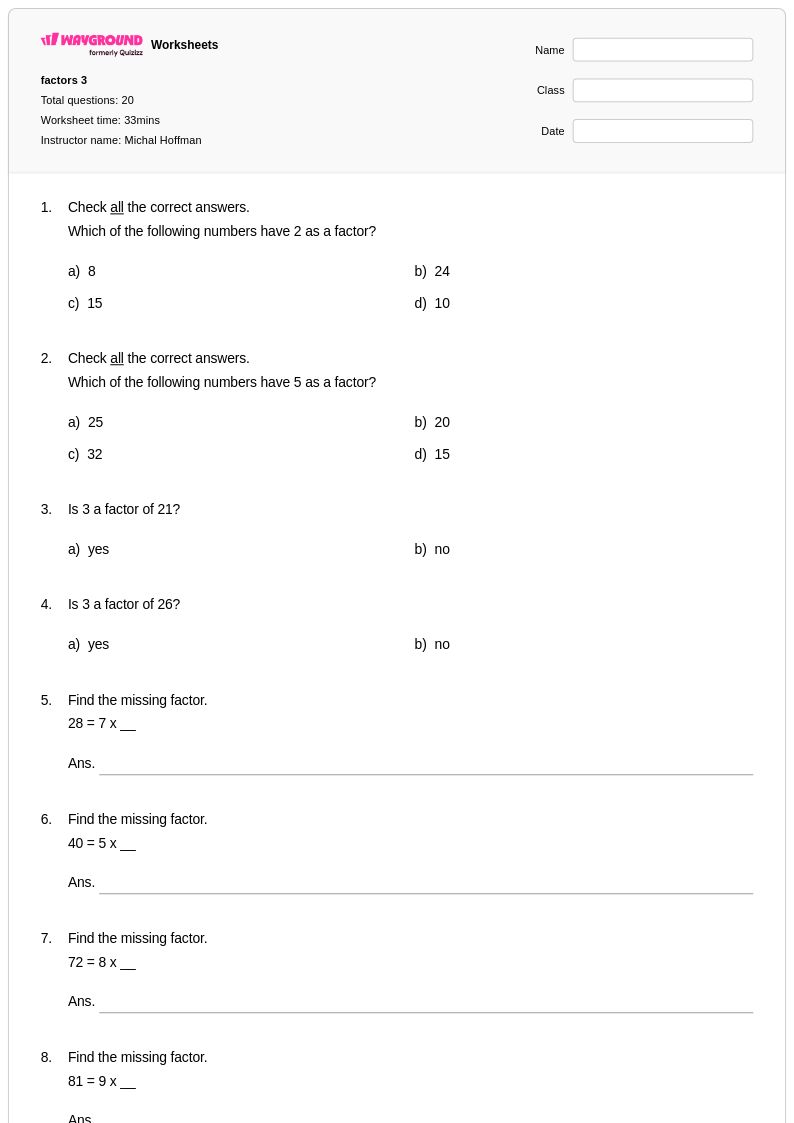
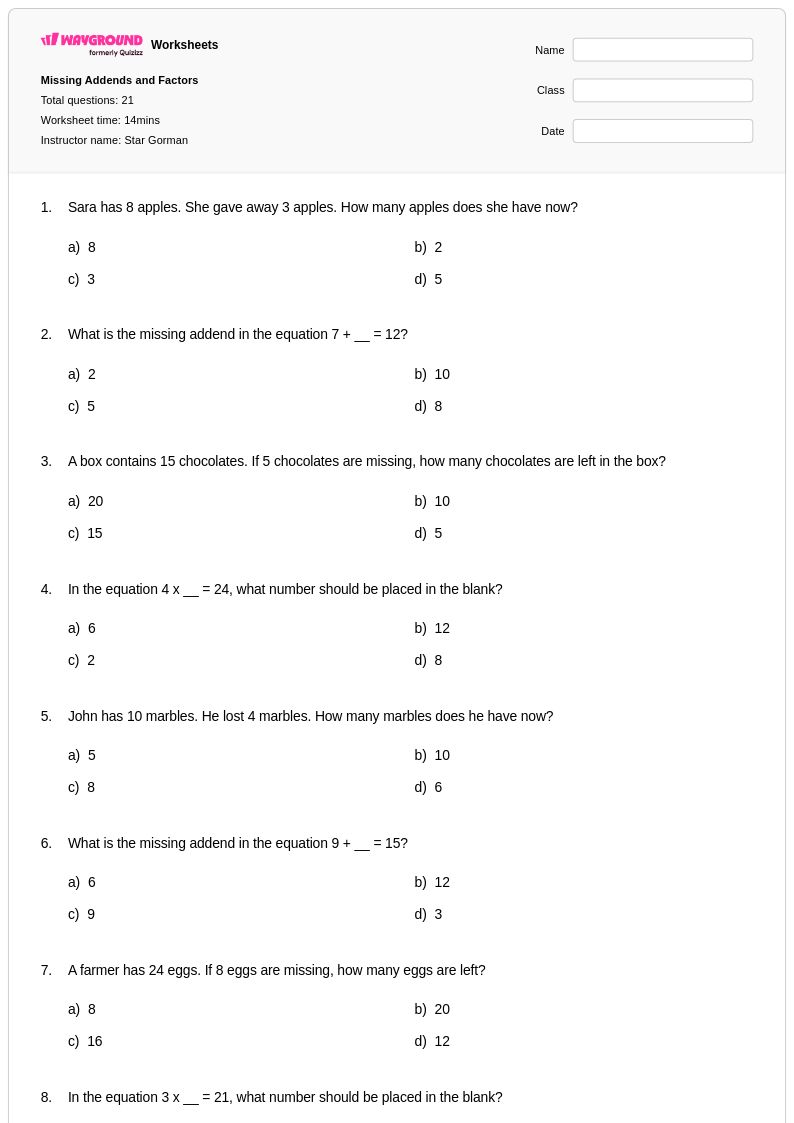
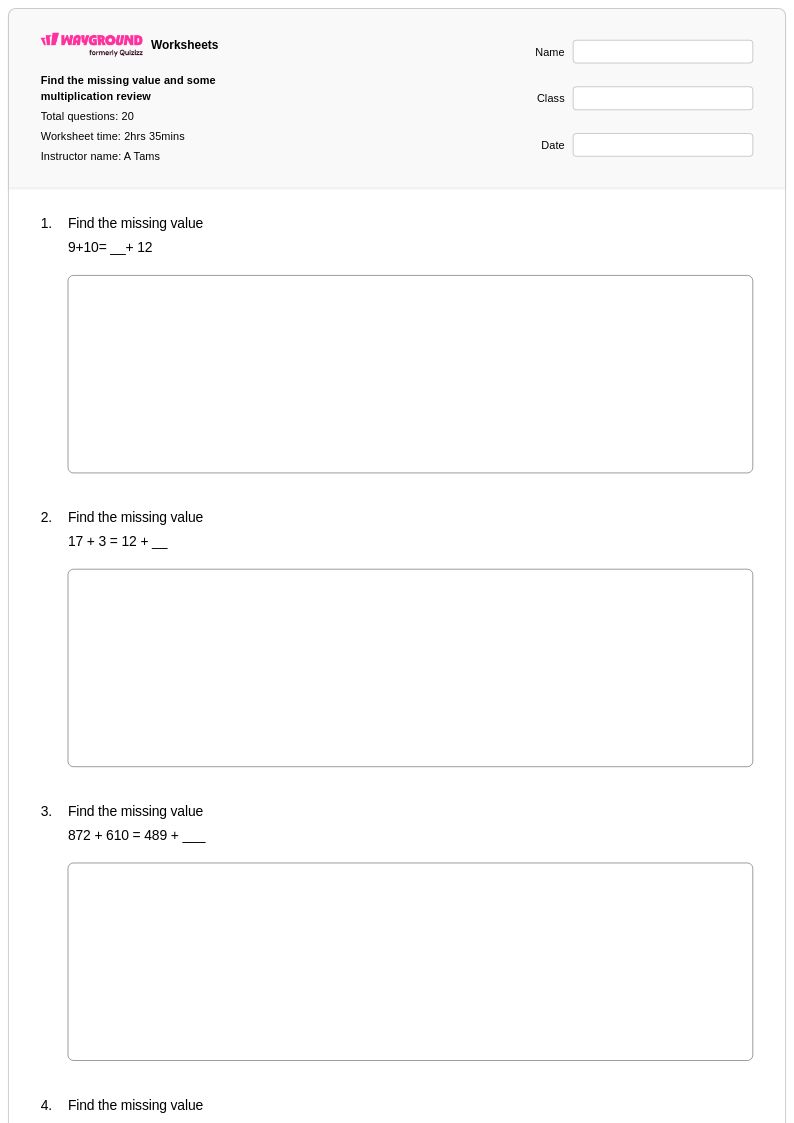
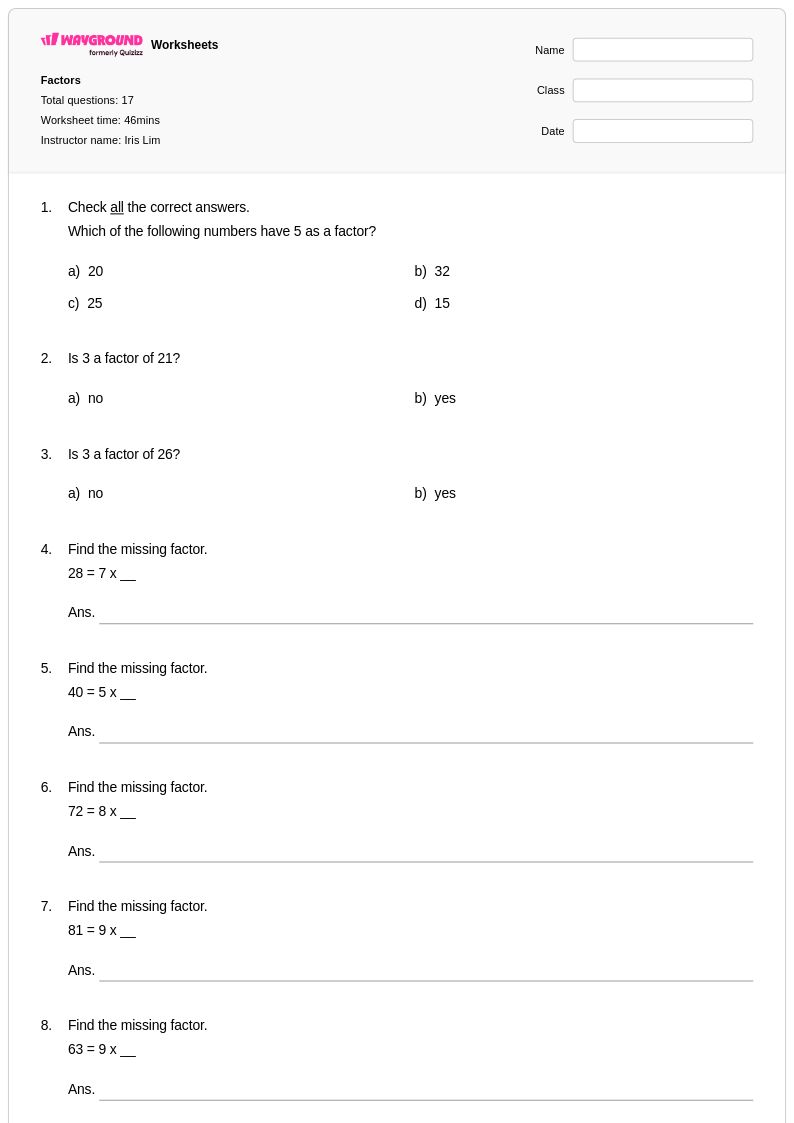
The most effective practice mixes equation formats — some with the missing factor on the left (___ × 7 = 56), some on the right (8 × ___ = 48) — so students can't rely on position alone. Wayground's worksheets progress from single-digit factors to multi-digit problems, giving students a ramp rather than a wall. Pairing written practice with timed drills helps build the fluency students need before this skill shows up inside word problems and multi-step equations.
What mistakes do students commonly make when finding missing factors?
The most common error is treating the equation like a straight multiplication problem and multiplying the two visible numbers together instead of dividing. Students also confuse which number to divide by when the missing factor is the multiplicand versus the multiplier — position in the equation trips them up. A quick fix: have students rewrite every missing-factor equation as a division sentence before solving. That one step forces them to think about the relationship rather than guess.
How do I use Wayground's finding missing factors worksheets in my classroom?
You can run these as a digital quiz hosted on Wayground — students work through the problems on a device and results come back to you automatically. If you'd rather go paper, download the printable PDF and assign it in class or as homework; every worksheet includes a complete answer key so grading is straightforward. For paper submissions, the Wayground for Teachers app lets you scan or capture student work to grade it without re-entering everything by hand.
How does finding missing factors fit into the Common Core math progression?
Common Core introduces missing-factor thinking in third grade, where students learn multiplication and division as related operations within the same fact family. By fourth grade, the expectation expands to larger factors and multi-step problems. Finding missing factors is the bridge between basic multiplication fluency and the variable-based equations students encounter in sixth grade — it's the first time students are asked to treat an unknown as something to solve for, which is the core move in algebra.
How can I differentiate finding missing factors practice for mixed-ability students?
For students who are still shaky on multiplication facts, Wayground's reduced answer choices accommodation narrows the options displayed, lowering the cognitive load so they can focus on the reasoning rather than the recall. The Read Aloud feature helps students who struggle with reading the equations independently. At the worksheet level, you can apply a larger font size or wider spacing for students who need a cleaner visual layout — same problems, easier to process.
What grade level is finding missing factors taught?
Finding missing factors is typically introduced in third grade alongside multiplication and division, then reinforced and extended through fourth and fifth grade as problems grow more complex. By sixth grade, the same skill reappears in a more formal algebraic context — solving for an unknown in a multiplication equation. Wayground offers worksheets targeting each of these grade bands specifically.