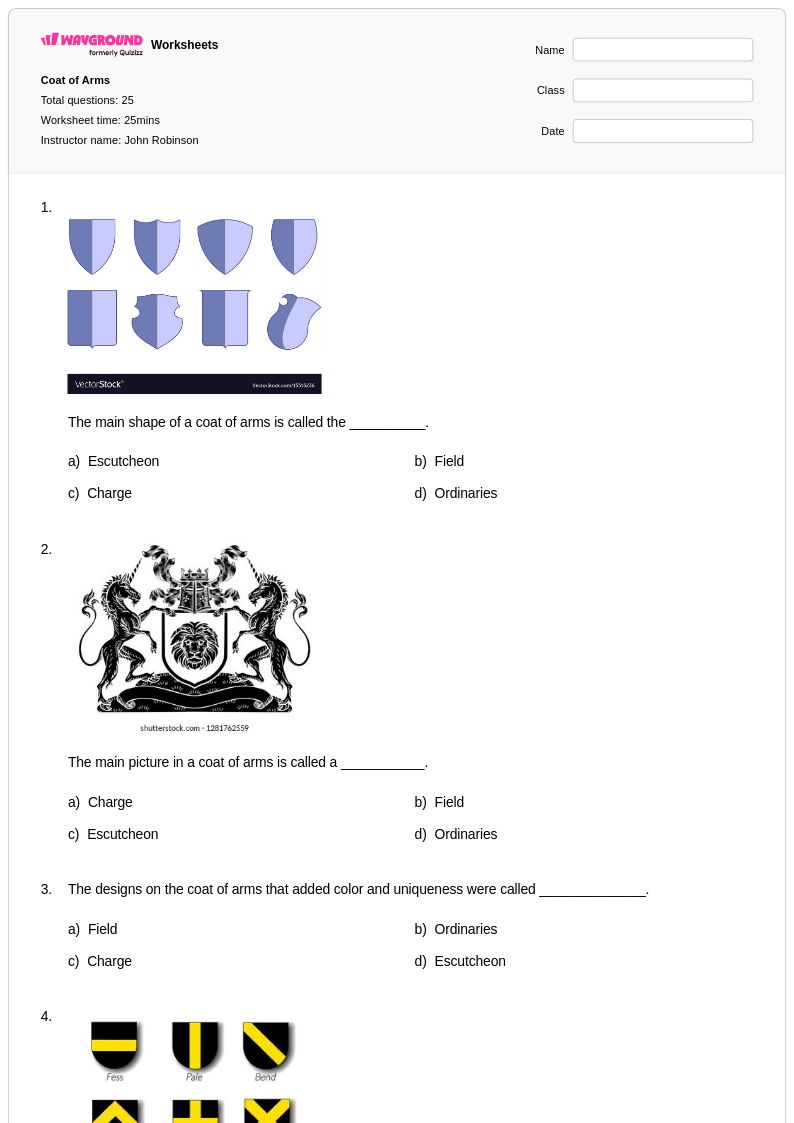
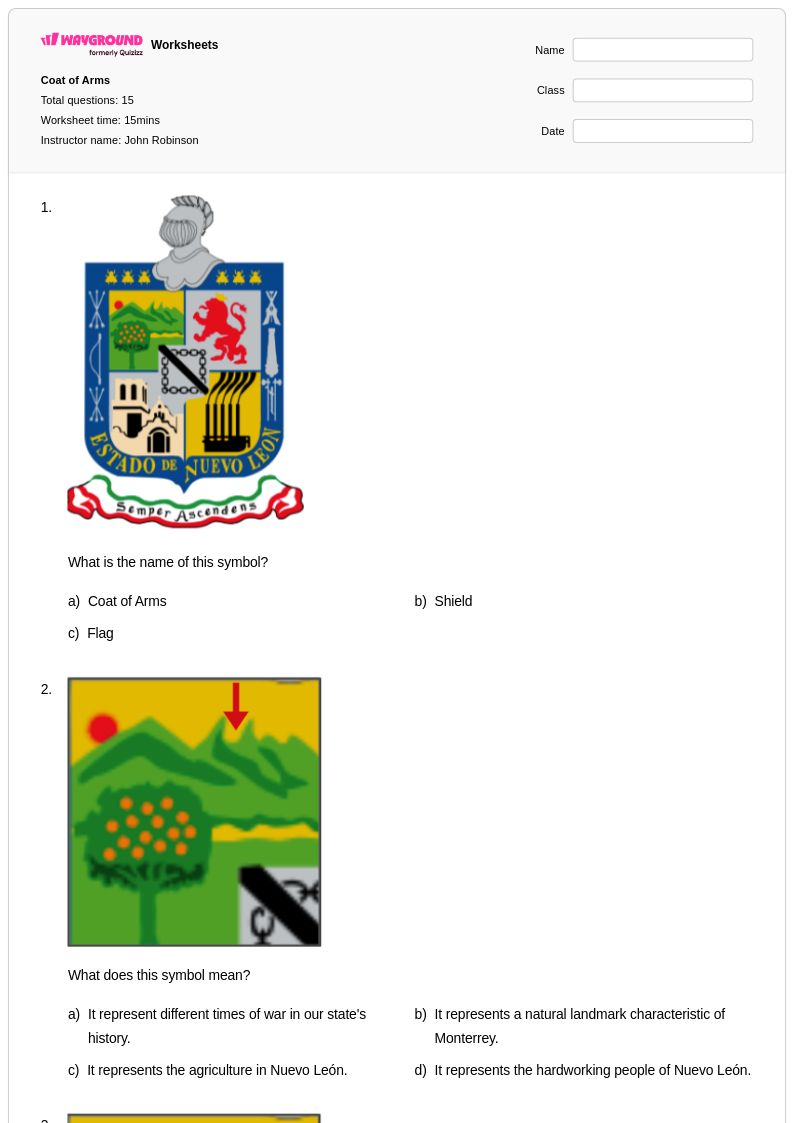
Free Printable Heraldry and Coat of Arms Worksheets for Class 12
Explore Class 12 heraldry and coat of arms printables and free worksheets that help students master medieval symbolism, noble family crests, and historical significance through engaging practice problems and comprehensive answer keys.
Explore printable Heraldry and Coat of Arms worksheets for Class 12
Heraldry and Coat of Arms worksheets for Class 12 students through Wayground (formerly Quizizz) provide comprehensive exploration of this fascinating aspect of medieval and modern symbolism within world history. These educational resources guide advanced students through the intricate rules of heraldic design, the historical significance of noble family crests, and the evolution of symbolic representation across different cultures and time periods. The worksheets strengthen critical thinking skills as students analyze the political, social, and cultural messages embedded within heraldic symbols, while developing visual literacy through interpretation of complex iconographic systems. Each printable resource includes detailed practice problems that challenge students to decode blazonry terminology, identify heraldic elements, and understand the hierarchical nature of medieval society reflected in coat of arms design, with comprehensive answer key materials supporting both independent study and classroom instruction.
Wayground's extensive collection of teacher-created heraldry and coat of arms worksheets draws from millions of educational resources specifically designed to meet the rigorous demands of Class 12 world history curricula. The platform's robust search and filtering capabilities allow educators to quickly locate materials aligned with specific learning standards, whether focusing on European feudalism, Japanese mon systems, or African symbolic traditions. Teachers benefit from sophisticated differentiation tools that enable customization of worksheet complexity, accommodating diverse learning needs within advanced placement and honors-level courses. Available in both digital and pdf formats, these flexible resources support varied instructional approaches from traditional classroom lessons to remote learning environments, facilitating targeted skill practice, remediation for struggling students, and enrichment opportunities for those ready to explore advanced heraldic concepts and cross-cultural comparative analysis.
FAQs
How do I teach heraldry and coat of arms in a history class?
Teaching heraldry works best when students connect visual symbols to their historical function. Start by explaining that coats of arms were identification systems used in feudal societies, then introduce core heraldic terminology such as tinctures, ordinaries, and charges. Having students analyze real historical examples before creating their own designs reinforces both vocabulary and conceptual understanding. Grounding the lesson in the social hierarchies these symbols represented helps students see heraldry as a primary source, not just a craft activity.
What exercises help students practice reading and interpreting heraldic symbols?
Effective practice exercises include decoding the meaning of specific colors and metals in heraldry, identifying charges on a shield and explaining their symbolic significance, and matching heraldic terminology to labeled diagram components. Students also benefit from exercises that ask them to interpret a complete coat of arms and describe what it communicates about the bearer's identity or status. These tasks build both vocabulary retention and the ability to read visual historical sources critically.
What mistakes do students commonly make when learning about coats of arms?
The most common misconception is that any family can have a coat of arms — students often confuse the modern commercial practice of selling 'family crests' with the historically regulated system of heraldic grants. Students also frequently mix up heraldic tinctures, particularly confusing metals (or and argent) with colors, and misapply the rule of tincture, which prohibits placing color on color or metal on metal. Addressing these errors explicitly during instruction prevents them from becoming entrenched misunderstandings.
How do heraldry worksheets connect to broader world history standards?
Heraldry and coat of arms worksheets connect directly to medieval European history standards, supporting learning objectives around feudal society, the social hierarchy of the Middle Ages, and the use of visual symbols as communication systems before widespread literacy. Analyzing heraldic designs also builds primary source literacy skills, as students learn to extract historical information from non-textual artifacts. This makes heraldry a productive entry point into broader units on medieval culture, identity, and class structure.
How do I use Wayground's heraldry and coat of arms worksheets in my classroom?
Wayground's heraldry and coat of arms worksheets are available as printable PDFs for traditional classroom use and in digital formats for technology-integrated or remote learning environments. Teachers can also host them as a quiz directly on Wayground, which adds an interactive layer to assessment. Each worksheet includes a complete answer key, supporting both teacher-led instruction and independent student work. The digital format makes it easy to assign worksheets for homework, station rotations, or differentiated practice without additional preparation.
How can I differentiate heraldry instruction for students at different levels?
For students who need additional support, focus on foundational vocabulary and color symbolism before moving to full coat of arms analysis. More advanced students can be challenged to research a specific historical family's arms and present an interpretation of its meaning within its feudal context. On Wayground, teachers can apply accommodations such as reduced answer choices to lower cognitive load for individual students, or enable Read Aloud so that heraldic terminology is read aloud for students who benefit from audio support, without affecting other students' experience.