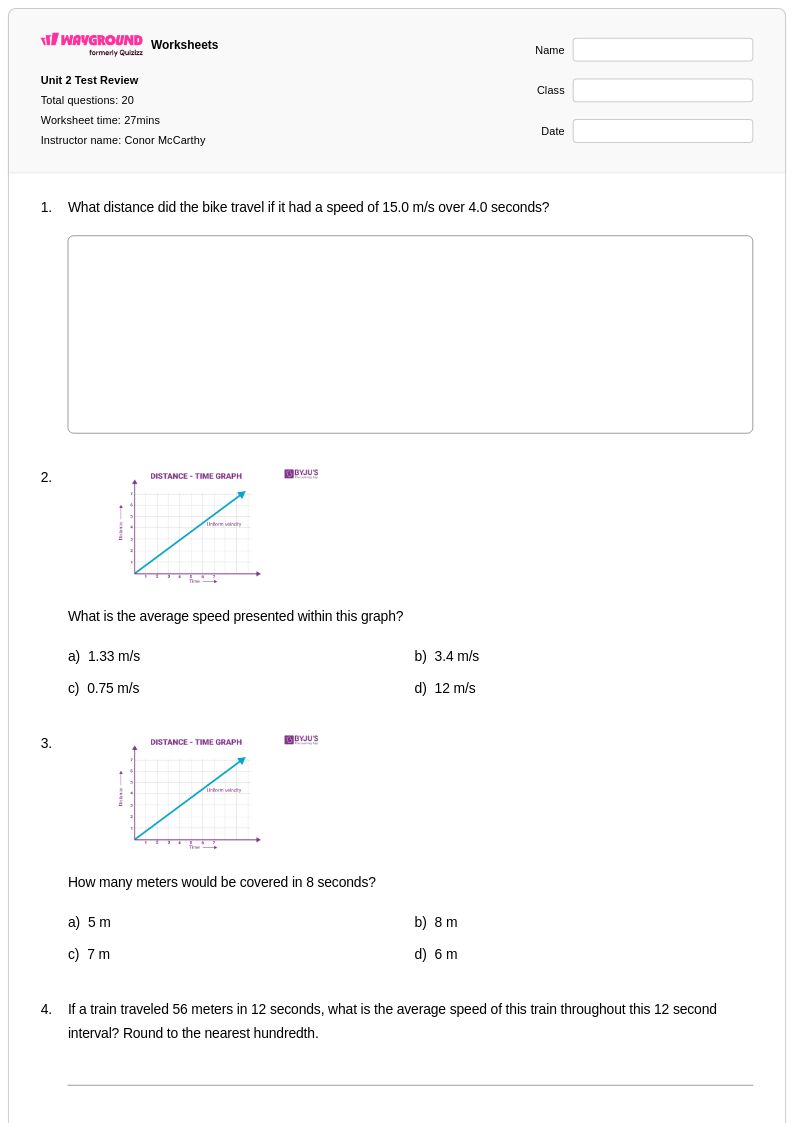
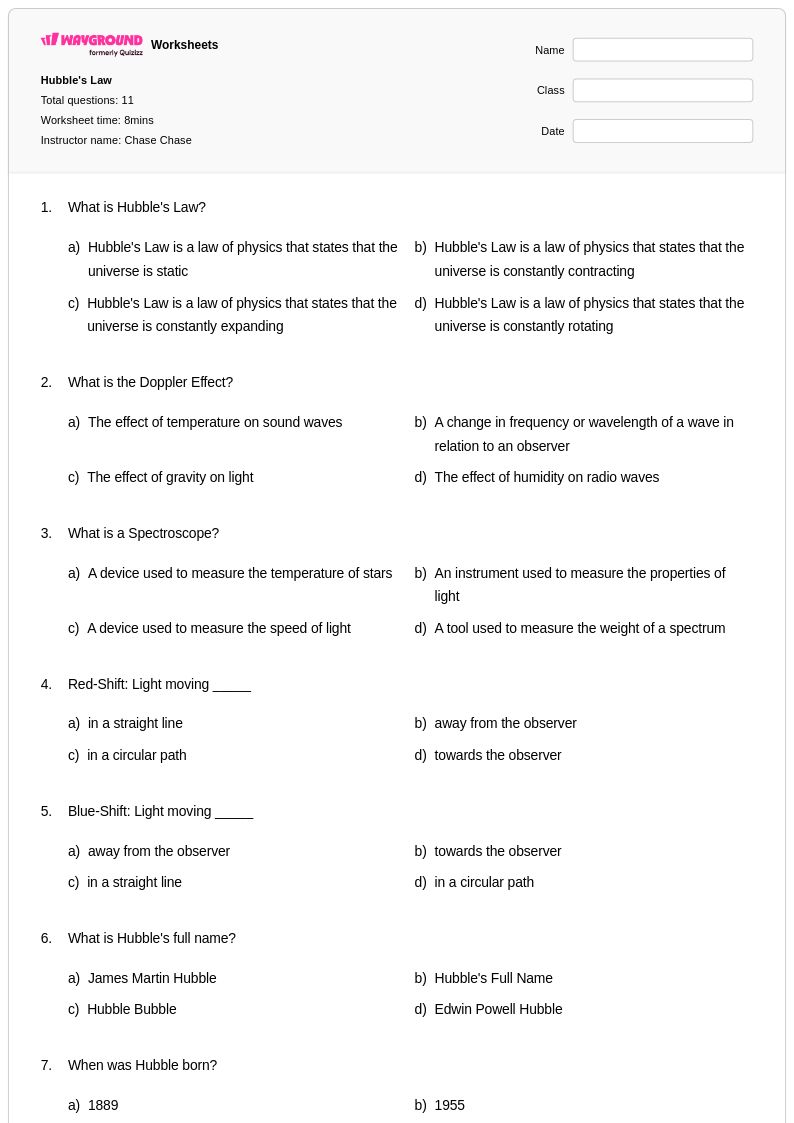
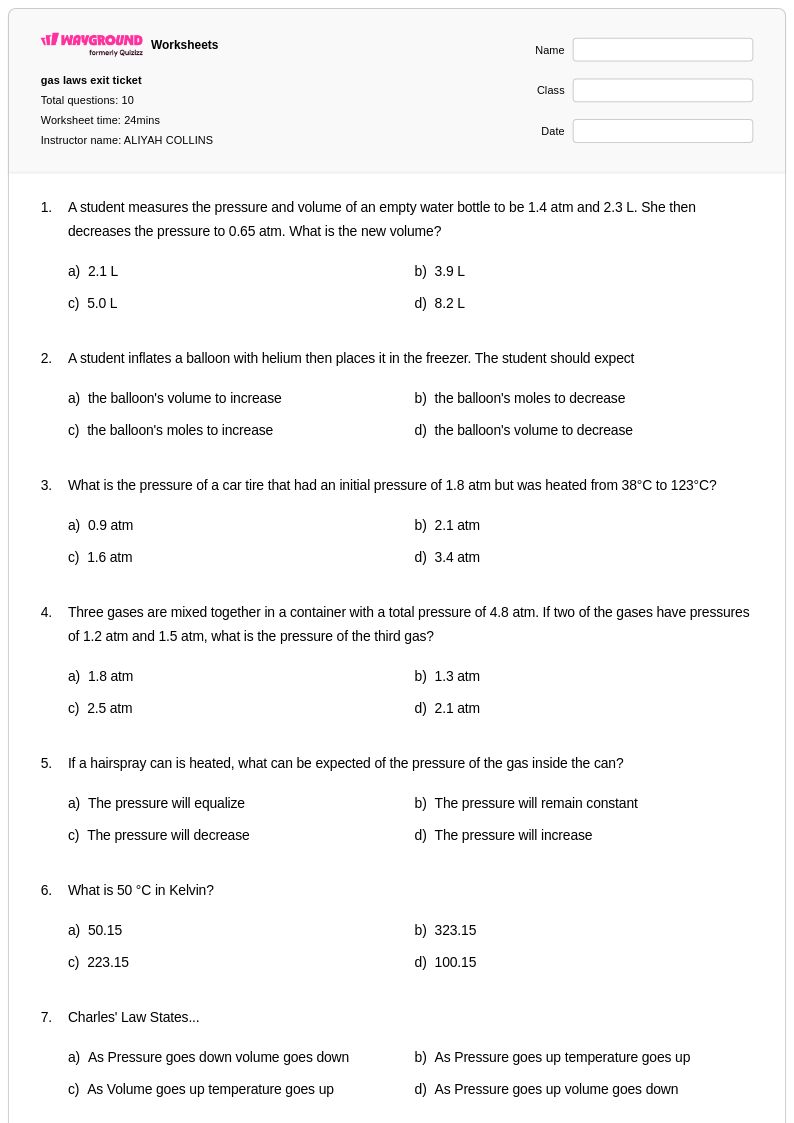
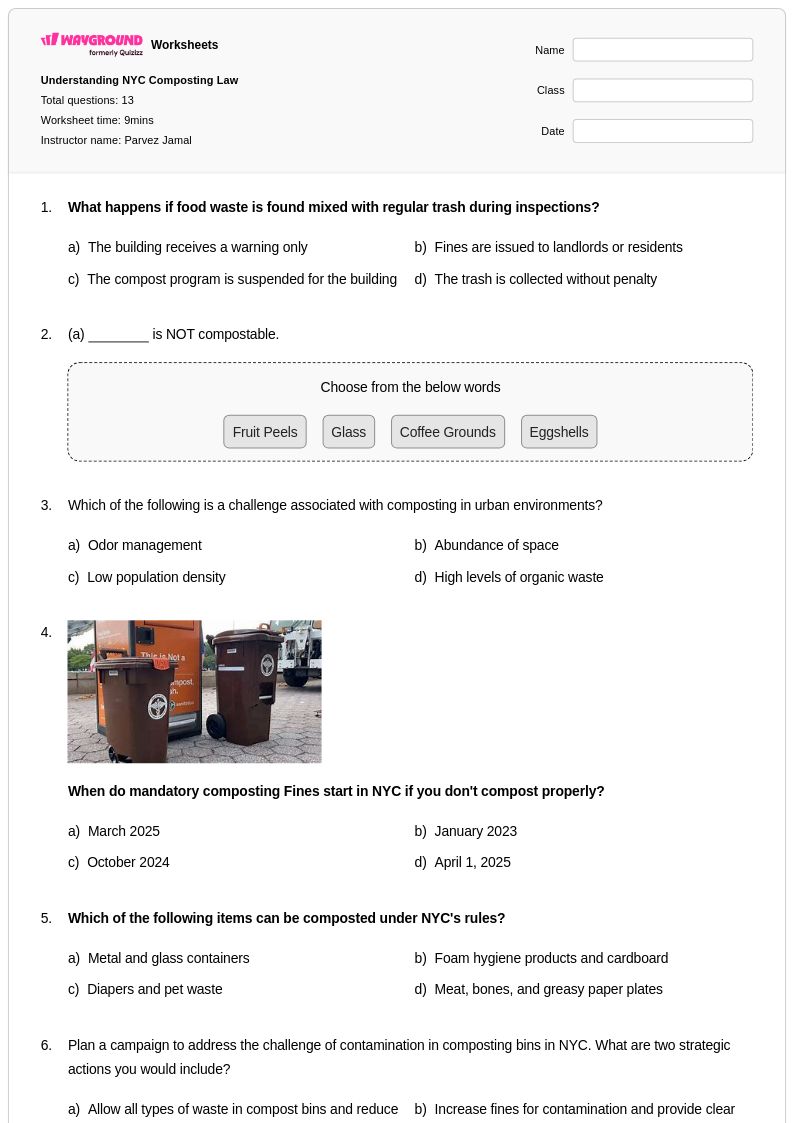
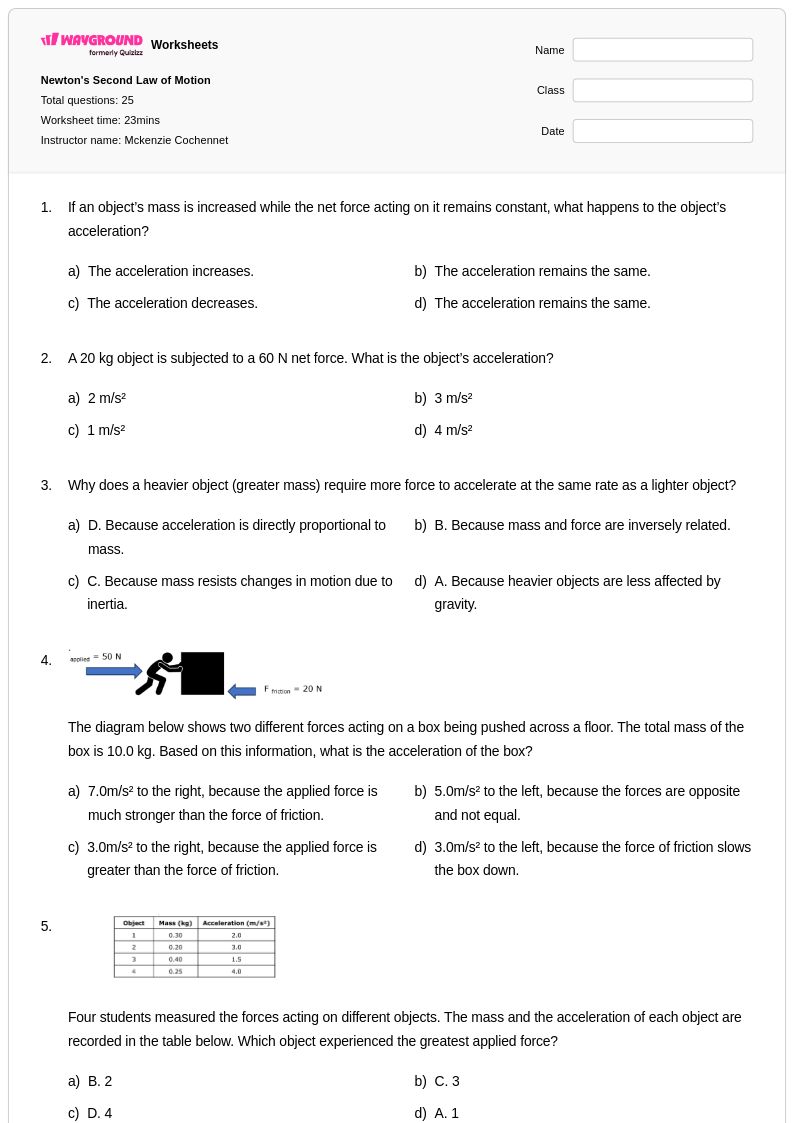
Master Hess's Law with Wayground's comprehensive Class 12 chemistry worksheets featuring free printables, practice problems, and detailed answer keys to help students understand enthalpy calculations and thermochemical equations.
Explore printable Hess's Law worksheets for Class 12
Hess's Law worksheets for Class 12 chemistry students provide comprehensive practice with one of thermodynamics' most fundamental principles, enabling students to calculate enthalpy changes for complex reactions using known enthalpy values from simpler reactions. These carefully designed worksheets available through Wayground (formerly Quizizz) focus on developing students' ability to manipulate thermochemical equations, apply the law of conservation of energy, and solve multi-step enthalpy problems that are essential for advanced chemistry coursework. Students work through practice problems that require them to analyze reaction pathways, construct enthalpy diagrams, and perform algebraic manipulations of chemical equations while understanding that enthalpy change is independent of the reaction pathway. Each worksheet includes detailed answer keys and step-by-step solutions, with free printable pdf formats that allow students to practice these challenging calculations both in classroom settings and as homework assignments.
Wayground (formerly Quizizz) supports chemistry educators with an extensive collection of teacher-created Hess's Law resources, drawing from millions of worksheets that have been developed and refined by experienced chemistry professionals. The platform's robust search and filtering capabilities allow teachers to quickly locate worksheets that align with specific curriculum standards and match their students' skill levels, while differentiation tools enable educators to customize problem complexity and provide appropriate scaffolding for diverse learners. These resources are available in both printable pdf formats for traditional classroom use and digital formats for online learning environments, giving teachers maximum flexibility in lesson planning and implementation. The comprehensive worksheet collections serve multiple instructional purposes, from initial concept introduction and guided practice to remediation for struggling students and enrichment challenges for advanced learners, ensuring that all Class 12 chemistry students can master the critical thinking skills required to apply Hess's Law effectively in thermochemical calculations.
FAQs
How do I teach Hess's Law to chemistry students?
Start by ensuring students are comfortable with the concept that enthalpy is a state function, meaning the total enthalpy change depends only on the initial and final states, not the reaction pathway. Introduce simple two-step problems where students practice reversing equations and multiplying them by coefficients before combining. Once students grasp the algebraic logic, layer in standard enthalpies of formation and multi-step pathways. Enthalpy diagrams are especially useful for visual learners because they make the additive nature of the law concrete before students work purely with numbers.
What exercises help students practice Hess's Law?
The most effective practice combines equation manipulation problems, standard enthalpy of formation calculations, and enthalpy diagram construction in sequence. Begin with problems that require students to reverse one equation and add it to another, then progress to multi-step problems involving three or more thermochemical equations. Including bond energy calculations alongside formation enthalpy problems helps students see Hess's Law applied across multiple problem types. Worksheets that provide complete answer keys allow students to self-check each algebraic step rather than only confirming the final answer.
What mistakes do students commonly make when solving Hess's Law problems?
The most common error is failing to flip the sign of the enthalpy value when reversing a thermochemical equation. Students also frequently forget to multiply the enthalpy change by the same scalar used to balance stoichiometric coefficients. A third persistent mistake is misidentifying which target equation to construct, causing students to combine equations in ways that do not cancel the correct intermediate species. Drilling students on explicitly labeling each manipulation step before adding enthalpies significantly reduces these errors.
How do I differentiate Hess's Law instruction for students at different skill levels?
For students who are still building confidence, start with two-equation problems where only one reversal is needed and intermediate species cancel cleanly. More advanced students can be challenged with four- or five-step pathways, non-integer scaling factors, or problems that require selecting the correct subset of given equations. On Wayground, teachers can apply accommodations such as reduced answer choices and read-aloud support for students who need additional scaffolding, while other students work through standard versions without disruption.
How can I use Hess's Law worksheets from Wayground in my classroom?
Wayground's Hess's Law worksheets are available as printable PDFs for traditional classroom use and in digital formats for technology-integrated environments, including the option to host them as a quiz directly on the platform. Teachers can assign worksheets for in-class practice, homework, or remediation and use the built-in answer keys to support self-paced review. The digital format also allows progress tracking so teachers can quickly identify which students are struggling with specific manipulation steps before moving on to calorimetry applications.
How does Hess's Law connect to other thermochemistry topics I teach?
Hess's Law sits at the intersection of several core thermochemistry concepts, making it an ideal integrating topic. It directly reinforces calorimetry because students apply experimentally measured heat values to calculate enthalpy changes they cannot measure directly. It also connects to bond energy calculations, where students sum bond-breaking and bond-forming energies as an alternative pathway to the same enthalpy change. Teaching these connections explicitly helps students see Hess's Law not as an isolated procedure but as an expression of the conservation of energy applied to chemistry.