Free Printable Ideal Gas Equation Worksheets for Class 12
Class 12 Chemistry students can master the Ideal Gas Equation with Wayground's comprehensive collection of free worksheets, printables, and practice problems featuring detailed answer keys and PDF resources.
Explore printable Ideal Gas Equation worksheets for Class 12
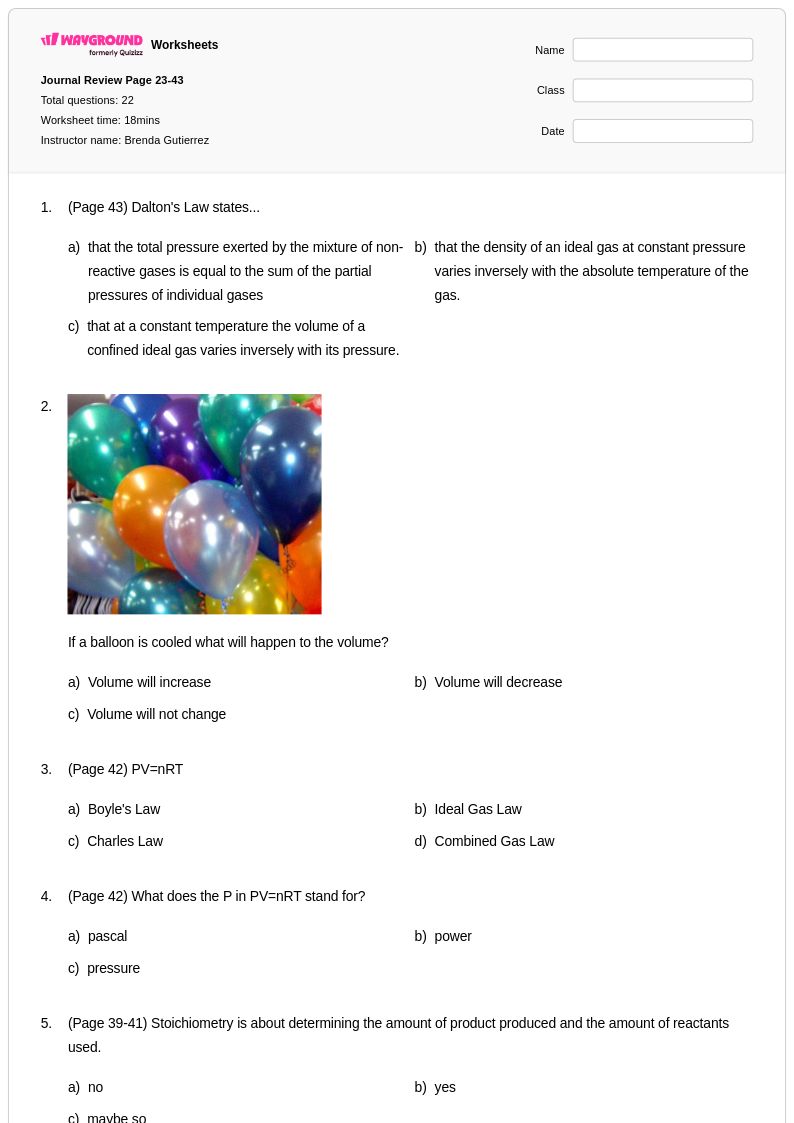
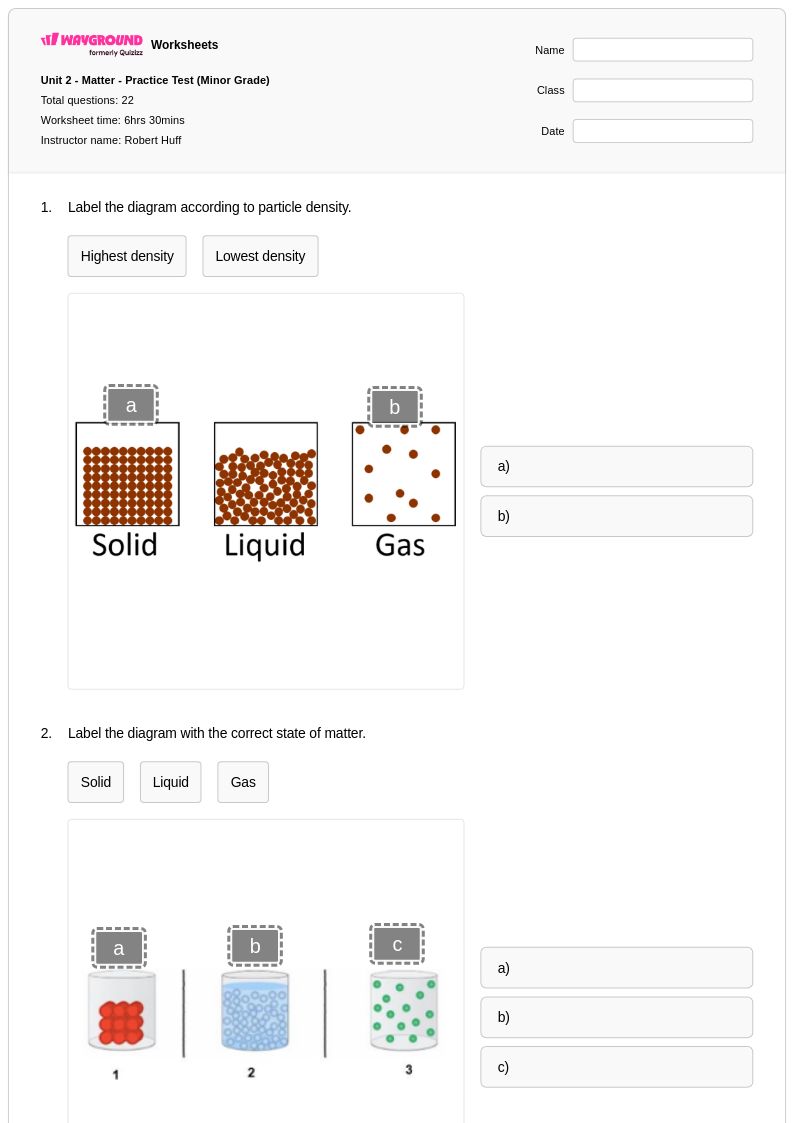
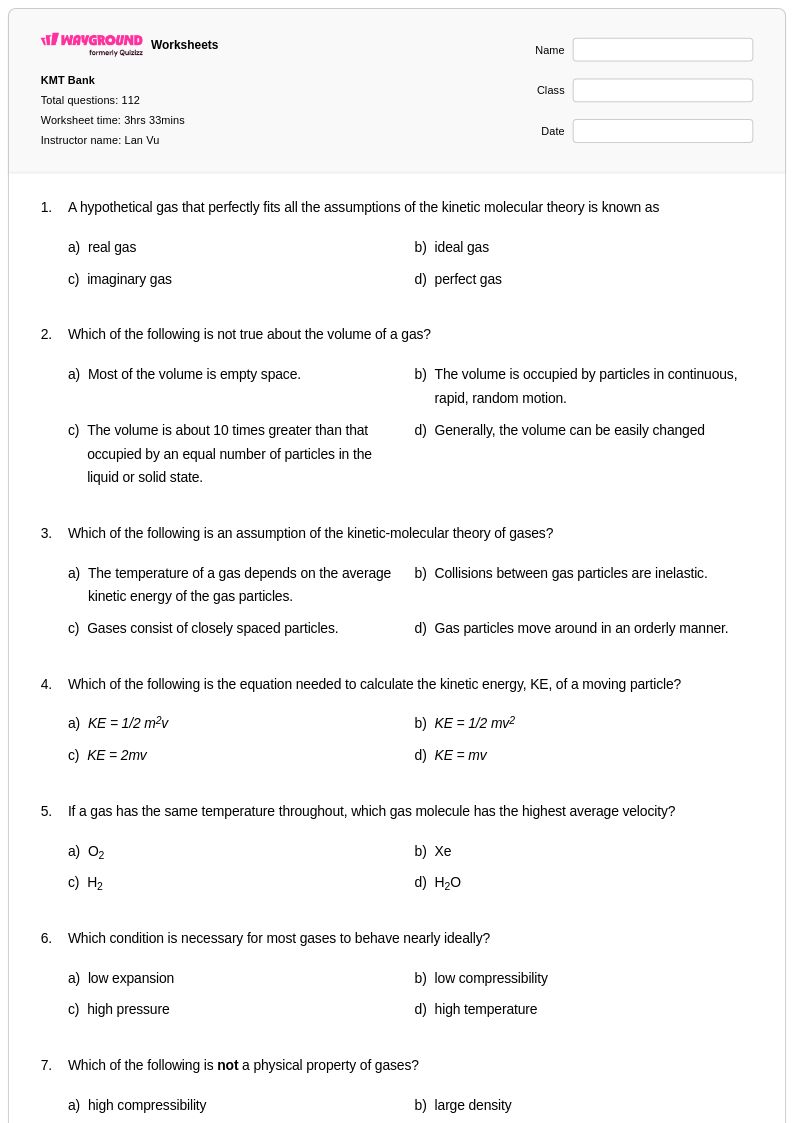
Class 12 ideal gas equation worksheets available through Wayground (formerly Quizizz) provide comprehensive practice with one of chemistry's most fundamental relationships, connecting pressure, volume, temperature, and moles of gas in quantitative problems. These expertly designed worksheets strengthen students' abilities to manipulate the PV=nRT equation, solve for unknown variables, and apply gas law principles to real-world scenarios involving atmospheric conditions, industrial processes, and laboratory calculations. Each worksheet collection includes detailed answer keys that guide students through multi-step problem-solving approaches, while the free printable format ensures accessibility for both classroom instruction and independent study. Practice problems range from straightforward substitution exercises to complex combined gas law scenarios, building the mathematical confidence and conceptual understanding essential for advanced chemistry coursework and standardized assessments.
Wayground (formerly Quizizz) supports chemistry educators with an extensive library of millions of teacher-created ideal gas equation resources, featuring robust search and filtering capabilities that allow instructors to locate materials perfectly aligned with their curriculum standards and student needs. The platform's differentiation tools enable teachers to customize worksheets for varying ability levels, while the dual availability in both printable pdf format and interactive digital versions provides maximum flexibility for diverse learning environments. These comprehensive collections streamline lesson planning by offering ready-to-use materials for initial instruction, targeted remediation for struggling students, and enrichment opportunities for advanced learners, ensuring that all Class 12 students can master the critical gas law calculations required for success in chemistry and related STEM fields.
FAQs
How do I teach the ideal gas equation to chemistry students?
Start by building conceptual understanding of each variable in PV=nRT before introducing calculations — students need to understand what pressure, volume, moles, and temperature represent physically before manipulating the equation algebraically. Use real-world contexts like inflating a tire or a sealed syringe to anchor the abstract relationship. Progress from single-variable isolation exercises to multi-step problems that require unit conversion alongside algebraic manipulation, so students develop both procedural fluency and conceptual clarity.
What kinds of practice problems help students get better at using PV=nRT?
Effective practice should sequence problems from basic substitution — where all variables but one are given in standard units — to problems requiring unit conversions (e.g., converting Celsius to Kelvin or kPa to atm) before applying the equation. Multi-step problems that ask students to find molar mass or density using the ideal gas equation build deeper algebraic fluency. Mixing problem types within a worksheet also reinforces when and how to isolate each variable.
What mistakes do students commonly make when solving ideal gas law problems?
The most frequent error is using Celsius instead of Kelvin for temperature, which produces incorrect results because the ideal gas law requires an absolute temperature scale. Students also commonly confuse which pressure units are compatible with which value of R, leading to systematic calculation errors. A third common mistake is misidentifying the number of moles when grams are given, skipping the conversion from mass to moles before substituting into PV=nRT.
How do I use Ideal Gas Equation worksheets from Wayground in my classroom?
Wayground's Ideal Gas Equation worksheets are available as printable PDFs for traditional classroom use and in digital formats for technology-integrated or hybrid learning environments, and teachers can host them as a quiz directly on Wayground. The printable versions work well for in-class practice or homework, while the digital format allows for self-paced review and immediate feedback. Both formats include complete answer keys, so teachers can use them for formative assessment, independent practice, or guided problem-solving sessions.
How do I differentiate ideal gas law instruction for students at different skill levels?
For struggling students, begin with scaffolded problems where the equation is already written out and students only need to substitute and solve, limiting cognitive load to one step at a time. Advanced students benefit from problems that require deriving molar mass or identifying whether a gas behaves ideally under given conditions. On Wayground, teachers can also apply individual accommodations such as reduced answer choices or read-aloud support for students who need additional accessibility scaffolding during digital practice sessions.
How does the ideal gas equation connect to other gas laws students have already learned?
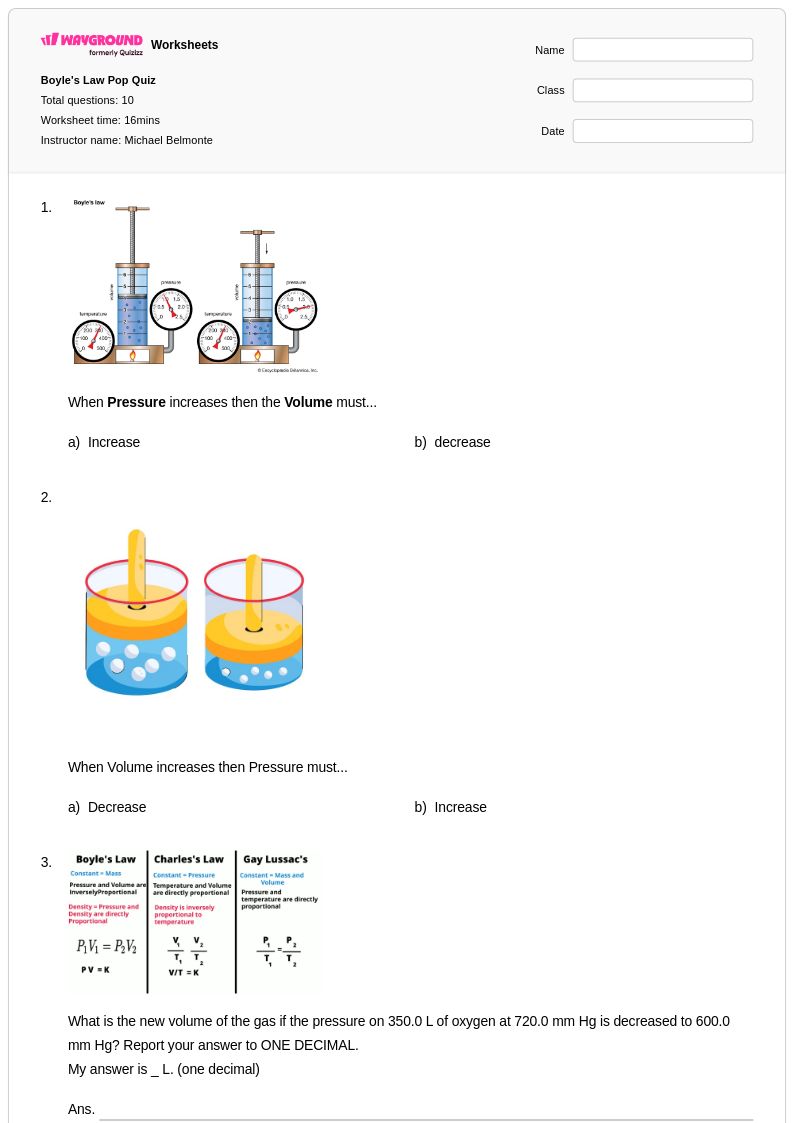
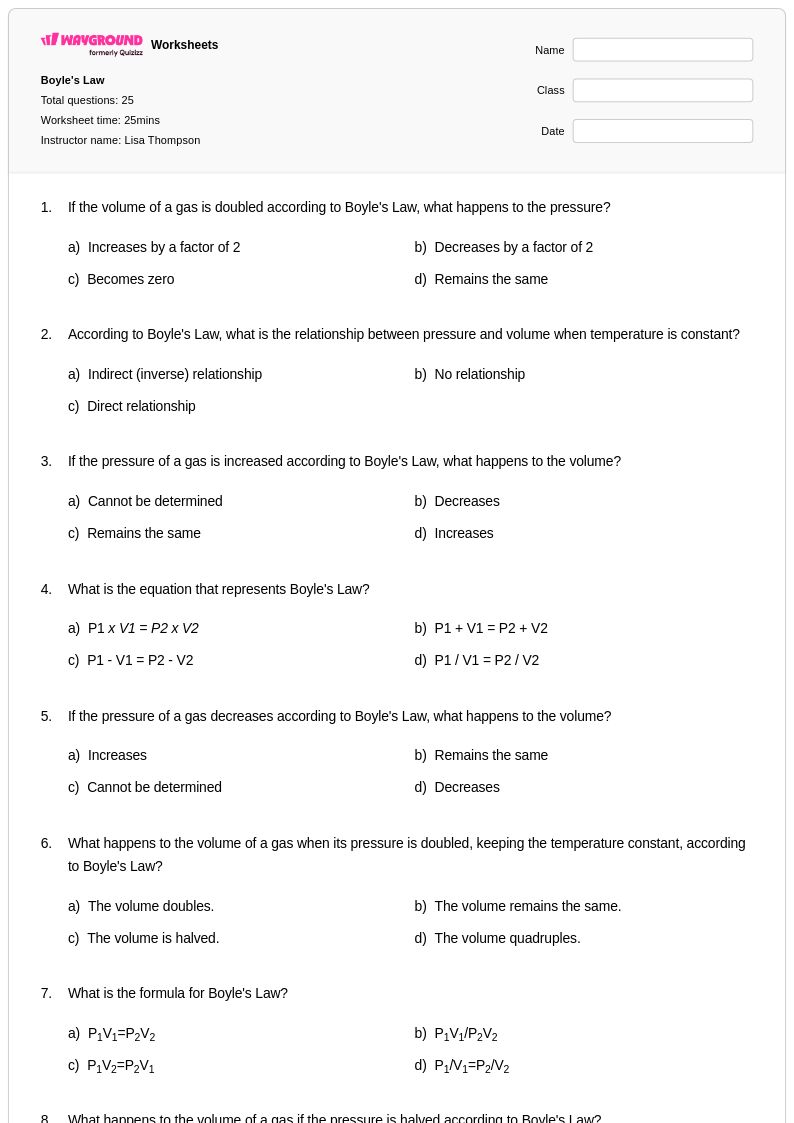
PV=nRT unifies Boyle's Law, Charles's Law, and Gay-Lussac's Law into a single relationship, so students who understand those individual laws have a strong conceptual foundation for the ideal gas equation. When n and T are held constant, PV=nRT simplifies to Boyle's inverse relationship; when n and P are constant, it simplifies to Charles's direct relationship. Explicitly connecting the ideal gas equation back to these simpler laws helps students see it as a generalization rather than an entirely new formula to memorize.