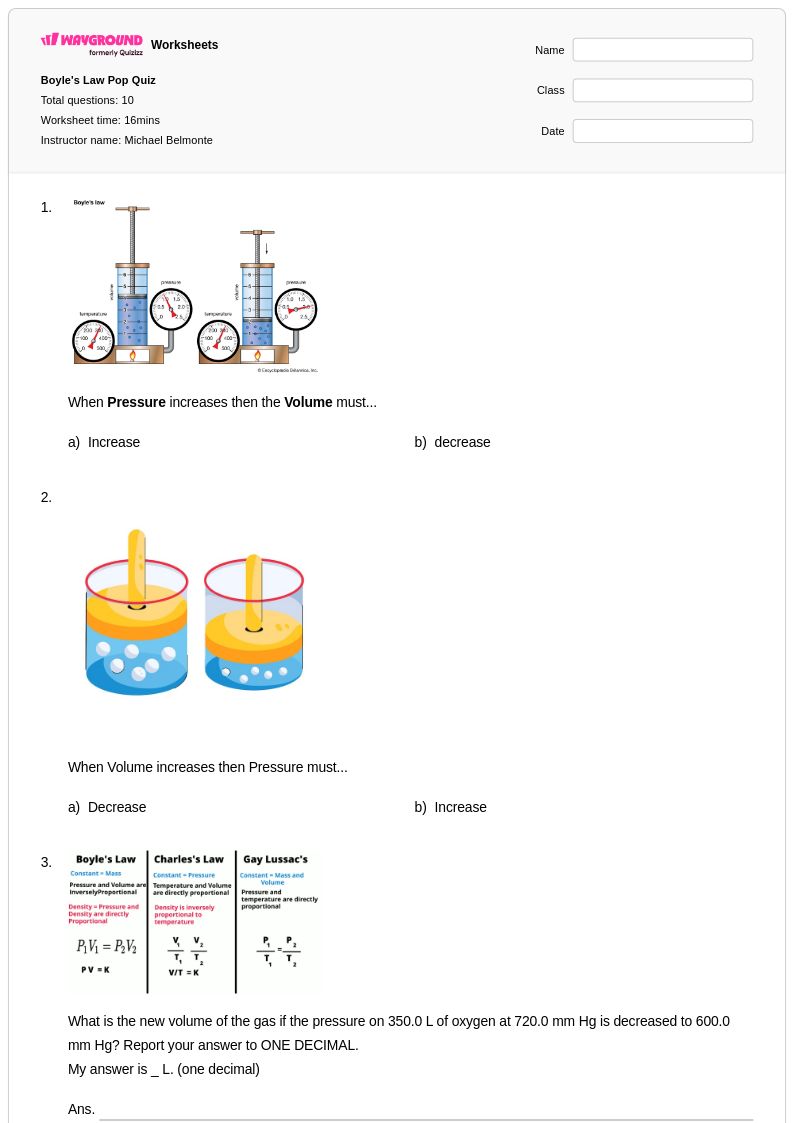
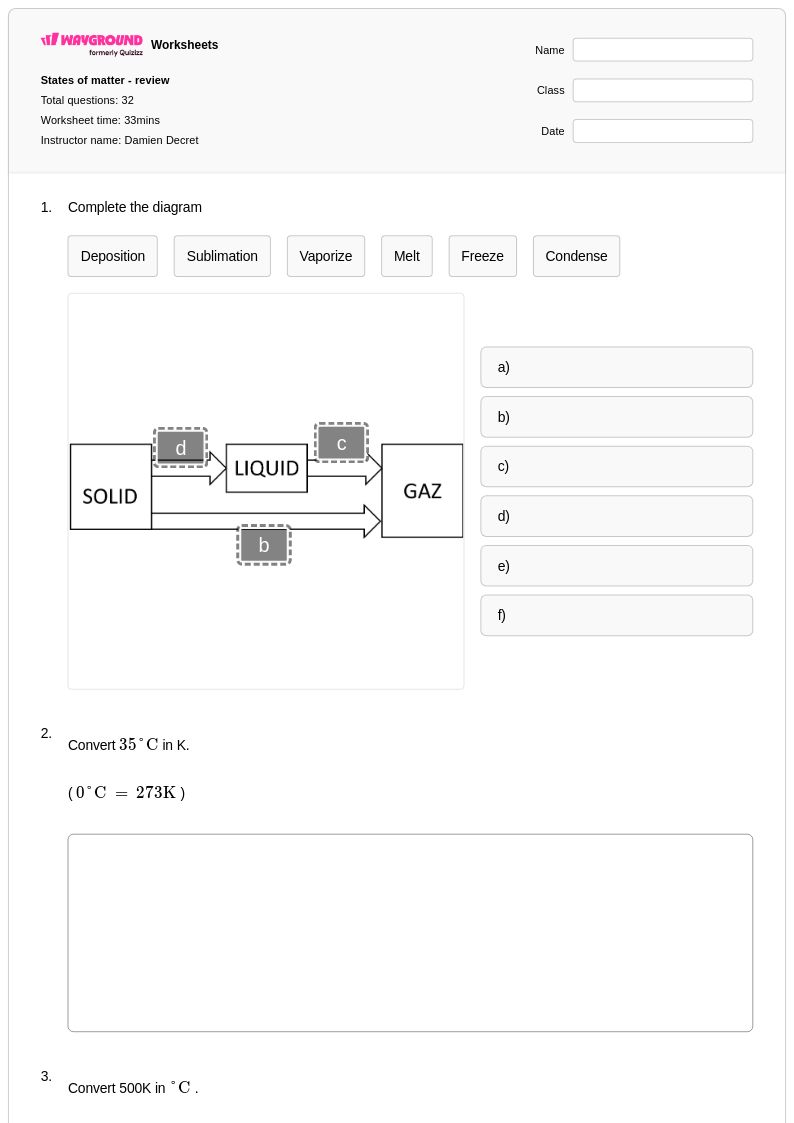
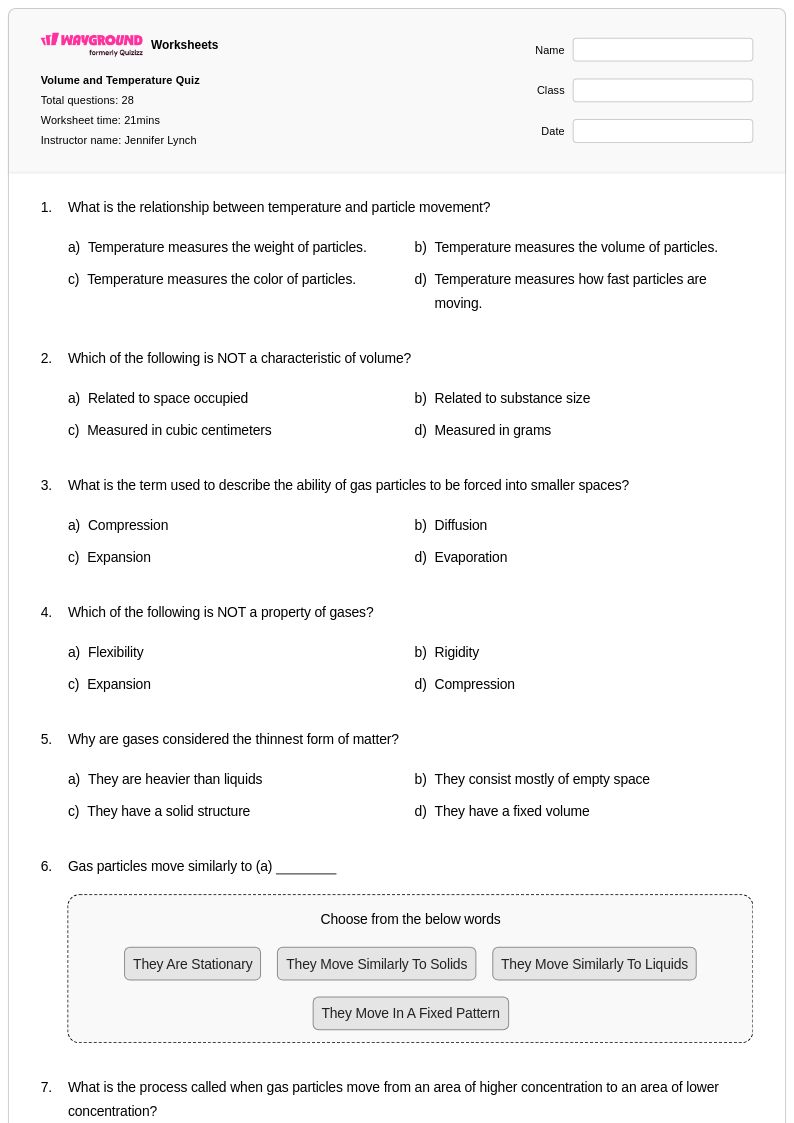
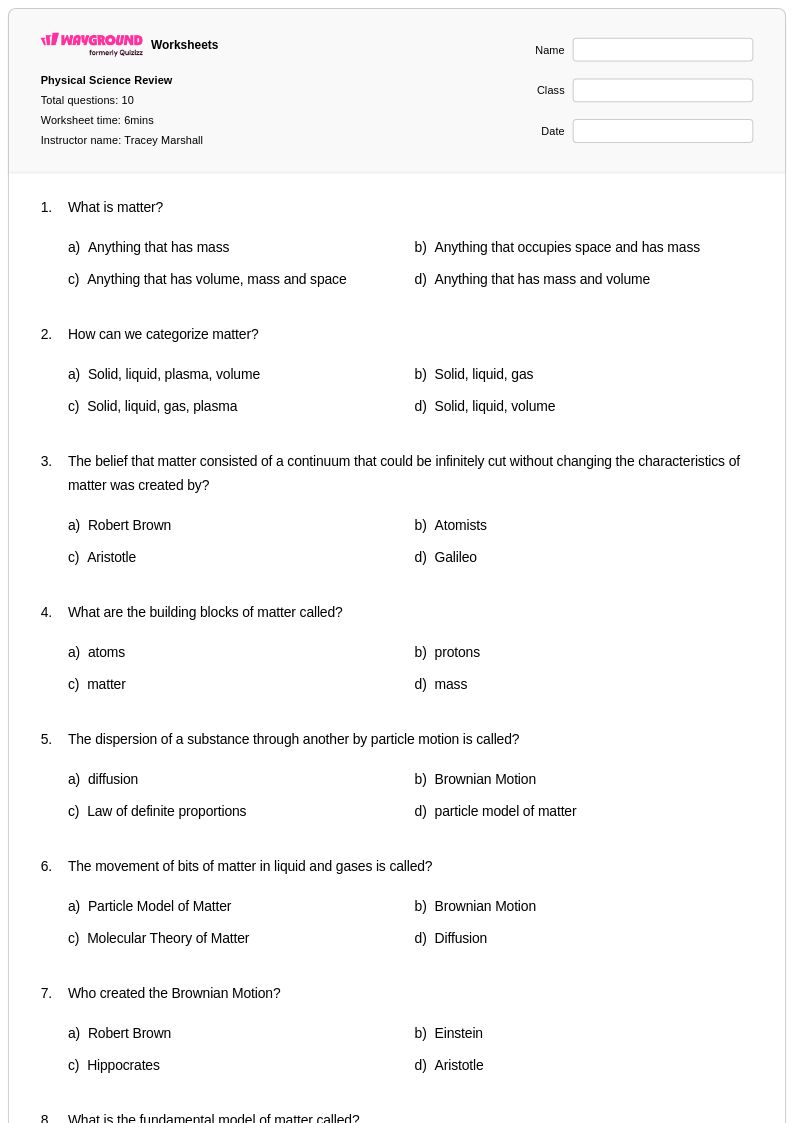
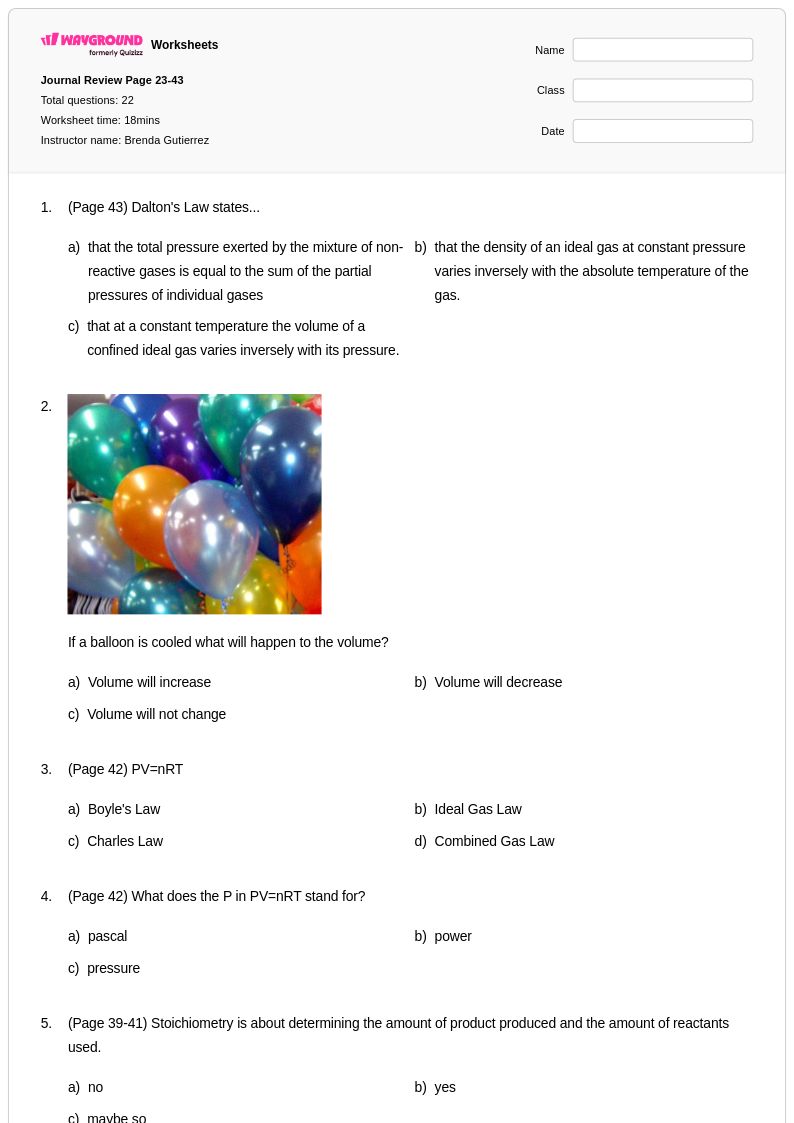
Free Printable Ideal Gas Law Worksheets for Class 9
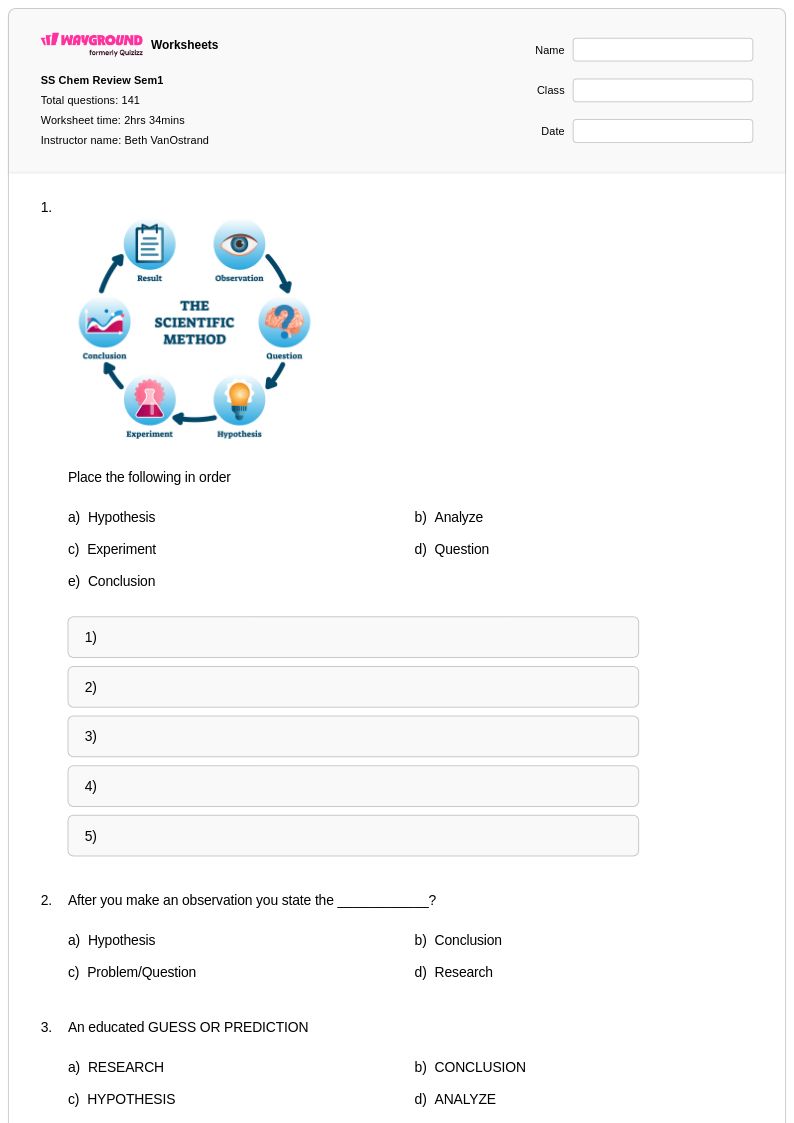
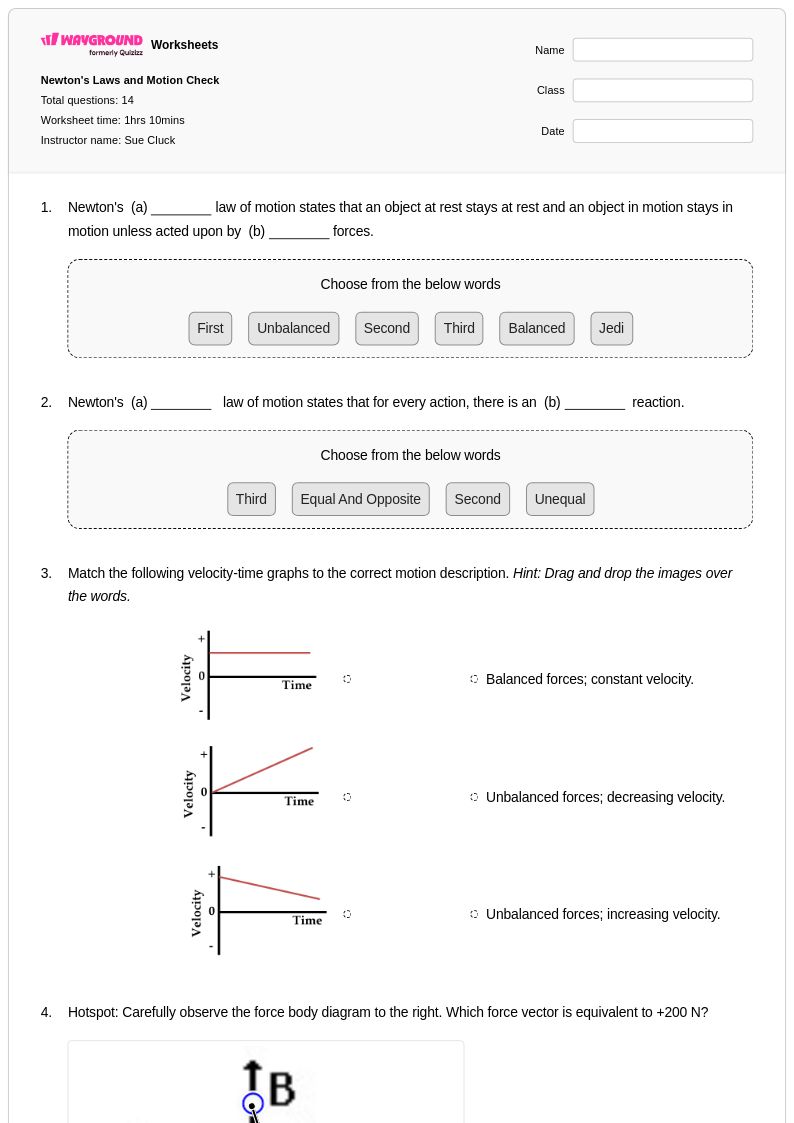
Class 9 Ideal Gas Law worksheets from Wayground provide comprehensive practice problems and free printables with answer keys to help students master gas pressure, volume, and temperature relationships through engaging PDF exercises.
Explore printable Ideal Gas Law worksheets for Class 9
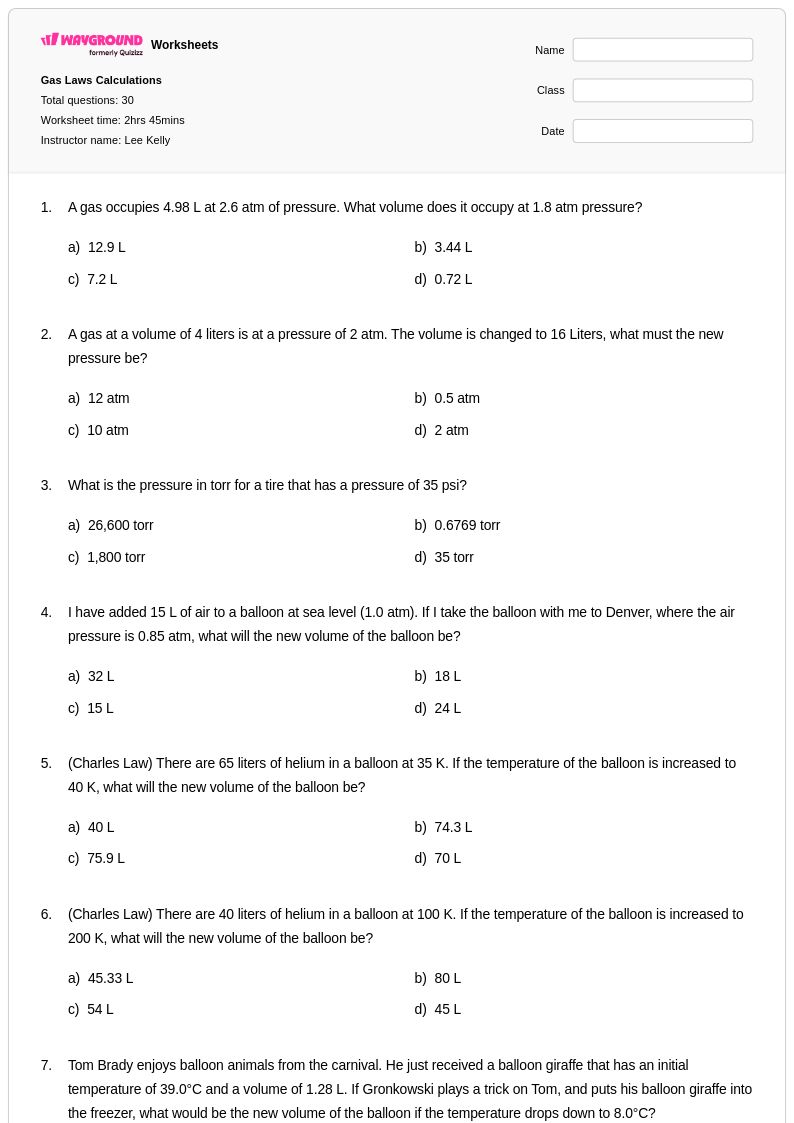
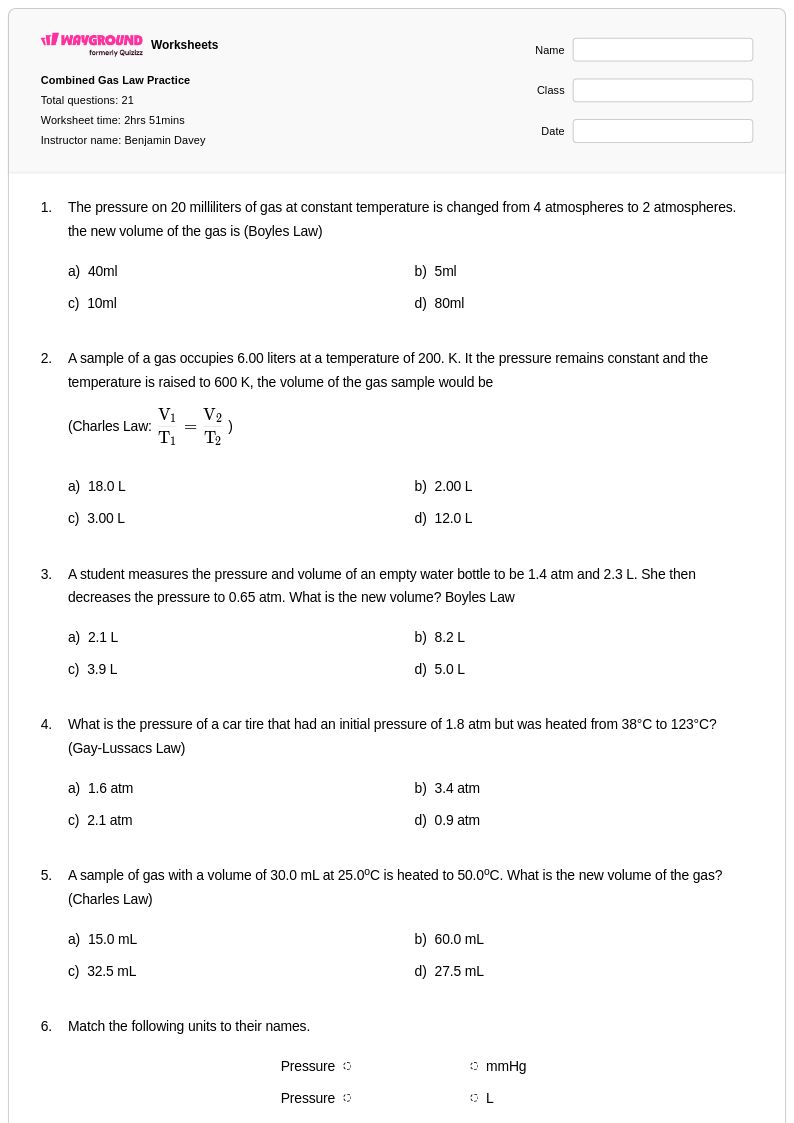
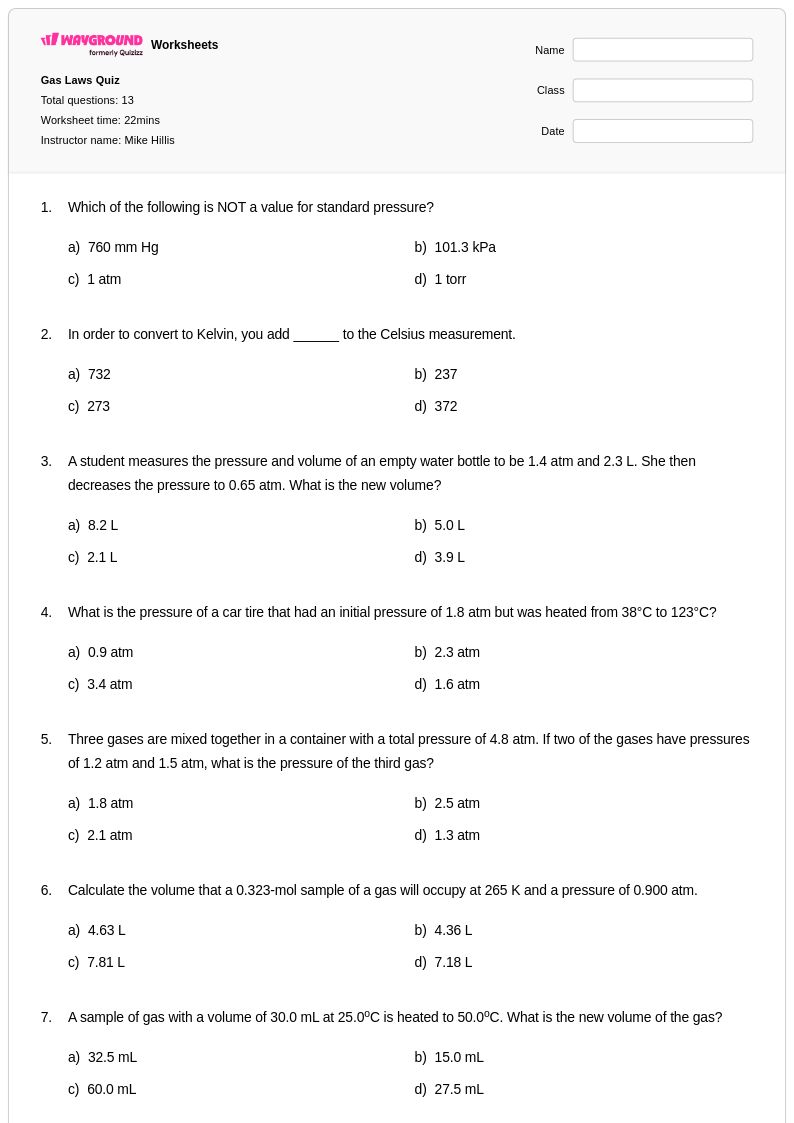
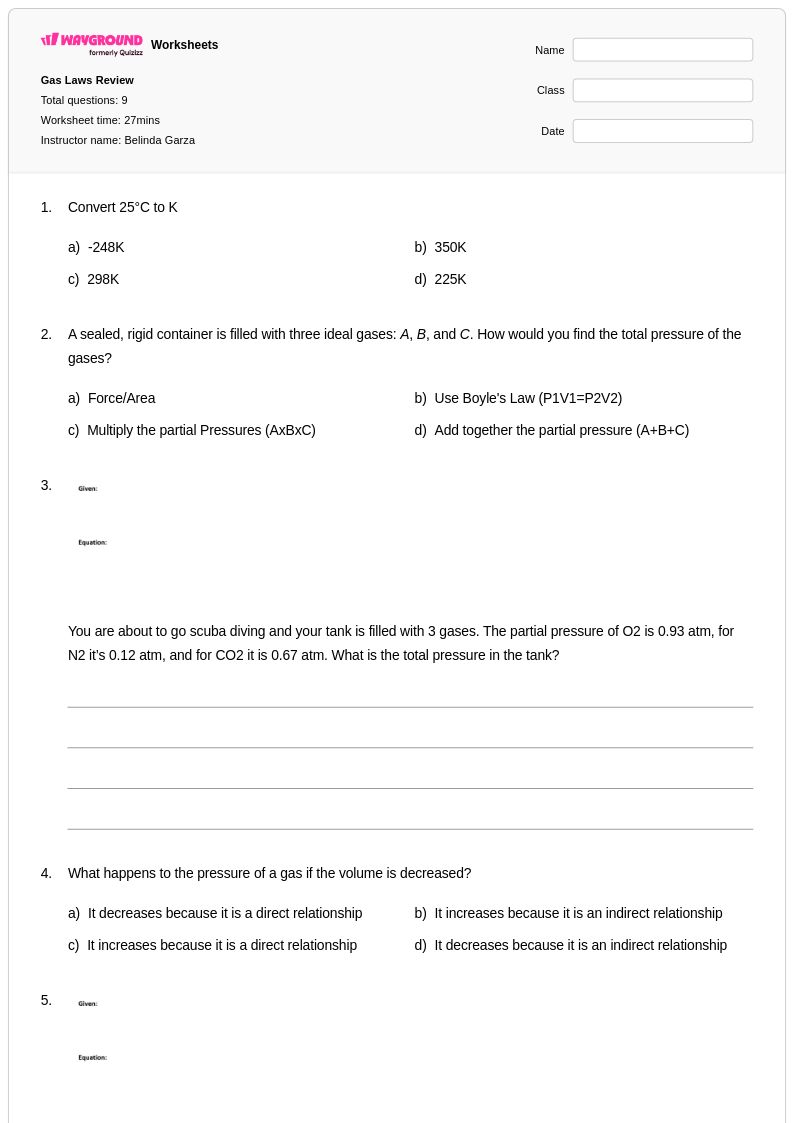
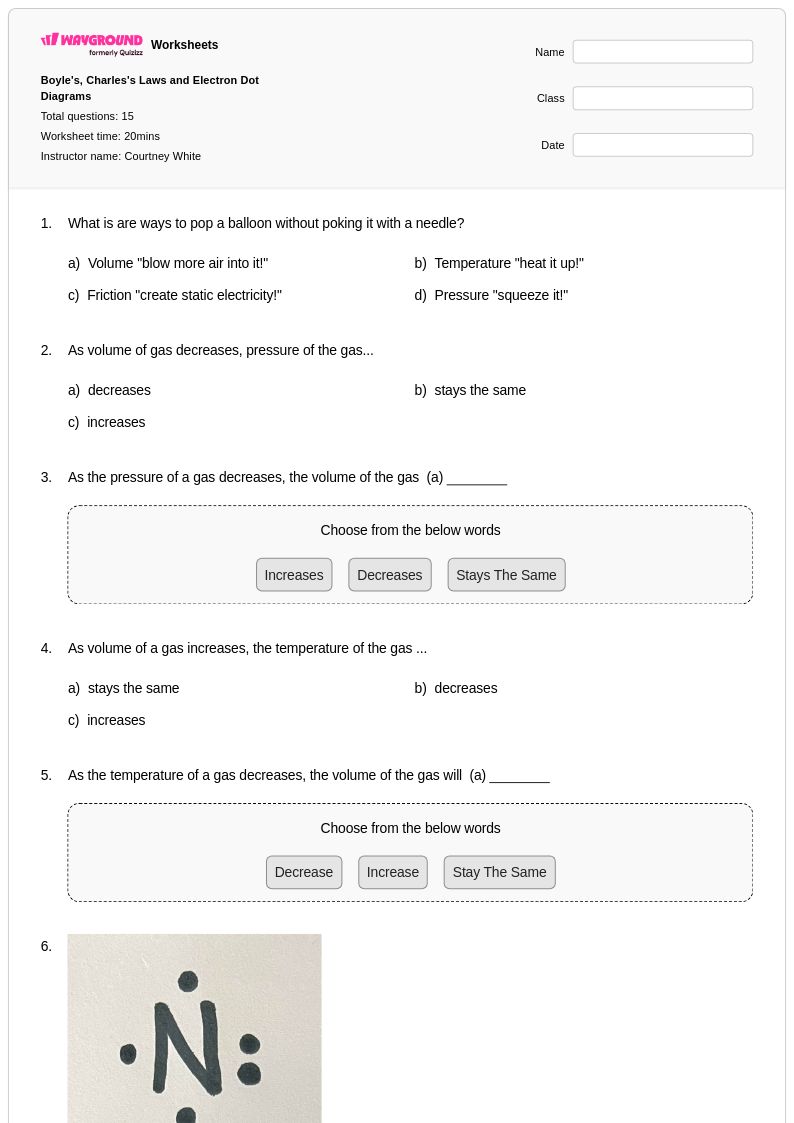
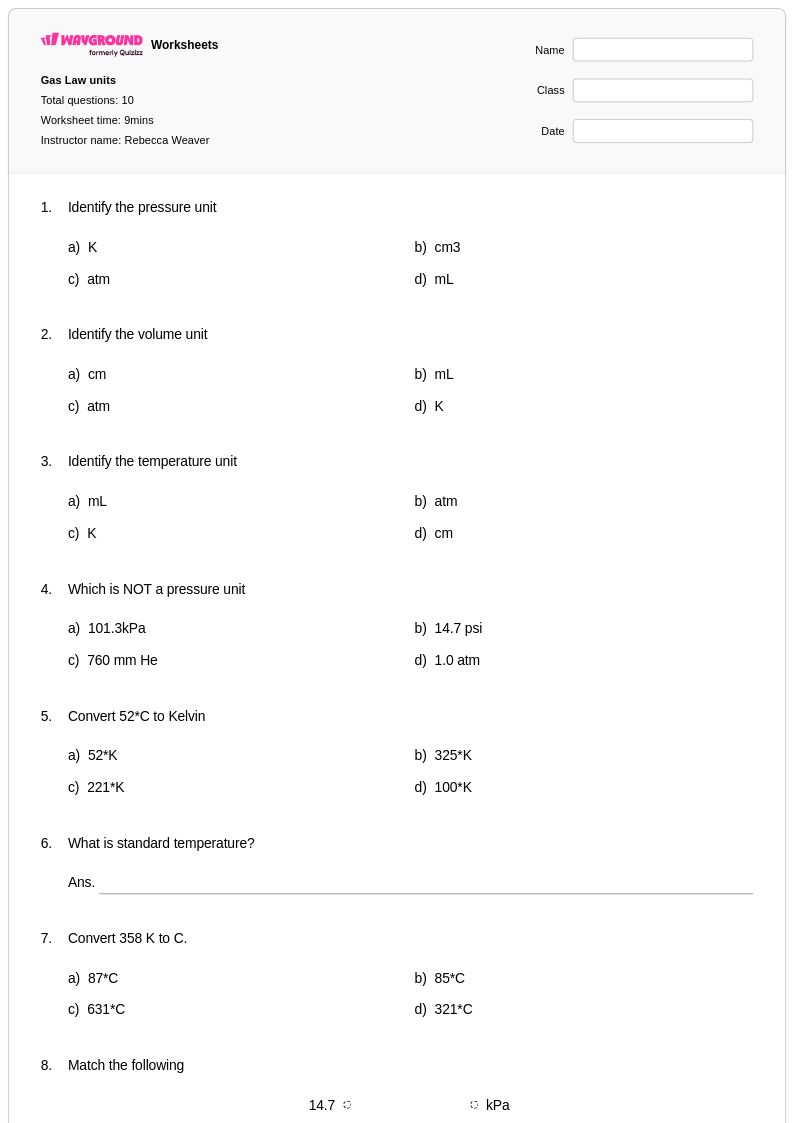
Ideal Gas Law worksheets for Class 9 students available through Wayground (formerly Quizizz) provide comprehensive practice with one of chemistry's most fundamental relationships between pressure, volume, temperature, and moles of gas. These carefully designed worksheets strengthen students' abilities to apply the PV=nRT equation in various problem-solving scenarios, from calculating unknown variables in closed gas systems to predicting gas behavior under changing conditions. The practice problems progress systematically from basic substitution exercises to more complex multi-step calculations that mirror real-world applications, while accompanying answer keys enable immediate feedback and self-assessment. Students work through printables that reinforce unit conversions, dimensional analysis, and the critical thinking skills needed to determine which gas law principles apply to specific situations, building the mathematical confidence essential for advanced chemistry coursework.
Wayground (formerly Quizizz) empowers teachers with millions of educator-created Ideal Gas Law resources that streamline lesson planning and accommodate diverse learning needs in Class 9 chemistry classrooms. The platform's robust search and filtering capabilities allow instructors to quickly locate worksheets aligned with state and national science standards, while built-in differentiation tools enable seamless modification of problem complexity and mathematical rigor. Teachers can customize existing materials or create original assessments that target specific misconceptions about gas behavior, kinetic molecular theory, or mathematical relationships between variables. Available in both printable pdf format for traditional classroom use and digital formats for technology-integrated instruction, these resources support targeted remediation for struggling students, enrichment opportunities for advanced learners, and consistent skill practice that reinforces conceptual understanding of how gases respond to environmental changes.
FAQs
How do I teach the ideal gas law to chemistry students?
Start by building conceptual understanding of how pressure, volume, temperature, and moles of gas relate to one another before introducing the equation PV=nRT. Use real-world examples such as inflating a tire or a sealed syringe to ground the abstraction in observable phenomena. From there, move students through increasingly complex calculations, beginning with single-variable problems where three of the four variables are known, then progressing to multi-step unit conversion problems. Connecting each variable to a physical meaning before drilling the algebra significantly reduces confusion and procedural errors.
What types of practice problems help students master PV=nRT calculations?
Effective practice should progress in three stages: single-variable solve problems where students isolate one unknown, unit conversion problems where quantities are given in non-standard units requiring conversion before substitution, and multi-step real-world application problems involving gas stoichiometry or changing conditions. Students benefit from working problems both forward (solving for an unknown) and backward (checking whether a given answer is physically reasonable). Structured worksheets that sequence these problem types explicitly help students build fluency with the equation rather than relying on pattern-matching.
What mistakes do students commonly make when using the ideal gas law?
The most frequent error is failing to convert temperature to Kelvin before substituting into PV=nRT, which produces wildly incorrect answers and is difficult for students to self-diagnose. A second common mistake is using inconsistent units for pressure and volume relative to the value of R being used, since R has different numerical values depending on the unit system. Students also frequently misidentify which variable is being held constant, especially when transitioning from combined gas law problems to ideal gas law problems. Targeted practice problems that isolate each of these pitfalls, with answer keys that show full unit analysis, help students catch and correct these patterns independently.
How do I use Ideal Gas Law worksheets from Wayground in my classroom?
Wayground's Ideal Gas Law worksheets are available as printable PDFs for traditional classroom use and in digital formats for technology-integrated environments, including the option to host them as a quiz directly on Wayground. The printable format makes them easy to distribute for in-class practice, homework, or test review without requiring any technology setup. The digital format supports self-paced practice and allows teachers to use Wayground's built-in accommodation tools, such as read aloud, extended time, and reduced answer choices, for students who need differentiated support. Both formats include complete answer keys so students can self-assess and teachers can use the materials for formative assessment.
How can I differentiate Ideal Gas Law instruction for students at different skill levels?
For students who are still building foundational skills, begin with problems that hold two variables constant and require solving for only one unknown with straightforward units. Advanced students can be challenged with multi-step stoichiometry problems, non-standard unit conversions, or real-world application scenarios involving gas mixtures. On Wayground, teachers can apply individual student accommodations such as extended time, read aloud for problem statements, or reduced answer choices to lower cognitive load for struggling learners, while the remaining class works through the standard problem set without interruption. These settings can be saved and reused across future sessions, making differentiation sustainable rather than a one-time setup.
How do I help students distinguish between the ideal gas law and the combined gas law?
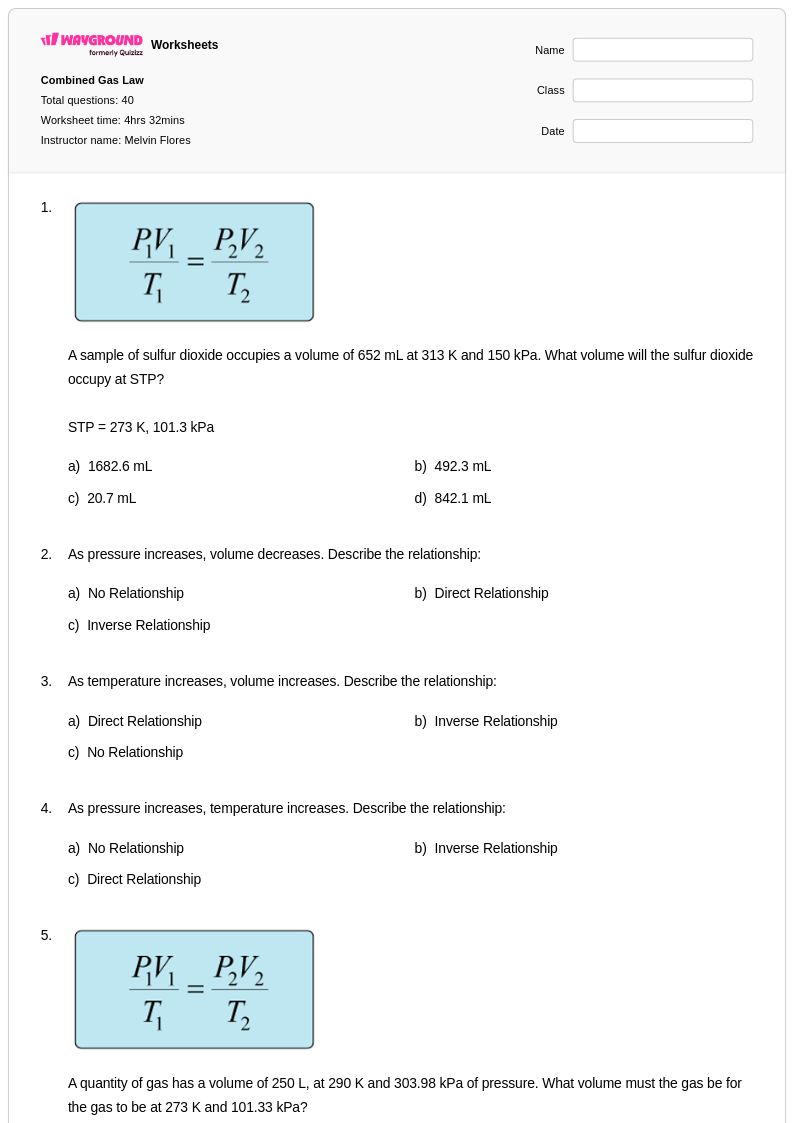
The combined gas law relates two states of the same gas sample by comparing initial and final conditions, making it useful when the amount of gas is constant and conditions change. The ideal gas law, PV=nRT, is used when the absolute values of all four variables are known or when moles of gas are explicitly part of the problem. A clear teaching strategy is to present students with a decision-making checklist: if the problem gives or asks for moles of gas, use PV=nRT; if it describes a gas changing from one set of conditions to another without specifying moles, use the combined gas law. Practice problems that deliberately mix both types force students to make this distinction actively rather than defaulting to one equation for all problems.