Free Printable Map Projections Worksheets for Class 10
Free Class 10 map projections worksheets and printables help students master different cartographic techniques, coordinate systems, and spatial distortions through engaging practice problems with comprehensive answer keys.
Explore printable Map Projections worksheets for Class 10
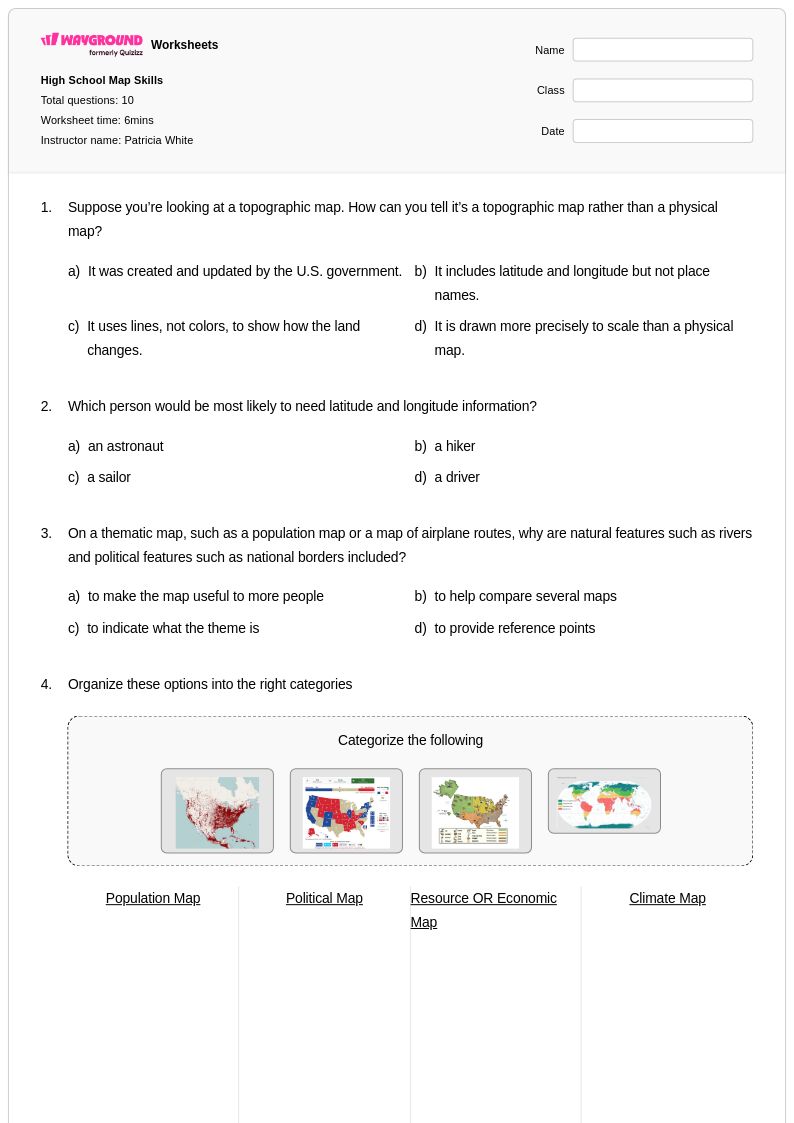
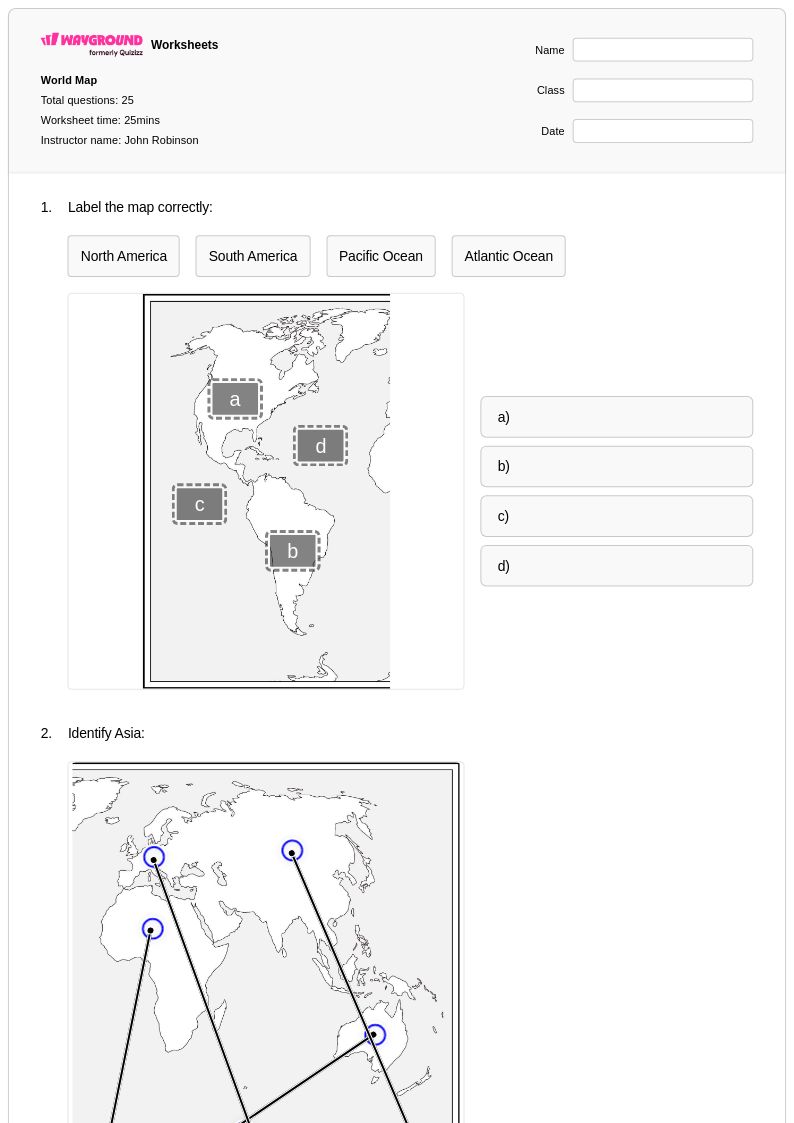
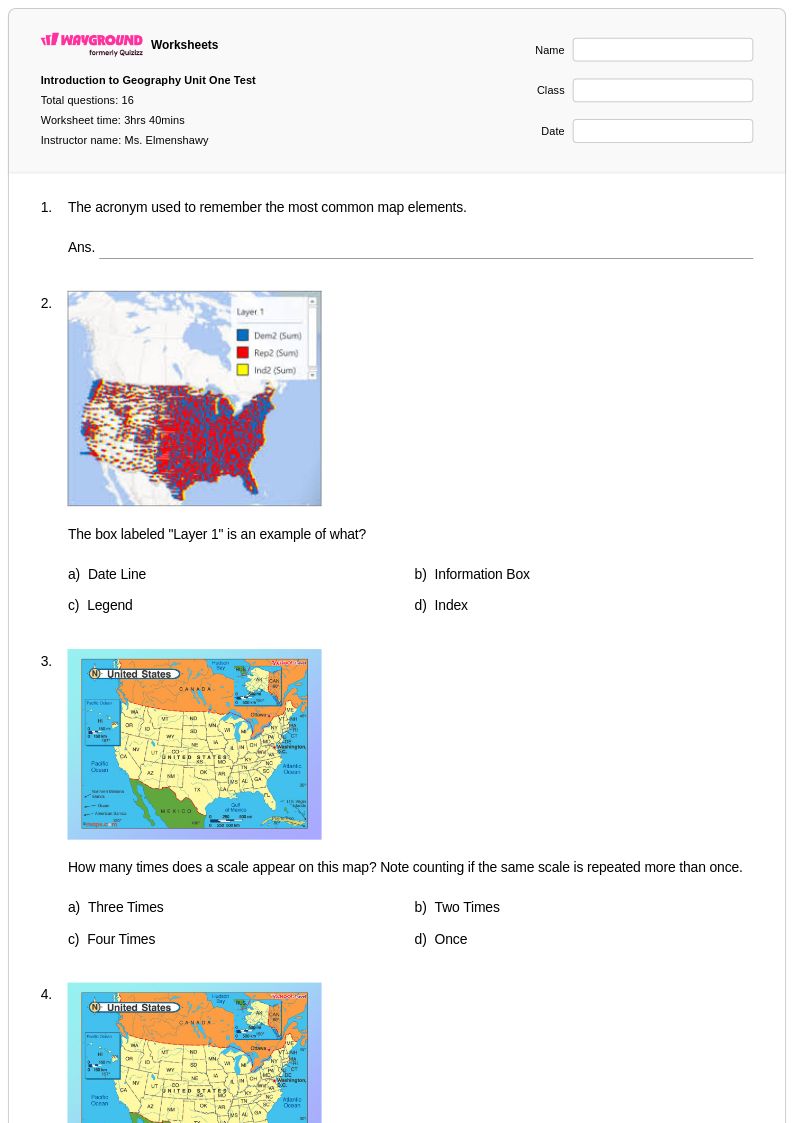
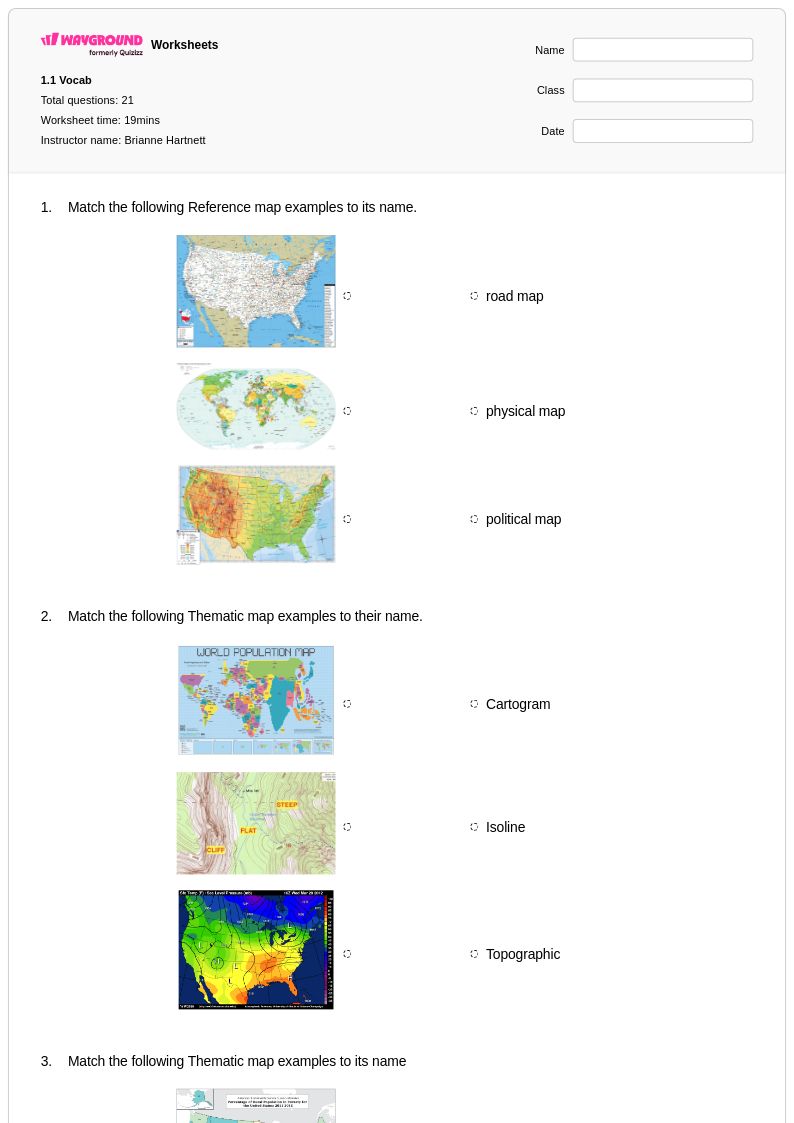
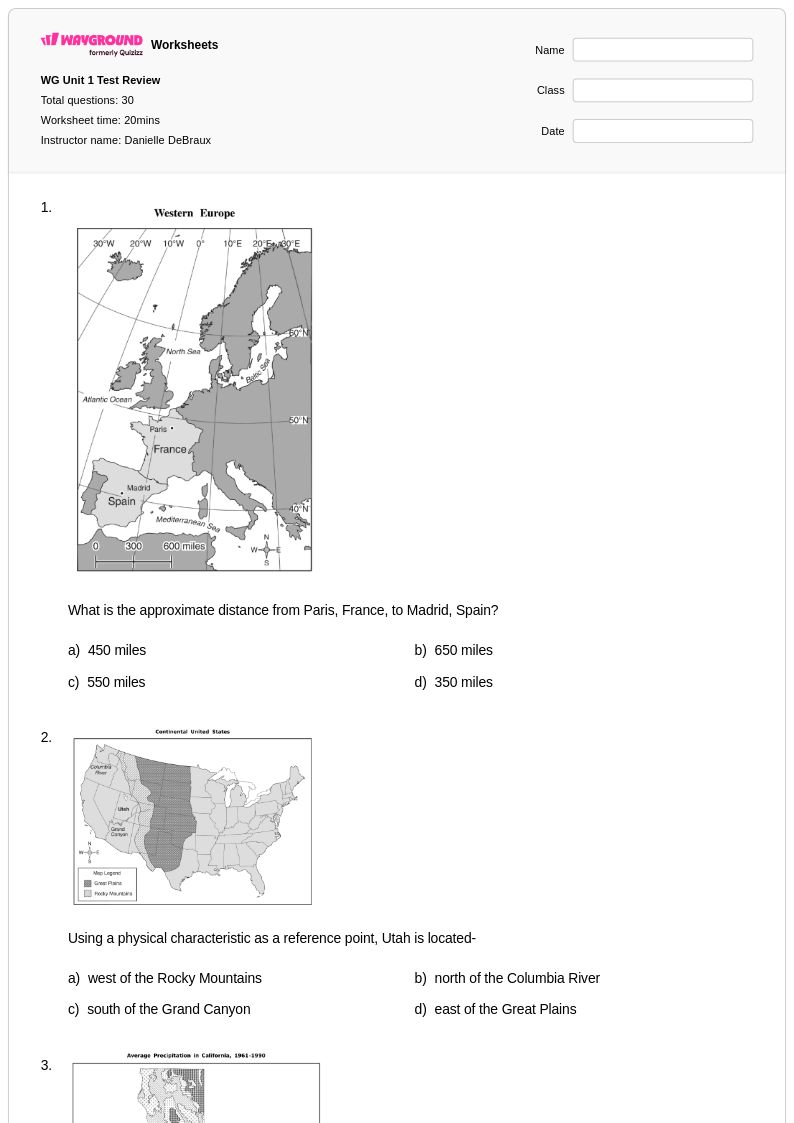
Map projections worksheets for Class 10 students available through Wayground (formerly Quizizz) provide comprehensive practice in understanding how three-dimensional Earth is represented on two-dimensional maps. These educational resources strengthen critical geographic skills by helping students analyze different projection methods, including cylindrical, conic, and azimuthal projections, while exploring the inherent distortions each creates in terms of area, shape, distance, and direction. The worksheets include practice problems that challenge students to identify specific projection types, compare their advantages and disadvantages, and evaluate which projections work best for different geographic purposes. Each worksheet comes with a complete answer key and is available as a free printable pdf, making it easy for educators to integrate these materials into their geography curriculum while supporting student mastery of this fundamental cartographic concept.
Wayground (formerly Quizizz) supports geography teachers with an extensive collection of map projections worksheets drawn from millions of teacher-created resources that can be easily searched and filtered by specific learning objectives and standards alignment. The platform's differentiation tools allow educators to customize these materials for varying skill levels within Class 10 classrooms, while the flexible format options provide both printable pdf versions for traditional classroom use and digital formats for interactive learning experiences. Teachers can utilize these comprehensive worksheet collections for initial skill-building lessons, targeted remediation for students struggling with projection concepts, enrichment activities for advanced learners, and ongoing practice to reinforce understanding of how cartographers balance the competing demands of accuracy and usability when creating maps for different purposes.
FAQs
How do I teach map projections to students?
Start by helping students visualize the core problem: a sphere cannot be flattened without distortion, so every map projection involves a trade-off. Introduce two or three projections side by side, such as Mercator, Robinson, and Peters, and ask students to compare how the same landmasses appear differently across each. Grounding the lesson in real-world use cases, like why navigators historically preferred the Mercator projection, helps students understand that projection choice is intentional, not arbitrary.
What are the most common misconceptions students have about map projections?
The most persistent misconception is that the Mercator projection accurately represents the relative size of countries and continents, when in fact it significantly exaggerates landmasses near the poles. Students often assume that all world maps are equally accurate and interchangeable, not realizing that every projection distorts at least one property: size, shape, distance, or direction. Explicitly comparing Greenland and Africa across multiple projections is one of the most effective ways to correct this misunderstanding.
What exercises help students practice comparing different map projections?
Effective practice tasks include side-by-side comparison activities where students analyze the same region across Mercator, Robinson, and Peters projections and identify what changes. Labeling exercises that ask students to mark where distortion is greatest, and short-answer prompts that require them to justify which projection is most appropriate for a given purpose, such as navigation versus thematic data display, build both analytical and applied skills.
How do map projection worksheets help students understand distortion?
Map projection worksheets provide structured opportunities for students to work through distortion concepts with guided practice problems, rather than relying on passive observation alone. Tasks that ask students to identify whether size, shape, distance, or direction is preserved or distorted in a given projection force them to engage with each property analytically. Regular exposure to these exercises builds the spatial reasoning skills that underpin geographic literacy.
How can I use map projections worksheets in my classroom?
Map projections worksheets on Wayground are available as printable PDFs for traditional classroom instruction and in digital formats for online or blended learning environments, and can also be hosted as a quiz directly on Wayground. Printable versions work well for guided note-taking, partner comparisons, or independent practice, while digital formats allow for quick whole-class review or self-paced work. Each worksheet includes a complete answer key, making them practical for both initial instruction and remediation.
How do I differentiate map projections instruction for students at different levels?
For students who need additional support, reduce the number of projections being compared at one time and focus first on the Mercator versus Robinson contrast before introducing additional types. Advanced students can be challenged to evaluate which projection is most appropriate for a specific real-world application and defend their reasoning in writing. On Wayground, teachers can apply accommodations such as read aloud, reduced answer choices, and extended time to individual students without affecting the rest of the class.