Free Printable Mole and Volume Worksheets for Class 12
Explore comprehensive Class 12 mole and volume chemistry worksheets from Wayground that help students master stoichiometric calculations through engaging practice problems, printable PDFs, and detailed answer keys.
Explore printable Mole and Volume worksheets for Class 12
Mole and volume concepts form the cornerstone of quantitative chemistry for Class 12 students, requiring mastery of gas laws, molar volume calculations, and stoichiometric relationships between gaseous reactants and products. Wayground's comprehensive collection of mole and volume worksheets provides structured practice problems that guide students through complex calculations involving Avogadro's law, ideal gas equations, and standard temperature and pressure conditions. These printable resources strengthen critical thinking skills as students learn to convert between moles, volume, and number of particles while applying theoretical concepts to real-world chemical scenarios. Each worksheet includes detailed answer keys that help students verify their understanding of molarity, gas density calculations, and the relationship between molecular quantities and measurable volumes, making these free educational materials invaluable for both independent study and classroom instruction.
Wayground's extensive platform, built from the foundation of Quizizz, empowers educators with millions of teacher-created mole and volume worksheets that can be easily searched, filtered, and customized to meet diverse classroom needs. The robust collection includes resources aligned with advanced chemistry standards, featuring differentiated materials that accommodate varying skill levels from basic molar volume problems to complex multi-step gas law applications. Teachers can seamlessly access both digital and printable pdf formats, enabling flexible implementation whether students are working in traditional classrooms or remote learning environments. These versatile tools support comprehensive lesson planning by providing targeted practice for skill reinforcement, remediation activities for struggling learners, and enrichment problems that challenge advanced students to apply mole and volume relationships in sophisticated chemical contexts.
FAQs
How do I teach mole and volume relationships in chemistry?
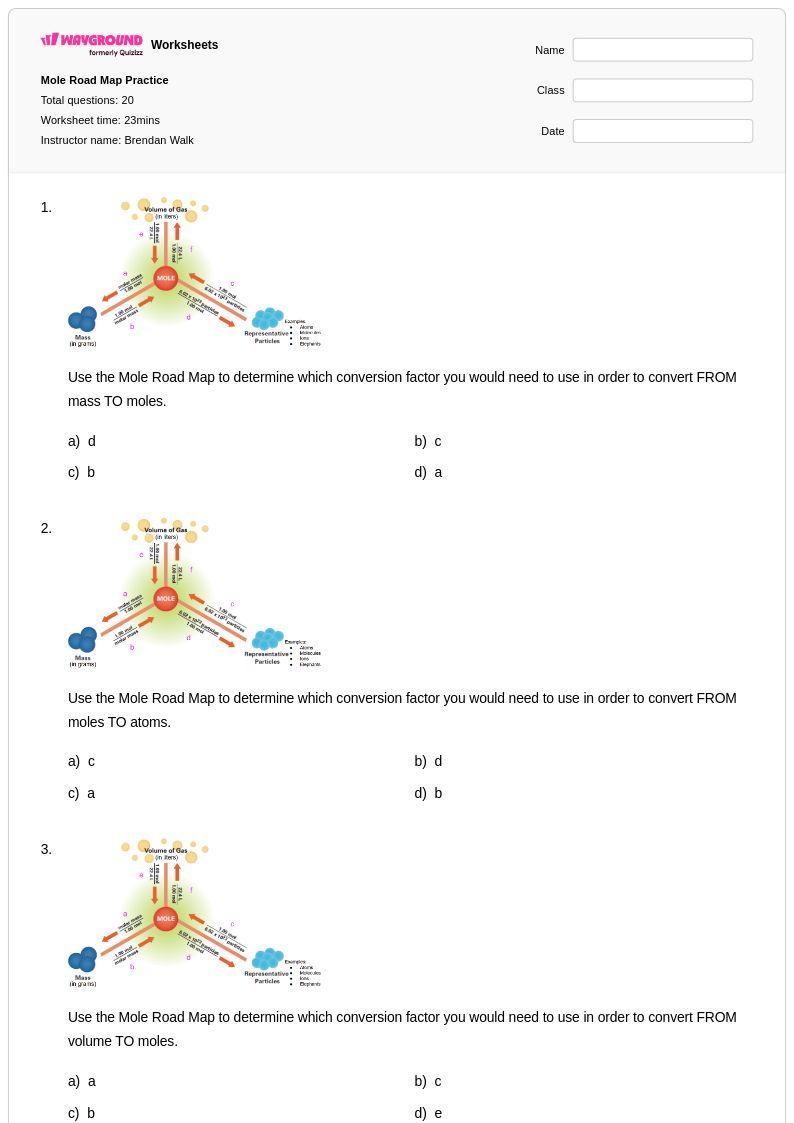
Start by grounding students in Avogadro's law — that one mole of any ideal gas occupies 22.4 liters at standard temperature and pressure (STP). From there, build to molar volume calculations before introducing stoichiometry problems involving gaseous reactants and products. Using layered examples that increase in complexity helps students internalize the relationship between moles, volume, and the conditions under which gases behave predictably.
What exercises help students practice mole and volume calculations?
Effective practice involves three core exercise types: converting between moles and liters at STP using the 22.4 L/mol factor, applying Avogadro's law to compare gas volumes at fixed temperature and pressure, and solving stoichiometry problems where one or more substances in a chemical equation is a gas. Progressive problem sets that begin with single-step conversions and advance to multi-step stoichiometry build procedural fluency systematically.
What mistakes do students commonly make with mole and volume problems?
The most frequent error is applying the 22.4 L/mol molar volume constant to conditions other than STP, particularly when temperature or pressure differs from standard values. Students also commonly confuse the number of moles with volume in liters, especially when working through multi-step stoichiometry problems. A third common mistake is failing to balance the chemical equation before using mole ratios to determine gas volumes for products or reactants.
How do I differentiate mole and volume instruction for students at different proficiency levels?
For struggling students, isolate the molar volume conversion step before introducing stoichiometry so they can build one skill at a time. On Wayground, teachers can apply accommodations such as reduced answer choices to lower cognitive load for individual students, or enable Read Aloud so that problem text is read to students who need support with reading-heavy word problems. These settings are saved per student and do not affect the experience of other students in the same session.
How can I use mole and volume worksheets from Wayground in my classroom?
Wayground's mole and volume worksheets are available as printable PDFs for traditional classroom use and in digital formats for technology-integrated learning environments. Teachers can also host these worksheets as a quiz directly on Wayground, allowing for real-time student responses and automatic grading. Each worksheet includes a complete answer key, making it suitable for guided practice, independent work, or formative assessment.
How does Avogadro's law connect to mole and volume calculations?
Avogadro's law states that equal volumes of gases at the same temperature and pressure contain equal numbers of molecules, which means volume is directly proportional to the number of moles when conditions are held constant. This principle is the foundation for the molar volume constant of 22.4 L/mol at STP and directly informs stoichiometric calculations involving gaseous substances. Teaching students to explicitly cite this law when setting up problems reinforces conceptual understanding alongside procedural skill.