Free Printable Parts of Tooth Worksheets for Class 2
Class 2 biology worksheets help students learn about parts of teeth through engaging printables and practice problems, featuring free PDF resources with comprehensive answer keys for effective classroom learning.
Explore printable Parts of Tooth worksheets for Class 2
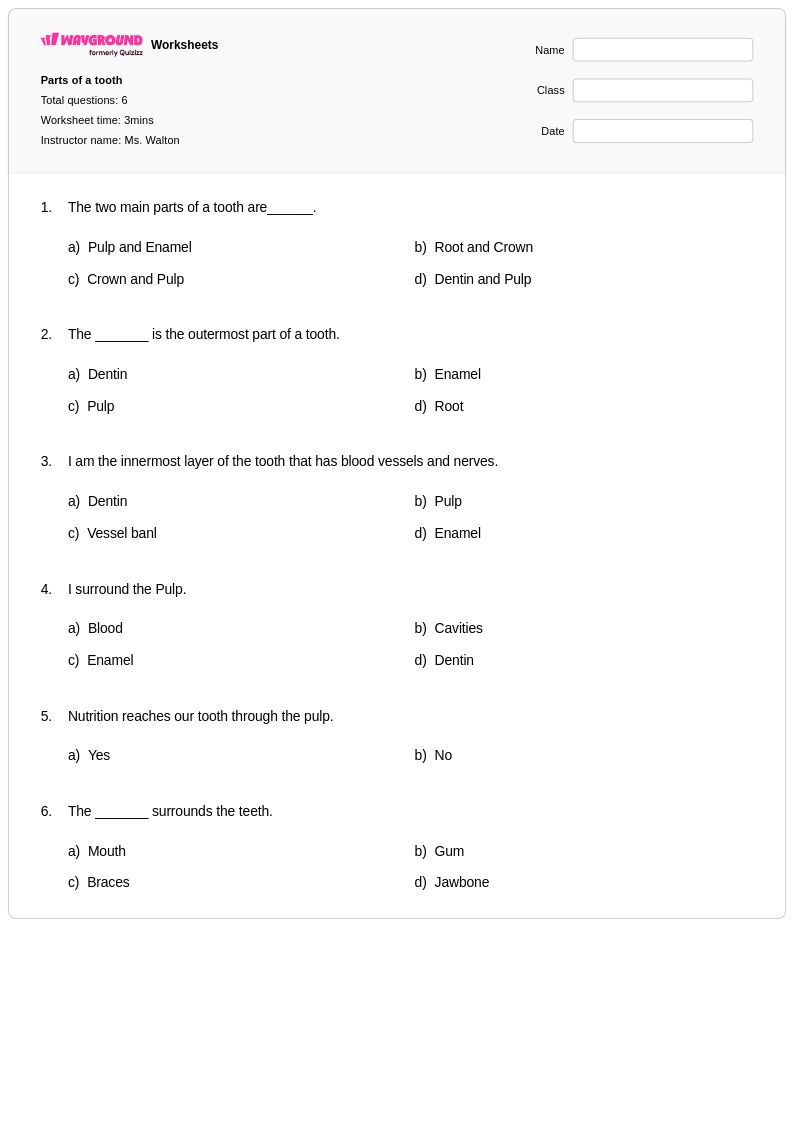
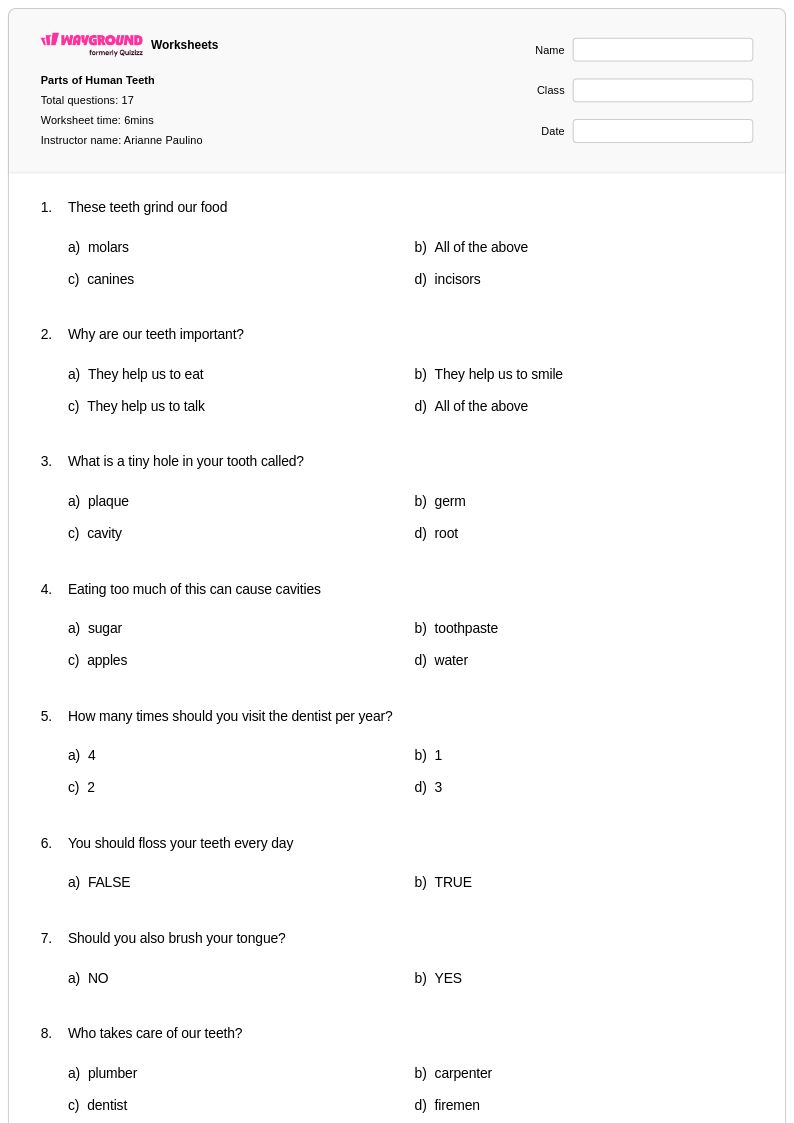
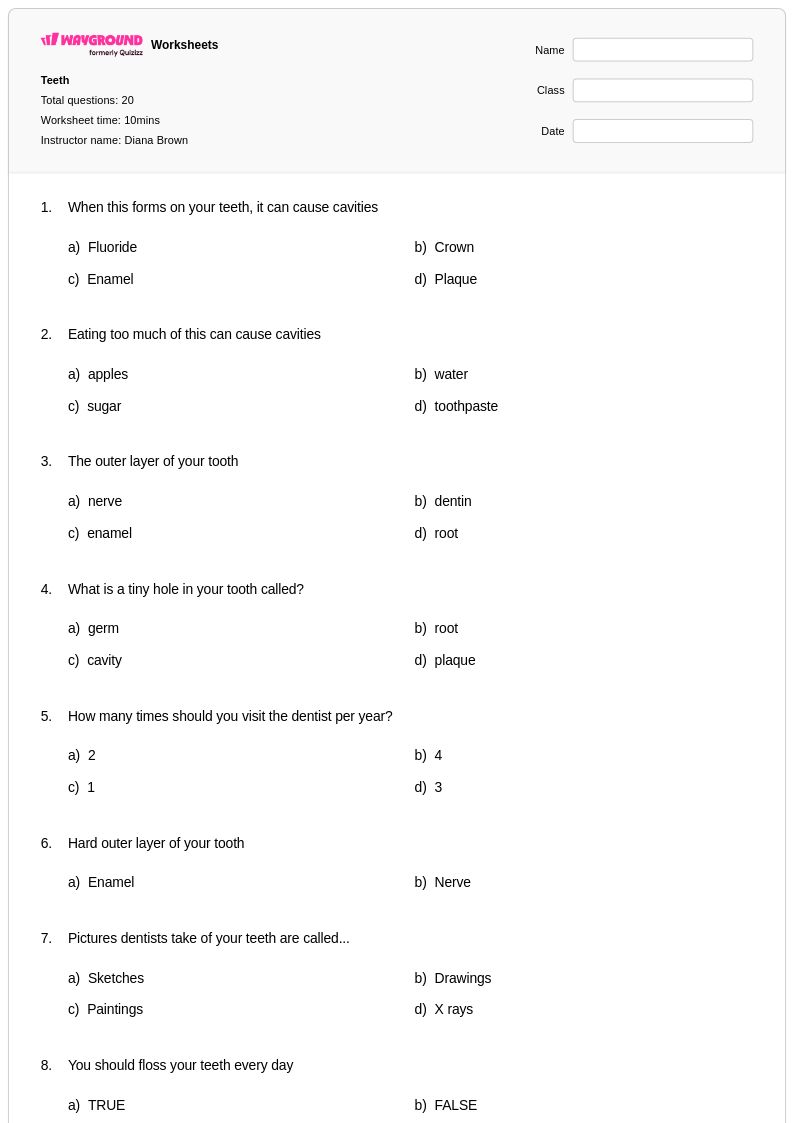
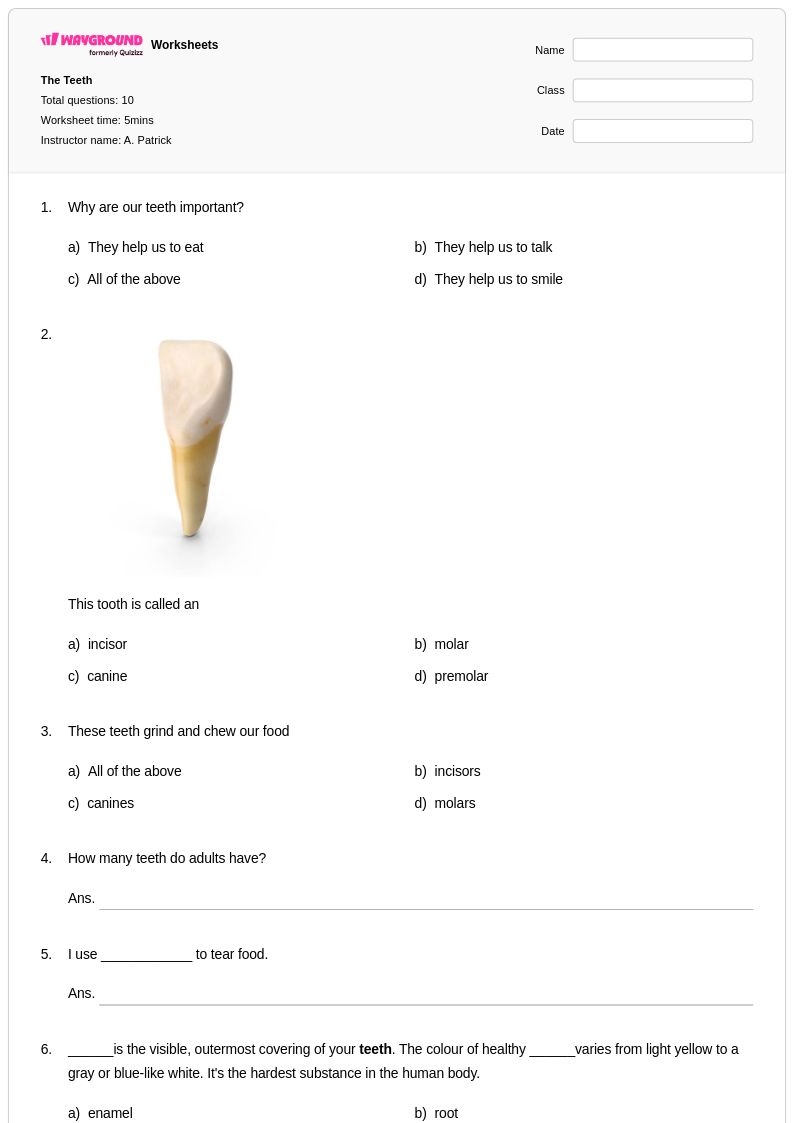
Parts of tooth worksheets for Class 2 students available through Wayground (formerly Quizizz) provide young learners with engaging activities to explore dental anatomy and understand the basic structure of human teeth. These educational resources focus on helping second-grade students identify and label the main components of a tooth, including the crown, root, enamel, and dentin, while building foundational knowledge about oral health and body systems. The worksheets strengthen essential skills such as scientific observation, vocabulary development, and anatomical awareness through age-appropriate diagrams, labeling exercises, and interactive practice problems. Teachers can access comprehensive materials that include detailed answer keys, making assessment and instruction more efficient, while students benefit from free printables designed specifically for their developmental level.
Wayground (formerly Quizizz) supports educators with an extensive collection of teacher-created resources covering parts of tooth instruction, drawing from millions of high-quality materials developed by experienced classroom professionals. The platform's robust search and filtering capabilities allow teachers to quickly locate worksheets that align with Class 2 science standards and match their specific instructional needs for dental anatomy lessons. These differentiation tools enable educators to customize content for diverse learning styles and academic levels, ensuring that both struggling students and advanced learners can engage meaningfully with tooth structure concepts. Available in both printable pdf formats and digital versions, these resources facilitate flexible lesson planning while supporting targeted skill practice, remediation activities, and enrichment opportunities that deepen students' understanding of human biology and promote lifelong awareness of dental health.
FAQs
How do I teach the parts of a tooth to students?
Start with a labeled cross-sectional diagram of a tooth, introducing each structure in order from the outermost layer inward: enamel, dentin, pulp, cementum, and periodontal ligament. Connecting each structure to its function — for example, explaining that enamel is the hardest substance in the human body because it serves as the primary protective layer — helps students retain the vocabulary. Pairing diagrams with real-world context, such as what happens when enamel erodes or the pulp becomes infected, gives abstract anatomy meaningful clinical relevance.
What exercises help students practice identifying parts of a tooth?
Labeling diagrams is the most effective practice format for dental anatomy because it requires students to recall and place specific structures rather than simply recognize them. Cross-sectional illustrations that students label independently, followed by self-checking against an answer key, reinforce both spelling and spatial understanding of where each structure sits within the tooth. Matching exercises that pair tooth components with their functions add a second layer of comprehension beyond simple identification.
What are common mistakes students make when learning tooth anatomy?
Students frequently confuse dentin and enamel, often assuming enamel is the thicker or more substantial layer when in fact dentin makes up the bulk of the tooth's structure. Another common error is conflating the pulp cavity with the root canal, not realizing the root canal is simply the portion of the pulp chamber that extends into the root. Students also tend to overlook the periodontal ligament entirely, not recognizing it as a distinct structural component that anchors the tooth to the jawbone.
How can I use parts of a tooth worksheets in my classroom?
Parts of tooth worksheets on Wayground are available as printable PDFs for traditional classroom use and in digital formats for technology-integrated learning environments, including the option to host them as a quiz directly on Wayground. Printable versions work well for independent practice, homework, or lab station rotations, while digital versions allow for interactive completion and instant feedback. Both formats include answer keys, making them efficient for formative assessment and self-directed review.
How do I differentiate tooth anatomy instruction for students with different learning needs?
For students who struggle with dense biological vocabulary, reducing the number of answer choices on labeling tasks lowers cognitive load without removing the core learning objective. Wayground's accommodation tools allow teachers to enable read-aloud support for individual students who benefit from hearing question text, and extended time can be configured per student for those who need additional processing time. These settings can be applied selectively so that other students in the class receive standard conditions without disruption.
At what grade level is tooth anatomy typically taught?
Dental anatomy is most commonly introduced in upper elementary and middle school science curricula, typically between grades 4 and 8, as part of broader units on human body systems or biology. However, the topic appears across grade levels depending on district standards — simplified versions focusing on basic tooth parts suit younger learners, while more detailed coverage of the periodontium and cellular structures fits secondary biology courses. Parts of tooth worksheets can be selected or adapted to match the depth of coverage required at any given level.