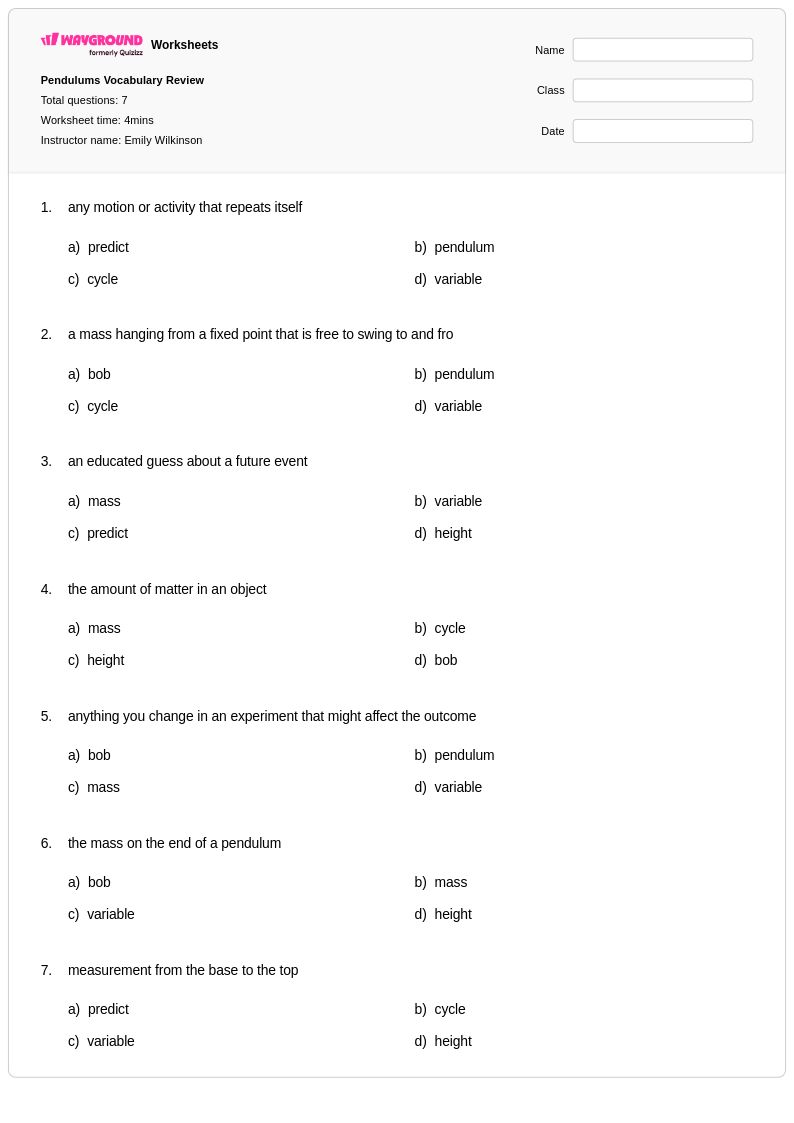
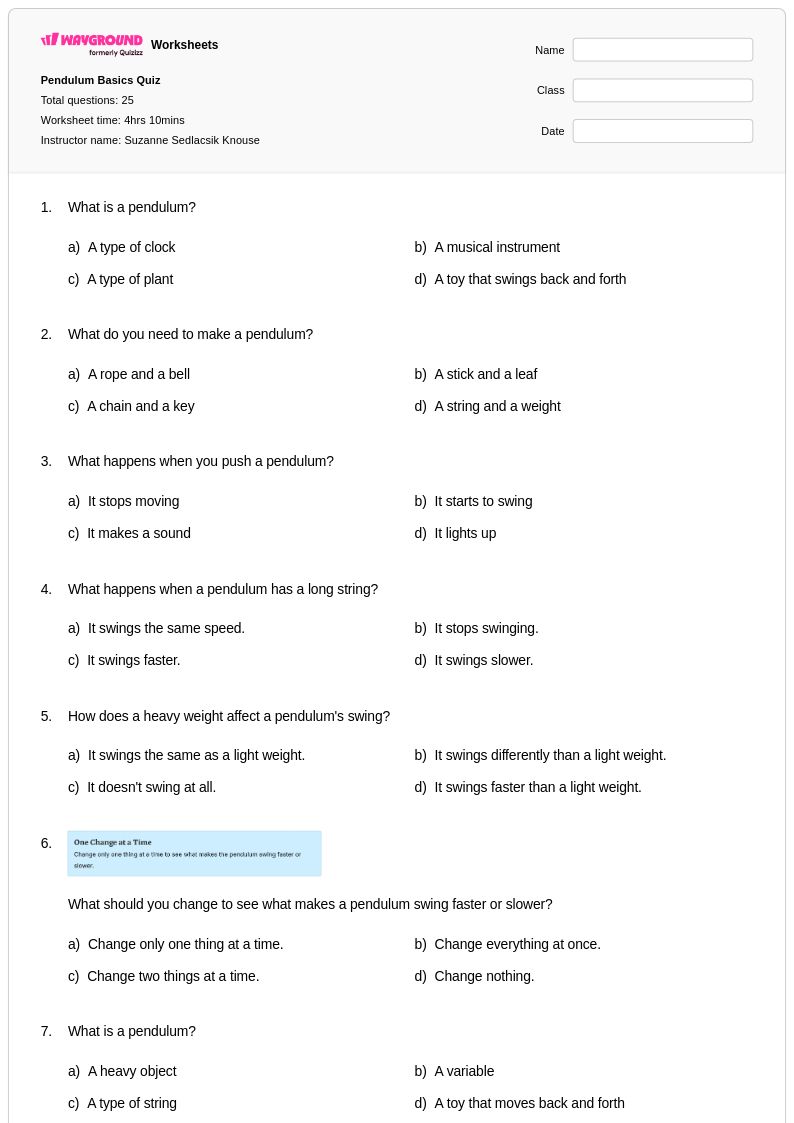
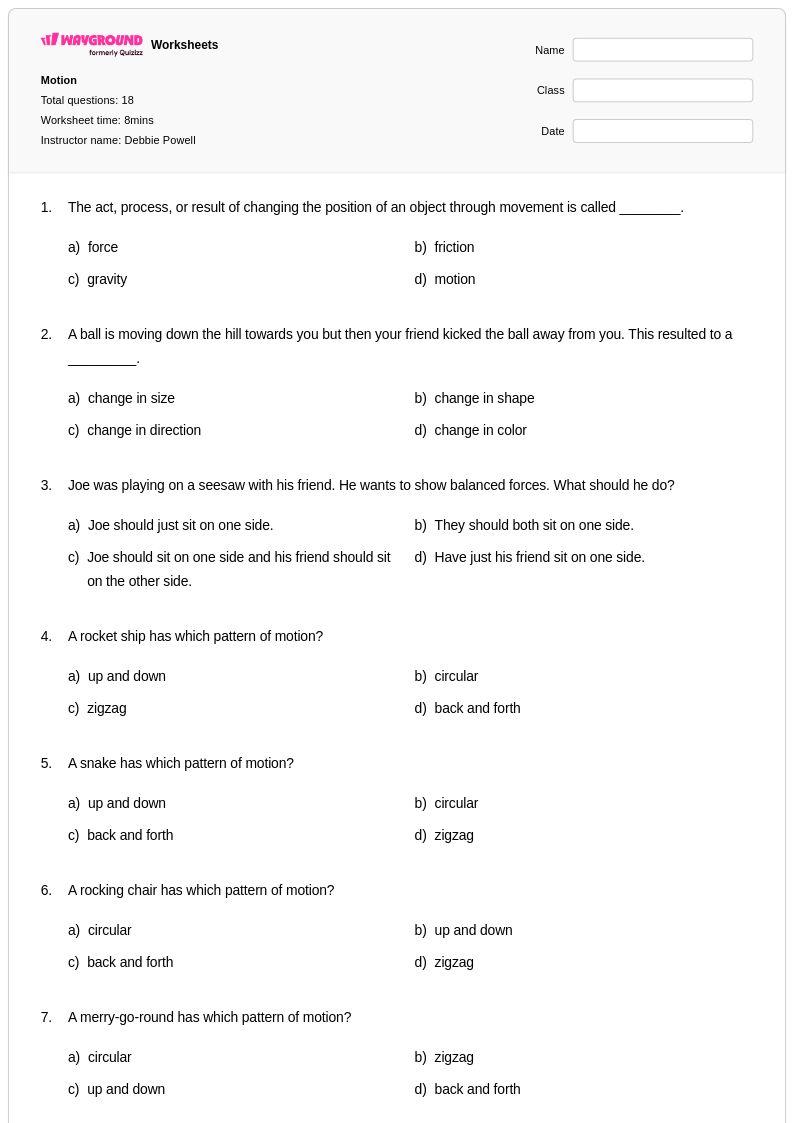
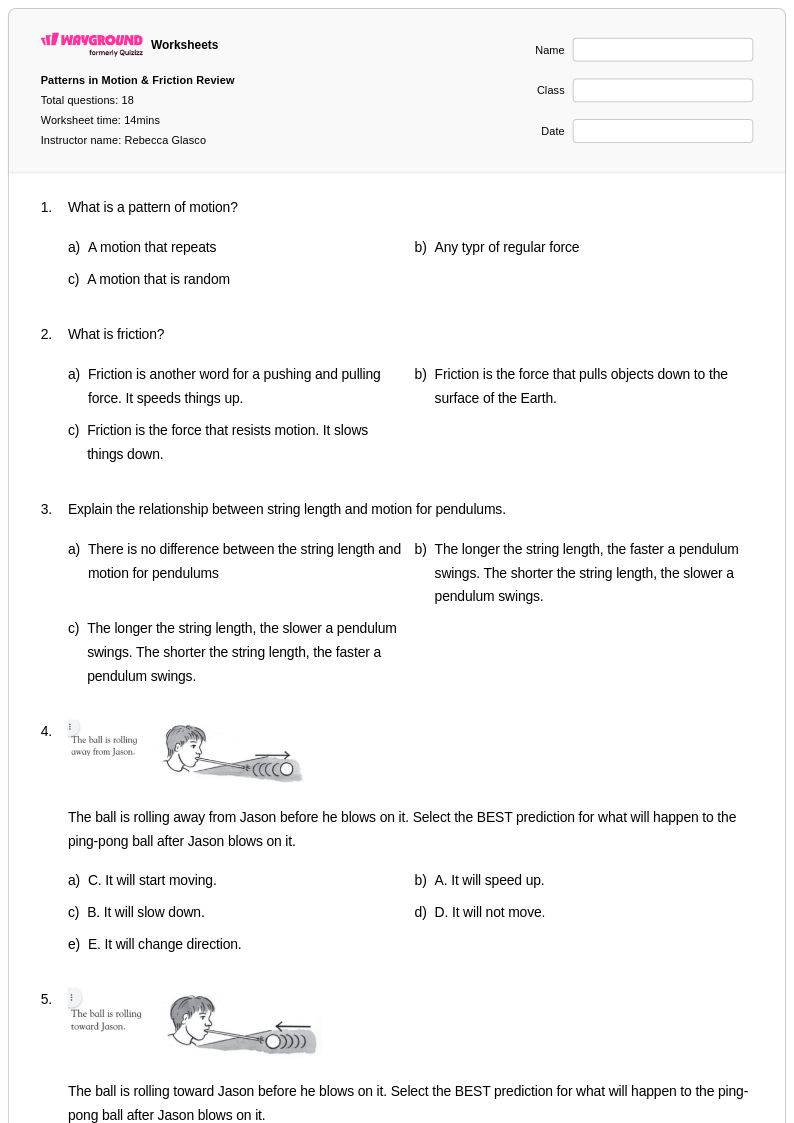
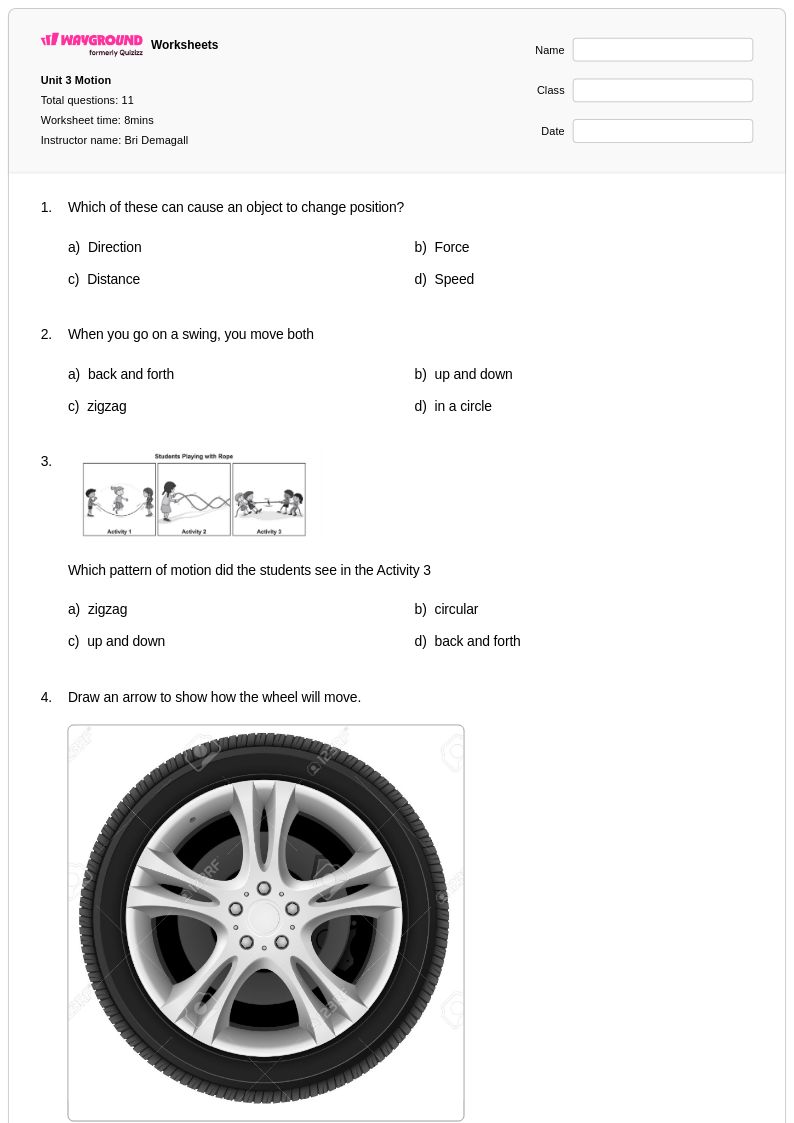
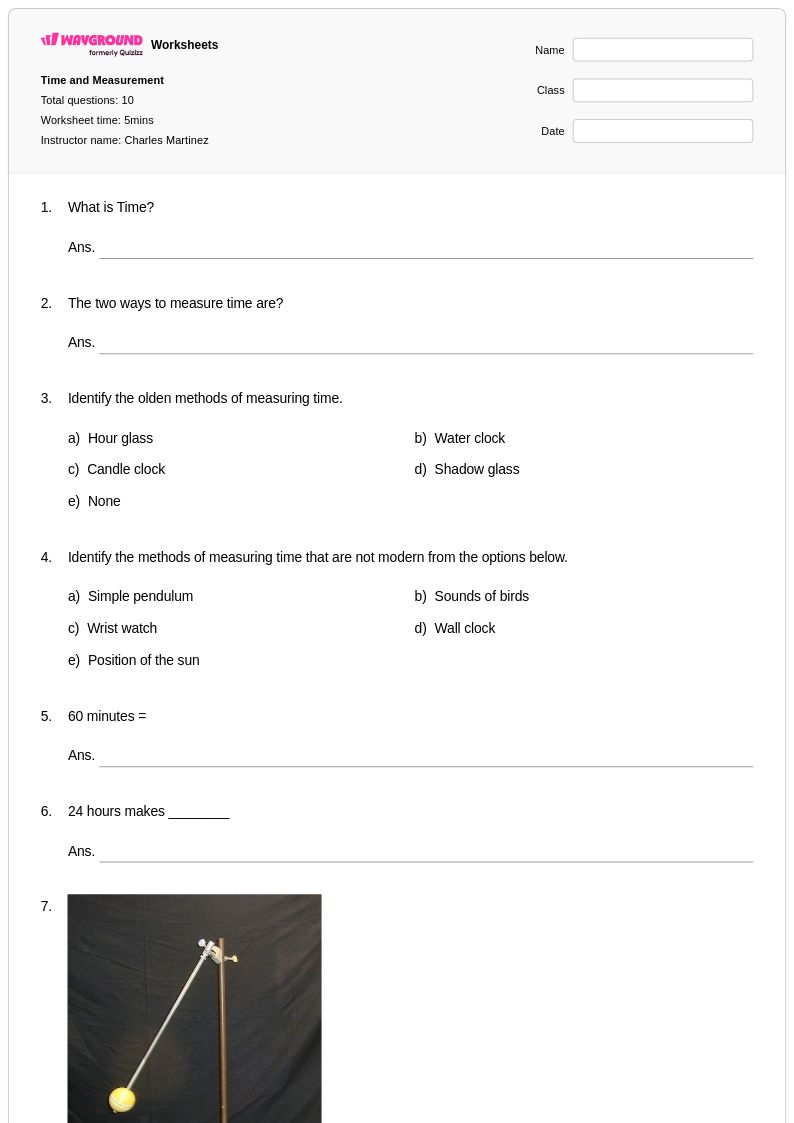
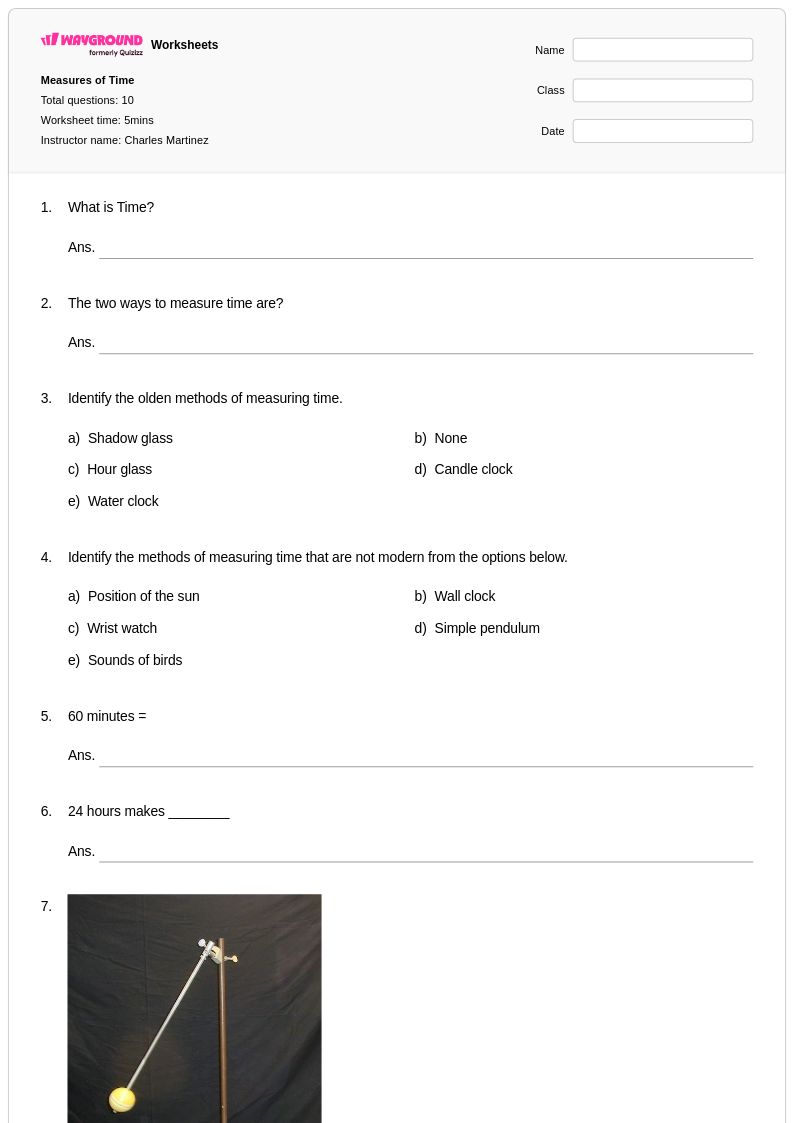
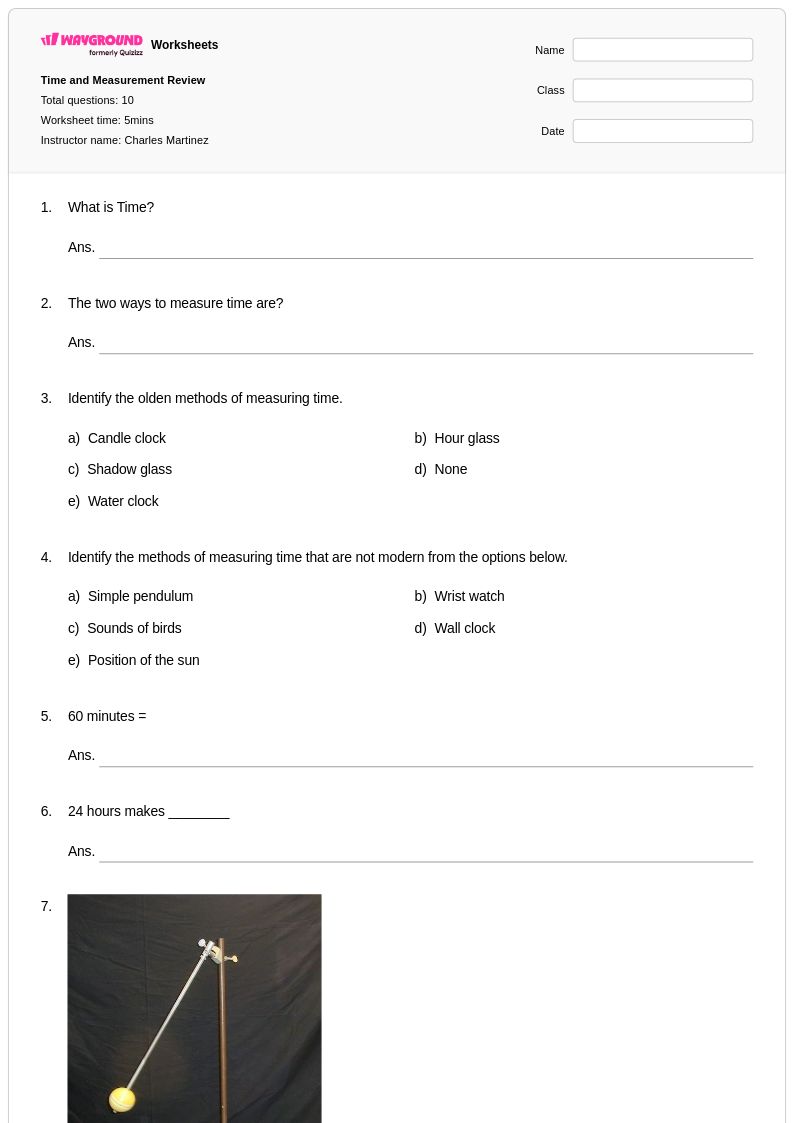
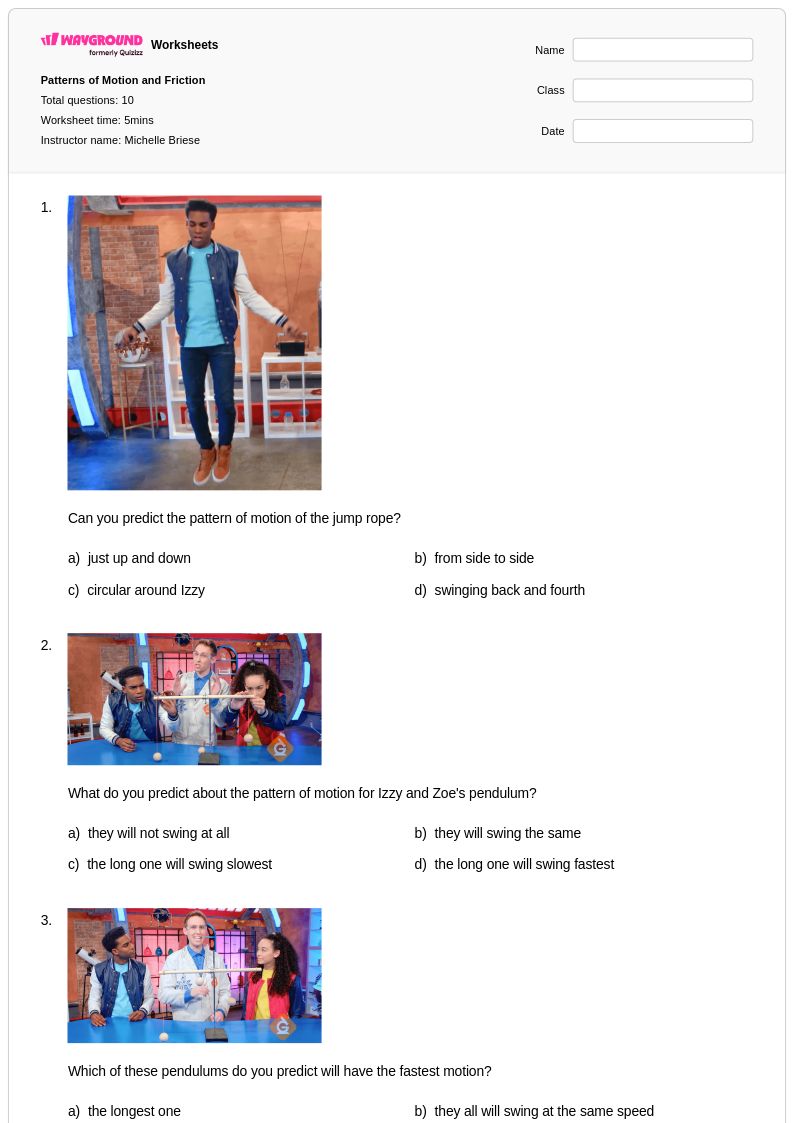
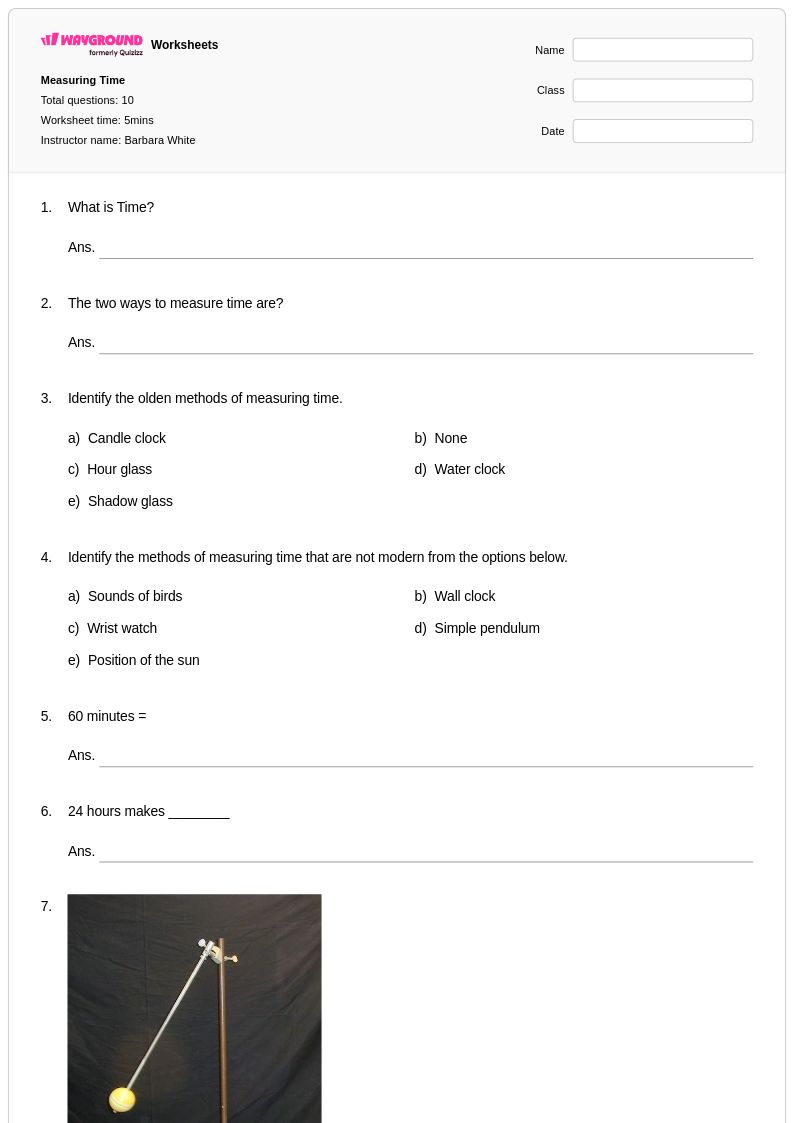
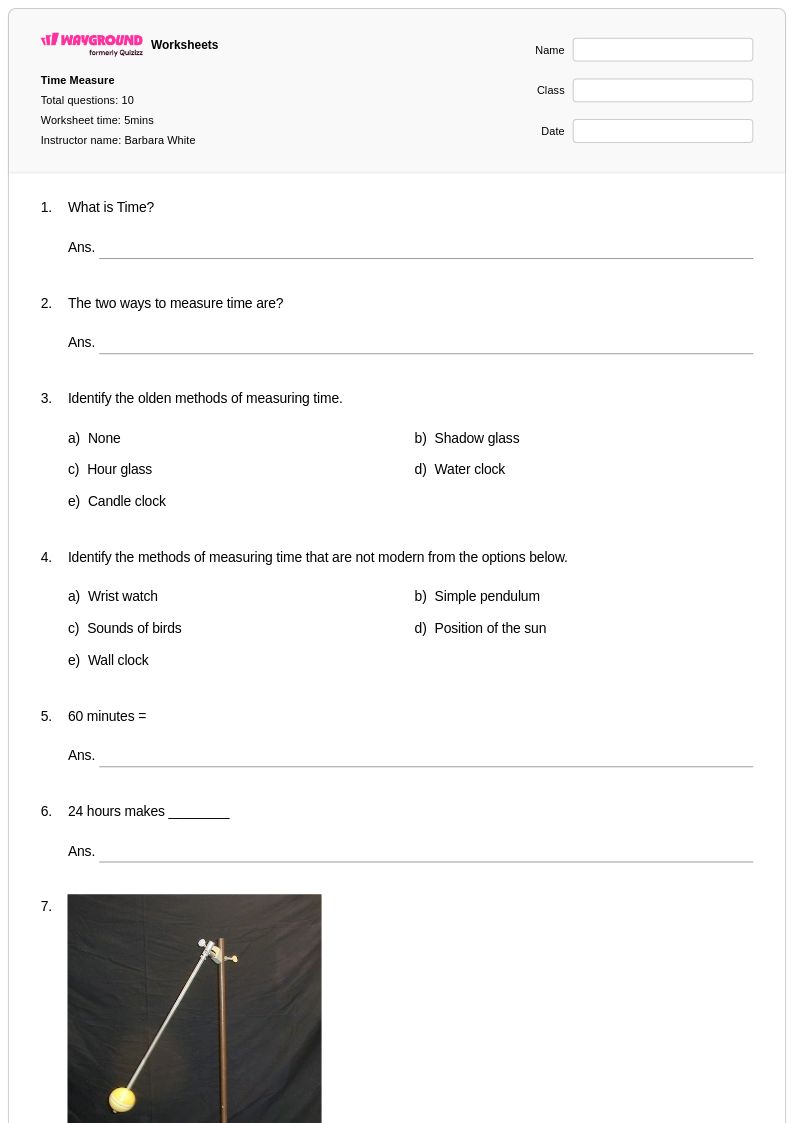
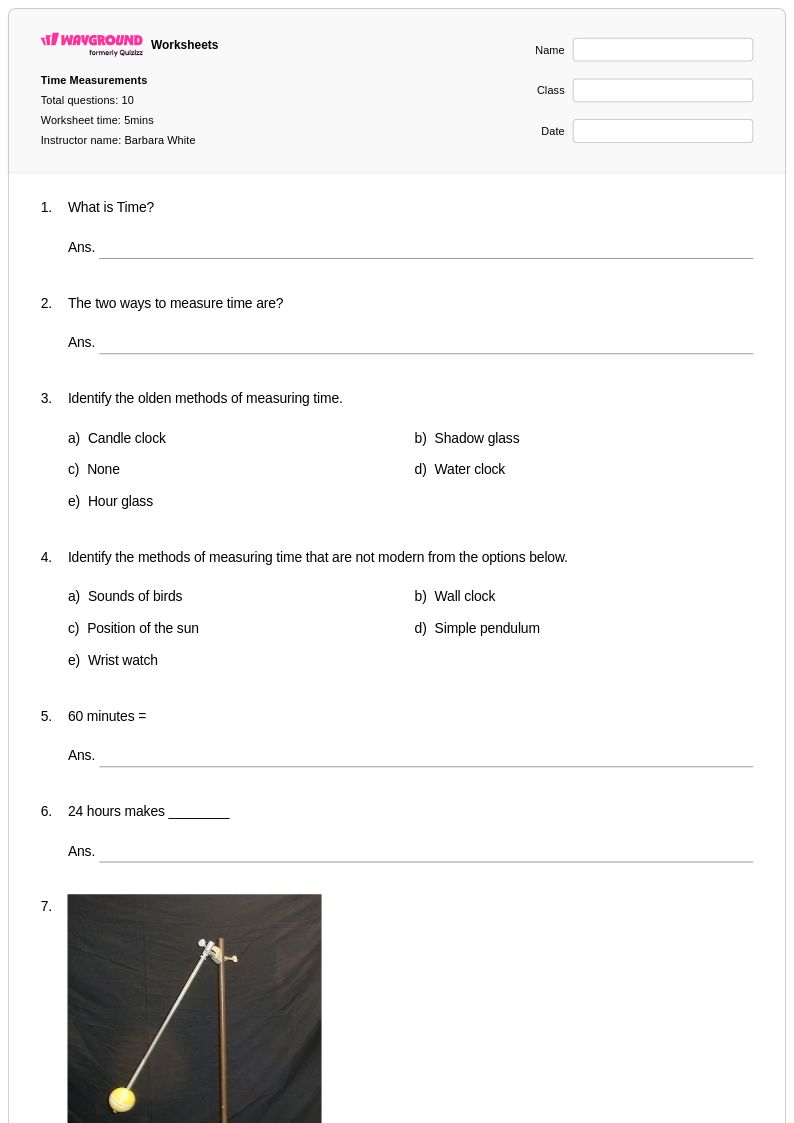
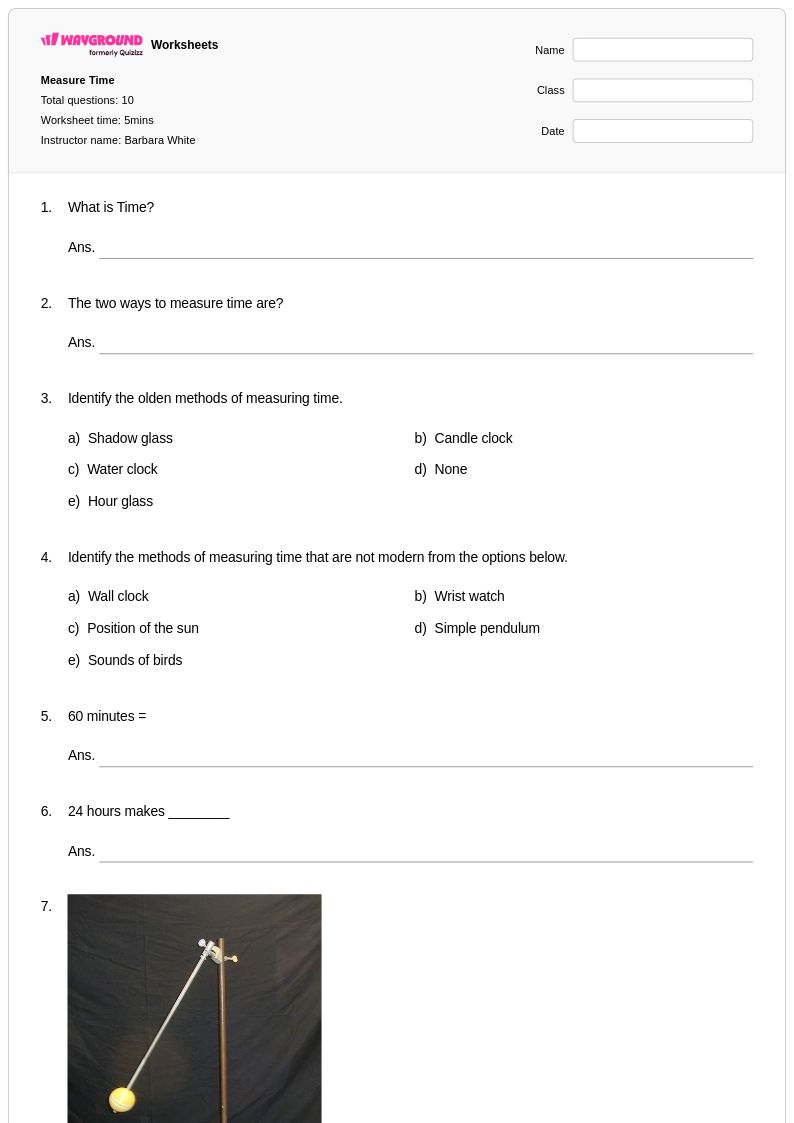
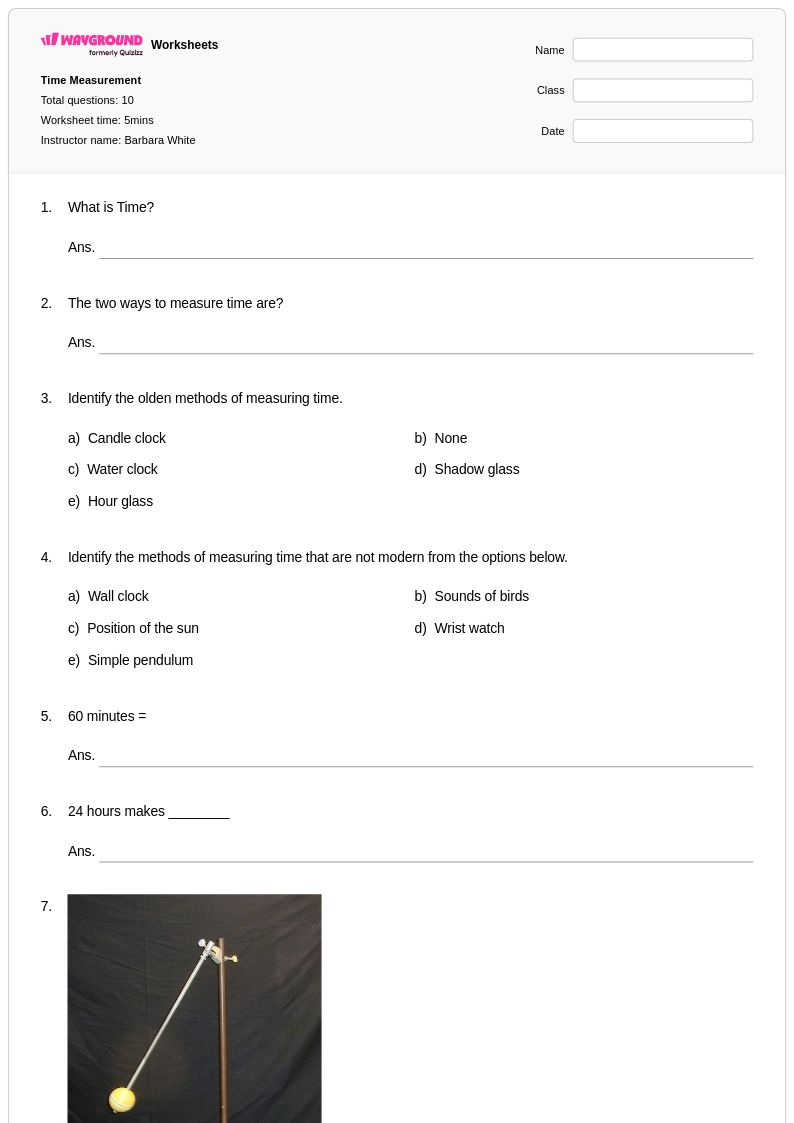
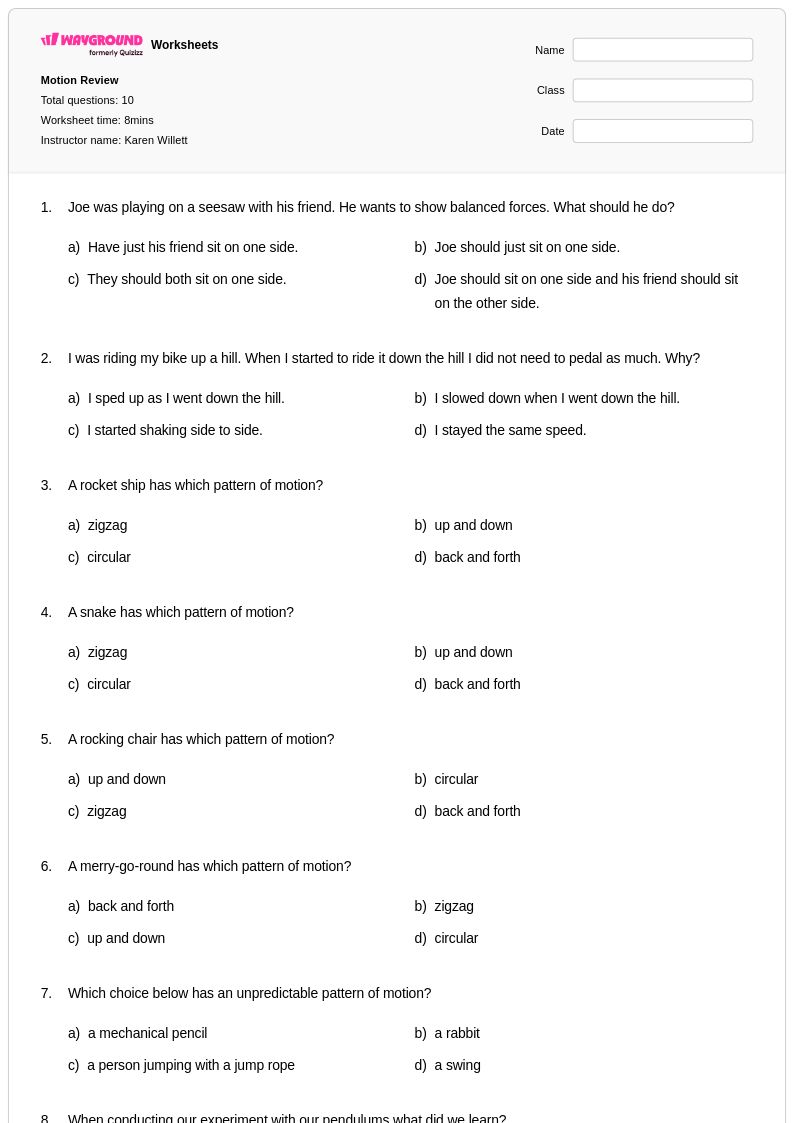
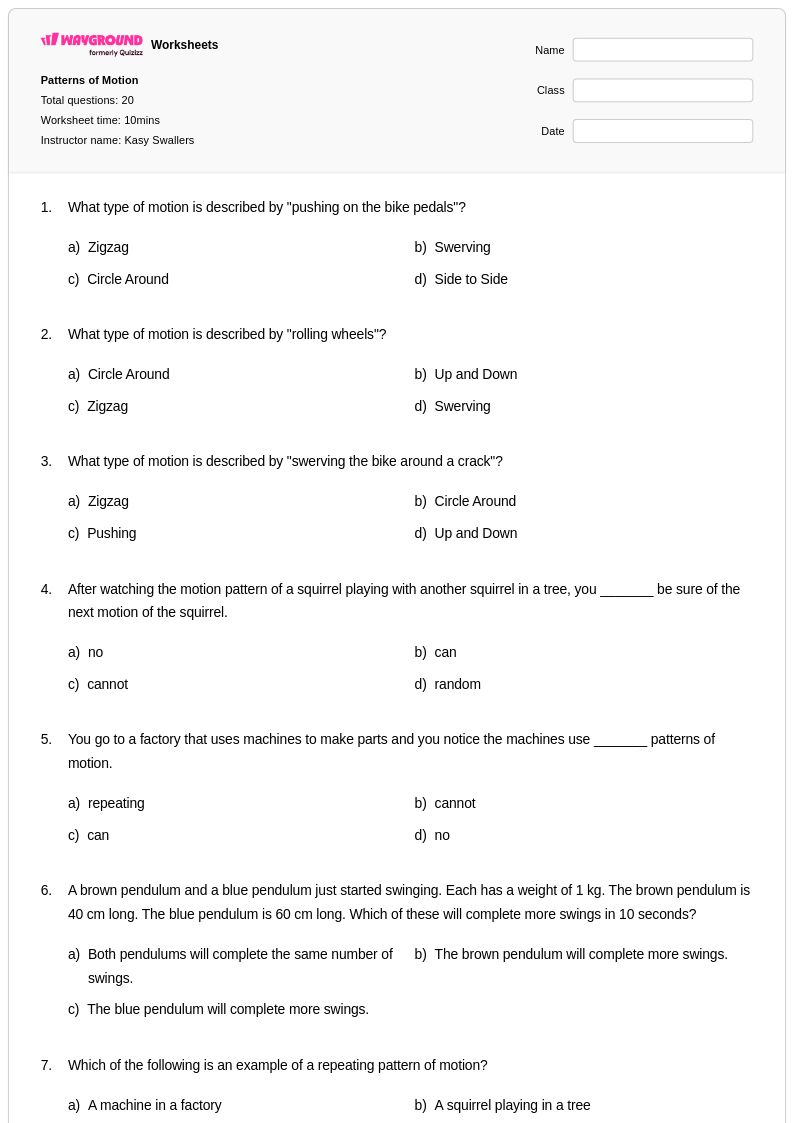
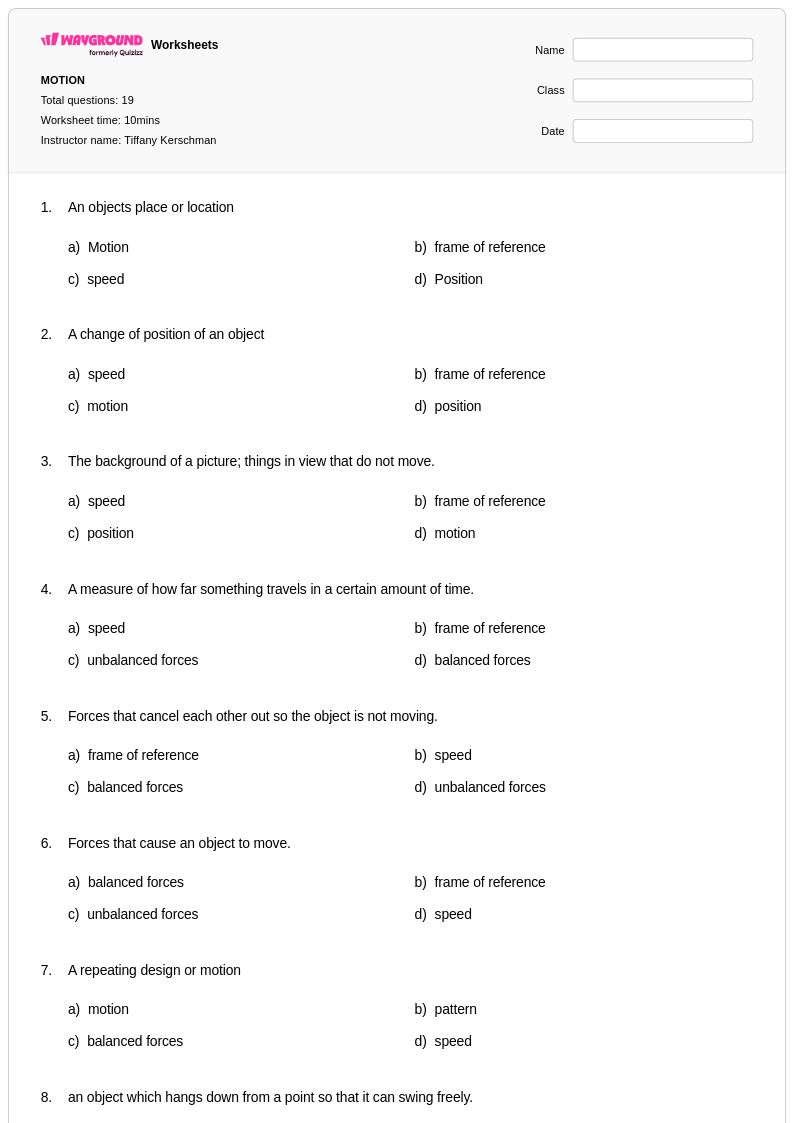
Explore our free Class 3 pendulum worksheets and printables that help young scientists understand motion, timing, and basic physics concepts through engaging practice problems with complete answer keys.
Class 3 pendulum worksheets available through Wayground (formerly Quizizz) introduce young learners to the fascinating world of simple machines and motion physics through age-appropriate activities and observations. These educational resources help third-grade students develop foundational scientific thinking skills by exploring how pendulums swing, investigating factors that affect pendulum motion, and making predictions about oscillating objects. The worksheets strengthen critical observation abilities, measurement skills, and hypothesis formation as students conduct hands-on experiments with everyday materials like string and small weights. Teachers can access comprehensive practice problems that guide students through systematic pendulum investigations, complete with answer keys that support accurate assessment and meaningful feedback. These free printables encourage scientific inquiry while building vocabulary related to motion, gravity, and simple machines.
Wayground (formerly Quizizz) empowers educators with millions of teacher-created pendulum resources specifically designed for Class 3 science instruction, featuring robust search and filtering capabilities that help identify materials aligned with state and national science standards. The platform's differentiation tools allow teachers to customize worksheets based on individual student needs, supporting both remediation for struggling learners and enrichment opportunities for advanced students ready to explore more complex pendulum concepts. These versatile resources are available in both printable pdf format for hands-on classroom activities and digital formats for interactive learning experiences, making lesson planning more efficient and flexible. Teachers can seamlessly integrate these pendulum worksheets into their physics curriculum to reinforce key concepts through repeated practice, enhance student understanding through varied problem types, and assess comprehension of fundamental motion principles that serve as building blocks for more advanced scientific learning.
FAQs
How do I teach pendulum motion to physics students?
Start by building conceptual understanding through a physical demonstration — suspend a weight from a string and vary the length, mass, and release angle one variable at a time so students can observe directly how each factor affects oscillation. Once students recognize that period depends on length and gravitational acceleration rather than mass or amplitude (for small angles), introduce the formula T = 2π√(L/g) with worked examples. Connecting pendulum motion to real-world applications like grandfather clocks and seismographs helps students see why mastering this concept matters beyond the formula.
What exercises help students practice pendulum period calculations?
Effective practice problems ask students to isolate and manipulate the variables in T = 2π√(L/g) — for example, calculating the period given a specific length, then working backward to find the length needed to produce a one-second period. Problems that require unit conversion, comparison of two pendulums with different lengths, or prediction of period on another planet (different g) build procedural fluency and conceptual depth. Pendulum worksheets on Wayground include diverse practice problems covering period and frequency relationships, energy conservation in swinging systems, and real-world applications in timekeeping devices and seismic instruments.
What mistakes do students commonly make when solving pendulum problems?
The most persistent misconception is that a heavier bob swings faster — students frequently assume mass affects period, when in fact the formula T = 2π√(L/g) contains no mass term at all. Students also confuse period and frequency, forgetting that they are reciprocals of each other. A third common error is applying the simple pendulum formula outside its valid range, using it for large angles where the small-angle approximation breaks down and introducing significant error.
How do I use pendulum worksheets to teach energy conservation?
Frame energy conservation problems around the conversion between gravitational potential energy at the top of the swing and kinetic energy at the bottom. Ask students to calculate the speed of the bob at the lowest point given a known starting height, or to determine the maximum height reached on the opposite side. These problems reinforce that total mechanical energy remains constant in an ideal pendulum, making this an effective context for applying E = mgh and KE = ½mv² together in a physically intuitive scenario.
How can I use Wayground's pendulum worksheets in my classroom?
Wayground's pendulum worksheets are available as printable PDFs for traditional classroom use and in digital formats for technology-integrated learning environments, giving you flexibility for in-class work, homework, or independent study. You can also host any worksheet as a live quiz directly on Wayground, which supports real-time student responses and immediate feedback. For students who need accommodations, Wayground allows you to enable features such as extended time, read-aloud support, or reduced answer choices on a per-student basis without disrupting the experience for the rest of the class.
How do I differentiate pendulum instruction for students at different skill levels?
For students still building foundational understanding, focus on qualitative questions — which pendulum swings faster, a longer or shorter one, and why — before introducing the period formula. Proficient students can move into quantitative period and frequency calculations, while advanced learners can tackle energy analysis problems or explore how damping affects oscillation over time. Wayground's filtering tools let you locate worksheets targeting specific skills, such as basic period calculations for remediation or complex energy and experimental design problems for enrichment.