Free Printable Percentage Composition Worksheets for Class 12
Master Class 12 percentage composition with Wayground's comprehensive collection of free chemistry worksheets, featuring printable PDFs, step-by-step practice problems, and detailed answer keys to strengthen molecular formula calculations.
Explore printable Percentage Composition worksheets for Class 12
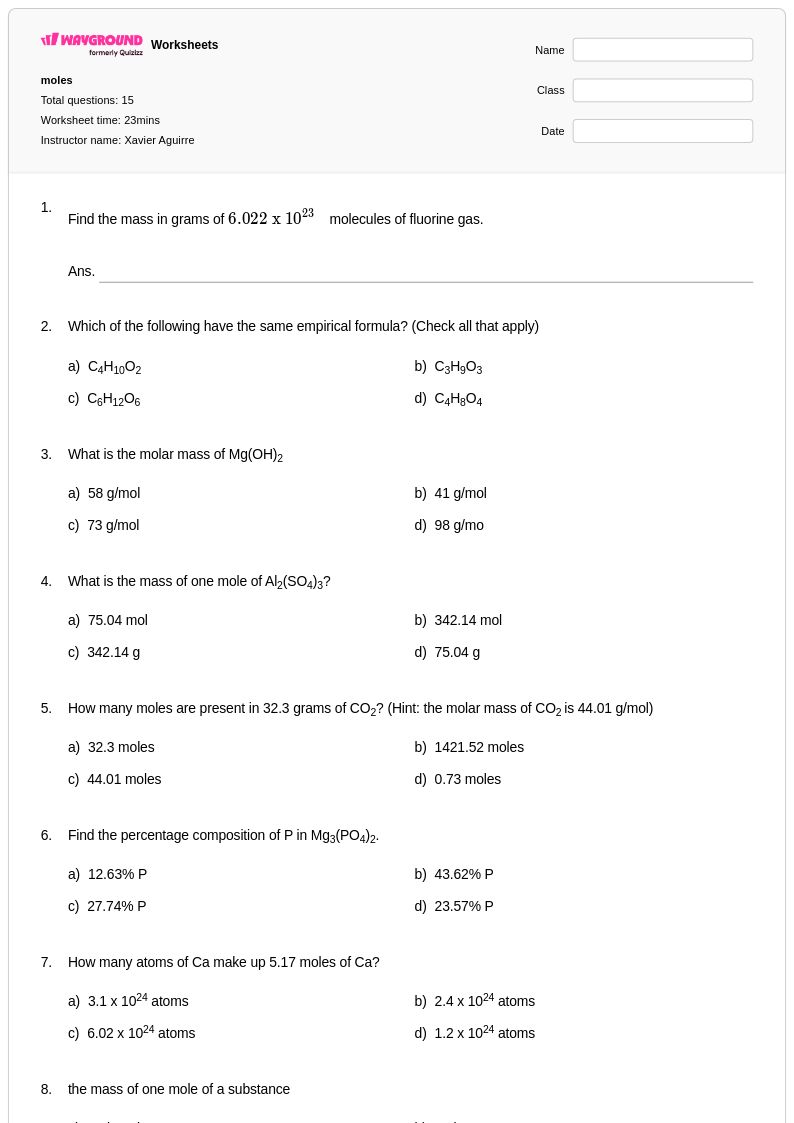
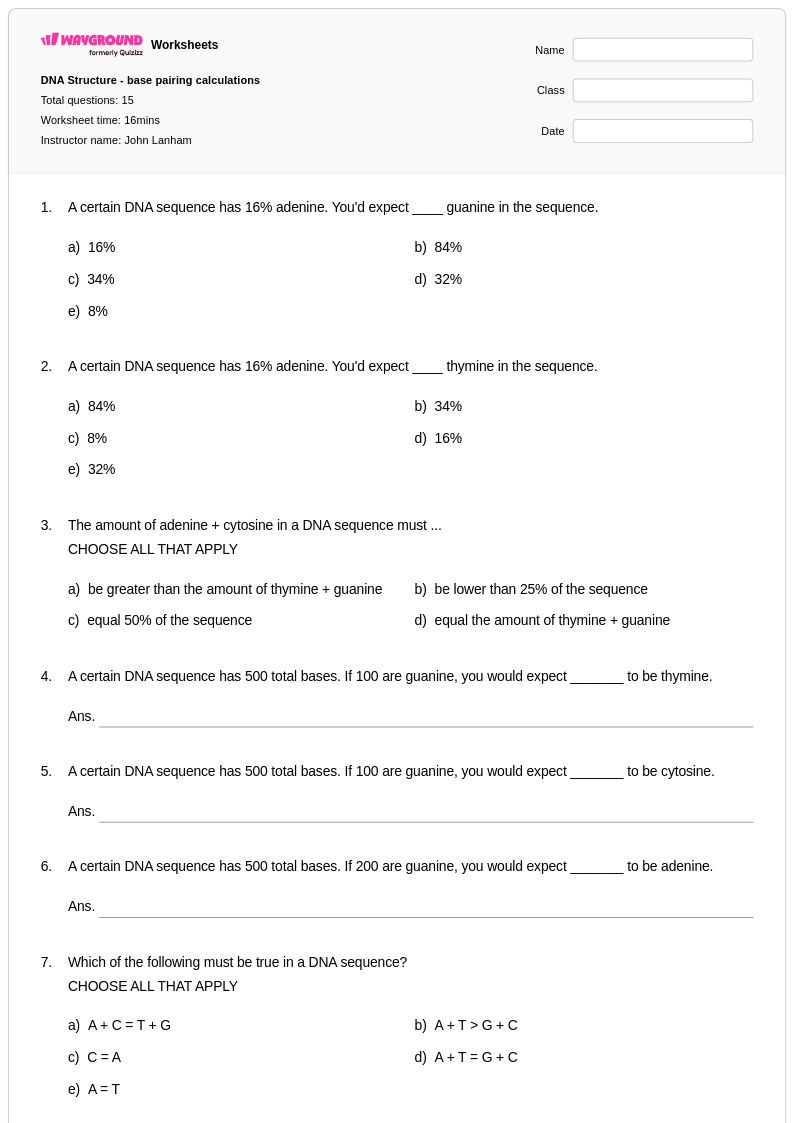
Class 12 percentage composition worksheets available through Wayground (formerly Quizizz) provide comprehensive practice with one of chemistry's most fundamental quantitative concepts. These expertly crafted resources strengthen students' abilities to calculate the mass percentage of elements within compounds, interpret empirical and molecular formulas, and solve complex stoichiometric problems involving percentage data. The worksheets feature graduated difficulty levels that challenge advanced students to work with multi-step calculations, hydrated compounds, and real-world applications in pharmaceutical and industrial chemistry. Each collection includes detailed answer keys and step-by-step solution guides, with free printables available in convenient PDF format that allow students to practice essential problem-solving techniques both in class and independently.
Wayground (formerly Quizizz) supports chemistry educators with an extensive library of millions of teacher-created percentage composition resources that can be easily searched, filtered, and customized to match specific curriculum standards and student needs. The platform's robust differentiation tools enable teachers to modify problem complexity, adjust mathematical rigor, and incorporate visual aids such as molecular diagrams and periodic table references to accommodate diverse learning styles. These versatile worksheet collections are available in both printable PDF formats for traditional classroom use and interactive digital versions that provide immediate feedback, making them invaluable for lesson planning, targeted remediation of weak areas, enrichment activities for advanced learners, and consistent skill practice throughout the academic year. Teachers can seamlessly align these resources with state chemistry standards while building students' confidence in quantitative analysis and chemical reasoning.
FAQs
How do I teach percentage composition in chemistry?
Teach percentage composition by first ensuring students are comfortable with molar mass calculations, then introduce the core formula: divide the total mass of each element in one mole of the compound by the compound's molar mass and multiply by 100. Use simple binary compounds like NaCl or MgO as entry points before progressing to polyatomic compounds. Connecting the concept to real-world applications, such as nutrient percentages in fertilizers or purity analysis in pharmaceuticals, helps students see why the skill matters beyond the calculation itself.
What exercises help students practice percentage composition?
Effective practice exercises include calculating the mass percent of each element in a given molecular formula, working backwards from percentage data to identify unknown compounds, and comparing the composition of related compounds to understand how formula changes affect ratios. Problems that range from simple binary compounds to complex molecular structures build procedural fluency progressively. Mixing calculation problems with interpretation questions, such as asking which element makes up the greatest fraction of a compound's mass, reinforces conceptual understanding alongside computational skill.
What mistakes do students commonly make when calculating percentage composition?
The most common error is failing to account for subscripts correctly when calculating the total mass contribution of an element, for example treating Fe2O3 as if it contains one iron atom instead of two. Students also frequently forget to multiply atomic mass by the number of atoms before dividing by molar mass. Another recurring mistake is rounding molar mass values too early in the calculation, which leads to compounding errors in the final percentage. Requiring students to show each step explicitly and verify that their percentages sum to approximately 100% helps catch these errors before they become habits.
How do I use percentage composition worksheets in my chemistry class?
Percentage composition worksheets on Wayground are available as printable PDFs for traditional classroom use and in digital formats for technology-integrated learning environments, including the option to host them as a quiz directly on Wayground. Printable versions work well for guided practice during class or as homework assignments, while digital versions allow for self-paced independent work and immediate feedback. Using the worksheets alongside answer keys supports student self-assessment and helps teachers identify specific steps where students are losing points.
How does percentage composition connect to other chemistry topics?
Percentage composition is a foundational skill that directly links to empirical and molecular formula determination, where percentage data is used to calculate mole ratios between elements. It also underpins stoichiometry, as understanding the mass relationships within a compound is essential for yield and limiting reagent calculations. Teachers should explicitly bridge these connections so students recognize percentage composition not as an isolated topic but as a recurring analytical tool throughout quantitative chemistry.
How can I differentiate percentage composition instruction for students at different skill levels?
For struggling students, begin with compounds containing only one atom of each element to reduce the cognitive load of managing subscripts, and provide partially completed calculation templates that scaffold each step. On-platform tools such as reduced answer choices and extended time can further support students who need additional assistance during digital practice. Advanced students benefit from open-ended problems that ask them to determine the empirical formula of an unknown compound from percentage data, or to evaluate the composition of real industrial compounds and assess their suitability for specific applications.