wayground logo

Free Printable Worksheets

NEW

Font size

S
M
L
XL
Worksheets

Unit 2 Test Review

Total questions: 42

Worksheet time: 1hrs 2mins

Name
Class
Date
1.
What happens to temperature during a phase change?
a)
It increases
b)
It decreases
c)
It remains constant until the change is completed
d)
It increases and then quickly decreases
2.
A substance that contains only one type of atom is a(n)
a)
compound
b)
element
c)
heterogeneous mixture
d)
homogeneous mixture
3.
Which of these is a pure substance?
a)
bread
b)
table salt
c)
garden soil
d)
sea water
4.
Two or more elements chemically combined:
a)
an atom
b)
a compound
c)
a mixture
d)
a pure substance
5.
A mixture that appears to be evenly mixed throughout:
a)
an atom
b)
a compound
c)
a homogeneous mixture
d)
a heterogeneous mixture
6.
Chemical or Physical Change?
a)
Chemical
b)
Physical
7.
A material made up of 2 or more substances that can be easily separated by physical means is a ___?
a)
compound
b)
colloid
c)
mixture
d)
solution
8.
What term describes a gas changing to a liquid?
a)
Deposition
b)
Sublimation
c)
Evaporation
d)
Condensation
9.
Solids melt when solid particles _____ energy, liquids freeze when liquid particles _____ energy.
a)
absorb, release
b)
release, absorb
c)
absorb, absorb
d)
release, release
10.
Liquid particles are...
a)
tightly packed
b)
loosely bonded and flowing
c)
free to fly in all directions
d)
rigid and can not change shape
11.
What is the rate of reaction?
a)
How fast a reaction is 
b)
How big a reaction is
c)
How loud a reaction is
d)
How much gas a reaction produces
12.
Which of the following would have the fastest rate of dissolving?
a)
a sugar cube in hot water
b)
a sugar cube in cool water
c)
powdered sugar in hot water
d)
powdered sugar in cool water
13.

Which of the following would have the slowest rate of dissolving?

a)

a sugar cube in hot water

b)

a sugar cube in cool water

c)

powdered sugar in cool water

d)

powdered sugar in hot water

14.
Filtration can be used to separate mixtures based on 
a)
their densities
b)
their boiling points
c)
their melting points
d)
the size of their particles
15.
What term describes a liquid changing to a gas?
a)
Deposition
b)
Sublimation
c)
Freezing
d)
Evaporation
16.
What kind of bond forms when atoms share electrons?
a)
Chemical bond
b)
Ionic bond
c)
Covalent bond
d)
Electron bond
17.
Which of the following has six valence electrons?
a)
Sodium
b)
Iodine
c)
Oxygen
d)
Neon
18.
When naming you always change the ending of the second element to ________.
a)
-ate.
b)
-ite.
c)
-ide.
d)
-ine.
19.

This rule says that all atoms want a full outer shell with 8 valence electrons.

a)

pentet rule

b)

hextet rule

c)

octet rule

d)

quartet rule

20.

What is the formula for calcium phosphide? (Be sure to apply the correct rules by first determining if this is an Ionic or Covalent Compound)

a)

CaP

b)

Ca2P3

c)

Ca3P2

d)

Ca2P

21.

Phosphorous trichloride

(Be sure to apply the correct rules by first determining if this is an Ionic or Covalent Compound)

a)

PCl3

b)

P3Cl

c)

P3Cl3

d)

PCL

22.

P2O5

(Be sure to apply the correct rules by first determining if this is an Ionic or Covalent Compound)

a)

Phosphorus Oxide

b)

Pentaphosphorus Dioxide

c)

Diphosphorous pentoxide

d)

Phosphoric Oxygen

23.
Metal ions are always
a)
positive
b)
negative
c)
neutral
d)
free
24.
What kind of chemical bond forms between a metal and a nonmetal?
a)
Covalent bond
b)
Ionic bond
c)
Can be either covalent or ionic
d)
Hydrogen bond
25.
Non-Metal ions are always
a)
positive
b)
negative
c)
neutral
d)
free
26.
What kind of bond forms between two nonmetals?
a)
Covalent bond
b)
Ionic bond
c)
Can be either covalent or ionic
d)
Hydrogen bond
27.

K2O

(Be sure to apply the correct rules by first determining if this is an Ionic or Covalent Compound)

a)

Potassium oxide

b)

Dipotassium oxide

c)

Dipotassium monoxide

d)

potassium dioxide

28.
Do ionic compounds have prefixes in the name?
a)
Yes
b)
No
29.
The name of Mg₃N₂ is
a)
manganese nitride
b)
magnesium nitride
c)
magnesium (III) nitride
d)
trimagnesium dinitride
30.
The chemical formula for an ionic compound of aluminum and chlorine is
a)
AlCl.
b)
ClAl.
c)
AlCl3.
d)
Al3Cl.
31.
Which of the following is the correct Lewis structure for Hydrogen Cyanide (HCN)
a)
Structure A
b)
Structure B
c)
Structure C
d)
Structure D
32.
Which of the following is Not a conclusion of the Kinetic Theory of Matter?
a)
All matter is composed of atoms
b)
These atoms are in constant random motion
c)
Atoms are made up of protons, neutrons, and electrons
d)
These atoms are colliding into the wall of their container
33.
What kind of compound is this?
a)
Covalent hydrocarbon
b)
Ionic hydrocarbon
c)
Metallic hydrocarbon
d)
Ionic Metalloid
34.
How many total electrons are shared in this compound?
a)
16
b)
4
c)
8
d)
12
35.
How many lone electron pairs are there in this compound?
a)
16
b)
4
c)
0
d)
8
36.
What type of Bond is likely to form between these two elements?
a)
polar covalent bond
b)
Ionic bond
c)
covalent bond
37.
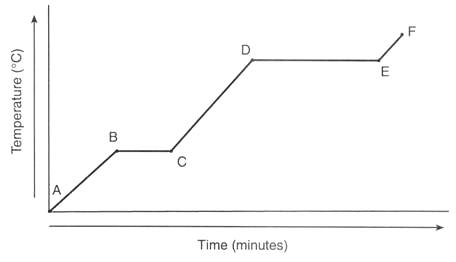
Between which points is the substance changing state?
a)
A-B only. 
b)
A-B, C-D, E-F
c)
B-C only. 
d)
B-C, D-E
38.
When the temperature of matter increases the particles...
a)
speed up and move closer
b)
speed up and move farther apart
c)
slow down and move closer together
d)
slow down and move farther apart
39.
What happens when thermal energy is taken away from particles?
a)
They move faster and farther apart
b)
They move slower and closer together
40.
Which phase of matter is represented by the atoms in this diagram? 
a)
solid
b)
liquid
c)
gas
41.
According to this graph, what is the melting point temperature of this substance?   (in degrees)
a)
40
b)
70
c)
100
d)
140
42.
According to this graph, what is the boiling point temperature of this substance?   (in degrees)
a)
40
b)
70
c)
100
d)
140