
 Worksheets
Science FCAT PreTest
Total questions: 58
Worksheet time: 40mins
Name
Class
Date
1.
Solids have
a)
a fixed or definite shape and volume
b)
a fixed or definite volume but no definite shape
c)
no definite shape or volume
d)
takes the shape of its container
2.
Gasses have -
a)
no definite/fixed shape but a definite volume
b)
a definite shape but no definite volume
c)
no definite shape or volume
d)
a stinky odor
3.

Example of:
a)
the particles in a solid
b)
the particles in a liquid
c)
the particles in a gas
d)
the particles in plasma
4.
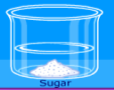
1.When the sugar and water in the beaker are combined, they will create a solution because -
a)
the water will now turn into a gas
b)
the sugar will dissolve into the water
c)
. the water will dissolve into the sugar
d)
the two substances are chemically combining and chemically changing their properties
5.
Why do we see lightning before we hear thunder ?
a)
because light travels slower than sound
b)
because light travels faster than sound
c)
because light and sound travel at the same speed
d)
because lightning is scary
6.

1. Based on the periodic table entry below, how many protons are in one helium atom.
a)
A. 1
b)
B. 2
c)
C. 4
d)
D. 6
7.
Which of the following is a property of a nonmetal?
a)
A. It has a hard and shiny surface
b)
B. It can be bent into different shapes
c)
C. It is a poor conductor of electricity
d)
D. It is a good conductor of heat
8.

Which item below is the most dense?
a)
A. Ping Pong Ball
b)
B. Lamp Oil
c)
C. Bolt
d)
D. Corn Syrup
9.
Animals that eat both plants and animals are called
a)
Carnivores
b)
Herbivores
c)
Omnivores
d)
Decomposers
10.
What type of cell has a nucleus?
a)
eukaryotic
b)
prokaryotic
11.

The picture above shows a large box being pushed by two men. The box did not change its position in the room because…
a)
A. The opposing forces were balanced
b)
B. The smooth floor created no friction
c)
C. The man on the left side applied more force than the man on the right side.
d)
D. The man on the right side applied more force than the man on the left side.
12.
Which of the following increases when the force applied to an object increases?
a)
A. The acceleration of the object.
b)
B. The force of gravity on the object.
c)
C. The effects of inertia on the object.
d)
D. The velocity of the object.
13.
Newton's First Law of Motion states...
a)
A. An unbalanced force causes an object to accelerate. The acceleration of the object is equal to the net force acting on it.
b)
B. For every action there is an equal and opposite reaction.
c)
C. An object at rest tends to stay at rest and an object in motion tends to stay in motion with the same speed and in the same direction unless acted upon by an unbalanced force.
d)
D. All of the above is Newton's First Law of Motion.
14.
A hypothesis is a reasonable and educated ___________.
a)
experiment
b)
guess
c)
scientist
d)
test
15.
To test a hypothesis, a scientist could conduct a(n) ________.
a)
observation
b)
experiment
c)
inference
d)
environment
16.
A rule that describes a pattern in nature is called a(n) ______.
a)
inference
b)
scientific law
c)
scientific theory
d)
hypothesis
17.
The results of an experiment must be _______.
a)
kept secret
b)
accepted right away
c)
reproducible
d)
unreproducible
18.
One of the reasons for using models is to ________.
a)
communicate
b)
save time, money, and lives
c)
test predictions
d)
all of the above
19.
In an experiment, the variable that does not change is called the _______.
a)
constant
b)
independent variable
c)
manipulated variable
d)
dependent variable
20.
An experiment must be repeatable and reproducible.
a)
True
b)
False
21.
This scientist discovered and named the cell.
a)
Robert Hooke
b)
Anton Van Leeuwenhoek
c)
Goldberg
d)
Mathias Schleiden
22.
Cells work together to make the following.
a)
tissues
b)
organs
c)
organ systems
d)
organism
23.
Tissues work together to make the following.
a)
cells
b)
organs
c)
organ systems
d)
organism
24.
Animal and Plant cells are both this type of cell.
a)
Eukaryote
b)
Prokaryote
25.
Bacteria cells are this type of cell.
a)
Eukaryote
b)
Prokaryote
26.
This type of cell needs a cell wall and chloroplasts
a)
Plant cell
b)
Animal Cell
c)
Bacteria
27.
The powerhouse of the cell is the...It converts energy from food into energy the cell can use
a)
Mitochondrion
b)
Golgi body
c)
Nucleus
d)
Ribosomes
28.
Where are proteins made? These are small, grain-like or rod shaped organelles.
a)
Golgi body
b)
Mitoichondrion
c)
Chromosomes
d)
Ribosomes
29.
This cell part is in ALL cells. It is the gel-like substance that provides cell shape.
a)
Chloroplasts
b)
Chromosomes
c)
Cytoplasm
d)
Mitochondria
30.
Plants perform photosynthesis through this organelle. It captures energy from the sun and uses it to produce food for the cell.
a)
Chlorophyll
b)
Chloroplasts
c)
Mitochondria
d)
Golgi Apparatus
31.
This structure packages and distributes proteins throughout the cell.
a)
Golgi Body
b)
Lysosome
c)
Ribosome
d)
Mitochondria
32.

Who is considered the "father of genetics"?
a)
Gregor Mendel
b)
Reginald Punnett
c)
James Watson
d)
Rosalind Franklin
33.
Where is DNA located?
a)
only in the brain
b)
the nucleus
c)
only in plant cells.
d)
in TrNA
34.

You have 46 of these in your nucleus.
a)
genes
b)
genotypes
c)
chromosomes
d)
phenotypes
35.

Which is the most specific classification level?
a)
Domain
b)
Kingdom
c)
Genus
d)
Species
36.

The 8 levels of classification, largest to smallest.
a)
Species, Genus, Family, Order, Class, Phylum, Kingdom, Domain
b)
Genus, Species, Kingdom, Domain, Phylum, Family, Class, Order
c)
Domain, Kingdom, Phylum, Class, Order, Family, Genus, Species
37.
White fur on an arctic fox would help it do what?
a)
run
b)
hide
c)
eat food
d)
sleep
38.
Who is at the bottom of an energy pyramid?
a)
producer
b)
organism
c)
consumer
d)
soil
39.
What is a decomposer?
a)
the waste of dead animals and plants
b)
a consumer that gets energy by eating only plants
c)
a dead animal or plant
d)
an organism such as an earthworm that eats the remains of animals
40.
The process in which organisms that possesses the most desirable traits and genes will be successful in surviving and producing the next generation.
a)
Adaptation
b)
Natural Selection
c)
Artificial Selection
d)
Selection
41.

What is the name of the instrument used to measure the waves of an earthquake?
a)
Richter Scale
b)
Octograph
c)
Seismograph
d)
Fault detecor
42.

When two plates are moving away from each other they are called (often forming rifts or valleys)?
a)
Divergent Plates
b)
Convergent Plates
c)
Transform Boundaries
d)
Mountain ranges
43.
Earthquakes occur very frequently in this region.
a)
Earthquake Alley
b)
Ring of Fire
c)
Dragon's Den
d)
Apocalypse Now
44.

Two plates that are pushing into each other (can form mountains) are called...
a)
Convergent Plates
b)
Divergent Plates
c)
Transform Boundaries
d)
Oceans
45.
What is Pangea?
a)
A famous person who studied tectonic plates
b)
When the continents made a big continent
c)
A painting
d)
A random question
46.
What is the process by which natural resources break down rocks?
a)
Erosion
b)
Weathering
c)
Abrasion
d)
Pressure
47.
Approximately what percentage of Earth’s water is fresh water?
a)
97%
b)
50%
c)
10%
d)
3%
48.
One complete revolution of Earth around the sun takes about
a)
one year
b)
one rotation
c)
one season
d)
one eclipse
49.

What Moon phase is this?
a)
Full Moon
b)
Waxing Gibbous
c)
New Moon
d)
Half Moon
50.

What Moon phase is this?
a)
Waxing Crescent
b)
Waning Gibbous
c)
Waning Crescent
d)
Waxing Gibbous
51.

What Moon phase is this?
a)
Waxing Crescent
b)
Waning Gibbous
c)
Waxing Gibbous
d)
Waning Crescent
52.

What Moon phase is this?
a)
Waning Crescent
b)
Waxing Crescent
c)
Waxing Gibbous
d)
Waning Gibbous
53.
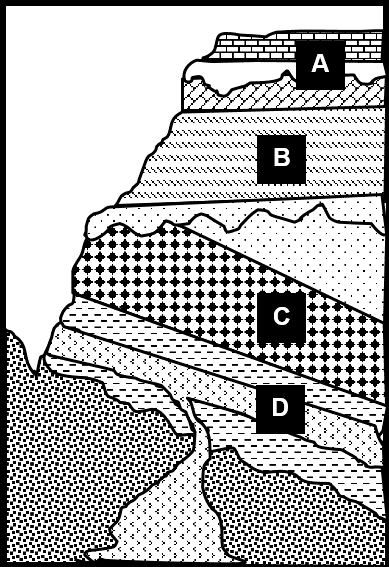
The picture to the right illustrates a cross-section of the layers of rock found underneath the topsoil of the earth. Which of the following MOST LIKELY caused Layer C to slant?
a)
volcano
b)
earthquake
c)
flood
d)
giants
54.
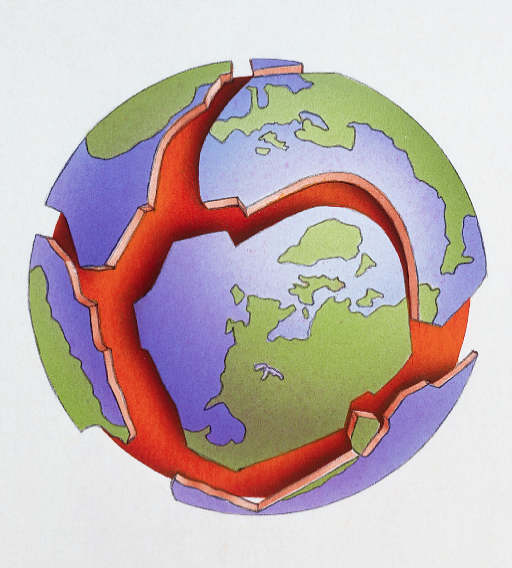
The Earth’s surface is not one solid piece of rock and soil, but is made up of large pieces called plates. These plates fit together like pieces of a puzzle and are constantly moving. Why can’t we feel the movement of these Earth plates?
a)
the plates move very quickly
b)
the plates move very slowly
c)
the plates are too small to feel
d)
the plates are underground
55.
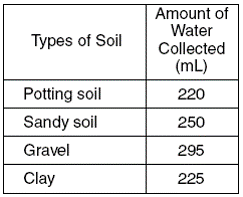
Similar containers were filled with different types of soil. Holes were poked into the bottom of each container, and 300 milliliters of water were added. The water that dripped out was collected and measured. According to the information in the table, which type of soil retained water best?
a)
potting soil
b)
sandy soil
c)
gravel
d)
clay
56.
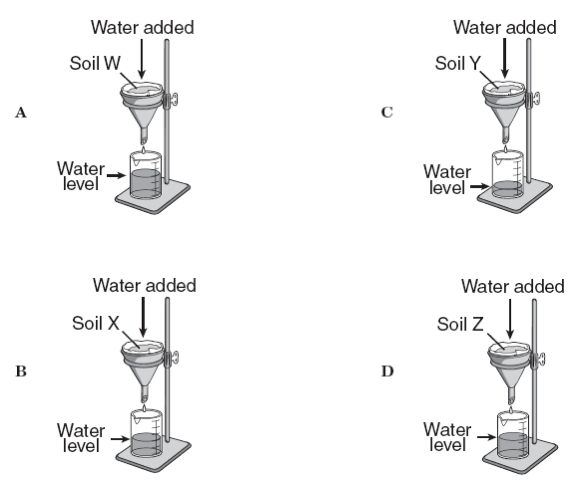
Some students added 500 milliliters of water to equal amounts of four different samples of soil. In this investigation, which sample of soil retained the most water?
a)
A
b)
B
c)
C
d)
D
57.
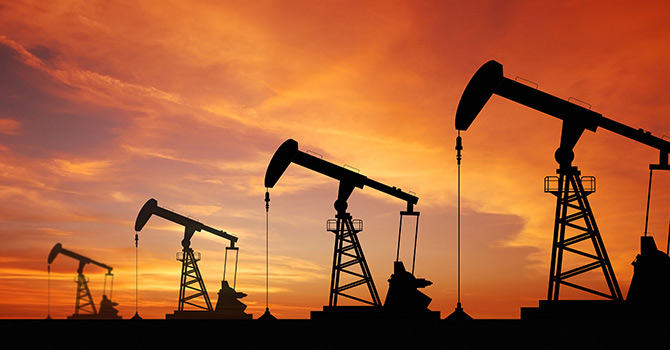
Petroleum is considered a nonrenewable resource because—
a)
it cannot be replaced easily
b)
it can be replaced easily
c)
it is made into gasoline
d)
it is very thick and black
58.
Which of these is a renewable resource?
a)
diamonds
b)
coal
c)
oil
d)
wind
100 %

