Worksheets
Chemistry 3
Total questions: 32
Worksheet time: 31mins
This bonding involves the transfer of electrons from atom to another.
(a)
This bonding involves two non metals or 2 hydrogens
(a)
This bonding involves a metal and a nonmetal.
(a)
Which is NOT an example of evidence of a chemical change.
steam from a pot of noodles
bubbles
The substances that are formed in a chemical reaction are called (a)
The big number on the front of the chemical formula is called the ______
Coefficient
Element Symbol
Subscript
Atomic Number
How many of each element are in 2Al2(SO4)3
6Al, 9S, 36O
3Al2, 3S, 12O
4Al, 6S, 24O
6Al, 12SO
A/an (a) reaction produces heat. so it will feel warmer when the reaction is happening.
A/an (a) reaction absorbs heat. so it will feel cooler when the reaction is happening.
Which example provides evidence of a chemical change?
Wood releases ash and smoke when burned.
Rock particles separate when soil is being sifted.
Boiling water bubbles when being heated.
Sugar is not visible when dissolved in water.
When vinegar and baking soda are combined, bubbles and foam are produced.
What evidence demonstrates that a chemical change has occurred?
A color change occurs.
A gas is formed.
A solid is dissolved.
A precipitate is formed.

Which processes from the table can be used as evidence to identify the formation of a new substance?
Processes A, B, C, and D
Processes A, C, D, and E
Processes A, C, D, and F
Processes C, D, E, and F

Students performed investigations using water and three chemicals, baking soda, calcium chloride, and phenol red solution. The student observations are shown in the table.
Which investigations above provide supporting evidence that a new substance formed?
Investigations 1, 2, and 3
Investigations 1, 3, and 5
Investigations 2, and 4
Investigations 3, 4, and 5
Flour, sugar, cocoa, oil, and eggs are mixed together and placed in the oven to make brownies. When the brownies are removed from the oven, they no longer look like the original ingredients.
Which of the following describes why the ingredients changed?
A biological change occurred.
No change occurred.
A physical change occurred.
A chemical change occurred.
Two liquids are mixed together. Which of the following does NOT identify the formation of a new substance?
A gas is produced.
One liquid dissolves into the other.
The temperature changes.
A solid is formed.
Chemicals that help start or speed up a reaction...
Reactants
Products
Catalysts
Which of the following statements BEST describes COLLISION THEORY?
A. Atoms or molecules must collide with a sufficient amount of energy in order to react.
B. Catalyst can be recovered unchanged at the end of process.
C. Increasing the concentration of a reactant increases the rate of reaction.
D. Smaller pieces have a greater surface area, thus, providing much greater contact among the reactants and effecting more collisions.
7. How will crushing a solid into a powder increase the reaction rate?
A. The activation energy barrier will be lowered.
B. The orientation of colliding particles will be improved.
C. The particles will collide with more energy.
D. The powdered form has more surface area.
Increasing the temperature will decrease the kinetic energy of particles, therefore decreasing the collisions between particles.
Increasing the concentration of the reactants will likely speed up the reaction.
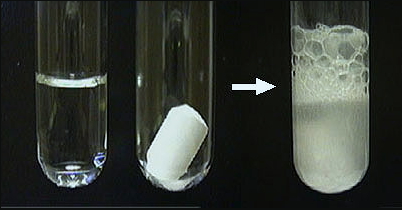
How could we make this reaction happen more quickly?
Decrease the concentration of the acid
crush the chalk to increase the surface area
Put the test tube in an ice bath
Add water to dilute the acid, thereby reducing its concentration so it can get between the chalk particles.
Which factors increase the rate of a reaction. CHOOSE ALL THAT APPLY AND DON'T HIT ENTER until you are done.
decreasing temperature
adding catalyst
adding inhibitor