Wayground logo

Free Printable Worksheets

Font size

S
M
L
XL
Worksheets

EOC - SB1 Cellular Structure and Function

Total questions: 50

Worksheet time: 38mins

Name
Class
Date
1.
This organelle is in all prokaryotic and eukaryotic cells.  It is a barrier between the cell and the environment controlling what goes in and out of a cell.
a)
cell wall
b)
cell membrane
c)
cell organelles
d)
mitochondria
2.
Where are proteins made? These are small, grain-like or rod shaped organelles.
a)
Golgi body
b)
Mitoichondrion
c)
Chromosomes
d)
Ribosomes
3.

What is the difference between rough and smooth ER?

a)

There is no difference.

b)

Plants have rough ER, animals have smooth ER.

c)

What type of injuries the Doctors treat.

d)

Rough has ribosomes, smooth does not.

4.
The two kinds of cells are Prokaryotes and Eukaryotes. How are they different?
a)
Prokaryotes have a nucleus.
b)
Eukaryotes have a nucleus.
c)
Prokaryotes are plant cells.
d)
There is no difference.
5.
What organelle do plants have surrounding their cells that animal cells lack?
a)
Cell Wall
b)
Plasma Membrane
c)
Cell Envelope
d)
Cell Membrane
6.
What is the cytoskeleton?
a)
A jelly-like fluid inside the cell.
b)
The power center of the cell.
c)
Web of proteins that acts as a muscle and a skeleton.
d)
Rigid structure that supports plant cells. 
7.
I store water in both plant and animal cells. What am I?
a)
cytoplasm
b)
ribosomes
c)
vacuole
d)
lysosomes
8.
I am a protein packaging and shipping machine! Who am I?
a)
vacuole
b)
ribosome
c)
endoplasmic reticulum
d)
golgi apparatus
9.
You might think of me as the trash collector or recycle center is maybe more accurate. What am I?
a)
cytoplasm
b)
lysosme
c)
vacuole
d)
ribosome
10.
What is the movement of a substance across the cell membrane without using  the cell's energy?
a)
Diffusion
b)
Osmosis
c)
Passive Transport 
d)
Active Transport
11.
The diffusion or movement of water across the cell membrane. The water will always moves to higher concentrations. What is this?
a)
Diffusion 
b)
Water Movement 
c)
Osmosis
d)
This one might be correct?
12.
What is the random movement of molecules from an area of high concentration to an area of low concentration?
a)
Passive Transport 
b)
Laser Narwhal
c)
Osmosis
d)
Diffusion
13.
Diffusion always occurs across/down a _______________ until the molecules are even in both areas.  Fill in the blank.
a)
Facilitated Diffusion
b)
Osmosis
c)
Passive Transport
d)
Concentration Gradient
14.
What is it called when one solution has a concentration that is lower than in another solution?
a)
Hypertonic
b)
Hypotonic
c)
Isotonic
d)
Osmotonic
15.
Molecules moving against the concentration gradient (from low to high) is...
a)
Facilitated Diffusion
b)
Simple Diffusion
c)
Active Transport
d)
Osmosis
16.
This picture represents what type of cell transport?
a)
endocytosis
b)
exocytosis
c)
osmosis
d)
passive transport
17.
This picture represents which type of cellular transport?
a)
passive transport
b)
endocytosis
c)
exocytosis
d)
osmosis
18.
A cell in an isotonic solution will
a)
swell
b)
shrink
c)
stay the same size
d)
impossible to tell
19.
A cell in a hypotonic solution will
a)
swell
b)
shrink 
c)
stay the same size
d)
impossible to tell
20.
A cell in a hypertonic solution will
a)
Swell
b)
Shrink
c)
Stay the same size
d)
Impossible to tell
21.
Particles are too large to enter the membrane.
Need help from channel proteins.
No energy
a)
active transport
b)
passive transport
c)
facilitated diffusion
22.
In a nerve cell, ATP energy is used to pump sodium (Na) out of the cell and potassium (K) into the cell. This is an example of...
a)
Facilitated Diffusion
b)
Simple Diffusion
c)
Active Transport
d)
Osmosis
23.

According to the theory of Endosymbiosis, which two organelles are thought to have originated from free-living prokaryotic cells?

a)

chloroplast and nucleus

b)

mitochondrion and chloroplast

c)

lysosome and mitochondrion

d)

nucleus and lysosome

24.
The combined observations of Mattias Schleiden, Theodor Schwann and Rudolph Virchow resulted in the formation of the cell theory. Which of the following is not part of the cell theory?
a)
All cells contain a nucleus. 
b)
All cells come from other living cells
c)
All living organisms are made of one or more cells.
d)
Cells are the basic unit of structure and function of all living things.
25.
As a cell grows, its ___ increases more than its ___.
a)
length, volume
b)
width, surface area
c)
volume, surface area
d)
none of these
26.
Which shows the levels of living organization from smallest to largest?
a)
atoms, cells, tissues, organs, organisms
b)
cells, tissues, organs, organelles, organisms
c)
atoms, molecules, organelles
d)
cells, tissues, organs, organ systems, organisms
27.

Which of the following is a prokaryote?

a)

animal cell

b)

bacteria

c)

virus

d)

plant cell

28.
What is the function of nucleic acids?
a)
store genetic information
b)
store energy (long-term)
c)
store energy (short-term)
d)
build skin, hair, nails, muscles
29.
Waxes, oils and fats are examples of
a)
Carbohydrates
b)
Lipids
c)
Proteins
d)
Nucleic Acids
30.
Which macromolecule is shown?
 View Figure 3 (if not visible)
a)
lipid
b)
protein
c)
nucleic acid
d)
carbohydrate
31.
Is found in the cell membrane as a bilayer. 
a)
lipids
b)
protein
c)
nucleic acid
d)
carbohydrate
32.

During cellular respiration, plants and animals use ................ to make energy (ATP).

a)

Oxygen and Carbon Dioxide

b)

Water and Oxygen

c)

Water and Glucose

d)

Oxygen and Glucose

33.
During the process of photosynthesis, plants produce ..... 
a)
More chlorophyll and cytoplasm 
b)
Glucose and Carbon Dioxide
c)
Glucose and Oxygen 
d)
Water, Sunlight, and Glucose
34.
What is the purpose of Mitosis?
a)
To make energy to grow
b)
To repair damaged tissue and to grow
c)
To help organisms use extra DNA
d)
So that Students have something to learn
35.
Process where food is broken down to release chemical energy. Occurs in the mitochondria.
a)
Cellular Respiration
b)
Photosynthesis
c)
Active Transport
d)
Passive Transport
36.
Plant cells take in light energy and change it into chemical energy in the form of glucose (food). Occurs in the chloroplasts.
a)
Photosynthesis
b)
Cellular Respiration
c)
Osmosis
d)
Diffusion
37.
Where does photosynthesis occur?
a)
Mitochondria
b)
Leaves 
c)
Chloroplast 
38.
Where does cellular respiration occur?
a)
Chloroplast
b)
Golgi Apparatus 
c)
Mitochondria
39.
Why would it be important to replicate DNA before a cell divides in mitosis or meiosis?
a)
In order for genetic information to be transferred into daughter cells.
b)
In order for the cell to be able to increase in size.
c)
In order for the DNA to be contained in the nucleus.
d)
In order for the cell to re-order the DNA sequencing in the new cells.
40.
In mitosis, the two resulting cells are
a)
different from the starting cell and identical to each other.
b)
different from the starting cell and different from each other.
c)
identical to the starting cell and different from each other.
d)
identical to the starting cell and identical to each other.
41.
The cells produced via meiosis are called:
a)
sex cells
b)
somatic cells
c)
body cells
d)
skin cells
42.
In binary fission how does the DNA of the daughter cells compare to the DNA of the parent cell? 
a)
It is only half of the amount of DNA found in the parent.
b)
It is identical.
c)
It is a mix of the parent's DNA.
d)
It has some similarities and some differences.
43.

Bacteria reproduce asexually by a process called

a)

replication

b)

sexual reproduction

c)

mitosis

d)

binary fission

44.
A Skin has 2 of every chromosome.  Which term means 1 of each chromosome? 
a)
Meiosis
b)
Mitosis
c)
Haploid
d)
Diploid
45.
If a cell has 2 of every chromosome.  1 of each pair from the maternal parent and 1 of each pair from the paternal parent. 
a)
homologous pairs
b)
replicated chromosomes
c)
haploid
d)
diploid
46.
What causes genetic variation in meiosis?
a)
chromosomes lining up
b)
crossing over of chromosomes
c)
separation of chromosomes
d)
chromosomes pulling apart
47.

Most enzymes are composed of .....

a)

Lipids

b)

Carbohydrates

c)

Proteins

d)

Nucleic Acids

48.

What happens to an enzyme when it denatures?

a)

The activation energy of the reaction is doubled.

b)

The activation energy of the reaction is lowered.

c)

It's optimal conditions for temperature of the enzyme are doubled.

d)

The shape of the enzyme molecule is changed.
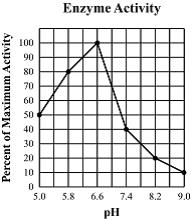
49.
Which of the following conclusions can be drawn from this graph?
a)
The optimum pH of the enzyme is 6.6.
b)
The optimum pH of the enzyme is 5.8
c)
The enzyme’s activity increases as pH increases 5.0 to 9.0
d)
The enzyme’s activity is greater around pH of 8.0 .
50.
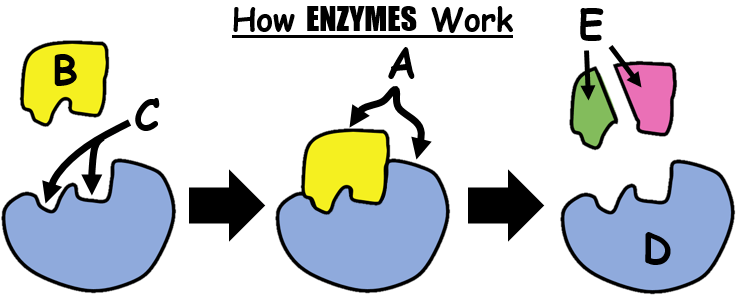
Letter D...
a)
active site
b)
enzyme
c)
substrate
d)
products