

wayground logo

Free Printable Worksheets

Font size

S
M
L
XL
Worksheets

EOC REVIEW

Total questions: 100

Worksheet time: 41mins

Name
Class
Date
1.
A type of reproduction that involves two parents and the offspring is not identical to parents.
a)
asexual
b)
sexual
c)
fission
d)
budding
2.
A type of reproduction that involves one parent and the offspring is identical to parent.
a)
meiosis
b)
sexual
c)
asexual
d)
gametes
3.
The basic unit of life is the _______________________.
a)
atom
b)
molecule
c)
cell
d)
DNA
4.
All _______________________ are made up of cells.
a)
matter
b)
living things
c)
ecosystems
d)
atom
5.
Cells come from _________________________ cells.
a)
sex
b)
body
c)
preexisting
d)
duplicate
6.
The alleles B and b are two different versions of the same _________________________.
a)
DNA
b)
gene
c)
trait
d)
heredity
7.
A scientist that observed cork, saw little boxes and called these structures cells. 
a)
Charles Darwin
b)
Reginald Punnett
c)
Robert Hooke
d)
Robert Virchow
8.
The ability to maintain a stable internal condition.
a)
Nucleotide
b)
Taxonomy
c)
Homeostasis
d)
Pedigree
9.
What kind of symbiotic relationship do Egyptian plovers have with crocodiles? 
a)
commensalism
b)
mutualism
c)
parasitism
d)
symbiosis
10.
Growth of a multicellular organism is mostly due to an increase in the _____________of cells.
a)
size
b)
number
c)
type
d)
growth
11.
_____________ means to examine research result fairly.
a)
bias
b)
subjective
c)
unbiased
d)
opposed
12.
A species that lived in the past that have similar descendants is called a______
a)
heritage
b)
lineage
c)
phylogeny
d)
common ancestor
13.
_________are located on the chromosomes of each cell.
a)
Genes
b)
Alleles
c)
Traits
d)
Pedigree
14.
A factor that remains the same in an experiment.
a)
control
b)
experiment
c)
constant
d)
variable
15.
_________________________,like Telekinesis, has never been supported by scientific evidence.
a)
Field of Science
b)
Branch of Science
c)
Science
d)
Pseudoscience
16.
____________allows the population to survive changes in the environment
a)
Artificial selection
b)
Selective breeding
c)
Natural Selection
d)
Breeding
17.
A body system that breaks down food so that it can be used by the body.
a)
respiratory
b)
excretory
c)
digestive
d)
circulatory
18.
Which two body systems work together to allow your body to move?
a)
muscular and nervous
b)
nervous and skeletal
c)
muscular and skeletal
d)
circulatory and integumentary
19.
A body system that protects us from the external environment.
a)
endocrine
b)
lymphatic
c)
integumentary
d)
nervous
20.
A body  system that inhales oxygen and eliminates carbon dioxide as waste.
a)
digestive
b)
respiratory
c)
circulatory
d)
lymphatic
21.
A body system that collects and eliminates waste from the body.
a)
lymphatic
b)
nervous
c)
reproductive
d)
excretory
22.
A body system that carries food, water, oxygen to your cells and removes waste products.
a)
digestive
b)
respiratory
c)
circulatory
d)
nervous
23.
A body system that protects your body from pathogens.
a)
immune
b)
skeletal
c)
muscular
d)
lymphatic
24.
A body system that gathers, processes, and responds to information from your  body.
a)
reproductive
b)
skeletal
c)
nervous
d)
circulatory
25.
A body system that enables organisms to form an offspring.
a)
nervous
b)
reproductive
c)
skeletal
d)
integumentary
26.
An organism's observable characteristics or traits.
a)
genotype
b)
phenotype
c)
gene
d)
chromosome
27.
The genetic makeup (two alleles) that control the traits of an organism.
a)
phenotype
b)
gene
c)
chromosome
d)
genotype
28.
A chemical reaction that converts food molecules and oxygen into ATP, CO₂ and water.
a)
photosynthesis
b)
water cycle
c)
cellular respiration
d)
respiration
29.
A chemical reaction in chloroplasts to convert light energy, water, and CO₂ into glucose and oxygen
a)
cellular respiration
b)
glycolsis
c)
fermentaion
d)
photosynthesis
30.
What kind of symbiotic relationship do remoras have with sharks?
a)
mutualism
b)
commensalism
c)
symbiosis
d)
parasitism
31.
A diagram that illustrates how the alleles of parents may be passed on to their offspring.
a)
dichotomous key
b)
pedigree
c)
cladogram
d)
punnett square
32.
Scientist having doubt as to the truth of something; which is valued in science.
a)
doctrine
b)
principles
c)
skepticism
d)
judgement
33.
Organisms that come in several sizes and colors is a characteristic of populations called ____
a)
adaptation
b)
variation
c)
symbiosis
d)
mutation
34.
Organisms that have different kinds of cells that have different functions.
a)
unicellular
b)
multicellular
c)
bacteria
d)
prokaryotes
35.
A group that is NOT tested on and is used as a comparison, 
a)
constant
b)
experimental
c)
control
d)
independent
36.
The first name of the organism's scientific name is the ____.
a)
family
b)
species
c)
genus
d)
kingdom
37.
Organisms that are made up of one cell.
a)
eukaryotes
b)
multicellular
c)
plants
d)
unicellular
38.
Ensures the experiment's results are valid and did not happen by accident.
a)
replication
b)
trial
c)
constant
d)
repetition
39.
Occurs when organisms adapt to their environment and live to breed successfully.
a)
artificial selection
b)
natural selection
c)
selective breeding
d)
inbreeding
40.
A diagram of family relationships that includes several generations.
a)
cladogram
b)
punnett square
c)
pedigree
d)
dichotomous key
41.
When other scientists perform your experiment is called _____________.
a)
repetition
b)
replication
c)
trial
d)
experimental erro
42.
Type of cell that has membrane bound organelles and a nucleus.
a)
bacteria
b)
prokaryotes
c)
eukaryotes
d)
virus
43.
A type of cell that does not have membrane bound organelles and lacks a nucleus.
a)
eukaryotes
b)
prokaryotes
c)
animal
d)
plant
44.
A diagram that shows an interconnection of feeding relationships in an ecological community.
a)
food chain
b)
energy pyramid
c)
food web
d)
ecosystem
45.
A diagram that shows a simple feeding relationship in an ecological community.
a)
energy pyramid
b)
food web
c)
food chain
d)
ecosystem
46.
Growth of a unicellular organism is mostly due to an increase in the ______________of the cell.
a)
number
b)
type
c)
size
d)
amount
47.
The cell division of eukaryotic cells, such as body cells.
a)
meiosis
b)
mitosis
c)
fission
d)
budding
48.
The cell division of eukaryotic cells, such as sex cells.
a)
mitosis
b)
meiosis
c)
fission
d)
budding
49.
The study of classification of living things.
a)
Ecology
b)
Biology
c)
Taxonomy
d)
Genetics
50.
The evolutionary development and history of a species.
a)
Taxonomy
b)
Genetics
c)
Phylogeny
d)
Biology
51.
A tool used to identify organisms based on a series of choices.
a)
pedigree
b)
cladogram
c)
dichotomous key
d)
phylogeny
52.
A branched diagram that shows the relationships among organisms.
a)
cladogram
b)
punnett square
c)
pedigree
d)
dichotomous key
53.
A branched diagram that shows the relationship among organisms, including common ancestors.
a)
cladogram
b)
punnett square
c)
pedigree
d)
dichotomous key
54.
Linnaeus developed a system for naming organisms called ____________
a)
taxonomy
b)
systematics
c)
binomial nomenclature
d)
cladogram
55.
Alleles that are the same are called _________.
a)
heterozygous
b)
genes
c)
chromosomes
d)
homozygous
56.

Alleles that are different are called ___________.

a)

homozygous

b)

heterozygous

c)

genes

d)

chromosomes

57.
All of the following structures are found in plant cells but not animal cells EXCEPT....
a)
chloroplasts
b)
cell wall
c)
one large vesicle
d)
one large vacuole
58.
A variable that can be observed(qualitative) and measured (quantitative).
a)
constant
b)
control
c)
independent
d)
dependent
59.
A variable that is being tested and changed by the scientist.
a)
control
b)
constant
c)
dependent
d)
independent
60.
Educated guess of an outcome based on facts or information
a)
conclusion
b)
hypothesis
c)
analysis
d)
experiment
61.
A logical explanation of an observation.
a)
hypothesis
b)
inference
c)
judgement
d)
data
62.
Observations using senses and descriptions 
a)
logical
b)
prediction
c)
qualitative
d)
quanitative
63.
Observations containing measurements.
a)
prediction
b)
quanitative
c)
qualitative
d)
graph
64.
A way of learning and understanding about the natural world.
a)
Science
b)
Technology
c)
Scientific Law
d)
Scientific Theory
65.
Prejudice in favor of or against one thing
a)
unbias
b)
objective
c)
bias
d)
skeptical
66.
When a scientist allows their personal bias to influence the experiment.
a)
unbias
b)
objective
c)
subjective
d)
science
67.
When a scientist does not allow their personal bias to influence the experiment.
a)
subjective
b)
objective
c)
inference
d)
hypothesis
68.
Science put to practical use.
a)
Technology
b)
Inference
c)
Data
d)
Pseudoscience
69.
A type of scientific investigation that emphasizes the pattern/makeup.
a)
research
b)
demonstration
c)
experiment
d)
model
70.
When the allele pair are both dominant (BB) or both recessive (rr).
a)
genes
b)
homozygous
c)
heterozygous
d)
diploid
71.
What will be the genotype of the offspring produced by the following parents: aa and AA
a)
50% AA, 50% Aa
b)
50% aa, 50% Aa
c)
100% AA
d)
100% Aa
72.
Which of the following will result in the expression of a recessive gene?  
a)
AA
b)
Aa
c)
aa
d)
All of the above
73.
What are gametes? 
a)
body cells
b)
sex cells
c)
nerve cells
d)
muscle cells
74.
How many cells are produced in Meiosis? 
a)
4
b)
2
c)
3
d)
1
75.

What percentage of the offspring will be tall if one parent is Tt and the other parent is Tt. (T = Tall and t = Short)? 
a)
0%
b)
50%
c)
75%
d)
100%
76.

If the offspring's genotypes are TT, TT, Tt, and Tt. What are the genotypes of the parents? 
a)
TT and Tt
b)
Tt and Tt
c)
TT and tt
d)
Tt and tt
77.
Body cells in a human have 46 chromosomes, how many chromosomes would a human's gametes have?
a)
96
b)
46
c)
23
d)
21
78.
Where does cellular respiration take place?
a)
nucleus
b)
mitochondria
c)
ribosomes
d)
chloroplasts
79.
What is the waste product of cellular respiration?
a)
oxygen
b)
nitrogen
c)
ATP
d)
carbon dioxide
80.
What is the waste product of photosynthesis?
a)
oxygen
b)
carbon dioxide
c)
ATP
d)
glucose
81.
How many cells are produced in the process of mitosis?
a)
4
b)
3
c)
2
d)
1
82.
Where does photosynthesis occur?
a)
cell wall
b)
mitochondria
c)
chloroplasts
d)
vacuole
83.
Which of the following is a biotic factor?
a)
wind
b)
soil
c)
water
d)
grass
84.
Which of the following is not a biotic factor?
a)
grass
b)
soil
c)
flower
d)
seed
85.
The study of the relations of organisms to one another and to their physical surroundings.
a)
genetics
b)
taxonomy
c)
ecology
d)
biology
86.

Why does every animal in an ecosystem rely on producers?

a)

producers start all food chains

b)

producers break down dead waste

c)

producers eat consumers

d)

producers recycle

87.
Which of the following statements is true for all living things (organisms)?
a)
All living things have organs
b)
All living things produce their own food through photosynthesis
c)
All living things are made of one or more cells
d)
All living things are made of more than one cell
88.
What is the function of the nucleus within a cell?
a)
Containing a cell's DNA and acting as the cell's "brain"
b)
Manufacturing proteins
c)
Completing photosynthesis
d)
Storage space
89.
How are organisms organized?
a)
Organism-Cell-Organ-Tissue-Organ System-
b)
Organism-Organ System-Organ-Tissue-Cell
c)
Tissue-Organ-Organ System- Organism-Cell
d)
Cell-Tissue-Organ-Organ System-Organism
90.
Which of these are not found in animal cells?
a)
Chloroplasts & organelles
b)
DNA & mitochondria
c)
Cell Wall & Cell Membrane
d)
Cell Wall & Chloroplasts
91.
What is mitosis?
a)
A process when cells divide to produce 2 daughter cells.
b)
A process where the body produces more body cells.
c)
A process where the body will growth, repair and regenerate itself.
d)
All of the Above
92.

A community of organisms and their environment, containing biotic and abiotic factors; healthy when there are a variety of organisms is called _______

a)

food chain

b)

food web

c)

ecosystem

93.

Chameleons can change color to match the color of the surroundings. If a chameleon was born with a mutation that prevented it from being able to change color, why would it be unlikely to pass on its trait?

a)

The gene would mutate before it passed on.

b)

The trait would be recessive, so it would not be passed on.

c)

The chameleon would be unlikely to survive and pass the trait.

d)

The chameleon would have to find another chameleon with the same trait.

94.

How does natural selection lead to evolution?

a)

Stronger offspring kill weaker members of the species.

b)

Individuals that are better adapted to their environment survive and reproduce.

c)

Overproduction provides food for stronger member of the species.

d)

Environmental changes kill weaker members of the species.

95.
Use the diagram to answer the question.
The Mayfly is a food source for which 3 organisms?
a)
Frog, Dragon Fly and snake
b)
Frog, trout and dragon fly
c)
Frog, salamander and trout
d)
Frog and phytoplankton
96.
Use the diagram to answer the question.
The trout is a source of food for the human and the eagle. When there are more than one organism vying for the same source we call this____?
a)
Population
b)
Resources
c)
Community
d)
Competition
97.
What does a food web represent?
a)
All connections of energy flow throughout all organisms in a habitat.
b)
The specific ways that mutualism is carried out.
c)
A single pathway or energy flow between organisms. 
d)
How carnivores get their food. 
98.
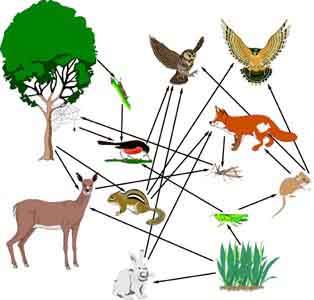
The rabbit in this food web would be considered a:
a)
Decomposer
b)
Producer
c)
Secondary Consumer
d)
Primary Consumer
99.
Which body systems work together to supply the body's cells with oxygen?
a)
Respiratory and immune
b)
Nervous and reproductive
c)
Circulatory and respiratory
d)
Endocrine and muscular
100.
The two body systems that work together to protect you from foreign pathogens are...
a)
Integumentary and immune
b)
Reproductive and muscular
c)
Endocrine and digestive
d)
Respiratory and circulatory
