
 Worksheets
Demography
Total questions: 105
Worksheet time: 56mins
Name
Class
Date
1.
What are the units for Crude Birth Rate and Crude Death Rate?
a)
% of total population
b)
% of zombie population
c)
per 100 people
d)
per 1000 people
2.
What is crude birth rate?
a)
the average number of babies born to a woman in her reproductive lifetime
b)
the total number of babies born by reproductively healthy nationals of a country
c)
the average number of babies born in a country per year as a %
d)
the number of babies born in a given year in a country per 1000 people
3.
Define life expectancy
a)
the average number of years a person can expect to live, if the conditions at the time of their birth remain the same
b)
the mean number of years a person in a developed country will live
c)
the average lifespan of a person if infant mortality decreases
d)
the mean lifespan of a newborn in a developing country
4.
The movement of greater number of people into cities.
a)
Industrial Revolution
b)
Urbanization
c)
City Migration
d)
Urban Renewal
5.
_____________ _________________ greatly increased the speed of urbanization.
a)
Civil War
b)
Industrial Revolution
c)
Great Depression
d)
Population Pyramid
6.
___________ ____________ affect were people settle.
a)
Factors
b)
Environmental Factors
c)
Physical Factors
d)
Human Factors
7.
2/3 of the world's population live within _____ miles of an ocean.
a)
100
b)
200
c)
300
d)
500
8.
How many people live in a given area.
a)
Population density
b)
Density
c)
Population area
d)
Saturation
9.
Uses patterns or colors to show how many people live in a given area.
a)
Population map
b)
Density map
c)
Population density map
d)
Population saturation map
10.
Study characteristics of human populations as well as where people settle.
a)
Geographer
b)
Cartographer
c)
Demographer
d)
Historian
11.
A graph that shows the number of males on the left side and the number of females on the right.
a)
Population pyramid
b)
Population bar graph
c)
Population statistics
d)
Population dot map
12.
Which characteristic is common to all four of these areas?
1. Siberian Plains
2. Sahara Desert
3. Amazon Rainforest
4. Russian Steppes
1. Siberian Plains
2. Sahara Desert
3. Amazon Rainforest
4. Russian Steppes
a)
They are all sparsely populated
b)
They are all found on the continent of Asia
c)
They are all located near the equator.
d)
They are all in mountainous areas.
13.
Physical features often influence where people live. Which type of environment typically has the highest population density?
a)
hills, mountains, and plateaus
b)
flat, fertile plains and river valleys
c)
wet bogs and swamps
d)
dry and barren desert regions
14.

What is one characteristic evident in this population pyramid of Vietnam in 2014?
a)
The population of youth under age 20 is growing.
b)
There are more females aged 0-4 than males.
c)
Vietnam is in Stage 2 of the Demographic Transition Model.
d)
There are more women aged 65-99 than men.
15.

What is the approximate population of men age 65-69 in the US in 2014? (see pyramid)
a)
7.5 million
b)
10.5 million
c)
5 million
d)
12 million
16.

Which of the following statements best supports the graph?
a)
Infant mortality rate has increased in most countries.
b)
Access to modern medicine has increased in many areas.
c)
War and disease have increased death rates in many countries.
17.

What is a push factor?
a)
A factor which pushes people to leave or migrate from an area (a negative force).
b)
A factor which pushes you home.
c)
A factor which pulls you or attracts you to an area (a positive force).
18.

A factor (usually a benefit) which attracts people to a certain area is called a ________.
a)
pull factor
b)
push factor
19.

Which of the following would be a pull factor (draws people to an area)?
a)
long term drought conditions
b)
high average income
c)
high rates of death due to famine
20.
Which of the following would be a pull factor (draws people to an area)?
a)
long term drought conditions
b)
high average income
c)
high rates of death due to famine
21.

To find population distribution you need to know location and _________.
a)
density
b)
jobs
c)
altitude
22.

Which of the following does NOT influence population growth rates?
a)
human factors
b)
emotional factors
c)
environmental factors
23.
Overpopulation, religious persecution, and lack of job opportunities have been push factors for _______.
a)
life expectancy
b)
educational reform
c)
migration
24.

According to the graph, which age group is the smallest for the male population in the United States?
a)
20-24
b)
85+
c)
50-54
25.

What is NOT one of the push factors that have caused migration?
a)
conflict
b)
lack of job opportunities
c)
arable (fertile) land
26.

This picture is an example of ____________.
a)
population distribution
b)
push factors
c)
cultural diffusion
27.

This is a prime example of cultural interaction. What does the photograph show?
a)
immigration
b)
diffusion of American culture to other regions
c)
transportation
28.

Migration occurs because of social, political, and --
a)
emotional factors
b)
physical factors
c)
environmental factors
29.

Which of the following choices would be considered a pull factor (positive) which would motivate people to migrate to an area?
a)
land availability
b)
religious persecution
c)
lack of job opportunities
30.

Which of the following is a way that suburban areas are like urban areas?
a)
the main roads are paved
b)
many people have cows and chickens as pets
c)
many people have a lot of land and houses are far apart
31.

Which of the following is NOT a reason why an urban (city) area would be a good location for a car factory?
a)
increased technology is available in a city
b)
a large labor supply is available in a city
c)
taxes on businesses are higher in a city
32.

Migration impacts all of the following EXCEPT--
a)
climate
b)
language
c)
traditions
33.

How could cultural diffusion have benefited humans settling in new lands?
a)
the spread of disease
b)
shared technological advancements
c)
replacing all past traditions and customs
34.

According to this table, which country is likely to have the highest emigration rate due to push (negative) factors?
a)
Costa Rica
b)
Chile
c)
Haiti
35.

According to this map, which state has the highest population growth rate?
a)
North Dakota
b)
Virginia
c)
West Virginia
36.
Which of the following does NOT influence population growth rates?
a)
climate
b)
hygiene
c)
education
37.

Oil, arable land, and water are considered--
a)
political resources
b)
natural resources
c)
economic resources
38.

Looking at this graphic, what information can be determined about the country?
a)
urban and rural populations
b)
infant mortality rates
c)
male and female distribution
39.

Based on this map, malnutrition is most likely to occur in which country?
a)
Peru
b)
Brazil
c)
Argentina
40.
One example of cultural interaction is--
a)
political shifts in other cultures
b)
economic shifts in other cultures
c)
diffusion of culture to other regions
41.
1. Industrialization and urbanization
2. Modern medicine and hygiene
3. Government policy
4. Education
These are all factors that influence--
2. Modern medicine and hygiene
3. Government policy
4. Education
These are all factors that influence--
a)
growth rates
b)
education
c)
immigration
42.
Which of the following is an EXAMPLE of a limiting factor?
a)
Water
b)
the color of the sky
c)
Migration
d)
Thick fur
43.

A supply of materials in a habitat
a)
Resources
b)
Biomes
c)
Organisms
d)
Groceries
44.

When a population grows past the ecosystem's carrying capacity, what happens to the population?
a)
Continues to grow
b)
The population starts to die off to return to carrying capcity
c)
The population will go extinct due to lack of resources
d)
The population grows then finds a new carrying capacity
45.

If a disease destroying barley plants in a field swept through an ecosystem, what would happen to the barley eating bird population in the the field ?
a)
The bird population would stay the same
b)
The bird population would infinitely increase
c)
The bird population would decrease
46.
Limiting factors are sometimes helpful because they can keep the population from getting to large.
a)
True
b)
False
47.

A large cluster of cities
a)
Megalopolis
b)
Ghetto
c)
Rural area
d)
Neighborhood
48.

The number of deaths compared to the total number of people in a population
a)
death rate
b)
doubling time
c)
population decline
d)
birth rate
49.

The growth of cities and surrounding areas
a)
migration
b)
urbanization
c)
emigration
d)
immigration
50.

Which of the following is a PULL factor for immigration?
a)
Natural disasters
b)
War
c)
Violence
d)
New job
51.

Which of the following is a PUSH factor for emigration?
a)
Family
b)
Education
c)
War
d)
New job
52.

To enter and live in a new country
a)
Emigration
b)
Immigration
c)
Urbanization
d)
Industrialization
53.
The movement of people from place to place
a)
Migration
b)
Urbanization
c)
Modernization
d)
Industrialization
54.

Sparsely populated areas such as the country side
a)
Urban areas
b)
Rural areas
c)
Suburbs
d)
Urbanization
55.

Densely populated areas such as cities
a)
Urban areas
b)
Rural areas
c)
Countryside
d)
Suburbs
56.
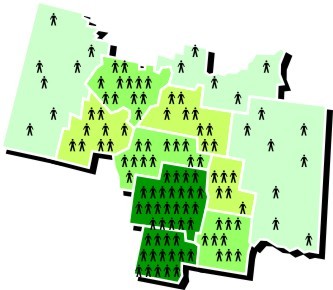
The average number of people per square mile
a)
population distribution
b)
population density
c)
urbanization
d)
population rate
57.

Which of the following is NOT a challenge to a growing population?
a)
Overcrowding
b)
Housing shortages
c)
Overuse of resources
d)
Increased food supplies
58.

Which is NOT a reason for the decreasing death rate?
a)
Better health care
b)
Greater food supply
c)
Cleaner water
d)
More pollution
59.
The number of births compared to the total number of people in a population
a)
death rate
b)
birth rate
c)
baby boom
d)
doubling time
60.

The number of years it takes a population to double in size based on its current growth rate
a)
death rate
b)
mortality rate
c)
birth rate
d)
doubling time
61.
A supply of materials in a habitat
a)
Resources
b)
Biomes
c)
Organisms
d)
Groceries
62.

Which definition best matches the term population?
a)
A measurement of people for a specific area.
b)
All the inhabitants of a particular area.
c)
Human beings in general.
d)
The increase in the number of people in a particular area.
63.

Which definition best matches the term population density?
a)
Human beings in general.
b)
Number of people in a particular area.
c)
A measurement of people for a specific area.
d)
All the inhabitants of a particular area.
64.

The number of deaths compared to the total number of people in a population is a:
a)
death rate
b)
doubling time
c)
population decline
d)
birth rate
65.

The number of births compared to the total number of people in a population is:
a)
death rate
b)
birth rate
c)
baby boom
d)
doubling time
66.

Which is NOT a reason for the decreasing death rate?
a)
Better health care
b)
Greater food supply
c)
Cleaner water
d)
More pollution
67.

Which of the following is NOT a challenge to a growing population?
a)
Overcrowding
b)
Housing shortages
c)
Overuse of resources
d)
Increased food supplies
68.

The average number of people per square mile is:
a)
population distribution
b)
population density
c)
urbanization
d)
population rate
69.

Densely populated areas such as cities are called:
a)
Urban areas
b)
Rural areas
c)
Countryside
d)
Suburbs
71.

Sparsely populated areas such as the country side are called:
a)
Urban areas
b)
Rural areas
c)
Suburbs
d)
Urbanization
71.
Sparsely populated areas such as the country side are called:
a)
Urban areas
b)
Rural areas
c)
Suburbs
d)
Urbanization
72.

The movement of people from place to place is:
a)
Migration
b)
Urbanization
c)
Modernization
d)
Industrialization
73.

What is the fertility rate?
a)
The number of children in each family.
b)
The average number of children per family.
c)
The total number of children in a city or a country.
74.

What do we usually use to show age groups?
a)
Bar charts
b)
Line graphs
c)
Pyramid graphs
75.

If a pyramid graph is wider at the base, the population is decreasing. True or false?
a)
True
b)
False
76.

If a pyramid graph is wider at the top, the population is decreasing. True or false?
a)
True
b)
False
77.

Two-thirds of the world's population is clustered in 4 regions. Which of the following is NOT one of these 4 regions?
a)
South Asia
b)
Southeast Asia
c)
Europe
d)
Sub-Saharan Africa
78.
A factor that leaves one with no choice but to leave one's current home (especially parental home), country, region, organization, or religion.
a)
environmental
b)
distribution
c)
pull factor
d)
push factor
79.
the way that something is divided or spread out
a)
routes
b)
distribution
c)
environmental
d)
push factor
80.
movement by people from one place to another with the intention of settling temporarily or permanently in the new location. The movement is typically over long distances and from one country to another
a)
pull factor
b)
push factor
c)
distribution
d)
migration
81.
thinly scattered or distributed
a)
carrying capacity
b)
immigration
c)
dense population
d)
sparse population
82.
On average, since 1950, the world infant mortality rates have
a)
slightly decreased
b)
drastically decreased
c)
stayed the same
d)
incresed slightly
83.
In terms of population pyramids, a youthful population will exhibit
a)
a tall pyramid
b)
a convex shape
c)
a wide bottom
d)
the chimney effect
84.
When describing population pyramids, we break it down to the base, the middle, and the top. These refer to
a)
youth, economically active, elderly
b)
youth, economically inactive, retired
c)
youth, working class, elderly
d)
youth, working class, elderly
85.
Areas close to rivers tend to be...
a)
Densely populated
b)
Sparsely populated
c)
Fairly populated.
d)
None of the above
86.
Deserts are usually....
a)
Densely populated
b)
Sparsely populated
c)
Fairly populated.
d)
None of the above
87.
What is a population pyramid?
a)
A type of graph showing the number of males and females in different age groups.
b)
A type of graph showing the number of males in different age groups.
c)
A type of graph showing the number of females in different age groups.
d)
A type of graph showing the number of males and females in only one age group.
88.
What does birth rate mean?
a)
The number of babies born per 1000 of the population.
b)
The number of babies that live in a country.
c)
The number of babies born per 100 of the population.
d)
The number of babies born per 1000 of the population per year.
89.
What is life expectancy?
a)
The number of years needed for one to reach 60 years.
b)
The number of years that a person is expected to live on his/her own.
c)
The number of years that a person is expected to live.
d)
What one expects to face in life.
90.
What is population density?
a)
The number of people living across Europe.
b)
The number of plants occupying an area.
c)
The number of people living in an area.
d)
The number of insects in an ecosystem.
91.
The infant mortality rate shows out of 1000 babies:
a)
the number who live past their 1st year
b)
the number who do not live past their 1st year
c)
the number who require medical attention
d)
the number who are unplanned
92.

Which of the following would be a correct fertilitity rate if India's population is growing?
a)
-1
b)
0
c)
2
d)
3
93.

Which of the following is the least accurate to determine the health of a nation?
a)
fertility rate
b)
infant mortality rate
c)
mortality rate
d)
birth rate
94.

What percentage of the population lives in the Northern Hemisphere?
a)
10
b)
30
c)
70
d)
90
95.

I study human populations. What is my title?
a)
Historian
b)
Demographer
c)
Cartographer
d)
Geographer
96.

What is the approximate population of our world?
a)
6.7 million
b)
4.3 billion
c)
7.2 billion
d)
7 trillion
97.

Which of the following is NOT one of the reasons the world's population skyrocketed?
a)
better sanitation practices
b)
people didn't want families before
c)
better methods to make and obtain food
d)
healthcare was more accessible
98.

In a group of 1000 people the number of live births would be considered the _________.
a)
growth rate
b)
infant rate
c)
baby total
d)
birth rate
99.

Which of the following would be a correct fertilitity rate if India's population is growing?
a)
-1
b)
0
c)
2
d)
3
100.
What happens if there are more births than deaths in an area?
a)
The population increases
b)
The population decreases
c)
The fertility rate increases
d)
The fertility rate decreases
101.
What's the world population?
a)
507 million people
b)
More than 7 billion people
c)
About 730 million people
102.

The average number of people per square mile
a)
population distribution
b)
population density
c)
urbanization
d)
population rate
103.

Which of the following is NOT a challenge to a growing population?
a)
Overcrowding
b)
Housing shortages
c)
Overuse of resources
d)
Increased food supplies
104.

A large cluster of cities
a)
Megalopolis
b)
Ghetto
c)
Rural area
d)
Neighborhood
105.

Which is NOT a reason for the decreasing death rate?
a)
Better health care
b)
Greater food supply
c)
Cleaner water
d)
More pollution
100 %

