Wayground logo

Free Printable Worksheets

Font size

S
M
L
XL
Worksheets

Ecosystem Review

Total questions: 50

Worksheet time: 2hrs 45mins

Name
Class
Date
1.

What are the reactants (ingredients) in cellular respiration?

a)
Water and Glucose
b)
Oxygen and Glucose
c)
Carbon Dioxide and Water
d)
Twenty One Pilots
2.

What are the products ( materials made) in cellular respiration?

a)
Energy (ATP), Water, and Carbon DIoxide.
b)
Water and Oxygen
c)
Oxygen and Carbon Dioxide
d)
Water and Energy (ATP)
3.
Where does cellular respiration take place in the cell?
a)
Cell Membrane
b)
Nucleus
c)
Mitochondria
d)
Vacuole
4.
What kind of things perform cellular respiration?
a)

Both plants and Animals

b)
plants only
c)
animals only
d)
yeast only
5.
Where in the cell does photosynthesis occur?
a)
mitochondria
b)
stomata
c)
xylem
d)
chloroplast
6.
Using carbon dioxide and water to create glucose and oxygen is
a)
photosynthesis
b)
respiration
c)
diffusion
d)
osmosis
7.
Which organisms perform Photosynthesis?
a)
Only Autotrophs
b)
Only Heterotrophs
c)
Autotrophs and Heterotrophs
8.
This is referred to as the energy form used by cells.
a)
ADP
b)
ATP
c)
Mitochondria
d)
Nucleus
9.
What is the ultimate ORIGINAL source of energy for living things
a)
Sugar
b)
Sun
c)
Moon
d)
Carbon Dioxide
10.
In the energy pyramid here, which organisms have the most energy available?
a)
Producers
b)
Carnivores
c)
Herbivores
d)
Top Predator
11.
In the energy pyramid below, which organism has the least amount of energy available?
a)
Producers
b)
Herbivores
c)
Carnivores
d)
Top Predator
12.
In the energy pyramid here, how much of the energy in the producers gets passed to the herbivores?
a)
10%
b)
20%
c)
80%
d)
90%
13.
What percentage of energy is passed on to each tropic level?
a)
10%
b)
50%
c)
90%
d)
100%
14.
Transfer of energy is represented by this in a food chain.
a)
Circles
b)
Arrows
c)
neon lights
d)
pyramids
15.
Barnacles create home sites by attaching themselves to whales. This relationship neither harms nor benefits the whales. 
a)
parasitism
b)
commensalism
c)
mutualism
16.
Yucca flowers are pollinated by yucca moths. The moths lay their eggs in the flowers where the larvae hatch and eat some of the developing seeds. Both species benefit. 
a)
parasitism
b)
commensalism
c)
mutualism
17.
Mistletoe extracts water and nutrients from a spruce tree. The spruce tree is harmed. 
a)
parasitism
b)
commensalism
c)
mutualism
18.
 The stork uses it saw-like bill to cut up the dead animals it eats. As a result, the dead animal carcass is accessible to some bees for food and egg laying. The relationship neither harms nor benefits the stork.
a)
parasitism
b)
commensalism
c)
mutualism
19.
When taken to a new habitat, non-native plants often threaten native plants of the new habitat.  Why do they do this?
a)
Non-native plants are able to mutate rapidly
b)
Non-native  plants cause native animals to relocate
c)
Non-native plants are able to be used for medicine
d)
Non-native plants compete with native plants for resources
20.
Kudzu has overgrown many parts of southern Missouri and native ground plants have disappeared from the area. This is an example of:
a)
Parasitism between kudzu and the native plants
b)
A predator prey relationship between ground plants and kudzu
c)
Competition occurring between the native and invasive species
d)
Commesalism occurring between the kudzo and native plants
21.
1. What makes a species invasive?
a)
Moving to a new ecosystem and taking resources from natives 
b)
Not having papers
c)
Species that can't adapt
d)
Plants that take up too much space
22.
Which organism recieves the least amount of energy from the producer?
a)
Owl
b)
Grasshopper
c)
Lilypad
d)
Mouse
23.

What is an environmental factor that prevents a population from increasing?

a)

Carrying Capacity

b)

Immigration

c)

Limiting Factor

d)

Population Density

24.

Which factors only affect a population when it reaches a certain density?

a)

Density Dependent Limiting Factors

b)

Density Independent Limiting Factors

c)

Emigration

d)

Immigration

25.

What term describes the largest population that an environment can support?

a)

Carrying Capacity

b)

Limiting Factor

c)

Population

d)

Population Density

26.

What are factors that affect a population no matter what its density is?

a)

Density Dependent Limiting Factors

b)

Density Independent Limiting Factors

c)

Population Density

d)

Carrying Capacity

27.

What is the carrying capacity of the dragon population in North Dakota?

a)

0

b)

200

c)

1000

d)

There isn't a carrying capacity.

28.

Which of the following is an example of a density independent limiting factor?

a)

Parasitism

b)

Crowding

c)

Disease

d)

Natural Disaster

29.

An organism that obtains energy and nutrients by feeding on other organisms or their remains.

a)

Consumer

b)

producer

c)

decomposer

30.

Bacteria and fungi that break down dead plant and animals.

a)

Consumer

b)

producer

c)

decomposer

31.
The fox in this food web would be considered a:
a)
Tertiary Consumer
b)
Producer
c)
Secondary Consumer
d)
Primary Consumer
32.

Recently, a family of bobcats(predator) moved into an area with a large rabbit(prey) population. What changes may occur in the food chain?

a)

The rabbit population may increase

b)

The rabbit population may decrease

c)

The rabbit population may increase first, then decrease

d)

The rabbit population will remain the same

33.
The rabbit in this food web would be considered a:
a)
Decomposer
b)
Producer
c)
Secondary Consumer
d)
Primary Consumer
34.

Represent the direction of energy flow from one organism to another

a)

food chain

b)

food web

c)

arrows

35.

An animal that is hunted, caught and eaten by another animal.

a)

carnivore

b)

predator

c)

prey

36.
What is the water cycle?
a)
the 3 forms of water
b)
the movement of water on, above, or below the surface of the Earth
c)
when water melts
d)
when clouds form
37.
Which is the opposite of condensation?
a)
runoff
b)
evaporation
c)
precipitation
d)
transpiration
38.
Snow, sleet, hail, and rain are all examples of  ________________. 
a)
evaporation
b)
condensation
c)
accumulation
d)
precipitation
39.
What is it called when plants give off water vapor as a waste product?
a)
condensation
b)
evaporation
c)
sublimation
d)
transpiration
40.

Which animal has the least amount of energy?

a)

Eagle

b)

Lizard

c)

Gradd

d)

Rabbit

41.

Which organism has the most amount of energy?

a)

Eagle

b)

Grass

c)

Snail

d)

Rabbit

42.

What eats only meat?

a)

Carnivores

b)

Herbivores

c)

Omnivores

d)

Cows

43.

What eats only plants?

a)

Carnivores

b)

Herbivores

c)

Omnivores

d)

Eagles

44.

What eats both plants and animals?

a)

Carnivore

b)

Herbivores

c)

Omnivore

d)

Cows

45.

Which activity does NOT contribute to the increase in carbon dioxide in the atmosphere?

a)

Burning Fossil Fuels

b)

Planting More Trees

c)

Cutting Down Trees

d)

Driving a Car

46.

During photosynthesis plants take in _____________________.

a)

oxygen

b)

glucose

c)

carbon dioxide

d)

water

47.

Process that release oxygen during oxygen cycle

a)

Respiration

b)

Photosynthesis

c)

Combustion

d)

Decomposition

48.

Process that release carbon dioxide during carbon cycle

a)

Respiration

b)

Combustion

c)

Photosynthesis

d)

Decomposition

49.

Combustion of fossil fuels is the process that release

a)

oxygen

b)

carbon dioxide

c)

nitrogen

d)

hydrogen

50.
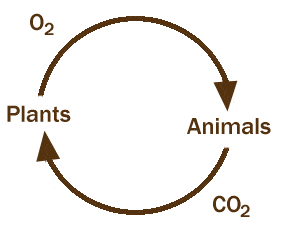
Which statement is true about the carbon dioxide-oxygen cycle?
a)
animals breathe in nitrogen and release oxygen which is used by plants
b)
animals breathe in oxygen and release carbon dioxide which is used by plants
c)
animals breathe in nitrogen and release carbon dioxide which is used by plants
d)
animals breathe in carbon dioxide and release oxygen which is used by plants