
 Worksheets
LE: Organic Compounds
Total questions: 38
Worksheet time: 21mins
Name
Class
Date
1.

Biochemistry is the study of...?
a)
inorganic compounds
b)
organic compounds
2.

Inorganic compounds come from ___________.
a)
living things
b)
nonliving things
3.

Organic compounds must contain what element?
a)
carbon
b)
nitrogen
c)
phosphorous
d)
calcium
4.

Which of the following is NOT considered to be a carbohydrate?
a)
sugar
b)
bread
c)
butter
d)
pasta
5.

The sugars found in fruits are considered to be what type of organic compound?
a)
carbohydrate
b)
lipid
c)
protein
d)
nucleic acid
6.

Nucleic acids are found in what types of food?
a)
bread, cereals, grains
b)
fruits & vegetables
c)
meat, poultry, & fish
d)
all of these!
7.

What are the building blocks, or monomers, of proteins?
a)
hormones
b)
amino acids
c)
glucose molecules
d)
fatty acids
8.

The simple, repeating units of organic compounds (aka building blocks) are called what?
a)
monomers
b)
polymers
c)
nutrients
d)
complex
9.

Many monomers together build large, complex compounds called what?
a)
monomers
b)
dimers
c)
peptides
d)
polymers
10.

What is the process by which large, organic compounds are broken down into smaller units?
a)
synthesis
b)
digestion
c)
chewing
d)
chemosynthesis
11.

By which process to smaller units, called monomers, combine to form larger, organic compounds?
a)
dehydration synthesis
b)
hydrolysis
c)
chemical makeup
d)
photosynthesis
12.

Which organic compound is primarily used to make ENERGY?
a)
carbohydrates
b)
proteins
c)
fats
d)
nucleic acids
13.

Which organic compound is used for stored energy and cell structures?
a)
lipids
b)
carbohydrates
c)
nucleic acids
d)
proteins
14.

Which of the following is NOT a lipid?
a)
fat
b)
oil
c)
wax
d)
starch
15.

DNA & RNA are examples of what type of organic compound?
a)
lipids
b)
carbohydrates
c)
nucleic acids
d)
proteins
16.

Most end-products of complete chemical digestion are described as
a)
high-energy inorganic compounds
b)
small, soluble organic molecules
c)
large, insoluble organic molecules
d)
complex, inorganic molecules
17.

In animals, which occurs during the synthesis of larger, more complex organic molecules from smaller organic molecules?
a)
Water is released.
b)
Oxygen is released.
c)
Nitrogen is absorbed.
d)
Phosphorus is absorbed.
18.

The diagram below represents a protein molecule present in some living things. This type of molecule is composed of a sequence of what?
a)
amino acids arranged in a specific order
b)
simple sugars alternating with starches arranged in a folded pattern
c)
large inorganic subunits that form chains that interlock with each other
d)
four bases that make up the folded structure
19.

An energy-rich organic compound needed by organisms is
a)
water
b)
salt
c)
oxygen
d)
glucose
20.

The shape of a protein molecule directly determines the
a)
movements through the cytoplasm
b)
functions inside and outside of cells
c)
roles in building water molecules
d)
circulation throughout the body
21.

Which group consists entirely of organic molecules?
a)
protein, oxygen, fat
b)
protein, starch, fat
c)
water, carbon dioxide, oxygen
d)
water, starch, protein
22.

This process best represents
a)
the bonding of amino acids to form a starch
b)
the digestion of amino acids to form a starch molecule
c)
the bonding of simple sugars to form a starch molecule
d)
the digestion of simple sugars to form a starch molecule
23.

Which row in the chart below correctly pairs a food molecule with its building block?
a)
1
b)
2
c)
3
d)
4
24.

The inability of an organism to produce certain proteins can occur when an organism is lacking an enzyme needed to combine
a)
oxygen molecules
b)
simple sugars
c)
amino acids
d)
biological compounds
25.
How do enzymes speed up chemical reaction?
a)
Increasing activation energy
b)
Decreasing activation energy
c)
Increasing deactivation energy
d)
Decreasing deactivation energy
26.
What is a substance called if it speeds up a chemical reaction?
a)
reusable
b)
catalyst
c)
specific
d)
fragile
27.
With what 3 letters do enzymes typically end?
a)
-ose
b)
-ase
c)
-ese
d)
-tic
28.
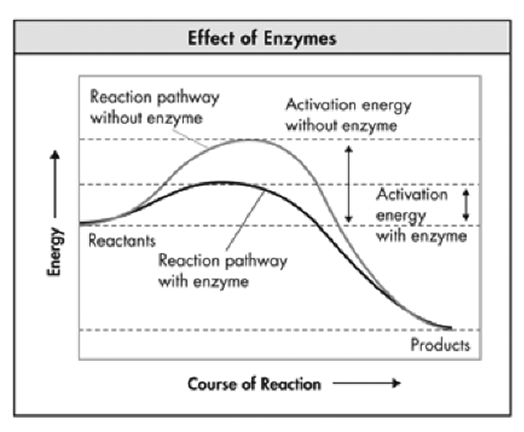
The graph shows how enzymes affect reactions in cells. Which statement best summarizes the information shown in the graph?
a)
Enzymes increase the energy of the reactants.
b)
Enzymes decrease the energy level of the products.
c)
Enzyme decrease the activation energy of the reaction.
d)
Enzymes reverse the direction of the reaction.
29.
Any substance that is acted upon by an enzyme is called a(n)?
a)
Coenzyme
b)
Substrate
c)
Vitamin
d)
Polypeptide
30.
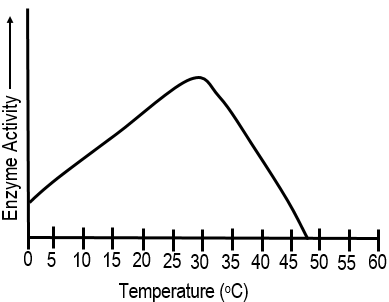
Based on the graph, what is the optimal temperature for this enzyme?
a)
15oC
b)
40oC
c)
30oC
d)
35oC
31.
Enzymes are...
a)
nucleic acids
b)
proteins
c)
lipids
d)
carbohydrates
32.
An enzyme speeds up a chemical reaction in the cell but can only be used once. True or False?
a)
true
b)
false
33.
What is the function of an enzyme?
a)
enzymes break themselves into small pieces
b)
enzymes slow down chemical reactions
c)
enzymes speed up chemical reactions
d)
enzymes combine products to form reactants
34.
What happens when enzymes are heated to a high temperature?
a)
The enzymes die.
b)
The shapes of the enzyme are altered denature
c)
The enzymes' amino acid sequence changes.
d)
The enzymes remain the same
35.
What is another name for enzymes?
a)
chemical catalysts
b)
microorganisms
c)
biological catalysts
d)
inorganic catalysts
36.
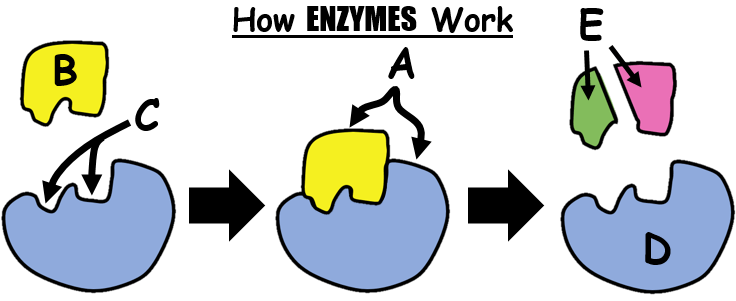
Letter C...
a)
active site
b)
enzymes
c)
substrate
d)
products
37.
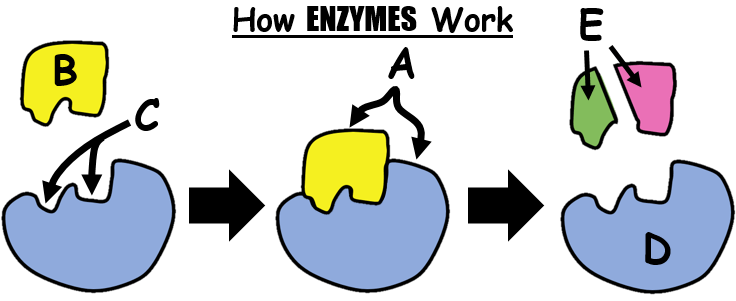
Letter B...
a)
active site
b)
enzyme
c)
substrate
d)
products
38.
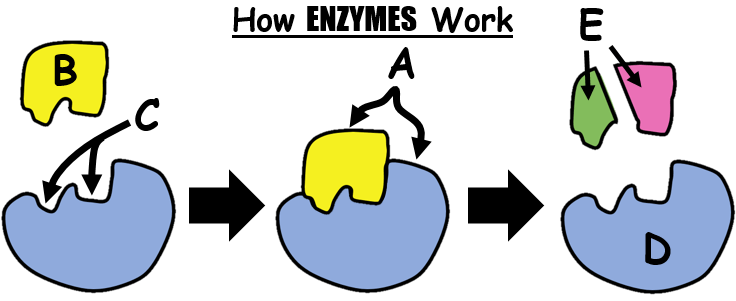
Letter E...
a)
active site
b)
enzyme
c)
substrate
d)
products
100 %

