wayground logo

Free Printable Worksheets

NEW

Font size

S
M
L
XL
Worksheets

Fingerprints

Total questions: 35

Worksheet time: 19mins

Name
Class
Date
1.
The area indicated by "A" in the diagram is known as a 
a)
Core
b)
Delta
c)
Whorl
d)
Arch
2.
The area indicated by "B" in the diagram is known as a(n)
a)
Core
b)
Delta
c)
Whorl
d)
Arch
3.
Which statement best describes the ridges in a whorl?
a)
The ridges in the core enter and exit the same side of the finger
b)
The ridges in the core enter and exit opposite sides of the finger
c)
Ridges in the core form a circle 
4.

A fingerprint is considered individual evidence.

a)

False

b)

True

5.
Invented by the Japanese. You place an object in a chamber and heat up this substance
a)
Iodine
b)
Ninhydrine
c)
superglue
d)
Black powder
6.

The technique shown produces only a temporary orange or brown print.

a)

iodine

b)

superglue fuming

c)

dusting

d)

minuatie

7.

The most common form of developing latent prints

a)

Dusting

b)

Silver Nitrate

c)

Ninhydrin

d)

Black light

8.
The most common ridge pattern is the: 
a)
arch
b)
whorl
c)
loop
d)
accidental
9.

IAFIS is a(n):

a)

method used to determine the age of latent print

b)

computer software designed to track fingerprint evidence within the chain of custody

c)

assay technique used to identify drugs

d)

computerized system for storing and retrieving fingerprint records

10.
What item is not considered a porous surface?
a)
paper
b)
cloth
c)
cardboard
d)
tile
11.

Which chemical treatment produces a white-appearing latent print?

a)

superglue fuming

b)

black powder

c)

iodine fuming

d)

ninhydrin

12.
Which of the following types of fingerprints are more likely to be found impressed in soft wax? 
a)
visible
b)
latent
c)
hidden 
d)
plastic
13.
Under which circumstances have two people been found to have identical fingerprints? 
a)
identical twins
b)
fraternal twins
c)
members of the same immediate family
d)
none to date
14.
An invisible print that must be developed using powder or chemicals is called
a)
plastic
b)
latent
c)
patent
d)
underdeveloped
15.

The tiny details in fingerprints used to match one fingerprint to another are called

a)

ridges

b)

details

c)

match points

d)

minutiae

16.
The least common fingerprint pattern is the 
a)
loop
b)
whorl
c)
arch
d)
they all occur equally
17.
A print that comes in and out on the same side is called
a)
An arch
b)
A loop
c)
A whorl
18.
Which type of fingerprint cannot be seen  the naked eye?
a)
patent fingerprint
b)
latent fingerprint
c)
visible fingerprint
d)
plastic fing
19.
When are fingerprints formed?
a)
When you are a teenager
b)
During fetal development
c)
By the time you are two years old
d)
At birth
20.
Type of fingerprint that is left by a person with soiled or stained fingertips
a)
plastic
b)
visible
c)
latent
21.

When a fingerprint expert takes the witness stand and says he's absolutely certain two fingerprints match, he means he's found

a)

at least 5 or more matching minutiae

b)

at least 12 or more matching minutaie

c)

at least 20 or more matching minutiae

d)

at least 50 or more matching minutiae

22.
What are the two types of arches?
a)
radial, ulnar
b)
plain, tented
c)
plain, central pocket 
d)
radial, central pocket 
23.
What are the two types of loops?
a)
radial, ulnar
b)
plain, tented
c)
plain, central pocket
d)
double loop, central pocket 
24.
How many deltas will an arch pattern have?
a)
0
b)
1
c)
2
d)
it's not always the same number 
25.
How many deltas does a loop have?
a)
1
b)
2
c)
3
d)
it's not always the same
26.
How many deltas does a whorl have? 
a)
1
b)
0
c)
at least 2 
d)
3 or more 
27.
What component of a fingerprint constitutes individual evidence?
a)
Class
b)
Minutiae
c)
Subclass
d)
Class and subclass
28.
The image was taken from the right hand.  What type of loop is it?
a)
Radial
b)
Ulnar
29.
What type of whorl is shown?
a)
Plain
b)
Central Pocket
c)
Double Loop
d)
Accidental
30.
What type of fingerprint is shown in the diagram below?
a)
Plain arch
b)
Plain whorl
c)
Central Pocket whorl
d)
Double Loop whorl
31.
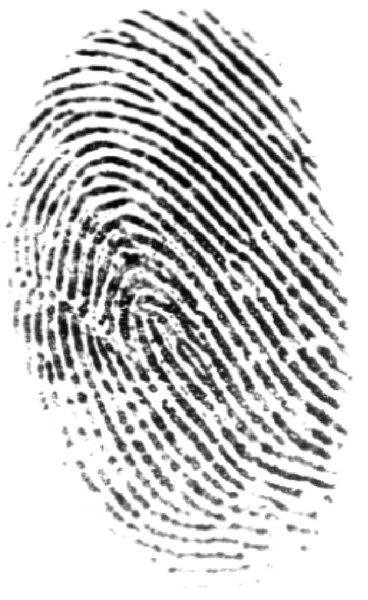
What pattern is this?
a)
Loop
b)
Arch
c)
Whorl
32.
a)
arch
b)
loop
c)
whorl 
33.
Print is on the right hand
a)
arch
b)
radial loop
c)
ulnar loop
d)
whorl 
34.
a)
Central pocket whorl
b)
Double loop whorl
c)
Plain whorl
d)
Plain arch
35.
What type of whorl is shown?
a)
Plain
b)
Central Pocket
c)
Double Loop
d)
Accidental