
 Worksheets
Earth Layers and Plate Tectonics
Total questions: 52
Worksheet time: 47mins
Name
Class
Date
1.

The four layers that make-up the earth’s composition are
a)
Crust, Lithosphere, Mesosphere and Core
b)
Lithosphere, Asthenosphere, Mantle and Core
c)
Crust, Mantle, Outer Core and Inner Core
d)
Mantle, Outer Core, Lithosphere and Crust
2.

Large pieces of lithosphere that move around on the asthenosphere are called
a)
Crust plates
b)
Tectonic plates
c)
Mantle pieces
d)
Core plates
3.

The hypothesis that land masses spread apart from each other and have done so in the past is known as
a)
Divergent Plate Boundary
b)
Tension
c)
Uplift
d)
Continental drift
4.

Where does sea-floor spreading take place?
a)
Convergent Boundaries
b)
Transform Boundaries
c)
Land Boundaries
d)
Mid-Oceanic Ridges
5.

The core is made-up of what two elements?
a)
iron and nickel
b)
iron and oxygen
c)
nickel and silicon
d)
oxygen and silicon
6.

What is the thinnest layer of the earth’s composition?
a)
mantle
b)
inner core
c)
crust
d)
outer core
7.

The thickest layer of the earth is the
a)
crust
b)
mantle
c)
inner core
d)
outer core
8.
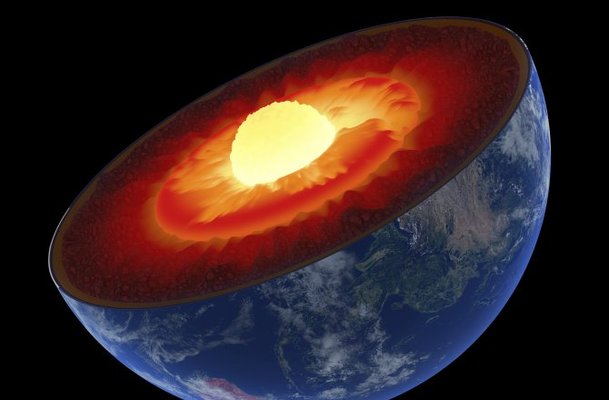
When the crust sinks down into the mantle, what happens to it?
a)
It becomes a tectonic plate.
b)
It slowly floats up.
c)
It sinks to the inner core.
d)
It melts.
9.
The order of the earth’s compositional layers from most dense to least dense are:
a)
Inner Core, Crust, Mantle and Outer Core
b)
Crust, Mantle, Outer Core and Inner Core
c)
Inner Core, Outer Core, Mantle and Crust
d)
Crust, Outer Core, Inner Core and Mantle.
10.
What type of boundary occurs when two tectonic plates slide past each other horizontally?
a)
divergent
b)
convergent
c)
transform
d)
uplift
11.
Tectonic plates are made up of continental crust and ________ crust.
a)
continental
b)
oceanic
c)
plates
d)
mantle
12.
What is the theory that all continents were once joined together in one single large landmass?
a)
Plate Tectonics
b)
Pangaea
c)
Continental Drift
d)
Subduction
13.
What type of boundary occurs when two tectonic plates collide?
a)
divergent
b)
convergent
c)
transform
14.
What did Wegener call the single, large, landmass containing all of our current continents?
a)
continental drift
b)
plate tectonics
c)
Pangaea
15.
What type of boundary occurs when two tectonic plates separate?
a)
divergent
b)
convergent
c)
transform
16.

There are ____ physical layers of the Earth.
a)
2
b)
1
c)
5
d)
7
17.
There are three types of convergent boundaries: oceanic-oceanic, continental-oceanic, and __________.
a)
continental-continental
b)
continental-convergent
c)
oceanic-convergent
d)
divergent-convergent
18.
According to the Continental Drift Theory, the Earth's plates are moving at a very quick pace.
a)
True
b)
False
19.
What is the deepest layer of the Earth a person has ever gotten to?
a)
the crust
b)
the upper mantle
c)
the mantle
d)
the outer core
20.
What are the chunks of crust called?
a)
continents
b)
tectonic plates
c)
crustal floats
d)
tectonic plains
21.
Where are oceans located?
a)
on top of oceanic plates
b)
on top of continental plates
c)
in holes of continental crust
d)
in areas where the crust does not exist
22.
What describes the outer core?
a)
solid
b)
liquid
c)
viscous
d)
gas
23.
What was the name given to all the continents when they were joined as one super continent?
a)
Supreme Continent
b)
Eurasia
c)
Plate tectonics
d)
Pangea
24.
Which of the following occurs because of convection currents?
a)
Tectonic plates on the crust move.
b)
The mantle increases in size.
c)
Pressure in the crust increases.
d)
Pressure in the crust decreases.
25.

Scientists think that convection currents that move the plates flow in Earth's
a)
Continental crust
b)
Oceanic crust
c)
Asthenosphere
d)
Lithosphere
26.

As you travel from the inner core to the crust, how would temperature, pressure and density of the material change?
a)
The would all increase
b)
The would all decrease.
c)
They would stay the same.
d)
Temperature would decrease, but pressure and density would increase.
27.

The physical layer of Earth made of solid rock and soil is called the ___________.
a)
mesosphere
b)
lithosphere
c)
asthenosphere
d)
mantle
28.
Where does the heat come from that drives this convection current in the mantle?
a)
The sun
b)
The crust
c)
the mantle
d)
the core
29.
What does the theory of continental drift state?
a)
The continents were once joined in a super-continent and have moved over time
b)
Continents are stationary and do not move
c)
The Earth is broken into lithospheric plates that move due to convection currents
d)
none of the above
30.

Name the boundary
a)
convergent boundary
b)
divergent boundary
c)
transform boundary
d)
sergent boundary
31.

Name the boundary
a)
convergent boundary
b)
divergent boundary
c)
transform boundary
d)
sergent boundary
32.

Name the boundary
a)
convergent boundary
b)
divergent boundary
c)
transform boundary
d)
sergent boundary
33.
During sea floor spreading, molten material rises up from the mantle...
a)
along the continents
b)
at the mid ocean ridges
c)
deep ocean trenches
d)
at north and south poles
34.
Which of the following is where one plate slides under another plate?
a)
submarine zone
b)
divergence zone
c)
subduction zone
d)
lower zone
35.
Associated with transform boundaries.
a)
Volcanoes
b)
mountains
c)
trenches
d)
earthquakes
36.
This land formation occurs at a divergent continental/ continental boundary.
a)
mid ocean ridge
b)
deep ocean trench
c)
pacific hot spot
d)
rift valley
37.
Mountains form from ...
a)
plates sliding past one another
b)
collision of plates
c)
plates moving away from each other
38.
Oceanic crust is
a)
Younger and less dense than continental crust
b)
Thinner, younger and more dense than continental crust
c)
Older, thicker and less dense that continental crust
d)
Bigger and younger than continental crust
39.
Earth's plates are...
a)
constantly moving and changing the face of the earth
b)
Never moves
c)
Moves seldom and very fast
d)
Moves when it feels like it
40.
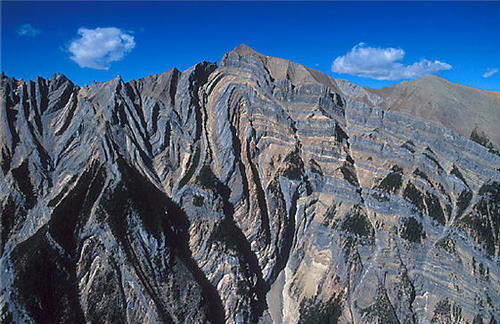
What type of boundary do folded mountains often occur?
a)
convergent with subduction
b)
convergent without subduction
c)
divergent
d)
transform
41.
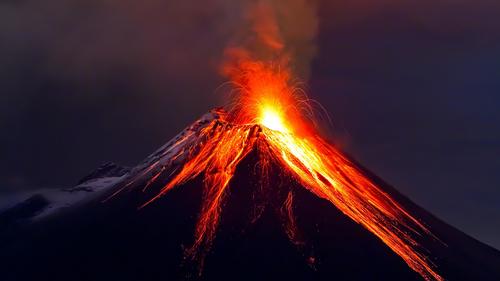
What type of boundary do volcanoes most commonly occur?
a)
strike-slip
b)
divergent
c)
convergent with subduction
d)
convergent without subduction
42.
What causes geologic land forms and events like mountains, volcanoes, and earthquakes?
a)
Hot Spots
b)
Tectonic Plate Movement
c)
Earthquakes
d)
Volcanic Eruptions
43.
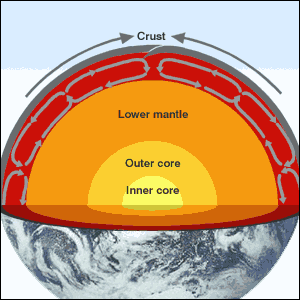
Convection heat transfer in the earths Mantle is known as_________.
a)
strike-slip
b)
convection currents
c)
reverse
d)
normal
44.
Supporting Evidence: fossils, continent shape, landforms
a)
Continental Drift
b)
Seafloor Spreading
c)
Plate Tectonics
45.
Supporting Evidence: subduction, earthquakes, volcanoes, Mid-Atlantic Ridge, older theories
a)
Continental Drift
b)
Seafloor Spreading
c)
Plate Tectonics
46.
Supporting Evidence: discovery of Mid-Atlantic Ridge, core rock samples showing older rocks the farther that you get from the mid ocean ridge
a)
Continental Drift
b)
Seafloor Spreading
c)
Plate Tectonics
47.
The name for the actual lithospheric plates
a)
Tectonic Plates
b)
Plate Tectonics
c)
Pangaea
d)
Continental Drift
48.
The process for new oceanic lithosphere forming at mid ocean ridges
a)
Continental Drift
b)
Seafloor Spreading
c)
Plate Tectonics
d)
Pangaea
49.
The circular pattern of heating, rising, cooling, sinking of magma in the mantle causing tectonic plates to move.
a)
Plate Tectonics
b)
Convection Currents
c)
Pangaea
d)
Subduction
50.
Volcanoes are most often formed at this boundary.
a)
Divergent
b)
Convergent
c)
Normal
d)
Transform
51.
The Mid-Atlantic Ridge is formed at this boundary.
a)
Divergent
b)
Convergent
c)
Normal
d)
Transform
52.
Hot spots are volcanically active areas that are not near tectonic plate boundaries.
a)
True
b)
False
100 %

