wayground logo

Free Printable Worksheets

Font size

S
M
L
XL
Worksheets

Life Science-Genetics

Total questions: 112

Worksheet time: 2hrs 53mins

Name
Class
Date
1.
The allele for hemophilia is on the X chromosome and is a ________________.
a)
hybrid gene
b)
heterozygous gene
c)
sex-linked gene
d)
incomplete dominance gene
2.
A homozygous dominant dog with brown fur is crossed with a heterozygous dog with brown fur. What are the percentages of the possible genotypes?
a)
100% BB
b)
75% BB and 25%Bb
c)
50 % BB and 50% Bb
d)
50% Bb and 50% bb
3.
The man who studied genetics and came up with genetics is
a)
Watson
b)
Crick
c)
Mendel
d)
Darwin
4.
Genotype refers to the ...
a)
physical expression of the genes
b)
the possible combination of alleles in a gene
c)
whether an allele is dominant or recessive
d)
how an organism will appear
5.
Squidward has light blue skin, and his genotype for this trait is Bb. Would Squidward be considered a purebred or hybrid for light blue skin?
a)
Purebred
b)
Hybrid
6.
An offspring will receive how many alleles from each parent to determine a specific trait?
a)
one
b)
two
c)
three
d)
five
7.
Which of the following is a phenotype?
a)
BB
b)
Bb
c)
bb
d)
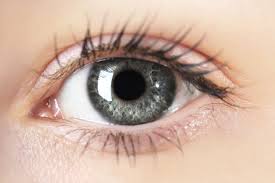
Blue eyes
8.
What is a phenotype
a)
The genetic make up (code)
b)
The physical trait
9.
the passing of genetic traits from parent to offspring.
a)
heredity
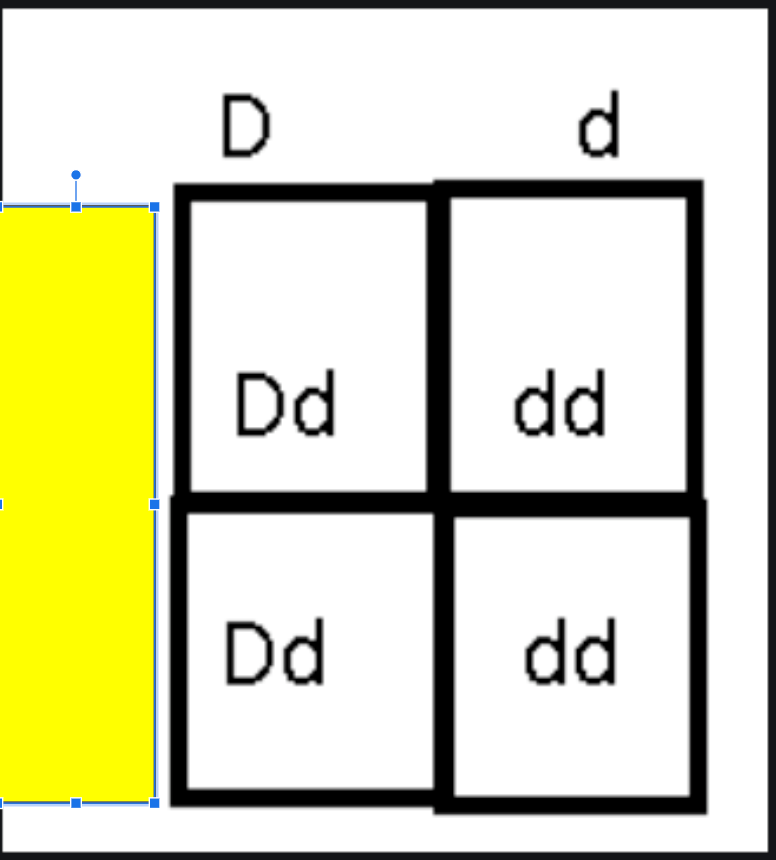
b)
trait
c)
gene
d)
allele
10.
having two of the same genes for the trait (sometimes called purebred).
a)
homozygous
b)
hetrozygous
c)
protein
d)
chromosome
11.
having two different genes for a trait (sometimes called hybrid).
a)
protein
b)
homozygous
c)
heterozygous
d)
genotype
12.
Two brown eyed parents (Bb) have a baby. What is the chance the baby is blue eyed?
a)
0 %
b)
25%
c)
50%
d)
75%
13.
G = green, g = yellow
The genotype for a yellow plant is...
a)
GG
b)
Gg
c)
gg
d)
all of the choices result in yellow
14.
An allele whose trait only shows up when no dominant allele is present.
a)
hidden allele
b)
dominant allele
c)
recessive allele
d)
present allele
15.
Two heterozygous (Tt) tall pea plants are crossed. Which describes their offspring?
a)
50% tall and 50% short
b)
75%tall and 25% short
c)
100%short
16.
W=white hair
w= non-white hair
If you cross a horse with WW and a horse with ww what fraction of the offspring would be expected to have white hair?
a)
none
b)
3/4
c)
1/2
d)
all
17.
Who is considered the "father of genetics"?
a)
Gregor Mendel
b)
Reginald Punnett
c)
James Watson
d)
Justin Bieber
18.
T = tall an t = short
What is the phenotype for Tt?
a)
short
b)
tall
c)
medium sized
d)
neither tall or short
19.
G = green, g = yellow
The genotype for a yellow plant is...
a)
GG
b)
Gg
c)
gg
d)
all of the choices result in yellow
20.
In a heterozygous genotype, the ___________ allele takes over in the phenotype.
a)
recessive
b)
dominant
c)
lower case letter
d)
both 
21.
Aa is
a)
homozygous (purebred)
b)
heterozygous (hybrid)
22.
Which of the following is a phenotype?
a)
Aa
b)
red hair
c)
heterozygous genes
d)
mutated DNA
23.
Which of the following alleles is homozygous (purebred) recessive?
a)
Tt
b)
tt
c)
TT
d)
t
24.
How many alleles (letters) do each person carry for a trait?
a)
1
b)
2
c)
3
d)
4
25.
How many alleles (letters) does a child get from each parent for each trait?
a)
1
b)
2
c)
3
d)
4
26.
T - tall and t = short
In the punnett square below, what belongs in the missing square
a)
tt
b)
Tt
c)
Bb
d)
TT
27.
Which of the following is homozygous dominant?
a)
Yy
b)
Y
c)
yy
d)
YY
28.
In a flowering plant species, red flower color (R) is dominant over white flower color (r). What is the genotype of any red-flowering plant resulting from this species?
a)
rr
b)
R
c)
RR
d)
RR or Rr
29.
In a flowering plant species, red flower color (R) is dominant over white flower color (r). What is the probability of having a white flowered plant if the parents were heterozygous red and homozygous red?
a)
0%
b)
25%
c)
50%
d)
100%
30.
___________________________ is the study of how traits are passed on, or inherited.
a)
dominant traits
b)
ratio
c)
phenotype
d)
genetics
31.
In a Punnett square each box represents a(n)....
a)
offspring
b)
parent
c)
gene
d)
trait
32.
Heredity is the passing of traits from _____________________ to _____________________
a)
predators to prey
b)
water to rain
c)
parents to offspring
d)
fungi to protists
33.
A ________________________ is used to predict the possible genotype from certain parents
a)

Mendel Grid

b)

Genetic Tic Tac Toe

c)

Punnett Square

d)

Pedigree Plot

34.
If you have two identical alleles for a trait, then you are
a)
homozygous
b)
heterozygous
c)
dominant
d)
a hybrid
35.
Heterozygous is when...
a)
the alleles are the same
b)
the alleles are different
c)
the alleles are absent
d)
the alleles are present
36.
What are the possible combinations of a pea plant with the alleles PP and a male pea plant with the alleles pp.
P= purple
p= white
a)
all Pp
b)
all PP
c)
Pp,PP,Pp,PP
d)
all pp
37.
Are recessive traits shown with capital or lowercase letters? 
a)
Capital
b)
Lowercase
38.
T = tall an t = short
TT and Tt would result in  the following phenotype
a)
short
b)
tall
c)
both tall and short
d)
neither tall or short
39.
Purebred is another word for __________, while hybrid is another word for __________.
a)
dominant; recessive
b)
recessive; dominant
c)
homozygous; heterozygous
d)
heterozygous; homozygous
40.
What is a phenotype?
a)
The expression of a trait; physical appearance.
b)
refers to the genetic makeup of an individual
c)
An organism that has the same genes for a trait (ex. TT or tt)
d)
the passing of traits from parent to offspring
41.
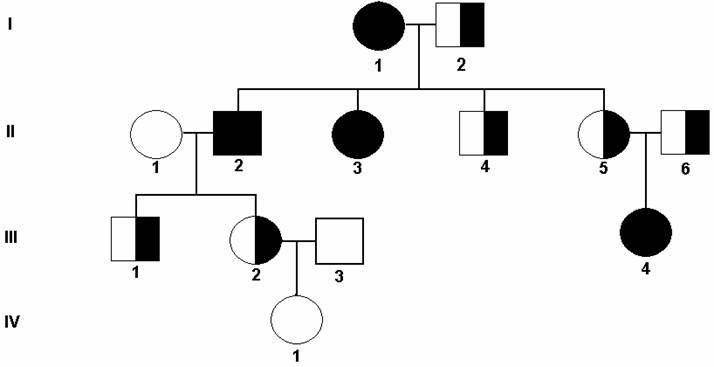
Which individual in the first generation is a carrier?
a)
The male
b)
The female
c)
individual 1
d)
None of the above
42.
In the second generation, how many people have the disease or display the physical trait?
a)
2
b)
4
c)
5
d)
6
43.
How many people in this whole pedigree have the trait/disease?
a)
2
b)
3
c)
4
d)
6
44.
Freckles (F) are dominant over non-freckles (f).   What is the phenotype of individual #3?
a)

Ff

b)

ff

c)

freckles 

d)

nonfreckles 

45.
The image shows:
a)
Not affected Female
b)
Not affected Male
c)
Affected Male
d)
Affected Female
46.
The image shows:
a)
Not Affected Male
b)
Not Affected Female
c)
Affected Male
d)
Affected Female
47.
Which of the following combinations of sex chromosomes represent a female?
a)
XY
b)
XXY
c)
XX
d)
XYY
48.
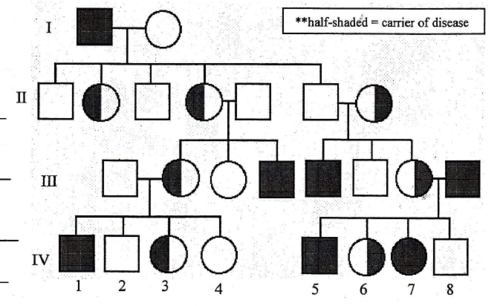
Which members of the family above are afflicted with Huntington's Disease?
a)
I-1, II-2, II-3, II-7, and III-3
b)
I-1, I-2, II-3, II-7, and III-5
c)
I-1, I-3, II-8, and III-2
d)
I-2, II-1, II-4, II-5, II-6, II-8, III-1, III-2, III-4, and III-5
49.
There are no carriers for Huntington's Disease- you either have it or you don't. Is Huntington's disease caused by a dominant or recessive trait?
a)
Dominant
b)
Recessive
50.
How many children did individuals I-1 and I-2 have?
a)
2
b)
4
c)
6
d)
8
51.
How many girls did II-1 and II-2 have?
a)
1
b)
2
c)
3
d)
4
52.
How many of II-1 and II-2's girls have Huntington's?
a)
1
b)
2
c)
3
d)
4
53.
Which gender can be carriers of colorblindness and not have it?
a)
Just males
b)
Just females
c)
Both genders
54.
What kind of trait is colorblindness if females can be carriers without having the disease?
a)
Regular trait
b)
Sex-linked trait
55.
The genetic makeup of an organism is called its _______________.
a)
phenotype
b)
genotype
c)
polygenic inheritance
d)
genetics
56.
Through______________ scientists are experimenting to change the arrangement of DNA in a gene.
a)
sex-linked genes
b)
polygenic inheritance
c)
genetic engineering
d)
incomplete dominance
57.
What type of blood can receive any type of blood?
a)
A
b)
B
c)
AB
d)
0
58.
What blood type is the "universal donor" because it can be donated to anyone?
a)
A
b)
B
c)
AB
d)
O
59.
What is the phenotype of a person with the genotype AO?
a)
type A
b)
type O
c)
AA
d)
OO
60.
A woman has type B blood and her husband has type O blood.  What must be the woman's genotype, if they have a child with type O blood?
a)
BO
b)
BB
c)
OO
d)
type B
61.
When the genetic code of an organism is altered by artificial means, we call this
a)
adaptation
b)
selective breeding
c)
genetic engineering
d)
natural selection
62.
What should students use to identify the percent chance of a trait being passed down from a parent to its offspring?
a)
a graph
b)
a flow chart
c)
a data table
d)
a Punnett square
63.
Which statement best supports why many offspring look similar to their parents?
a)
Offspring inherit characteristics from one parent.
b)
Offspring inherit characteristics from both parents.
c)
Parents choose which characteristics to pass on to their offspring.
d)
Parents choose to change their appearance to match that of their offspring.
64.
When the allele combination is a dominate and a recessive trait together which trait will be seen?
a)
Dominate
b)
Recessive
c)
none
d)
both
65.
Homozygous is when...
a)
the alleles are the same
b)
the alleles are different
c)
the alleles are absent
d)
the alleles are present
66.
B = brown fur  b = white fur
In the punnett square, what is the probability for white fur? 
a)
0%
b)
25%
c)
50%
d)
75%
67.
Aa is
a)
homozygous (purebred)
b)
heterozygous (hybrid)
68.
What is a phenotype?
a)
The expression of a trait; physical appearance.
b)
refers to the genetic makeup of an individual
c)
An organism that has the same genes for a trait (ex. TT or tt)
d)
the passing of traits from parent to offspring
69.
Homozygous or heterozygous?
BB
a)
Homozygous
b)
Heterozygous
70.
Which of the following is a phenotype?
a)
Aa
b)
red hair
c)
heterozygous
d)
DNA
71.
What are the possible combinations of a pea plant with the alleles PP and a male pea plant with the alleles pp.
P= purple
p= white
a)
all Pp
b)
all PP
c)
Pp,PP,Pp,PP
d)
all pp
72.
Dominant or recessive?
Dd
a)
Dominant
b)
recessive
c)
neither
d)
homozygous
73.
Dominant or recessive?
tt
a)
Dominant 
b)
Recessive
74.
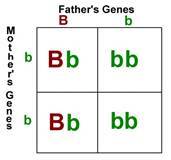
T - tall and t = short
In the punnett square below, what belongs in the missing square
a)
tt
b)
Tt
c)
Bb
d)
TT
75.
What you see, or the physical appearance.
a)
Genotype
b)
Phenotype
c)
Homozygous
d)
Heterozygous
76.
What is the probability of heterozygous offspring?
a)
25%
b)
50%
c)
0%
d)
100%
77.
What allele combination should go in the missing box?
a)
AA
b)
Aa
c)
aa
d)
none of these
78.
Each one of the boxes on the Punnett Square represents what probability of an offsprings' genotype?
a)
25%
b)
1%
c)
10%
d)
0%
79.
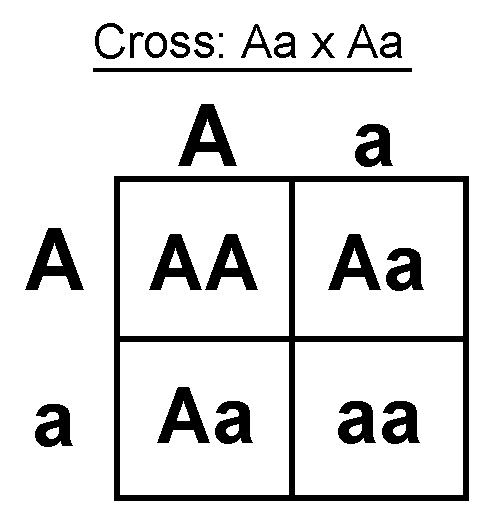
Which choice best represents the genotype of this cross?
a)
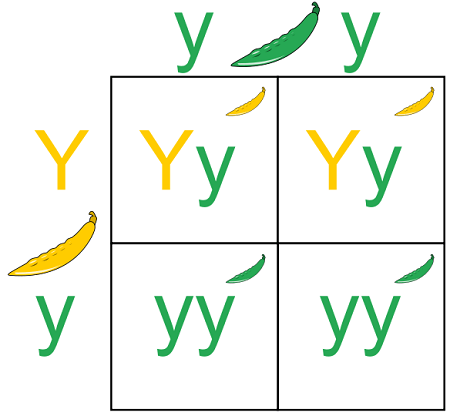
1 Yy: 2 yy: 0 YY
b)
2 Yy: 2 yy: 0 YY
c)
3 Yy: 1 yy: 0 YY
d)
1 Yy: 3 yy: 0 YY
80.
What is the phenotype of the offspring? (A-Brown hair; a-blond hair) 
a)
50 % Brown Hair and 50% Blond Hair 
b)
25 % Brown Hair and 75% Blond Hair 
c)
75 % Brown Hair and 25% Blond Hair 
d)
0% Brown Hair and 100% Blond Hair 
81.
Which of the following genotypes is homozygous dominant?
a)
A
b)
Aa
c)
AA
d)
aa
82.
Which of the following genotypes is heterozygous?
a)
Bb
b)
BB
c)
bb
d)
B
83.
Which of the following is homozygous recessive?
a)
Tt
b)
tt
c)
TT
d)
T
84.
Which of the following genotypes is heterozygous?
a)
Bb
b)
BB
c)
bb
d)
B
85.
Which of the following genotypes is homozygous dominant?
a)
A
b)
Aa
c)
AA
d)
aa
86.
In pea plants, the tall allele is dominant to the short allele. What key would demonstrate this?
a)
Tall = T
Short = S
b)
Tall = T
Short = t
c)
Tall = t
Short = T
d)
Tall = TT
Short = tt
87.

Which of the following is a homozygous recessive genotype?

a)

HH

b)

dd

c)

Aa

88.

Which of the following is a Homozygous Dominant Genotype?

a)

Yy

b)

XX

c)

zz

89.

Which of the following is a heterozygous genotype?

a)

Gg

b)

UU

c)

pp

90.

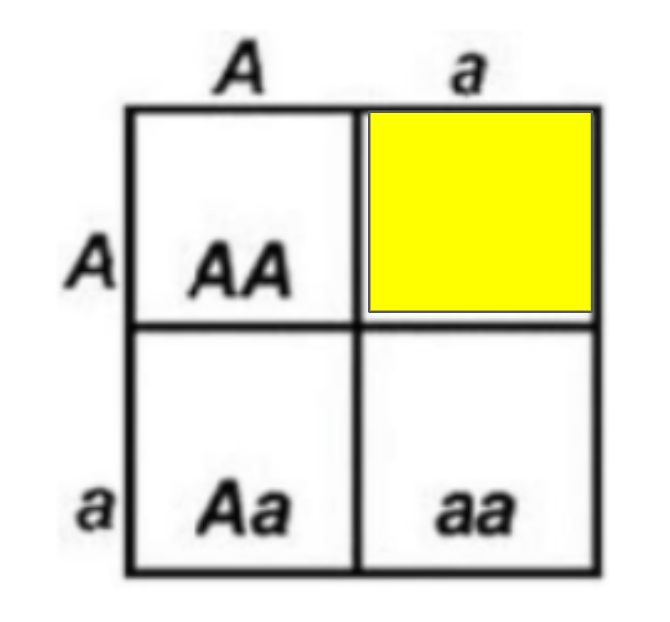
Fill in the Yellow Box

a)

AA

b)

Aa

c)

aa

91.

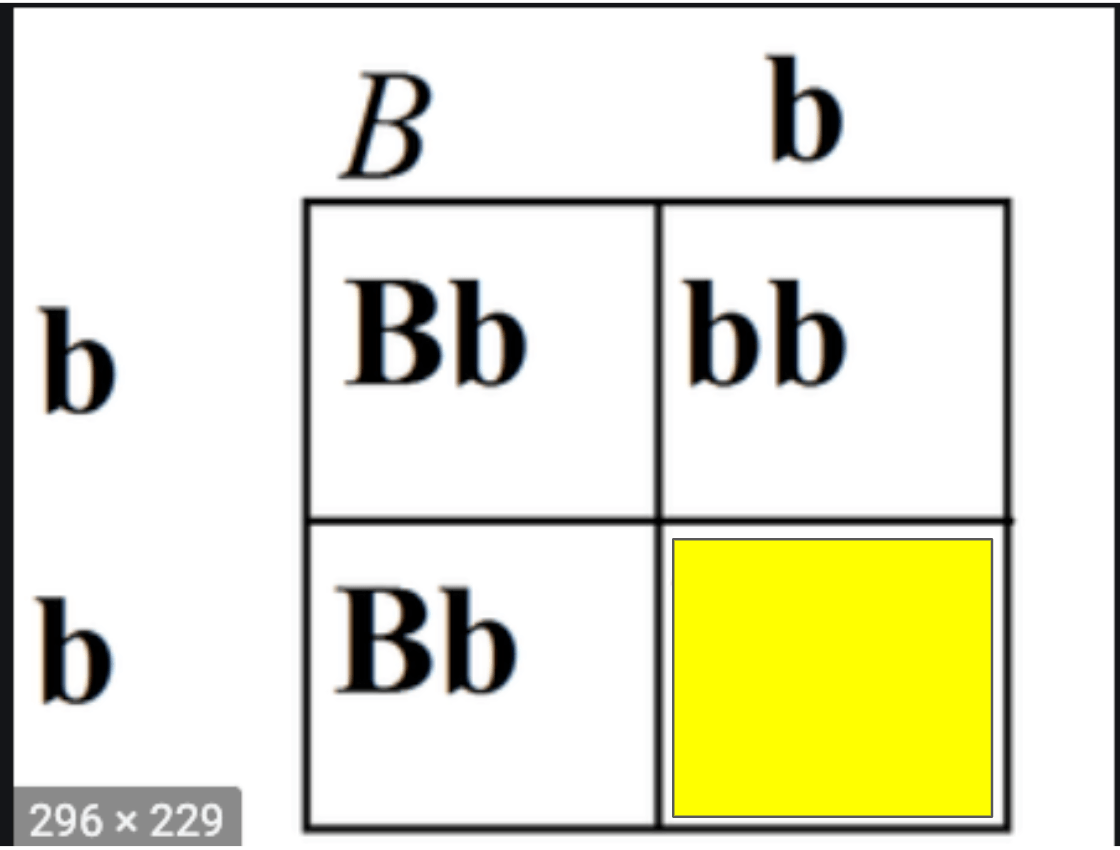
Fill in the Yellow Box

a)

Bb

b)

BB

c)

bb

92.

What is the mother's genotype?

a)

DD

b)

Dd

c)

dd

93.

Dominant alleles are represented by a:

a)

capital letter

b)

lowercase letter

94.

AA and Aa will both show up as ___________________ traits.

a)

dominant

b)

recessive

95.

What is the probability that the offspring will have blue eyes?

a)

25%

b)

50%

c)

75%

d)

100%

96.

What is the likelihood that the offspring will have brown eyes (B)?

a)

0%

b)

100%

97.

Which trait is dominant?

a)

pink

b)

white

98.

A tall pine tree (Tt) is crossed with a tall pine tree (Tt). What is the likelihood that an offspring would be tall?

a)

0%

b)

25%

c)

50%

d)

75%

99.

A tall pine tree (Tt) is crossed with a tall pine tree (Tt). What is the likelihood that an offspring could be short?

a)

0%

b)

25%

c)

50%

d)

75%

100.

Round seeds are dominant (R). Wrinkled seeds are recessive (r). What is the likelihood that this offspring is wrinkled (r)?

a)

0%

b)

25%

c)

50%

d)

75%

101.

Round seeds are dominant (R). Wrinkled seeds are recessive (r). What is the likelihood that this offspring is round (R)?

a)

0%

b)

25%

c)

50%

d)

75%

102.

G = green, g = yellow

The genotype for a yellow plant is...

a)

GG

b)

Gg

c)

gg

d)

all of the choices result in yellow

103.

B = brown fur b = white fur

In the punnett square, what is the probability for white fur?

a)

0%

b)

25%

c)

50%

d)

75%

104.

In plants, tall (T) is dominant to short (t). Perform the following cross: Tt x Tt. What is the probability of producing a short plant?

a)

0%

b)

25%

c)

50%

d)

75%

105.

Aa, DD, Ba, and yy are all examples of ---

a)

genotypes

b)

phenotypes

106.

Which of the following alleles is purebred recessive?

a)

Tt

b)

tt

c)

TT

107.

AA and Aa always show up as ---

a)

dominant.

b)

recessive.

108.

A trait controlled by a recessive allele only appears in the organism's phenotype ---

a)

if the organism is a hybrid.

b)

if the organism does not have any dominant alleles.

c)

if the organism is a purebred.

109.
In a flowering plant species, red flower color (R) is dominant over white flower color (r). What is the genotype of any red-flowering plant resulting from this species?
a)
rr
b)
R
c)
RR
d)
RR or Rr
110.
A homozygous dominant brown mouse is crossed with a heterozygous brown mouse (tan is the recessive color). 
a)
100 % tan
b)
100 % brown 
c)
50 % brown and 50% tan 
d)
75 % brown and 25 % tan 
111.

If a heterozygous parent and a homozygous recessive parent mate, what percentage of their offspring will be dominant?

a)

25%

b)

50%

c)

75%

d)

100%

112.
What you see, or the physical appearance.
a)
Genotype
b)
Phenotype
c)
Homozygous
d)
Heterozygous