
 Worksheets
Unit 4 States of Matter and Energy
Total questions: 63
Worksheet time: 2hrs 25mins
Name
Class
Date
1.
If the atoms of an object are moving fast, the temperature would be...
a)
High
b)
Low
2.
If the atoms of an object are moving slow, the object would feel...
a)
Cold
b)
Hot
3.
What is the measure of the average kinetic energy of the particles in an object?
a)
Motion
b)
Temperature
c)
Thermal Energy
d)
Heat
4.
What is an increase in the size of a substance in response to an increase in the temperature of the substance called?
a)
Thermal Contraction
b)
Thermal Property
c)
Thermal Expansion
d)
Expansion Property
5.
The kinetic theory of matter states that all of the particles that make up matter are constantly
a)
growing
b)
shrinking
c)
crying
d)
moving
6.
Particles in a solid move __________, than particles in a liquid
a)
faster
b)
slower
7.
Particles in a liquid move __________, than particles in a gas
a)
faster
b)
slower
8.
Particles in a gas move __________, than particles in a solid
a)
faster
b)
slower
9.
What is the definition of sublimation?
a)
a chemical process where a solid turns into a gas without going through a liquid stage
b)
the process of a liquid changing into a gas
10.
Sublimation is a chemical change. (True or False)
a)
False
b)
True
11.
The temperature at which a solid can change to a liquid.
a)
Boiling Point
b)
Color
c)
Density
d)
Melting Point
12.
The temperature at which a substance changes from a liquid to a gas.
a)
Boiling Point
b)
Color
c)
Density
d)
Melting Point
13.
The movement of gas molecules is greatly affected by _________.
a)
the shape of the container
b)
size of the container
c)
temperature of the container
14.
In which state of matter are the particles only vibrating and not in motion?
a)
Gas
b)
Liquid
c)
Solid
d)
Plasma
15.
In which state of matter are the particles moving the least random
a)
Gas
b)
Liquid
c)
Solid
d)
Plasma
16.
If you place a balloon in a freezer what happens to the size of the balloon?
a)
Doubles
b)
increases
c)
decreases
d)
stays still
17.
The energy of an object as it is in motion is defined as
a)
Kinetic Theory
b)
Kinetic energy
c)
Potential energy
d)
Electric energy
18.
When a liquid changes to a solid, it _________.
a)
gains energy
b)
looses energy
c)
shares energy
d)
does not have energy
19.
The total energy of the particles in a substance
a)
pressure
b)
heat
c)
chemical energy
d)
thermal energy
20.
A measure of the average kinetic energy of all particles in an object is ______________
a)
thermometer
b)
Celsius
c)
temperature
d)
scalar
21.
The transfer of thermal energy between objects that are different temperatures is ___________.
a)
temperature
b)
thermal energy
c)
heat
d)
specific heat
22.
The theory that states that all particles in matter are constantly moving; helps to describe the phases of matter
a)
behavior of gases
b)
kinetic theory
c)
matter matters
d)
temperature
23.

Which form of matter has a definite shape like this picture?
a)
liquid
b)
solid
c)
gas
d)
clay
24.

Which form of matter take the shape of a container like this juice?
a)
liquid
b)
solid
c)
glass
d)
gas
25.

Which form of matter fills the space like it has in the balloon?
a)
liquid
b)
string
c)
solid
d)
gas
26.
What is happening when my ice cream changes from a solid to a liquid?
a)
freezing
b)
melting
c)
burning
d)
evaporation
27.
What is happening when water in the freezer changes from a liquid state to a solid state?
a)
melting
b)
evaporating
c)
freezing
d)
cutting
28.
What happens when my glass of water is sitting in the sun and disappears into a gas?
a)
evaporation
b)
burning
c)
melting
d)
freezing
29.
Which of the following statement is true for Gas
a)
The atoms are close together. They able to slide around
b)
The atoms are spread out and move freely.
c)
The atoms are packed closely together. They don't move much.
30.
Which form of matter does not take the shape of its container?
a)
liquid
b)
gas
c)
solid
d)
air
31.

Which of the images shown below represent liquid
a)
A
b)
B
c)
C
32.
Sublimation is . . . .
a)
solid to gas
b)
gas to solid
c)
solid to liquid
d)
liquid to gas
33.
Deposition is . . . .
a)
gas to solid
b)
solid to gas
c)
gas to liquid
d)
liquid to solid
34.
Condensation is . . . .
a)
gas to liquid
b)
liquid to gas
c)
gas to solid
d)
solid to liquid
35.
Evaporation (or vaporization) is . . . .
a)
liquid to gas
b)
gas to liquid
c)
solid to gas
d)
liquid to solid
36.
Melting (or fusion) is . . . .
a)
solid to liquid
b)
liquid to solid
c)
liquid to gas
d)
solid to gas
37.
Freezing (or solidification) is . . . .
a)
liquid to solid
b)
solid to liquid
c)
solid to gas
d)
solid to plasma
38.
To create dew (transforming vapor to liquid water), what do you need?
a)
add heat
b)
remove heat
c)
add cold
d)
add salt particles
39.
To transform water from ice (solid) to liquid, what do you need to add?
a)
heat
b)
vapor
c)
salt
d)
oxygen
40.
How many atoms of hydrogen are in each molecule of water?
a)
One
b)
Two
c)
Three
d)
Four
41.
Vaporization is the term we use to describe which phase change?
a)
Solid to a liquid
b)
Solid to a gas
c)
Gas to a liquid
d)
Liquid to a gas
42.

When a puddle of water dries up this process is called
a)
Condensation
b)
Evaporation
c)
Melting
d)
Freezing
43.

What is the boiling point of water?
a)
80 degrees Celsius
b)
27 degrees Celsius
c)
90 degrees Celsius
d)
100 degrees Celsius
44.

When water boils, what is inside the bubbles?
a)
Air
b)
Water
c)
Water Vapor (Steam)
d)
Carbon Dioxide
46.
Increasing the energy of particles will cause the particles to
a)
Move faster and spread out
b)
Slow down move closer together
c)
Get bigger
d)
Get smaller
46.
Increasing the energy of particles will cause the particles to
a)
Move faster and spread out
b)
Slow down move closer together
c)
Get bigger
d)
Get smaller
48.
Which state of matter does NOT have a definite volume?
a)
Solid
b)
Liquid
c)
Gas
48.
Which state of matter does NOT have a definite volume?
a)
Solid
b)
Liquid
c)
Gas
49.
What state of matter has a definite volume but an indefinite shape
a)
Solid
b)
Liquid
c)
Gas
50.
Which type of vaporization occurs below the surface?
a)
Boiling
b)
Evaporating
51.
Thermal energy is...
a)
heat energy.
b)
the energy of motion
c)
energy of nuclear processes.
d)
an indication of physical change.
55.
The slower the particles in a substance move,
a)
the colder it is.
b)
the warmer it is.
c)
the more energy it has.
d)
the less energy it has.
53.
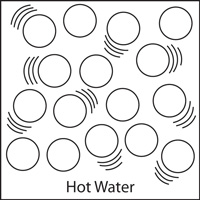
The speed of the molecules determines the _____.
a)
volume
b)
density
c)
pressure
d)
temperature
54.
Define a liquid.
a)
Indefinite shape, indefinite volume
b)
Definite shape, definite volume
c)
Found in stars
d)
Definite volume, indefinite shape
55.
The slower the particles in a substance move,
a)
the colder it is.
b)
the warmer it is.
c)
the more energy it has.
d)
the less energy it has.
56.

After burning this candle all day, the candle has melted. Which statement best describes the melted candle?
a)
It is a solid because it fills up the jar
b)
It is a liquid because it fills up the jar
c)
It is a solid because it takes the shape of the jar
d)
It is a liquid because it takes the shape of the jar
57.

Change of state from a solid directly to a gas is called
a)
deposition
b)
melting
c)
evaporation
d)
sublimation
58.

Freezing, condensation and deposition are all changes that involve ______________.
a)
increase in temperature/energy
b)
decrease in temperature/energy
59.
Law of conservation of mass states that
a)
matter is created
b)
matter is destroyed
c)
matter is neither created nor destroyed
d)
matter does not change
60.
What is a closed system?
a)
a system where none of the reactants or products are allowed to escape
b)
compounds made of thousands of repeating smaller molecules
c)
the output, or result of a chemical reaction
d)
occurs when the atoms and molecules of two or more substances rearrange to form new substances
61.
Fill in the blank:
It is best to observe the law of conservation of mass in a _____________________ because it will ensure that the mass is the same in the beginning and end of a chemical reaction.
It is best to observe the law of conservation of mass in a _____________________ because it will ensure that the mass is the same in the beginning and end of a chemical reaction.
a)
closed
b)
open
c)
balanced
d)
rearranged
62.
Can matter be created or destroyed?
a)
Yes, it can be created.
b)
Yes, it can be destroyed.
c)
No, matter is always conserved
d)
None of these
63.
The higher the average kinetic energy the __________________
a)
the higher the volume
b)
the higher the mass
c)
the higher the temperature
d)
the higher the density
100 %

