
Font size
S
M
L
XL
 Worksheets
6th Gr ACP Review
Total questions: 131
Worksheet time: 4hrs 4mins
Name
Class
Date
1.
A pure substance is matter that has...
a)
definite physical and chemical properties that do not change.
b)
definite chemical properties that do not change.
c)
definite physical properties that do change.
d)
definite chemical and physical properties that do not change.
2.
A pure substance that cannot be separated into simpler substances by chemical or physical means.
a)
Element
b)
Compound
c)
Mixture
d)
Chemical
3.
These contain only one kind of atom.
a)
element
b)
compound
c)
mixture
d)
water
4.
Elements can be broken down into simpler substances.
a)
false
b)
true
c)
sometimes
5.
A compound is made of ________ atoms.
a)
big
b)
similar
c)
different
6.
Carbon Dioxide is a ______
a)
compound
b)
element
c)
mixtures
d)
Battle of Bunker Hill
7.
Salt is a _________.
a)
compound
b)
element
c)
mixture
8.
Which of the following represents an element?
a)
H2O
b)
H2
c)
NaCl
d)
CaCO3
9.
Which of the following is not a compound?
a)
HCl
b)
Cl
c)
NaCl
d)
CO2
10.
A combination of substances that are not chemically combined is called a(n)____________.
a)
mixture
b)
compound
c)
physical
11.

This picture represents which of the following?
a)
element
b)
compound
c)
mixture of elements
d)
mixture of compounds
12.

This picture represents which of the following?
a)
element
b)
compound
c)
mixture
13.

This picture represents which of the following?
a)
element
b)
compound
c)
mixture
14.
How many elements are represented in the compound?
Na2CO3
Na2CO3
a)
1
b)
2
c)
3
d)
4
15.
Two or more different substances not chemically combined?
a)
mixture
b)
compound
c)
compound formula
16.
The letter in the periodic table box represents the?
a)
atomic #
b)
name
c)
symbol
17.
The word that appears in the periodic table box represents the?
a)
name
b)
atomic weight
c)
symbol
18.
The number located below the name of the element in the periodic table represents the?
a)
name
b)
atomic #
c)
atomic weight
19.
The atomic number represents the number of ___________ found in the nucleus of an atom.
a)
protons
b)
electrons
c)
neutrons
20.
The atomic number also represents the number of ____________ surrounding the nucleus of an atom.
a)
electrons
b)
protons
c)
neutrons
21.
The atomic weight- the atomic number tells us how many _____________ are in the nucleus of an atom.
a)
protons
b)
neutrons
c)
electrons
22.
What kind of properties can only be observed when a substance changes into a different substance?
a)
physical properties
b)
chemical properties
c)
liquid properties
d)
real properties
23.
Which of the following is a sign that a chemical reaction has occurred?
a)
change in shape
b)
melting
c)
formation of a gas
d)
dissolving
24.
Is hammering wood together to build a house a chemical or physical change?
a)
chemical
b)
physical
25.
Is melting butter for popcorn a chemical or physical change?
a)
chemical
b)
physical
26.

Is burning wood a chemical or physical change?
a)
chemical
b)
physical
27.
A change in the size, shape, or state of matter.
a)
chemical change
b)
physical change
c)
chemical reaction
d)
electron change
28.
Which of the following is NOT an example of a physical change?
a)
crumpled paper
b)
pencil sharpening
c)
shrunken clothing
d)
sour milk
29.
Kim puts an ice cube in a beaker and it melts. This is a good example of:
a)
a physical change.
b)
a chemical change.
c)
an experiment.
d)
an analysis.
30.
Hydrochloric acid reacts with magnesium to produce hydrogen gas
a)
Physical change
b)
Chemical change
31.
A granular substance is added to a liquid. Which of the following would provide evidence to suggest a chemical change has taken place?
a)
The liquid gives off heat.
b)
The granules dissolve completely.
c)
The volume of the liquid increases.
d)
The granules seem to get smaller.
32.
A student observes some sugar as it is heated and burns. The student concludes that a chemical reaction has occurred. Which of the following observations about the burning sugar provides evidence of a chemical reaction?
a)
Heat is added to the sugar crystals.
b)
The sugar melts and becomes a liquid.
c)
Gas is produced as the sugar turns black.
d)
No evidence of chemical reaction is present.
33.
A student mixes two clear liquids together. After a few minutes, a white powdery solid can be seen settling on the bottom of the test tube. Which of the following is a conclusion that the student can draw based on these observations? The two clear liquids –
a)
were pure substances before they were mixed.
b)
are toxic and should be handled with extreme caution.
c)
have gone through a chemical change in which a new substance called a precipitate was produced.
d)
have been stored too long and are no longer good.
34.
Which type of element is a good conductor of heat and electricity?
a)
Metals
b)
Nonmetals
c)
Metalloids
d)
Metals and Nonmetals
35.
Which type of element is a poor conductor of heat and electricity?
a)
Metals
b)
Nonmetals
c)
Metalloids
d)
Metals and Nonmetals
36.
Which type of element is a semiconductor?
a)
Metals
b)
Nonmetals
c)
Metalloids
d)
Metals and Nonmetals
37.
Which type of elements are usually shiny?
a)
Metals
b)
Nonmetals
c)
Metalloids
d)
Metals and Nonmetals
38.
Which type of elements are usually dull?
a)
Metals
b)
Nonmetals
c)
Metalloids
d)
Metals and Nonmetals
39.
Which type of elements are to the left of the Periodic Table?
a)
Metals
b)
Nonmetals
c)
Metalloids
d)
Metals and Metalloids
40.
Which type of elements are to the right of the Periodic Table?
a)
Metals
b)
Nonmetals
c)
Metalloids
d)
Metals and Metalloids
41.
Which type of elements touch the zigzag line?
a)
Metals
b)
Nonmetals
c)
Metalloids
d)
Metals and Metalloids
42.
Which types of elements are brittle with low densities or mostly gases?
a)
Metals
b)
Nonmetals
c)
Metalloids
d)
Metals and Metalloids
43.
______________ describes the way a substance reflects light, or SHINES.
a)
ductile
b)
brittle
c)
luster
d)
magnetic
44.
If a metal is ___________ it can be drawn into a wire.
a)
magnetic
b)
ductile
c)
conductive
d)
metalloid
45.
Which of the following properties is true for metalloids?
a)
is a semiconductor with properties of both is a semiconductor with properties of both metals and nonmetals
b)
always conducts electricity and is shiny
c)
they are not elements
d)
never conducts electricity and is dull
46.
______________ describes how well the substance can be hammered into sheets.
a)
Ductility
b)
Conductivity
c)
Luster
d)
Malleability
47.

Which table below correctly lists the properties of metals and nonmetals? *
a)
A
b)
B
c)
C
d)
D
48.
What is the formula for density?
a)
density = mass x volume
b)
density = mass / volume
c)
density = mass + volume
d)
density = mass - volume
49.
Frank has an eraser. It has a mass of 4g, and a volume of 2cm3. What is its density?
a)
8 g/cm3
b)
2 g/cm3
c)
1/2 g/cm3
d)
24 g/cm3
50.

Which box has a higher density?
a)
Box A
b)
Box B
c)
cannot be determined
d)
they are the same
51.
Jack has a rock. The rock has a mass of 20g and a volume of 2cm3. Jack breaks the rock in half. What is the density of each piece of rock?
a)
20 mL
b)
10 g/cm3
c)
5 g/cm3
d)
2 g/cm3
52.

What is the volume of Object X?
a)
10.0 cm3
b)
15.0 cm3
c)
20.0 cm3
d)
25.0 cm3
53.
__________ is stored energy.
a)
Potential
b)
Kinetic
c)
None of the above
d)
All of the above
54.
When you are holding a book, energy is stored between the book and Earth; this type of energy is called ________ potential energy.
a)
Kinetic
b)
Potential
c)
Gravity
d)
Friction
55.
Gravitational potential energy depends on the ________ and ________ of the object.
a)
Height and mass
b)
Friction and movement
c)
Mass and Movement
d)
Height and Friction
56.

What type of energy transformation happens in this object?
a)
Radiant to Electric
b)
Electric to Thermal
c)
Potential to Kinetic
d)
Kinetic to Potential
57.

The glow sticks produce light for a short amount of time. The light from the glow stick is a conversion from what to what?
a)
thermal to light
b)
gravitational to potential
c)
radiant to electrical
d)
chemical to light
58.

At which point is potential energy greatest?
a)
W
b)
X
c)
Y
d)
Z
59.

What is the speed of an object that travels 60 meters in 4 seconds?
a)
240 m/s
b)
15 m/s
c)
0.067 m/s
d)
15 mph
60.

A runner races in the 100 meter dash (distance). It takes her 10 seconds to finish (time). What is her average speed?
a)
10 m/s
b)
1000 m/s
c)
100 seconds
d)
10 seconds
61.

What is velocity?
a)
the quickness of an object
b)
the location of an object
c)
acceleration
d)
speed in a specific direction
62.

Are forces balanced or unbalanced when a car is moving at a constant speed in a straight line?
a)
Balanced
b)
Unbalanced
63.

A girl is pushing a cart by herself with a force of 7 N. What will happen if a boy begins to help her and their combined force is 17 N?
a)
The cart will speed up.
b)
The cart will slow down.
c)
The cart will move at a constant speed in a straight line.
d)
The cart will fly to never never land!
64.

Are the forces acting on the rope balanced or unbalanced?
a)
Balanced
b)
Unbalanced
65.

Are forces balanced or unbalanced when plates at a transform fault move and cause an earthquake?
a)
Balanced
b)
Unbalanced
66.

Which runner started out the fastest?
a)
Albert
b)
Bob
c)
Charlie
67.

At which point on the graph is the object decelerating?
a)
A - B
b)
B - C
c)
C - D
d)
D - E
68.

At which point is the object accelerating?
a)
A - B
b)
B - C
c)
D - E
d)
E - F
69.

What is happening in this graph from point B to C?
a)
The object is going down a hill.
b)
The object is returning to its starting location.
c)
The object is slowing down.
d)
The object is staying still.
70.

Calculate the speed of the object using this graph.
a)
Speed = 5 m/s
b)
Speed = 50 m/s
c)
Speed = 2 m/s
d)
Speed = 3 m/s
71.

Calculate the speed of object B.
a)
6 m/s
b)
2 m/s
c)
1 m/s
d)
4 m/s
72.

In this position vs time graph, describe the object's motion between 3 and 4 seconds.
a)
Stopped
b)
Slowing down
c)
Constant speed
d)
Speeding up
73.
a natural, nonliving substance that makes up rock
a)
mineral
b)
rocks
c)
plasma
d)
lava
74.
Fossils are often found in ____________ because it is formed from the remains of once living things.
a)
metamorphic
b)
magma
c)
igneous
d)
sedimentary
75.
What type of rock forms from stratification?
a)
Intrusive
b)
Igneous
c)
Sedimentary
d)
Metamorphic
76.
Marble is formed when intense heat and pressure is applied to limestone. What type of rock is marble?
a)
A) metamorphic
b)
B) sedimentary
c)
C) extrusive igneous
d)
D) intrusive igneous
77.

This rock was molten lava that cooled quickly as it came out of a volcano. What type of rock is this?
a)
Sedimentary
b)
Igneous
c)
Metamorphic
78.

This rock was formed by smaller pieces of rock that settled at the bottom of a lake millions of years ago. What type of rock is this?
a)
Sedimentary
b)
Igneous
c)
Metamorphic
79.
In order for a metamorphic rock to form, _______ is needed.
a)
Pressure
b)
Heat
c)
Heat and Pressure
d)
Weathering
80.

Which type of rock is made from lava cooling on Earth's surface?
a)
igneous
b)
lava rock
c)
metamorphic
d)
sedimentary
81.

Which type of rock is made by small bits of rock, mud, or sand compacted and cemented together?
a)
Coal
b)
igneous
c)
metamorphic
d)
sedimentary
82.

Which type of rock is made from a rock being changed by heat and pressure?
a)
Smooshed Rock
b)
igneous
c)
metamorphic
d)
sedimentary
83.
Which type of rock is heated and pressurised but does NOT melt?
a)
igneous
b)
hard rock
c)
metamorphic
d)
sedimentary
84.
Sediment goes through _________________ to become sedimentary rock.
a)
heat and pressure
b)
compacting and cementing
c)
weathering and erosion
d)
melting and cooling
85.
Metamorphic rocks go through __________________________ to become igneous rock.
a)
heat and pressure
b)
weathering and erosion
c)
compacting and cementing
d)
melting and cooling
86.
Lava which cools on Earth's surface forms an
a)
metamorphic rock
b)
intrusive igneous rock
c)
extrusive igneous rock
d)
foliated metamorphic rock
87.
The three groups of rocks are classified by
a)
How they form
b)
Color
c)
Grain size
d)
Chemical Composition
88.
As lava cools and crystallizes, what type of rock will form?
a)
Sedimentary
b)
Metamorphic
c)
Extrusive Igneous
d)
Intrusive Igneous
89.
An igneous rock containing large crystals is most likely a(n)
a)
Chemical Rock
b)
Foliated Rock
c)
Extrusive Rock
d)
Intrusive Rock
90.
Which type of rock is made from magma cooling inside Earth?
a)
intrusive igneous
b)
extrusive igneous
c)
metamorphic
d)
sedimentary
91.
This layer of Earth is the thickest part
a)
crust
b)
outer core
c)
mantle
d)
inner core
92.
What is Pangaea?
a)
The name of a German Scientist
b)
the name of the supercontinent that existed millions of years ago
c)
another name for continental drift
d)
the name of an ancient fossil
93.
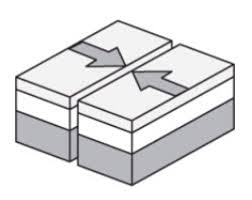
Name the boundary
a)
convergent boundary
b)
divergent boundary
c)
transform boundary
d)
sergent boundary
94.

Name the boundary
a)
convergent boundary
b)
divergent boundary
c)
transform boundary
d)
sergent boundary
95.
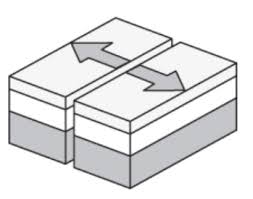
Name the boundary
a)
convergent boundary
b)
divergent boundary
c)
transform boundary
d)
sergent boundary
96.
A subduction zone is formed...
a)
when one tectonic plate sinks below another
b)
at every type of convergent plate boundary
c)
at every type of divergent plate boundary
d)
at transform boundaries
97.
Whenever a subduction zone is formed a ______ is formed.
a)
Mountain
b)
Island Arc
c)
Rift
d)
Volcano
98.
Plate movement is caused by ______________.
a)
the rotation of the Earth
b)
ocean tides
c)
convection currents in the mantle
d)
the moon's gravity
99.

Who is the person credited with developing the theory of continental drift?
a)
Harry Hess
b)
Galileo
c)
Alfred Wegener
d)
Newton
100.
Created by a divergent boundary.
a)
Rocky Mountains
b)
Mariana Trench
c)
Mid Atlantic ridge
101.
Mountains form from ...
a)
plates sliding past one another
b)
collision of plates
c)
plates moving away from each other
102.
Which is true about hotter material in the mantle?
a)
more dense, sinks
b)
less dense, sinks
c)
less dense, rises
d)
more dense, rises
103.
During sea floor spreading, molten material rises up from the mantle...
a)
along the continents
b)
at the mid ocean ridges
c)
deep ocean trenches
d)
at north and south poles
104.
Which of these layers is ALL solid iron and nickle?
a)
inner core
b)
outer core
c)
lithosphere
d)
mesosphere
105.

Scientists think that convection currents that move the plates flow in Earth's
a)
Continental crust
b)
Oceanic crust
c)
Asthenosphere
d)
Lithosphere
106.

The physical layer of Earth made of solid rock and soil is called the ___________.
a)
mesosphere
b)
lithosphere
c)
asthenosphere
d)
mantle
107.
Earth's plates are...
a)
constantly moving and changing the face of the earth
b)
Never moves
c)
Moves seldom and very fast
d)
Moves when it feels like it
108.
Any object with mass has gravity.
a)
True
b)
Sometimes
c)
False
d)
Never
109.
Two factors effecting the magnitude of the force of gravity between 2 objects are...
a)
mass and distance
b)
mass and matter
c)
distance and weight
d)
weight and mass
110.
A person would weigh less on on the Moon than on the Earth because . . .
a)
Moon has more mass, and therefore more gravity
b)
Moon has less mass, and therefore more gravity
c)
Moon has more mass, and therefore less gravity
d)
Moon has less mass and therefore less gravity
111.
What star is closest so the Earth?
a)
Proxima centaury
b)
The sun
c)
I don't know
d)
who cares
112.
which is a dwarf planet?
a)
Jupiter
b)
Pluto
c)
Saturn
d)
The sun
113.
Who was the first person on the moon?
a)
Mitt Patel
b)
Ayush Patel
c)
Neil Armstrong
d)
Anthony Padea
114.
The universe is always ______________
a)
exploding
b)
shrinking
c)
dying
d)
expanding
115.
The earth is located between which 2 planets?
a)
Jupiter & Saturn
b)
Mercury & Venus
c)
Venus & Mars
d)
Saturn and Uranus
116.
The asteroid belt is located between which 2 planets?
a)
Mercury & Venus
b)
Jupiter & Saturn
c)
Mars & Jupiter
d)
Uranus & Neptune
117.

The Moon ________ around the Earth.
a)
moves parallel
b)
rotates
c)
moves perpendicular
d)
revolves
118.
Day and night is caused by the _____________ of earth on its axis.
a)
revolution
b)
orbit
c)
rotation
119.
How long does Earth take to make a complete rotation?
a)
365 days
b)
24 hours
120.
What is the distance light travels in one year?
a)
light moon
b)
light star
c)
light year
d)
light planet
121.

The __________ has planets, moons, comets, and asteroids.
a)
solar system
b)
earth
c)
rotation
d)
United States
122.

The order of the planets is:
a)
Mars,Venus,Earth,
Mercury,Saturn
Jupiter, Uranus, Neptune
Mercury,Saturn
Jupiter, Uranus, Neptune
b)
Earth,Venus,Mars
Jupiter, Neptune,
Mercury,Saturn,
Uranus
Jupiter, Neptune,
Mercury,Saturn,
Uranus
c)
Mercury,Venus,Earth
Mars,Jupiter,
Saturn,Uranus
Neptune
Mars,Jupiter,
Saturn,Uranus
Neptune
123.
What are natural or artificial bodies that revolve around larger bodies such as planets?
a)
dwarf planets
b)
satellites
c)
moons
124.
All of the ______ have multiple moons.
a)
gas giants
b)
inner planets
125.
Jupiter's four largest moons as known as Galilean _____.
a)
giants
b)
satellites
c)
moons
d)
craters
126.
They are sometimes called shooting stars
a)
interplanetary dust
b)
asteroids
c)
comets
d)
meteors
127.
A meteorite is DIFFERENT from a comet mainly because
a)
has a tail of ice and gas
b)
is found in orbit between Jupiter and Mars
c)
enters the Earth's atmoshere
d)
has a nucleus mad of rock and snow.
128.
Sometimes I am called a "dirty snowball". I have a hydrogen cloud, coma, and a nucleus. I am invisible except when near the sun. What am I?
a)
Asteroid
b)
Star
c)
Meteor
d)
Comet
129.
The tail of a comet usually faces
a)
toward the sun
b)
toward the Earth
c)
away from the Sun
d)
away from the Earth
130.
I am several miles in diameter, originate beyond the outer plants, thought to have struck early Earth, consists of bodies of ice, stone and organic compounds
a)
comet
b)
asteroid
c)
meteor
d)
star dust
131.
Made of very dense rock and metal that is very different from the rocks that make up the inner planets.
a)
asteroid
b)
meteoroid
c)
comet
d)
meteor
Reset

