
 Worksheets
Final Review
Total questions: 158
Worksheet time: 2hrs 59mins
Name
Class
Date
1.
Mr. S. sets up an experiment to see how the mass of a ball affects the distance it rolls off a ramp. Identify the dependent variable.
a)
height of the ramp
b)
distance traveled by the ball
c)
mass of the ball
d)
weight of the ball
2.
Mr. S. normally uses praise as a reward to train his dog. He wants to know the best way to train his dog, so he sets up an experiment to find out if there is a better way to get his dog to respond to commands. What is his independent variable?
a)
amount of times the dog follows the command
b)
type of reward
c)
praise
d)
type of dog
3.
Mr. S. uses a new spray cleaner to remove green slime left by students on the lab tables. Identify the dependent variable
a)
type of cleaner
b)
the new cleaner
c)
the old cleaner
d)
the effect of the cleaners
4.
The independent variable is the ONE thing you _____.
a)
change
b)
keep the same
c)
experiment with
d)
investigate
5.
How many variables can be tested in a controlled experiment?
a)
one
b)
two
c)
three
d)
as many as possible
6.
The subatomic particle with a neutral charge is:
a)
protons
b)
electrons
c)
neutrons
d)
cloud
7.
Which two subatomic particles are found in the NUCLEUS of at atom?
a)
protons & nuetrons
b)
protons & electrons
c)
neutrons & electrons
d)
electrons & protons
8.
What type of subatomic particles are found in the cloud?
a)
neutrons
b)
electrons
c)
protons
d)
reactions
9.
If an element has 6 protons, 7 neutrons, and 6 electrons, what type of charge does the element have?
a)
positive
b)
negative
c)
neutral
d)
imaginary
10.
What gives an atom mass?
a)
Protons & electrons in the nucleus
b)
electrons in the cloud
c)
protons & neutrons in the nucleus
d)
Protons & electrons in the cloud
11.
If an atom has 24 protons and 24 electrons, what is the atomic number of this element?
a)
24
b)
48
c)
0
d)
42
12.
How are elements distinguished from one another?
a)
The number of valence electrons
b)
The number of neutrons
c)
The number of protons
d)
How they react with other elements
13.
The number of protons is equal to
a)
the atomic number
b)
the number of neutrons
c)
the energy levels
d)
the periodic table groups
14.

How many neutrons does NA have?
a)
11
b)
23
c)
22
d)
12
15.

How many protons does this element have?
a)
40
b)
21
c)
20
d)
41
16.
If the number of electrons in an atom changes you make a(n) __________________.
a)
ion
b)
isotope
c)
new element
d)
isomer
17.
Negative ions form when atoms _________ valence electrons.
a)
lose
b)
gain
c)
share
18.
When an atom loses a valence electron, it becomes a(n) _____________ ion.
a)
positive
b)
negative
c)
neutral
d)
polyatomic
19.
How many protons are in an atom with an atomic number of 20, an atomic mass of 45, and a charge of +2?
a)
20
b)
10
c)
2
d)
18
20.
How many electrons are in an atom that has an atomic number of 34, an atomic mass of 74 and a charge of -2?
a)
34
b)
36
c)
2
d)
40
21.
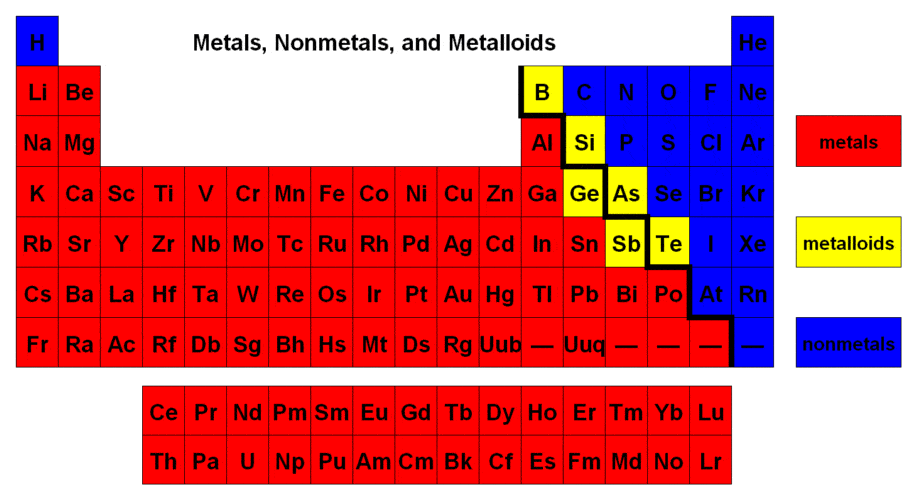
What elements generally make an ionic bond?
a)
metal and nonmetal
b)
2 or more nonmetals
c)
metal
d)
none of the above
22.
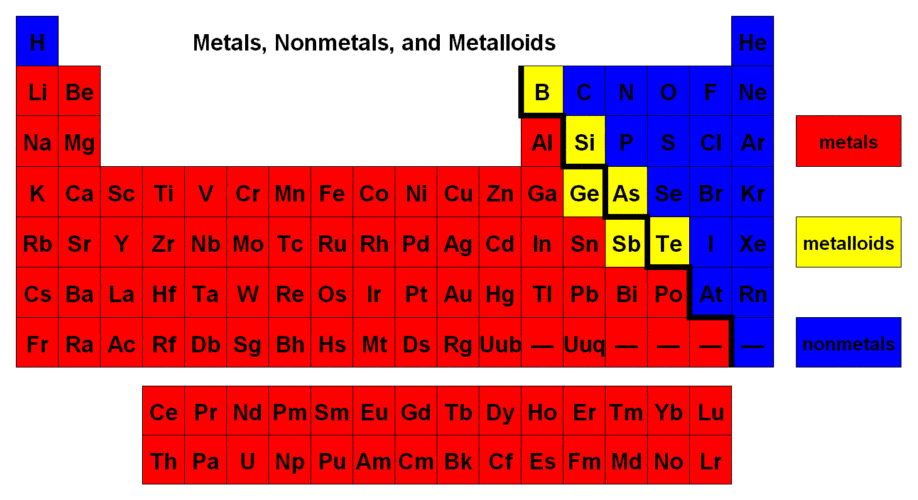
What elements generally make a covalent bond?
a)
metal and nonmetal
b)
2 or more nonmetals
c)
metal
d)
none of the above
23.

What type of macromolecule is being represented in this image?
a)
carbohydrate
b)
lipid
c)
protein
d)
nucleic acid
24.
Which of the following decreases the activation energy necessary to initiate the chemical change within the body?
a)
nucleotides
b)
enzymes
c)
amino acids
d)
fatty acids
25.
What are the building blocks of proteins?
a)
amino acid
b)
fatty acid
c)
nucleotide
d)
lipid
26.
What are the single sugars that are the building blocks of carbohydrates?
a)
monosaccharides
b)
disaccharides
c)
polysaccharides
d)
amino acid
27.
Which macromolecule stores energy, insulates us, and makes up the cell membrane?
a)
lipids
b)
proteins
c)
carbohydrates
d)
nucleic acids
28.
DNA and RNA are examples of...
a)
proteins
b)
nucleic acids
c)
carbohydrates
d)
lipids
29.
Another name for fats and oils
a)
proteins
b)
sugar
c)
lipids
d)
nucleic acids
30.
What is the monomer of nucleic acids?
a)
Glycerol
b)
Monosaccharides
c)
Amino Acids
d)
Nucleotides
31.
What are the four macromolecules?
a)
proteins, nucleic acids, carbohydrates, and lipids
b)
monosaccharides, lipids, polysaccaharides, and proteins
c)
RNA, DNA, proteins, and carbohydrates
d)
proteins, DNA, RNA, and steroids
32.
Which of the following is a lipid?
a)
cholesterol
b)
cellulose
c)
glucose
d)
protein
33.
Most enzymes:
a)
speed up the chemical reaction
b)
have no effect on the rate of the chemical reaction
c)
slow the rate of the chemical reaction
d)
keep the rate of the chemical reaction the same
34.
What suffix (word ending) is used in the names of most carbohydrates?
a)
-ase
b)
-nic
c)
-ose
d)
-yme
35.

Which macromolecule is shown?
a)
lipid
b)
protein
c)
nucleic acid
d)
carbohydrate
36.
cellulose, glycogen, starch, or chitin
a)
carbohydrates
b)
lipids
c)
proteins
d)
nucleic acid
37.
may be saturated or unsaturated
a)
carbs
b)
lipids
c)
proteins
d)
nucleic acids
38.

Which biomolecule is this a picture of?*
a)
polysaccharide
b)
saturated fat
c)
monounsaturated fat
d)
polyunsaturated fat
39.
Which of these nitrogenous bases is NOT in RNA?
a)
Uracil
b)
Thymine
c)
Cytosine
d)
Guanine
40.
What is the complementary base pair to Adenine in DNA?
a)
Cytosine
b)
Guanine
c)
Thymine
d)
Uracil
41.
What is the complementary base pair to Cytosine in DNA?
a)
Cytosine
b)
Guanine
c)
Thymine
d)
Uracil
42.
What is the complementary base pair to Adenine in RNA?
a)
Cytosine
b)
Guanine
c)
Thymine
d)
Uracil
43.
Which of the following organelle is the power plant of a cell?
a)
Nucleus
b)
E.R.
c)
mitochondria
d)
ribosome
44.

The Golgi apparatus _____.
a)
packages cell products for export
b)
eliminates waste
c)
stores DNA
d)
makes energy
45.

Where is DNA stored in a cell?
a)
Lysosomes
b)
Golgi Complex
c)
Ribosomes
d)
Nucleus
46.

What is the fluid inside a cell called?
a)
Endoplasimic Reticulum
b)
Orange Juice
c)
Water
d)
Cytoplasm
47.
This organelle eliminates waste.
a)
Nucleus
b)
ER
c)
Vacuole
d)
Lysosome
48.

This organelle makes proteins.
a)
Cell membrane
b)
Nucleus
c)
Ribosome
d)
ER
49.
This is a double layer of phospholipids that creates a barrier between the cells internal and external environments; it controls what comes in or out of the cell (selective permeable)
a)
Nucleus
b)
Cilia
c)
Cell membrane
d)
Flagella
50.
Which is true about active transport?
a)
It requires energy
b)
it does not require energy
c)
It moves substances down the concentration gradient
d)
it moves material from high to low concentration
51.
Osmosis is the movement of _____ across a membrane.
a)
food
b)
energy
c)
oxygen
d)
water
52.
Movement across the cell membrane that does not require energy is called
a)
active transport
b)
passive transport
53.
What is diffusion
a)
active transport
b)
passive transport
c)
cell division
d)
cell mutation
54.
The movement of molecules from higher concentration to lower concentration is
a)
diffusion
b)
cell division
active transport
active transport
c)
active transport
d)
tonicity
55.
Active transport requires
a)
energy
b)
the nucleus
c)
chloroplasts
d)
lysosomes
56.
What is the purpose of an enzyme?
a)
give permission for the reaction
b)
raise activation energy
c)
speed up reactions
d)
control how many reactions occur
57.
Enzymes are considered to be
a)
Lipids
b)
Carbohydrate
c)
Protein
d)
Nucleic Acid
58.
Where do substrates bind on an enzyme?
a)
voltage-gated channels
b)
surface receptor
c)
calcium channels
d)
active site
59.

What is structure A?
a)
Substrate
b)
Active site
c)
Enzyme
d)
Products
60.

What is structure D?
a)
Substrate
b)
Active site
c)
Enzyme
d)
Products
61.

What is structure C?
a)
Substrate
b)
Active site
c)
Enzyme
d)
Products
62.
Each enzyme only has 1 substrate that will fit its active site. What is this called?
a)
reusable
b)
catalyst
c)
specific
d)
fragile
63.
What 3 letters do enzymes typically end in?
a)
-ose
b)
-ase
c)
-ese
d)
-tic
64.

Which of the following conclusions can be drawn from this graph?
a)
The optimum pH of the enzyme is 6.6.
b)
The optimum pH of the enzyme is 5.8
c)
The enzyme’s activity increases as pH increases 5.0 to 9.0
d)
The enzyme’s activity is greater around pH of 8.0 .
65.
What is the name for the mechanism of enzyme activity?
a)
Lock and key
b)
jigsaw puzzle
c)
hammer and nail
d)
two hands pattern
66.
Changes in pH and temperature can damage an enzymes active site. What is this called?
a)
reusable
b)
catalyst
c)
specific
d)
denature
67.
Where does glycolysis occur?
a)
Inner mitochondrial membrane
b)
Mitochondrial Matrix
c)
Cytosol
d)
At a ribosome
68.
Glycolysis is a _______ process
a)
Anabolic
b)
Catabolic
c)
Single Step
d)
Strictly Eukaryotic
69.
Which molecule enters Kreb's Cycle?
a)
Pyruvate
b)
Glucose
c)
Acetyl CoA
d)
reducing powers
70.
Where does ETC occur?
a)
Mitochondrial matrix
b)
Outer mitochondrial membrane
c)
Inner mitochondrial membrane
d)
Cytosol
71.

site of ATP synthase
a)
1
b)
2
c)
3
d)
4
72.

site of the krebs cycle
a)
1
b)
2
c)
3
d)
4
73.
A plane that divides the body into left and right halves.
a)
sagittal
b)
midsagittal
c)
transverse
d)
frontal
74.
A plane that divides the body into superior and inferior halves.
a)
sagittal
b)
midsagittal
c)
transverse
d)
frontal
75.

Which plane is this?
a)
Sagittal
b)
Transverse
c)
Coronal
76.
Which of the following correctly describes the acromial region?
a)
forehead
b)
inferior, posterior region of the skull
c)
point of shoulder
d)
front of the elbow
77.
Which of the following correctly describes the frontal region?
a)
forehead
b)
inferior, posterior region of the skull
c)
point of shoulder
d)
front of the elbow
78.
Which of the following correctly describes the occipital region?
a)
forehead
b)
inferior, posterior region of the skull
c)
point of shoulder
d)
front of the elbow
79.
Which of the following correctly describes the antecubital region?
a)
forehead
b)
inferior, posterior region of the skull
c)
point of shoulder
d)
front of the elbow
80.
Which of the following correctly describes the costal region?
a)
ribs
b)
thigh
c)
fingers or toes
d)
hip
81.
Which of the following correctly describes the femoral region?
a)
ribs
b)
thigh
c)
fingers or toes
d)
hip
82.
Which of the following correctly describes the digital region?
a)
ribs
b)
thigh
c)
fingers or toes
d)
hip
83.
Which of the following correctly describes the coxal region?
a)
ribs
b)
thigh
c)
fingers or toes
d)
hip
84.
Which of the following correctly describes the cubital region?
a)
elbow
b)
wrist
c)
abdomen
d)
neck
85.
Which of the following correctly describes the carpal region?
a)
elbow
b)
wrist
c)
abdomen
d)
neck
86.
Which of the following correctly describes the celiac region?
a)
elbow
b)
wrist
c)
abdomen
d)
neck
87.
Which of the following correctly describes the cervical region?
a)
elbow
b)
wrist
c)
abdomen
d)
neck
88.
Which of the following correctly describes the axillary region?
a)
armpit
b)
upper arm
c)
cheek
d)
head
89.
Which of the following correctly describes the brachial region?
a)
armpit
b)
upper arm
c)
cheek
d)
head
90.
Which of the following correctly describes the buccal region?
a)
armpit
b)
upper arm
c)
cheek
d)
head
91.
Which of the following correctly describes the cephalic region?
a)
armpit
b)
upper arm
c)
cheek
d)
head
92.
Which of the following correctly describes the antebrachial region?
a)
forearm
b)
leg
c)
back
d)
reproductive organs
93.
Which of the following correctly describes the dorsal region?
a)
forearm
b)
leg
c)
back
d)
reproductive organs
94.
Which of the following correctly describes the crural region?
a)
forearm
b)
leg
c)
back
d)
reproductive organs
95.
Which of the following correctly describes the lumbar region?
a)
buttocks
b)
groin
c)
lower back between ribs and pelvis
d)
breast/milk producing glands
96.
Which of the following correctly describes the mental region?
a)
chin
b)
mouth
c)
eye
d)
knee
97.
Which of the following correctly describes the oral region?
a)
chin
b)
mouth
c)
eye
d)
knee
98.
Which of the following correctly describes the nasal region?
a)
nose
b)
chest
c)
ear
d)
anterior side of the hand (when in anatomical position)
99.
Which of the following correctly describes the otic region?
a)
nose
b)
chest
c)
ear
d)
anterior side of the hand (when in anatomical position)
100.
Which of the following correctly describes the pedal region?
a)
foot
b)
inferior side of the foot
c)
instep of foot
d)
back of knee
101.

a)
stratified columnar
b)
pseudostratified columnar
c)
stratified cuboidal
d)
transitional
102.
Connective tissue is
a)
The tissue that protects, supports, and binds together other body tissue
b)
Tissue that is the lining, covering, and glandular tissue of the body
c)
Tissue that contracts and shortens to produce movement
103.

a)
simple squamous
b)
stratified squamous
c)
simple cuboidal
d)
stratified cuboidal
104.

Name this tissue
a)
Bone
b)
Cartilage
c)
Blood
d)
Adipose
105.

Name this tissue
a)
Bone
b)
Hyaline cartilage
c)
Fibrocartilage
d)
Adipose
106.

What tissue is this
a)
Bone
b)
Cartilage
c)
Blood
d)
Adipose
107.
Commonly known as fat. Forms the subcutaneous layer beneath skin.
a)
Blood
b)
Bone
c)
Cartilage
d)
Adipose
108.
Which type of tissue lines or is found lining a cavity or tube?
a)
Connective
b)
Muscule
c)
Epithelial
d)
Nervous
109.

a)
Columnar epithelium
b)
simple columnar epithelium
c)
Psuedostratified ciliated columnar epithilium
d)
Psuedostratified cubical ciliated epithelium
110.

Name this tissue
a)
Bone
b)
Cartliage
c)
Blood
d)
Dense fibrous connective tissue
111.

a)
Simple columnar
b)
Simple cuboidal
c)
Stratified columnar
d)
Stratified cuboidal
112.
How many layers of cells can be found in pseudostratified columnar tissue?
a)
Numerous
b)
3 to 4
c)
2
d)
1
113.

a)
Fibrocartilage
b)
Stratified squamous epithelium
c)
Simple columnar epithelium
d)
Elastic connective tissue
114.
Which of the following is not a function of epithelial tissue?
a)
Absorption
b)
Excretion
c)
Communication
d)
Protection
115.

Name this tissue
a)
Skeletal
b)
Cardiac
c)
Smooth
116.

Name this tissue
a)
Skeltal
b)
Cardiac
c)
Smooth
117.
Pigment that ranges in color from yellow to brown to black; produced by cells called melanocytes
a)
melanin
b)
keratin
c)
dermis
118.
proteins, found in tissues such as hair, nails, and epidermis of the skin
a)
synovial fluid
b)
subcutaneous tissue
c)
keratin
d)
sweat
119.
Oil glands that are found all over the skin, except on the palms and soles of the feet; ducts usually empty into a hair follicle
a)
exocrine glands
b)
sebaceous glands
c)
sebum
d)
sweat glands
120.
product of sebaceous glands, mixture of oily substances, helps keep the skin soft & moist
a)
sebum
b)
matrix
c)
sweat
d)
basal
121.
produce sweat and are found all over the body
a)
eccrine glands
b)
apocrine glands
c)
sebaceous glands
122.
"Goosebumps" are caused by contractions of the
a)
synovial membrane
b)
arrector pilli muscle
c)
apocrine glands
d)
eccrine glands
123.
Burn that involves injury to the epidermis and upper dermis and is painful is referred to as a
a)
1st degree burn
b)
2nd degree burn
c)
3rd degree burn
124.
Which vitamin is synthesized by the skin?
a)
A
b)
E
c)
K
d)
D
125.
Which of the following abnormal skin colors results from liver disorders?
a)
bruising
b)
palor
c)
juandice
d)
cyanosis
126.
Which 3 layers compose the skin?
a)
Hyperdermis, Intradermis, Hypodermis
b)
Epicutaneous, Cutaneous, Subcutaneous
c)
Epidermis, Dermis, Subcutaneous
d)
None of the Above
127.
Outermost layer of skin
a)
Epidermis
b)
Dermis
c)
Corium
d)
Subcutaneous
128.
Outermost layer of the epidermis
a)
Stratum corneum
b)
Stratum germinativum
c)
Dermal layer
d)
Adipose layer
129.
The epidermis is avascular. What does that mean?
a)
The epidermis bleeds easily
b)
The epidermis is very dry
c)
The epidermis has no blood vessels and does not bleed
d)
The epidermis has blood vessels but they do not bleed
130.
Function of the skin made possible by the presence of sudoriferous glands
a)
Heat production
b)
Temperature regulation
c)
Absorption
d)
Manufacture of Vitamin D
131.
Part of the hair that is implanted into the skin
a)
Follicle
b)
Medulla
c)
Cortex
d)
Root
132.
Condition in which the hair is replaced by very thin, transparent hair
a)
Male pattern baldness
b)
Alopecia
c)
Psoriasis
d)
Eczema
133.
Most malignant form of skin cancer
a)
Basal cell
b)
Squamous cell
c)
Melanoma
d)
Fungal
134.
Type of burn that results in total destruction of nerve endings
a)
1st degree
b)
2nd degree
c)
3rd degree
d)
4th degree
135.
The inner layer of the epidermis is constantly reproducing itself enabling the skin to:
a)
Adapt to changes in the environment
b)
Repair itself if injured
c)
Regulate temperature
d)
Manufacture vitamin D
136.
Make new bone and help repair damage.
a)
Osteoblast
b)
Osteoclast
c)
Osteocytes
d)
Osetoblank
137.
Osteocytes
a)
Make new bone and help repair damage
b)
–Carry nutrients and waste products to and
from blood vessels in the bone.
c)
They grow within the bone to aid in
flexibility.
d)
Break down bone and help to sculpt and
shape it.
138.
attaches bone to bone
a)
tendon
b)
ligament
139.
attaches muscle to bone
a)
tendon
b)
ligament
140.
our hip joint would be considered which type of joint?
a)
hinge
b)
ball and socket
c)
ball
d)
fixed
141.
many bones form from what?
a)
bones
b)
bone tissue
c)
Cartilage
d)
skin tissue
142.
adduction means ?
a)
Move toward the body
b)
Move away from the body
c)
All joints straight
d)
Joints bent
143.
all joints are straight or extended
a)
flexion
b)
adduction
c)
abduction
d)
extension
144.
skull, vertebral column, and thorax
a)
axial skeleton
b)
appendicular skeleton
c)
skeleton
d)
bones
145.
which one of these IS a function of the skeletal system
a)
vitamin D production
b)
fat storage
c)
movement
146.

What part of the bone is the yellow region?
a)
ilium
b)
ischium
c)
pubis
d)
acetabulum
147.

what are the top 7 vertebrae called?
a)
coccyx
b)
lumbar
c)
cervical
d)
sacrum
148.

what type of bone is the femur
a)
Long bone
b)
Short bone
c)
Flat bone
d)
Irregular bone
149.

Which one of the following is an irregular bone
a)
humerus
b)
tibia
c)
patella
d)
vertebrae
150.
What is the name of the collar bone?
a)
Clavicle
b)
Scapular
c)
Sternum
d)
Xiphoid
151.

Name the bone located at number 12.
a)
Patella
b)
Clavicle
c)
Sternum
d)
Scapula
152.

Name the bone located at number 8.
a)
Carpals
b)
Metacarpals
c)
Phalanges
d)
Tarsals
153.
The appendicular skeleton is made up of which structures?
a)
The arms and legs
b)
The arms, legs, pelvic and pectoral girdle
c)
the pelvic and pectoral girdle only
d)
The arms, legs, vertebral column, and the pectoral girdle.
154.
Which type of cell destroys bone?
a)
osteoclasts
b)
osteoblasts
c)
osteocytes
155.
thin membrane that covers and protects; contains blood vessels and nerves
a)
compact bone
b)
periosteum
c)
cancellous bone
d)
marrow
156.
hard bone that provides structure to bone.
a)
cancellous bone
b)
compact bone
c)
periosteum
d)
marrow
157.
Which bone marrow contains fat cells?
a)
yellow
b)
red
158.
True or False... bones can bend before they break.
a)
True
b)
False
100 %

