wayground logo

Free Printable Worksheets

Font size

S
M
L
XL
Worksheets

SBI3U Exam Multiple Choice Review

Total questions: 153

Worksheet time: 2hrs 41mins

Name
Class
Date
1.

The 6 kingdoms used to classify

organisms are:

a)

Animalia, plantae, protozoa,archaea, bacteria, fungi

b)

Animalia, plantae, protista, archaea, bacteria, fungi

c)

Kingdom, phyloneus, clade, order, family, gene

d)

Animalia, plantae, protista, eubacteria, bacteria, fungi

e)

Anime, plantae, protista, archaea, bacteria, fungi

2.

Binomial nomenclature is:

a)

The two part naming system of organisms

b)

The seventh kingdom

c)

The ability of an organism to make its own food

d)

The evolutionary history of an organism

e)

The system used to classify organisms

3.

Streptococcus bacteria are:

a)

Rod-shaped and arranged in clusters

b)

Round and arranged in chains

c)

Rod-shaped and arranged in pairs

d)

Spiral-shaped and arranged in pairs

e)

Cube-shaped and singular

4.

If humans and pandas belong in the same class, then they must also belong in the same

a)

order

b)

phylum

c)

neighbourhood

d)

family

e)

genus

5.

Staphylococcus, Streptococcus and Enterococcus are bacteria that are stained purple by Gram stain. Which statement about these organisms is false?

a)

All are gram positive bacteria

b)

All are prokaryotic

c)

All are round in shape

d)

All are gram-negative

e)

All are spherical in shape

6.

Examples of Fungi include all of the following except

a)

Moulds

b)

Yeast

c)

Algae

d)

Mushrooms

7.

Why is there no duplication of the DNA between meiosis I and meiosis II?

a)

To produce genetically identical daughter cells

b)

To increase genetic variability

c)

To reduce the chromosome number to haploid in the

resulting daughter cells

d)

The cell forgets to duplicate

e)

The chromosomes duplicate twice during meiosis I

8.

The four main mechanisms of evolution in nature are:

a)

Gene flow, genetic drift, bottleneck effect, artificial selection

b)

Gene flow, bottle neck effect, natural selection, artificial selection

c)

Gene flow, genetic drift, natural selection, mutations

d)

Gene flow, migration, mutations, genetic drift

9.

If a female with the genotype Bb is crossed with a male with genotype BB, what phenotypic ratio would you expect to see in the offspring?

a)

2 dominant: 2 recessive

b)

All dominant phenotype

c)

All recessive phenotype

d)

3 dominant: 1 recessive

e)

1 dominant: 1 recessive

10.

Which is the correctcorresponding strand sequence for the following DNA strand?

G – T – T – C – A – G

a)

A-C-C-T-G-A

b)

G-T-T-C-A-G

c)

C-A-A-G-T-C

d)

T-G-G-A-C-T

e)

C-A-A-G-U-A

11.

The number of autosomes in a human somatic cell is

a)

22

b)

23

c)

44

d)

45

e)

46

12.

Which of the following is NOT a piece of evidence in support of evolution?

a)

Fossils

b)

DNA

c)

Embryology

d)

Uniformitarianism

e)

Anatomy

13.

The primary function of plant leaves is to

a)

Support the plant

b)

produce flowers

c)

take in water

d)

shade the roots

e)

trap sunlight for photosynthesis

14.
Found in extreme places. 
a)
Archaea
b)
Fungus 
c)
Eukaryotes
d)
Plants cells 
15.
Very common and found in soil and animals
a)
Archaea
b)
Protists 
c)
Gymnosperms  
d)
Bacteria
16.
Add flavor to food and causes athlete's foot
a)
Archaea
b)
Eukaryotes 
c)
Bacteria 
d)
Fungus
17.
Unicellular of multicellulars includes algae and amoebas. 
a)
Protist
b)
Gymnosperms 
c)
Angiosperms 
d)
Fungus 
18.
Nonvascular plants have 
a)
tissues 
b)
xylem
c)
phloem 
d)
none of the above 
19.
Vascular plants have 
a)
muscles 
b)
tissues 
c)
mosses 
d)
ferns 
20.
Vascular plants have 
a)
muscles 
b)
tissues 
c)
mosses 
d)
ferns 
21.
Woody plants that produce seeds but not in fruits. 
a)
Gymnosperms 
b)
Angiosperms 
c)
mosses 
d)
ferns 
22.
Angiosperms 
a)
have fruit with seeds
b)
have flowers 
c)
birds carry pollen
d)
All the above 
23.
Have a backbone 
a)
Invertebrates 
b)
Vertebrates 
24.
Warm-blooded and feed their young with milk 
a)
mammals 
b)
reptiles 
c)
ectotherm 
25.
No backbone
a)
Vertebrate 
b)
Invertebrate 
26.
There are how many domains and kingdoms
a)
3 domains and 4 kingdoms 
b)
2 domains and 1 kingdom 
c)
6 domains and 5 kingdoms 
27.
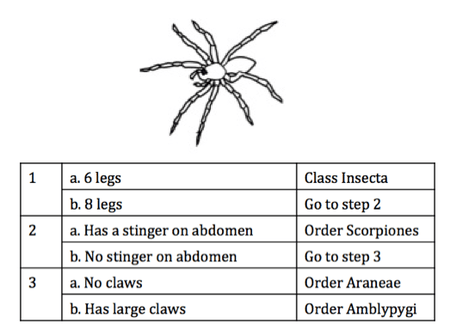
An illustration and a dichotomous key are given. What is the correct classification for this organism?
a)
Class Insecta
b)
Order Amblygygi
c)
Order Araneae
d)
Order Scorpiones
28.
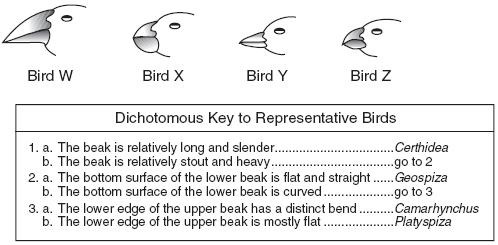
What is the name of bird Z?
a)
Certhidea
b)
Geospiza
c)
Camarhynchus
d)
Platyspiza
29.
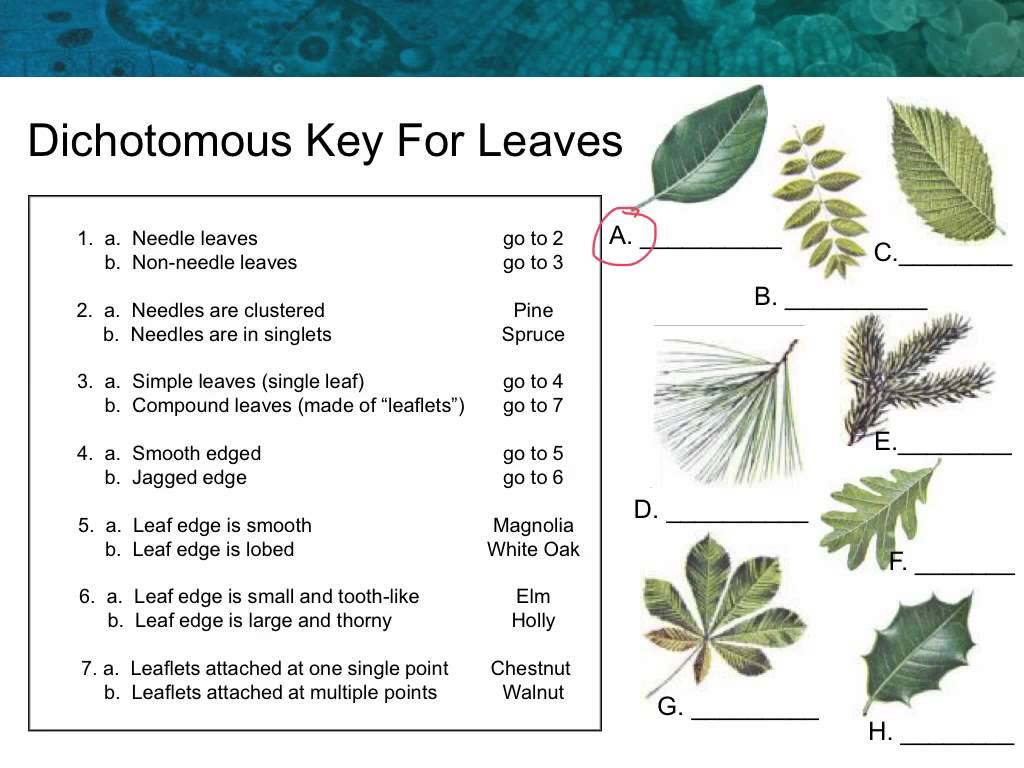
What is a dichotomous key used for in science?
a)
To organize biomes
b)
Classify organisms
c)
Identify bacteria only
d)
None of these
30.
What process is being shown in this image?
a)
Variation
b)
Natural selection
c)
Selective breeding
d)
Overpopulation
31.
What process is being shown in this image?
a)
Variation
b)
Natural selection
c)
Selective breeding
d)
Overpopulation
32.
Natural selection was proposed by what scientist?
a)
Charles Darwin
b)
Albert Einstein
c)
Steven Hawking
d)
Isaac Newton
33.
These moths are all the same species. The differences between their wings is an example of: 
a)
Natural selection
b)
Variation
c)
Evolution
d)
Extinction
34.
A species of white rabbits is introduced into this environment. Most of the rabbits are killed by hawks. Assuming some individuals survive each year, what do you think may happen to future generations of rabbits?
a)
They go extinct
b)
They begin turning brown
c)
They stay white
d)
They stop living here because there isn't any food. 
35.
Domesticated dogs are an example of:
a)
Natural selection
b)
Selective breeding
36.
Corn that is easy to peel and sweet to taste is an example of
a)
Natural Selection
b)
Selective breeding
37.
What animal did Darwin study when he got the idea of natural selection?
a)
Dogs
b)
Lemurs
c)
Finches
d)
Sea Turtles
38.
Which of the following is the correct equation for PHOTOSYNTHESIS?
a)
CO+ light + H2O --> O+ Sugar
b)
CO+ sugar + H2O --> O+ light
c)
O2 + light + H2O --> CO+ Sugar
d)
CO+ O2 + H2O --> Light+ Sugar
39.
Movement of the plant in response to touch is called what?
a)
Gravitropism
b)
Thigmotropism
c)
Photoperiodism
d)
Phototropism
40.

Movement of the plant in response to gravity is called what?

a)

Geotropism

b)

Thigmotropism

c)

Photoperiodism

d)

Phototropism

41.
Response to an external stimulus in a specific direction is called what?
a)
Tropism
b)
Petiole
c)
Meristem
d)
Root cap
42.
An example of Gravitropism is
a)
a sunflower turning to the sun
b)
roots of a plant growing down
c)
ivy plants clinging to a tree trunk
d)
a cactus in the dessert, storing water
43.
What type of vascular tissue is responsible for transporting water from the roots to the leaves?
a)
Cuticle
b)
Phloem
c)
Stomata
d)
Xylem
44.
What type of tropism is seen here?
a)
hydrotropism
b)
gravitropism
c)
thigmotropism
d)
phototropism
45.
What type of tropism is seen here with the ivy plant and the wooden stake?
a)
phototropism
b)
gravitropism
c)
thigmotropism
d)
hydrotropism
46.
A plant growing in response to the sunlight. 
a)
Gravitropism 
b)
Phototropism
c)
Thigmotropism
d)
Hydrotropism
47.
what is the function of xylem tissue?
a)
transports water and minerals salt 
b)
control the opening and closing of stoma
c)
carry out photosynthesis
d)
provide support for young plant
48.
When a threatening situation appears, what is the name of the instinctive mechanism used by animals to protect themselves?
a)
Flight or Run
b)
Hide and Seek
c)
Fight or Flight
d)
Run and Fight
49.
If the environment gets cold, we will often shiver in order to:
a)
keep body temperature the same as the external temperature
b)
decrease body temperature
c)
increase body temperature
d)
regulate blood pressure
50.
The binomial nomenclature (scientific name) for an organism is made from the:
a)
class and family
b)
genus and species
c)
domain and kingdom
d)
kingdom and phylum
51.
A flower who self-pollinates is...
a)
a sexual reproducer
b)
an asexual reproducer
c)
neither sexual or asexual
52.
Molds, yeast, and mushroom belong to kingdom:
a)
Eubacteria
b)
Archaebacteria
c)
Protista
d)
Fungi
53.
Cells that do not have a true nucleus are called....
a)
eukaryote
b)
prokaryote
c)
unicellular
d)
multicellular
54.
Cells that have a true nucleus are called....
a)
eukaryotes
b)
prokaryotes
c)
unicellular
d)
multicellular
55.
The ___ control what enters and leaves the cell.
a)
cell membrane
b)
cell wall
c)
nucleus
d)
cytoplasm
56.
Using the diagram, which of the following has vertebrae, a bony skeleton and four limbs?
a)
Shark
b)
Birds
c)
Primates
d)
Amphibians
57.
An example of an autotroph is a...
a)
tree
b)
bear
c)
mold
d)
bacteria
58.

Which Domain(s) is made of Prokaryotes (Single Cell)

a)

Bacteria

b)

Archea

c)

Eukarya

d)

Protista

59.
Which of the following is a fossil?
a)
a plant that has recently died
b)
a group of organisms that can reproduce
c)
a structure or organ that no longer functions
d)
a trace of an organisms that existed in the past
60.
In natural selection, the selective agent is the
a)
humans
b)
mutations
c)
breeders
d)
environment
61.
what did Charles Darwin observe in finch populations of the Galapagos Islands off the coast of South America?
a)
different species on different islands
b)
all species on one of the islands
c)
identical species on all the islands
d)
the same species as North America
62.
Mutations are important because they bring about
a)
death of the organism in which they develop
b)
genetic variation needed for a population to evolve
c)
benefits for the individual, not for the population
d)
Hardey-Weinberg equilibrium within a population
63.

What is the term for a feature that allows an organism to survive better in its environemtn?

a)

variation

b)

adaptation

c)

homologous structure

d)

vestigial structure

64.
What is the process in which humans breed organisms for certain traits?
a)
natural selection
b)
inheritance
c)
artificial selection
d)
descent withOUT modification
65.
Natural selection results in change over time by acting on traits that are
a)
heritable
b)
new
c)
mutated 
d)
better than the best
66.
The Physical remains of a plant or animal preserved in rock or Earth's crust. 
a)
Adapt
b)
Fossil
67.
Charles Darwin came up with this theory 
a)
Natural Selection
b)
Mutation
68.
What increases genetic variation when animals move from one population to another
a)
genetic drift
b)
sexual selection
c)
bottleneck effect
d)
gene flow
69.
Choose which scientist corresponds best with the statement: 
acquired characteristics are inherited
a)
Darwin 
b)
Lamarck
70.
Who is the father of evolution?
a)
Darwin
b)
Mendel
c)
Newton
d)
Einstein
71.
What is another name for natural selection?
a)
survival of the smartest
b)
survival of the fastest
c)
survival of the biggest
d)
survival of the fittest
72.
What is the study of organisms at the early stages of development?
a)
DNA studies
b)
embryology 
c)
extinction
d)
fossil record
73.
The organ system that physically & chemically breaks down food
a)
endocrine
b)
nervous
c)
digestive
d)
excretory
74.
The piece of technology that can see inside the digestive tract using a camera on a tube
a)
X-ray
b)
CT scan
c)
MRI
d)
endoscope
75.
The 4 steps of food processing, in order, are
a)
absorption, ingestion, digestion, egestion
b)
ingestion, digestion, absorption, egestion
c)
egestion, digestion, absorption, ingestion
d)
ingestion, aborption, digestion, egestion
76.
The region at the back of the mouth where the oral cavity, nasal cavity, and esophagus meet
a)
duodenum
b)
salivary glands
c)
pharynx
d)
trachea
77.
Teeth involved in tearing meat
a)
incisors
b)
canines 
c)
premolars
d)
molars
78.
Herbivores have pronounced (large)
a)
incisors
b)
canines
c)
premolarsémolars
d)
wisdom teeth
79.
Chemical digestion begins in the _____ and ends in the _____
a)
mouth....rectum
b)
stomach...small intestine
c)
mouth....small intestine
d)
stomach.....large intestine
80.
The enzyme active in the mouth is
a)
amylase
b)
pepsin
c)
trypsin
d)
bolus
81.
Which is not a function of the saliva
a)
begin chemical digestion of amylose (starch)
b)
forma bolus and lubricate food passing down esopagus
c)
allow for taste
d)
none of the above (all are important functions of saliva)
82.
The rhythmic contractions that move food along the alimentary canal
a)
mastication
b)
homeostasis
c)
churn
d)
peristalsis
83.
Contents of the stomach are held in at the top by the _____ sphincter and at the bottom by the _____ sphincter
a)
cardiac......pyloric
b)
pyloric.....cardiac
c)
iliocaecal.....esophogeal
d)
sphincters are not a part of the stomach
84.
The primary function of the stomach is _____ and the secondary function is _____
a)
aborption.....mixing churning
b)
digestion.....aborption
c)
absorption....digestion
d)
the stomach only has one function
85.
The bacteria involved in making gastric ulcers is _____ ; the bacteria that make vit B & K is _____
a)
H. pylori.....E. coli
b)
E. coli....H. pylori
c)
E. coli for both
d)
H. pylori for both
86.
Bile is produced by the ____ and stored in the _______
a)
liver.....gall bladder
b)
gall bladder.....liver
c)
liver....duodenum
d)
liver....pancreas
87.
Which function is not a function of the liver
a)
chemical digestion
b)
produce bile
c)
store carbs, vitamins, and amino acids
d)
detoxify harmful substances
88.
The condition where damaged liver tissue is replaced by connective tissue and fat
a)
cirrhosis
b)
jaundice
c)
gall stones
d)
diarrhea
89.
The 3 parts of the small intestine, in order, are
a)
jejunum, ileum, and duodenum
b)
ileum, jejunum, duodenum
c)
duodenum, jejunum, ileum
d)
duodenum, ileum, jejunum
90.
The majority of chemical digestion occurs in the
a)
mouth
b)
stomach
c)
duodenum
d)
ileum
91.
lubricated food leaving the mouth is called a ______ and once it leaves the stomach it is called ______.
a)
bolus.....chyme
b)
chyme.....bolus
c)
bolus...stool
d)
chyme.....stool
92.
The purposes of the large intestine are
a)
absorb moisture and minerals & produce vit B & K
b)
break down lipids and absorb nutrients
c)
neutralize the acidic chyme
d)
all the above
93.
The structure(s) that increase the surface area that can absorb (and thus absorption rate)
a)
villi and microvilli
b)
smooth muscles
c)
pseudopods
d)
gastrovascular cavity
94.
B=brown eyes
b= blue eyes
What is true about two brothers that have brown eyes?
One has genotype BB the other Bb.
a)
they have same phenotype and genotype
b)
they have different genotypes and phenotypes
c)
they have same phenotype but different genotypes
d)
they have same genotype but different phenotypes
95.
What does heterozygous mean?
a)
An organism that has the same genes for a trait (TT or tt)
b)
An organism that has different genes for a trait (Tt)
c)
When neither gene is fully dominant; offspring is a mixture of both
d)
the different forms of a trait (hair color--> brown, blonde, red
96.
This is an example of what?
a)
Complete dominance
b)
Incomplete dominance
c)
Codominance
d)
None of the above
97.
If T=Tall & t=short, what is the genotypic ratio?
a)
1:3
b)
3:1
c)
1:2:1
d)
2:2
98.
Snapdragon flowers come in red, pink and white.  What type of inheritance is this?
a)
Complete Dominance
b)
Incomplete Dominance
c)
Codominance
d)
Polygenic Inheritance
99.
A heterozygous yellow pea plant's genotype would be:
a)
YY
b)
yy
c)
Yy
d)
Yg
100.
Which process and type of resulting cells are represented?
a)
mitosis, gametes
b)
mitosis, body cells
c)
meiosis, gametes
d)
meiosis, body cells
101.
Which process and type of resulting cells are represented?
a)
mitosis, gametes
b)
mitosis, body cells
c)
meiosis, gametes
d)
meiosis, body cells
102.
Which of the following cell types is formed by meiosis?
a)
muscle cells
b)
skin cells
c)
sperm cells
d)
blood cells
103.
Which best describes the process shown?
a)
mutation in which the DNA content of the gene is ltered
b)
segregation of sister chromatids
c)
condensation and segregation of the alleles
d)
crossing-over which alleles are exchanged
104.
What is one advantage of sexual reproduction?
a)
offspring are identical to parents
b)
offspring are resistant to viruses
c)
offspring are born live, rather thna from eggs
d)
offspring inherit a wider variety of genetic information
105.
How many times in meiosis does the cell divided?
a)
2
b)
4
c)
3
d)
1
106.
What phase is  shown in the picture?
a)
anaphase 1
b)
anaphase 2
c)
metaphase 1
d)
telophase 1
107.
When two haploid sex fuse together during fertilization they become ______________ 
a)
haploid cells
b)
meiosis
c)
mitochondria
d)
diploid cells
108.
The sex of an offspring is determined by ______________________.
a)
the mother
b)
the father
c)
the mother and the father
d)
by the environment
109.
Term for homozygous organisms that display two dominant phenotypes at the same time
a)
codominance
b)
incomplete dominance
c)
multiple alleles
d)
linked genes
110.
What is a phenotype?
a)
The expression of a trait; what you see.
b)
refers to the genetic makeup of an individual
c)
An organism that has the same genes for a trait (ex. TT or tt)
d)
the passing of traits from parent to offspring
111.
The inherited combination of alleles is known as the offspring's
a)
heredity
b)
phenotype
c)
genotype
d)
redigree
112.
How many chambers does the heart have ? 
a)
4
b)
6
c)
3
d)
1
113.
What is the main function of the heart ? 
a)
The heart circulates blood, oxygen, and nutrients throughout the body.
b)
The heart is the control centers for all body activities.
c)
The heart gets rid of the wastes in your body produced by homeostasis. 
d)
The heart transports , protection and regulation. Blood transports the following substances: 
114.
A blood vessel that carries blood TO the heart is called ...
a)
vein
b)
capillary
c)
blood vessel
d)
artery
115.
White blood cells (WBC’s), red blood cells (RBC’s), plasma, & platelets are the 4 parts of what?
a)
blood vessels
b)
organs
c)
heart disease
d)
blood
116.
The bottom chambers of the heart are called
a)
ventricles
b)
atria
c)
vena cava
d)
valves
117.
Which part of the heart pumps deoxygenated (oxygen-poor) blood?
a)
Left side
b)
Right side
c)
Top side
d)
Bottom side
118.
When looking at the heart, which side is the right?
a)
my right
b)
my left
c)
at the apex
d)
at the base
119.
Where is the bicuspid valve located?
a)
between right atrium & right ventricle
b)
between left atrium & left ventricle
c)
between left ventricle & aorta
d)
between right ventricle & pulmonary trunk
120.
What electrical part of the heart is also called the intrinsic pacemaker of the heart?
a)
SA node
b)
AV node
c)
VA node
d)
purkinje fibers
121.
What is the largest artery in the human body?
a)
Aorta 
b)
lung
c)
ventricle
d)
vein 
122.
What do the arteries do?
a)
pumps blood to the heart
b)
pumps blood to and from the heart
c)
carry's blood away from the heart 
d)
a muscle 
123.
What is a pulmonary vein?
a)
  a aorta
b)
a main blood vessel 
c)
the blood vessel that carries newly oxygenated blood from the lungs
d)
it is a heart valve 
124.
What is the main organ in the circulatory system?
a)
vein
b)
lung
c)
heart
d)
aorta 
125.
How many types of blood vessels are in our body?
a)
1
b)
2
c)
3
d)
4
126.
The circulatory system works with the ___________ system to provide our body with oxygen.
a)
respiratory
b)
digestive
c)
muscular
d)
skeletal
127.
The circulatory system works with the __________ system to obtain energy from nutrients that we eat. 
a)
respiratory 
b)
digestive
c)
skeletal
d)
nervous
128.
Which order is correct? 
a)
Superior and inferior vena cavas into the right atrium through the tricuspid valve
b)
Superior and inferior vena cavas into the left atrium through the bicuspid valve
c)
right ventricle through the tricuspid valve into the right atrium
d)
body cells and tissues to the aorta through the aortic valve
129.
What do capillaries, the smallest blood vessels, do?
a)
Exchange O2 only
b)
Exchange CO2 only
c)
exchange nutrients and  oxygen for waste 
d)
break down foods
130.
Which component of blood makes up 1% of the blood?
a)
White blood cells & Platelets
b)
Plasma & Platelets
c)
Plasma & White blood cells
d)
Platelets & Red blood cells
131.
Which does not make up the circulatory system?
a)
heart
b)
blood
c)
lungs
d)
blood vessels
132.
Where does blood go after the right atrium?
a)
left atrium
b)
left ventricle
c)
right ventricle
d)
aorta
133.
Where does the blood go after it goes into the pulmonary arteries?
a)
lungs
b)
heart
c)
head
d)
hands
134.
Un-oxygenated blood enters the right atrium from the top of the heart.
a)
inferior vena cava
b)
superior vena cava
c)
aorta
135.
Un-oxygenated blood enters the right atrium from the bottom of the heart.
a)
inferior vena cava
b)
superior vena cava
c)
pulmonary veins
136.
1?
a)
Septum
b)
Right Pulmonary Vein
c)
Superior Vena Cava
d)
Inferior Vena Cava
137.
2?
a)
Heart
b)
Right Ventricle
c)
Left Atrium
d)
Left Ventricle
138.
7?
a)
Left Atrium
b)
Left Ventricle
c)
Aortic Valve
139.
9?
a)
Left Ventricle
b)
Left Atrium
c)
Left Pulmonary Vein
d)
Left Pulmonary Artery
140.
Which of the following define diastole and systole
a)
systole is the contraction of the heart and diastole is the relaxation of the heart
b)
diastole is the contraction of the heart and systole is the relaxation of the heart
c)
diastole and systole are both contractions of the heart
d)
diastole and systole are both relaxation phases of the heart
141.
Identify
a)
Left atrium
b)
Right atrium
c)
Left ventricle
d)
Right ventricle
142.
Identify
a)
Left atrium
b)
Right atrium
c)
Left ventricle
d)
Right ventricle
143.
What are the main organs of gas exchange in the respiratory system?
a)
diapragm
b)
lungs
c)
trachea
d)
bronchi
144.

When you breathe, your lungs take in ___ and remove ___.

a)

air/oxygen

b)

oxygen/carbon dioxide

c)

carbon dioxide/waste

d)

waste/air

145.
The two main branches from the trachea (one to each lung)
a)
bronchi
b)
alveoli
c)
capillaries
d)
bronchioles
146.
The air sacs that are covered with capillaries that separate gases we need from gases we don't need.
a)
bronchi
b)
lungs
c)
oxygen
d)
alveoli
147.
What is the function of the bronchi (bronchial tubes)?
a)
Transport air from nose to lungs
b)
Transport air from trachea to lungs
c)
Transport air from lungs to alveoli
d)
Transport air from alveoli to blood
148.
What is the main function of the respiratory system?
a)
to provide oxygen and remove carbon dioxide from the body
b)
to bring oxygen to the body
c)
to break down food and absorb nutrients
d)
to remove oxygen from the body and deliver carbon dioxide
149.
A disorder of the lungs called ____ causes the bronchi to become restricted (get smaller) so air can't get to the lungs.
a)
asthma 
b)
cold
c)
influenza 
d)
bronchitis 
150.
What is tube that is also known as your wind pipe?
a)
esophogus
b)
bronchi
c)
trachea
d)
alveoli
151.
What is an other word for windpipe?
a)
Larynx
b)
Trachea
c)
Oesophagus
d)
Diaphragm
152.
What is the name of the muscle below the lungs that helps with breathing?
a)
trachea
b)
alveoli
c)
diaphragm
d)
bronchi
153.
Flap of skin that covers the opening to the windpipe during swallowing
a)
Stomach
b)
Trachea
c)
Pancreas
d)
Epiglottis