
 Worksheets
Review for Final Anatomy
Total questions: 158
Worksheet time: 8hrs 35mins
The _______________ fill with air to distribute oxygen to the blood stream and release carbon dioxide.
Heart
Lungs
Ears
Muscles


Which of the following is NOT a function of the cardiovascular system?
Transport Oxygen and Carbon Dioxide to and from the respiratory system
Transport nutrients and waste to and from the digestive system
Break down food into nutrients for the body
Maintain homeostasis by regulating body temperature
___ takes place when blood travels from the heart, through the lungs, and back to the heart.
pulmonary circulation
systemic circulation

Gaseous exchange happens where?
Bronchi
Heart
Alveoli
Trachea
After breathing in this is the first place oxygen travels to
Bronchi
Bronchioles
Alveoli
Trachea
Which component of blood fights off foreign invaders like bacteria and viruses?
Plasma
White blood cell
Red blood cell
Platelet
What is the liquid component of the blood?
Plasma
White blood cell
Red blood cell
Platelet
Which component of blood forms clots?
Plasma
White blood cell
Red blood cell
Platelet
Which blood vessel has thick walls and carries oxygenated blood?
Artery
Capillary
Vein
Heart
Which blood vessel is a single cell thick and exchanges oxygen and carbon dioxide with cells?
Artery
Capillary
Vein
Heart
The two tubes that branch into the lungs are called the...
alveoli
bronchi
bronchioles
diaphragm
This muscle contracts and relaxes to control when you inhale and exhale...
alveoli
bronchi
bronchioles
diaphragm


the respiratory function is to take in (answer) and remove (answer) from an animals body
oxygen,carbon
oxygen,carbon dioxide
carbon dioxide ,oxygen
water,food

the diaphragm does what ?
its an air sac
controls breathing
it in the lungs
its part of alveoli
what is below the larynx
alveoli
mouth
trachea
esophagus
what comes after the bronchi
lungs
alveoli
bronchioles
larynx
What is the special protein that transports oxygen?
kidney beans
mitochondria
peanut butter
hemoglobin
The right lung is slightly larger than the left lung. This is because the right lung has ________ lobes.
2
3
4
5
Breathing is a(n)_________________ function caused by the phrenic nerve.
concentrated
conscious
automatic
occasional
What is the function of the red blood cells?
To allow your blood to clot
To carry oxygen and nutrients to all of the body's cells
To fight germs that cause infection

What organ is #3?
nose
mouth
bronchial tubes
trachea
What organ is #4?
lung
mouth
bronchial tubes
trachea
What organ is #5?
lung
mouth
bronchial tubes
trachea
What organ is #6?
lung
alveoli
bronchial tubes
trachea
What organ is #7?
diaphragm
alveoli
bronchial tubes
trachea
What is the function of the nervous system?
to control and coordinate body functions and systems.
to protect the body from harm.
to identify pain and begin healing.
to break down food.
Which of the following is the nervous system?


The basic unit of structure and function in the nervous system is a nerve cell. Nerve cells are also called-
Osteocytes
Dendrites
Neurons
Spinal Cords
What is the function of a nerve?
To transport needed food around the body
To control body movement for reflexes.
To carry messages (impulses) to and form the Central Nervous System
All of the above
The Central Nervous system includes what two organs?
Brain and Nerves
Brain and Spinal Cord
Spinal cord and Nerves
Nerves and Neurons
What controls the nervous system and all decision-making?
Brain
Spinal Cord
Nerves
Neurons
The column of tissue connecting the brain to nerves is...
spinal cord
central nervous system
peripheral nervous system
All of the above
What part of your brain controls involuntary muscle movements?
olfactory
Cerebrum
Brain Stem
cerebellum
What part of your brain is responsible for coordinating muscle movements between the voluntary and involuntary muscles?
Cerebellum
Cerebrum
Brain Stem
Nerves
If your voluntary and involuntary muscles both work, but they do not work together, what part of your brain might be damaged?
Nerves
Cerebrum
Brain Stem
Cerebellum

What is the number 2 pointing to?
brain stem
cerebrum
cerebellum
spinal cord

What is the number 1 pointing to?
Spinal Cord
Brain Stem
Cerebellum
Cerebrum
How do your nerves work?
They carry messages back and forth from the brain to the rest of the body
The send messages only to the spinal cord
They only receive messages from the spinal cord
They really don't work. They are lazy and want everything done for them.
Why is your spinal cord important?
Because it holds our spine together
Because all communication needs to travel through the spinal cord, towards and away from the brain.
Because it controls our senses
It's not
What part of the brain deals with appetite and temperature control?
Cerebellum
Cerebrum
Hypothalamus
Brain stem
What part of the nervous system is responsible for slowing down breathing and pulse?
Spinal Nerves
Sympathetic
Parasympathetic
Spinal Nerves
The cerebrum deals with planning, recalling information, and decision making.
True
False


Which part of the neuron transmits impulses to other neurons?
axon
cell body
dendrite
node
Which of the following is a function of the nervous system?
gathers information
processes information
transmits information
all of the above
Dopamine and Serotonin are examples of _______________
Axon
Neurotransmitters
Somatic Nerves
Autonomic Nerves
Neurotransmitters are ______________ that travel across the ______________ to another cell.
electrical signals; receptors
electrical signals; synapse
chemicals; receptors
chemicals; synapse
The branch like figures that receive impulses & conducts them to the cell body
Dendrite
Axon
Cell Body
Myelin Sheath
The two parts of the Peripheral Nervous System
Brain and Spinal Cord
Somatic and Autonomic
Systematic and Brain
Spinal cord and Autonomic
The ____________ is part of the peripheral nervous system and controls our senses.
Systemic
Autonomic
Somatic
Autonomous
Regulates the amount of light entering the eye and gives the eye its color.
Iris
Lens
Pupil
Retina


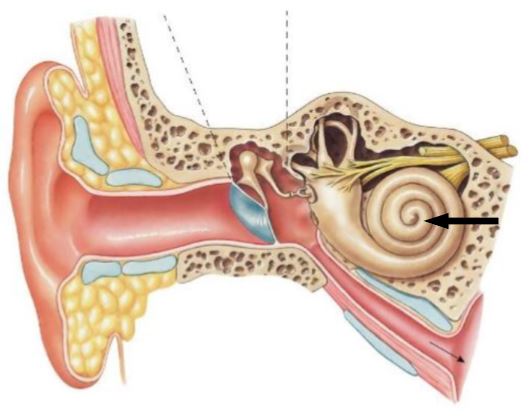
What is this?
Pinna
Hearing Nerve
Cochlea
Ear Drum
Anvil

What is this?
Anvil
Hammer
Stirrup
Cochlea
Ear drum
When a person's body has become used to the effects of the a drug or medicine and needs a greater amount to be effective.
Stimulant
Side Effect
Tolerance
Addcition
Craving
A drug that decreases the speed of the body's functions.
Stimlants
Depressants
Hallucinogens
Narcotics
Inhalants
A drug that increases the speed of the body's functions.
Stimulants
Depressants
Hallucinogens
Narcotics
Inhalants

What muscle is the arrow pointing toward?
biceps
traps
pecs
triceps

What muscle is the arrow pointing to?
Pectoralis (Pecs)
Biceps
Triceps
Lats

What muscle is the arrow pointing to?
Biceps
Triceps
Lats
Quads


This is showing the major muscle group on your back, called what?
latissimus dorsi
trapezius
pectorals
external obliques

These muscles that make up someone's "six pack" are really called what?
extermal obliques
gluteus maximus
rectus abdominus
gastrocnemius

Heart
Heart


What connects muscles to bones?
cartilage
tendons
ligaments
flexors
Found in the walls of hollow organs; also called visceral
smooth
cardiac
skeletal
all

What is the length between Z-lines of an actin molecule called?
fascicle
sarcomere
myosin binding site
sarcoplasmic length
____________ attaches to actin to form the cross bridge.
Troponin
Tropomyosin
Myosin
Calcium
Which is false when you are flexing your biceps?
Your triceps extends
It is a 3rd class lever
It is a first class lever

Temporal Bone
Parietal Bone
Occipital Bone


Temporal Bone
Parietal Bone
Frontal Bone
Occipital Bone

What bone is at point D?
Skull
Radius
Pelvis
Sternum

The bones that make up the lower leg at points F and G are:
the ulna and radius
the tibia and fibula
the skull and the jaw
the leg and the foot

There are how many bones in an adult human body?
12
109
270
206
These type of bones have a variety of shapes.
Long
Short
Irregular
Flat
These type of bones are typically longer than they are wide.
Irregular
Flat
Short
Long
These bones are thin and flattened.
Flat
Long
Short
Irregular
Which of the following is NOT an example of a long bone?
forearm bone
wrist bone
femur
thigh bone
Either end of a long bone.
Diaphysis
Periosteum
Spongy Bone
Epiphyses
Shaft of a long bone.
Epiphysis
Compact Bone
Sternum
Diaphysis
Dense bone tissue that have a continuous extracellular matrix with no gaps.
Spongy Bone
Endosteum
Compact Bone
Periosteum
This bone has irregular interconnecting spaces between bony plates.
Spongy bone
Compact Bone
Irregular Bone
Wish Bone



