wayground logo

Free Printable Worksheets

Font size

S
M
L
XL
Worksheets

EOC Study Guide

Total questions: 160

Worksheet time: 3hrs 55mins

Name
Class
Date
1.
The science of heredity
a)
heredity
b)
genetics
c)
trait
d)
gene
2.
The passing of traits from parents to offspring
a)
heredity
b)
genetics
c)
trait
d)
alleles
3.
Characteristics can also be called
a)
heredity
b)
traits
c)
gene 
d)
alleles
4.
The different forms of a gene
a)
heredity
b)
genetics
c)
gene
d)
alleles
5.
The factors that control a trait
a)
genetics
b)
trait
c)
gene
d)
alleles
6.
This trait always shows up in an organism when the allele is present
a)
dominant allele
b)
codominance
c)
probability
d)
recessive allele
7.
This trait is hidden whenever the dominant allele is present
a)
dominant allele
b)
codominance
c)
recessive allele
d)
Punnett Square
8.
A chart that shows all the possible combinations of alleles that can result from a genetic cross
a)
dominant allele
b)
codominance
c)
probability
d)
Punnett Square
9.
An organism's physical appearance or visible traits
a)
fertilization
b)
genotype
c)
phenotype
d)
homozygous
10.
An organism's genetic makeup, or allele combination
a)
fertilization
b)
genotype
c)
phenotype
d)
heterozygous
11.
An organism that has two different alleles for a trait (hybrid)
a)
fertilization
b)
genotype
c)
homozygous
d)
heterozygous
12.
An organism that has two identical alleles for a trait (purebred)
a)
genotype
b)
phenotype
c)
homozygous
d)
heterozygous
13.
A ________________________ is used to predict the possible genotype from certain parents
a)
Mendel Grid
b)
Genetic Tic Tac Toe
c)
Punnett Square
d)
Pedigree Plot
14.

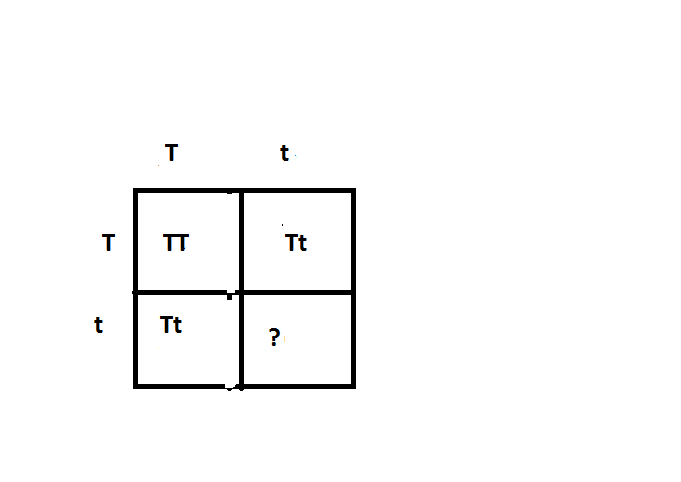
T - tall and t = short

In the punnett square below, what belongs in the missing square

a)

tt

b)

Tt

c)

Bb

d)

TT

15.

B = brown eyes

b = blue eyes

One brother has genotype BB and the other brother has genotype Bb.

Which statement is true about these two brothers?

a)

They have same phenotype and genotype

b)

They have different phenotypes and genotypes

c)

They have same phenotype, but different genotypes

d)

They have different phenotypes, but the same genotype

16.

B = brown eyes

b = blue eyes

One brother has genotype BB and the other brother has genotype Bb.

Which statement is true about these two brothers?

a)

They have same phenotype and genotype

b)

They have different phenotypes and genotypes

c)

They have same phenotype, but different genotypes

d)

They have different phenotypes, but the same genotype

17.

Which of the following genotypes is Purebred? Select 2 answers.

a)

aA

b)

Aa

c)

AA

d)

aa

18.
Which of the following genotypes is heterozygous?
a)
Bb
b)
BB
c)
bb
d)
B
19.

Which of the following genotypes is homozygous dominant?

a)

Yy

b)

yY

c)

yy

d)

YY

20.

Which of the following genotypes is homozygous recessive?

a)

Tt

b)

tt

c)

TT

d)

tT

21.

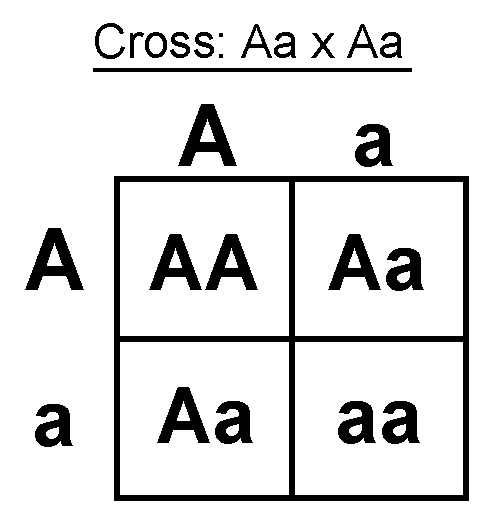
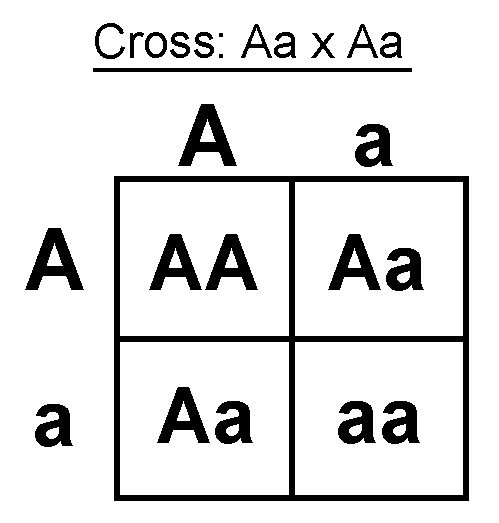
What is the genotypic ratio of the offspring?

a)

3:1

b)

1:3

c)

1:2:1

d)

2:2

22.

What are the phenotype percentages of the offspring?

(A-Brown fur color; a-white fur color)

a)

50 % Brown fur and 50% White fur

b)

25 % Brown fur and 75% White fur

c)

75 % Brown fur and 25% White fur

d)

0% Brown fur and 100% White fur

23.
How does RNA differ from DNA?
a)
RNA contains uracil and deoxyribose
b)
RNA contains ribose and thymine
c)
RNA contains uracil and ribose
d)
RNA contains adenine and ribose
24.
How would the DNA sequence GCTATA be transcribed to mRNA?
a)
GCUAUA
b)
CGATAT
c)
CGAUAU
d)
GCUTUT
25.
The process by which the genetic code of DNA is copied into a strand of RNA is called
a)
translation
b)
transcription
c)
transformation
d)
replication
26.
Which of the following describes RNA?
a)
RNA is usually double-stranded and contains the base thymine
b)
RNA is usually single-stranded and contains the base uracil
c)
RNA is longer than DNA and uses five bases to encode information
d)
RNA is made in the nucleus of eukaryotic cells and stays there to carry out its functions
27.
Which of the following statements is true?
a)
DNA is single-stranded
b)
RNA is single-stranded
c)
DNA contains uracil
d)
RNA contains deoxyribose
28.
What is Transcription?
a)
The making of tRNA from a DNA segment.
b)
The making of an rRNA strand from a DNA segment.
c)
The making of an mRNA strand from a DNA segment.
d)
IDK. I just want the semester to be over...
29.
What type of macro-molecules are DNA and RNA?
a)
Protein
b)
Carbohydrate
c)
Nucleic Acid
d)
Lipid
30.
Which of the following would be a nucleotide found in DNA
a)
Ribose + phosphate + uracil
b)
Deoxyribose + phosphate + uracil  
c)
Deoxyribose + phosphate + adenine
d)
Ribose + phosphate + adenine
31.
In mRNA, each codon specifies a particular 
a)
nucleotide
b)
amino acid
c)
purine
d)
pyrimidine
32.
How many bases are in one codon?
a)
1
b)
2
c)
3
d)
4
33.
Using the codon identify the amino acid sequence:
AUG-CCA-GUA-GGG-UAA
a)
MET-HIS-ALA-GLY-STOP
b)
MET-PRO-GLY-VAL-STOP
c)
MET-PRO-VAL-GLY-STOP
d)
MET-THR-SER-ASP-STOP
34.
What is the correct sequence?
a)
RNA --> DNA --> Protein
b)
Protein --> RNA --> DNA
c)
DNA --> RNA --> Protein
d)
DNA --> Protein --> RNA
35.
What structure in a cell is the site for making proteins?
a)
ribosomes
b)
mitochondria
c)
lysosome
d)
Golgi body
36.
Which amino acid is made from the RNA codon UUA?
a)
Phenylalanine
b)
Leucine
c)
Serine
d)
Tyrosine
37.
What is the relationship between a protein, the cell, and DNA?
a)
DNA is produced by protein which is produced in the cell
b)
Protein is composed of DNA which is produced in the cell
c)
DNA makes RNA which produces protein in the cell
d)
A cell is composed of DNA and protein
38.
Which structure reads the mRNA codons?
a)
Nucleus
b)
Ribosome
c)
Golgi Body
d)
Enzyme
39.
If the mRNA sequence is AGA UUU CGA GCC,
what is the complementary tRNA anticodons?
a)
AGA TTT CGA GCC
b)
UCU AAA GCU CGG
c)
TCT AAA GCT CGG
d)
UCU AAA CGA GGG
40.
What type of molecule is the end product of translation?
a)
Glucose
Glucose
b)
Fatty Acid
c)
Glycogen
d)
Protein
41.
Brings the amino acids to the ribosome
a)
mRNA
b)
tRNA
c)
rRNA
d)
DNA
42.

There are 3 types of RNA. What are they? (Select all that apply)

a)

tRNA

b)

rRNA

c)

mRNA

d)

xRNA

43.
RNA contains the sugar
a)
ribose
b)
deoxyribose
c)
glucose
d)
lactose
44.
What pairs with Adenine (A)? 
a)
Guanine (G)
b)
Cytosine (C)
c)
Adenine (A)
d)
Thymine (T)
45.
What pairs with Guanine (G)?
a)
Adenine (A)
b)
Thymine (T)
c)
Cytosine (C)
d)
Guanine (G)
46.
What pairs with Guanine (G)?
a)
Adenine (A)
b)
Thymine (T)
c)
Cytosine (C)
d)
Guanine (G)
47.
What are the three types of mutation? 
a)
Insertion, Deletion, Subsitution
b)
Deletion, Newstion, Subsitution 
c)
Newstion, Deletion, Insertion 
d)
Insertion, Newstion, Substitution 
48.
Normal-
GAG-CTC-GAC-AGA
Mutant
GAG CTC-CAC-AGA
a)
no mutation
b)
substitution
c)
insertion
d)
deletion
49.
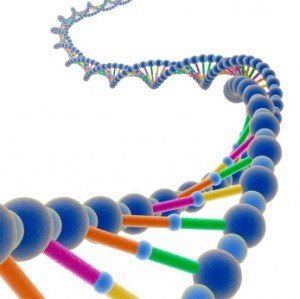
DNA molecule segment is : TTACGCAAG
The mutated DNA segment is TTCGCAAG. This is an example of ___ mutation.
a)
Substitution
b)
Deletion
c)
Insertion
d)
Inversion
50.
Which of the following best describes a DNA molecule?
a)
double helix
b)
contains ribose
c)
made of amino acids
d)
contains Uracil
51.
Why is DNA important?
a)
it is very small and very complicated
b)
it's in everything
c)
it serves as the blueprint for traits of all living things
d)
because we eat it every day for energy
52.
Which of the following is an example of a hurtful mutation? 
a)
Developing cancer
b)
Makes the organism faster
c)
Makes the organism a predator 
d)
Develops sharp claws
53.
What mutation has occurred here? 
T-G-A-C-C-A
T-G-A-G-C-A
a)
Substitution
b)
Deletion
c)
Insertion
d)
Frameshift 
54.
Original: ATC CAT
Mutation: ATC GCAT
What mutation occurred?
a)
deletion
b)
insertion
c)
silent
d)
transverse
55.
DNA is replicated during the ______ phase of the cell cycle.
a)
G1
b)
Synthesis
c)
G2
d)
G0
56.
Fruit fly body cells have 8 chromosomes. After mitosis, you would expect a resulting fruit fly daughter cell to have ...
a)
16 chromosomes.
b)
46 chromosomes.
c)
8 chromosomes.
d)
4 chromosomes.
57.
Structure B is pointing to the _____. 
a)
chromosome
b)
centromere
c)
DNA
d)
chromatid
58.
Structure C is pointing to one ____. 
a)
sister chromatid
b)
chromosome
c)
centromere
d)
gene
59.

How many chromosomes are normally found in human body cells?

a)

46

b)

23

c)

26

d)

44

60.
What is the name of the structure labeled X?
a)
Centriole
b)
Centrosome
c)
Chromatid
d)
Chromosome 
61.
Identify the phase of mitosis.
a)
prophase
b)
metaphase
c)
anaphase
d)
telophase
62.
Which phase comes NEXT?
a)
prophase
b)
metaphase
c)
anaphase
d)
telophase
63.
a)
Prophase
b)
Interphase
c)
Anaphase
d)
Telophase
64.
a)
Cytokinesis
b)
Interphase
c)
Anaphase
d)
Metaphase
65.
a)
Anaphase
b)
Cytonkinesis
c)
Interphase
d)
Prophase
66.
a)
Cytokinesis
b)
Anaphase
c)
Telophase
d)
Prophase
67.
What causes genetic variation in meiosis?
a)
chromosomes lining up
b)
crossing over of chromosomes
c)
separation of chromosomes
d)
chromosomes pulling apart
68.
What kind of cells are made in MEIOSIS?
a)
Haploid cells
b)
Diploid Cells
c)
Skin Cells
d)
Liver Cells
69.
If the Diploid number of Carrots is 18, the haploid number is
a)
18
b)
9
c)
27
d)
36
70.
The process of crossing over occurs in what phase of meiosis?
a)
anaphase 1
b)
prophase 1
c)
prophase 2
d)
telophase 1
71.
The chromosomes that pair up during meiosis, are called __________ chromosomes.  
a)
homozygous 
b)
asexual
c)
homologous
d)
genes
72.
Which cellular process is shown?
a)
meiosis
b)
endocytosis
c)
mitosis
d)
phagocytosis
73.
Which of the following best describes meiosis?
a)
It is carried out in all tissues theat require cell replacement
b)
It occurs only in cells in the reproductive structures of an organism
c)
It happens in all of the tissues except the brain and spinal cord
d)
It is the first stage of mitosis
74.
What phase is represented?
a)
metaphase 1
b)
metaphase 2
c)
anaphase 1
d)
anaphase 2
75.
What phase is  shown in the picture?
a)
metaphase 2
b)
anaphase 2
c)
metaphase 1
d)
telophase 1
76.
A human zygote should have _____ chromosomes inside.
a)
46
b)
23
c)
92
d)
64
77.
What is one of the advantages, of reproducing sexually versus asexually?
a)
survival of the fittest
b)
overproduction
c)
genetic variation
d)
cloning
78.
What is one reason why we need meiosis?
a)
To double the number of chromosomes going into sex cells
b)
To halve the number of chromosomes going into sex cells
c)
To triple the number of chromosomes going into sex cells
d)
To not change the number of chromosomes going into sex cells
79.
products of meiosis are genetically
a)
different
b)
identical
80.

Select the two REACTANTS of photosynthesis.

a)

oxygen

b)

carbon dioxide

c)

glucose

d)

water

81.

Select the two REACTANTS of cellular respiration.

a)

oxygen

b)

carbon dioxide

c)

glucose

d)

water

82.

Select the two PRODUCTS of cellular respiration.

a)

oxygen

b)

carbon dioxide

c)

glucose

d)

water

83.

Select the two PRODUCTS of photosynthesis.

a)

oxygen

b)

carbon dioxide

c)

glucose

d)

water

84.

What is the purpose of cellular respiration?

a)

to make oxygen

b)

to make carbon dioxide

c)

to make sugar

d)

to make ATP energy

85.

Select the step(s) of cellular respiration that require no oxygen.

a)

glycolysis

b)

Krebs cycle

c)

electron transport chain

d)

carbonation

86.

Select the step(s) of cellular respiration that require oxygen.

a)

glycolysis

b)

Krebs cycle

c)

electron transport chain

d)

carbonation

87.

What is the energy source for photosynthesis?

a)

ATP energy

b)

sunlight

c)

electricity

d)

ADP energy

88.
Which organelle performs PHOTOSYNTHESIS?
a)
Chloroplast
b)
Mitochondria
89.
Chloroplasts are...
a)
Structures of animal cells to produce ATP
b)
Organelles where lipids are elaborated
c)
Specialized structures of plants where food is made
d)
Waste organelle of plants
90.

What are the names of the two reactions that occur during photosynthesis?

a)

Light independent reaction

b)

Krebs Cylce

c)

Light deferment reaction

d)

Light dependent reaction

91.
Use the diagram to answer the question. Which chemical is an electron carrier molecule?
a)
H2O
b)
carbon dioxide
c)
NADP+
d)
oxygen
92.

Both plants and animals use photosynthesis.

a)

True

b)

False

93.

Select all the organisms that use cellular respiration.

a)

Bears

b)

Beets

c)

Bacteria

d)

Blue whales

94.

If a plant is facing away from the sun, it will move to face the sun.

a)

True

b)

False

95.
Which type of respiration occurs without the presence of oxygen?
a)
Aerobic 
b)
Anaerobic 
96.
What is the net gain of ATP during glycolysis?
a)
1
b)
2
c)
4
d)
34
97.
___ produces the most ATP.
a)
Aerobic respiration
b)
Anaerobic respriation
c)
Glycolysis
d)
Photosynthesis
98.

What is the total net gain of ATP at the end of aerobic respiration?

a)

2-4 ATP

b)

32-34 ATP

c)

36-38 ATP

d)

40-42 ATP

99.
What are tiny organelles that convert glucose into ATP?
a)
Ribosomes
b)
Vesicles
c)
Cytoskeleton
d)
Mitochondria
100.
Proteins are made of monomers called ___________
a)
Nucleotides
b)
Monosaccharides
c)
Amino Acids
d)
Glycerol and fatty acids
101.

The element _______is found in all of the organic compounds.

a)

Iron

b)

Nitrogen

c)

Carbon

d)

Phosphorus

102.
_________ are composed out of carbon (C), hydrogen (H), oxygen (O), nitrogen (N), and phosphorus (P)
a)
Carbohydrates
b)
Lipids
c)
Proteins
d)
Nucleic Acids
103.
DNA and RNA are examples of 
a)
Carbohydrates
b)
Lipids
c)
Proteins
d)
Nucleic Acids
104.
Monosaccharides are monomers of
a)
Carbohydrates
b)
Lipids
c)
Proteins
d)
Nucleic Acids
105.
Nucleotides are monomers of
a)
Carbohydrates
b)
Lipids
c)
Proteins
d)
Nucleic Acids
106.
Waxes, oils and fats are examples of
a)
Carbohydrates
b)
Lipids
c)
Proteins
d)
Nucleic Acids
107.
Glycerol and fatty acids are the monomers of
a)
Carbohydrates
b)
Lipids
c)
Proteins
d)
Nucleic Acids
108.
Which macromolecule is shown?
 View Figure 1 (if not visible)
a)
lipid
b)
protein
c)
nucleic acid
d)
carbohydrate
109.
What is the function of nucleic acids?
a)
store genetic information
b)
store energy (long-term)
c)
store energy (short-term)
d)
build skin, hair, nails, muscles
110.
Which macromolecule is shown?
 View Figure 2 (if not visible)
a)
lipid
b)
protein
c)
nucleic acid
d)
carbohydrate
111.
Which macromolecule is shown?
 View Figure 3 (if not visible)
a)
lipid
b)
protein
c)
nucleic acid
d)
carbohydrate
112.
Which macromolecule is shown?
 View Figure 4 (if not visible)
a)
lipid
b)
protein
c)
nucleic acid
d)
carbohydrate
113.
What type of macromolecule are enzymes?
a)
Protein
b)
Carbohydrate
c)
Lipid
d)
Nucleic Acid
114.

Which of the following organic compounds is the main and immediate source of energy for living things?

a)

carbohydrates

b)

lipids

c)

nucleic acids

d)

proteins

115.
Lipids are made of... 
a)
C H O
b)
C H O N
c)
C H O N P
d)
C H O N S
116.
Proteins are made of... 
a)
C H O
b)
C H O N
c)
C H O N P
d)
C H O N S
117.
Which macromolecule stores energy, insulates us, and makes up the cell membrane?
a)
lipids
b)
proteins
c)
carbohydrates
d)
nucleic acids
118.
Which macromolecule is made of simple and complex sugars?
a)
lipids
b)
proteins
c)
carbohydrates
d)
nucleic acids
119.

Monomer is to Macrocolecule like ___ is to ____

a)

Building is to Bricks.

b)

Brick is to Building.

c)

Carpenter is to Building.

d)

Building is to Carpenter.

120.

Homeostasis is the regulation and maintenance of the ________

a)

External Environment

b)

Ecosystem

c)

Internal environment

d)

Body temperature

121.

Every change is a challenge to your body, and the environment is _______________

a)

never changing

b)

constantly changing

c)

changing often

d)

changing sometimes

122.

In negative feedback, a control system _________________ any change in the body that moves conditions above or below a set point.

a)

increases

b)

counteracts

c)

adds to

d)

prevents

123.

Negative feedback helps to keep...

a)

the environment always changing

b)

a stable external environment

c)

the internal environment stable

d)

changes inside the body to keep changing

124.

In _______________, the control center uses information from the sensors to increase the rate of change away from a set point.

a)

Negative Feedback

b)

Homeostasis

c)

Mitochondria

d)

Positive Feedback

125.

Which term most accurately describes your body's response to temperature changes?

a)

Positive Feedback

b)

Negative Feedback

c)

Control Center

d)

Condensation

126.
The clear, jelly-like material in a cell that supports and protects the cell’s organelles.
a)
Cytoplasm
b)
Cell Membrane
c)
Nucleus
d)
Mitochondria
127.
The part of the cell that makes protein.
a)
Vacuoles
b)
Ribosomes
c)
Golgi Apparatus
d)
Cytoplasm
128.
Protects the cell from the outside environment. (Only Plants)
a)
Cell Membrane
b)
Chloroplasts
c)
Cell Wall
d)
Vacuoles
129.
Packages proteins into vesicles and ships them out.
a)
Endoplasmic Reticulum
b)
Ribosomes
c)
Golgi Apparatus
d)
Nucleus
130.
Provides support and protection for the cell while also controlling the movement of materials in and out of the cell.
a)
Cellular Membrane
b)
Nucleus
c)
Ribosomes
d)
Vacuole
131.
Breaks down food  to release energy. Known as the power plant of the cell.
a)
Endoplasmic Reticulum
b)
Mitochondria
c)
Ribosomes
d)
Cell Wall
132.
The part of the cell that is used for storage.
a)
Nucleus
b)
Cell Membrane
c)
Mitochondria
d)
Vacuole
133.
The control center of the cell.
a)
Nucleus
b)
Nuclear Membrane
c)
Chloroplasts
d)
Golgi Aparatus
134.
Uses energy from the sun to make food for the plant.
a)
Cell Wall
b)
Cell Membrane
c)
Chloroplasts
d)
Vacuole
135.
A __________ is a branching diagram that shows evolutionary relationships.
a)
cladogram
b)
table
c)
derived character
d)
relationship tree
136.
______________ is the process by which populations change in response to their environment.
a)
natural selection
b)
adaptation
c)
reproductive isolation
d)
divergence
137.
__________ enable an organism to survive in its environment.
a)
adaptations
b)
natural selections
c)
divergence
d)
extinctions
138.
What is the process of which humans breed organisms for certain traits?
a)
artificial selection
b)
descent without modification
c)
inheritance of acquired characteristics
d)
natural selection
139.
Vertebrate embryos pass through similar stages of development is evidence for
a)
use and disuse
b)
homologous structures
c)
common ancestry
d)
acquired characteristics
140.
Individuals that are well adapted to their environment will survive and produce
a)
better traits
b)
stronger genes
c)
more offspring
d)
fewer mutations
141.
All the individuals of a species that live in a particular area are called a 
a)
group
b)
population
c)
variation
d)
fossil
142.
The remnant of an organ that had a function in an early ancestor is known as a(n)
a)
vestigial structure
b)
analogous structure
c)
homologous structure
d)
fossil structure
143.
Dolphins have the same arm structure as wolfs, what type of evidence for evolution does this represent?
a)
DNA
b)
vestigial structures
c)
homologous structures
d)
embryology
144.
What would indicate that a series of fossils represent evolution?
a)
the fossils were identical
b)
the fossils were found in the same layers of rock
c)
the fossils show similarities
d)
the fossils were completely different
145.
What animal is Darwin known for studying?
a)
dinosaurs
b)
tunicates
c)
finches
d)
horses
146.
Natural selection is
a)
survival of the fittest
b)
humans change
c)
two species are the same
d)
more animals survive
147.
The tree of life is a metaphor for what idea?
a)
we came from a common ancestor
b)
we need water and sunlight to survive
c)
we have multiple species
d)
we are old
148.
Who was Charles Darwin?
a)
A naturalist who came up with the theory of evolution
b)
A scientist who studied plants
c)
A geologist who looked at rocks and fossils
d)
A paleontologist who studied dinosaurs
149.

Gigantopithecus were very large primates that lived 500,000 years ago. Since none of these mammals are still today, they are said to be....

a)

Extinct

b)

Threatened

c)

Endangered

d)

Declining

150.

Scientists have collected millions of fossils of different organisms, and have developed a timeline of life on Earth. What do we call this?

a)

Mutation

b)

Natural Selection

c)

The theory of evolution

d)

Fossil Record

151.

Sometimes bones in the front limbs of animals are very similar in structure. What do we call similar bone structures that indicate a link to a common ancestor?

a)

Adaptations

b)

Gradualism

c)

Homologous Structures

d)

Extinction

152.
What is the study of the distribution of organisms around the world?
a)
geology
b)
biogeography
c)
paleontology
d)
geography
153.
a)
analogous structures
b)
homologous structures
c)
vestigial structures
d)
none of the above
154.

What is the study of organisms at the early stages of development?

a)

DNA studies

b)

Comparative Embryology

c)

Extinction

d)

Fossil Record

155.

What do we call a change in a species over time?

a)

Adaptation

b)

Evolution

c)

Extinction

d)

Environmental influences

156.

When looking at two birds of the same species, you notice that one has darker feathers than the other one. You also notice that one has a beak that is just a little longer. These slight differences within members of the same species are called.....

a)

Fossils

b)

Extinction

c)

Meiosis

d)

Variations

157.
Darwin wrote that organisms with traits that are best suited to the environment will ________________
a)
increase in number
b)
become extinct
158.
Which of the following is NOT an example of natural selection? 
a)
People selectively breeding hamsters.
b)
Insect populations developing resistance to certain pesticides.
c)
Bacteria becoming resistant to antibiotics.
d)
Male birds of certain species developing colorful feathers to attract female mates.
159.
The environment around Manchester, England, changed during the Industrial Revolution.  How did this change affect peppered moths living in the area?
a)
Natural selection favored moths with dark wings because predators could not see them on the soot-colored trees.
b)
Natural selection favored moths with white wings that were easy for predators to see.
c)
Natural selection favored moths with white wings because predators could not see them on the soot-colored trees.
d)
Natural selection caused moths with white wings to become extinct.
160.
Group of organisms all of the same species, living in the same place at the same time.
a)
gene pool
b)
population
c)
species
d)
evolution