
 Worksheets
2023-24 PMA 2 Review
Total questions: 163
Worksheet time: 2hrs 13mins

This cell organelle helps organisms maintain homeostasis by controlling what substances may enter or leave cells.
vacuole
nucleus
cell membrane
cell wall


In a cell membrane, where are the hydrophobic parts?
A
B
C
D




Which of the following elements are found in all macromolecules? (Select all that apply).


Match the following MONOMERS and MACROMOLECULES

Nucleic Acid

Protein

Lipid

Carbohydrate
An enzyme is a ______________.
carbohydrate
lipid
nucleic acid
protein


Which macromolecule is shown?
lipid
protein
nucleic acid
carbohydrate


Which macromolecule is shown?
lipid
protein
nucleic acid
carbohydrate

What is the macromolecule of structure A2 and what is its function?
Nucleic Acid - it stores genetic information for protein production
Lipid - it regulates the movement of materials into and out of the cell
Protein - it speeds up chemical reactions in the cytoplasm of the cell
Carbohydrate - it stores short term energy to produce ATP for the cell
All of the biological macromolecules found in organisms contain hydrogen, oxygen and carbon. However, there are distinguishing features of each. Which of the following could be used to differentiate between a carbohydrate and a nucleic acid?
Carbohydrate molecules have a nitrogen base, whereas, nucleic acid molecules have an R-group.
Carbohydrate molecules have nitrogen atoms, whereas, a nucleic acids have an attached phosphate group.
Carbohydrate molecules are only found in rings, while nucleic acid molecules form ring or branched chain shapes.
Carbohydrate molecules contain only carbon, hydrogen and oxygen atoms, whereas, nucleic acid molecules also have a nitrogen base and phosphate group.
Carbohydrates are a macromolecule that provides short term energy while Lipids are a macromolecule that provides long term energy. In terms of their structure, carbohydrates and lipids have what in common?
Both structures are the shape of a hexagon
Both structures are the shape of a long chain
Both structures contain the elements Carbon, Hydrogen, and Oxygen
Both structures contain the elements Carbon, Hydrogen, Nitrogen, and Oxygen
Ovalbumin is a protein found in eggs. Which of the following best describes the molecular structure of ovalbumin?
A group of six carbon atoms joined in a ring
A chain of amino acids folded and twisted into a molecule
A set of three fatty acids attached to a molecule of glycerol
A sequence of nitrogenous bases attached to a sugar phosphate backbone
Plants get their nutrients from the soil. If the phosphorus was removed from the soil, what macromolecule would be decreased in the plant?
Carbohydrate
Lipid
Protein
Nucleic Acid

In a plant, the soil was altered. The presence of each macromolecule was measured and recorded before and after the soil was altered. This can be seen in the graph. What could have caused this change?
Decrease in nitrogen
Increase in phosphorus
Decrease in water
Increase in carbon dioxide
Match the following.
Carbohydrate
Short Term Energy Storage
Protein
Structure, support, assists in chemical reactions
Lipid
Long Term Energy Storage
Nucleic Acid
Stores genetic information
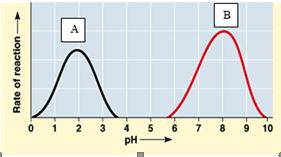
What is the optimal pH of enzyme A?
8
2
5.7-10
10

Which enzyme would you expect to find in bacteria growing in a hot environment?
Enzyme X
Enzyme Y

Which enzyme has an optimum temperature of 40 degrees Celsius?
Enzyme X
Enzyme Y
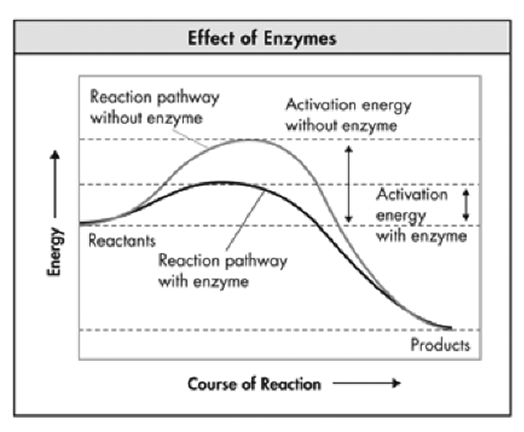
Enzymes are important for the body because
they increase the activation energy needed for a chemical reaction.
keep the activation energy of a chemical reaction at a constant level.
lower the activation energy needed for the chemical reaction.
remove all of the activation energy needed for a chemical reaction.

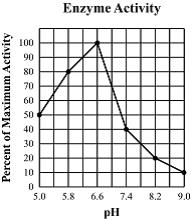
The optimum pH for this enzyme is approximately
2
3.5
5.5
8
10
What happens to enzyme activity if it is denatured?
Enzyme activity will increase
Enzyme activity will decrease
Enzyme activity will remain the same
Enzyme activity will increase and then decrease

What is the optimum temperature this enzyme works the best in?
20
26
38
50
Which of the following best explains why enzymes are necessary for many cellular reactions?
Enzymes supply the oxygen necessary for the reactions
Enzymes change reactants from solid to liquids during the reactions
The reactions take up too much space in the cell if the enzymes are missing
The reactions are too slow to meet the needs of the cell if enzymes are missing
As food travels through the digestive system, it is exposed to a variety of pH levels. The stomach has a pH of 2 due to the presence of hydrochloric acid (HCl), and the small intestine has a pH ranging from 7 to 9. HCl converts pepsinogen into pepsin, an enzyme that digests proteins in the stomach. Which of the following most likely happens to pepsin as it enters the small intestine?
It becomes inactive.
It begins to replicate.
Its begins to engulf large proteins.
Its activity increases to digest more proteins.
Meat tenderizer contains an enzyme that interacts with meat. If meat is coated with the tenderizer and then placed in a refrigerator for a short time, how would the enzyme be affected?
It would get broken down
Its activity would slow down
Its shape would change
It would no longer act as an enzyme

Consider the energy diagram for a chemical reaction in Figure 6-3. Overall, is energy released or absorbed?
absorbed, because the energy level increases during the reaction
absorbed, because the energy level of the products is greater than that of the reactants
released, because the reaction does not require the input of activation energy
released because the energy level of the reactants is greater than that of the products

Which of the following experimental conditions would produce the most product?
Place it in pH 14
Place it in pH 5
Heat it to 40*C
Heat it to 70*C

The diagram shows the relationship between substrate concentration and reaction rate.
Based on the graph, which of the following describes why continually adding substrate does not lead to a continuous increase in reaction rate?
More substrate needs to be added for the reaction to occur
The rate of reaction slows down as enzymes are used up
There is only a certain amount of enzyme present in the reaction.
Enzymes do not replicate fast enough to keep up with the substrate

Salivary amylase is an enzyme in spit that breaks down starches into sugars, which can be easily absorbed by the body. Salivary amylase was tested at different pHs to see how much starch is broken down into sugar and these numbers were recorded in the graph.
Based on these results, what is the optimal pH for salivary amylase to function?
pH 1 because that is where the starch concentration is the highest.
pH 5 because that is where the starch and sugar concentrations are equal.
pH 7 because that is where the sugar concentration is the highest.
pH 11 because the higher the pH, the more active the enzyme is.
Which statement was NOT included in cell theory?
All living things are composed of cells.
Living cells come only from other living cells.
Each cell contains a cell membrane, cytoplasm, nucleus, mitochondria, and endoplasmic reticulum.
Cells are the smallest structure of living things that can perform the functions necessary for life.
The first ever lab grown burger was created in 2013. After extensive testing, the first country to approve the production and consumption of lab-grown meat was Singapore in 2020. To create this meat product, scientists extract muscle stem cells from an animal and grow them in a laboratory setting. Next, the tissue is fed, multiplied, shaped, and structured using bioreactors to become what we might recognize as a burger or meat product. This meat has the same properties as a traditional burger since it is the same muscle. What part of cell theory best supports the ability to do this?
The cell is the basic unit of life
All living things are made of cells
All cells come from preexisting cells
Cells contain hereditary information

The slides show a plant cell‚ cheek cells‚ and a paramecium as seen through a light microscope.
Which component of the cell theory is supported most by the cells pictured above?
Living things are made of cells.
Atoms are the basic units of matter.
Single-celled organisms come from existing organisms.
Cells of larger organisms are larger than the cells in smaller organisms.

A cell containing only starch was placed into a beaker of water. Based on the graph, what happened?
The water from the beaker moved into the cell
The starch from inside the cell moved out of the cell
The water from inside the cell moved out of the cell
The starch from the beaker moved into the cell

What is a FALSE statement about what happened in the image?
Water moved into the cell until it reach equilibrium
Sodium is a small molecule that moved out of the cell
Fats are able to move freely into and out of the cell
The cell membrane is semi-permeable so only certain substances can move through it

Which graph could describe what happened INSIDE THE CELL based on this image?


What best describes what is happening INSIDE THE CELL in the image?


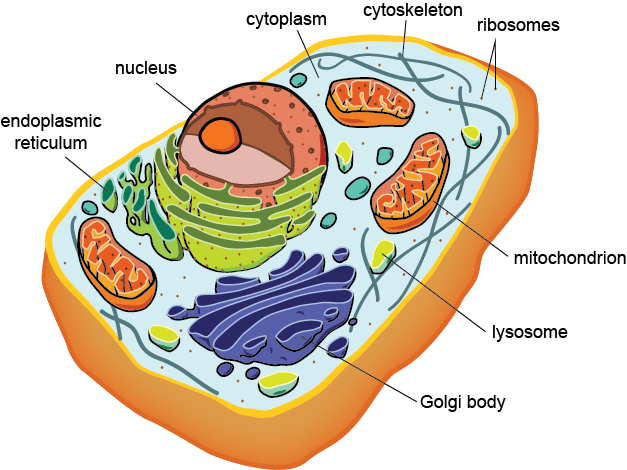
The body gets a disease that prevents it from producing proteins. What organelle is affected by this disease?
mitochondria
lysosome
ribosome
chloroplast
The body gets a disease that prevents it from breaking down lipids and digesting them. What organelle is affected by the disease?
chloroplast
mitochondria
endoplasmic reticulum
lysosome
The body gets a disease that prevents it from producing usable energy. What organelle is affected?
mitochondria
lysosome
ribosome
golgi apparatus

carbon dioxide + water -> glucose + oxygen
The formula above represents which chemical reaction?

What is NOT one of the products of cellular respiration?
CO2
C6H12O6
H2O
ATP
Carbon Dioxide is to Photosynthesis as Oxygen is to...
Anaerobic Respiration
Photosynthesis
Cellular Respiration
Energy
The equation below represents a biological process. Where is this process completed?
glucose + oxygen -> carbon dioxide + water + energy
mitochondria
ribosomes
cell membrane
chloroplasts
When you breathe out, what reactant of photosynthesis are you exhaling?
Oxygen
Carbon Dioxide
Steam
Glucose
The transfer of pollen, containing the sperm cells, to the female part of the flower.
seed dispersal
pollination
germination
fertilization

The part of the flower on which the pollen grains land
pistil
stamen
stigma
style

The part of a flower that produces the male reproductive cells.
anther
stigma
style
filament
The part of the plant that holds the plant in place and absorbs water and minerals from the soil.
stem
roots
root cap
leaves
Which part of the plant makes the food?
roots
leaf
stem
flower
What is the male part of the flower?
Petals
Sepals
Stamen
Pistil
What is the female part of the flower?
Petals
Sepals
Stamen
Pistil
Water travels ____ the plant, through the _____
up, phloem
down, phloem
up, xylem
down, xylem
Glucose travels ______ the plant, through the ______
up, phloem
down, phloem
up, xylem
down, xylem
Xylem and Phloem are both __.
Transpiration
Absorption
Photosynthesis
Vascular tissue

Opening that allows gas exchange, BUT results in water loss
Leaves
Stomata
Roots
Vascular tissue
How are photosynthesis and cellular respiration related?
They have the same equation
They both produce carbon dioxide
They have opposite equations
They both produce oxygen
Primary growth is the result of growth of cells made by the
cork cambium
vascular cambium
apical meristem
primary xylem

What does label 3 point to?
leaves
meristem
fruit
stem
Through what part of the plant are gases such as CO2 and O2 able to enter and leave?
Chloroplasts
Roots
Stomata
Seeds
Where are the seeds located on an adult plant?
roots
stem
leaf
flower
Part of a plant that makes food
roots
stem
flower
leaves
Part of a plant used for support and has tubes for carrying food, minerals, and water
roots
stem
leaves
flower
Part of a plant that holds and protects seeds
roots
stem
fruit
leaves

What is the purpose of petals on a flower?
Soak in sunlight for photosynthesis
Attract pollinators to transfer their pollen to other flowers
Make seeds to reproduce more plants
In which tissue does growth happen?
Dermal
Meristematic
Ground
Vascular
If the stomata were damaged, what would be the effect?
Plant cannot absorb water and oxygen from the air which would dry out the plant
Plant cannot exchange oxygen for carbon dioxide which would decrease photosynthesis
Glucose made in photosynthesis cannot get to the rest of the plant which would starve the plant
Sunlight cannot reach the plant's tissues which would limit photosynthesis
If xylem were damaged, what would be the effect?
Plant would not be able to transport food down
Plant would not be able to transport water up
Plant cannot collect sunlight anymore
Plant will become diseased and die
If a closed container has 500 L of CO2 in it and a plant is placed inside, what will happen to the amount of CO2 in the container?
It will increase
It will decrease
It will stay the same
What allows you to move?
Your mitochondria use respiration to create lipids to make you move
Your mitochondria use respiration to create enzymes to make you move
Your mitochondria use respiration to create proteins to make you move
Your mitochondria use respiration to create ATP to make you move

