wayground logo

Free Printable Worksheets

Font size

S
M
L
XL
Worksheets

Bio 102, Exam 3 Practice Questions

Total questions: 161

Worksheet time: 2hrs 57mins

Name
Class
Date
1.

Which in the classification hierarchy is the most specific?

a)

phylum

b)

genus

c)

domain

d)

species

2.
Which types of organisms developed first due to the early environmental conditions on Earth? 
a)
prokaryotic and aerobic
b)
prokaryotic and anaerobic 
c)
eukaryotic and aerobic
d)
eukaryotic and anaerobic
3.
What is a species?
a)
A group of organisms that can mate with each other and produce fertile offspring. 
b)
A group of organisms that genetically are very different from each other. 
c)
A group of organisms that can mate and produce offspring even if those offspring are infertile.
d)
Indivual organisms that live in the same environment. 
4.
What is speciation?
a)
The change from one species into two or more distinct species. 
b)
The movement of a group of organisms into a new area. 
c)
The ability to mate and reproduce.
d)
The death of an entire species. 
5.
When did life on Earth begin?
a)
4.6 to 4.0 billion years ago
b)
3.9 to 3.5 billion years ago
c)
4.6 to 4.0 million years ago
d)
3.9 to 3.5 thousand years ago
6.
Which of the following pieces of evolution evidence deals with aged and identified fossils?
a)
fossil record
b)
comparative embryology
c)
comparative biochemistry
d)
comparative anatomy
7.
Which of the following describes what the first life form resembled?
a)
Eukaryotes
b)
Plants
c)
Bacteria
d)
Fungi
8.
Eukaryotic life evolved during the _______________ eon.
a)
Hadean
b)
Archea
c)
Proterozoic
d)
Phanerozoic
9.
Approximately how long ago did the earth form?
a)
4.6 billion years ago
b)
4.2 billion years ago
c)
3.8 billion years ago
d)
3. 6 billion years ago
10.
The two most closely related organisms are
a)
hagfish and chimp
b)
perch and mouse
c)
salamander and bird
d)
mouse and chimp
11.
the study of the development of an animal from the fertilized egg to the newly born or hatched organism
a)
Embryology
b)
Homologous Structures
c)
Comparative Anatomy
d)
Relative Dating
12.
What single-celled organism can be both plant-like and animal-like?
a)
Protista
b)
Fungi
c)
Plant
d)
Animal
13.
Tigers, Jellyfish, Gorillas and Sponges are all part of kingdom _______.
a)
Animalia
b)
Plantae
c)
Fungi
d)
Bacteria
14.
Which kingdom is autotrophic AND has a cell wall?
a)
Bacteria
b)
Fungi
c)
Plantae
d)
Protista
15.
 You would find mushrooms in which kingdom?
a)
Plantae
b)
Protists
c)
Fungi
d)
Animalia
16.
The scientific name for an organism is made from the:
a)
class and family name
b)
genus and species name
c)
domain and kingdom name
d)
kingdom and phylum name
17.
Term given to describe the 2 name naming system is:
a)
dichotmous key
b)
binomial nomenclature
c)
2 scientific names
d)
binomial key
18.
The 8 levels of classification, most broad to most specific.
a)
Domain, Genus, Family, Order, Class, Phylum, Kingdom, Species
b)
Domain, Species, Kingdom, Genus, Phylum, Family, Class, Order
c)
Domain, Kingdom, Phylum, Class, Order, Family, Genus, Species
d)
Order, Kingdom, Species, Domain, Phylum, Family, Class, Genus
19.
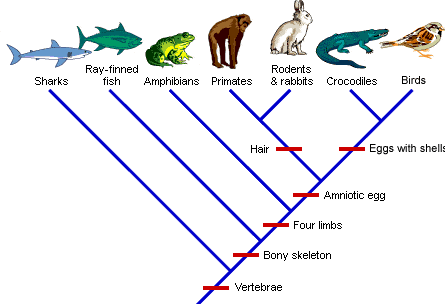
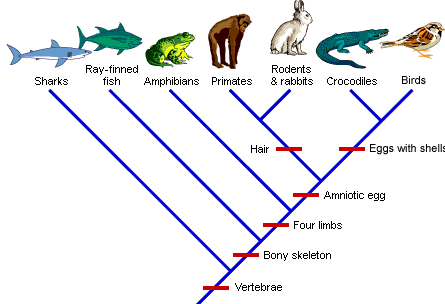
According to this cladogram, sharks are MOST closely related to which organism? 
a)
Amphibians
b)
Ray finned fish
c)
Crocodiles
d)
Birds
20.
Which two orgainsms have hair? 
a)
Sharks & Ray Finned Fish
b)
Primates & Rodents
c)
Birds & Crocodiles
d)
Rabbits & Birds
21.
Which trait do only humans have, according to the cladogram?
a)
jaws
b)
mammary glands & hair
c)
terrestrial during all life stages
d)
bipedal & opposable thumbs
22.
What are the names of the domains?
a)
Eukarya, Bacteria, Archaea
b)
Eubacteria, Archaebacteria, Protista, Animalia, Fungi, Plantae
23.
What does eukaryotic mean?
a)
Has a nucelus
b)
No nucleus
c)
Makes own food
d)
Gets its food from others
24.
Based on the following characteristics, what kingdom would you classify the organism below?
Eukaryotic
Autotrophic
Unicellular
Asexual Reproduction
a)
Eukarya
b)
Plantae
c)
Protista
d)
Fungi
25.
Based on the following characteristics, what kingdom would you classify the organism below?
Eukaryotic
Autotrophic
Multicellular
Asexual or Sexual Reproduction
a)
Protista
b)
Plantae
c)
Fungi
d)
Animalia
26.
Bacteria are prokaryotes.
a)
True
b)
False
27.
What is a major characteristics of Archaebacteria?
a)
Multicellular, prokaryotic organisms
b)
Unicellular, eukaryotic organisms
c)
Live in extreme environments
d)
Cell walls made of peptidoglycan
28.
Which of the following types of bacteria produce methane?
a)
Halophiles
b)
Methanogens
c)
Methanophiles
d)
Themoacidophiles
29.
Which of the following types of bacteria live in salty environments?
a)
Halophiles
b)
Methanogens
c)
Oceanaophiles
d)
Themoacidophiles
30.
What shape of bacteria is shown in the picture?
a)
Bacilli
b)
Cocci
c)
Spirilla
31.
What shape of bacteria is shown in the picture?
a)
Bacilli
b)
Cocci
c)
Spirilla
32.

There are about 100 trillion cells in/on you right now.

How many trillions of human and microbial cells make up you, respectively?

a)

90 : 10

b)

10 : 90

c)

40 : 60

d)

60 : 40

33.
Bacteria help break down dead organisms in a process called...
a)
Decomposition
b)
Nitrogen Fixation
c)
Reproduction
d)
Photosynthesis
34.

Bacteria that live in the root nodules of certain plants carry out...

a)

Nutrient cycling

b)

Nitrogen fixing

c)

Normal flora

35.

Bacteria that decompose material and return vital nutrients to the environment contribute to...

a)

Nutrient Cycling

b)

Nitrogen Fixing

c)

Normal Flora

36.
Which type of cell?
a)
Prokaryote
b)
Eukaryote
37.
The theory of Endosymbiosis explains
a)
The origin of eukaryotes
b)
How species develop
c)
How bacteria live
d)
Why cells rely on one another
38.

____________ & _________________ are organelles that likely arose from endosymbiosis.

a)

Rough ER & Smooth ER

b)

Mitochondria & Flagellum

c)

Chloroplast & Mitochondria

d)

Chloroplast and Golgi apparatus

39.
A protist that can not make its own food is called what? 
a)
Autotroph
b)
Heterotroph 
40.
Fine hairs that allow protist to move is called what? 
a)
Pseudopods 
b)
Euglena 
c)
Flagella 
d)
Cilia 
41.
Which kingdom is MOST LIKELY to contain organisms that are decomposers?
a)
Kingdom Fungi
b)
Kingdom Eubacteria
c)
KIngdom Animalia
d)
Kingdom Plantae
42.
All protists are __________________________.
a)
Prokaryotic
b)
Eukaryotic
c)
Unicellular
d)
Multicellular
43.
This picture is an example of:
a)
Plant-like protist names algae
b)
Plant-like protist names diatoms
c)
Plant-like protist named euglenoids
44.
What are short, hairlike structures that grow on the surface of some protists?
a)
Cilia
b)
Paramecium
c)
Amoeba
45.
A unicellular algae with cell walls filled with silica is called
a)
dinoflagellates
b)
red algae
c)
diatoms
d)
green algae
46.
_________ cause poisonous red tides.
a)
dinoflagellates
b)
diatoms
c)
euglena
d)
rhodophyta
47.
These are protists called _____
a)
diatoms
b)
dinoflagellates
c)
green algae
d)
amoeba
48.
Cnidarians have ______ symmetry.
a)
asymmetrical
b)
Radial
c)
bilateral
d)
none
49.
Which are Cnidarians Species?
a)
Vase sponge
Tube sponge
b)
Coral
Jellyfish
Sea anemone
c)
planaria
tapeworms
50.
How do sponges eat?
a)
they hunt
b)
they are producers
c)
they filter food from the water
51.

_____ are threadlike tubes in fungi.

a)

Heterotrophs

b)

Hyphae

c)

Spores

d)

Lichens

52.

Fungi are important to an ecosystem as

a)

Producers

b)

Controllers

c)

Decomposers

d)

Regulators

53.

Fungi are _____, which means they cannot make their own food.

a)

Autotrophs

b)

Heterotrophs

c)

Carnivores

d)

Omnivores

54.
Which is an example of a disease caused by fungi
a)
Diphtheria
b)
The Common Cold
c)
Strep Throat
d)
Athlete's Foot
55.

Fungi reproduce by releasing _____ into the air.

a)

seeds

b)

pollen

c)

cells

d)

spores

56.

Which group of fungi?

a)

club fungi

b)

sack fungi

c)

zygote fungi

d)

lichen

e)

imperfect

57.
Fungi obtain water and nutrients through hyphae.  What are hyphae?
a)
Hair-like structures to gather food in water environments
b)
Structures that help fungi to gather light.
c)
Structures that produce spores.
d)
Fibrous strands that will grow toward food or water.
58.
An antibiotic made from a species of thread-like fungus.
a)
lichen
b)
mold
c)
penicillin
d)
asprin
59.
Fungi cells walls are made of a material called ____.
a)
cellulose
b)
fibers
c)
hyphae
d)
chitin
60.
Yeasts, mildews and morels are examples of
a)
club fungi
b)
sac fungi
c)
zygote fungi
d)
mold fungi
61.
relationship in which both organisms benefit
a)
predation
b)
parasitism
c)
commensalism
d)
mutualism
62.
Name the scientist who discovered the antibiotic penicillin while studying the fungus Penicillium.
a)
Alexander Fleming
b)
Alexander the Great
c)
Alexander Graham Bell
d)
Alexander Ragtime Band
63.

Which group of fungi?

a)

club fungi

b)

sack fungi

c)

zygote fungi

d)

lichen

e)

imperfect

64.

A combination of a fungus and an algae

a)

club fungi

b)

sack fungi

c)

zygote fungi

d)

lichen

e)

imperfect

65.

The association between a fungus and plant roots is called...

a)

ascocarp

b)

lichen

c)

mold

d)

mycorrhizae

66.
What is the tissue that is used to transport necessary materials throughout the plant?
a)
Circulatory tissue
b)
Transport tissue
c)
Vascular tissue
d)
Pathway tissue
67.
Which of the following statements best describes xylem's function in the plant?
a)
transpports water and minerals up from the roots to the rest of the plant
b)
transports food down from the leaves to the rest of the plant
c)
transports water and minerals down from the roots to the rest of the plant
d)
transports food up from the leaves to the rest of the plant
68.
Which of the following statements best describes phloem's function in the plant?
a)
transpports water and minerals up from the roots to the rest of the plant
b)
transports food down from the leaves to the rest of the plant
c)
transports water and minerals down from the roots to the rest of the plant
d)
transports food up from the leaves to the rest of the plant
69.
What part of the flower turns into the fruit?
a)
Seeds
b)
Ovary
c)
Stamen
d)
Sepals
70.
What is the male reproductive material of plants?
a)
Seeds
b)
Pollen
c)
Fruit
d)
Sepals
71.
What part of the female part of the flower gathers pollen?
a)
Ovary
b)
Style
c)
Filament
d)
Stigma
72.

In this life cycle number 6 is:

a)

Haploid

b)

Diploid

73.

In this life cycle number 1 indicates:

a)

The sporophyte

b)

The gametophyte

c)

Dipolid structures

d)

Gametes

74.
All of the following are vascular plants EXCEPT:
a)
ferns
b)
horsetails
c)
liverworts
d)
club moss
75.
The two groups of seed plants are....
a)
angiosperms and gymnosperms
b)
vascular and nonvascular
c)
spores and seeds
d)
short and tall
76.
The green body of the mosses we can see is...
a)
The flower of the bryophyte
b)
The gametophyte life stage
c)
The sporophyte life stage
d)
The roots of the bryophyte
77.

How are haploid spores created from diploid sporophytes?

a)

mitosis

b)

meiosis

c)

fertilization

d)

binary fission

78.
Gametophytes are __.
a)
haploid
b)
diploid
79.

Select ALL plants that reproduce by using seeds.

a)

Gymnosperms

b)

Angiosperms

c)

Seedless vascular plants

d)

Nonvascular plants

80.

This is a(n) ...

a)

Angiosperm

b)

Gymnosperm

81.

This is a(n) ...

a)

Angiosperm

b)

Gymnosperm

c)

Seedless vascular plant

d)

Nonvascular plant

82.

This is a(n) ...

a)

Angiosperm

b)

Gymnosperm

83.
Plants with seeds in cones are called?
a)
gymnosperms
b)
angiosperms
c)
flowers
d)
mosses
84.
Where do angiosperms produce their seeds?
a)
pollen
b)
cones
c)
flowers
85.
The pollen grains are found in this part of the stamen.
a)
anther
b)
style
c)
pistil
86.
if the food has seeds, it is considered a 
a)
vegetable 
b)
fruit
c)
grain
d)
protein
87.
a tomato is a 
a)
fruit
b)
vegitable
88.
cucumbers are a 
a)
fruit
b)
vegitable
89.
broccoli is a 
a)
fruit
b)
vegetable 
90.
green beans are a
a)
fruit
b)
vegetable
91.
A flower is pictured. Can it be classified as a dicot or monocot?
a)
monocot
b)
dicot
c)
Neither
d)
Lily
92.
What type of leaves would you expect this flower to have?
a)
Branching (net-like) veins
b)
Parallel veins
c)
Scattered veins
d)
None of these.
93.
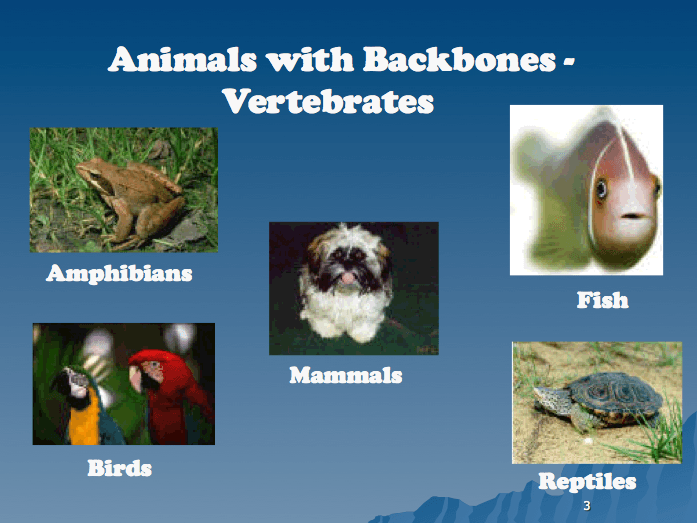
There are five categories of vertebrates.  Which one is not a vertebrate?
a)
Mammals
b)
Birds
c)
Arthropods
d)
Reptiles
94.
My body is moist and smooth, I lay eggs, and live in or near the water.  What am I?
a)
Amphibian
b)
Reptile
c)
Bird
d)
Fish
95.
My body is warm, I have fur, feed my young on milk, and have live births.  What am I?
a)
Reptile
b)
Bird
c)
Mammal
d)
Fish
96.
These all belong to the phylum _________.
a)
porifera
b)
annelida
c)
arthropoda
d)
cnidaria
97.
What is an invertebrate?
a)
An animal with a backbone
b)
a mammal
c)
An animal without a backbone
d)
birds
98.
This picture is an example of which group of invertebrates?
a)
Segmented worms
b)
Fish
c)
Sponges
d)
Arthropods
99.
The organism in the picture is a(n)
a)
echinoderm
b)
mollusk
c)
arthropod
d)
cnidarian
100.
Starfish have.....
a)
Asymmetry
b)
Radial symmetry
c)
bilateral symmetry
101.
What type of skeleton is shown with this animal?
a)
endoskeleton
b)
exoskeleton
102.
Vertebrate animals must have which two features?
a)
endoskeleton and backbone
b)
exoskeleton and backbone
c)
brain and spinal cord
d)
spinal cord and backbone
103.
Choose the characteristics that animals must possess in the Animal Kingdom.
a)
multicellular
b)
eukaryotic and multicellular
c)
eukaryotic, multicellular, heterotroph
d)
eukaryotic, multicellular, autotroph
104.

Sponges lack

a)

Bones, specific body plan, and flagella

b)

Organs, specific body plan, and tissue

c)

Organs, specific body plan, and cells

105.

What are Flatworms?

a)

Acoelomates

b)

Pseudocoelomate

c)

Coelomates

106.

What type of body plan to flatworms/roundworms have?

a)

asymmetrical

b)

radial

c)

bilateral

107.
I am spiny, have a water vascular system with tube feet, radial symmetry, and am called a brittle star.
a)
Mullosk
b)
Arthropod
c)
Echinoderm
d)
Cnidarian
108.
Invertebrates are animals
a)
with a backbone
b)
without a backbone
109.
What am I?
a)
Arthropod
b)
Cnidarian
c)
Mollusk
d)
Porifera
110.
I have a soft-body, a hard shell, and live on land and water.  What am I?
a)
Mollusk
b)
Arthropod
c)
Echinoderm
d)
Cnidarian
111.
I have a long thin body and pairs of legs on each section of my body.  I am a centipede.
a)
Arthropod
b)
Annelid
c)
Echinoderm
d)
Cnidarian
112.
In what phylum am I?
a)
Annelid
b)
Mollusk
c)
Echinoderm
d)
Cnidarian
113.
All insects have _____ legs.
a)
6
b)
8
c)
10
114.

You have observed an animal that lives in the water that has an hard outer covering, a segmented body and jointed legs. In which group of invertebrates would you classify this animal?

a)

Echinoderms

b)

Arthropods

c)

Mollusks

d)

Segmented Worms

115.
This phylum contains segmented worms
a)
Mollusca
b)
Annelida
c)
Platyhelminthes
d)
Nematoda
116.
This phylum contains snails, nautilus, and squids
a)
Mollusca
b)
Annelida
c)
Platyhelminthes
d)
Nematoda
117.
What is the meaning of Cephalopods?
a)
Stomach-foot
b)
Head-footed
c)
Two-shelled
d)
Soft-bodied
118.
What type of circulatory system do annelids have?
a)
Open Circulatory System
b)
Closed Circulatory System
c)
They don't need a circulatory system
d)
They have both types
119.
Which group of arthropods have 3 body segments: head, thorax, and abdomen?
a)
Diplopoda
b)
Chilopoda
c)
Arachnids
d)
Insecta
120.
What two characteristics do all Arthropods have?
a)
two legs per body segment
b)
jointed legs and a cephalothorax
c)
three body segments and metamorphosis
d)
jointed legs and segmented bodies
121.
Lobster, shrimp, and crabs are examples of what group of Arthropods?
a)
Chilopoda
b)
Diplopoda
c)
Crustaceans
d)
Arachnida
122.
An organism that has a dorsal, hollow nerve chord during some stage of its life is in the
a)
Phylum Chordata
b)
Kingdom Mammalia
c)
Phylum Porifera
d)
Domain Archae
123.
Lampreys and hagfish are
a)
Jawless fish
b)
Cartilaginous fish
c)
Bony fish
124.
Fish with bodies of cartilage and scales.
a)
chondrichthyes
b)
osteichthyes
c)
agnatha
125.
Which group of fish includes trout, catfish and marlin?
a)
Agntatha
b)
Chondricthyes
c)
Osteichthyes
126.
Which group of fish include sharks, rays and skates?
a)
Agnatha
b)
Chondrichthyes
c)
Osteichthyes
127.
Where are most amphibian eggs laid?
a)
On land
b)
In trees
c)
In water
d)
In grass 
128.
Reptiles lay their eggs
a)
On land
b)
In water
129.
Which is NOT a characteristic of a reptile?
a)
Warm Blooded
b)
Scaly skin
c)
Has lungs
d)
lays leathery eggs
130.
Which of the following is a characteristic that all mammals share?
a)
they all have a pouch
b)
they all have a cloaca
c)
they all have hair
d)
they all have a short gestational period
131.
Which of the following is a structure that mammals share that enables them to feed their young?
a)
diphyodont
b)
mammary glands
c)
sebaceous glands
d)
aortic arch
132.
Which group of mammals give birth to immature young that continue to develop in the mother's pouch?
a)
monotremes
b)
marsupials
c)
mammals
d)
none of these
133.
What are a mammals three traits?
a)
hair, nails, and skin
b)
hair/fur, backbone, and lungs
c)
fur, ears, and feet
134.
The two groups of seed plants are....
a)
angiosperms and gymnosperms
b)
vascular and nonvascular
c)
spores and seeds
d)
short and tall
135.
The green body of the mosses we can see is...
a)
The flower of the bryophyte
b)
The gametophyte life stage
c)
The sporophyte life stage
d)
The roots of the bryophyte
136.

Sporophyte

a)

Diploid

b)

Haploid

137.

Ferns have a dominant ______ stage

a)

sporophyte

b)

gametophyte

138.
Concentration of nerves and other sensory organs on the anterior (front) end of the body is called____
a)
acoelmate
b)
cestoda
c)
cephalization
d)
tegument
139.
Which type of worm was the first to show cephalization?
a)
flatworm 
b)
roundworm 
c)
neither are cephalized 
140.
Which type of algae is most similar to land plants?
a)
Green algae
b)
Red algae
c)
Brown algae
141.
Which type of algae lives primarily in freshwater?
a)
Green algae
b)
Red algae
c)
Brown algae
142.
Which type of angiosperm has 2 cotyledons and uses a taproot system?
a)
eudicotyledon (eudicot)
b)
monocotyledon (monocot)
143.
The type of mammal that gives birth to offspring that are not well developed
a)
Monotremes
b)
Placentals (eutherians)
c)
Marsupials
d)
All of these
144.
if a species has a notochord at any stage during its life cycle, it is, by definition a 
a)
notochord
b)
ambulacral groove
c)
chordate
d)
Dorsal Nerve Cord
145.

What term describes organisms with body cavities with linings and dividers between segments?

a)

Pseudocoelomate

b)

Protostome

c)

Notochord

d)

Coelomate

146.

Which Phylum of animals includes the largest number of species?

a)

Mammals

b)

Chordates

c)

Mollusks

d)

Arthropods

147.
Which of the following is a correct description of the Cnidarian digestive tract?
a)
A complete digestive tract consisting of two openings.
b)
A complete digestive tract consisting of one opening
c)
An incomplete digestive tract consisting of two openings.
d)
An incomplete digestive tract consisting of one opening.
148.
If an organism has a nucleus, what Domain does it belong to?
a)
Eukaraya
b)
Archaea
c)
Bacteria
d)
Animalia 
149.
The 8 levels of classification, most broad to most specific.
a)
Domain, Genus, Family, Order, Class, Phylum, Kingdom, Species
b)
Domain, Species, Kingdom, Genus, Phylum, Family, Class, Order
c)
Domain, Kingdom, Phylum, Class, Order, Family, Genus, Species
d)
Order, Kingdom, Species, Domain, Phylum, Family, Class, Genus
150.
Sponges belong in which phylum?
a)
Cnidaria
b)
Porifera
c)
Chordata
d)
Arthropoda
151.
Sponges feed by ______ particles out of the water column as it passes through their pores. 
a)
filtering
b)
suspending
c)
consuming
d)
eating
152.
Echinoderms have an internal skeleton and a system of fluid-filled tubes called a(n)...
a)
water vascular system
b)
nervous system
c)
notochord
d)
ampulla
153.
What type of skeleton do echinoderms have?
a)
Exoskeleton
b)
Hydrostatic skeleton
c)
Endoskeleton
d)
Mesenteric skeleton
154.
Letter B represents the
a)
pharynx
b)
eyespots
c)
ganglia
d)
gastrovascular cavity
155.
HYDRA
Function:  Digests food. 
Structure: ?
a)
gastrovascular cavity
b)
mouth
c)
pharynx
156.
This is a group of vascular plants where their seeds are not surrounded by a fruit?
a)
dicots
b)
monocots
c)
angiosperms
d)
gymnosperms
157.
Some organisms that share a common ancestor have features that have different functions, but similar structures.  These are known as
a)
vestigial structures
b)
analogous structures
c)
homologous structures
d)
fossil structures
158.
How would you describe this evolution?
a)
Homologous structure
b)
Analogous structure
c)
Structural adaption
d)
Functional adaption
159.
Like tunicates, lancelets feed in which way?  
a)
Herbivory
b)
Deposit feeding
c)
Filter feeding
d)
Hunting
160.
Which of the following is not a defining trait of chordates?
a)
a notochord
b)
gill slits open across the wall of the pharynx
c)
muscular tail that extends beyond the anus
d)
a closed circulatory system
161.
In chordates, the __________ is a dorsal rod, with a sheath of connective tissue, functioning in support. spinal column endostyle hemichord backbone notochord
a)
Nerve cord
b)
Notacord
c)
vertebrate
d)
backbone