wayground logo

Free Printable Worksheets

Font size

S
M
L
XL
Worksheets

Biology EOC Review

Total questions: 156

Worksheet time: 2hrs 57mins

Name
Class
Date
1.
When experimenting with the growth of a plant, a scientist uses three (of the same type of) plants, two different fertilizers, equal light, and equal water. What type of variable is the fertilizer?
a)
Dependent
b)
Independent
c)
Control
d)
Compound
2.
Research Question: Does the type of gasoline put in a car effect how fast the car can drive. What is the independent variable?
a)
Type of gasoline
b)
which car the gas is put into
c)
how fast the car can drive
d)
how much gas is put into the car
3.
Ms. S set up an experiment to see how the mass of a ball affects the distance it rolls off a ramp. What is the dependent variable?
a)
Distance traveled by the ball
b)
Height of the ramp
c)
Mass of the ball
d)
Where the experiment took place.
4.
Mr. S normally uses praise as a reward to train his dog. He wants to know the best way to train his dog, so he sets up an experiment to find out if there is a better way to get his dog to respond to commands. What is his dependent variable?
a)
Type of reward
b)
Praise
c)
Type of dog
d)
Amount of time the dog follows commands
5.
The independent variable is the ONE thing you _____.
a)
change
b)
keep the same
c)
experiment with
d)
investigate
6.
The measurable factor in an experiment is known as the: 
a)
Control
b)
Independent Variable
c)
Constant
d)
Dependent Variable
7.
A comprehension test was given to students after they had studied textbook material either in silence or working together.
What is a possible control variable?
a)
Comprehension Test Results
b)
The thickness of the text book
c)
All students working in Silence
d)
Number of students working together and in Silence
8.
If a student thinks an apple a day keeps the doctor away what are some constants they need to consider?
a)
the number of apples eaten by test subject, who eats them, amount of sleep testing subjects recieve
b)
the apples
c)
the number of doctors visits
d)
the age of the test subjects, the general sleep and meals eaten by test subjects
9.
Everything starts with an observation or a question
a)
True
b)
False
10.
How many variables do we want to be testing at one time?
a)
1
b)
2
c)
3
d)
4
11.

A hypothesis has to have which two words? (Select two)

a)

If

b)

Think

c)

Due

d)

Then

12.

Which one is the best hypothesis?

a)

If we feed our children different amounts of candy, then the kids with the most amount of candy will be the most hyper.

b)

If we feed our children different amounts of candy, then all of the kids will be hyper.

c)

If we feed our children different amounts of candy, then none of the kids will be hyper.

13.
Does the type of shoes affect the running speed?Which is the correct testable question?
a)
If the subject wears boots, then the subject will jump the fastest.
b)
If the subject wears heels, then the subject will run the slowest.
c)
The subject wears Nike, then the subject will run the fastest.
d)
If I wear Nike, then I will run the slowest.
14.
What element is considered the building block of life?
a)
carbon
b)
hydrogen
c)
oxygen
d)
water
15.
Which carbon-based molecule contains the genetic information of the cell?
a)
carbohydrates
b)
lipids
c)
proteins
d)
nucleic acids
16.
Enzymes are made of which monomer?
a)
monosaccharides
b)
fatty acids and glycerol
c)
amino acids
d)
nucleotides
17.

This molecule provides quick energy for the cells.

a)

carbohydrates

b)

lipids

c)

proteins

d)

nucleic acids

18.
My monomer is nucleotide.
a)
carbohydrates
b)
lipids
c)
proteins
d)
nucleic acids
19.

These are outer shell electrons that are associated with an atom, and that can participate in the formation of a chemical bond if the outer shell is not closed.

a)

A. valence electrons

b)

B. weak electrons

c)

C. strong electrons

d)

D. paired electrons

20.

A large molecule made of subunits called monomers.

a)

A. isomer

b)

B. polymer

c)

C. misnomer

d)

D. hydrocarbon

21.
Monomer of nucleic acids; consists of a phosphate group, sugar, and a base. 
a)
steroid
b)
nucleotide
c)
polypeptide
d)
polymer
22.
A class of biological molecules which include waxes, oils, fats, and fatty acids.
a)
protein
b)
monomer
c)
lipids
d)
glycogen
23.

What enables a water strider to stand on the water?

a)

Adhesion

b)

High Specific Heat

c)

Surface Tension

d)

None of the above

24.
A solvent is...
a)
a substance into which the solute dissolves
b)
a compound being dissolved
c)
a substance that does not dissolve
d)
None of the above
25.
Which property of water will cause water to bead up on glass?
a)
Adhesion
b)
Cohesion
c)
Ability to dissolve substances
d)
High specific heat
26.
The term that describes the idea the hydrogen atoms of a water molecule has the positive charges and oxygen atom has a negative charge. These charges are opposite which is why the water molecule is able to stay bonded.
a)
Polarity
b)
Surface Tension
c)
Specific Heat
d)
Heat of Vaporization
27.
The energy needed to raise water to a specific temperature is called: 
a)
Specific Heat
b)
Heat of Vaporization
c)
Density
d)
Polarity
28.
This organelle is a rigid outer layer that protects plant cells.
a)
Cell Membrane
b)
Cell Wall
c)
Nucleus
d)
Chloroplast 
29.

This organelle controls what goes in and out of plant and animal cells.

a)

Cell Wall

b)

Cell Membrane

c)

Chloroplasts

d)

Cytoplasm

30.

The _____________ stores food, water, wastes, and other materials in both plant and animal cells.

a)

Vacuole

b)

Mitochondria

c)

Cytoplasm

d)

Nucleus

31.
An organelle that captures energy from the sunlight in order to use it to produce food in plant cells is ______________.
a)
Chromatin
b)
Chloroplast
c)
Cytoplasm
d)
Cell Membrane
32.

The _____________ holds the DNA, and controls the functions of eukaryotic cells.

a)

Nucleus

b)

Nuclear Membrane

c)

Mitochondria

d)

Chloroplast

33.

The _____________ is a gel-like fluid that fills plant and animal cells. It holds the organelles in place and gives each cell its shape.

a)

Cytoplasm

b)

Cell Membrane

c)

Cell Wall

d)

Chloroplast

34.

What can only be found in plant cells?

a)

Cell membrane

b)

Vacuole

c)

Chloroplast

d)

Mitochondria

35.

What organelle is called the "powerhouse" of a cell?

a)

mitochondria

b)

nucleus

c)

cell wall

d)

cell membrane

36.
All living things are made of...
a)
atoms 
b)
cells 
c)
bacteria 
d)
plants 
37.
What type of cell has a nucleus? 
a)
eukaryotic
b)
prokaryotic 
38.
Amino acids link together to form proteins. In which organelle would this process occur?
a)
Lysosome
b)
Ribosome
c)
Centriole
d)
Mitochondria
39.
packages proteins for delivery
a)
Endoplasmic reticulum
b)
ribosomes
c)
golgi apparatus
d)
lysosomes
40.
break down (digest) worn out cell parts, mostly in animal cells
a)
cytoplasm
b)
lysosomes
c)
mitochondria
d)
vacuoles
41.
Transportation network for the cell, moves materials around in the cell
a)
Lysosome
b)
Nuclear Membrane
c)
Endoplasmic Reticulum
d)
Centriole
42.
What am I?
a)
mitochondria
b)
lysosomes
c)
chloroplast
d)
endoplasmic reticulum
43.
The cell membrane is selectively permeable, which means...
a)
All materials can enter and leave the cell
b)
Certain things can enter while others cannot
c)
The cell manually sorts through all materials
d)
Only certain cells can interact with the cell.
44.
Lipid tails are...
a)
Nonpolar
b)
Polar
45.
Lipid heads are...
a)
Hydrophobic
b)
Hydrophilic
46.
When looking at the cell membrane, where are the lipid heads located?
a)
Floating between bilayer levels
b)
Outer part of the bilayer
c)
Inner part of the bilayer
d)
Located at different parts throughout the bilayer
47.
Which bond of the ATP molecule is broken in order to release energy?
a)
A
b)
B
c)
C
d)
D
48.
Which of the following can be compared to a battery in need of recharging?
a)
ADP
b)
ATP
c)
Ribose
d)
Adenosine
49.
Which cellular organelle is responsible for manufacturing ATP?
a)
Ribosome
b)
Nucleus
c)
Mitochondria
d)
Chloroplast
50.
Energy is released from ATP when
a)
a phosphate group is added
b)
adenine bonds to ribose
c)
ATP is exposed to sunlight
d)
a phosphate group is removed
51.
What do all cells use as energy?
a)
Carbs
b)
Protein
c)
Fat
d)
ATP
52.
Which structures shown in the Figure make up the ADP molecule?
a)
A and B
b)
A, B and C
c)
A, B, C, and D
d)
C and D
53.

Plants need ________ to conduct photosynthesis

a)

Oxygen

b)

Soil

c)

Carbon dioxide

d)

Sugar

54.
Why do plants conduct photosynthesis?
a)
To make light
b)
To make mitochondria
c)
To make glucose
d)
To release carbon dioxide
55.
Which organelle in the plant cell performs photosynthesis?
a)
Chloroplast
b)
Mitochondria
c)
Nucleus
d)
Cytoplasm
56.

What are the products of photosynthesis?

a)

Glucose and Chlorophyll

b)

Glucose and Oxygen

c)

Water and Light

d)

Carbon dioxide and Water

57.

Which of these conditions would decrease the rate of photosynthesis in a plant?

a)

Appropriate precipitation

b)

Changing the daylight hours from 14 hrs to 10 hrs

c)

Changing the CO2 concentration from 380 ppm to 410 ppm

d)

All of these choices

58.
Which choice correctly shows the gases that enter and exit plants during photosynthesis?
a)
Enter: Oxygen
Exit: Carbon dioxide
b)
Enter: Water vapor
Exit: Glucose
c)
Enter: Carbon dioxide
Exit: Oxygen
d)
Enter: Light
Exit: Water vapor
59.

Which of the following is NOT a product of the light reactions?

a)

Oxygen

b)

NADPH

c)

ATP

d)

Glucose (Sugar)

60.
Where do the light reactions happen?
a)
mitochondria membrane
b)
thylakoid membrane
c)
stroma
d)
central vacuole
61.
What is the main purpose of the light dependent reactions?
a)
To provide the energy for the calvin cycle
b)
To capture energy and make sugar
c)
To reflect green light
d)
To make sugars
62.
Thylakoids are arranged in stacks called ____.
a)
Lamellae
b)
Stroma
c)
Granum
d)
Glucose
63.
The gel-like material that surrounds the grana is called ____
a)
lamellae
b)
granum
c)
thylakoid
d)
stroma
64.
In the ________________________, energy from the sun is used to make ATP 
a)
light-independent reaction
b)
dark reaction
c)
light-dependent reaction
d)
Calvin cycle
65.

Which of the following equations represents the overall chemical reaction for photosynthesis?

a)

6O2+ 6H2O → C6H12O6+ 6O2

b)

C6H12O6 + 6H2O→ 6O2+ 6O2

c)

6H2O + 6CO2 → 6O2 + C6H12O6

d)

6O2 + 6H2O→ C6H12O6 + 6CO2

66.

Where do the light independent reactions (Calvin cycle) take place?

a)

thylakoid membrane

b)

lumen

c)

stroma

67.
In green plants, the primary function of the Calvin cycle is to
a)
Use ATP to release carbon
b)
Split water to release oxygen.
c)
Construct simple sugars from carbon dioxide.
d)
Use NADPH to release carbon
68.
TRUE or FALSE.  The Calvin Cycle can happen during the day.
a)
True
b)
false
69.

Which of the following processes occur in the cytoplasm?

a)

Glycolysis

b)

Alcoholic Fermentation

c)

Lactic Acid Fermentation

d)

All of these

70.

Which of the following is the correct chemical equation for Cellular Respiration?

a)

C6H12O6 + 6O2 --> 6CO2 + 6 H2O + ATP Energy

b)

C6H12O6 + H2O --> 6CO2 + 6 6O2 + ATP Energy

c)

6CO2 + 6 H2O + Light Energy --> C6H12O6 + 6O2

d)

C6H12O6 + 6CO2 --> 6O2 + 6 H2O + ATP Energy

71.

What is the net/overall amount of ATP made in Glycolysis?

a)

1

b)

2

c)

32

d)

36

72.

What is always the first step/process in either type of respiration?

a)

Fermentation

b)

Kreb's Cycle

c)

Electron Transport Chain

d)

Glycolysis

73.

Which type of fermentation produces CO2 gas and ethyl alcohol?

a)

Alcoholic Fermentation

b)

Lactic Acid Fermentation

74.

What is the ultimate goal of Fermentation?

a)

to directly make more ATP for the cell

b)

to make more NADH for the ETC

c)

to remake NAD+ for Glycolysis to continue making ATP

d)

to make glucose for the cell

75.

The number of ATP molecules produced out of 1 turn of the Krebs Cycle is:

a)

1

b)

3

c)

2

d)

0

76.
Krebs Cycle takes place in the:
a)
Cytoplasm
b)
Matrix
c)
Ribsome
d)
InterMembrane Space
77.
Folds in the mitochondrion are called:
a)
Cristae
b)
Matrix
c)
Golgi Bodies
d)
Carbuncles
78.
The first step in getting energy in the cell by breaking down glucose is known as
a)
the Krebs cycle
b)
electron transport
c)
fermentation
d)
glycolysis
79.
Where does the electron transport chain happen?
a)
Matrix
b)
Cristae
c)
Outer membrane
d)
Cytoplasm
80.
Before cells can divide, what must be copied?
a)
mitochondria
b)
cytoplasm
c)
DNA
d)
Cell Wall
81.
The division of the nucleus is known as:
a)
Synthesis
b)
Mitosis
c)
G1
d)
G2
82.
The ___________ holds the replicated sister chromatids together.
a)
centriole
b)
chromosomes
c)
centromere
d)
cycles
83.
The cell spends most of it's life in ________________.
a)
mitosis
b)
cytokinesis
c)
Interphase
d)
None of the above
84.
In the S stage of interphase_______________
a)
the cell grows
b)
the nucleus divides
c)
the cell membrane divides
d)
the DNA is replicated
85.
A human cell has 46 chromosomes before mitotic division.  How many chromosomes will the daughter cells after mitosis.
a)
12
b)
23
c)
46
d)
92
86.
Cells of organism must replicate for ?
a)
growth
b)
repair of damaged cells
c)
replacement of dying cells.
d)
All of the above
87.
Name the phase:
a)
Prophase
b)
Metaphase
c)
Anaphase
d)
Telophase
88.
Name the phase:
a)
Prophase
b)
Metaphase
c)
Anaphase
d)
Telophase
89.
The stages of mitosis in order
a)
Metaphase, Anaphase, Prophase, Telophase
b)
Prophase, Anaphase, Metaphase, Telophase
c)
Prophase, Metaphase, Anaphase, Telophase
d)
Anaphase, Prophase, Telophase, Metaphase
90.
The structures labeled B are
a)
centrioles
b)
chromatids
c)
centromeres
d)
chromopheres
91.

What kind of cells are made in MEIOSIS?

a)

Haploid Gametes

b)

Diploid Somatic Cells

c)

Skin Cells

d)

Liver Cells

92.

A human body (somatic) cell usually has how many chromosomes?

a)

6

b)

22

c)

4

d)

46

93.
When an area of a chromatid is exchanged with the matching area on a chromatid of its homologous chromosome, _________________ occurs
a)
crossing over
b)
mutagenesis
c)
hybridization
d)
fertilization
94.
If the Diploid number of Carrots is 18, the haploid number is
a)
18
b)
9
c)
27
d)
36
95.
Why do we need meiosis?
a)
To double the number of chromosomes going into sex cells
b)
To halve the number of chromosomes going into sex cells
c)
To triple the number of chromosomes going into sex cells
d)
To not change the number of chromosomes going into sex cells
96.
If a somatic (body) cell in a butterfly contains 24 chromosomes, a butterfly egg would contain
a)
3
b)
6
c)
12
d)
24
97.
The result of meiosis is:
a)
two diploid cells
b)
two haploid cells
c)
four diploid cells
d)
four haploid cells
98.

The chromosomes that pair up during meiosis, are called __________ chromosomes.

a)

heterozygous

b)

asexual

c)

homologous pairs

d)

genes

99.
What phase is represented?
a)
metaphase 1
b)
metaphase 2
c)
anaphase 1
d)
anaphase 2
100.
A child is diagnosed with a rare disease. Neither parent has the disease. How did the child inherit the disorder?
a)
The disorder is dominant and carried by a parent.
b)
The disorder is recessive and carried by both parents.
c)
The disorder is sex-linked and inherited only from the father.
d)
A mutation in the child occurred.
101.
A phenotype that results from a dominant allele must have at least ___ dominant allele(s) present in the parent(s).
a)
one
b)
two
c)
three
d)
four
102.
In pea plants, the trait for tall stems is dominant over the trait for short stems. If two heterozygous tall plants are crossed, what percentage of the offspring would be expected to have the same phenotype as the parents?
a)
100%
b)
75%
c)
50%
d)
25%
103.
The observable traits of an organism are known as its
a)
allele
b)
dominance
c)
phenotype
d)
genotype
104.
Each parent contributes one of the genes for a particular trait. The genes of the pair are called:
a)
variables
b)
gametes
c)
hybrids
d)
alleles
105.
In snapdragons, Tallness (T) is dominant to dwarfness (t). In a cross between two plants that are heterozygous for this trait, the percent of offspring expected to exhibit dwarfness is
a)
 25%
b)
100%
c)
50%
d)
0%
106.
In snapdragons, Tallness (T) is dominant to dwarfness (t). In a cross between two plants that are homozygous for the recessive allele, the percent of offspring expected to exhibit tallness is
a)
 25%
b)
 75%
c)
100%
d)
0%
107.
Mendel discovered principles of inheritance because he:
a)
 observed simultaneously all of the characteristics in which the parents differed
b)
 ignored all characteristics except a few markedly contrasting ones which he studied carefully
c)
studied only the offspring obtained from a single mating
d)
was smarter than any other scientist of his time
108.
The gene makeup of an organism for a particular trait is known as its
a)
dominance
b)
phenotype
c)
allele
d)
genotype
109.

This type of inheritance pattern is a MIXTURE/BLEND of two traits. This is known as ---

a)

incomplete dominance.

b)

codominance

110.

What type of inheritance pattern is shown here?

a)

Codominance

b)

Incomplete dominance

111.

Snap dragon color is a incomplete dominant trait. A red flower (RR) is crossed with white flower (WW)? What color are flowers that are RW?

a)

Red and White

b)

Red

c)

Pink

d)

White

112.

The hair form gene shows incomplete dominance. Straight hair (SS) is dominant, curly hair (CC) is recessive, and wavy hair (SC) is heterozygous. Mr. and Mrs. Anderson both have wavy hair (SC). What percentage of their children will also have wavy hair (SC)?

a)

25%

b)

50%

c)

75%

d)

100%

113.
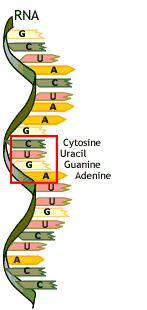
In RNA, Uracil pairs with ______. 
a)
cytosine
b)
adenine
c)
guanine
d)
thymine
114.
The process to go from DNA to mRNA is _______
a)
translation
b)
transcription
c)
replication
115.
The process to go from mRNA to a protein is called ____
a)
transcription
b)
rRNA
c)
replication
d)
translation
116.
DNA holds the code for
a)
lipids
b)
carbohydrates
c)
protein
d)
sugar
117.
Choose the nucleotide sequence of the RNA strand that would be complementary to the following strand: 
GTAGTCA
a)
UATUAGA
b)
ACGACTG
c)
CAUCAGU
d)
CATCAGT
118.
The main function of tRNA is to...
a)
carry a message that, when translated, forms proteins
b)
form a portion of ribosomes
c)
string together complementary RNA and DNA strands
d)
bring amino acids from the cytoplasm to the ribosomes
119.

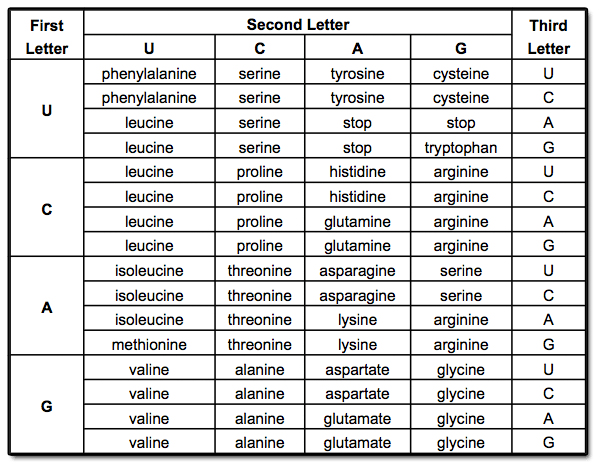
What amino acid is represented by the codon AUG?

a)

Phenylalanine

b)

Tyrosine

c)

Methionine

d)

Stop codon

120.

What is the location in the cell for translation?

a)

nucleus

b)

mitochondria in cytoplasm

c)

ribosome in cytoplasm

d)

chloroplast in cytoplasm

121.
What is the three base sequence of mRNA that codes for a single amino acid?
a)
Anticodon
b)
Codon
c)
Protein
122.
What is the location in the cell for transcription?
a)
nucleus
b)
cytoplasm
c)
ribosome
d)
mitochondria
123.
Does the order of amino acids in a protein matter?
a)
YES!
b)
NO!
124.
A characteristic that improves an individual's ability to survive and reproduce in a particular environment.
a)
Ancestor
b)
Adaptation
c)
Descendant
d)
Fossil
125.

The process of selecting a few organisms with desired traits to serve as parents of the next generation. Selective breeding of plants and animals to promote the occurrence of desirable traits in offpsring.

a)

Evolution

b)

Natural Selection

c)

Generation Time

d)

Artificial Selection

126.
English natural scientist who formulated a theory of evolution by natural selection (1809-1882).
a)
Darwin
b)
Wallace
c)
Linnaeus
d)
Lamarck
127.
The information provided by fossils about the Earth's history.
a)
Fossil Record
b)
Extinction
c)
Evolution
d)
Genetic Variation
128.
A trait passed from parent to offspring through DNA.
a)
Natural Resources
b)
Survival of the Fittest
c)
Genetic variation
d)
Genetic trait
129.
Differences among individuals in the composition of their genes or other DNA segments.
a)
Natural Selection
b)
Derived traits
c)
Genetic Variation
d)
Adaptation
130.

Process by which individuals that are better suited to their environment survive and reproduce most successfully; also called survival of the fittest.

a)

Extinction

b)

Speciation

c)

Natural Selection

d)

Artificial Selection

131.
Bird wings and butterfly wings are an example of
a)
Homologous structure
b)
Analogous structure
c)
Mimicry
d)
Camoflague
132.
Analogous structures show common ancestry.
a)
True
b)
False
133.
An organism's ability to survive and reproduce in its environment refers to its
a)
Fitness
b)
Variation
c)
Selection
d)
Mutation
134.
Which of the following pieces of evolution evidence deals with structures common in embryos that form differently or for different purposes in adult form?
a)
fossil record
b)
comparing embryology
c)
comparing biochemistry
d)
comparing anatomy
135.
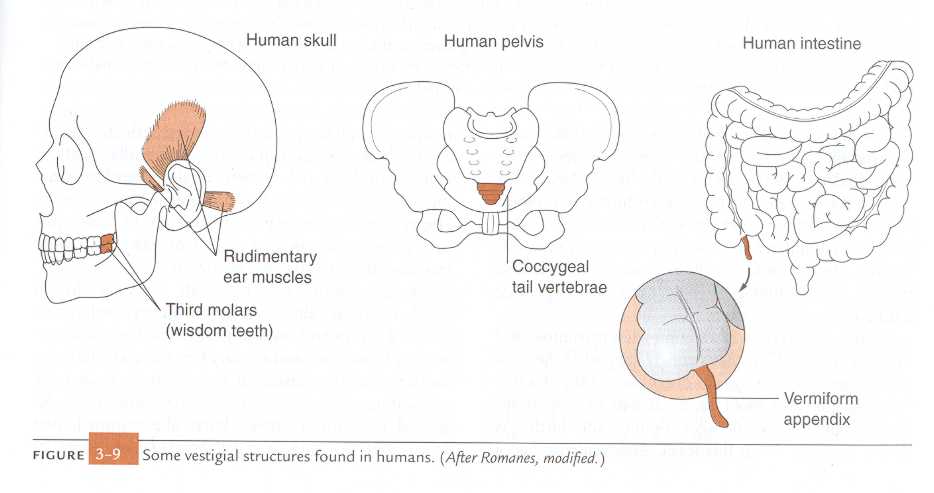
If an organism has a vestigial structure, that structure likely once had a function in a(n)
a)
close relative
b)
early ancestor
c)
unrelated organism
d)
embryological stage
136.
Mutations are important because they bring about
a)
death of the organism in which they develop
b)
genetic variation needed for a population to evolve
c)
benefits for the individual, not for the population
d)
Hardey-Weinberg equilibrium within a population
137.

The muscles of the human ear are examples of

a)

homologous structures

b)

analogous structures

c)

fossils

d)

vestigal structures

138.
Members of a species in a defined area
a)
Ecosystem
b)
community
c)
biodiversity
d)
population
139.
Consumer that eats plants
a)
heterotroph
b)
herbivore
c)
producer
d)
community
140.
Series of steps in which organisms transfer energy by eating and being eaten
a)
foodweb
b)
consumer
c)
food chain
d)
omnivore
141.
Organisms that relies on other organisms for food; consumer
a)
herbivore
b)
decomposer
c)
heterotroph
d)
species
142.
All the organisms in a particular location, including their nonliving environment
a)
ecosystem
b)
carnivore
c)
niche
d)
population
143.
What does fungi do to dead plants and animals?
a)
Leave them there
b)
Decompose them
c)
Wait for other animals to eat them
d)
Move away
144.
In the energy pyramid here, how much of the energy in the producers gets passed to the herbivores?
a)
10%
b)
20%
c)
80%
d)
90%
145.
Which of the following leads to a decrease in biodiversity?
a)
protection of ecosystems
b)
pollution control
c)
selective cutting
d)
introduction of exotic or invasive species
146.
What is it called when water is changed from a liquid to a gas?
a)
EVAPORATION
b)
PRECIPITATION
c)
TRANSPIRATION
147.
What is the ultimate source of energy for all ecosystems?
a)
the Sun
b)
plants
c)
secondary consumers
d)
primary consumers
148.
A farmer plants two species of grass with similar nutrient needs on the same small plot of land.  What kind of interaction will most likely occur between the two species?
a)
parasitism
b)
competition
c)
commensalism
d)
mutualism
149.
A relationship between two organisms in which one organism benefits and the other is unharmed...
a)
Mutualism 
b)
Competition
c)
Parasitsm 
d)
Commensalism 
150.
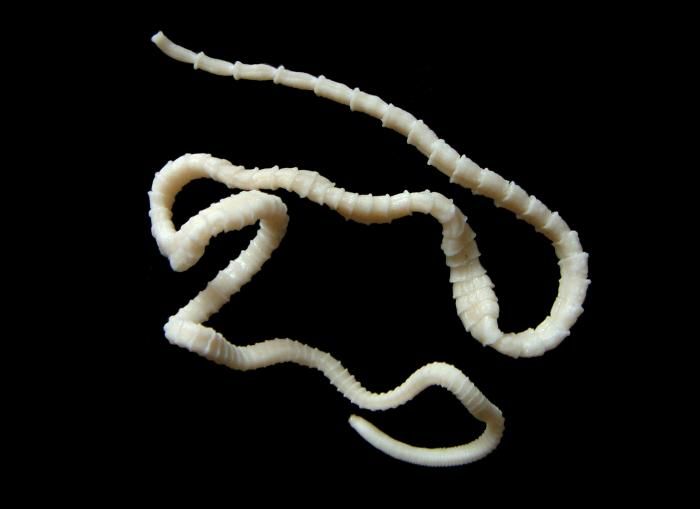
A tapeworm and a cat have this type of relationship.
a)
mutualism
b)
parasitism
c)
commensalism
d)
competition
151.
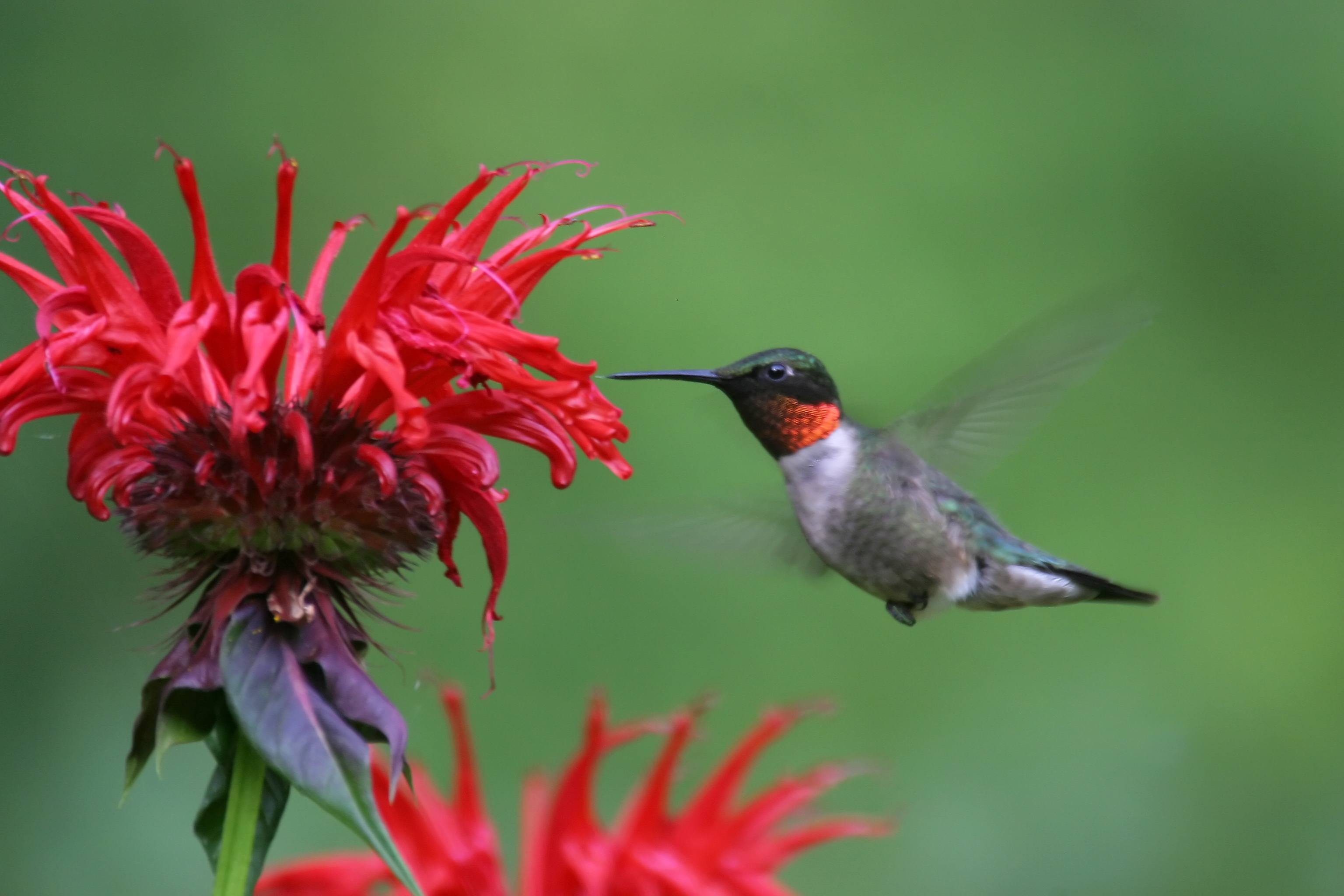
What type of symbiosis?  Hummingbirds feed on nectar from flowers.  The flowers are pollinated by hummingbirds as they move from flower to flower.
a)
commensalism
b)
mutualism
c)
parasitism
d)
predation
152.
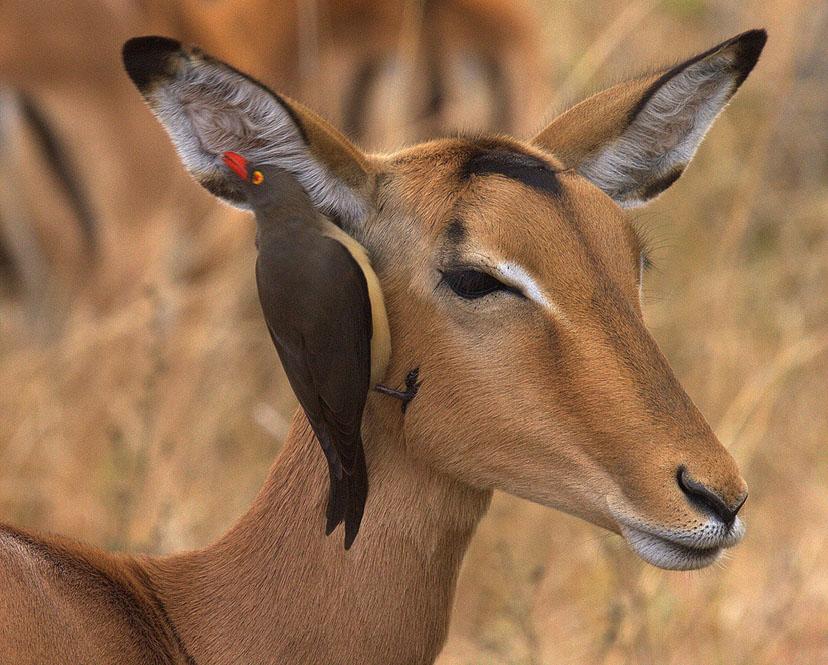
Red-billed oxpeckers are birds that often feed on parasites that infest impala.  This is an example of _______.
a)
commensalism
b)
mutualism
c)
neutralism
d)
competition
153.
Barnacles create home sites by attaching themselves to whales. This relationship neither harms nor benefits the whales. 
a)
parasitism
b)
commensalism
c)
mutualism
154.
What is the water cycle?
a)
the 3 forms of water
b)
the movement of water on, above, or below the surface of the Earth
c)
when water melts
d)
when clouds form
155.
What is it called when plants give off water vapor as a waste product?
a)
condensation
b)
evaporation
c)
sublimation
d)
transpiration
156.
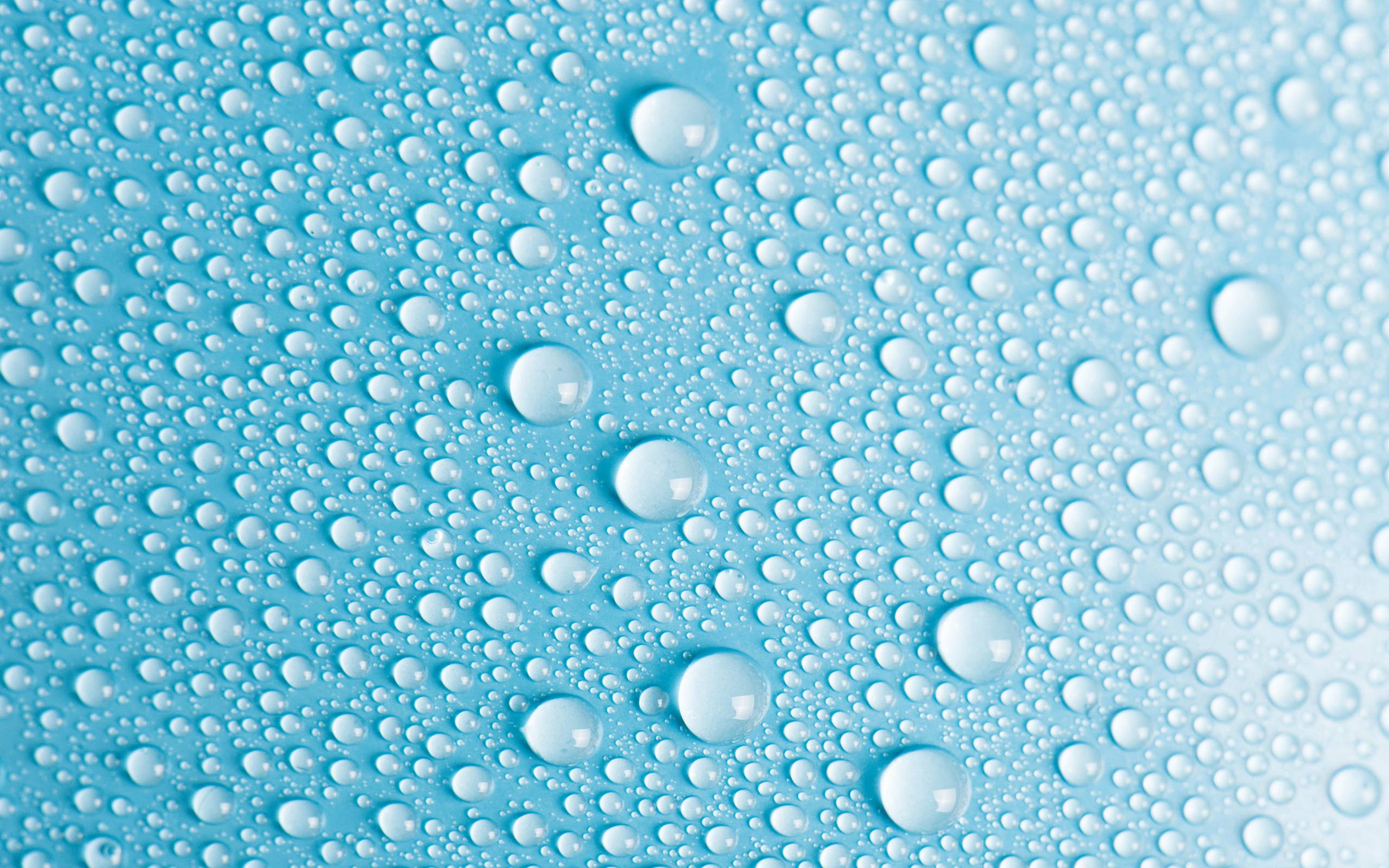
When water _________, dew forms.
a)
Melts
b)
Evaporates
c)
Condenses
d)
Precipitates