
 Worksheets
Biomolecules & Enzymes TEST Review Sheet
Total questions: 165
Worksheet time: 2hrs 15mins
Name each of the 4 biomolecules.
Carbohydrate, Lipids, Proteins, Nucleic acids
Carbohydrate, Vitamins, Proteins, Minerals
Glucose, Fatty acids, Enzymes, DNA
Starch, Oils, Hormones, RNA
What is the main function of carbohydrates?
A) Energy storage, cell membrane structure, hormone regulation, and insulation
B) Provide and store energy short term
C) Structural support, biochemical catalysts, hormones, enzymes, building blocks, and initiators of cellular death
D) Storing, transmitting, and using genetic information necessary for life
Which biomolecule is responsible for storing, transmitting, and using genetic information necessary for life?
Carbohydrate
Lipids
Proteins
Nucleic acids
Fill in the blank: The monomer of carbohydrates is ________ (a simple sugar), such as glucose.
monosaccharide
polysaccharide
amino acid
nucleotide
Fill in the blank: The monomers of lipids are ________ and ________.
fatty acids and glycerol
amino acids and glucose
nucleotides and phosphate
monosaccharides and starch
Fill in the blank: The monomer of proteins is ________.
amino acid
fatty acid
nucleotide
monosaccharide
Fill in the blank: The monomer of nucleic acids is ________.
nucleotide
amino acid
monosaccharide
fatty acid
Which elements are found in carbohydrates?
Carbon (C), Hydrogen (H), and Oxygen (O)
Carbon (C), Hydrogen (H), Oxygen (O), and Nitrogen (N)
Carbon (C), Hydrogen (H), Oxygen (O), Nitrogen (N), and Phosphorus (P)
Carbon (C), Hydrogen (H), and Oxygen (O), and Nitrogen (N)
Which elements are found in nucleic acids?
Carbon (C), Hydrogen (H), and Oxygen (O)
Carbon (C), Hydrogen (H), Oxygen (O), and Nitrogen (N)
Carbon (C), Hydrogen (H), Oxygen (O), Nitrogen (N), and Phosphorus (P)
Carbon (C), Hydrogen (H), and Oxygen (O), and Nitrogen (N)
Which biomolecule has the function of energy storage, cell membrane structure, hormone regulation, and insulation long term?
Carbohydrate
Lipids
Proteins
Nucleic acids
Which biomolecule contains the elements carbon (C), hydrogen (H), oxygen (O), and nitrogen (N)?
Carbohydrate
Lipids
Proteins
Nucleic acids
What other biomolecules can be made as a result of breaking down carbohydrates in our diet?
glycoproteins and glycolipids
nucleic acids and DNA
enzymes and hormones
vitamins and minerals
What other elements would have to be added to make the other biomolecules that support our body's functions?
carbon, hydrogen, oxygen, nitrogen, and phosphorus
carbon, hydrogen, sulfur, calcium, and sodium
oxygen, nitrogen, magnesium, iron, and zinc
hydrogen, oxygen, potassium, chlorine, and copper
What does an organic compound mean? It contains the element _______.
hydrogen atom, or to other carbon atoms
oxygen atom
nitrogen atom
sulfur atom
How does the structure of a biomolecule relate to its caloric value? More bonding = more energy.
A biomolecule's caloric value is primarily determined by the types and number of chemical bonds within its structure.
A biomolecule's caloric value is unrelated to its chemical bonds and depends only on its color.
A biomolecule's caloric value is determined by its physical shape, not its chemical bonds.
A biomolecule's caloric value is higher if it contains more water molecules.
What is a catalyst?
a substance that increases the rate of a chemical reaction without itself undergoing any permanent chemical change.
a substance that slows down a chemical reaction and is consumed in the process.
a substance that reacts permanently and changes the color of the solution.
a substance that is always used up during a chemical reaction.
What is an enzyme?
A type of chemical that reacts to another chemical which causes a chemical reaction.
A type of cell found in plants.
A type of protein that stores genetic information.
A type of molecule that provides energy to cells.
How do enzymes speed up a reaction?
by lowering the activation energy
by increasing the temperature of the reaction
by providing energy to the reactants
by increasing the concentration of products
A graph showing how enzymes speed up a reaction typically displays which of the following?
A curve showing increased reaction rate with enzyme presence compared to without enzymes.
A straight line indicating no change in reaction rate with enzymes.
A graph with a decreasing reaction rate as enzyme concentration increases.
A flat line showing constant reaction rate regardless of enzyme presence.
What is activation energy?
the minimum amount of energy required to start a chemical reaction
the energy released during a chemical reaction
the energy stored in reactants
the energy required to break all chemical bonds
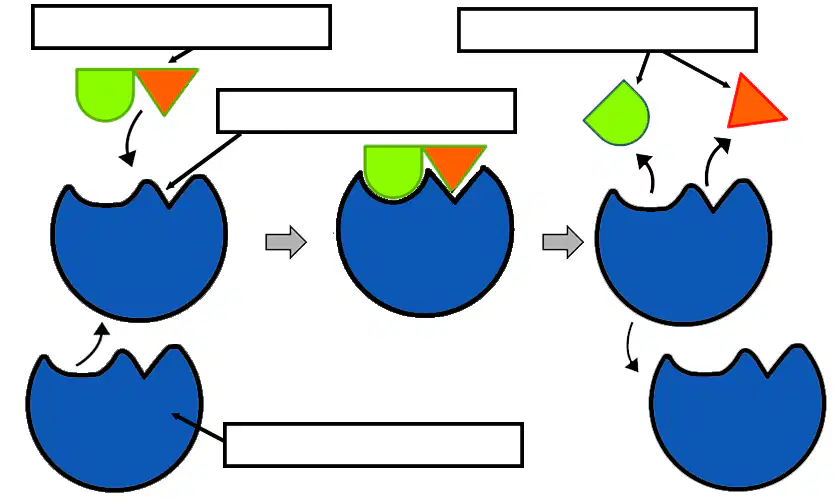
Label the substrate, active site, product, and enzyme on a diagram.
Substrate binds to the active site of the enzyme, forming a product.
Product binds to the substrate, forming an enzyme at the active site.
Enzyme is the product that binds to the substrate at the active site.
Active site is the product that binds to the enzyme and substrate.
Name two conditions that have an effect on the activity of an enzyme.
temperature and pH
light and sound
pressure and gravity
humidity and altitude
What are reactants and products? Where are they located in a chemical reaction?
Reactants are found on the left side of the arrow, while products are located on the right side.
Reactants are found on the right side of the arrow, while products are located on the left side.
Reactants and products are both found on the same side of the arrow.
Reactants and products are not shown in a chemical reaction.
Why are cells small?
Smalls are more efficient.
Cells are easier to see when small.
Small cells have more DNA.
Small cells can store more energy.
Why do cells divide?
Mitosis is for cell growth, repair & replacement.
Cells divide to decrease their size.
Cells divide to stop metabolism.
Cells divide to produce energy.
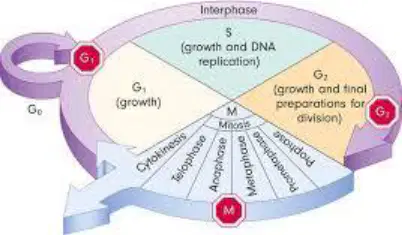
Insert a picture of the Cell Cycle and list what happens in each phase.
The Cell Cycle consists of Interphase (cell growth and DNA replication), Mitosis (division of the nucleus), and Cytokinesis (division of the cytoplasm).
The Cell Cycle consists of only Mitosis and Cytokinesis.
The Cell Cycle consists of Interphase and Meiosis only.
The Cell Cycle consists of DNA replication and protein synthesis only.
Which of the following correctly lists the stages of mitosis and what happens in each phase?
Prophase: Chromosomes condense; Metaphase: Chromosomes align at the center; Anaphase: Chromatids separate; Telophase: Nuclear membranes reform.
Prophase: Chromosomes split; Metaphase: Chromosomes disappear; Anaphase: Chromosomes condense; Telophase: Cells fuse.
Prophase: Chromosomes align; Metaphase: Chromatids condense; Anaphase: Nuclear membrane dissolves; Telophase: Chromosomes split.
Prophase: Chromatids separate; Metaphase: Nuclear membranes reform; Anaphase: Chromosomes condense; Telophase: Chromosomes align.
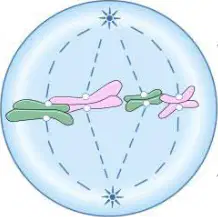
The role of centrioles in cell division and the types of cells they are found in is:
They help organize the mitotic spindle and are found in animal cells.
They produce energy and are found in plant cells.
They synthesize proteins and are found in bacterial cells.
They store genetic material and are found in all cell types.
Tell the difference in how prokaryotic cells divide and how that is different from eukaryotic cells.
Prokaryotic cells divide by binary fission, while eukaryotic cells divide by mitosis and meiosis.
Prokaryotic cells divide by mitosis, while eukaryotic cells divide by binary fission.
Both prokaryotic and eukaryotic cells divide by meiosis only.
Prokaryotic cells divide by budding, while eukaryotic cells divide by binary fission.
What phase will the 2 new daughter cells immediately enter?
G1 phase
S phase
G2 phase
M phase
What do we know about the 2 new daughter cells at the end of cytokinesis?
They are genetically identical to each other and to the parent cell.
They have half the number of chromosomes as the parent cell.
They are completely different from each other.
They are not functional cells.
The difference between a cleavage furrow and a cell plate is:
A cleavage furrow forms during animal cell division, while a cell plate forms during plant cell division.
A cleavage furrow is found only in bacteria, while a cell plate is found in fungi.
A cleavage furrow is a type of chromosome, while a cell plate is a type of organelle.
A cleavage furrow and a cell plate are both found in plant cells only.
The role of contact inhibition and enzymes in the regulation of the cell cycle is to:
prevent uncontrolled cell division and ensure proper progression through the cell cycle
promote uncontrolled cell growth and division
inhibit all forms of cell communication
cause cells to stop functioning entirely
Where are the 3 checkpoints in the cell cycle? What do the enzymes do if they detect a problem?
The 3 checkpoints in the cell cycle are at G1, G2, and M phases. If enzymes detect a problem, they halt the cycle for repairs or trigger cell death.
The 3 checkpoints in the cell cycle are at S, G2, and M phases. If enzymes detect a problem, they speed up the cycle.
The 3 checkpoints in the cell cycle are at G1, S, and G2 phases. If enzymes detect a problem, they ignore the issue.
The 3 checkpoints in the cell cycle are at G1, G2, and M phases. If enzymes detect a problem, they allow the cell to continue dividing without repair.
What is cancer?
Uncontrolled cell division → cell cycle regulation breaks down
A type of bacterial infection
A genetic disorder caused by viruses
A result of excessive exercise
What are some causes of cancer?
Biological factors (Age, genetics, skin type), Lifestyle choices (Diet, lack of physical activity, Sun exposure), Viruses and other infections (HPV), Exposure to carcinogens → chemicals mutate DNA (smoking, asbestos)
Eating only organic food
Drinking purified water
Regular exercise and meditation
What are some ways to reduce your risk of getting cancer?
Do good lifestyle choices, and avoid smoking, asbestos
Eat more sugar and processed foods
Avoid all fruits and vegetables
Stay indoors all the time
What is the difference between benign and malignant tumors?
Benign – abnormal cells that remain together. It may be harmless & easily removed Malignant – cancer cells that break away from the tumor and move to other parts of the body make more tumors
Benign – cells that always spread rapidly. Malignant – cells that never spread.
Benign – cancer cells that break away from the tumor and move to other parts of the body. Malignant – abnormal cells that remain together.
Benign – cells that are always cancerous. Malignant – cells that are always harmless.
How does our body naturally defend against cancer?
Checkpoints
Hormones
Enzymes
Vitamins
What is apoptosis?
Apoptosis = programmed cell death. Internal/external signals activate genes that produce self-destructive enzymes.
Apoptosis = uncontrolled cell division leading to tumor formation.
Apoptosis = process of cell growth and differentiation.
Apoptosis = fusion of two cells to form a larger cell.
What are stem cells?
Stem cell - cell with the unique ability to develop into specialized cell types in the body
Stem cell - a type of virus that attacks healthy cells
Stem cell - a cell that only exists in plants
Stem cell - a cell that cannot divide or change
What is the process that stem cells go through to become specialized cells? How does this happen?
Stem cells = undifferentiated cells that can become differentiated into one or more types of specialized cells.
Stem cells = specialized cells that cannot change into other cell types.
Stem cells = cells that only divide but never change.
Stem cells = cells that die after a single division.
What does the word “genome” mean?
The complete set of DNA (genetic material) in an organism
A type of protein found in cells
The process of cell division
A disease caused by genetic mutation
Which of the following statements correctly lists a pro and con of both adult and embryonic stem cells?
Adult stem cells: less risk of rejection, limited differentiation; Embryonic stem cells: can become any cell type, ethical concerns.
Adult stem cells: can become any cell type, ethical concerns; Embryonic stem cells: less risk of rejection, limited differentiation.
Adult stem cells: ethical concerns, can become any cell type; Embryonic stem cells: limited differentiation, less risk of rejection.
Adult stem cells: limited differentiation, ethical concerns; Embryonic stem cells: less risk of rejection, can become any cell type.
What are the 5 levels of organization of living things in order from simplest to most complex?
Cell
Tissue
Organ
Organ system
Organism
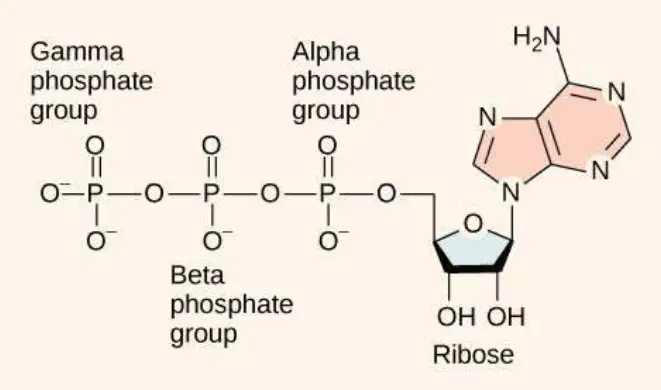
List the three parts of the ATP molecule.
base, a ribose sugar, and three phosphate groups
base, a deoxyribose sugar, and two phosphate groups
adenine, a ribose sugar, and one phosphate group
base, a ribose sugar, and four phosphate groups
What does ATP give us? How does ATP release this for the cell...when which bond is broken?
An enzyme helps break the high-energy bond between the second and third phosphate groups in the ATP molecule.
ATP releases energy when the bond between the first and second phosphate groups is broken.
ATP releases energy when the ribose sugar is removed from the molecule.
ATP releases energy when the adenine base is separated from the phosphate groups.
When is energy released from ATP?
released: This reaction releases the energy that was stored in that chemical bond.
stored: This reaction stores energy in the chemical bond.
used: This reaction uses energy from another source.
absorbed: This reaction absorbs energy from the environment.
Describe what happens during the ATP/ADP cycle. What enzyme is responsible for “remaking” the ADP molecule into ATP?
The ATP/ADP cycle is like a rechargeable battery for the cell.
The ATP/ADP cycle is a process that only occurs in plant cells.
The ATP/ADP cycle is responsible for breaking down proteins in the cell.
The ATP/ADP cycle is unrelated to cellular energy.
Write down the purpose for photosynthesis.
to make their own food
to produce oxygen for animals
to absorb sunlight for warmth
to help plants grow taller
to attract pollinators
Photosynthesis happens in what organism? In what organelle?
Plants in the chloroplast
Animals in the mitochondria
Fungi in the nucleus
Bacteria in the ribosome
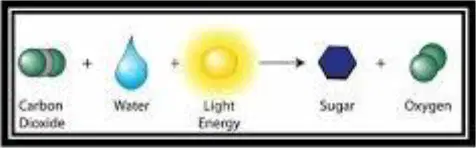
Write down or copy/paste the photosynthesis equation below. Label the REACTANTS and the PRODUCTS.
Reactants: 6 CO2 + 6 H2O + sunlight; Products: C6H12O6 + 6 O2
Reactants: C6H12O6 + 6 O2; Products: 6 CO2 + 6 H2O + sunlight
Reactants: 6 O2 + C6H12O6; Products: 6 CO2 + 6 H2O + sunlight
Reactants: 6 CO2 + 6 H2O; Products: C6H12O6 + 6 O2 + sunlight
What are the 2 reactions in photosynthesis and where do they occur?
The light-dependent reactions occur in the thylakoid membrane and the Calvin cycle occurs in the stroma of the chloroplast
The light-dependent reactions occur in the stroma and the Calvin cycle occurs in the thylakoid membrane
The Krebs cycle occurs in the thylakoid membrane and glycolysis occurs in the stroma
The Calvin cycle occurs in the mitochondria and the light-dependent reactions occur in the cytoplasm
Write down 3-4 sentences describing what occurs in the light dependent reactions. Be sure to include the reactants and products.
In the light-dependent reactions, plants use water and light energy to create temporary energy-carrying molecules. Chlorophyll absorbs the light energy, which is used to split water molecules. This process releases oxygen as a waste product and creates energy-storing molecules called ATP and NADPH.
In the light-dependent reactions, plants use carbon dioxide and glucose to produce oxygen and water. Chlorophyll absorbs carbon dioxide, which is used to create glucose molecules. This process releases water as a waste product and creates energy-storing molecules called ADP and NADP+.
In the light-dependent reactions, plants use oxygen and ATP to create water and glucose. Chlorophyll absorbs oxygen, which is used to split glucose molecules. This process releases carbon dioxide as a waste product and creates energy-storing molecules called NADPH and FADH2.
In the light-dependent reactions, plants use glucose and sunlight to create carbon dioxide and water. Chlorophyll absorbs glucose, which is used to split water molecules. This process releases carbon dioxide as a waste product and creates energy-storing molecules called ATP and NADH.
Write down 3-4 sentences describing what occurs in the light independent reactions/Calvin Cycle. Be sure to include the reactants and products.
The Calvin cycle converts carbon dioxide, ATP, and NADPH into G3P. The enzyme converts atmospheric CO2 into G3P using ATP and NADPH. For every three molecules entering the cycle, one G3P is produced and used to regenerate RuBP.
The Calvin cycle uses oxygen and glucose to produce ATP and NADPH. It occurs in the mitochondria and releases water as a byproduct.
The Calvin cycle breaks down glucose into pyruvate, generating ATP and NADH. It is a part of cellular respiration and does not involve carbon dioxide.
The Calvin cycle converts water and sunlight directly into glucose, without the need for ATP or NADPH.
What are 4 things plants can use glucose for?
Energy source, store energy, Cellulose, and essential elements for building biomolecules
Energy source, store energy, Oxygen production, and leaf color
Energy source, store energy, Water absorption, and root growth
Energy source, store energy, Photosynthesis, and flower blooming
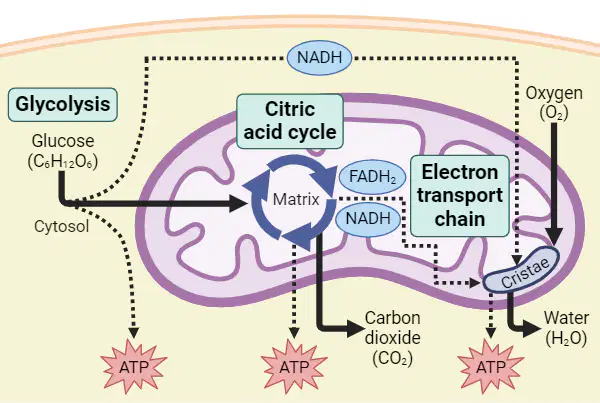
Where does cellular respiration occur, what are the 3 stages, and are they an aerobic or anaerobic process?
aerobic; Glycolysis, Krebs Cycle, and Electron Transport Chain
anaerobic; Glycolysis, Calvin Cycle, and Electron Transport Chain
aerobic; Glycolysis, Light Reaction, and Krebs Cycle
anaerobic; Krebs Cycle, Calvin Cycle, and Electron Transport Chain
The meaning of aerobic respiration and anaerobic respiration is:
Aerobic respiration uses oxygen, while anaerobic respiration does not use oxygen.
Aerobic respiration does not use oxygen, while anaerobic respiration uses oxygen.
Both aerobic and anaerobic respiration use oxygen.
Neither aerobic nor anaerobic respiration involves oxygen.
Write down or copy/paste the formula for cellular respiration below. Label the REACTANTS and PRODUCTS of cellular respiration. Label the reactants and products in the formula.
Reactants: Glucose (C6H12O6), Oxygen (O2) Products: Carbon Dioxide (CO2), Water (H2O), Energy (ATP)
Reactants: Carbon Dioxide (CO2), Water (H2O) Products: Glucose (C6H12O6), Oxygen (O2), Energy (ATP)
Reactants: Oxygen (O2), Water (H2O) Products: Carbon Dioxide (CO2), Glucose (C6H12O6), Energy (ATP)
Reactants: Glucose (C6H12O6), Carbon Dioxide (CO2) Products: Oxygen (O2), Water (H2O), Energy (ATP)
Glycolysis occurs in a specific part of the cell and involves a particular process. Where does glycolysis take place and what happens during glycolysis?
Glycolysis occurs in the cytoplasm, where glucose is broken down into pyruvate, producing ATP and NADH.
Glycolysis occurs in the mitochondria, where glucose is converted directly into ATP.
Glycolysis occurs in the nucleus, where glucose is stored for later use.
Glycolysis occurs in the cell membrane, where glucose is used to build proteins.
The Krebs Cycle/Citric Acid Cycle occurs in which part of the cell and what is its main function?
It occurs in the mitochondria and produces energy by breaking down acetyl-CoA.
It occurs in the cytoplasm and synthesizes proteins.
It occurs in the nucleus and replicates DNA.
It occurs in the ribosome and assembles amino acids.
The electron transport chain occurs in a specific location in the cell and involves a series of events. Where does the electron transport chain take place and what is its main function?
It occurs in the inner mitochondrial membrane and produces ATP by transferring electrons.
It occurs in the cytoplasm and breaks down glucose into pyruvate.
It occurs in the nucleus and synthesizes DNA.
It occurs in the Golgi apparatus and packages proteins.
How many ATP are made during each stage of cellular respiration?
Glycolysis: 2 ATP, Krebs Cycle: 2 ATP, Electron Transport Chain: 32-34 ATP
Glycolysis: 4 ATP, Krebs Cycle: 2 ATP, Electron Transport Chain: 28 ATP
Glycolysis: 2 ATP, Krebs Cycle: 4 ATP, Electron Transport Chain: 30 ATP
Glycolysis: 1 ATP, Krebs Cycle: 2 ATP, Electron Transport Chain: 36 ATP
What are the 2 types of anaerobic respiration discussed in the notes?
Lactic acid fermentation and Alcoholic fermentation
Photosynthesis and Cellular respiration
Aerobic respiration and Glycolysis
Krebs cycle and Electron transport chain
Name the organisms that use lactic acid fermentation and describe what occurs during this process.
Bacteria and muscle cells; glucose is converted to lactic acid for energy without oxygen.
Yeast and plant cells; glucose is converted to ethanol and carbon dioxide.
Fungi and algae; glucose is converted to acetic acid for energy.
Insects and fish; glucose is converted to lactic acid with oxygen.
Name the organisms that use alcoholic fermentation and briefly describe what occurs during this process.
Yeast and some bacteria; they convert sugars into alcohol and carbon dioxide.
Plants; they convert alcohol into oxygen and glucose.
Animals; they convert alcohol into lactic acid and energy.
Fungi and viruses; they convert alcohol into proteins and fats.
The relationship between chromosomes, genes, and DNA is:
Chromosomes contain genes, which are made of DNA.
Genes contain chromosomes, which are made of DNA.
DNA contains chromosomes, which are made of genes.
Chromosomes are made of DNA, which is made of genes.
What is the job of DNA?
To go out and make proteins
To contain the code for making proteins
Where is DNA stored in the cell?
Nucleus
Cytoplasm
Cell membrane
Mitochondria
The building block (monomer) of DNA is called a nucleotide. What are the three parts of a nucleotide?
A nitrogenous base, a phosphate group, and a deoxyribose sugar
A ribose sugar, a phosphate group, and a fatty acid
A nitrogenous base, a ribose sugar, and a protein
A phosphate group, a fatty acid, and a deoxyribose sugar

What 2 words describe the shape of DNA?
Double helix
Single strand
Beta sheet
Alpha coil
What are the outside parts of the DNA ladder made of?
Deoxyribose sugar and Phosphate group
Amino acids and Ribose sugar
Fatty acids and Glycerol
Nitrogen bases and Proteins
What type of bond is found between the sugar of one nucleotide and the phosphate of the next nucleotide?
covalent bond
hydrogen bond
ionic bond
metallic bond
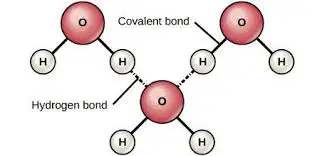
Is it a strong or weak bond?
Strong
Weak
Temporary
Unstable
What is the significance of the answer above?
backbone for the DNA molecule
energy source for cellular respiration
site of protein synthesis
carrier of genetic mutations
What are the rungs of the DNA ladder made of?
nitrogenous bases
phosphate groups
sugars
lipids
What are the 4 DNA nitrogenous bases and how do they pair?
Adenine (A), Thymine (T), Cytosine (C), and Guanine (G)
Adenine (A), Uracil (U), Cytosine (C), and Guanine (G)
Adenine (A), Thymine (T), Cytosine (C), and Uracil (U)
Adenine (A), Thymine (T), Guanine (G), and Uracil (U)
What type of bond holds them together in the middle?
hydrogen bonds
ionic bonds
covalent bonds
metallic bonds

Is it a strong or weak bond?
Weak
Strong
Ionic
Covalent
What is the significance of the answer above?
DNA double helix to easily "unzip," or separate.
DNA double helix to become more rigid.
DNA double helix to form a triple helix.
DNA double helix to dissolve in water.
What is the name of the process where DNA makes a copy of itself?
DNA replication
Transcription
Translation
Mutation
Why must this process occur? (DNA replication)
essential for cell growth, repair, and reproduction.
to decrease genetic material in cells.
to prevent cells from dividing.
to eliminate old DNA from the cell.
What are the 4 steps to this process?
1. Initiation start 2. Synthesis 3. Elongation 4. Termination
1. Initiation start 2. Elongation 3. Synthesis 4. Termination
1. Synthesis 2. Initiation start 3. Elongation 4. Termination
1. Initiation start 2. Synthesis 3. Termination 4. Elongation
Where does it occur in the cell? (DNA replication)
In the nucleus
In the mitochondria
In the cytoplasm
On the cell membrane
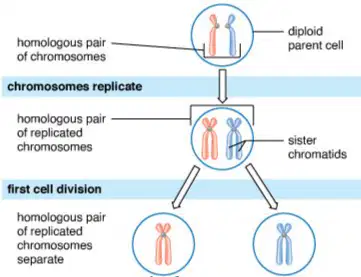
What is the end result of this process?
two identical DNA molecules
one RNA molecule and one DNA molecule
two different proteins
one DNA molecule and one protein
Pick and highlight the correct one below:
Each of the DNA molecules formed is completely new
Each of the DNA molecules made is half of the original parent DNA strand and half of new nucleotides (semi-conservative model)
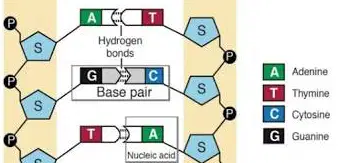
If the following is a string of DNA bases, write the complementary DNA bases underneath in a bold red font.
RNA - AUU CAU GUA UGC CCG
TAA GTA CAT ACG GGC
ATT CAT GTA TCG CCG
ATT GTC TAC TCG GCC
TTA GAT CTA AGC GGC
Why is the DNA strand broken into sets of 3 letters at a time? What is the set of 3 called?
codon
trimer
triplet code
nucleotide
What does each set of 3 letters code for?
amino acid
sugar
fatty acid
nucleotide
Why does one organism look different from another?
The order or sequence of the DNA bases.
The number of cells in the organism.
The amount of water in the organism.
The temperature of the environment.
List 3 differences between DNA and RNA.
1. Sugar 2. Strands 3. (The third difference is not provided in the image, but commonly: DNA contains thymine, RNA contains uracil)
1. Both have the same sugar 2. Both are double-stranded 3. Both contain uracil
1. Both are found only in the nucleus 2. Both are single-stranded 3. Both contain thymine
1. Both have identical functions 2. Both are made of amino acids 3. Both are triple-stranded
Since DNA codes for the making of proteins, but doesn’t actually go out and make the proteins, we need a molecule to make a copy of DNA in the nucleus and take that information to the (where? name that organelle) to make the protein. What is the name of this molecule that we need to make?
transfer RNA (tRNA)
messenger DNA (mDNA)
ribosomal DNA (rDNA)
deoxyribose RNA (dRNA)
Since DNA codes for the making of proteins, but doesn’t actually go out and make the proteins, we need a molecule to make a copy of DNA in the nucleus and take that information to the (where? name that organelle) to make the protein. - Where (in the cell) do we need to make it?
Ribosomes
Mitochondria
Golgi apparatus
Lysosomes
Since DNA codes for the making of proteins, but doesn’t actually go out and make the proteins, we need a molecule to make a copy of DNA in the nucleus and take that information to the (where? name that organelle) to make the protein. What is the name of the process that makes it?
transcription
translation
replication
mutation
Once the mRNA (made of codons) goes to the ribosome, what molecule (with the anticodon on one end) brings the amino acid to the ribosome to build the protein?
tRNA
mRNA
rRNA
DNA
Once the mRNA (made of codons) goes to the ribosome, what molecule (with the anticodon on one end) brings the amino acid to the ribosome to build the protein?
Nucleus
DNA polymerase
tRNA
Golgi apparatus
If the following strand of mRNA letters came from the DNA code, what would be the original DNA letters that you started with?
RNA - ATT CAT GTA TAC CCG
TAA GTA CAT ATG GGC
AAT GTC CAA TAC CCG
ATT GCA GTA TAC GGG
TTA GAT CAA ATC GGC
What is the building block of proteins?
amino acid
fatty acid
nucleotide
monosaccharide
How many are there? (Refers to building blocks of proteins)
20
10
50
5
How many proteins can be made from them? (Refers to building blocks of proteins)
300
20
1000
64


What is being represented by the letter A in the image?
Substrate
Enzyme
Product
Complex

Which labeled part is the substrate?
letter A
letter B
letter D
letter E


In the punnett square below, what belongs in the missing square
If a homozygous dominant allele (AA) is crossed with a homozygous recessive allele (aa), all of the resulting offspring will be
Homozygous dominant
Heterozygous
Homozygous Recessive
Brown hair is dominant over light hair. If a homozygous parent (Aa) is crossed with a heterozygous recessive parent (aa), their children will have...
Only Brown Hair
Only Light Hair
Some brown and some light
Passing traits from parents to their offspring
Genetics
Heredity
Punnett square
Monohybrid cross
In DNA, C pairs with G , and A pairs with
U
A
C
T
In RNA, C pairs with G , and A pairs with
U
A
C
T
Is this a strand of DNA or RNA?
TACGGACTA
DNA
RNA
Impossible to tell
GTAGTCA
A section of DNA has these bases: TAG CAG TAC. What mRNA sequence is produced fro this DNA section?
ATC GTC ATG
AUC GUC AUG
AUG CUG AUC
UTC GTC UTG
ATG GGA ACT

Select the RNA sequence or sequences for Glutamine.
CGU
CAG
CUA
CAA

Find the amino acid that this segment of RNA codes for: GAC
Arginine
Asparagine
Aspartic Acid
Alanine
Find the amino acid that this segment of RNA codes for: UUG
Glycine
Asparagine
Lysine
Leucine
Select the DNA sequence or sequences for Lysine.
TTC
AAC
TTT
TAT
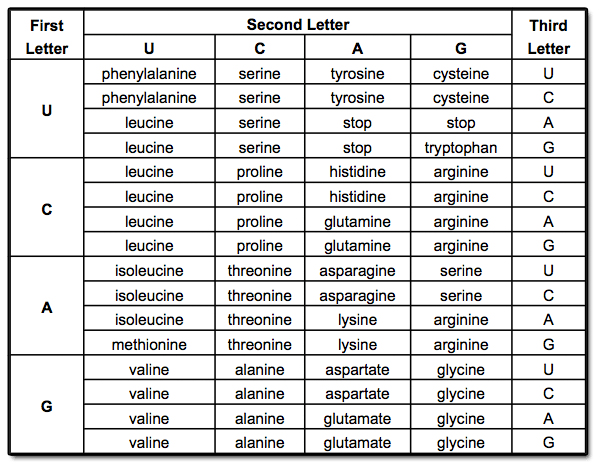


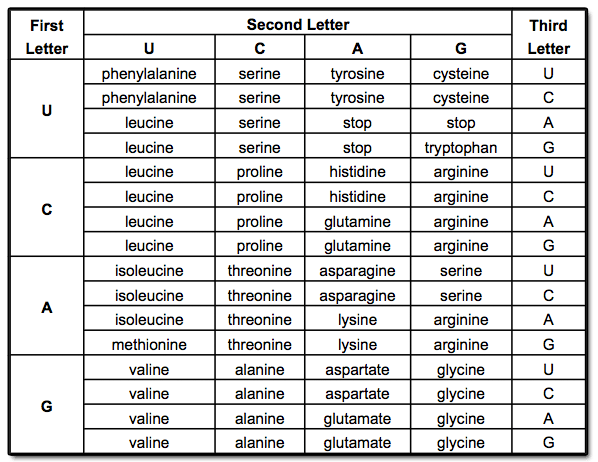
What is the correct amino acid sequence for the mRNA code AUG-CCA-GUA-UGA
Met-Pro-Ala-Val
Met-Pro-Val
Tyr-Gly-His
Tyr-Gly-Arg-His

What is the amino acid sequence for the following mRNA strand:
GUA-CAU-UUG-AGA
(a)
TRANSLATE this RNA sequence: AUGCAAUGA
Met-Glu-Stop
Met-His-Stop
Thr-Glu-Stop
Thr-Pro-Stop


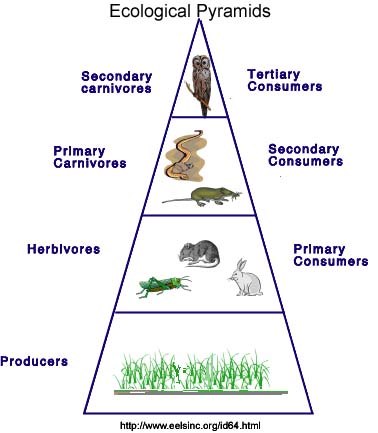

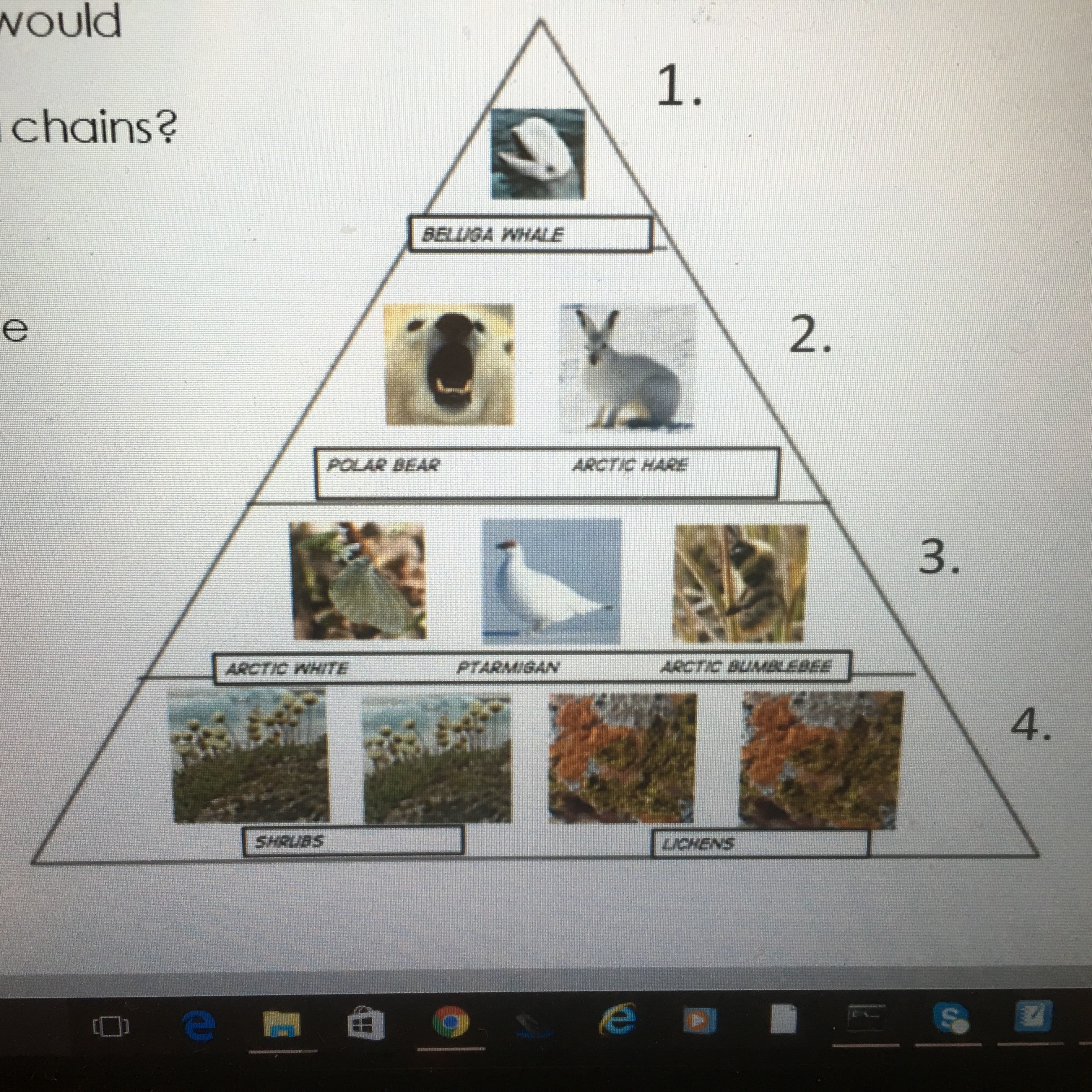
What amount of percentage does the energy decrease as it goes up the pyramid?
100%
1000%
10%
1%
How does the energy flow in an energy pyramids?
up the pyramid
down the pyramid
Photosynthesis is important because...
it makes carbon dioxide
it makes food for the food webs
it makes water
it's not important

