wayground logo

Free Printable Worksheets

Font size

S
M
L
XL
Worksheets

DNA and Inheritance practice

Total questions: 165

Worksheet time: 2hrs 50mins

Name
Class
Date
1.

What is the scientific word that refers to the differences within a species?

a)

variation

b)

characteristics

c)

features

d)

inheritance

2.

What causes variation?

a)

inherited factors only

b)

environmental factors only

c)

inherited and environmental factors

3.

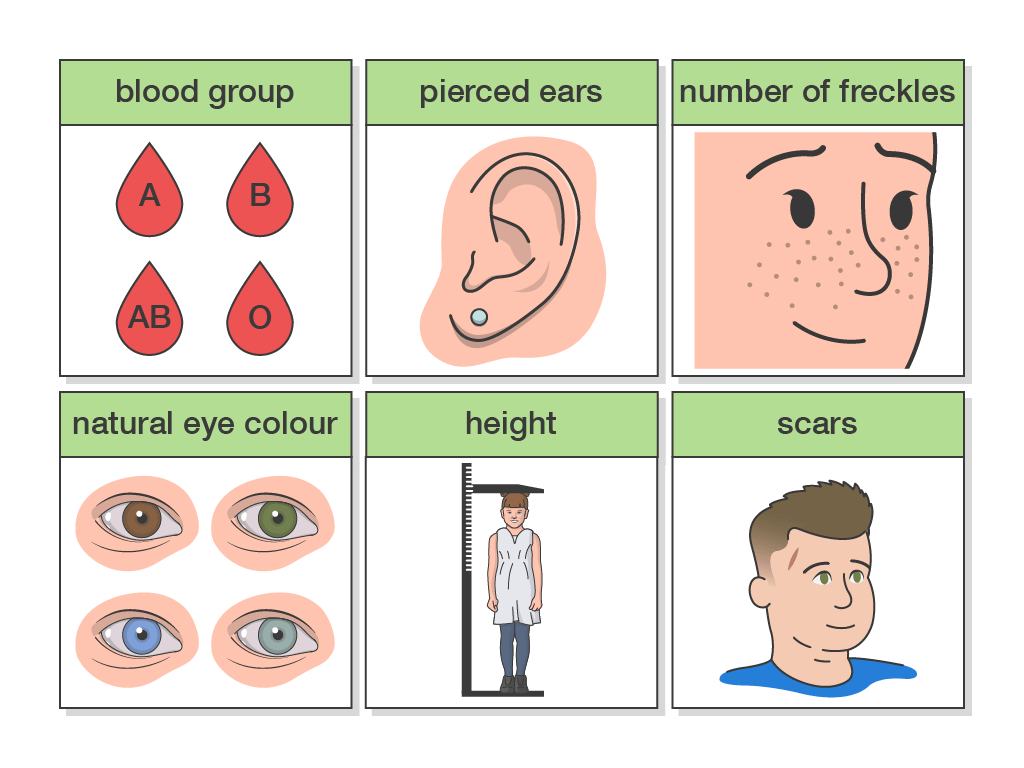
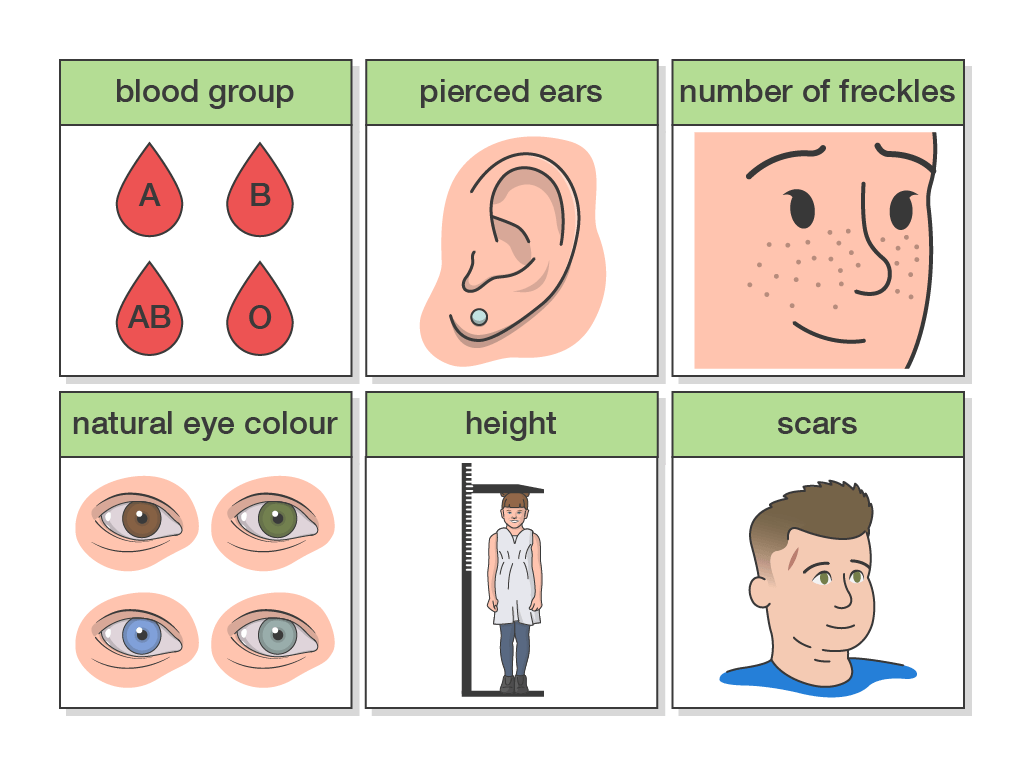
Which two characteristics show variation as a result of inherited factors only?

a)

blood group

b)

pierced ears

c)

number of freckles

d)

natural eye colour

e)

height

4.

Which two characteristics show variation as a result of environmental factors only?

a)

blood group

b)

pierced ears

c)

Scar

d)

natural eye colour

e)

height

5.

Which two characteristics show variation as a result of a combination of both inherited and environmental factors?

a)

blood group

b)

pierced ears

c)

number of freckles

d)

natural eye colour

e)

height

6.

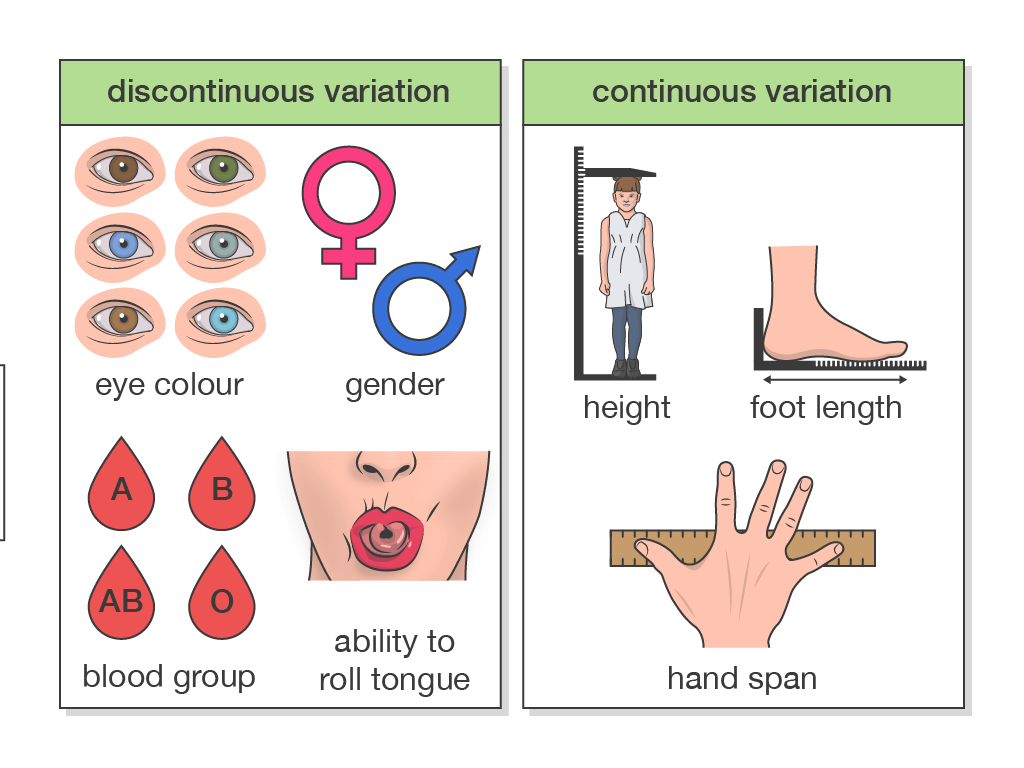
For which type of variation can a measurement have any numerical value?

a)

continuous variation

b)

discontinuous variation

7.

For which type of variation are differences grouped into categories?

a)

continuous variation

b)

discontinuous variation

8.

If you were to investigate the height of everyone in your class, what type of data would you be gathering?

a)

continuous variation

b)

discontinuous variation

9.

If you were to investigate the eye colour of everyone in your class, what type of data would you be gathering?

a)

continuous variation

b)

discontinuous variation

10.

Which three features show discontinuous variation?

a)

blood group

b)

height

c)

foot length

d)

eye colour

e)

gender

11.

Which Two features show continuous variation?

a)

blood group

b)

height

c)

foot length

d)

eye colour

e)

gender

12.

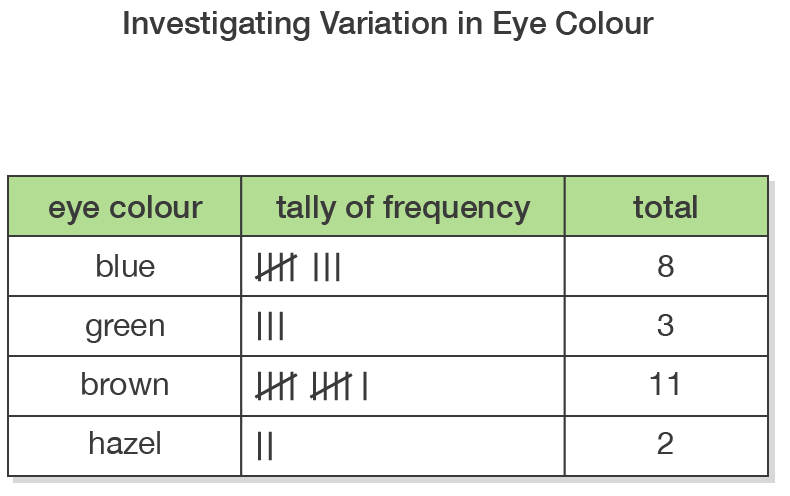
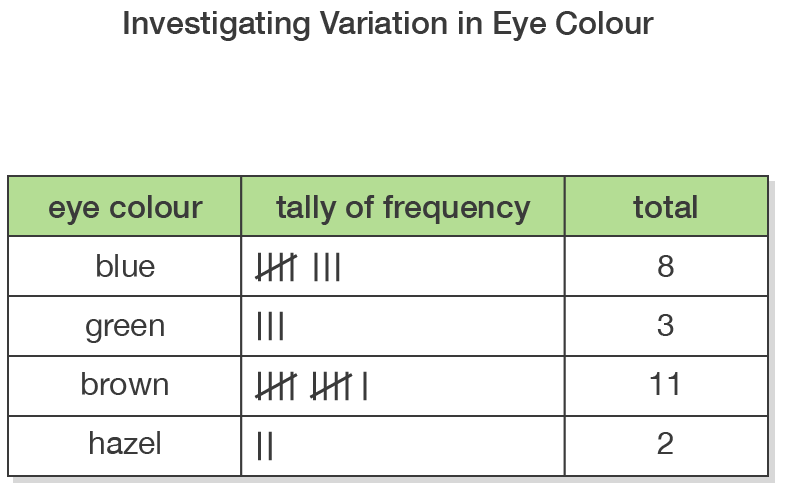
How should the data in the table shown be presented?

a)

scatter graph

b)

bar chart

c)

histogram

13.

Why should the data in the table shown be presented in a bar chart?

a)

The data is numerical.

b)

The data is in categories

14.

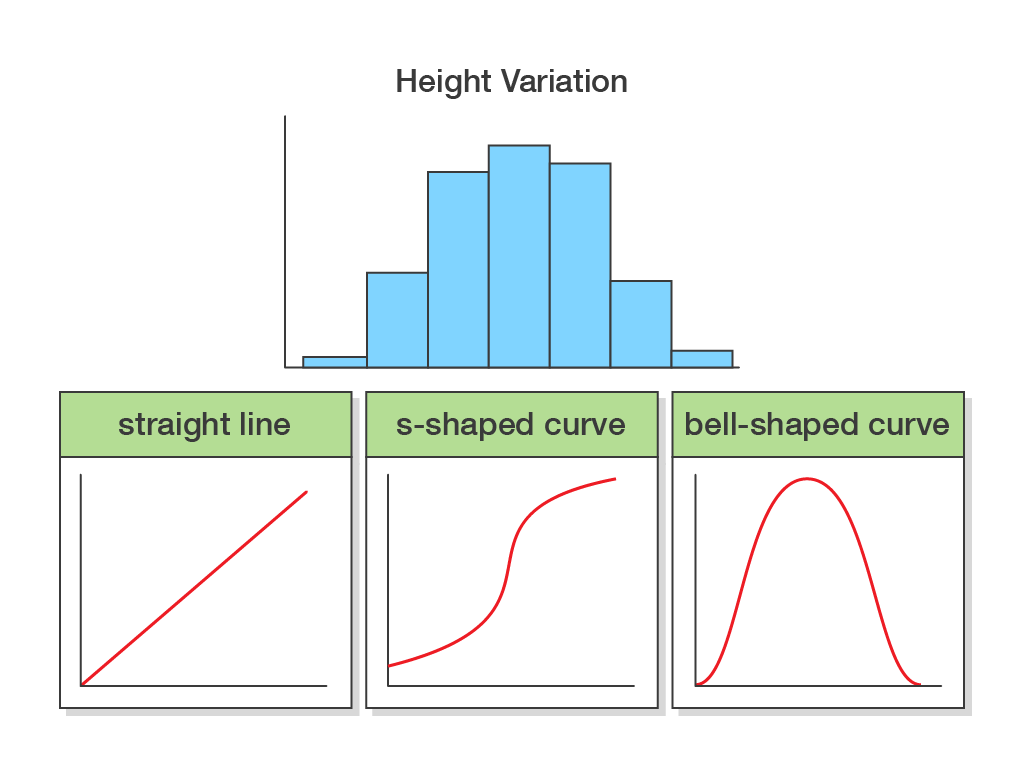
Features with continuous variation have a normal distribution curve, which is shown by the bars on the graph. What shape do the bars form when there is normal distribution?

a)

straight line

b)

s-shaped curve

c)

bell-shaped curve

15.

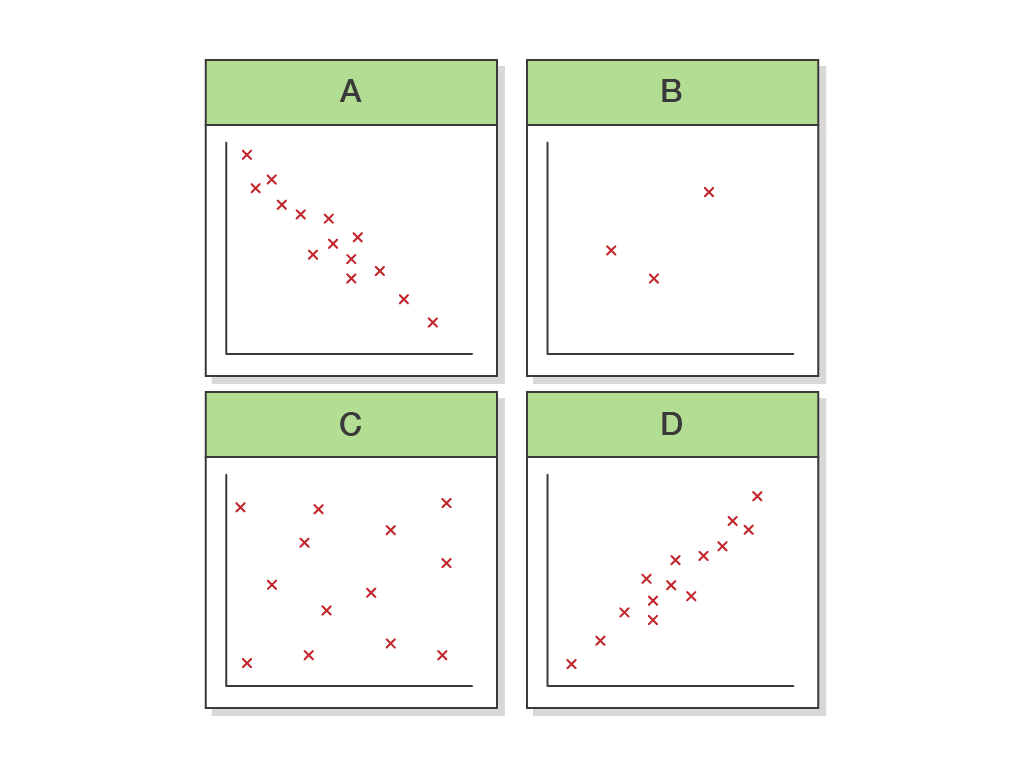
Which two scattergraphs show a correlation (relationship) between the two plotted variables?

a)

scattergraph A

b)

scattergraph B

c)

scattergraph C

d)

scattergraph D

16.
Which one of the following shows discontinuous variation?
a)
Eye colour
b)
Height
c)
Strength
d)
Weight
17.
Which one of the following shows continuous variation?
a)
Blood group
b)
Height
c)
Male or female
d)
Tongue rolling
18.
Which one of the following is an environmental variation?
a)
Attached ear lobes
b)
Eye colour
c)
Male or female
d)
Short hair
19.
What type of graph do we use for discontinuous variation?
a)
A bell-shape
b)
Bar chart
c)
Line graph
d)
Scatter Graph
20.
What shape graph do you see for many examples of continuous variation?
a)
A straight line downwards
b)
A straight line upwards
c)
A bell-shape
d)
A flat line
21.

Which type of data would student height be categorized as?

a)

Categorical

b)

Continuous

c)

Discontinuous

d)

Normal

22.

Student eye colour could be considered what type of data

a)

Discontinuous

b)

Independent

c)

Continuous

d)

Colours

23.
Which of these is an example of inherited variation only?
a)
Eye colour 
b)
Height 
c)
Weight 
d)
Skin colour 
24.
Differences between members of the same species are called
a)
predators
b)
traits
c)
selections
d)
variations
25.
Which of the following is an example of Inherited variation?
a)
Eye colour
b)
Blood type
c)
Skin colour
d)
All of the above
26.
Which of the following is an example of discontinuous variation?
a)
Weight
b)
blood type
c)
height
d)
Hand span
27.
Which of the following is an example of continuous variation?
a)
hair colour
b)
height
c)
eye colour
d)
Gender
28.
Which characteristic did Malek most likely inherit from his parents?
a)
his ability to read fast
b)
his need to wear glasses
c)
his ability to speak English
d)
his need to count using his fingers
29.
Which characteristic is inherited?
a)
hair color
b)
sleeping late
c)
enjoying hiking
d)
loving to read
30.

Giraffe's long neck

a)

Inherited

b)

Learned

31.
An acquired trait means _________.
a)
your sister gave it to you
b)
it is learned or happened after birth
c)
you are a squire for the king
d)
your parents gave it to you
32.
Characteristics passed from parents to their offspring.
a)
behavior
b)
learned trait
c)
inherited trait
d)
function
33.
If a parent cactus has spines, the offspring will have  ______
a)
fruit
b)
spines
c)
leaves
d)
petals 
34.
Which is an example of an inherited trait? 
a)
Reading
b)
Speaking Spanish
c)
Having stripes
d)
Throwing a baseball 
35.

Having dark hair like dad

a)

acquired trait

b)

inherited trait

36.

What means you learned it, so it's an acquired trait?

a)

Heredity

b)

Nurture

c)

Gene

37.

The passing on of genetic traits from parents to children or offspring.

a)

Nurture

b)

Heredity

c)

Environment

38.

Sammi is very curious person, how did she get that trait?

a)

Nature

b)

Environment

c)

Acquire

39.

Your parents can give you crazy, wild, shy, or calm traits what is it called?

a)

Nurture

b)

Environment

c)

DNA

40.

Attribute, Feature, and trait are what?

a)

Environment

b)

Characteristic

c)

Nurture

41.

A part of a chromosome in a cell that controls a particular characteristic

a)

Environment

b)

Nurture

c)

Gene

42.

What is opposite of nurture?

a)

environment

b)

Nature

c)

Characteristic

43.

To receive a characteristic or trait genetically form one's parent or grandparent.

a)

Inherit

b)

Nurture

c)

Acquire

44.

Brown eyes and black hair are what kind of traits?

a)

Environment

b)

Heredity

c)

Nurture

45.

What is the opposite of lose and forfeit?

a)

Acquire

b)

Trait

c)

Nature

46.

What is the same thing as obtain?

a)

Acquire

b)

Characteristic

c)

Environment

47.

The conditions surrounding a living things that affect its life.

a)

Environment

b)

Heredity

c)

Characteristic

48.

In sexual reproduction, _______ parents each contribute a sex cell to the new organism.

a)

two

b)

one

c)

three

d)

several

49.

Half the _________ in the offspring come from each parent.

a)

genes

b)

molecules

c)

particules

d)

substances

50.

Males produce sex cells called ________ cells

a)

sperm

b)

male

c)

egg

d)

sex

51.

Females produce sex cells called ________

a)

eggs

b)

sperms

c)

ovaries

d)

uterus

52.

Sex cells are produced by __________

a)

meiosis

b)

mitosis

c)

cell division

d)

binary fission

53.

A sperm and an egg join together in a process called ________

a)

fertilization

b)

meiosis

c)

condensation

d)

mitosis

54.

When an egg is fertilized by a sperm cell, a new cell, called a _______

a)

zygote

b)

eukaryote

c)

prokaryote

d)

gene

55.

Sexual reproduction increases genetic _______

a)

variation

b)

division

c)

explanation

d)

condensation

56.
A human usually has xx amount of chromosomes.
a)
6
b)
22
c)
4
d)
46
57.
Meiosis makes sperm and egg cells. In humans, sperm and egg cells each have _____ chromosomes. Therefore a fertilized human egg cell (sperm and egg cell combined) would create a cell with _____ chromosomes.
a)
23, 46
b)
46, 23
c)
2, 4
d)
50, 100
58.
Unlike mitosis, meiosis in male mammals results in the formation of
a)
one haploid gamete
b)
three diploid gametes
c)
four diploid gametes
d)
four haploid gametes
59.
What kind of cells are made in MEIOSIS?
a)
Haploid Gametes
b)
Diploid Somatic Cells
c)
Skin Cells
d)
Liver Cells
60.
Which process and type of resulting cells are represented?
a)
mitosis, gametes
b)
mitosis, body cells
c)
meiosis, gametes
d)
meiosis, body cells
61.
If a somatic cell in a butterfly contains 24 chromosomes, a butterfly egg would contain
a)
3
b)
6
c)
12
d)
24
62.
The chromosomes that pair up during meiosis, are called __________ chromosomes.  
a)
homozygous 
b)
asexual
c)
homologous
d)
genes
63.
A male shark has 40 chromosomes in each of its sex cells. How many would be present in its body cells?
a)
20
b)
40
c)
80
d)
160
64.
What is another reason we need meiosis?
a)
So the offspring has genes from both parents
b)
So the offspring has genes from one parent
c)
So the offspring has genes from neither parents
d)
So the offspring makes its own genes
65.
Chromosomes exchange genetic material during 
a)
crossing over
b)
replication
c)
synthesis
d)
translation
66.

All of the following statements are disadvantages of sexual reproduction except ______.

a)

Takes much time to process reproduction

b)

Hard t find a mate

c)

Limited to some factors like fertilization cannot take place during pregnancy

d)

Selective breeding

67.

What type of reproduction takes place when one parent organism produces offspring without meiosis and fertilization?

a)

pollination

b)

sexual reproduction

c)

asexual reproduction

d)

fertilization

68.

All of the following are advantages of asexual reproduction except ____________.

a)

produce varied offspring

b)

spread and colonize certain part of an area

c)

Reproduce without a mate

d)

produce a large number of offspring

69.

Which is an example of asexual reproduction by regeneration?

a)

cloning sheep

b)

lizard regrowing a tail

c)

sea star arm producing a new organism

d)

strawberry plant producing stolons

70.

Hydra produce offspring by growing the new individual on the body of the parent. This is an example of...

a)

budding.

b)

fission.

c)

regeneration.

d)

tubers.

71.

Which of the following types of reproduction would result in the greatest genetic diversity in the offspring?

a)
b)
c)
d)
72.

How much genetic material is provided by the parents in sexual reproduction?

a)

0% from each

b)

25% from each

c)

50% from each

d)

100% from each

73.
Where does fertilisation take place?
a)
Ovary
b)
Womb
c)
Vagina
d)
Fallopian tube
74.
Identical twins develop from
a)
two zygotes that fuse during cleavage
b)
two eggs fertilized by one sperm cell
c)
one egg fertilized by sperm cells
d)
one zygote that divides into two parts
75.

Where is the place which the embryo begins to develop into foetus?

a)

Fallopian tube

b)

Uterus

c)

Ovary

d)

Uterine lining

76.
1. Choose the incorrect statement from the following:
a)
a. In birds and mammals internal fertilisation takes place
b)
Colostrum contains antibodies and nutrients
c)
Polyspermy is prevented by the chemical changes in the egg surface
d)
In the human female implantation occurs almost seven days after fertilisation
77.

Fertilisation is when a sperm fuses with an egg.

a)

True

b)

False

78.
How are identical twins formed?
a)
two eggs fertilised
b)
fertilized egg splits
c)
two identical eggs are released
d)
two identical sperm fertilize the egg
79.
The male part of the flower is known as the _____.
a)
stamen
b)
pistil
c)
ovary
d)
petal
80.
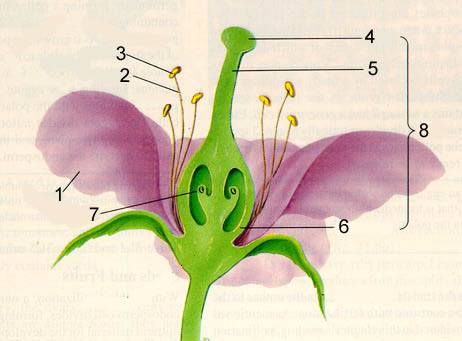
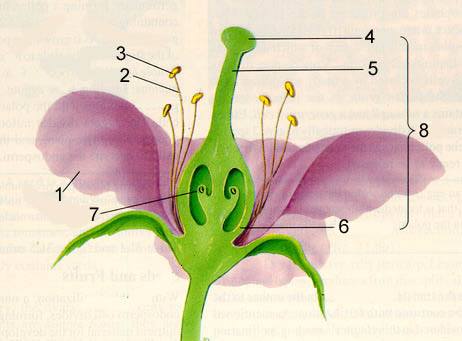
What is #2 pointing to?
a)
anther
b)
filament
c)
ovary
d)
style
81.
What is #4 pointing to?
a)
anther
b)
style
c)
stigma
d)
ovary
82.

Which part of the flower is brightly coloured and attracts insects?

a)

anther

b)

stigma

c)

petal

d)

filament

83.
Where is pollen made?
a)
ovary
b)
petal
c)
pistil
d)
anther
84.

What is inside of the Ovary?

a)

Stem

b)

Oval

c)

Ovule(s)

d)

Petal

85.

The male gamete of a plant.

a)

pollen

b)

egg

86.

How many groups of mammals are there

a)

1

b)

2

c)

3

d)

11

87.

which type of mammal has a pouch

a)

monotremes

b)

Marsupial

c)

Placental

d)

None

88.

Which mammals lay eggs

a)

Monotremes

b)

Marsupials

c)

Placental

d)

None

89.

Which group are humans in

a)

placental

b)

Marsupials

c)

Monotremes

90.

In what type of sexual reproduction are the eggs or ova released into water?

a)

Internal reproduction

b)

External fertilisation

c)

Internal fertilisation

d)

External reproduction

91.

Which type of fertilisation occurs inside the female?

a)

Internal fertilisation

b)

Internal reproduction

c)

External reproduction

d)

External fertilisation

92.

Selective breeding is...

a)

a process to create an organism with desired traits from parents with those desired traits

b)

natural method of producing offspring with desired traits

c)

creating a new species

d)

making organisms reproduce during times of stress

93.

An example of selective breeding is

a)

a dog breeder mating 2 dogs to make more dogs

b)

a farmer grows bees to pollinate the plants on his farm

c)

a person pollinates 2 white rose plants to only create white roses

94.

One problem with selective breeding is

a)

creating a new species

b)

gene variety is lost

c)

new food sources

95.
The evolution of dogs from wolves is due to:
a)
Natural Selection
b)
Sexual Selection
c)
Artificial Selection
d)
Vestigial Structures
96.
Which is another term for selective breeding?
a)
Artificial selection
b)
Natural Selection
c)
Intelligent selection
97.
Evidence shows that the wolf is the ancestor to all of the breeds of dogs shown below. How did this variation arise in a relatively short period of time?
a)
A.  Genetic manipulation
b)
Natural selection
c)
Random chance
d)
Selective breeding
98.

Problems with selective breeding include

a)

Better animals

b)

Increased meat production

c)

Animals can have bad health problems

d)

more diversity

99.

Which is NOT a result of selective breeding?

a)

Large seedless watermelons that consumer demand

b)

Bright oranges that are all about the same size

c)

An insect that matches the color of the environment

d)

A dog that has been bred to have short hair

100.

Which of the following best represents inbreeding?

a)

removing DNA from an organism

b)

changing traits based on environment

c)

crossing 2 similiar animals

d)

crossing 2 different animals

101.
Use the following table to answer the next question. A family visited a dog breeder and requested a puppy that had short fur and was friendly and lovable.  Which dogs should the breeder select to be the parents of the requested puppy?
a)
1 and 2
b)
2 and 3
c)
1 and 4
d)
2 and 4
102.
Scientists genetically engineer corn to be immune to corn diseases. This is BENEFICIAL because
a)
This causes corn to be less likely to reproduce
b)
This causes corn to be less likely to survive
c)
This causes corn to be smaller
d)
This allows increased production of corn
103.

Selective breeding is...

a)

a process to create an organism with desired traits from parents with those desired traits

b)

natural method of producing offspring with desired traits

c)

creating a new species

d)

making organisms reproduce during times of stress

104.

An example of selective breeding is

a)

a dog breeder mating 2 dogs to make more dogs

b)

a farmer grows bees to pollinate the plants on his farm

c)

a person pollinates 2 white rose plants to only create white roses

105.

Increasing helpful traits to an organism is one way a breeder may use selective breeding.

a)

True

b)

False

106.

Which of these is the first step in selective breeding flowers.

a)

Repeat the process only with the offspring with the desired traits

b)

watch the seeds grow

c)

Choose plants that have the desired trait to pollinate

d)

chose which trait is desirable

107.

Which of these is the second step in selective breeding flowers.

a)

Choose which trait is desirable

b)

Watch the seeds grow

c)

Choose plants that have the desired trait to pollinate

d)

Repeat the process only with the offspring with the desired traits.

108.

Which of these is the third step in selective breeding flowers.

a)

Choose which trait is desirable

b)

Watch the seeds grow

c)

Choose plants that have the desired trait to pollinate

d)

Repeat the process only with the offspring with the desired traits.

109.

Artificial Selection is

a)

making a new species

b)

making varieties of the same species

c)

only occurs in a laboratory

110.

A mutation

a)

is always bad for an organism

b)

is always good for an organism

c)

is a change in an organism's DNA

d)

never changes an organism

111.

A dog breeder breeds a black poodle with another black poodle to hopefully get only grey poodles. This is an example of

a)

artificial selection

b)

selective breeding

112.

A dog breeder breeds a german shepherd dog with a poodle to create a dog that has traits of both varieties of dogs. This is an example of...

a)

artificial selection

b)

selective breeding

113.
What does pollination mean?
a)
fertilization
b)
growing
c)
seed dispersal
d)
absorbing sunlight
114.
A plant that cross-pollinates...
a)
reproduces with itself
b)
reproduces with one other plant
c)
reproduces with more than one other plant
115.
If a bee does not come in contact with a flower's pollen...
a)
the plant is not likely to reproduce
b)
the plant is more likely to reproduce
116.
What is a flower called if it has both male and female parts?
a)
a happy flower
b)
a perfect flower
c)
an imperfect flower
d)
an pristine flower
117.
What is an ovary?
a)
the female part of the flower that becomes a fruit
b)
the female part of the flower that accepts the pollen
c)
the male part of the flower that produces pollen
d)
another name for the stem of the plant
118.
True/False: Pollination can occur between flowers of the same plant
a)
True 
b)
False 
119.
True/False: Pollination can occur between flowers of the different plants of the same species
a)
True 
b)
False 
120.
I am a flower that produces nectar. What is the function of the nectar?
a)
To provide food for the flower
b)
To attract pollinators
c)
To attract animals to disperse the fruits
d)
To produce perfumes for Man
121.
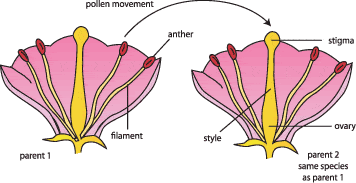
Pollination is the process by which the pollen grains are transferred from the ________ to the _________. 
a)
anther... ovary
b)
anther ... stigma
c)
stigma ... ovary 
d)
stigma ... filament
122.
Which of the following is/are types of pollination?
A) wind pollination 
B) Insect pollination 
C) explosive pollination  
a)
B only
b)
A and B only
c)
All of the above
123.
Wind-pollinated flowers usually have ______ and ________ petals. 
a)
big ... bright 
b)
small .... bright 
c)
big ... dull 
d)
small ... dull
124.
My flowers are not sweet-scented and I do not produce nectar. How am I likely dispersed by?
a)
By wind 
b)
By insects 
c)
By water 
d)
By explosive action
125.
I have long and feathery stigma that sticks out of the flower. How am I likely to be pollinated by?
a)
By wind 
b)
By insects 
c)
By water 
d)
By explosive action
126.
My pollens are usually sticky and spiky so that they can _______________. 
a)
stay on the pollinators' body without falling off easily 
b)
prevent pollinators from eating them
127.
What does an ovule become when it is pollinated?
a)
a seed
b)
a sprout
c)
a fruit
d)
it stays an ovule
128.
Pollination is the process by which pollen
a)
causes people to sneeze
b)
is formed inside a plant
c)
moves from stamen to pistil
129.
Fertilization is the process by which an 
a)
egg and pollen combine
b)
embryo grows into a plant
c)
animal carries pollen between plants
130.
Can a plant reproduce if it doesn't make seeds?
a)
yes
b)
no
131.
What is the sticky part of the flower that catches pollen?
a)
style
b)
stigma
c)
ovary
d)
petal
132.
Which does not belong in the female part (pistil) of the flower?
a)
style
b)
stigma
c)
filament
d)
ovaries
133.
What is an ovary?
a)
the female part of the flower that becomes a fruit
b)
the female part of the flower that accepts the pollen
c)
the male part of the flower that produces pollen
d)
another name for the stem of the plant
134.

What is the first cloned mammal?

a)

goat

b)

cat

c)

sheep

d)

cow

135.
A clone can be BEST thought of as a(n)  _____ created in the lab. 
a)
identical twin
b)
GMO
c)
science fiction experiment
136.
A somatic cell contains _______________
a)
Half the number of chromosomes coming from one parent
b)
a complete set of chromosomes coming from both parents
137.
Why might people be against cloning? 
a)
It's creepy
b)
It can cause unknown defects
c)
It is detrimental to genetic diversity
d)
All of the above
138.
In cloning, what is the purpose of the surrogate mother? 
a)
Donate her DNA
b)
Donate her egg cell
c)
Incubate and carry the baby until birth
d)
Nothing.  She's useless.
139.

What can you conclude from the fact that humans have cloned plants for thousands of years?

a)

Most of the crops that exist today are clones

b)

Cloning plants is much easier than cloning animals

c)

Cloned plants are immune to all diseases and pests

d)

Much of today's modern technology was developed in ancient times

140.

Clones have the exact same:

a)

Personalities

b)

Physical appearances

c)

Intelligence levels

d)

Genetic material

141.

What was the significance of Dolly the Sheep?

a)

She was the first organism ever cloned

b)

She was the first clone created from an adult animal

c)

She was the first animal cloned as an embryo

d)

She was the first animal to be cloned multiple times

142.

How many sheep were required to create Dolly?

a)

3

b)

2

c)

1

d)

0

143.

Why would scientists want to clone cows?

a)

To produce more cows at a faster rate

b)

To produce adult cows instead of calves

c)

To produce stronger and healthier livestock

d)

To replace chickens and goats, which are harder to clone

144.

How might cloning eventually help humans live longer?

a)

Clones tend to live longer than the parent organism

b)

Cloned human organs could replace unhealthy ones

c)

By being cloned multiple times, a person could essentially live forever

d)

The food obtained from cloned organisms would be healthier than ordinary food

145.

How did Dolly compare to sheep that were cloned with the same DNA?

a)

Dolly lived longer

b)

Dolly had more genetic material

c)

Dolly was less healthy

d)

Dolly had fewer parents

146.

Which of the following is an ethical question about cloning?

a)

Can a human clone ever lead a fulfilling life?

b)

How can DNA be removed from adult animal cells?

c)

What will happen to crop yields if cloned plants develop a virus?

d)

Is human cloning scientifically possible?

147.

This diagram shows .............................................. process.

a)

cloning

b)

regeneration

148.

Why did it take three sheep to create one clone?

a)

One sheep donated DNA, another donated an egg cell, and a third carried Dolly in her womb.

b)

The sperm and egg cells of two sheep were combined,and implanted in the womb of a third sheep.

c)

Scientists combined different pieces of DNA from three separate sheep.

d)

Two fertilized eggs were implanted into the wombs of two sheep, but only one matured properly.

149.

In the term "nuclear transfer," the word "nuclear" refers to:

a)

The source of power used to clone animals.

b)

The cell nucleus.

c)

The atomic nucleus.

d)

The familiar relationship between clones.

150.
A scientific name consists of 
a)
Genus and Order
b)
Genus and Domain
c)
Genus and species
d)
Kingdon and Phylum
151.
The most general in the order of classification is?
a)
Kingdom 
b)
Phylum 
c)
Class 
d)
Order
152.
The most specific of the classifications is?
a)
class 
b)
order 
c)
genus 
d)
species
153.
The 2 kingdoms that make up Prokaryotes are?
a)
Animals and Plants 
b)
Protists and Fungi
c)
Archea and Bacteria
154.
Kingdom, Phylum, Class, _______
a)
Family 
b)
Order
c)
Genus 
d)
Species
155.
Which of the following organisms are LEAST closely related?
a)
organisms that share a domain
b)
organisms that share a family 
c)
organisms that share a genus 
d)
organisms that share a species 
156.
The most specific of the classifications is?
a)
class 
b)
order 
c)
genus 
d)
species
157.
Binomial Nomenclature means?   
a)
classification
b)
characteristics
c)
2 name system
158.
The scientific name of Humans is? 
a)
Homo Sapiens
b)
Homo Habilus 
c)
Canis Latrans
159.
What is taxonomy?
a)
The study of DNA and RNA
b)
The study of how organisms are related
c)
The study of classifying and describing organisms
d)
The study of organisms in their habitat
160.
What scientist gave us the system of classification we still use today?
a)
Mendel
b)
Linnaeus
c)
Darwin
d)
Watson
161.
Choose the correct order of taxa from LARGEST to SMALLEST
a)
Species, Genus, Family, Order, Class, Phylum, Kingdom
b)
Family, Kingdom, Order, Phylum, Class, Order, Species, Genus
c)
Kingdom, Phylum, Class, Order, Family, Genus, Species
d)
Phylum, Order, Species, Family, Genus, Kingdom
162.
The three Domains are:
a)
Plant, Animal, Bacteria
b)
Bacteria, Archaea, Eukarya
c)
Fungi, Animal, Plant
d)
Invertebrates, Vertebrates, Plants
163.
Having a wide variety and lots of different species (like that in a rain forest) is called:
a)
Biodiversity
b)
Species Richness
c)
Phylogeny
d)
Systematics
164.
Moss, Sunflowers, Pine trees, and algae are all in this kingdom:
a)
Fungi
b)
Anamalia
c)
Plantae
d)
Bacteria
165.
Which organisms are closely related? 
a)
American badger and leopard
b)
coyote and gray wolf
c)
european otter and leopard
d)
coyote and american badger