
 Worksheets
Revision quiz unit 1 IGCSE
Total questions: 162
Worksheet time: 2hrs 1mins
Which structures do plant cells have that animal cells do NOT have?
cell wall
large central vacuole
chloroplasts
all of these
The cell membrane is selectively permeable. What does "selectively permeable" mean?
All thing can enter.
Nothing can enter.
Some things can, others can't enter.
What is the major difference between a prokaryote and a eukaryote?
prokaryotes do not have a nucleus
prokaryotes do not have ribosomes.
prokaryotes do not have a cell membrane.
prokaryotes do not contain DNA

If a cell has a nucleus it must have a:
nuclear membrane
capsid
cell wall
central vacuole
The plant organelle that captures light to make energy is the:
Cell Wall
Mitochondria
Chloroplast
Ribosome
The cell wall provides
Genetic Material
Energy
Structure
Proteins
Organelles in cells are called membrane-bound because
They are attached to the cell membrane
They are surrounded by their own membrane


What is the function of the cell membrane?
Produces ATP
Produces proteins and lipids
Keep the organelles in place
Control what enters and leaves the cell

The cytoplasm is were......
chemicals go
chemical reactions take place
is a jelly
helps the cell get bigger
The microscope......
makes cells larger
makes cells smaller
makes the image of cells larger
increases there size
Plants store food as.....
Glycogen
Starch
Glucose
Sucrose
Animals store food as......
starch
glucose
glycogen
fructose
Select all of the biological molecules that make up our body.
proteins
alkanes
carbohydrates
nucleic acids
lipids
The building blocks of proteins are ....
glycerol and water
glucose
amino acids
triglycerides
An example of simple sugar (monosaccharide).
glucose
sucrose
starch
glycogen
Basic units of cabohydrates.
simple sugars
amino acids
fatty acids and glycerol
nucleotides
An organic chemical that contains nitrogen is....

The diagram shows the structure of something called a triglyceride. A triglyceride is a
fat
protein
carbohydrate
sugar

If the yellow and blue circles in this diagram represent amino acids, then this whole structure represents
a protein
a fat
a reducing sugar
a simple carbohydrate
None of these

Which chemical elements are found in lipid molecules ?
Carbon, hydrogen & oxygen
Carbon, nitrogen & oxygen
Nitrogen, hydrogen & oxygen
Nitrogen, carbon & hydrogen

Which sugar is broken down during respiration ?
Maltose
Fructose
Sucrose
Glucose
The thread-like filaments of fungi are called
hyphae.
spores
zygospores
One way that fungi are similar to plants is
they both have cell walls made of cellulose.
they both carry out photosynthesis.
they both move rapidly from place to place.
have membrane-bound nuclei, which contain DNA
Which kingdoms contain species which can photosynthesise?
Animals
Plants
Fungi
Protoctists
Prokaryotes
Which kingdoms contain species which are unicellular?
Animals
Plants
Fungi
Protoctists
Prokaryotes
This kingdom is made up of microscopic unicellular organisms.
Animals
Plants
Fungi
Protoctists
Prokaryotes
This kingdom is made up of multicellular organisms which make their own food from sunlight and water.
Animals
Plants
Fungi
Protoctists
Prokaryotes
These two kingdoms of multicellular organisms cannot make their own food. They must break down other organisms to get energy.
Animals
Plants
Fungi
Protoctists
Prokaryotes
In this kingdom, the organisms' cells have no nucleus.
Animals
Plants
Fungi
Protoctists
Prokaryotes
What is the main difference between members of the plant and fungi kingdoms?
Fungi are multicellular
Fungi are heterotrophs
Fungi cells have a nucleus
Fungi cells have a cell wall
Biologists give each species a two-word Latin name. What is the term used to describe this naming system?
Binomial System
Scientific name System
Binary System
Groups of specialized cells working together to perform the same function.
tissue
organelle
mass
tendon
A structure made up of different types of tissue and performs a specific function in the body.
cells
tissue
organ
organ system
Which of the following is the correct order of organization in living things from least organized to most organized?
a. Organism, cell, tissue, organ, organ system
a. Organ system, organ, tissue, cell, organism
a. Cell, tissue, organ, organ system, organism
a. Cell, organ, tissue, organ, organism, organ system
Which of the following is a term used to describe all the chemical reactions that take place in a living thing?
A plant growing towards a light source is an example of which of the following?
attracting a mate
destroying infectious germs
responding to a stimuli
obtaining moisture from the air
Infants will often smile when they hear a parent’s voice. In this situation, the parent’s voice is considered
stimulus
response
adaptation
resource
Maintaining a stable internal
environment is called
homeostasis
equilibrium
balance
evenness
The light intensity where photosynthesis equals the rate of respiration:
saturation point
compensation point
transpiration point
equal point
Which type of large, biological molecule are enzymes made of?
(a)
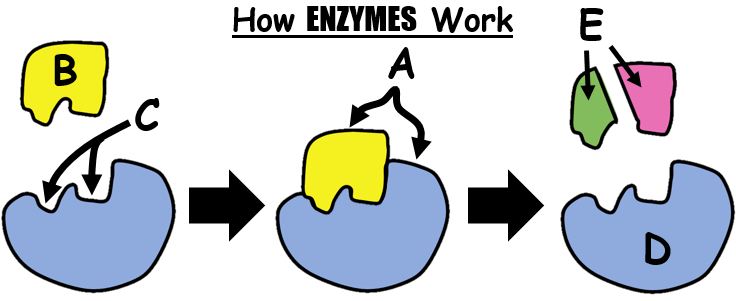
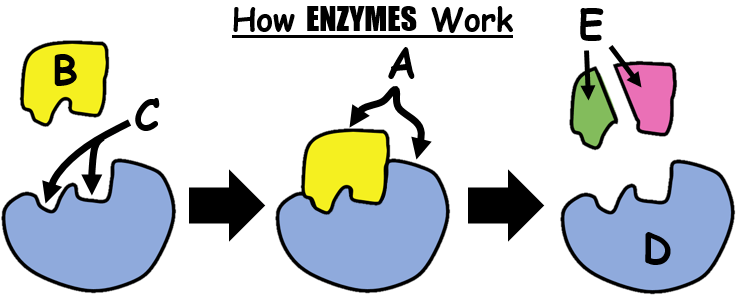
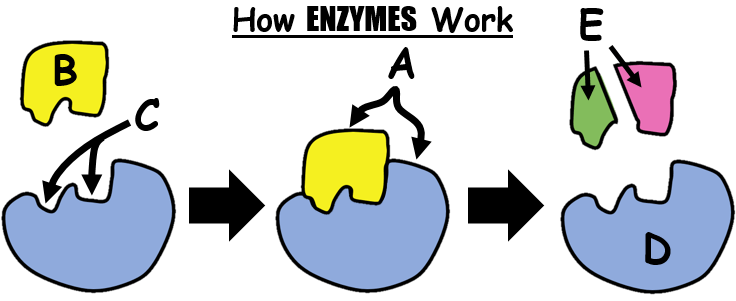
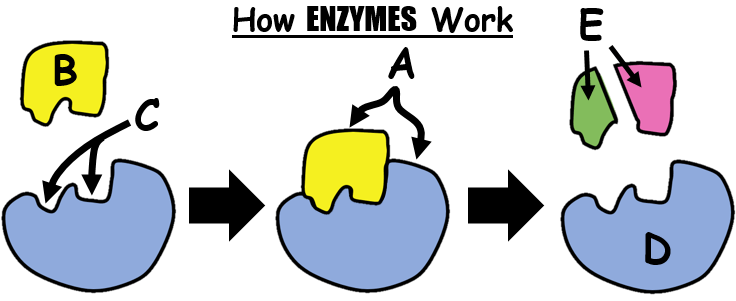
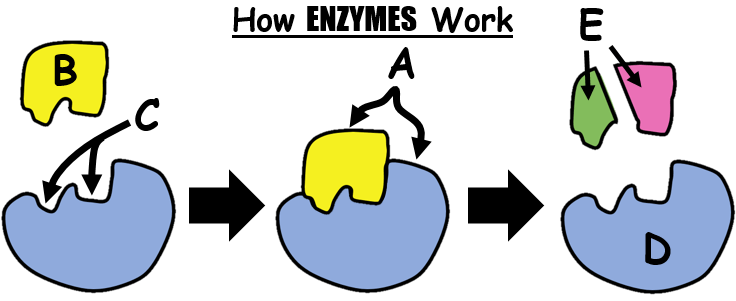
What is the name of the part of an enzyme that binds to the substrate molecule?
(a)
What is the name of the molecule that can bind to the active site of the enzyme?
(a)
What word describes any substance that speeds up a chemical reaction but do not get changed or used up themselves?
(a)
What 3 letters are found at the end of the names of most enzymes?
(a)
Which element is not found in carbohydrates?
Carbon
Nitrogen
Oxygen
Hydrogen
Which element is not common to both proteins and lipids?
Carbon
Nitrogen
Hydrogen
Oxygen
What is the name of the building block that proteins are made from?
Amino Acid
Fatty acid
Glycerol
Simple sugar
Which of the following factors would not affect the rate of an enzyme-controlled reaction?
Temperature
pH
Concentration of enzyme
Concentration of product
Concentration of substrate
Which statement is true about enzymes?
The shape of an enzyme's active site matches the shape of its substrate
Enzymes are used up in biological reactions
Enzymes work faster at higher temperatures
Every enzyme has one specific substrate that it breaks down or builds up.

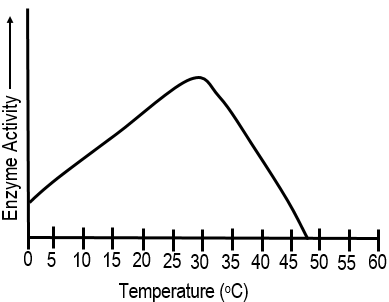
The graph shows the effect of temperature on an enzyme. Which statement explains the trend from 10-70oC?
As temperature increases, enzyme activity increases
70oC is the optimum temperature for this enzyme
As temperature increases, enzymes become denatured.
As temperature increases, enzyme activity decreases.
As temperature increases, molecules gain more kinetic energy and have more successful collisions
What does the term optimum mean for enzyme temperature? Select the best description.
The lowest temperature at which the enzyme works to form enzyme-substrate complexes
The temperature which gives the highest enzyme activity forming the maximum number of enzyme-substrate complexes
The highest temperature before denaturing occurs
Which of these statements about enzymes is true?
Temperature does not affect their activity
They can be reused
They lower the activation energy of a reaction
Which statement about the optimum pH for an enzyme is correct?
It is the pH at which the enzyme's activity is greatest with the maximum number of enzyme-substrate complexes being formed
It is the same for all enzymes
It is the pH at which the enzyme cannot be damaged by heat

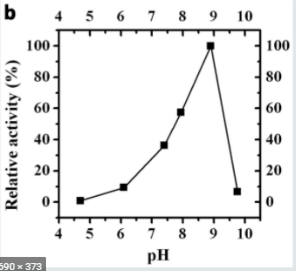
What is the optimal pH for this enzyme?
6
10
9
7
Changes in pH and temperature can ___________________ an enzyme which causes it to lose its shape and affects its function.
puncture
denature
double
delete

The graph shows how the activity of an enzyme changes over a range of pH values.
Which of the following conclusions can be drawn from this graph?
The optimum pH of the enzyme is 5.8
The optimum pH of the enzyme is 6.6
The enzyme’s activity continually increases as pH increases from 5.0 to 9.0
The enzyme’s activity is greater around pH of 8.0 than around pH of 5.0
Once a new product leaves an enzyme, the enzyme is unchanged and ready for the next substrate. What is this called?
fragile
reusable
specific
catalyst
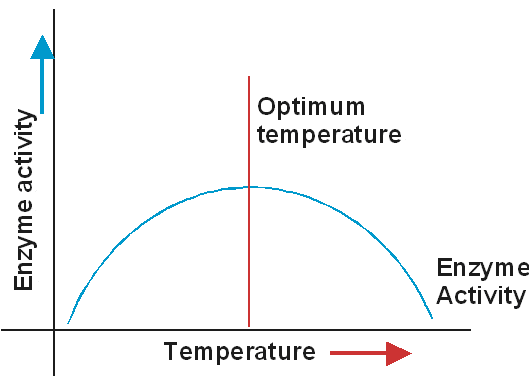
At high temperatures enzyme activity declines because of:
Denaturation
Enzyme death
Movement
It doesn´t

What is the process by which plants manufacture carbohydrates from raw materials using energy from light?
Respiration
Photosynthesis
Fermentation
Transpiration

Which pigment is responsible for trapping light energy from the Sun in plants?
Chlorophyll
Xanthophyll
Anthocyanin
Carotene

What is the primary WASTE product released during photosynthesis?
Carbon Dioxide
Water
Oxygen
Glucose
Which of the following is NOT a raw material required for photosynthesis?
Carbon Dioxide
Water
Light Energy
Oxygen
Which of the following is NOT a use of the carbohydrates produced during photosynthesis?
Energy Store
Cell Wall Building
Protein Synthesis
Insect Attraction

What is the balanced chemical equation for photosynthesis?
O2 + CO2 -> H2O + C6H12O6
6CO2 + 6H2O -> C6H12O6 + 6O2
C6H12O6 + O2 -> CO2 + H2O
H2O + O2 -> CO2 + C6H12O6
What is the pathway of carbon dioxide from the atmosphere to chloroplasts in a leaf?
Atmosphere -> Spongy Mesophyll -> Cuticle -> Chloroplasts
Atmosphere -> Guard Cells -> Vascular Bundles -> Stomata
Atmosphere -> Air Spaces -> Leaf Mesophyll Cells -> Chloroplasts
Atmosphere -> Upper Epidermis -> Lower Epidermis -> Palisade Mesophyll

What is the primary function of the palisade cells in the leaf?
Water Absorption
Photosynthesis
Protection
Gas Exchange
What structures are found in the vascular bundle? (pick 2 options)
Xylem
Phleom
Palisade mesophyll
Spongy mesophyll
The stomata are openings in the leaf which allow for gas exchange. Which cells found either side of the opening control the stomata?
Guard cell
Palisade cell
Spongy mesophyll
What is the role of the spongy mesophyl?
It transport water
It transport sugar
It allows gas to move through the leaf
It is where photosynthesis happens
Which essential element is needed to make all four types of macromolecules?
phosphorus
Zinc
Carbon
Copper

I were to test this leaf for starch, I should find a positive result...
at the edges
in the middle
A student conducting an investigation on a plant places part of a leaf from the plant in an airtight container and left for 24 hours.
The leaf is tested for starch and is negative.
What was the leaf lacking that it needed to do photosynthesis?
Water
Oxygen
Light
Carbon Dioxide
Chlorophyll

A plant with variegated leaves has the starch removed from its leaves by placing it in a dark cupboard for 48 hours.
Black paper is then placed on one leaf as shown and the plant is sat in a sunny window.
After 24 hours, which part of the leaf contains starch?A
A
B
C
D
In order for plants to create chlorophyll, they need to get ________________ from the soil.
Nitrates
Phosphates
Magnesium
Potassium

Which letter represents the epidermis of the leaf?
A
B
C
D
E
In order for plants to create amino acids and proteins, they need to get ________________ from the soil.
Nitrates
Phosphates
Magnesium
Potassium
Which part of the leaf is a waxy layer that protects the outer surface and prevents water loss?
Stomata
Guard Cells
Mesophyll Cells
Cuticule

Which type of food is not digested before being absorbed by the body?
A
B
C
D

In which structure is most glucose absorbed into the blood?
A
B
C
D

The correct order of parts labelled 2,3,7,8
Oesophagus,stomach,pancreas,liver
Oesophagus,stomach,liver,pancreas
Oesophagus,pancreas,stomach,liver
Oesophagus,pancreas,liver,stomach
The part that stores liver’s digestive juice until they are needed by the intestines.
Pancreas
Gall bladder
Duodenum
Spleen
Occurs when the cells of the digestive system take in small molecules of digested food
absorption
digestion
egestion
ingestion
A gastric juice found in the stomach
acidic fluid
pepsin
rennin
alkaline fluid
The folds of the small intestine are covered with fingerlive projections called...
bolus
bile
villi
rugae
Which of the following nutrient has no energy value?
Fats
Protein
Carbohydrate
Vitamin
Which vitamin is lacking when scurvy occurs
Vitamin A
Vitamin E
Vitamin C
Vitamin D
What is protein broken down into?
Maltose
Amino Acid
Lactic Acid
Glucose
Sucrose
In which part of the digestive system are most of the nutrients absorbed into the bloodstream?
Stomach
Oesophagus
Small Intestine
Large Intestine
What is the function of dietary fibre in the human body?
Provides energy
Fights infection and disease
Keeps the digestive system healthy
Promotes healthy hair and nails
Maltose is digested into glucose by maltase
True
False
What is the function of Bile Juice secreted by Liver?
It makes the food alkaline.
It makes the food acidic.
It breaks down the big fat globules for effective enzyme action
It converts fat to fatty acid and glycerol

Name part marked A.
Stomata
Nucleus
Stoma
Epidermal cell
Which of the following is not true during inhalation?
Diaphragm flattens
External intercostal muscles contract
Internal intercostal muscles relax
Volume of thoracic cavity decreases

What does Bell jar represent in human being?
Trachea
Lung
Rib cage
Diaphragm
What does Balloon represent in human being?
Trachea
Lung
Rib cage
Diaphragm
What does Glass tube represent in human being?
Trachea
Lung
Rib cage
Diaphgram
What makes up a higher percentage of inspired air compared with expired air?
oxygen
nitrogen
noble gases
carbon dioxide
The main components of atmospheric air are carbon dioxide, nitrogen, oxygen and water vapour.
Which of these are present in greater quantities in expired air compared to inspired air?
carbon dioxide and nitrogen
nitrogen and oxygen
water vapour and carbon dioxide
oxygen and water vapour
What is the route for carbon dioxide passing out of the body?
alveoli → capillaries → bronchioles → bronchi → trachea → larynx
alveoli → capillaries → bronchi → bronchioles → larynx → trachea
capillaries → alveoli → bronchi → bronchioles → trachea → larynx
capillaries → alveoli → bronchioles → bronchi → trachea → larynx
What is the function of the human alveoli?
breathing
gas exchange
digestion
respiration
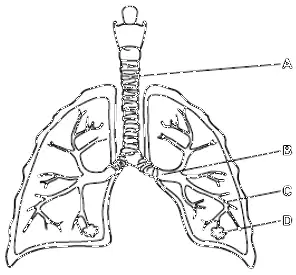
The diagram shows the human breathing system. Where does diffusion of oxygen and carbon dioxide take place?
A
B
C
D
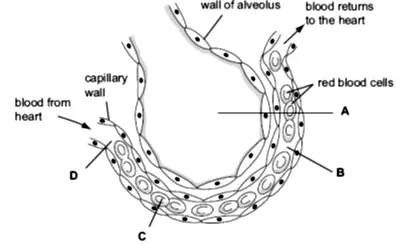
The diagram shows a section through an alveolus and an associated blood capillary. In which part is the concentration of carbon dioxide highest?
A
B
C
D
Which is the correct air passage in the breathing mechanism?
Nostril, nasal cavity, pharynx, larynx, trachea, bronchus, bronchiole, alveolus
Nostril, nasal cavity, larynx, pharynx, trachea, bronchus, bronchiole, alveolus
Nostril, nasal cavity, pharynx, larynx, trachea, bronchiole, bronchus, alveolus
Nostril, nasal cavity, trachea, larynx, pharynx, bronchus, bronchiole, alveolus
During inhalation....
intercostal muscles contract
air pressure in the thoracic cavity to increase
rib cage moves downwards and inwards
diaphragm muscles relax and curve upwards
Which of the structures of human respiratory system NOT involve in the air passage in the breathing mechanism?
Trachea
Intercostal muscle
nostril
Larynx
During exhalation....
intercostal muscles contract
air pressure in the thoracic cavity to decrease
diaphragm muscles relax and curve upwards
intercostal muscles contract
"Movements of the rib cage and diaphragm make the thoracic cavity smaller and cause the air pressure in the thoracic cavity to increase"
The situation happens during....
inhalation
exhalation
excretion
blood circulation
Choose the correct combo-
xylem-water, phloem -sugar
xylem- sugar, phloem -water
When the guard cells are filled with water, the stomata is
open
closed
Products of respiration include:
O2, H2O, energy
CO2, H2O, energy
CO2, H2O, O2.
CO2, O2, energy
The process of respiration is closely related to the temperature factor because:
Temperature affects the stomatal opening and closing mechanism which affects the oxygen concentration.
Temperature affects the amount of water that is the raw material of respiration
Each species only respires under certain temperature conditions.
Respiration consists of chemical reactions that require enzyme catalysis, so it is strongly dependent on temperature.
The general equation of respiration is:
C6H12O6 + O2 ---> CO2 + H2O + Q (energy).
C6H12O6 + O2 ---> 12CO2 + 12H2O + Q (energy).
C6H12O6 + 6O2 --> 6CO2 + 6H2O + Q (energy).
C6H12O6 + 6O2 --> 6CO2 + 6H2O
In which part of the plant does respiration take place?
all organs
leaf
roots
flower
In which way are photosynthesis and cellular respiration similar?
Both processes destroy energy.
Both create energy.
Photosynthesis breaks down sugar while cellular respiration produces sugar.
Both processes transfer energy from one form to another.
What's the chemical formula for glucose?
6C6H12O6
C12H6O12
C6H12O6
CHO

Glucose molecules store _____________.
chemical energy
kinetic energy
gravitational potential energy
heat energy
The energy stored in glucose is transferred to ________________.
A molecule known as ATP
A molecule known as ADP
water molecules
oxygen molecules

