
 Worksheets
Honors Biology Semester 1 Final Exam Review
Total questions: 163
Worksheet time: 3hrs 41mins
Name
Class
Date
1.
Which of the following illustrates the correct ordering of trophic levels?
a)
decomposers-carnivores-autotrophs-herbivores
b)
herbivores-autotrophs-carnivores-decomposers
c)
producers-herbivores-carnivores-decomposers
d)
carnivores-producers-omnivores
2.
The transfer of energy from a lower trophic level to the next highest level is roughly
a)
1%
b)
10%
c)
100%
d)
1000%
3.
Trophic levels are represented by
a)
squares
b)
circles
c)
pyramids
d)
lines
4.

Which animal is the top predator?
a)
hawk
b)
lizard
c)
snake
d)
grass
5.

In the energy pyramid here, how much of the energy in each level gets lost as heat or used by the organism for survival?
a)
80%
b)
90%
c)
10%
d)
20%
6.

Which of the following is a herbivore?
a)
cricket
b)
frog
c)
hawk
d)
shrew
7.
Hawks weigh about 1.5 kg. About how much grass must be consumed by grasshoppers to support the one hawk? (Hint: multiply by 10)
a)
1.5 kg
b)
50 kg
c)
1,500 kg
d)
5,000 kg
8.
What would happen if a decomposer is removed from the ecosystem?
a)
Nothing
b)
The ecosystem would eventually die
c)
Only the producers would be affected
d)
Only the consumers would be affected
9.
What would happen to the ecosystem if the biomass of primary consumers was higher than the biomass of producers?
a)
The primary consumers will eat all of the producers...no more organisms to convert light energy to chemical energy (glucose)
b)
The primary consumers will become the producers and perform photosynthesis
c)
The producers will become primary consumers
d)
This is DEFINITELY not the right answer.
10.
What is the water cycle?
a)
the 3 forms of water
b)
the movement of water on, above, or below the surface of the Earth
c)
when water melts
d)
when clouds form
11.
Which is the opposite of condensation?
a)
runoff
b)
evaporation
c)
precipitation
d)
transpiration
12.

What is it called when plants give off water vapor as a waste product?
a)
condensation
b)
evaporation
c)
sublimation
d)
transpiration
13.
What follows condensation in the water cycle?
a)
evaporation, by the sun's heat
b)
condensation, because the air is cooled
c)
precipitation, because the cloud is saturated, or full
d)
run off, because gravity pulls things down
14.
What is the role of decomposers in an Ecosystem?
a)
They recycle matter and nutrients to form fossil fuels
b)
They are burn and release as carbon dioxide
c)
Decomposers are responsible to turn oxygen into carbon dioxide
d)
They recycle energy back to the sun
15.
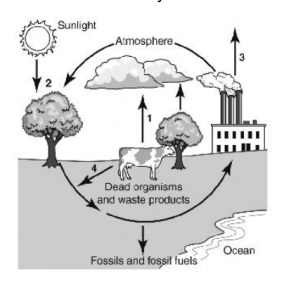
What is happening at 1?
a)
respiration: releasing CO2
b)
decomposing CO2 in the soil
c)
photosynthesis: absorbing CO2
d)
turning CO2 from the atmosphere into organic molecules
16.
Photosynthesis
a)
absorbs CO2
b)
releases CO2
17.
Respiration
a)
absorbs CO2
b)
releases CO2
18.
Greenhouse gases....
a)
make plants green
b)
increase the temperature of the earth
c)
produce oxygen
d)
decrease the temperature of the earth
19.
What biome has the most rainfall per year?
a)
Tundra
b)
Taiga
c)
Tropical Rainforest
d)
Deciduous Forest
20.
What biome covers half of the USA?
a)
Tundra
b)
Taiga
c)
Tropical Rainforest
d)
Deciduous Forest
21.
What biome is the coldest?
a)
Tundra
b)
Taiga
c)
Temperate Forest
d)
Desert
22.
Which biome receives the least amount of precipitation?
a)
Desert
b)
Grasslands
c)
Savanna
d)
Tropical Rainforest
23.
If an area has fir, spruce, and pine trees and the winters are cold, you are probably in a ________.
a)
Taiga
b)
Tundra
c)
Grassland
d)
Desert
24.
Abiotic factors are parts of the environment that are...
a)
Nonliving
b)
Living
c)
Populations
d)
Vegetation
25.

The trees in this forest biome have needle like leaves that are hard to eat.
a)
Coniferous Forest
b)
Deciduous Forest
c)
Tropical Rain Forests
d)
Deserts
26.

Which biome is MOST LIKE the "desert" in terms of precipitation?
a)
tropical rainforest
b)
temperate deciduous forest
c)
tundra
d)
coniferous forest
27.

Identify the Biome in the picture:
a)
tundra
b)
tropical rainforest
c)
desert
d)
grassland
28.

In which biome would you MOST LIKELY find this organism?
a)
savanna
b)
tropical rainforest
c)
temperate grassland
d)
tundra
29.
The permanently frozen soil below the arctic tundra.
a)
porafrost
b)
permafrost
c)
perlafrost
d)
polarfrost
30.
You should always carry the microscope by the
a)
arm and base
b)
arm and body tube
c)
arm only
31.
The diaphragm helps to
a)
focus
b)
allow light to pass through the stage
c)
change the lens size
32.
When looking at a specimen on your slide, you should always start with the
a)
low objective lens
b)
medium objective lens
c)
high objective lens
33.
The _______focuses the image under low power.
a)
revolving nosepiece
b)
fine adjustment knob
c)
coarse adjustment knob
34.
The__________ sharpens the image under high magnification.
a)
revolving nosepiece
b)
fine adjustment knob
c)
coarse adjustment knob
35.

What is number 17?
a)
body tube
b)
arm
c)
stage
d)
base
36.

What is number 16?
a)
revolving nosepiece
b)
objective lense
c)
body tube
d)
eyepiece
37.

What is number 18?
a)
stage
b)
stage clips
c)
coarse adjustment
d)
fine adjustment
38.

Which of the following statements is not part of the cell theory?
a)
Cells are the basic unit of structure and function in all living things.
b)
All cells are produced from other cells.
c)
Only animal cells are composed of cells.
d)
All living things are composed of cells.
39.

What is one way in which all living things on Earth are alike?
a)
All living things have hair.
b)
All living things are made of cells and come from other cells.
c)
The cells of all living things have chloroplast.
d)
All living things can move.
40.

Which statement reflects one of the major components of the cell theory?
a)
All living things are multi-cellular.
b)
Organs are the basic unit of structure and function for all living things.
c)
All cells come from previously existing cells.
d)
Every organism has a reproductive system to ensure survival of the species.
41.
What structures distinguish a plant cell from an animal cell?
a)
Plant cells have cell walls and ribosomes.
b)
Plant cells have cell walls and chloroplasts.
c)
Plant cells have chloroplasts and ribosomes.
d)
Plant cells have chloroplasts and mitochondria.
42.

When cells are damaged, new cells are created by cell division. How does the cell theory support this fact?
a)
It states that all cells have a nucleus which divides.
b)
It states that all living things are made up of one or more cells.
c)
It states that cells come from previously existing cells.
d)
It states that the basic units of structure and function are cells.
43.
The basic unit of life is called a (n)
a)
atom
b)
compound
c)
cell
d)
energy
44.
"Endosymbiosis" means
a)
Living together
b)
Living inside
c)
Entering together
d)
Joining together
45.
The theory of Endosymbiosis explains
a)
The origin of eukaryotes
b)
How species develop
c)
How bacteria live
d)
Why cells rely on one another
46.
____________ & _________________ are organelles that definitely arose from endosymbiosis.
a)
Rough ER & Smooth ER
b)
Mitochondria & Flagellum
c)
Chloroplast & Mitochondria
d)
Chloroplast and Golgi apparatus
47.
What did the host cell receive from its endosymbiont (cell living inside of it)?
a)
Shelter
b)
Motility
c)
Energy
d)
Reproduction
48.
What did the endosymbiont (cell living inside another) receive from its host cell?
a)
Shelter
b)
Energy
c)
Motility
d)
Reproduction
49.
Living things need energy to survive?
a)
True
b)
False
50.
All living things are composed of cells.
a)
True
b)
False
51.
Living things do all of the following except:
a)
Respond to stimulus
b)
Grow and develop
c)
maintain homeostasis
d)
They do not change
52.
Living things respond to the environment (homeostasis) and external stimuli (react to something).
a)
True
b)
False
53.
During ___________ conditions inside our body are kept stable (the same)
a)
homeopathic
b)
Homo sapian
c)
homeostasis
d)
homologous
54.
An example of homeostasis includes maintaining :
a)
oxygen level
b)
body temperature
c)
blood sugar level
d)
all of these levels
55.
What does reproduce mean?
a)
They grow
b)
They are living things
c)
Organisms make other organisms
56.
What is a living thing?
a)
reproduction
b)
organism
c)
development
d)
homeostasis
57.

What type of cell is pictured?
a)
Prokaryotic
b)
Eukaryotic
c)
Plant
d)
Animal
58.
Which is true of prokaryotic and eukaryotic cells?
a)
Prokaryotic cells are larger than eukaryotic cells.
b)
Eukaryotic cells do not have nuclei, and prokaryotic cells do have nuclei.
c)
Prokaryotic cells lack membrane-bound organelles, and eukaryotic cells contain membrane-bound organelles.
d)
Eukaryotic cells are simpler than prokaryotic cells.
59.
Which of the following would be found in both eukaryotic AND prokaryotic cells?
a)
chloroplast
b)
cytoplasm
c)
nucleus
d)
endoplasmic reticulum
60.

Type of cell shown?
a)
Bacterial
b)
Prokaryotic
c)
Eukaryotic
d)
Red blood
61.
Cells of organism must replicate for ?
a)
growth
b)
repair of damaged cells
c)
replacement of dying cells.
d)
All of the above
62.
Before cells can divide, what must be copied?
a)
mitochondria
b)
cytoplasm
c)
DNA
d)
Cell Wall
63.
The division of the nucleus is known as:
a)
Synthesis
b)
Mitosis
c)
G1
d)
G2
64.
Humans have ________ pairs of chromosomes.
a)
21
b)
23
c)
46
d)
None of the above
65.
Eukaryotic cells store their genetic information(DNA) in __________.
a)
Chromosomes
b)
Centromeres
c)
karyotypes
d)
Proteins
66.
The individual strands on duplicated chromosomes are called_____________
a)
Centromeres
b)
daughters
c)
Chromatids
d)
Karyotypes
67.
A pair of chromosomes that consists of XX is a __________________.
a)
Male
b)
Female
68.
The cell spends most of it's life in ________________.
a)
mitosis
b)
cytokinesis
c)
Interphase
d)
None of the above
69.
In the G1 stage of the cell cycle, the cell
a)
Grows
b)
Matures
c)
Carries on normal activities
d)
All of the above
70.
In the S stage of interphase_______________
a)
the cell grows
b)
the nucleus divides
c)
the cell membrane divides
d)
the DNA is replicated
71.
In the G2 stage of cell division, ______________ are made.
a)
organelles
b)
structures for cell division
c)
proteins
d)
all of the above
72.
A human cell has 46 chromosomes before mitotic division. How many chromosomes will the daughter cells after mitosis.
a)
12
b)
23
c)
46
d)
92
73.

a)
Prophase
b)
Interphase
c)
Anaphase
d)
Telophase
74.

a)
Anaphase
b)
Cytokinesis
c)
Telophase
d)
Metaphase
75.

a)
Cytokinesis
b)
Interphase
c)
Anaphase
d)
Metaphase
76.

a)
Anaphase
b)
Cytonkinesis
c)
Interphase
d)
Prophase
77.

a)
Interphase
b)
Anaphase
c)
Telophase
d)
Prophase
78.

In mitosis, the two resulting cells are
a)
different from the starting cell and identical to each other.
b)
different from the starting cell and different from each other.
c)
identical to the starting cell and different from each other.
d)
identical to the starting cell and identical to each other.
79.

How many chromosomes do humans have?
a)
46
b)
21
c)
10
80.
If the environment gets cold, we will often shiver in order to:
a)
keep body temperature the same as the external temperature
b)
decrease body temperature
c)
increase body temperature
d)
regulate blood pressure
81.
The maintenance of an organism’s internal environment is called:
a)
compensating
b)
homeostasis
c)
balancing
d)
routine
82.
When a threatening situation appears, what is the name of the instinctive mechanism used by animals to protect themselves?
a)
Flight or Run
b)
Hide and Seek
c)
Fight or Flight
d)
Run and Fight
83.
Name the levels of organization in the human body in order from smallest to largest:
a)
Tissue, organ, organ system
b)
Organ system, tissue, organs, cells
c)
Cells, tissue, organs, organ system
d)
Cells , organs, tissue, organ system
84.

What type of feedback loop is shown?
a)
Positive
b)
Neutral
c)
Negative
85.
True or False Blood clotting and uterine contractions are good examples of negative feedback.
a)
True
b)
False
86.

What type of feedback loop is shown?
a)
negative
b)
neutral
c)
positive
87.
When you are cold, you shiver and your blood vessels contract, which warms you up. When you are hot, you sweat and your blood vessels expand, which cools you down.
a)
Positive Feedback Response
b)
Negative Feedback Loop
88.
Which of the following is an example of positive feedback to indirectly maintain homeostasis?
a)
the chemical reactions involved in blood clotting
b)
your blood vessels dilate and you begin to sweat in response to elevated body temperature
c)
your blood vessels constrict and you begin to shiver in response to low body temperature
d)
your coach compliments you on your performance in practice
89.
Osmosis is the movement of _____ across a membrane.
a)
food
b)
energy
c)
oxygen
d)
water
90.
Which is true about active transport?
a)
It requires energy
b)
it does not require energy
c)
It moves substances down the concentration gradient
d)
it moves material from high to low concentration
91.

This picture represents which type of cellular transport?
a)
passive transport
b)
endocytosis
c)
exocytosis
d)
osmosis
92.

The cell below is in a _________ solution.
a)
Hypotonic
b)
Hypertonic
c)
Isotonic
93.
This cellular structure helps organisms maintain homeostasis by controlling what substances may enter or leave cells.
a)
vacuole
b)
nucleus
c)
cell membrane
d)
cell wall
94.

The cell below is in a _____________ solution.
a)
Hypertonic
b)
Hypotonic
c)
Isotonic
95.
A cell in a hypotonic solution will
a)
swell
b)
shrink
c)
stay the same size
d)
impossible to tell
96.
A cell in an isotonic solution will
a)
swell
b)
shrink
c)
stay the same size
d)
impossible to tell
97.
A saltwater fish is accidentally placed in a freshwater aquarium in a few short hours it sadly died. Which explains why this occurred?
a)
The cells of the fish body were dehydrated by the quick loss of water.
b)
The cells of the fish quickly absorbed massive amounts of water and it ended up killing the fish.
c)
The fish hated the new decor in the freshwater tank.
d)
It was just its time.
98.
Which term means "water-loving"?
a)
Cohesion
b)
Nonpolar
c)
Hydrophilic
d)
Hydrophobic
99.
Which term means "water-fearing"?
a)
Adhesion
b)
Polar
c)
Hydrophilic
d)
Hydrophobic
100.
The cell membrane is made mostly of
a)
phospholipid monolayer and proteins
b)
phospholipid bilayer and proteins
c)
proteins and carbohydrates bilayer
d)
triglycerides and carbohydrates
101.

What type of transport is this?
a)
facilitated diffusion
b)
active transport
c)
diffusion
d)
osmosis
102.
Which organelle does photosynthesis take place in?
a)
Mitochondrion
b)
Chlorplast
c)
Cytoplasm
d)
Nucleus
103.
What are the reactants of photosynthesis
a)
Water, light, and carbon dioxide
b)
sugar, light and water
c)
Water, light, carbon dioxide
d)
sugar and oxygen
104.
What are the products of photosynthesis?
a)
Sunlight and water
b)
oxygen and sugar
c)
Energy and Carbon dioxide
d)
Heat
105.
The sac like portion inside the chloroplast is called
a)
Golgi appartus
b)
Endoplasmic reticulum
c)
Stroma
d)
Thykloids
106.
The fluid like substance found inside the chloroplast is called
a)
Cytoplasm
b)
Stroma
c)
Thykloids
d)
Cell Wall
107.
Which of the following is the correct equation for PHOTOSYNTHESIS?
a)
6CO2 + 6H2O --> 6O2 + C6H12O6
b)
6CO2 + C6H12O6 + 6H2O --> O2
c)
6O2 + 6H2O --> 6CO2 + C6H12O6
d)
C6H12O6 + 6O2 ---> 6H2O + 6CO2
108.
What pigment absorbs sunlight for photosynthesis?
a)
chloroplast
b)
thylakoid
c)
grana
d)
chlorophyll
109.
The main source of energy for all life comes from ____.
a)
the Earth
b)
the moon
c)
the sun
d)
the food we eat/make
110.
How can photosynthesis be related to cellular respiration?
a)
What's produced (made) by one is needed (the reactants) for the other
b)
They both produce the same products
c)
They both have the same reactants (need the same things)
d)
These 2 processes have nothing in common
111.
All living things do which of the following?
a)
Chemosynthesis
b)
Respiration
c)
photosynthesis
d)
all of the answers
112.
What is one of the reactants of cellular respiration?
a)
energy
b)
glucose
c)
carbon dioxide
d)
water
113.
______________ produces the most ATP.
a)
photosnthesis
b)
aerobic respiration
c)
anaerobic respiration
d)
glycolysis
114.
What is the molecule called that mitochondria produce when they respire glucose?
a)
ATP
b)
ADP
c)
DNA
d)
80p
115.
How many ATP are gained through glycolysis?
a)
0
b)
2
c)
4
d)
30-38
116.
Where does glycolysis occur?
a)
Inner mitochondrial membrane
b)
Mitochondrial Matrix
c)
Cytosol
d)
At a ribosome
117.
Where does ETC occur?
a)
Mitochondrial matrix
b)
Outer mitochondrial membrane
c)
Inner mitochondrial membrane
d)
Cytosol
118.
what travel through the electron transport chain?
a)
cells
b)
electrons
c)
blood
d)
thylokoid
119.
at the end, ____ turns into ____
a)
NADPH, NADP
b)
ATP, ADP
c)
ADP, ATP
d)
NADP, NADPH
120.
how many ATP can be produce from 1 glucose?
a)
2
b)
40
c)
4
d)
38
121.
ATP is formed from photosynthesis and cellular respiration
a)
true
b)
false
122.
what is ATP?
a)
newly used word for ADP
b)
part of a membrane
c)
energy carrier
123.
Lactic acid fermentation occurs in your muscles after a workout because your cells are struggling to get...
a)
Glucose
b)
Sunlight
c)
Oxygen
d)
Water
124.
Because fermentation takes place in the absence of oxygen, it is said to be
a)
aerobic
b)
anaerobic
c)
cyclic
d)
oxygen-rich
125.
The process carried out by yeast that causes bread to rise is
a)
alcoholic fermentation
b)
lactic acid fermentation
c)
cellular respiration
d)
yeast mitosis
126.
What part of our cells holds our DNA?
a)
cytoplasm
b)
cell membrane
c)
nucleus
d)
ribosomes
127.
What has DNA?
a)
animals
b)
plants
c)
bacteria
d)
all of the above
128.

Which of the following best describes a DNA molecule?
a)
double helix
b)
contains ribose
c)
made of amino acids
d)
contains Uracil
129.
Which of the following units are repeatedly joined together to form a strand of DNA?
a)
amino acids
b)
nucleotides
c)
fatty acids
d)
polysaccharides
130.

In a molecule of double-stranded DNA, the amount of Adenine present is always equal to the amount of
a)
cytosine
b)
guanine
c)
thymine
d)
uracil
131.

Why is DNA important?
a)
it is very small and very complicated
b)
it's in everything
c)
it serves as the blueprint for traits of all living things
d)
because we eat it every day for energy
132.
What are the 4 nitrogen bases?
a)
adenine, thymine, cytoplasm, and guanine
b)
adenine, thymine cytosine, and guanine
c)
adenine, thymine, cytosine, and gylcerol
d)
adenine, thymine, cytosine, and glucose
133.

What is the relationship between a protein, the cell, and DNA?
a)
DNA is produced by protein which is produced in the cell
b)
Protein is composed of DNA which is produced in the cell
c)
DNA controls the production of protein in the cell
d)
A cell is composed of DNA and protein
134.
Where does Translation take place?
a)
RNA
b)
ribosome
c)
nucleus
d)
chromosome
135.
Specific proteins produced in a cell are directly related to the
a)
number of mitochondria in the cell
b)
types of ribosomes in the cell
c)
sequence of sugars and phosphates in the cell
d)
sequence of nucleotides in the DNA
136.
The process of making RNA (i.e. mRNA) from DNA is called
a)
Replication
b)
Transcription
c)
Translation
d)
Protein synthesis
137.
Which shows the correct complementary base pairing for DNA?
a)
C-A, T-G
b)
A-G, C-T
c)
C-G, U-A
d)
T-A, G-C
138.
A segment of DNA that codes for a protein is called a...
a)
Enzyme
b)
Mutation
c)
Gene
d)
Complimentary
139.
Which of the following displays the correct order of DNA replication?
1. Sugar and phosphate groups form the side of each new strand
2. DNA unzips
3. The bases attach from a supply in the cytoplasm
4. DNA unwinds
1. Sugar and phosphate groups form the side of each new strand
2. DNA unzips
3. The bases attach from a supply in the cytoplasm
4. DNA unwinds
a)
4-2-3-1
b)
2-4-1-3
c)
2-4-3-1
d)
4-2-1-3
140.

What is the term for a three nucleotide sequence that codes for an amino acid? For example: AUG
a)
Nitrogen base
b)
Codon
c)
Amine
d)
Phosphate group
141.

Transfer RNA (tRNA) is important because it __________.
a)
Carries amino acids to the ribosome
b)
Carries ribosomes to the ER
c)
Carries glucose to mitochondria
d)
Carries mRNA out of the nucleus
142.
If the percentage of DNA is made of 30% Thymine, what is the correct percentage of Guanine?
a)
30
b)
15
c)
20
d)
60
143.
The enzyme that unzips the DNA to prepare for replication
a)
helicase
b)
replicase
c)
polymerase
d)
synthase
144.
A scientist observes a base sequence of AGCTAGCTAGCT. Which of the following would be the complimentary strand?
a)
TGCATGCATGCA
b)
TCGATCGATCGA
c)
TAGCTAGCTAGC
d)
TTAAGGCCTTCC
145.
The bonds that hold the two strands of DNA together come from...
a)
the attraction of phosphate groups
b)
strong bonds between bases and sugars
c)
carbon to carbon bonds in the sugar
d)
weak hydrogen bonds between the bases
146.
The DNA nucleotide is composed of three parts. Which two components make up the nucleotide backbone?
a)
ribose sugar and base
b)
ribose sugar and phosphate group
c)
nitrogen base and deoxyribose sugar
d)
deoxyribose sugar and phosphate group
147.
This enzyme joins Okazaki fragments together.
a)
Polymerase
b)
Ligase
c)
Telomerase
d)
Helicase
148.
DNA is built in the
a)
3'-3' direction
b)
5'-5' direction
c)
3'-5' direction
d)
5'-3' direction
149.
The ___________________ strand builds continuously.
a)
Lagging
b)
Ligase
c)
Leading
d)
Telomeres
150.
When does replication occur?
a)
G0 phase
b)
G1 phase
c)
G2 phase
d)
S phase
151.
What mutation has occurred here?
T-G-A-C-C-A
T-G-A-G-C-A
T-G-A-C-C-A
T-G-A-G-C-A
a)
Substitution
b)
Deletion
c)
Insertion
d)
Frameshift
152.
Are all mutations bad?
a)
Yes
b)
No
153.
ATTTGAGCC- Original
ATTGAGCC - Mutated
The example above is an example of a
ATTGAGCC - Mutated
The example above is an example of a
a)
Insertion- Frameshift
b)
Deletion- Substitution
c)
Deletion -Frameshift
d)
All of the above
154.
Identify the SUBSTITUTION mutation from the following:
ATG CCA AAT
ATG CCA AAT
a)
ATG TCA AAT
b)
ATG CCT AAA T
c)
ATC CA AT
d)
ATG CCA AAT
155.
Identify the DELETION mutation form the following:
ATG CCA AAT
ATG CCA AAT
a)
ATG TCA AAT
b)
ATG CCT AAA T
c)
ATC CA AT
d)
ATG CCA AAT
156.
Identify the ADDITION mutation form the following:
ATG CCA AAT
ATG CCA AAT
a)
ATG TCA AAT
b)
ATG CCT AAA T
c)
ATC CA AT
d)
ATG CCA AAT
157.
Which RNA bases would pair with TACGAA in transcription?
a)
AUGCUU
b)
ATGCTT
c)
GCATCC
d)
GCAUCC
158.
In DNA replication, which enzyme is responsible for building the new DNA strand?
a)
helicase
b)
polymerase
c)
ligase
d)
primase
159.

What is occurring in this picture?
a)
Translation
b)
Replication
c)
Translocation
d)
Transcription
160.
What would be the tRNA anticodon for the mRNA codon CAG?
a)
GTC
b)
GUC
c)
CUG
d)
CAG
161.
What type of bonds are forming during translation?
a)
Peptide bonds
b)
Hydrogen bonds
c)
Acid bonds
162.
How many amino acids are coded for by this sequence of nucleotides:
ATG GGA ACT CCA
ATG GGA ACT CCA
a)
4
b)
2
c)
6
d)
12
163.

What is the correct amino acid sequence for the mRNA code AUGCCAGUAUGA
a)
Met-Pro-Ala-Val
b)
Met-Pro-Val
c)
Tyr-Gly-His
d)
Tyr-Gly-Arg-His
100 %

