wayground logo

Free Printable Worksheets

Font size

S
M
L
XL
Worksheets

year 9A BIOLOGY LIFE PROCESSES AND GAS EXCHANGE

Total questions: 163

Worksheet time: 6hrs 58mins

Name
Class
Date
1.

passage of inhaled air in human beings

a)

trachea - lungs - larynx - pharynx - alveoli

b)

nose - larynx - pharynx - bronchus - alveoli - bronchioles

c)

nostril - pharynx - larynx - trachea - bronchi - bronchioles - alveoli

d)

nose - mouth - lungs

2.

inhalation occurs when

a)

diaphragm is lowered

b)

diaphragm is elevated

c)

ribs move upwards

d)

ribs move downward

3.

Excretion commonly involves

a)

Removal of by products during catabolism

b)

Removal of by products during anabolism

c)

Removal of nitrogenous waste

d)

All of the above

4.

The mode of nutrition found in fungi is:

a)

(a) Parasitic nutrition

b)

(b) Holozoic nutrition

c)

(c) Autotrophic nutrition

d)

(d) Saprotrophic nutrition

5.

The green pigment used in photosynthesis is

a)

A. Phytochrome

b)

B. Chlorophyll

c)

C. Hemoglobin

d)

D. None

6.

The breakdown of pyruvate to give carbon di-oxide, water and energy takes place in

a)

(a) cytoplasm

b)

(b) mitochondria

c)

(c) chloroplast

d)

(d) nucleus

7.

Name the substances whose build up in the muscles during vigorous physical exercise may cause cramps?

a)

(a) Ethanol + Carbon dioxide + Energy

b)

(b) Lactic acid + Energy

c)

(c) Carbon dioxide + Water + Energy

d)

(d) Pyruvate

8.

Kind of nutrition in which the organisms feed on dead and decaying organic matter is ____________

a)

Holozoic

b)

saprophytic

c)

parasitic

d)

autotrophic

9.

Excess glucose is stored in the form of glycogen in the _____________

a)

pancreas

b)

gall bladder

c)

blood

d)

liver

10.

Plant cells and animal cells have many organelles in common. Which two organelles do animal cells NOT have?

a)

Nucleus

b)

Ribosomes

c)

Vacuoles

d)

Mitochondria

e)

Chloroplasts

11.

Breathing and respiration refer to the same thing.

a)

True

b)

False

c)

It depends on the organism.

12.

Which animal can breathe through their skin?

a)
b)
c)
d)
13.

Which is NOT a respiratory structure found in animals?

a)

Lungs

b)

Gills

c)

Skin

d)

Fur

14.

How do fishes obtain oxygen?

a)

Their gills absorb it from the water.

b)

They take it in when they breathe the air.

c)

Their eyes absorb it from the water.

d)

Axolotls do not need oxygen.

15.

What do fish absorb through their gills?

a)

oxygen

b)

carbon dioxide

c)

oxygen dissolved in water

d)

carbon dioxide dissolved in water

16.

Diagram shows a model of human respiratory system. K represents....

a)

lung

b)

rib cage

c)

diaphragm

d)

thoracic cavity

17.

Exchange of gases in the body cells occurs in the bronchioles.

a)

TRUE

b)

FALSE

18.

Choose The Function Of The Pancreatic Juice From The Following

a)

Trypsin digests proteins and lipase carbohydrates

b)

Trypsin digests emulsified fats and lipase proteins

c)

Trypsin and lipase digest fats

d)

Trypsin digests proteins and lipase emulsified fats

19.
What is a substance called if it speeds up a chemical reaction?
a)
reusable
b)
catalyst
c)
specific
d)
fragile
20.
With what 3 letters do enzymes typically end?
a)
-ose
b)
-ase
c)
-ese
d)
-tic
21.

Enzymes are an example of

a)

Lipids

b)

Carbohydrate

c)

Protein

d)

Nucleic Acid

22.
Each enzyme only has 1 substrate that will fit its active site.  What is this called?
a)
reusable
b)
catalyst
c)
specific
d)
fragile
23.
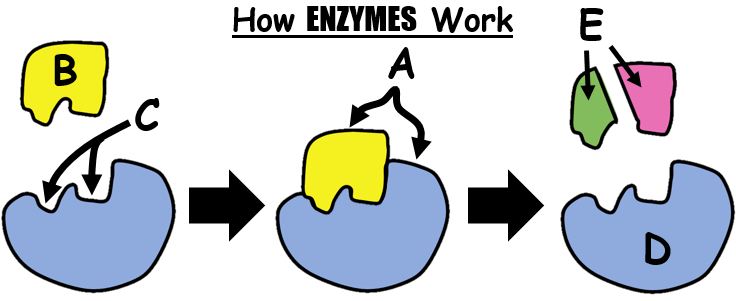
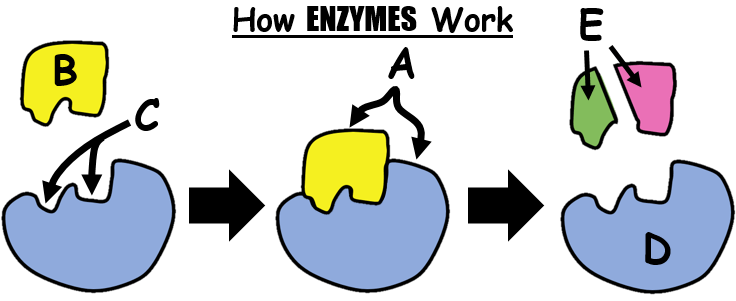
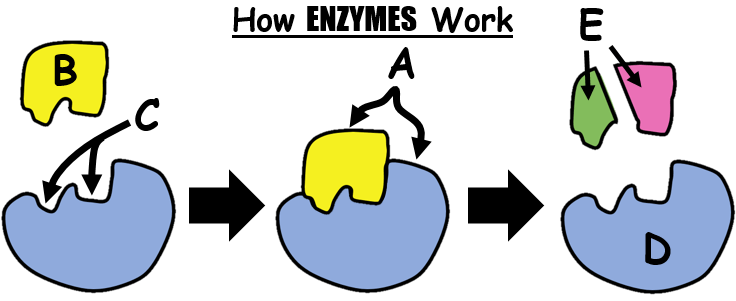
In the diagram, what is letter A? 
a)
product
b)
substrate
c)
enzyme-substrate complex
d)
active site
24.
Letter D...
a)
active site
b)
enzyme
c)
substrate
d)
products
25.
Letter D...
a)
active site
b)
enzyme
c)
substrate
d)
products
26.
Letter B...
a)
active site
b)
enzyme
c)
substrate
d)
products
27.
Letter C...
a)
active site
b)
enzymes
c)
substrate
d)
products
28.
Letter E...
a)
active site
b)
enzyme
c)
substrate
d)
products
29.
Each enzyme only has 1 substrate that will fit its active site.  What is this called?
a)
reusable
b)
catalyst
c)
specific
d)
fragile
30.
With what 3 letters do enzymes typically end?
a)
-ose
b)
-ase
c)
-ese
d)
-tic
31.
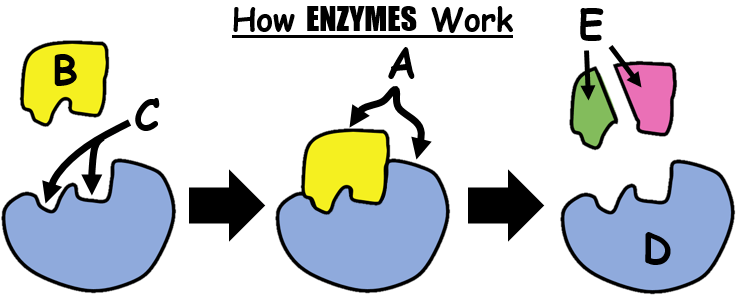
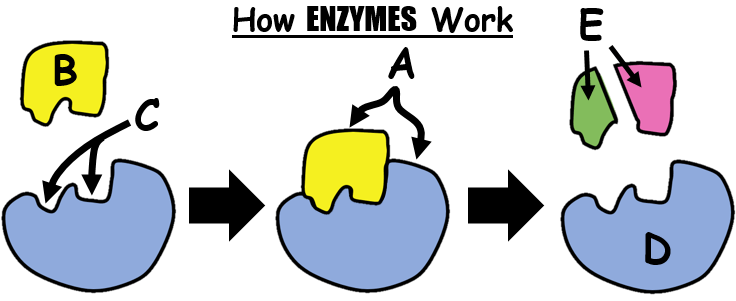
In the diagram, what is letter A? 
a)
product
b)
substrate
c)
enzyme-substrate complex
d)
active site
32.
Letter D...
a)
active site
b)
enzyme
c)
substrate
d)
products
33.
Letter B...
a)
active site
b)
enzyme
c)
substrate
d)
products
34.
Letter C...
a)
active site
b)
enzymes
c)
substrate
d)
products
35.
Letter E...
a)
active site
b)
enzyme
c)
substrate
d)
products
36.
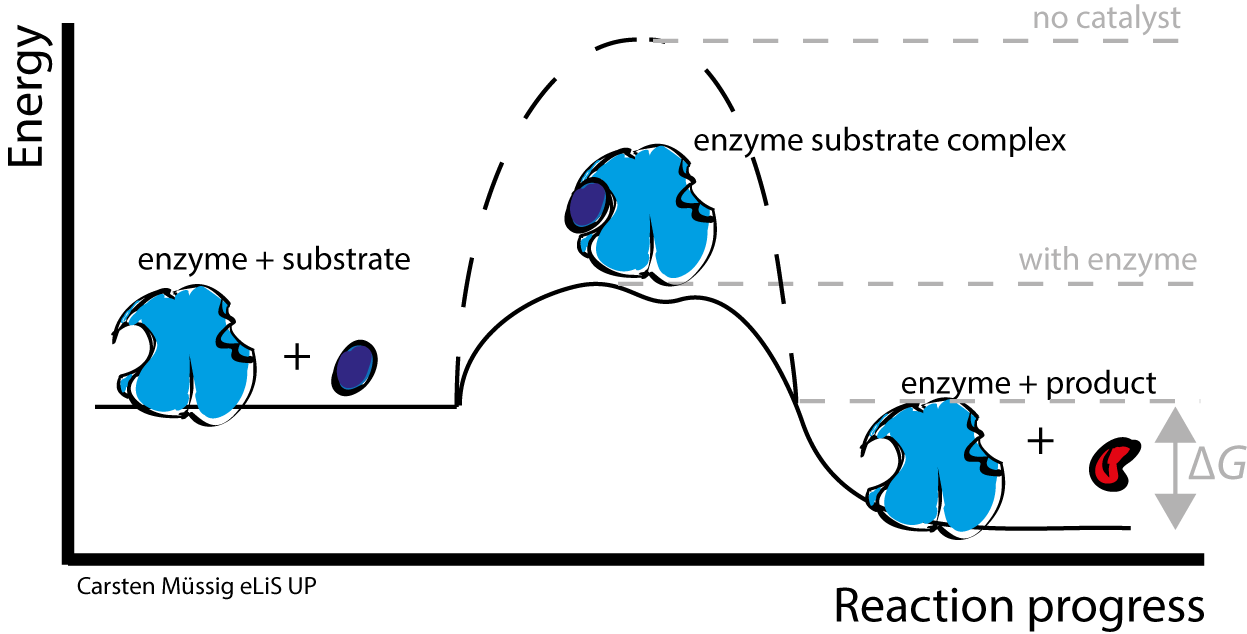
An enzyme speeds up a reaction by
a)
lowering the activation energy.
b)
raising the activation energy.
c)
releasing energy.
d)
absorbing energy.
37.
What is a substance called if it speeds up a chemical reaction?
a)
reusable
b)
catalyst
c)
specific
d)
fragile
38.

Enzymes are an example of

a)

Lipids

b)

Carbohydrate

c)

Protein

d)

Nucleic Acid

39.

What happens when enzymes are heated to a high temperature?

a)

The enzymes die.

b)

The shape of the enzyme are changed and it denatures

c)

The enzymes' amino acid sequence changes.

d)

The enzymes remain the same

40.

These organs help our body to breath except

a)

Nasal cavity

b)

Lungs

c)

Trachea

d)

Mouth

41.

Which of the following processes transport oxygen from the alveoli into the capillaries?

a)

Respiration

b)

Inhalation

c)

Exhalation

d)

Diffusion

42.

During exhalation, what will happen to these respiratory organs?

a)

Diaphragm moves downward and flatten

b)

Rib cage moves upwards and outwards

c)

intercostal muscles relax

d)

Intercostal muscles contract

43.

These organs help our body to breath except

a)

Nasal cavity

b)

Lungs

c)

Trachea

d)

Mouth

44.

Which of the following processes transport oxygen from the alveoli into the capillaries?

a)

Respiration

b)

Inhalation

c)

Exhalation

d)

Diffusion

45.

During exhalation, what will happen to these respiratory organs?

a)

Diaphragm moves downward and flatten

b)

Rib cage moves upwards and outwards

c)

intercostal muscles relax

d)

Intercostal muscles contract

46.

When inhalation

a)

Thoracic cavity become smaller

b)

The air pressure in the thoracic cavity increases

c)

The air pressure n the thoracic cavity decreases

d)

Air is pushed out

47.

The composition of the oxygen in inhaled air is

a)

21%

b)

16%

c)

4%

d)

0.04%

48.

The composition of carbon dioxide in exhaled air is

a)

79%

b)

21%

c)

4%

d)

0.04%

49.

What is diffusion process?

a)

Molecules move from a region of lower concentration to a region of higher concentration

b)

Molecules move from a region of higher concentration to a region of lower concentration

50.

State the products of respiration in the body cells?

a)

Oxygen, carbon dioxide and water

b)

glucose, oxygen and water

c)

carbon dioxide, water and oxygen

d)

carbon dioxide, water and energy

51.

Following are the characteristics of alveoli that make it efficient for gaseous exchange except:

a)

Thin wall of blood capillaries

b)

small surface area of alveoli

c)

Moist wall of alveoli

d)

Dense netword of blood capillaries

52.

What is the name of the compound found in the red blood cells

a)

Oxyhaemoglobin

b)

Haemoglobin

c)

Hormones

d)

Enzymes

53.
How do plants get the carbon that they need?
a)
from the air
b)
from water
c)
from the soil
d)
from fertilizer
54.
What does it mean for something to be anaerobic?
a)
It requires CO2
b)
It does not require CO2
c)
It requires oxygen
d)
It does not require oxygen
55.
Where in the cell does aerobic respiration take place?
a)
Nucleus
b)
Cytoplasm
c)
Mitochondria
d)
Cell membrane
56.
The purpose of cellular respiration is to make
a)
food from energy
b)
ATP from glucose
c)
heat for the organism
d)
oxygen
57.
Which is not a product of cellular respiration?
a)
oxygen
b)
carbon dioxide
c)
water
d)
ATP
58.
What are the products of aerobic respiration?
a)
Glucose and oxygen
b)
Carbon dioxide and water
c)
Lactic acid
d)
Carbon monoxide
59.
What gas is released into the air during cellular respiration?
a)
oxygen
b)
carbon dioxide
c)
water 
d)
glucose
60.
This organelle is the _____________.
a)
chloroplast
b)
Golgi bodies
c)
nucleus
d)
mitochondria
61.
which kind of cells would have the most mitochondria?
a)
brain cells
b)
bone cells
c)
plant cells
d)
muscle cells
62.
What are the reactants for cellular respiration?
a)
glucose and carbon dioxide
b)
water and glucose
c)
glucose and ATP
d)
glucose and oxygen
63.

The correct word equation for aerobic respiration is

a)

carbon dioxide + water (+ energy) → glucose + oxygen

b)

water + oxygen → carbon dioxide + glucose (+ energy)

c)

glucose + oxygen → carbon dioxide + water (+ energy)

d)

glucose + water → carbon dioxide + water (+ energy)

64.

What are the products (what is released) of cellular respiration? (Mark all of them!)

a)

oxygen

b)

glucose

c)

carbon dioxide

d)

water

e)

ATP (energy)

65.

What are the reactants (taken into) of cellular respiration? (Mark all of them!)

a)

oxygen

b)

glucose

c)

carbon dioxide

d)

water

e)

energy

66.

What type of respiration requires oxygen?

a)

Aerobic

b)

Anaerobic

67.

O2 is the chemical formula for

a)

Oxygen

b)

Carbon Dioxide

c)

Glucose

d)

Water

68.

Aerobic means

a)

without oxygen

b)

with oxygen

c)

without effort

69.

Anaerobic means

a)

with oxygen

b)

without oxygen

c)

to run for a long time

70.

What are the uses of the energy produced in respiration? Tick all that apply.

a)

To build larger molecules from smaller molecules.

b)

To break down smaller molecules into larger molecules.

c)

To maintain our body temperature.

d)

To allow muscles to contract.

71.
Which statement is true about bacterial cells?
a)
The cells are very large
b)
The cells have no nucleus
c)
The are eukaryotes
d)
They have organelles
72.
Which is present only in eukaryotic cells?
a)
cell membrane
b)
cytoplasm
c)
DNA
d)
nucleus
73.
Which organelle converts sugars into energy?
a)
lysosome
b)
mitochondria
c)
nucleus
d)
ribsome
74.
A scientist at the polar ice cap was studying an ice sample from 100 meters below the surface.  He noticed the cell structures of cytoskeleton, mitochondria, nucleus, cell wall and ribosomes.  What kind of organism did he find?
a)
animal
b)
bacteria
c)
plant
d)
not enough info
75.
Chloroplasts are organelles that convert light energy to sugars.  These organelles are found only in plants.  Which organelles are found only in animals?
a)
Golgi apparatus
b)
lysosomes
c)
mitochondria
d)
ribosomes
76.
Some cells, such as human nerve and muscle cells, contain many more mitochondria than do other cells, such as skin cells.  Why do some cells have more mitochondria than others?
a)
The cells use more energy
b)
The cells store more nutrients
c)
The cells degrade more proteins
d)
The cells divide more frequently
77.
A cell with numerous ribosomes is probably specialized for 
a)
enzyme storage
b)
energy production
c)

cell division

d)
protein synthesis
78.
All cells must have a
a)
cell wall
b)
cell membrane
c)
nucleus
d)
nucleoli
79.
The main difference between prokaryotic and eukaryotic cells is that
a)
prokaryotic cells are always larger
b)
prokaryotic cells do not have a cell membrane
c)
eukaryotic cells have a smaller cell nucleus
d)
eukaryotic cells have a more advanced cellular organization
80.
A cell stores food, water or waste products in
a)
chloroplast
b)
nuclei
c)
ribosomes
d)
vacuole
81.
Who was the first  person to see cells under the microscope and give them their name?
a)

Mattias Schleiden

b)
Robert Hooke
c)
Theordor Schwann
d)
Anton van Leeuwenhoek
82.
Which of the following is not part of the cell theory?
a)
cells must contain DNA 
b)
all living things are made from cells
c)
cells can only come from other cells
d)
cells are the basic unit of life
83.
He discovered that all plants are made of cells:
a)
Anton van Leeuwenhoek
b)
Theordor Schwann
c)
Robert Hooke
d)
Mattias Schleiden
84.
Which statement is a fundamental principle of the cell theory?
a)
All cells have a cell membrane (plasma membrane)
b)
Eukaryotic cells are larger than prokaryotic cells
c)
Living organisms are composed of cells
d)
The genetic material in cells is DNA
85.
Which organism can survive either with or without oxygen?
a)
heterotrophs
b)
autotrophs
c)
obligate anaerobe
d)
facultative anaerobe
86.
A structure that can help bacteria survive harsh conditions.
a)
capsids
b)
endospores
c)
pili
d)
DNA
87.
 A cell that contains a nucleus is
a)
prokaryote
b)
eukaryote
88.
Bacteria exchange genetic information during 
a)
asexual reproduction
b)
binary fission
c)
conjugation
d)
photosynthesis
89.
Superbugs can be prevented if people
a)
get rid of antibiotics
b)
take the antibiotics of another person
c)
do not follow the directions for taking prescribed antibiotics
d)
help people become aware of how to use antibiotics
90.
Archea differ from Bacteria in that the cell wall 
a)
contains peptidoglycan
b)
contains lipids
c)
contains oxygen
d)
contains nitrogen
91.
Prokaryotes are found in which domain
a)
Animalia
b)
Plantae
c)
Eukarya
d)
Bacteria
92.
The bacteria seen in the picture is
a)
bacillus
b)
coccus
c)
spirilla
93.
 A cell that does not contains a nucleus is
a)
prokaryote
b)
eukaryote
94.
Photoheterotrophs will use 
a)
oxygen or carbon dioxide for energy
b)
nitrogen or peptidoglycan for energy
c)
Organic compounds or light
d)
Chemicals or light
95.
Why are superbugs difficult to control?
a)
They are difficult to transmit from one person to another
b)
They have mild symptoms that often go unreported
c)
They occur in remote regions of the world
d)
They are resistant to antibiotics.
96.
The bacteria seen in the picture is
a)
cocci
b)
bacillus
c)
spirilla
97.
Which organism cannot survive in the presence of oxygen?
a)
heterotrophs
b)
autotrophs
c)
obligate anaerobe
d)
facultative anaerobe
98.
The bacteria seen in the picture is
a)
bacillus
b)
cocci
c)
spirilla
99.
During an experiment a scientist observed prokaryotes that lived near volcanic vents deep in the ocean.  The scientist must likely observed
a)
photoautotrophs
b)
chemoautotrophs 
c)
heterotrophs
d)
photoheterotrophs
100.
The ecological roles filled by prokaryotes include all of the following except
a)
decomposers
b)
producers
c)
scavengers
d)
nitrogen fixers
101.
A prokaryote will contain a cell membrane
a)
False
b)
True
102.
Which organism can survive either with or without oxygen?
a)
heterotrophs
b)
autotrophs
c)
obligate anaerobe
d)
facultative anaerobe
103.
A structure that can help bacteria survive harsh conditions.
a)
capsids
b)
endospores
c)
pili
d)
DNA
104.
 A cell that contains a nucleus is
a)
prokaryote
b)
eukaryote
105.
Bacteria exchange genetic information during 
a)
asexual reproduction
b)
binary fission
c)
conjugation
d)
photosynthesis
106.
Superbugs can be prevented if people
a)
get rid of antibiotics
b)
take the antibiotics of another person
c)
do not follow the directions for taking prescribed antibiotics
d)
help people become aware of how to use antibiotics
107.
Archea differ from Bacteria in that the cell wall 
a)
contains peptidoglycan
b)
contains lipids
c)
contains oxygen
d)
contains nitrogen
108.
Prokaryotes are found in which domain
a)
Animalia
b)
Plantae
c)
Eukarya
d)
Bacteria
109.
The bacteria seen in the picture is
a)
bacillus
b)
coccus
c)
spirilla
110.
 A cell that does not contains a nucleus is
a)
prokaryote
b)
eukaryote
111.
Photoheterotrophs will use 
a)
oxygen or carbon dioxide for energy
b)
nitrogen or peptidoglycan for energy
c)
Organic compounds or light
d)
Chemicals or light
112.
Why are superbugs difficult to control?
a)
They are difficult to transmit from one person to another
b)
They have mild symptoms that often go unreported
c)
They occur in remote regions of the world
d)
They are resistant to antibiotics.
113.
The bacteria seen in the picture is
a)
cocci
b)
bacillus
c)
spirilla
114.
Which organism cannot survive in the presence of oxygen?
a)
heterotrophs
b)
autotrophs
c)
obligate anaerobe
d)
facultative anaerobe
115.
The bacteria seen in the picture is
a)
bacillus
b)
cocci
c)
spirilla
116.
During an experiment a scientist observed prokaryotes that lived near volcanic vents deep in the ocean.  The scientist must likely observed
a)
photoautotrophs
b)
chemoautotrophs 
c)
heterotrophs
d)
photoheterotrophs
117.
The ecological roles filled by prokaryotes include all of the following except
a)
decomposers
b)
producers
c)
scavengers
d)
nitrogen fixers
118.
A prokaryote will contain a cell membrane
a)
False
b)
True
119.
What part of the phage is the DNA?
a)
A
b)
B
c)
C
d)
D
120.
What part of the virus is number 1?
a)
Capsid
b)
DNA
c)
Surface Markers
d)
Envelope
121.
What part of the virus is number 2?
a)
Capsid
b)
DNA
c)
Surface Markers
d)
Envelope
122.
What part of the virus is number 3?
a)
Capsid
b)
DNA
c)
Surface Markers
d)
Envelope
123.
What part of the virus is number 4?
a)
Capsid
b)
DNA
c)
Surface Markers
d)
Envelope
124.
Viruses are...
a)
prokaryotic
b)
eukaryotic
c)
non-living
d)
endospores
125.
Needs host cell to reproduce.
a)
Virus
b)
Bacteria
c)
Fungus
d)
Protozoan
126.
How does a virus cause a person to develop the common cold?
a)
invades the host cell to reproduce
b)
removes energy from the host cell
c)
produces toxins in the host cell
d)
protects the host cell from bacteria
127.
When a virus invades a living cell, its _______
takes over the cell's functions.
a)
outer coat
b)
genetic material
c)
core
d)
cytoplasm
128.
One reason that viruses are considered to be nonliving is that they are not made of ______.
a)
protein
b)
viruses
c)
bacteria
d)
cells
129.
What do viruses have in common with living cells? They both...
a)
store genetic information
b)
have chloroplasts
c)
use glucose for cellular respiration
d)
have endoplasmic reticulum
130.
True or False
The flu is caused by a virus.
a)
true
b)
false
131.
What do viruses need to reproduce?
a)
they need genetic material
b)
They need a host cell
c)
They need  bacteria
d)
They need insulin
132.
Antibiotics kill viruses
a)
True
b)
False
133.
Viruses are cells. 
a)
True 
b)
False
134.
How could you describe the size of a virus?
a)
Smaller than bacteria
b)
Larger than a parasite
c)
About the size of a dime
d)
Smaller than a proton
135.
What is the purpose of surface marker on a virus
a)
As defense.
b)
They provide structural support.
c)
To allow the virus to move.
d)
To attach to the host cell.
136.
Some viruses have envelopes made of cell membranes. Where did they get those membranes?
a)
It is coded in their DNA.
b)
From the host cell.
c)
From the protein capsid
d)
They make it during mitosis.
137.

The taxonomic level that would include the MOST number of species

a)

class

b)

kingdom

c)

phylum

d)

genus

138.

The science of grouping and naming organisms

a)

Phylogeny

b)

Dichotomy

c)

Taxonomy

d)

Genetics

139.

The scientist who came up with the current classification system

a)

Darwin

b)

Newton

c)

Mendel

d)

Linnaeus

140.

The first word in a scientific name is the

a)

species

b)

phylum

c)

genus

d)

class

141.

Stem cells are

a)

undifferentiated or unspecialized cells in the body.

b)

differentiated or specialized cells in the body.

c)

only found in the inner mass cells of blastocyst

d)

only found in a fetus

142.

_________ refers to a stem cell's ability to differentiate into other cell types

a)

potency

b)

potential

c)

dormancy

d)

aptitude

143.

a cell that has the most potential, able to become any type of cell.

a)

Totipotent

b)

Pluripotent

c)

Multipotent

144.

can become any of the three cell layers in a

developing embryo (endoderm, mesoderm, ectoderm), but not the placenta surrounding the embryo.

a)

Totipotent

b)

Pluripotent

c)

Multipotent

145.

partially differentiated, with only the capacity to become one cell type.

a)

Totipotent

b)

Pluripotent

c)

Multipotent

146.

Which has the highest potency?

a)

Morula

b)

Blastocyst

c)

Fetus

d)

Adult

147.

Which has the lowest potency?

a)

Morula

b)

Blastocyst

c)

Fetus

d)

Adult

148.

Which cell type would divide the most rapidly?

a)

Skin

b)

Muscle

c)

Nerve

149.

Which cell type would divide the least rapidly?

a)

Skin

b)

Red Blood cells

c)

Nerve

150.

As cells become more specialized

a)

cells have access to more genes

b)

some genes are turned off

c)

some gene segments get lost

151.
What is one goal of cellular differentiation/specialization?
a)
To create specialized cells to help organism maintain homeostasis.
b)
To many cells.
c)
To make stem cells
d)
to make single celled organisms
152.
Why are scientists interested in studying stem cells?
a)
They never die.
b)
They come from the brain stem. 
c)
They can be transplanted into monkeys.
d)
They can become any type of cell.
153.
What is the importance of apoptosis?
a)
To eliminate damaged or unnecessary cells
b)
To create specialized cells
c)
To produce two identical cells
d)
To cause uncontrolled cell growth
154.
What is cell differentiation?
a)
Process by which cells produce more cells
b)
Process by which cells become specialized
c)
Process by which cells become unspecialized
d)
Process by which cells die
155.
What is the difference between embryonic stem cells and adult stem cells?
a)
Embryonic stem cells can differentiate into more cell types than adult stem cells
b)
Adult stem cells are pluripotent, just like embryonic stem cells
c)
Adult stem cells can differentiate into more cell types than embryonic stem cells
d)
Adult stem cells grow bigger than embryonic stem cells
156.
Stem cells are
a)
cells that grow uncontrollably
b)
undifferentiated and can be any type of cell
c)
never go through cell division
d)
only found in embryos
157.
what is the role of stem cells in the body 
a)
fight against infection 
b)
provide specialized roles in the body 
c)
used for fertility treatment 
d)
they produce new specialized cells in the body to replace old cells that are used up 
158.
Stem cell research is controversial because in involves?
a)
social issues
b)
ethical issues
c)
educational issues
d)
economical issues
159.

Name the cellular process responsible for repair, growth, and development in living organisms.

a)

meiosis

b)

mitosis

c)

transcription

d)

translation

160.

Mitosis is also referred to as...

a)

cellular multiplication

b)

cellular subtraction

c)

cellular addition

d)

cellular division

161.

Mitosis starts with one cell and ends with...

a)

one cell

b)

two cells

c)

three cells

d)

four cells

162.

DNA replication is important for mitosis because...

a)

it results in a variety of traits amongst the same type of cells

b)

it ensures more genetic material in the strongest cells

c)

it ensures both cells will have identical, correct genetic information

d)

it creates variety amongst cells

163.

What best explains the role of cellular division?

a)

to grow, develop, and repair tissue

b)

to eliminate unneeded cells

c)

to produce egg and sperm cells

d)

to eliminate waste from your body