wayground logo

Free Printable Worksheets

Font size

S
M
L
XL
Worksheets

HBio- 2nd Sem Final

Total questions: 166

Worksheet time: 3hrs 46mins

Name
Class
Date
1.

What is produced during transcription?

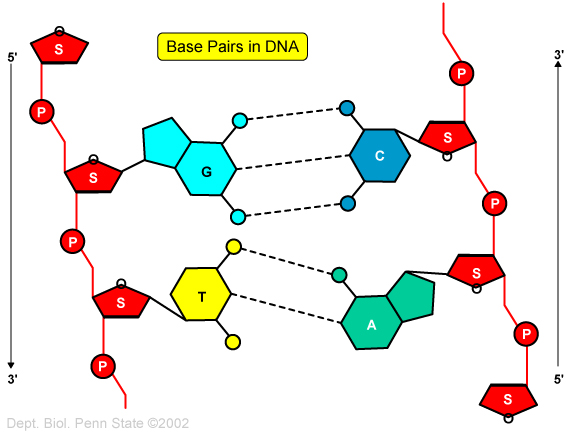
a)

mRNA molecules

b)

DNA molecules

c)

RNA Polymerase

d)

proteins

2.

What happens during translation?

a)

Messenger RNA is made from a DNA code.

b)

The cell uses a messenger RNA code to make proteins.

c)

Transfer RNA is made from a messenger RNA code.

d)

Copies of DNA molecules are made.

3.

The Figure shows the % of bases in a DNA sample. How much Thymine should you expect to find in the sample?

a)

44%

b)

28%

c)

24%

d)

22%

4.

During DNA replication, a DNA strand that has the bases CTAGGT produces a complementary strand with the bases

a)

GAUCCA

b)

AGCTTG

c)

GATCCA

d)

TCGAAC

5.

What is the shape of DNA?

a)

double helix

b)

triple helix

c)

complementary helix

d)

nitrogenous helix

6.

A, B, and C are the three types of

a)

DNA

b)

RNA

c)

Protein

d)

Enzymes

7.

When during the cell cycle is a cell’s DNA replicated?

a)

S Phase

b)

M Phase

c)

G1 Phase

d)

G2 Phase

8.
I am single stranded.
a)
DNA
b)
RNA
c)
Both DNA and RNA
9.
I am a nucleic acid.
a)
DNA
b)
RNA
c)
Both DNA and RNA
10.
I have the sugar ribose.
a)
RNA
b)
DNA
c)
Both DNA and RNA
11.
I have the sugar deoxyribose.
a)
RNA
b)
DNA
c)
Both DNA and RNA
12.
I include the bases guanine, cytosine, and adenine.
a)
DNA
b)
RNA
c)
Both DNA and RNA
13.
In eukaryotic cells, I travel out of the nucleus to a ribosome.
a)
Both DNA and RNA
b)
DNA
c)
RNA
14.
I have the base uracil.
a)
RNA
b)
DNA
c)
Both DNA and RNA
15.
I have the base thymine.
a)
Both DNA and RNA
b)
RNA
c)
DNA
16.
Adenine bonds with ______________.
a)
Guanine
b)
Thymine
c)
Cytosine
d)
Adenine
17.
Guanine bonds with ______________.
a)
Adenine
b)
Guanine
c)
Cytosine
d)
Thymine
18.
Why is DNA important?
a)
it is very small and very complicated
b)
it's in everything
c)
it serves as the blueprint for traits of all living things
d)
because we eat it every day for energy
19.
Which 2 molecules form the sides (backbone) of the DNA ladder?
a)
deoxyribose sugar and adenine
b)
deoxyribose sugar and a hydrogen bond
c)
deoxyribose sugar and the nucleus
d)
deoxyribose sugar and phosphate
20.
Nitrogenous bases are joined by which type of bond?
a)
polar bonds
b)
ionic bonds
c)
covalent bonds
d)
hydrogen bonds
21.
What are the three components of a nucleotide?
a)
sugar, hydrogen, nitrogen base
b)
sugar, oxygen, nitrogen base
c)
sugar, phosphate, nitrogen base
d)
sugar, phosphate, protein
22.

Where does TRANSCRIPTION occur?

a)

Nucleus

b)

Ribosome

c)

Cytoplasm

d)

Mitochondria

23.

Why must transcription occur where DNA can be found?

a)

because DNA can't leave

b)

because ribosomes are in the nucleus

c)

because DNA polymerase is found there

d)

because helicase unzips the DNA

24.

TRANSCRIBE this DNA sequence: TACGTTACT

a)

AUGCAAUGA

b)

ATGCAATGA

c)

AUGGATUGA

d)

TACGTTACT

25.

When these bond together, they form a protein

a)

Amino Acids

b)

Peptide Bonds

c)

Ribose

d)

Nucleotides

26.
The process to go from DNA to mRNA is _______
a)
translation
b)
transcription
c)
replication
27.
The process to go from mRNA to a protein is called ____
a)
transcription
b)
rRNA
c)
replication
d)
translation
28.
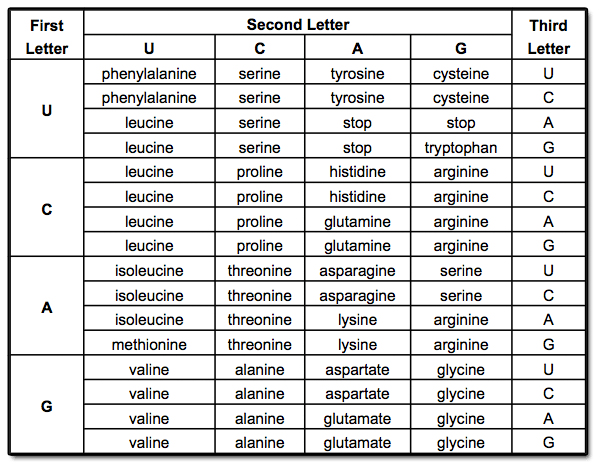
What amino acid is represented by the codon UUA?
a)
Phenylalanine
b)
Tyrosine
c)
Leucine
d)
Stop codon
29.
Each enzyme only has 1 substrate that will fit its active site.  What is this called?
a)
reusable
b)
catalyst
c)
specific
d)
fragile
30.
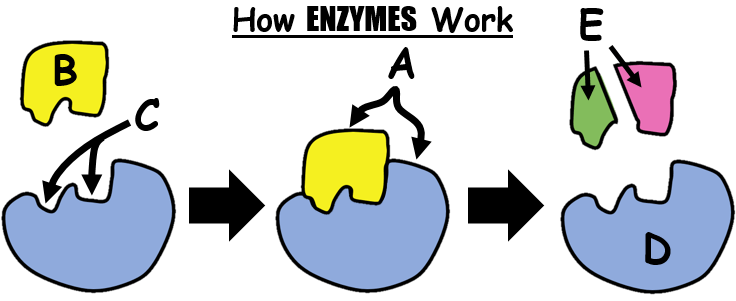
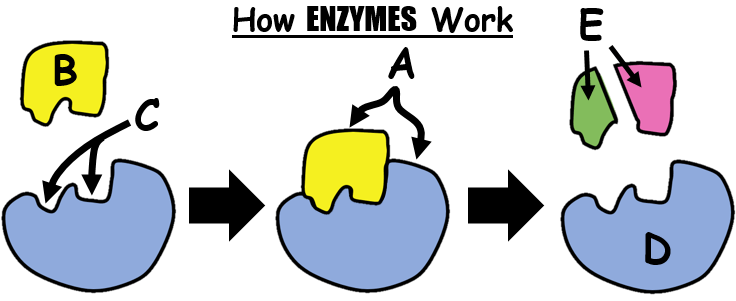
Letter D...
a)
active site
b)
enzyme
c)
substrate
d)
products
31.
Letter B...
a)
active site
b)
enzyme
c)
substrate
d)
products
32.
Letter C...
a)
active site
b)
enzymes
c)
substrate
d)
products
33.
Letter E...
a)
active site
b)
enzyme
c)
substrate
d)
products
34.

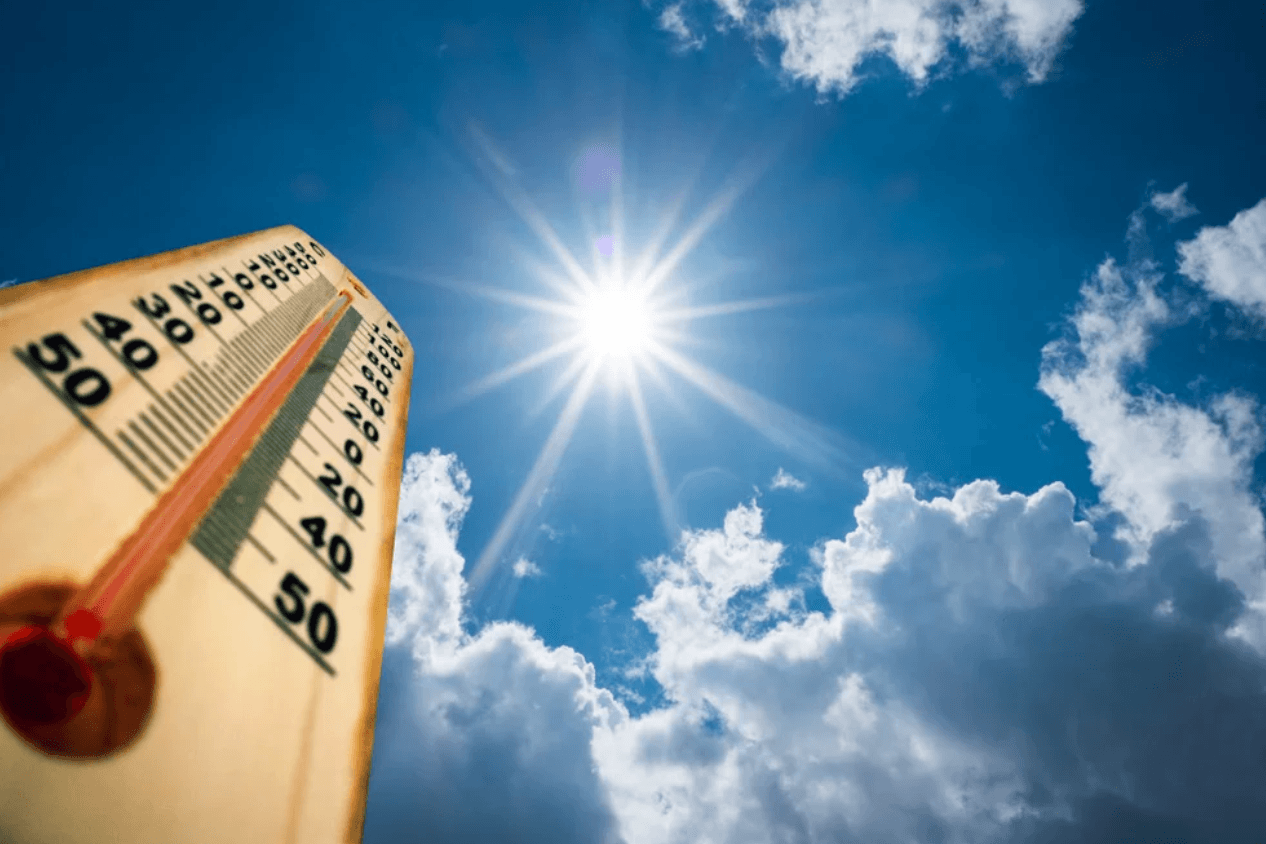
What happens when enzymes are heated to a high temperature?

a)

The enzymes die.

b)

The shape of the enzyme are changed and it denatures

c)

The enzymes' amino acid sequence changes.

d)

The enzymes remain the same

35.

Where does digestion begin:

a)

nose

b)

mouth

c)

esophagus

d)

stomach

36.

What is the squeezing motion called that moves food down the esophagus?

a)

peristalsis

b)

absorption

c)

sneezing

d)

suffocation

37.
Tube that carries swallowed food to the stomach
a)
esophagus
b)
liver
c)
pancreas
d)
rectum
38.
What happens when the food goes to the small intestine?
a)
nutrients gets into the blood
b)
the food keeps on going
c)
nothing
39.
The organ in orange represents the:
a)
Liver
b)
Lung
c)
Stomach
d)
Pancreas
40.
Breaking food down with the use of enzymes is known as:
a)
Chemical Digestion
b)
Physical Digestion
41.
The part of the digestive system which is highlighted represents:
a)
Esophagus
b)
Small intestine
c)
Stomach
d)
Trachea
42.
The red organ is
a)
stomach
b)
small intestine
c)
large intestine
d)
liver
43.
The highlighted organ is the
a)
liver
b)
large intestine
c)
small intestine
d)
stomach
44.
Peristalsis refers to
a)
one of the digestive organs
b)
the action of the stomach
c)
heart rate increasing
d)
smooth muscles moving food through the digestive system
45.
Chewing food is an example of _____________.
a)
chemical digestion
b)
mechanical digestion
46.
The main purpose of the large intestine.
a)
absorb hormones
b)
absorb protein
c)
absorb nutrients
d)
absorb water
47.
The organ that stores bile.
a)
gall bladder
b)
stomach
c)
liver
d)
appendix
48.
Bile is made by which digestive organ?
a)
Gallbladder
b)
Stomach
c)
Rectum
d)
Liver
49.

The term aerobic means

a)

wine-making

b)

with carbon dioxide

c)

without carbon dioxide

d)

with oxygen

e)

without oxygen

50.

Which of the following processes is most efficient (produces most ATP per molecule if glucose oxidized)

a)

aerobic respiration

b)

anaerobic respiration

c)

alcoholic fermentation

d)

lactic acid fermentation

51.

Muscle soreness associated with strenuous exercise is at least partly due to

a)

an excess of ATP that builds up during exercise

b)

the presence of lactic acid from fermentation by muscle cells

c)

the large amount of carbon dioxide that builds up in muscle

d)

the accumulation of alcohol from anaerobic respiration

52.
This molecule contains three phosphate groups
a)
ADP
b)
ATP
c)
Mitochondria
d)
Nucleus
53.
This molecule contains two phosphate groups
a)
ADP
b)
ATP
c)
Mitochondria
d)
Nucleus
54.
Cellular respiration takes place in the
a)
nucleus
b)
cytoplasm
c)
ribosomes
d)
mitochondria
55.
Aerobic respiration is different from anaerobic respiration in that aerobic respiration needs...
a)
chlorophyll
b)
carbon dioxide
c)
glucose
d)
oxygen
56.
In which way are photosynthesis and cellular respiration different?
a)
Cellular respiration stores ATP, while photosynthesis releases ATP.
b)
Cellular respiration produces oxygen, while photosynthesis uses oxygen.
c)
Photosynthesis releases energy, while cellular respiration stores energy.
d)
Photosynthesis used carbon dioxide, while cellular respiration produces carbon dioxide.
57.
The energy in ATP is stored 
a)
in the bond between the second and third phosphate
b)
in the bond between the first and second phosphate
c)
in the bond between the adenosine and the first phosphate
d)
I like turtles
58.
Where does anaerobic respiration occur?
a)
glucose molecule
b)
mitochondria
c)
cytoplasm
59.

Photosynthesis takes place in which organelle?

a)

chloroplast

b)

mitochondria

60.

Cellular respiration happens in

a)

plants only

b)

animals only

c)

plants and animals

61.

What are the products of photosynthesis?

a)

carbon dioxide and water

b)

glucose and oxygen

c)

sunlight and water

d)

glucose and carbon dioxide

62.

What are the products of cellular respiration?

a)

carbon dioxide, water, ATP

b)

oxygen and carbon dioxide

c)

water and sunlight

d)

glucose and carbon dioxide

63.

Which type of fermentation produces bread?

a)

lactic acid fermentation

b)

alcoholic fermentation

c)

both of these

64.

What are the reactants of cellular respiration?

a)

Oxygen and Glucose

b)

Carbon Dioxide and Sunlight

c)

Carbon Dioxide and Water

d)

Glucose and Carbon Dioxide

65.

What are the reactants of Photosynthesis?

a)

Glucose and Oxygen

b)

Carbon Dioxide, Water, Sunlight

c)

Oxygen and Carbon Dioxide

d)

Glucose and Carbon Dioxide

66.
What is a series of events a cell goes through as they grow and divide?
a)
Cell Division
b)
Cell Cycle
c)
Cytokinesis
d)
Mitosis
67.
During what stage does the G1, S and G2 phases happen?
a)
Interphase
b)
M phase
c)
Mitosis
d)
Cytokinesis
68.
During what phase of the cell cycle is DNA replicated?
a)
G1 phase
b)
S phase
c)
G2 phase
d)
M phase
69.
Put the following stages of mitosis in order: anaphase, prophase, metaphase, and telophase. 
a)
prophase, metaphase, telophase, anaphase
b)
prophase, anaphase, metaphase, telophase
c)
prophase, metaphase, anaphase, telophase
d)
prophase, telophase, metaphase, anaphase
70.
Why would it be important to replicate DNA before a cell divides in mitosis or meiosis?
a)
In order for genetic information to be transferred into daughter cells.
b)
In order for the cell to be able to increase in size.
c)
In order for the DNA to be contained in the nucleus.
d)
In order for the cell to re-order the DNA sequencing in the new cells.
71.

In which phase of Mitosis do the Chromosomes pull Apart

a)

Metaphase

b)

Prophase

c)

Anaphase

d)

Telophase

72.

What is the purpose of Mitosis?

a)

Growth of an organism and Repair of damaged tissue

b)

To help the body get rid of extra cells

c)

To increase the amount of classwork you have to do

d)

To get rid of the nucleus

73.

Nuclear membrane breaks down, spindle fibers form describes:

a)

Prophase

b)

Anaphase

c)

Metaphase

d)

Telophase

74.

Spindle fibers attach, centrioles line chromosomes in the center of the cell describes:

a)

Prophase

b)

Telophase

c)

Metaphase

d)

Anaphase

75.

The splitting of the cytoplasm and cell membranes is called?

a)

Interphase

b)

Telophase

c)

Centromere

d)

Cytokinesis

76.
What phase of mitosis is shown in the picture?
a)
Prophase
b)
Anaphase
c)
Telophase
d)
Metaphase
77.

Check the two correct boxes:

a)

Plant Cell - cell plate; Animal Cell - cleavage furrow

b)

Plant Cell - cleavage furrow; Animal Cell - cell plate

78.
Fruit fly body cells have 8 chromosomes. After mitosis, you would expect a resulting fruit fly daughter cell to have ...
a)
16 chromosomes.
b)
46 chromosomes.
c)
8 chromosomes.
d)
4 chromosomes.
79.

What phase of mitosis is shown in the picture?

a)

Metaphase

b)

Anaphase

c)

Prophase

d)

Telophase

80.
During this stage, chromosomes are first visible
a)
Anaphase
b)
Prophase
c)
Metaphase
d)
Telophase
81.
The enzyme that unwinds the DNA to prepare for replication
a)
helicase
b)
replicase
c)
polymerase
d)
synthase
82.
Which enzyme is responsible for adding nucleotides?
a)
Topoisomerase
b)
DNA Polymerase
c)
Ligase
d)
Primase
83.
Seals the Okazaki fragments together
a)
DNA Polymerase
b)
ligase
c)
helicase
d)
primase
84.
synthesizes a short fragment of RNA that allows DNA polymerase III to bind
a)
ligase
b)
DNA polymerase I
c)
primase
d)
helicase
85.

What are the three components of a nucleotide?

a)

sugar, hydrogen, nitrogen base

b)

sugar, oxygen, nitrogen base

c)

sugar, phosphate, nitrogen base

d)

sugar, phosphate, protein

86.
Which cells are more efficient at obtaining nutrients?
a)
Small Cells
b)
Medium Size Cells
c)
Large Cells
d)
X-Large Cells
87.
As a cell becomes larger, its
a)
surface area increases faster than its volume.
b)
volume increases faster than its surface area
88.

Which of the following are reasons why cells need to divide?

a)

Growth

b)

Replace

c)

Repair

d)

Reproduction

89.

A small cell has a ________ surface area to volume ratio than a larger cell.

a)

larger

b)

smaller

c)

equal

90.

Which of the following is least efficient?

a)

A

b)

B

c)

C

d)

D

91.

Which of the following has the largest surface area to volume ratio?

a)

A

b)

B

c)

C

d)

D

92.

Oxygen (O2) is a reactant material of which process?

a)

Photosynthesis

b)

Cellular Respiration

93.
The diagram below shows the relationship between photosynthesis and cellular respiration and the organelles in which they occur.Which statement describes how photosynthesis and cellular respiration are interrelated?
a)
 Oxygen is produced during cellular respiration and stored during photosynthesis.
b)
Carbon dioxide and water released by cellular respiration are used in photosynthesis.
c)
Photosynthesis releases the energy that is stored during the process of cellular respiration.
d)
 Glucose is used during cellular respiration to produce food that is broken down during photosynthesis.
94.
Which structures shown in the Figure make up the ADP molecule?
a)
A and B
b)
A, B and C
c)
A, B, C, and D
d)
C and D
95.
Which bond of the ATP molecule is broken in order to release energy?
a)
A
b)
B
c)
C
d)
D
96.
order of replication
a)
3, 4, 2, 1
b)
3, 1, 4, 2
c)
2, 1, 4, 3
d)
3, 4, 1, 2
97.

Identify #3.

a)
nitrogen base
b)
phosphate group
c)
deoxyribose sugar
d)
nucleotide
98.

An abnormal mass/group of cancer cells is called a

a)

tumor

b)

cyst

c)

lesion

d)

polyp

99.
What is cancer?
a)
The heart does not receive enough blood.
b)
Sudden disruption of blood flow to part of the brain.
c)
Blood filled weak spot.
d)
Uncontrolled growth and spread of abnormal cells.
100.
Using drugs or medicines to destroy cancer cells.
a)
chemotherapy
b)
radiation therapy
c)
cancer surgery
d)
mitotic spindling
101.

Which type of tumor is being described:


Slow growing Not dangerous Does not spread

a)

Malignant

b)

Benign

102.

Anything that can cause mutations or turn on cancer genes.

Examples: smoking, radiation, chemicals, poor diet

a)

Risk Factors

b)

Mutations

c)

Tumors

d)

Predispositions

103.

Are exact clones of parents

a)

Asexual

b)

Sexual

c)

Both

d)

Neither

104.

Which type of reproduction do strawberries, sweet potatoes, and bacteria do?

a)

Asexual

b)

Sexual

c)

Both

d)

Neither

105.

Most Multicellular and eukaryotes use this type of reproduction

a)

Asexual

b)

Sexual

c)

Both

d)

Neither

106.

Offspring are genetically different

a)

Asexual

b)

Sexual

c)

Both

d)

Neither

107.
after mitosis, how many daughter cell are present
a)
1
b)
2
c)
3
d)
4
108.
after meiosis, there are _______daughter cells.
a)
1
b)
2
c)
3
d)
4
109.
in meiosis, the daughter cells have _____the number of chromosomes compared to the parent cell
a)
1/3
b)
1/2
c)
6/6
d)
2/2
110.
________is the process where sex cells are obtained.
a)
mitosis
b)
meiosis
111.

How many chromosomes are there in a somatic cell?

a)

23

b)

26

c)

43

d)

46

112.

This diagram represents

a)

making of gametes

b)

asexual reproduction

c)

oogenesis

d)

mitosis

113.
Having two of the SAME alleles for a trait (example HH or hh):
a)
homozygous
b)
heterozygous
c)
recessive
d)
dominant
114.
An organism's genetic make-up:
a)
phenotype
b)
genotype
c)
dominant
d)
recessive
115.
An organism's appearance or other observable characteristics:
a)
phentoype
b)
genotype
c)
recessive
d)
dominant
116.

If Norma has Huntington's disease (Hh) and her husband, Bob, does not, what is the chance that their only son, James, will inherit Huntington's?

a)

50%

b)

0%

c)

100%

d)

75%

117.
If two checkered chicks (BW) are crossed, what are the offspring?
a)
100% checkered
b)
50% white, 50% black
c)
25% white, 50% checkered, 25% black
d)
100% grey
118.
The type of inheritance shown when a red-flowered plant is crossed with a white-flowered plant and only pink flowers are produced is _____.
a)
inbreeding
b)
incomplete dominance
c)
polygenic inheritance
d)
multiple alleles
119.
What do you call the non-Mendelian inheritance pattern that states that both traits are dominant and both appear in the organism and neither trait is masked?
a)
Codominance
b)
Incomplete dominance
c)
Polygenic traits
d)
Sex-linked traits
120.
If a trait is controlled by one gene, but there are 4 possible alleles, the inheritance pattern is called...
a)
dominance
b)
sex-linked
c)
multiple alleles
d)
polygenic
121.
AB blood type is an example of what type of inheritance?
a)
complete dominance
b)
incomplete dominance
c)
codominance
d)
polygenic inheritance
122.
ABO blood types are an example of what type of inheritance?
a)
multiple alleles
b)
incomplete dominance
c)
polygenic inheritance
d)
genetic mutations
123.

Hemophilia is a disorder carried on the X chromosome. What type of inheritance pattern does it follow?

a)

codominance

b)

sex-linked inheritance

c)

multiple allele inheritance

d)

incomplete dominance

124.
In Andalusian fowls, black individuals (BB) and white individuals (bb) are homozygous. Heterozygous individuals are grey (Bb).  
What is the genotype ratio for a cross between a grey fowl and a white fowl?
a)
2 BB: 2 Bb: 0 bb
b)
0 BB: 4 Bb: 0 bb
c)
0 BB: 2 Bb: 2 bb
d)
1 BB: 2 Bb: 1 bb
125.
Mike has type O+ blood. Mike can receive blood from someone who has Type A or Type B.
a)
True
b)
False
126.
Jim has type AB+ blood. His dad could be type O+.
a)
True
b)
False
127.
Someone who has Type O blood has what for antibodies (clumping proteins)?
a)
No antibodies
b)
A antibodies
c)
B antibodies
d)
A and B antibodies
128.
If one of your parents is blood type A and the other is type B, which of the following blood types would you likely be?
a)
O
b)
AB
c)
A or B
d)
Any
129.
In the second generation-how many people are carriers of the trait?
a)
2
b)
3
c)
5
d)
6
130.
Examine the pedigree. The allele for the presence of a widow’s peak is dominant. Therefore, we can tell from the chart that in the couple labeled 2:
a)
the male is heterozygous and the female is homozygous.
b)
the male is homozygous and the female is heterozygous.
c)
the male is homozygous and the female is homozygous.
d)
the male is heterozygous and the female is heterozygous.
131.
Why do all the daughters in Generation II carry the colorblind gene?
a)
Because mom passed on the gene.
b)
Because dad passed on the X chromosome.
c)
Because their brother has it.
d)
Because their brother gave it to them.
132.
Why does individual IV-7 have colorblindness?
a)
Because his mom is a carrier.
b)
Because his dad has it.
c)
Because his siblings have it.
d)
Because his uncle has it.
133.
Give the genotype for person II-1
a)
GG
b)
Gg
c)
gg
134.

In pea plants tall stems(T) are dominant over short stems(t) and round seeds(R) are dominant over wrinkled seeds(r). Consider the following cross: TtRr X Ttrr

Next 4 questions will be about this information. Please take notes.


a. Find the number of possible phenotypes

a)

2

b)

4

c)

6

d)

8

135.

In a cross between a round(R)-yellow(Y) seeded plant and a wrinkled (r)- yellow(Y) seeded pea plant, green(y)-wrinkled (r) seeded offspring are produced.

(Next 2 questions will be about this information.)

a. What are the genotypes of parents?

a)

RrYy X rrYy

b)

RrYY X rrYy

c)

RrYy X RrYy

d)

RRYy X rrYy

e)

RRYy X RrYY

136.
T4 - What genotype is missing from this Punnett Square?
a)
RrYy
b)
RRYY
c)
rryy
d)
RrYY
137.
T4 - Based off this Punnett Square, what fraction of the offspring will have wrinkled, yellow seeds?
a)
9/16
b)
3/16
c)
1/16
d)
16/16
138.
Assume mom's gametes are on the left, what is her genotype?
a)
TTZz
b)
TtZz
c)
ttZZ
d)
TtZZ
139.
Assume dad's gametes are on top, what is his genotype?
a)
AAPP
b)
AaPp
c)
aaPP
d)
Aapp
140.

Zebra

a)

Biotic (living)

b)

Abiotic (non-living)

141.

Temperature

a)

Biotic (living)

b)

Abiotic (non-Living)

142.

Sand

a)

Abiotic (non-living)

b)

Biotic (living)

143.

Sunlight

a)

Biotic (living)

b)

Abiotic (non-living)

144.

Which of the following would be the most likely effect, if there were a sudden increase in the cricket population?

a)

There would be a decrease in the small bird population.

b)

There would be a decrease in the grass/flowers population.

c)

There would be a decrease in the mice population.

d)

There would be an increase in the grass/flowers population.

145.
In this food chain, what will happen if the frogs become extinct?
a)
The snakes will increase.
b)
The grasshoppers will decrease.
c)
The eagles will remain the same.
d)
The grasshoppers will increase.
146.
A food chain shows the transfer of ___ from one organism to another. 
a)
matter
b)
consumers
c)
energy
d)
habitat
147.
What percentage of energy is passed on to each tropic level?
a)
10%
b)
50%
c)
90%
d)
100%
148.
Which represents the largest group in a food web?
a)
carnivores
b)
omnivores
c)
herbivores
d)
producers
149.
Use the diagram to answer the question.
The Mayfly is a food source for which 3 organisms?
a)
Frog, Dragon Fly and snake
b)
Frog, trout and dragon fly
c)
Frog, salamander and trout
d)
Frog and phytoplankton
150.
True or False. In this Food Web Pyramid the consumers on each level only get about 10 percent of energy that the plants have stored.
a)
True
b)
False
151.
In this Food Web Pyramid what is the proper name for the organisms above the producer level at the bottom.
a)
herbivores
b)
consumers
c)
carnivores 
d)
omnivores
152.
The deer, grasshopper, and bird are all examples of which type of consumers on this food pyramid?
a)
decomposers
b)
omnivores
c)
carnivore
d)
herbivore
153.
The snake and the frog, are all examples of which type of consumers on this food pyramid?
a)
decomposers
b)
omnivores
c)
carnivore
d)
herbivore
154.

What level of ecological organization do the animals represent?

a)

Species

b)

Population

c)

Community

d)

Ecosystem

155.

This may cause a population to increase

a)

increase of food supply

b)

removal of predators

c)

removal of disease

d)

all of these

156.

Something that regulates the size of a population is called...

a)

a limiting measure

b)

a limiting factor

c)

carrying capacity

d)

biodiversity

157.

What are factors that affect carrying capacity?

a)

Biotic only

b)

Biotic and abiotic

c)

Depends on the ecosystem

d)

Abiotic only

158.

What is the carrying capacity of the graph?

a)

1000

b)

8000

c)

800

d)

600

159.
If a disease destroying barley plants in a field swept through an ecosystem, what would happen to the barley eating bird population in the the field ?
a)
The bird population would stay the same
b)
The bird population would infinitely increase
c)
The bird population would decrease
160.
Which limiting factor is density independent?
a)
competition
b)
disease
c)
natural disasters
161.
What does biodiversity mean?
a)
Only one species in an area.
b)
The different amount of species in an area
c)
All abiotic life
d)
Nitrogen fixation
162.

High biodiversity is a sign of a healthy ecosystem.

a)

True

b)

False

163.

What word describes a trait that helps an organism survive in its environment?

a)

natural selection

b)

mutation

c)

camouflage

d)

adaptation

164.

What word describes the process that "better traits" help an organism survive and reproduce?

a)

natural selection

b)

adaptation

c)

mutation

d)

genetic engineering

165.
Why do frogs and other organism reproduce so many eggs or offspring?
a)
so that their babies can have friends to play with
b)
the more offspring the more likely the offspring will survive
c)
the more offspring the less likely offspring will survive 
d)
the more offspring the less competition
166.
Which organisms are most likely to survive?
a)
the best adapted
b)
the fastest
c)
the strongest
d)
the most domesticated (tamed)